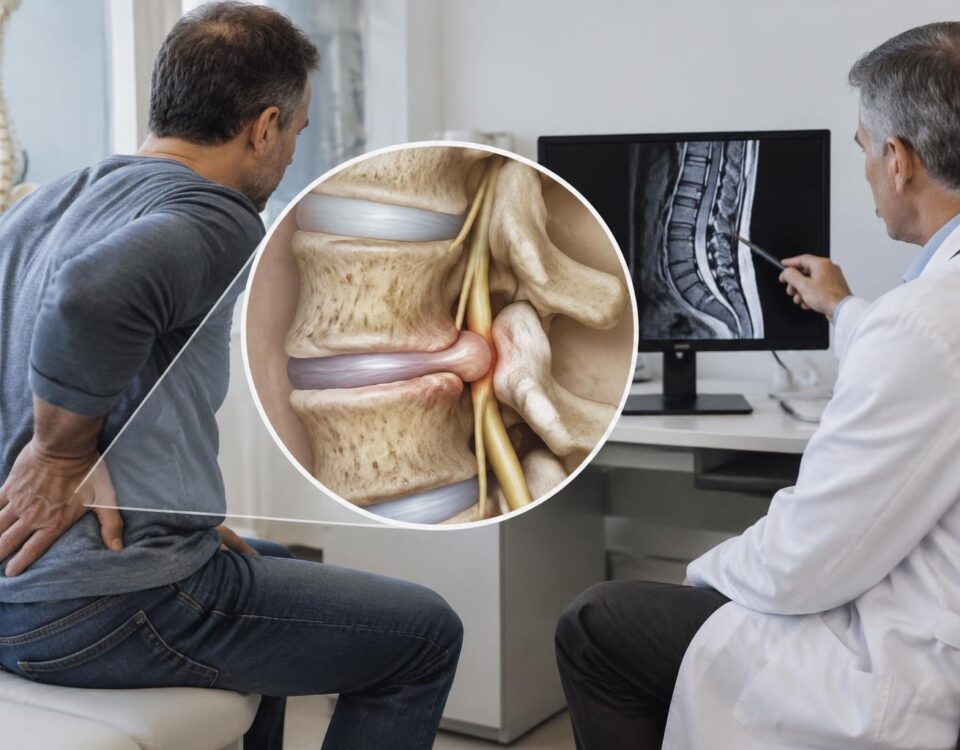
Sciatica and pain relieved while seated: consider stenosis?
24/10/2026
IN BRIEF
| A lumbar disc protrusion is a bulging of a disc often related to disc degeneration. It does not always cause symptoms but can contribute to lower back pain or pain radiating down the leg if a nerve is irritated. Imaging and medical evaluation help interpret the diagnosis. Depending on the symptoms, non-surgical management and appropriate activity can promote relief and maintain mobility. |
Lumbar degeneration refers to the gradual wear and tear of the discs between the vertebrae in the lower back. Over time, a disc can lose some of its flexibility and form a disc protrusion, which is a bulging of its contour. These changes are common and do not always produce symptoms.
When present, symptoms may include lower back pain, stiffness, or pain that radiates to the buttock and leg if a nerve structure is irritated. The diagnosis relies on clinical evaluation; imaging is considered based on symptoms and the advice of a healthcare professional. Management may include maintaining appropriate activity, rehabilitation, and, if necessary, medical treatments.
Quickly consult a doctor if there is significant or progressive weakness, loss of bladder or bowel control, or numbness in the saddle area. This content is educational and does not replace a medical evaluation.
A lumbar disc protrusion is a bulging of the disc located between two vertebrae in the lower back. It may accompany disc degeneration, a common phenomenon particularly related to age and mechanical stress. These changes visible on imaging do not always cause pain. When they are accompanied by symptoms, a professional evaluation helps determine their origin and appropriate management options.
Disc protrusion and lumbar degeneration: understanding the difference
The intervertebral discs are located between the vertebrae. They contribute to the mobility of the spine and the absorption of stress. Over time, a disc can lose some of its water and height. Its outer ring can also become weakened. This is referred to as disc degeneration or degenerative disc disease.
A disc protrusion refers to a broader bulging of the disc beyond its normal contours. It may be associated with degenerative changes, but these terms do not mean exactly the same thing. A disc herniation corresponds to another form of displacement of the disc material. The difference is clarified based on imaging results and clinical evaluation.
For additional explanations on possible signs, please consult the page dedicated to the symptoms of disc protrusion. You can also read this presentation on disc protrusion, MRI, and treatments.
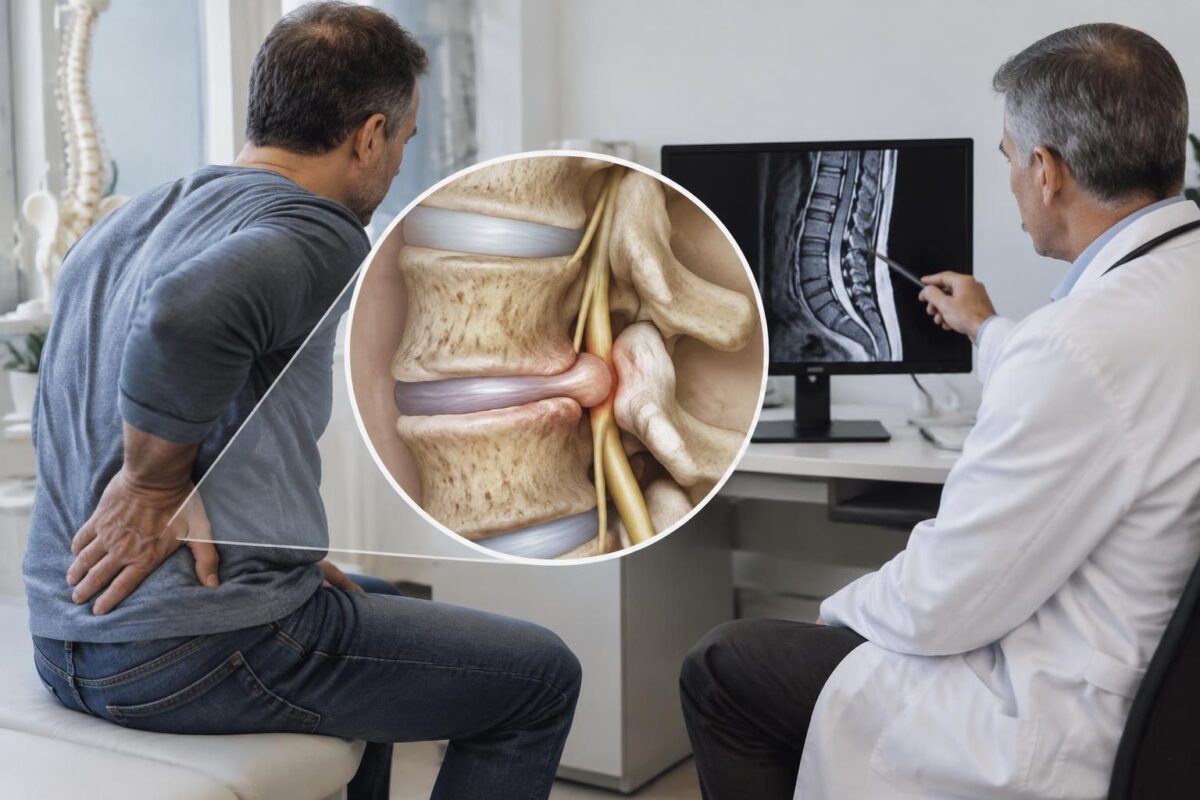
Disc protrusion and disc pinching: combined mechanisms
IN BRIEF A disc protrusion is a bulging of the disc, while a disc narrowing refers to a decrease in its height. These changes can coexist and sometimes irritate a nerve root, leading to pain or radiation, but they can…

Disc herniation and associated foraminal stenosis
IN BRIEF A disc protrusion associated with foraminal stenosis occurs when a bulging disc coexists with a narrowing of the opening through which a nerve root passes. This association can lead to lower back pain radiating into the leg, tingling,…
Why does lumbar degeneration occur?
The lumbar region supports a significant share of the loads associated with movement and daily activities. Disc aging is common, but its rate varies from person to person. Genetic characteristics may play a role. Certain habits and stresses can also contribute to additional strain on the back.
Associated factors include repeated loads, certain professional movements, long periods of sitting, lack of physical activity, overweight, and smoking. However, none of these alone can determine the cause of pain. To learn more about ergonomics and workplace stresses, please consult this resource on disc protrusion and ergonomics.
Degeneration can affect a single disc or multiple levels. The L4-L5 level is often involved, as it experiences stress during trunk and pelvic movements. An issue at this location does not automatically mean that a nerve is compressed or that intervention is necessary.

Spinal disc protrusion and nerve inflammation
IN BRIEF A disc protrusion is a bulging of the disc that can irritate or compress a nerve, without necessarily causing symptoms. When it leads to nerve inflammation, it can cause pain in the back or neck, sometimes accompanied by…

Disc protrusion and irritation of L5
IN SHORT A disc protrusion is a bulging of the disc that can irritate the L5 root and cause lower back pain radiating to the buttock, leg, or foot, sometimes with tingling or weakness. MRI alone is not sufficient to…
What symptoms may be associated with a lumbar protrusion?
A disc protrusion may not cause any symptoms. An MRI image alone is not sufficient to explain pain: the healthcare professional must compare the results with symptoms and clinical examination.
When symptoms are present, they may include lower back pain, stiffness, or discomfort that increases in certain positions. If a nerve structure is irritated or compressed, the pain may radiate to the buttock or leg. Tingling, numbness, or weakness may also occur.
Increased pain while driving may depend on posture, the duration of the trip, and several other factors. Consult our page on disc protrusion and pain that increases while driving to better understand this situation.
Tingling in the toes may sometimes accompany nerve irritation, but it can also have other causes. Their location, duration, and associated signs are important to report to the professional evaluating you. For further information, please consult the page on disc protrusion and tingling in the toes.
Pain in the leg or foot can occur even if the lower back does not hurt. The presence or absence of lower back pain alone does not confirm or exclude sciatica. You can find more information on pain in the foot without lower back pain.

Disc protrusion and pain after twisting the back
IN BRIEF A disc protrusion is a bulging of the disc that can contribute to pain after a back twist, but it alone does not confirm the cause. The pain can remain in the lower back or radiate to the…

Disc herniation and pain after lifting
IN BRIEF A disc protrusion is a bulging of a disc between the vertebrae. Pain that appears after lifting a load does not prove that it is the cause: the MRI must be interpreted alongside the symptoms and the clinical…
How is the diagnosis made?
The healthcare professional begins by gathering information about the pain and its progression. The examination may assess mobility, sensitivity, strength, and certain signs of nerve irritation. It helps guide the continuation of the evaluation but does not replace a medical diagnosis when one is necessary.
An MRI or an X-ray is not necessary for every lower back pain. A doctor may request imaging when symptoms persist, when a particular sign justifies it, or when the result could alter the management. A CT scan may be used in certain situations. Imaging should always be interpreted in relation to the examination and symptoms.
A protrusion observed on an MRI does not automatically indicate the severity of the pain. A small disc anomaly may be associated with marked symptoms, while a more visible anomaly may cause no discomfort. To better understand this difference, consult our article on significant pain despite a small protrusion.
Disc Protrusion or Herniation: What Are the Differences?
A protrusion generally corresponds to a bulging of the contour of the disc. A herniation refers to a disc bulge whose shape and extent are defined by imaging. In both cases, the imaging result alone does not allow one to conclude that a nerve is affected.
When the pain follows the path of a nerve, the doctor seeks to determine if there is irritation or nerve compression and if it corresponds to the observed signs. Coughing or straining may alter the pain in some individuals, without allowing the cause to be identified alone. To delve deeper into this topic, consult our page on cough pain and nerve irritation.
What Management Options Should Be Considered?
The management depends on the intensity of the symptoms, their duration, the results of the evaluation, and the needs of the person. The doctor may discuss relief options, including medications, taking into account history and contraindications. Do not start, modify, or stop a medication without consulting a qualified professional.
A personalized evaluation can also help identify positions or activities that exacerbate symptoms and think about adaptations. Manual or functional approaches may be discussed depending on the situation, but they do not replace a medical diagnosis or the care recommended by the doctor.
At the TAGMED Clinic, an evaluation may allow for discussing available options, including motorized neurovertebral decompression or specific osteopathy, as appropriate. These approaches are not suitable for everyone and do not guarantee a result. They do not replace medical advice, especially in the presence of neurological signs or significant pain.
Symptoms can evolve over time. For a more general presentation of signs, treatments, and possible evolution, consult this article on degenerative disc disease, its symptoms and evolution, as well as this resource on causes and symptoms of disc protrusion.
When to Seek Medical Help Quickly?
See a doctor promptly if significant or progressive weakness appears in a leg or foot, if you lose control of the bladder or bowel, or if you experience a loss of sensitivity in the saddle area. These signs require urgent evaluation. Fever, recent trauma, severe pain, or rapid worsening also warrant seeking medical advice without delay.
About the Author
Sylvain Desforges, B.Sc., D.O., N.D., osteopath and naturopath, is the founding president of TAGMED and the ACMA association. He dedicates his practice to chronic pain of the spine, lower back pain, and pain compatible with sciatica, especially when the pain radiates to the buttock, leg, calf, foot, or toes.
Through SOS Sciatique, he publishes educational content on the symptoms of sciatica, possible causes such as disc herniation, disc pinching, foraminal stenosis, or irritation of a lumbar nerve root, as well as non-surgical approaches that may be considered based on the evaluation. At TAGMED Clinic, care may include, depending on the case, motorized neurovertebral decompression, specific osteopathy, or precision impact therapy.
For an evaluation related to sciatica treatment in Montreal / Mont-Royal or sciatica treatment in Terrebonne, check the services available at the TAGMED Clinic.
Medical Disclaimer
The information published on SOS Sciatique is provided for educational purposes and does not replace a consultation, diagnosis, opinion, or treatment performed by a doctor or other licensed health professional. The author of this article is not a doctor or a specialist in a medical specialty recognized by the College of Physicians of Quebec. The osteopathy, manual medicine, or functional support approaches described on this site do not constitute medical acts and are not intended to replace medical supervision.
Consult a doctor or emergency service in case of loss of bladder or bowel control, anesthesia in the saddle region, significant or progressive weakness in the leg or foot, fever, recent trauma, severe pain, or rapid worsening. For more details, please read our Legal Notice.
Medical disclaimer: The information and advice provided on this site do not replace the opinion, diagnosis, or treatment of a healthcare professional. Please note that Dr. Sylvain Desforges, osteopath, is neither a doctor of medicine nor a physician, and is not a specialist in a medical specialty as defined by the Collège des médecins du Québec. Manual medicine, functional medicine, and sports medicine as described on this site exclude any medical treatment or diagnosis made by a physician or specialist. Always consult your doctor for any medical questions. For more details, please read our Complete Legal Notice.
Disc protrusion and lumbar degeneration: understanding the results and taking action
What these terms mean
- Disc protrusion: bulging of the disc beyond its normal contour.
- Lumbar degeneration: gradual changes in the disc, sometimes related to age.
- These imaging findings do not necessarily mean they cause pain.
Useful everyday tips
- Connect imaging results to your symptoms with a healthcare professional.
- In the absence of contraindications, favor an appropriate activity over immobility.
- Consult if the pain persists, worsens, or is accompanied by weakness.
- A loss of bladder or bowel control requires urgent evaluation.

A lumbar disc protrusion corresponds to a bulging of the disc between two vertebrae, while degeneration describes its gradual wear. These changes are common and do not always cause pain. If symptoms appear, a professional assessment can help identify the cause and choose appropriate measures, without relying solely on imaging results.
Understanding changes in lumbar discs
Intervertebral discs help distribute stress and allow movement of the spine. Over time, they can lose some of their flexibility and height. A protrusion occurs when a disc bulges beyond its normal contour. It is not automatically synonymous with herniation, nerve compression, or pain.
Imaging exams may reveal protrusions or signs of degeneration in individuals who have no symptoms. The diagnosis must therefore take into account the history of pain, clinical examination, and, when indicated, imaging. An MRI result alone does not always explain symptoms.
Recognizing symptoms and consulting at the right time
A symptomatic lumbar condition may be accompanied by pain in the lower back, stiffness, or discomfort during certain activities. If a nerve root is irritated, the pain may also radiate down into the buttock or leg, sometimes with tingling or numbness. These manifestations have multiple possible causes; avoid making a diagnosis based on a single symptom.
Consult a healthcare professional if the pain persists, worsens, or limits your activities, or if you notice weakness or loss of sensitivity. Rapid medical evaluation is necessary in cases of loss of bladder or bowel control, numbness in the saddle area, or significant or progressive weakness of the leg or foot.
Adapting activities without immobilizing your back
Favoring gradual movement
In the absence of medical contraindication, maintaining gentle and tolerable activities is generally preferable to prolonged bed rest. Walking, for example, can be gradually resumed based on comfort. Temporarily reduce movements or loads that significantly aggravate pain, then gradually reintroduce them. A physiotherapist or qualified professional can help choose exercises suitable for your situation.
Improving daily habits
Alternate sitting and standing positions, take breaks during prolonged periods at the office or in the car, and adjust your workstation to limit discomfort. When lifting a load, bring it close to your body and avoid sudden twists. The goal is not to avoid all movements, but to gradually regain confidence and functional capacity.
Choosing individualized care
Based on the assessment, care may include education, exercises, rehabilitation, or medical treatments. Medications and injections should be discussed with a qualified professional, taking into account your medical history and potential risks. Surgery is considered only in certain situations, particularly when severe symptoms persist despite appropriate care or when a neurological deficit justifies it.
A manual approach can be considered as a complement after evaluation, but it does not replace a medical diagnosis or necessary care. Before starting treatment, ask how it will be tailored to your symptoms and what signs should prompt the interruption of sessions and consultation.
Medical warning: this content is educational and does not replace a consultation, diagnosis, or treatment by a licensed healthcare professional. If you experience severe pain or rapid deterioration, consult without delay.
| Disc protrusion | Lumbar degeneration |
|---|---|
| Nature | Localized bulging of an intervertebral disc. |
| Extent | Usually involves a specific disc. |
| Evolution | May accompany disc wear, without necessarily evolving into herniation. |
| Symptoms | Often absent; sometimes low back pain or irradiation if a nerve is irritated. |
| Lumbar degeneration | Progressive wear of one or more discs in the lower back. |
| Location | May affect multiple levels, particularly L4-L5 or L5-S1. |
| Evaluation | Clinical examination; imaging is considered based on symptoms and their evolution. |
Illustrative testimonials on disc protrusion and lumbar degeneration
Note: the stories below are fictional examples, written for educational purposes. They do not correspond to real patients and do not predict the evolution of another person.
A disc protrusion discovered on MRI
“After several weeks of pain in my lower back, I had an MRI. The report mentioned a disc protrusion and lumbar degeneration. I initially thought my back was severely damaged. My doctor explained that the images needed to be interpreted alongside my symptoms and clinical examination. This context helped me better understand the situation and gradually resume adapted activities.”
Lower back pain aggravated by prolonged positions
“I felt stiffness and pain in my lower back after sitting or standing for long periods. The diagnosis suggested a degenerative lumbar disc disease, but this alone did not account for all my sensations. With the professionals who were following me, I learned to alternate positions, take breaks, and gradually resume movement.”
Pain radiating down the leg
“My lower back pain sometimes radiated down to my buttock and thigh. I was worried about having sciatica related to my disc protrusion. The evaluation allowed verification of my symptoms and muscle strength, followed by a discussion of management options. I understood that an MRI image alone cannot determine the exact cause of pain.”
Several affected discs
“The imaging report described changes at different levels of the lumbar spine. I was afraid this indicated inevitable deterioration. I was told that the significance of visible changes does not always correspond to the intensity of the symptoms. The follow-up was adapted to my capabilities and goals, with particular attention paid to maintaining tolerable activity.”
Regaining confidence in movement
“After a period where I limited almost all my movements, I lost confidence in my back. I was afraid to bend or walk for too long. Gradual support helped me better gauge my activities and identify the movements I could reintroduce without straining my body. Progress was variable, but I found it useful to advance step by step.”
These examples do not replace an individual evaluation. A disc protrusion or lumbar degeneration can be seen on imaging without causing pain. Diagnosis and management options should be discussed with a licensed healthcare professional, taking into account symptoms, clinical examination, and history.
About the author
Sylvain Desforges, B.Sc., D.O., N.D., osteopath and naturopath, is the founding president of TAGMED and the ACMA association. His practice is dedicated to chronic spinal pain, lower back pain, and pain compatible with sciatica. Treatments offered at TAGMED Clinic may include, according to the evaluation, motorized spinal decompression, specific osteopathy, or precision impactor.
Medical disclaimer
The content is provided for educational purposes and does not replace consultation, diagnosis, or treatment by a doctor or another licensed healthcare professional. The author is neither a physician nor a specialist in a medical specialty recognized by the Collège des médecins du Québec. Osteopathy, manual medicine, or functional support approaches do not constitute medical acts and do not replace medical follow-up.
Consult a doctor or emergency service quickly if you experience loss of bladder or bowel control, numbness in the saddle area, significant or progressive weakness in a leg or foot, fever, recent trauma, severe pain, or rapid deterioration.
Disc protrusion and lumbar degeneration: understanding symptoms and support options
The lumbar disc protrusion refers to a bulging of the intervertebral disc, not necessarily causing pain. Located between two vertebrae, the disc helps distribute stresses and allows for back movements. Over time, it can lose some of its hydration and flexibility. Its height may decrease while its contour slightly bulges, a phenomenon often associated with disc degeneration.
These changes are common with age and do not automatically mean that a person is suffering from a serious illness. A protrusion can be discovered during imaging performed for another reason and remain silent. Symptoms mainly appear when surrounding sensitive structures are irritated or when a nerve root is compressed. Therefore, the link between an image observed on MRI and the pain experienced should be evaluated in context, rather than assumed.
In the lumbar region, the discs bear the stresses related to the movements of the trunk and pelvis. The L4-L5 level is often involved, but several levels may also show signs of wear. A person may experience localized pain in the lower back, stiffness, or discomfort during certain activities. If a nerve root is irritated, the pain may radiate down to the buttock or leg; tingling or reduced sensitivity may also occur. These manifestations require appropriate evaluation, as they can have different causes.
Disc degeneration results from a progressive and variable process from person to person. Age and familial factors can contribute to the evolution, while repeated loads, certain prolonged postures, smoking, sedentary lifestyle, or overweight can influence the stresses placed on the spine. However, this alone does not determine the source of a particular pain. Diagnosis relies on the history of symptoms and clinical examination; an X-ray, MRI, or other examination is considered by a healthcare professional when the situation warrants.
Management depends on the intensity of symptoms, their duration, and the results of the evaluation. It may include medical advice, a gradual return to activities, adapted exercises, and rehabilitation. The goal is to preserve mobility and functional capabilities while reducing factors that perpetuate discomfort. Prolonged rest is generally not a sufficient strategy: the level of activity must be adjusted according to tolerance and the recommendations of the professional following the person. Manual treatment or a functional support approach may be considered on a case-by-case basis, without replacing a medical diagnosis or guaranteeing the disappearance of the protrusion.
Surgery is not indicated solely because a protrusion appears on an image. It can be discussed by a specialist when symptoms persist despite appropriate management or when significant nerve compression is observed. In cases of marked or progressive weakness, loss of bladder or bowel control, or numbness in the saddle area, one should consult a doctor or an emergency service without delay.
Sylvain Desforges, B.Sc., D.O., N.D., osteopath and naturopath, is the founding president of TAGMED and the ACMA association. His career is dedicated to supporting people living with chronic pain, particularly in the spine and lower back. His practice focuses on non-surgical approaches and the integration of technologies, including motorized neurovertebral decompression, according to each person’s evaluation and needs. The information presented here is educational and does not replace a consultation, diagnosis, or treatment performed by a licensed health professional.
The lumbar disc protrusion corresponds to an overflow of the disc between the vertebrae, often linked to its dehydration and progressive wear. It may be visible on imaging without causing pain. When it becomes symptomatic, the manifestations depend particularly on its location and any irritation of a nerve structure. Clinical evaluation and, if necessary, imaging help guide appropriate management.
Understanding the link between protrusion and lumbar degeneration
The disc degeneration refers to progressive changes in the intervertebral disc, which may lose its water content, height, and flexibility. A protrusion is a bulging of the disc beyond its usual contour. It does not automatically mean there is a symptomatic herniation or that intervention is necessary. To delve deeper into the concept of degeneration, refer to this presentation on intervertebral disc degeneration.
The distinction between protrusion and herniation notably concerns the shape of the deformation and the state of the annulus fibrosus surrounding the disc. However, these terms alone do not determine the intensity of the pain or its origin. An explanation of the differences between protrusion and disc herniation can help better understand these notions.
Symptoms to interpret with caution
A lumbar protrusion may be discovered incidentally, without pain. When accompanied by symptoms, these may include lower back pain, stiffness, or radiation to the buttock and leg. Pain that radiates down the leg may be compatible with nerve irritation, but it does not prove that a protrusion is the cause. To understand this mechanism, refer to the information on the possible relationship between disc herniation and sciatica as well as on pain that progresses further down the leg after a movement.
An issue located between the L4 and L5 vertebrae may be associated with low back pain or symptoms in the leg, but signs vary from person to person. The presence of a protrusion at this level does not precisely predict the progression or allow for treatment choices without examination. To learn more about this location, consult this resource on L4-L5 disc protrusion.
The role of examination and imaging
The health professional evaluates symptoms, mobility, and neurological signs before determining if examinations are indicated. An MRI can show the discs and surrounding structures, but the images must be interpreted according to the examination and clinical context: a visible anomaly is not necessarily the source of the pain. To better understand what this examination can reveal, refer to the information on what the MRI can show in cases of herniation and sciatica.
A protrusion may sometimes coexist with narrowing of the passage space of a nerve root, called foraminal stenosis. This association should be evaluated by a professional: imaging alone does not always determine if the narrowing explains the symptoms. Further details are available on the possible coexistence of a disc herniation and foraminal stenosis.
Management and signs requiring prompt attention
Management is tailored according to symptoms, functional abilities, and evaluation results. It may include advice on maintaining appropriate activity as well as a rehabilitation or exercise program determined with a health professional. Manual approaches or functional support may be considered depending on the situation, but they do not replace a medical diagnosis or follow-up when necessary. For additional information on lumbar discopathy and its consequences, refer to this resource dedicated to degenerative lumbar discopathy.
Significant or progressive weakness of a leg or foot, loss of bladder or bowel control, or numbness in the saddle region require urgent medical evaluation. A decrease in reflexes may also be part of the neurological signs to be examined; more information is available in this article on the decrease in reflexes and possible nerve injuries.

Disc herniation and lumbar flexion: why caution is necessary
IN BRIEF A disc protrusion is a bulge of the intervertebral disc, which can be silent or irritate a nerve. Lumbar flexion is not necessarily dangerous but can worsen symptoms in some individuals. Adapting movements, avoiding those that aggravate pain,…

Disc herniation and pain that worsens in the car
IN BRIEF A disc protrusion is a bulging of a disc that can irritate a nerve. In a car, prolonged sitting and vibrations can exacerbate back, buttock, leg, or arm pain. Regular breaks, an adapted posture, and personalized management can…

Dr Sylvain Desforges, B.Sc., D.O., N.D., osteopath, is the founding president of TAGMED and of the ACMA association. He dedicates his practice to chronic spinal pain, low back pain and symptoms compatible with sciatica, particularly when pain radiates toward the buttock, leg, calf, foot or toes.
Through SOS Sciatique, he publishes educational content on sciatica symptoms, possible causes such as disc herniation, disc narrowing, foraminal stenosis or irritation of a lumbar nerve root, as well as non-surgical approaches that may be considered according to the evaluation. At Clinique TAGMED, care may include, depending on the case, motorized neurovertebral decompression, specific osteopathic care or precision percussion.
For an evaluation related to sciatica treatment in Montreal / Mount Royal or sciatica treatment in Terrebonne, please consult the services available at Clinique TAGMED.
Medical disclaimer
The information published on SOS Sciatique is provided for educational purposes only and does not replace a consultation, diagnosis, opinion or treatment provided by a physician or another authorized healthcare professional. The author of this article is neither a medical doctor nor a specialist in a medical specialty recognized by the Collège des médecins du Québec. The osteopathic, manual medicine or functional support approaches described on this site do not constitute medical acts and are not intended to replace medical follow-up.
Consult a physician or emergency service in cases of loss of bladder or bowel control, anesthesia in the saddle area, significant or progressive weakness in the leg or foot, fever, recent trauma, severe pain or rapid worsening of symptoms. For more details, please read our Legal Notice.