Sciatica and pain that improves when walking
22/10/2026
Sciatica and popular stretches: why to stay cautious
22/10/2026
IN BRIEF
| A disc protrusion associated with foraminal stenosis occurs when a bulging disc coexists with a narrowing of the opening through which a nerve root passes. This association can lead to lower back pain radiating into the leg, tingling, or weakness. Clinical examination and MRI help specify the cause and guide management options, often initially non-surgical. Treatment depends on symptoms and medical evaluation. |
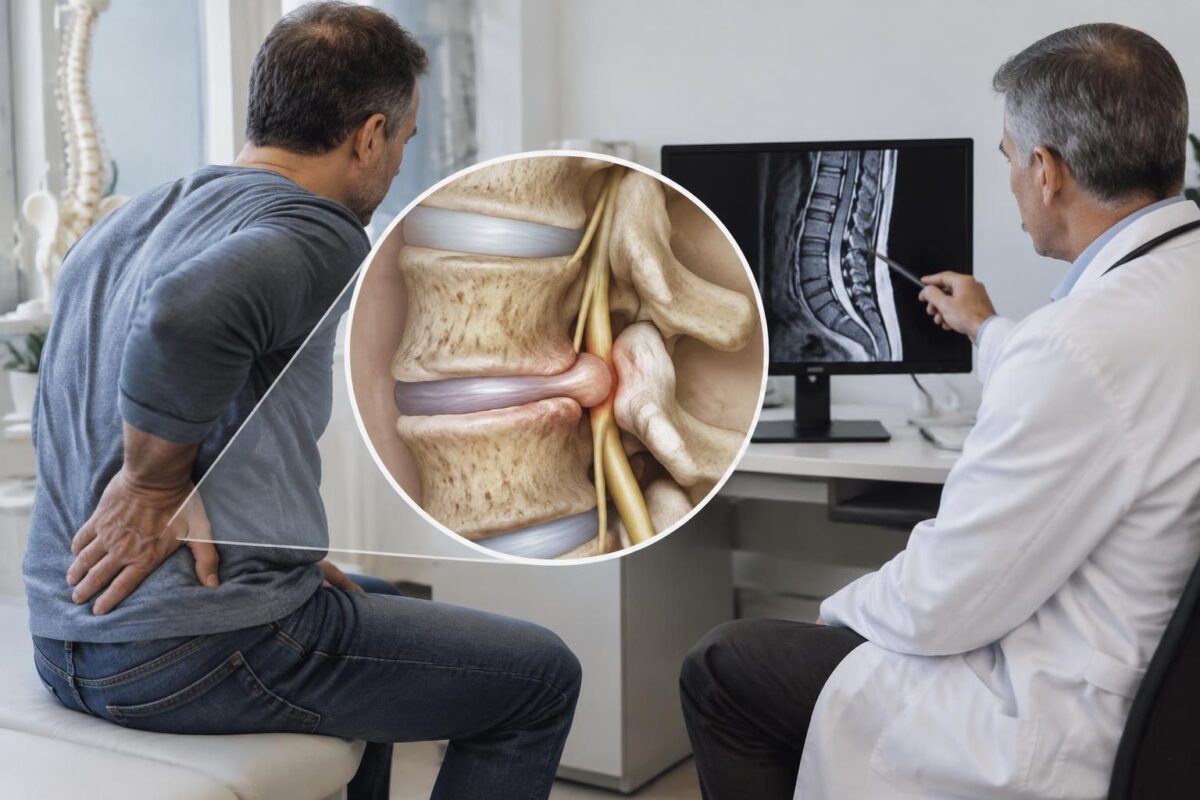
A disc protrusion associated with a foraminal stenosis can narrow the space where a nerve root passes and irritate or compress it. It can cause lower back pain radiating into the buttock or leg, as well as tingling or numbness. Diagnosis is based on clinical assessment and, if necessary, imaging such as MRI. Treatment depends on symptoms and may include non-surgical care; a medical evaluation is recommended to determine the appropriate approach.
A disc protrusion can coexist with a foraminal stenosis, which is a narrowing of the opening where a nerve root exits the spine. This association can irritate or compress a nerve and cause pain in the lower back, buttock, or leg. However, the presence of abnormalities on MRI is not enough to explain the symptoms: a healthcare professional must compare the imaging, clinical signs, and their evolution to choose the appropriate management.
What is a disc protrusion?
Intervertebral discs are located between the vertebrae. They help distribute stress and allow movement of the spine. A disc protrusion refers to a disc that bulges beyond its usual contour, without necessarily meaning that a fragment has detached.
The term “protrusion” describes an aspect observed in imaging. It does not alone determine the intensity of pain or the need for treatment. To better distinguish these terms, see our article on disc protrusion and pain behind the thigh.
What is foraminal stenosis?
The foramen, also called the intervertebral foramen, is the lateral opening through which a nerve root exits the spine. A foraminal stenosis corresponds to a narrowing of this opening. It can be related to several changes, such as loss of disc height or osteoarthritis of the spinal joints.
A protrusion can reduce the available space in the foramen. Therefore, both phenomena can be present at the same level. However, narrowing does not automatically mean that the nerve is compressed or that the person will experience pain.
How can these two problems cause symptoms?
A protrusion and foraminal stenosis can irritate a nerve root. A person may experience lower back pain that radiates into the buttock or leg. Depending on the affected root, they may also experience tingling, numbness, or muscle weakness.
Symptoms depend in particular on the affected level, the side involved, and the extent of nerve irritation. A protrusion at L4-L5 does not always produce the same picture from one person to another. Also, see information about L4-L5 protrusion and possible sciatica pain signs, as well as about irritation of the L5 root.
Pain radiating down the back of the thigh can have multiple causes. Similarly, an image visible on MRI may exist without pain. The healthcare professional checks if the side and level described in the report correspond to the symptoms. To understand this distinction, see our article on visible disc herniation without pain.
Disc protrusion and disc pinching: combined mechanisms
IN BRIEF A disc protrusion is a bulging of the disc, while a disc narrowing refers to a decrease in its height. These changes can coexist and sometimes irritate a nerve root, leading to pain or radiation, but they can…

Spinal disc protrusion and nerve inflammation
IN BRIEF A disc protrusion is a bulging of the disc that can irritate or compress a nerve, without necessarily causing symptoms. When it leads to nerve inflammation, it can cause pain in the back or neck, sometimes accompanied by…
What signs may appear?
Possible manifestations include pain in the lower back, pain that follows the path of a leg, sensations of tingling, or a less sensitive area. Some people describe more pain when standing or walking. Others feel discomfort mainly when sitting or changing position.
Weakness in the leg or foot requires medical evaluation, especially if it worsens. The intensity of symptoms cannot be deduced solely from the size of the protrusion or the degree of narrowing described on the MRI.
Pain can also change over time. Pain that radiates from the lower back does not of itself have a certain meaning. The doctor interprets it along with clinical examination and the evolution of other symptoms. See our page on centralizing pain and its interpretation.

Disc protrusion and irritation of L5
IN SHORT A disc protrusion is a bulging of the disc that can irritate the L5 root and cause lower back pain radiating to the buttock, leg, or foot, sometimes with tingling or weakness. MRI alone is not sufficient to…

Disc protrusion and pain after twisting the back
IN BRIEF A disc protrusion is a bulging of the disc that can contribute to pain after a back twist, but it alone does not confirm the cause. The pain can remain in the lower back or radiate to the…
How is the diagnosis established?
The healthcare professional begins by gathering the medical history and clarifying the symptoms: their location, duration, factors that modify them, and their impact on activities. They may then perform a clinical and neurological examination to assess sensitivity, strength, and certain reflexes.
The MRI can show the protrusion, foraminal narrowing, and their location. An X-ray or other examination may be requested depending on the situation. The report must be correlated with clinical findings: an image does not alone prove that the protrusion or stenosis is causing the pain.
The diagnosis must also distinguish foraminal stenosis from other possible causes of lower back pain or leg pain. The professional specifically verifies whether the level indicated by the imaging corresponds to the pathway of symptoms.

Disc herniation and pain after lifting
IN BRIEF A disc protrusion is a bulging of a disc between the vertebrae. Pain that appears after lifting a load does not prove that it is the cause: the MRI must be interpreted alongside the symptoms and the clinical…

Disc herniation and lumbar flexion: why caution is necessary
IN BRIEF A disc protrusion is a bulge of the intervertebral disc, which can be silent or irritate a nerve. Lumbar flexion is not necessarily dangerous but can worsen symptoms in some individuals. Adapting movements, avoiding those that aggravate pain,…
What management options can be considered?
Management depends on the pain, examination, imaging, and overall health condition. A doctor may propose measures aimed at relieving symptoms and monitor progress. Medications, injections, or other medical options require evaluation and prescription tailored to each individual.
An appointment with a spinal specialist may be indicated if symptoms persist, worsen, or are accompanied by neurological deficits. A decompression surgery may be considered in certain cases, particularly if nerve compression is significant or if non-surgical treatments do not provide sufficient relief. The specialist explains the expected benefits, risks, and possible solutions before any decision.
At TAGMED Clinic, an evaluation may allow for discussing non-surgical approaches, including neurovertebral decompression or specific osteopathy, when these options are considered appropriate. These treatments do not replace a medical diagnosis or follow-up by a physician. The services are presented on the website of TAGMED Clinic.
When should you consult urgently?
Seek urgent medical evaluation in case of loss of control of the bladder or bowels, numbness in the saddle area, significant or progressive weakness in a leg or foot, fever, recent trauma, or rapid deterioration. These signs require immediate attention.
Also consult a professional if the pain significantly limits your activities, if it persists, or if new symptoms appear. A professional opinion can determine whether imaging or specific management is necessary.
Frequently Asked Questions about disc protrusion and foraminal stenosis
Does a disc protrusion mean that a nerve is compressed?
No. A protrusion can be visible without causing symptomatic compression. The professional checks if the imaging corresponds to the symptoms and the results of the clinical examination.
Does foraminal stenosis always cause sciatic pain?
No. Some people have foraminal narrowing without pain. In others, irritation of a root may lead to pain in the buttock or leg, or changes in sensitivity. The presentation depends on the affected root and the evolution of the condition.
Is surgery always necessary?
No. Surgery is not the only option and is not indicated for every protrusion or stenosis. A specialist considers it based on symptoms, examination results, imaging, and the response to measures already tried.
Can an MRI abnormality be present without symptoms?
Yes. A protrusion or narrowing may appear on an image without causing pain. The MRI must be interpreted alongside the clinical history and examination of the person.
About the Author
Sylvain Desforges, B.Sc., D.O., N.D., osteopath and naturopath, is the founding president of TAGMED and the ACMA association. He dedicates his practice to chronic pain of the spine, low back pain, and pain consistent with sciatica, particularly when the pain radiates to the buttock, leg, calf, foot, or toes.
Through SOS Sciatique, he publishes educational content on the symptoms of sciatica, possible causes such as herniated disc, disc pinching, foraminal stenosis, or irritation of a lumbar nerve root, as well as on non-surgical approaches that may be considered depending on the evaluation. At TAGMED Clinic, care may include, as appropriate, motorized neurovertebral decompression, specific osteopathy, or precision percussion.
For an evaluation related to sciatica treatment in Montreal / Mont-Royal or sciatica treatment in Terrebonne, consult the services available at TAGMED Clinic.
Medical Disclaimer
The information published on SOS Sciatique is provided for educational purposes and does not replace a consultation, diagnosis, opinion, or treatment by a physician or other licensed health professional. The author of this article is neither a doctor nor a specialist in a medical specialty recognized by the Collège des médecins du Québec. The approaches of osteopathy, manual medicine, or functional support described on this site do not constitute medical acts and are not intended to replace medical follow-up.
Consult a physician or an emergency service in case of loss of urinary or bowel control, numbness in the saddle area, significant or progressive weakness in the leg or foot, fever, recent trauma, severe pain, or rapid deterioration. For more details, please read our Legal Notice.
Medical Disclaimer: The information and advice provided on this site do not replace the opinion, diagnosis, or treatment of a health professional. Please note that Dr. Sylvain Desforges, osteopath, is neither a medical doctor nor a physician and is not a specialist in a medical specialty as defined by the Collège des médecins du Québec. Manual medicine, functional medicine, and sports medicine as described on this site exclude any treatment or medical diagnosis made by a physician or medical specialist. Always consult your physician for any medical concerns. For more details, please read our complete Legal Notice.
Disc Protrusion
- The disc bulges, without necessarily rupturing.
- May irritate or compress a nerve root.
- Symptoms depend on the affected level and side.
Associated Foraminal Stenosis
- The foramen, passageway of the nerve root, is narrowed.
- May be related to arthritis or loss of disc height.
- The association may accentuate compression and radiating pain.

A disc protrusion associated with foraminal stenosis can reduce the space available for a nerve root and cause lower back pain radiating to the buttock or leg. Management depends on symptoms, clinical examination, and their alignment with imaging: prioritize professional assessment, appropriate measures, and monitoring for warning signs.
Understanding the association between protrusion and foraminal stenosis
A disc protrusion corresponds to an overflow of the intervertebral disc, without it necessarily meaning that a nerve is compressed. Foraminal stenosis refers to a narrowing of the lateral opening through which the nerve root exits the spine. It can be related to degenerative changes in the disc or nearby joints.
When these two phenomena occur at the same level, they can contribute to irritating or compressing a nerve root. Possible symptoms include pain that radiates down a leg, tingling, numbness, or a feeling of weakness. However, MRI results alone are not sufficient to determine the cause of symptoms: the side, level, and affected root must align with the clinical examination.
What actions should be prioritized?
Have symptoms evaluated
Consult a healthcare professional if the pain persists, worsens, or limits your activities. The evaluation may include questions about the onset of symptoms, movements that modify them, and sensory or motor disturbances, as well as a neurological examination. Imaging, often an MRI, may be considered depending on the situation. Ask the professional to explain what the images show and how that corresponds to your symptoms.
Stay active in a measured way
In the absence of medical contraindications, avoid prolonged immobility. Gradually resume tolerated activities and break down tasks that exacerbate the pain. Physiotherapy may suggest adapted exercises to maintain mobility and progressively strengthen the muscles. The exercises should not cause persistent worsening or new weakness: adjust the program if this occurs.
For medications, injections, or any other intervention, discuss with a professional the expected benefits, risks, and alternative solutions. Osteopathy or manual approaches can be considered as support after assessment but do not replace medical diagnosis or necessary care in case of neurological impairment.
Adapting daily life and work
Alternate positions, schedule breaks, and temporarily adjust tasks that require lifting loads or staying in an uncomfortable posture for long periods. At work, seek advice from your primary care physician or occupational physician to determine if accommodations are useful. A gradual return can be discussed based on your capabilities and the evolution of symptoms.
Recognizing signs requiring quick help
Obtain urgent evaluation in cases of significant or progressive weakness in a leg or foot, loss of urinary or bowel control, or numbness in the saddle region. Severe pain that worsens rapidly, fever, or symptoms following trauma also warrant prompt consultation.
About the author
Sylvain Desforges, B.Sc., D.O., N.D., osteopath and naturopath, is the founding president of TAGMED and the ACMA association. His practice focuses on chronic spinal pain, lower back pain, and symptoms consistent with sciatica. The care offered at the TAGMED Clinic may include, based on assessment, specific osteopathy or motorized spinal decompression.
Medical warning
This content is provided for educational purposes and does not replace a consultation, diagnosis, or treatment by a licensed healthcare professional. The author is neither a physician nor a specialist in a medical specialty recognized by the Collège des médecins du Québec. Osteopathy and manual medicine approaches do not replace medical follow-up.
| Reference | Disc protrusion with foraminal stenosis |
|---|---|
| Disc protrusion | The disc overflows, without necessarily breaking its envelope. |
| Foraminal stenosis | The passage where the nerve root exits is narrowed. |
| Association | The protrusion and the narrowing can reduce the space around the nerve. |
| Possible symptoms | Radiating pain, tingling, or numbness depending on the affected root. |
| Associated factors | Disc wear, osteoarthritis, or decreased height of the disc. |
| Evaluation | Clinical examination and imaging, including MRI, interpreted together. |
| Management | Adapted to symptoms and examination; it may be conservative or surgical. |
| Caution point | An abnormal image alone is not enough to explain the pain. |
Illustrative testimonials: associated disc protrusion and foraminal stenosis
The narratives below are fictional and serve to illustrate possible situations. They do not constitute testimonials from real patients nor predictions about the evolution of a back problem.
A pain that radiates down the leg
“At first, I mainly felt pain in my lower back. Then it started radiating down into my buttock and leg, with tingling. The MRI showed a disc protrusion and a narrowing of the foramen. I learned that these results had to be interpreted with my symptoms and clinical examination, and not in isolation.”
In a situation like this, foraminal stenosis — the narrowing of the opening through which a nerve root passes — can contribute to nerve irritation. The location, affected side, and alignment with the symptoms are important elements to discuss with a healthcare professional.
Variable symptoms depending on positions
“My pain changed depending on the activities. Staying standing for long periods or walking could exacerbate sensations in my leg, whereas certain positions relieved me temporarily. I kept a journal of my symptoms to describe more clearly what aggravated or calmed them during my appointments.”
The discomfort related to a disc protrusion and foraminal stenosis can vary from person to person. Noting the frequency, duration, and distribution of the pain, as well as any numbness or changes in strength, can help the care team assess the progression.
An adapted management for daily life
“After the evaluation, I discussed options with the professionals who were following me. The plan was adjusted to my abilities and activities. I also asked for advice on temporarily adapting certain tasks at work, rather than resuming exactly at the same pace.”
Management depends on the diagnosis, the intensity of symptoms, and the neurological state. It may include medical follow-up, adapted exercises or rehabilitation, as well as adjustments to activities. An intervention may be discussed in certain situations, especially if symptoms persist or if a neurological deficit is concerning.
Understanding the imaging report
“The terms of the MRI report worried me. I was explained that an image of protrusion or narrowing alone was not sufficient to determine the cause of all my pain. It was necessary to compare the imaging with the examination and the area where I felt symptoms.”
A report mentioning a disc protrusion and an associated foraminal stenosis should be interpreted by a healthcare professional in the context of the clinical history. The image alone does not allow for the selection of treatment or prediction of evolution.
Consult a doctor quickly in case of significant or progressive weakness in the leg or foot, loss of bladder or bowel control, or numbness in the saddle area. These signs require urgent evaluation.
Disc Protrusion and Associated Foraminal Stenosis: Understanding Symptoms and Management Options
A disc protrusion refers to an overflow of the intervertebral disc beyond its usual outline. The disc, located between two vertebrae, helps distribute stress and facilitates the movements of the spine. Over time, a decrease in its hydration and elasticity can alter its shape. Repeated efforts, certain prolonged postures, or trauma can also contribute to the development of disc changes. However, a protrusion does not automatically lead to pain: it can be observed in imaging in a person who presents no symptoms.
Foraminal stenosis refers to a narrowing of the foramen, the lateral opening through which a nerve root exits the spinal canal. It can be linked to wear of the spinal joints, loss of disc height, or other degenerative changes. When a disc protrusion and foraminal stenosis coexist, the available space for the nerve root may be further reduced. This association can contribute to nerve irritation or compression, without imaging alone being sufficient to establish the cause of symptoms.
The manifestations depend on the affected area, the concerned root, and the degree of irritation. Lumbar pain may be accompanied by radiation into the buttock or leg; cervical involvement may cause pain shooting down into the shoulder or arm. Tingling, numbness, or weakness may also occur. The exact location of symptoms and their evolution are important elements: an anomaly visible on an image must correspond to the findings of the clinical examination to be considered relevant.
Evaluation generally starts with the history of symptoms and a physical examination, sometimes supplemented by neurological tests. An MRI may show the discs, foramina, and nerve structures. Depending on the situation, other examinations may be contemplated by the healthcare professional. The diagnosis relies on relating these results to observed signs, activities that worsen or relieve pain, and the person’s medical history. This approach helps avoid treating an image rather than a real clinical problem.
Management is tailored to the symptoms, their duration, and their impact on daily activities. It may include medical follow-up, advice to maintain tolerable activity, gradual rehabilitation, and pain management strategies. Medications or injections may be discussed with an authorized professional. If significant pain persists despite appropriate care, or if a neurological deficit appears, a specialized opinion may be necessary. An intervention aimed at relieving the nerve root is reserved for certain situations, after evaluating benefits and risks.
The resumption of activities often benefits from being gradual. Temporarily adapting certain tasks, varying positions, and avoiding efforts that clearly trigger symptoms can facilitate daily life. Exercises should be chosen according to the person’s condition and adjusted if pain intensifies or new signs appear. Significant or progressive weakness, loss of bladder or bowel control, or anesthesia in the saddle region requires urgent medical evaluation.
About the author
Sylvain Desforges, B.Sc., D.O., N.D., osteopath and naturopath, is the founding president of TAGMED and the ACMA association. His practice particularly focuses on chronic spinal pain and lumbar pain. The approaches proposed in the clinic may include, depending on the evaluation and situation of each person, specific osteopathy or motorized neurovertebral decompression. The information presented is educational and does not replace a consultation, diagnosis, or treatment from a licensed healthcare professional.
A disc protrusion associated with a foraminal stenosis can reduce the available space for a nerve root and cause lumbar pain radiating into the buttock or leg, sometimes accompanied by tingling, numbness, or weakness. However, the significance of these results depends on their concordance with symptoms and the clinical examination: an MRI image alone is not sufficient to determine the cause of pain or the appropriate treatment.
The protrusion refers to an overflow of the intervertebral disc that generally remains contained by its outer envelope. Foraminal stenosis, on the other hand, refers to a narrowing of the lateral passage through which a nerve root exits the spinal column. It may be related to wear of the disc, a decrease in its height, or joint changes. When both phenomena coexist, the available space for the nerve may be further reduced. To better distinguish these mechanisms, consult the resources on the difference between disc herniation and disc pinching, as well as on the possible impacts of foraminal protrusion.
Symptoms vary according to the affected level, the side involved, and the severity of nerve irritation. Pain may primarily remain in the lower back or radiate down into the buttock, thigh, calf, or foot. Symptoms in the calf are addressed in this article on disc protrusion and calf pain. Pain may also be influenced by certain positions, particularly sitting, as explained on this page about pain that worsens when sitting. The intensity felt does not always correspond to the size of the protrusion: a small anomaly on imaging may sometimes be associated with significant pain, and vice versa.
Medical evaluation brings together symptoms, neurological examination, and imaging results, typically MRI. The professional checks if the level and side of the narrowing correspond to the pain pathway and any changes in sensitivity or strength. They also consider other possible causes. General information on causes and treatments can be found in these resources dedicated to foraminal disc herniation and foraminal protrusion and its management options.
When the situation allows, management often starts with non-surgical measures tailored to the individual: advice to maintain tolerable activity, supervised rehabilitation, and pain management strategies. Task and workstation adjustments can also be helpful; ergonomic solutions are presented in this resource on disc protrusion and ergonomics. The choice of exercises, medications, or other interventions should be discussed with a healthcare professional, based on medical history, symptoms, and examination results.
A medical consultation becomes particularly important if the pain persists, worsens, or is accompanied by weakness. The decision to consider intervention depends, among other factors, on the progression, functional impact, and the correlation between imaging and clinical signs. Resources on factors influencing the progression of a disc herniation and sciatica and on significant pain despite a small protrusion provide insights without replacing an individualized assessment. For issues related to daily life and work, also consult information on living with foraminal herniation and lower back pain.
Significant or progressive weakness, loss of control over the bladder or bowels, or loss of sensation in the saddle area requires urgent medical evaluation. These signs should not be attributed solely to a protrusion or stenosis visible on imaging without clinical assessment.

Disc herniation and pain that worsens in the car
IN BRIEF A disc protrusion is a bulging of a disc that can irritate a nerve. In a car, prolonged sitting and vibrations can exacerbate back, buttock, leg, or arm pain. Regular breaks, an adapted posture, and personalized management can…

Disc protrusion and pain that increases when sitting
IN BRIEF A disc protrusion is an intervertebral disc that bulges without necessarily breaking its outer covering. Pain may increase when sitting and sometimes radiate into the buttock or leg, like sciatica. Alternating positions, moving regularly, and following a suitable…

Dr Sylvain Desforges, B.Sc., D.O., N.D., osteopath, is the founding president of TAGMED and of the ACMA association. He dedicates his practice to chronic spinal pain, low back pain and symptoms compatible with sciatica, particularly when pain radiates toward the buttock, leg, calf, foot or toes.
Through SOS Sciatique, he publishes educational content on sciatica symptoms, possible causes such as disc herniation, disc narrowing, foraminal stenosis or irritation of a lumbar nerve root, as well as non-surgical approaches that may be considered according to the evaluation. At Clinique TAGMED, care may include, depending on the case, motorized neurovertebral decompression, specific osteopathic care or precision percussion.
For an evaluation related to sciatica treatment in Montreal / Mount Royal or sciatica treatment in Terrebonne, please consult the services available at Clinique TAGMED.
Medical disclaimer
The information published on SOS Sciatique is provided for educational purposes only and does not replace a consultation, diagnosis, opinion or treatment provided by a physician or another authorized healthcare professional. The author of this article is neither a medical doctor nor a specialist in a medical specialty recognized by the Collège des médecins du Québec. The osteopathic, manual medicine or functional support approaches described on this site do not constitute medical acts and are not intended to replace medical follow-up.
Consult a physician or emergency service in cases of loss of bladder or bowel control, anesthesia in the saddle area, significant or progressive weakness in the leg or foot, fever, recent trauma, severe pain or rapid worsening of symptoms. For more details, please read our Legal Notice.