


Sciatica and pain after a long journey
10/10/2026
Sciatica and jogging: pain in the leg after effort
10/10/2026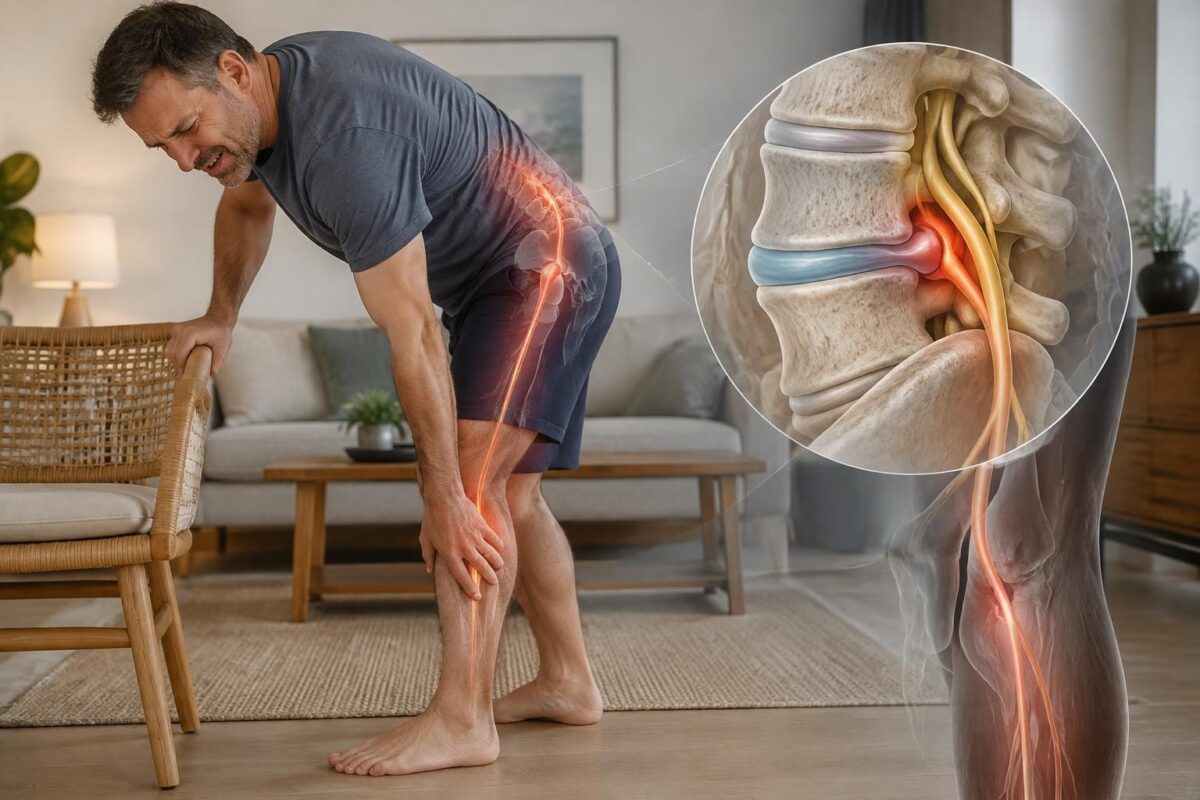
IN BRIEF
| A disc protrusion is a bulging of a disc that can irritate a nerve root and cause pain radiating down into the buttock and the calf, sometimes with tingling. However, it does not always cause symptoms. Evaluation helps link the pain to the disc and choose an appropriate management plan, often non-surgical; consult quickly if significant or progressive weakness appears. |
A lumbar disc protrusion can irritate a nerve root and cause pain that radiates from the buttock down into the leg and the calf, sometimes with tingling or numbness. However, a protrusion is often painless: calf pain can have other causes, and imaging alone may not always determine its origin.
An evaluation by a healthcare professional helps guide management. Consult quickly in case of significant or progressive weakness, loss of urinary or bowel control, or numbness in the saddle area.
A disc protrusion can sometimes irritate a nerve root and cause pain that radiates from the lower back to the calf. However, a protrusion visible on imaging does not always cause symptoms, and calf pain may also have other origins. Evaluating symptoms and, if necessary, medical tests help determine the cause and next steps. An intervertebral disc is located between two vertebrae. Over time, it can lose some of its height and form a bulge. This bulge, called a disc protrusion, does not automatically mean that the disc compresses a nerve. Some individuals may have a protrusion without pain. Pain in the calf can occur if a nerve root in the lower back is irritated. It may accompany pain in the buttock or thigh, tingling, numbness, or a burning sensation. These symptoms may correspond to sciatic-type pain, but they do not alone identify the cause. The nerves that originate from the lumbar region transmit sensations to the buttock and leg. Irritation of a nerve root can therefore produce pain away from the affected disc. The pain may be limited to the thigh or extend down to the calf, foot, or toes. The location varies depending on the affected nerve root and individual characteristics. Pain behind the thigh may also accompany these symptoms. To better understand this presentation, refer to the article on disc protrusion and pain behind the thigh. An X-ray does not show discs with the same level of detail as an MRI. A healthcare professional may request an MRI when symptoms and examination warrant it. They then interpret the images alongside the observed signs and the individual’s history. The imaging result must correspond to the painful area and symptoms. A protrusion may be a finding with no direct link to calf pain. Conversely, pain radiating into the leg deserves evaluation even if the imaging report appears minimal. Protrusion describes a bulging of the disc without a complete rupture of its outer layer. A disc herniation refers to a more localized extrusion of disc material through a weakened area. These terms describe different changes, but they do not alone predict the intensity of pain. Symptoms such as numbness or weakness may signal nerve irritation and should be evaluated. To learn more, see the pages on numbness associated with nerve irritation and the necessity of an accurate diagnosis in cases of sciatica. Pain in the calf does not always stem from the spine. A muscle injury, local irritation, or a circulation problem can cause pain in this area. The presence of a protrusion on an MRI does not rule out these other causes. A calf that suddenly swells, feels warm, or appears red, especially with new pain, requires prompt medical evaluation. Calf pain accompanied by shortness of breath or chest pain demands urgent management. The healthcare professional will ask you about the onset of the pain, its trajectory, intensity, and factors that modify it. They will also check sensitivity, strength, and certain movements of the leg. These elements help distinguish nerve pain from muscle pain or another cause. The doctor decides if imaging is useful. They may also check for any signs that require quick management. A precise diagnosis prevents automatically attributing calf pain to an imaging finding of disc protrusion. Management depends on the cause, duration of symptoms, and results from the evaluation. A physician or another authorized professional can discuss options suited to your situation. Non-surgical care is often considered first, but no treatment is right for everyone. At the TAGMED Clinic, an evaluation may determine if specific osteopathy care or motorized neurovertebral decompression can be considered. These approaches do not replace a medical diagnosis and do not guarantee a result. They should be chosen based on the evaluation and may not be suitable for all cases. Services are available in Montreal / Mont-Royal and Terrebonne. Consult a physician promptly if calf pain is accompanied by new or progressive weakness in the leg or foot, significant numbness, or increasing difficulty walking. Foot weakness deserves special attention. You can read the article on foot weakness associated with disc involvement. Go to the emergency room in case of loss of bladder or bowel control, numbness in the saddle area, significant or rapidly progressive weakness, fever, recent trauma, or severe pain that worsens quickly. Pain that extends further into the leg or toward the foot should also be reported to a healthcare professional. Consult the information on pain that spreads into the leg. Dr Sylvain Desforges, B.Sc., D.O., N.D., osteopath, is the founding president of TAGMED and the ACMA association. He dedicates his practice to chronic pain of the spine, lower back pain, and pain compatible with sciatica, particularly when the pain radiates down to the buttock, leg, calf, foot, or toes. Through SOS Sciatique, he publishes educational content on the symptoms of sciatica, possible causes such as disc herniation, disc pinch, foraminal stenosis, or irritation of a lumbar nerve root, as well as on non-surgical approaches that may be considered based on the assessment. At TAGMED Clinic, treatments may include, depending on the case, motorized neurovertebral decompression, specific osteopathy, or precision impactor. For an assessment related to sciatica treatment in Montreal / Mont-Royal or sciatica treatment in Terrebonne, check the services available at TAGMED Clinic. The information published on SOS Sciatique is provided for educational purposes and does not replace a consultation, diagnosis, advice, or treatment performed by a doctor or another licensed health professional. The author of this article is neither a doctor nor a specialist in a medical specialty recognized by the Collège des médecins du Québec. The approaches of osteopathy, manual medicine, or functional support described on this site do not constitute medical acts and are not intended to replace medical follow-up. “Medical Disclaimer: The information and advice provided on this site do not replace the opinion, diagnosis, or treatment of a healthcare professional. Please note that Dr. Sylvain Desforges, osteopath, is neither a medical doctor nor a physician, and is not a specialist in a medical specialty as defined by the Collège des médecins du Québec. Manual medicine, functional medicine, and sports medicine as described on this site exclude any medical treatment or diagnosis made by a doctor or medical specialist. Always consult your physician for any medical questions. For more details, please read our Complete Legal Disclaimer.How pain can extend down to the calf
A visible protrusion does not prove the cause of the pain
Disc protrusion or disc herniation
Other possible causes of calf pain
How the evaluation unfolds
Management options
When to consult quickly
About the author
Medical Disclaimer
When a disc protrusion irritates a nerve
- Pain may start from the lower back or buttock and radiate down to the calf.
- Numbness, tingling or weakness may accompany the pain.
- A protrusion visible on imaging does not always cause symptoms.
Important Guidelines
- Pain in the calf alone does not allow for identifying its cause: an assessment may be necessary.
- A swollen, warm, or red calf requires prompt consultation, as other causes must be ruled out.
- Consult urgently in case of significant or progressive weakness, loss of bladder or bowel control, or numbness in the saddle area.

Disc Protrusion and Calf Pain: Understanding and Acting
A disc protrusion can sometimes irritate a lumbar nerve root and cause pain that radiates into the buttock, leg, and down to the calf. However, a protrusion visible on imaging is not necessarily the cause of the pain: assessing the symptoms and a clinical examination are essential. While awaiting professional advice, remain gently active, avoid movements that clearly exacerbate the pain, and monitor for any warning signs.

Disc herniation and associated foraminal stenosis
IN BRIEF A disc protrusion associated with foraminal stenosis occurs when a bulging disc coexists with a narrowing of the opening through which a nerve root passes. This association can lead to lower back pain radiating into the leg, tingling,…

Spinal disc protrusion and nerve inflammation
IN BRIEF A disc protrusion is a bulging of the disc that can irritate or compress a nerve, without necessarily causing symptoms. When it leads to nerve inflammation, it can cause pain in the back or neck, sometimes accompanied by…
Why can a disc protrusion cause calf pain?
The protrusion refers to a bulging of the disc between the vertebrae, without a complete rupture of its envelope. It is common with age and can be asymptomatic. If it irritates a nerve root, the pain may follow a path down the leg, sometimes with tingling, numbness, or weakness. However, calf pain alone does not allow one to conclude that it is sciatica: other muscular, joint, or vascular causes are possible.
Observe the symptoms without self-diagnosing
Note the affected side, the moment when the pain appears, the activities that trigger it, and any possible presence of electrical sensations, tingling, or loss of strength. This information will help the health professional determine if the symptoms suggest nerve irritation or another origin. An MRI image must always be interpreted in conjunction with the examination and symptoms, as its results alone are not sufficient to identify the source of the pain.

Disc protrusion and irritation of L5
IN SHORT A disc protrusion is a bulging of the disc that can irritate the L5 root and cause lower back pain radiating to the buttock, leg, or foot, sometimes with tingling or weakness. MRI alone is not sufficient to…

Disc protrusion and pain after twisting the back
IN BRIEF A disc protrusion is a bulging of the disc that can contribute to pain after a back twist, but it alone does not confirm the cause. The pain can remain in the lower back or radiate to the…
Cautious Measures to Relieve Pain
If the symptoms remain moderate, prioritize gentle movements and activities according to your tolerance. Prolonged bed rest may promote stiffness and is generally not recommended without medical indication. Alternate positions, take breaks during extended sitting periods, and temporarily avoid heavy loads or movements that clearly increase the pain down to the calf.
Do not force stretches and do not continue an exercise that increases radiating pain, numbness, or weakness. A rehabilitation program may include, after assessment, progressive mobility and strengthening exercises. The choice depends on your condition: an exercise suitable for one person may not be appropriate for another. A doctor or rehabilitation professional can also advise you on pain relief and appropriate non-surgical options.
When to Seek Medical Evaluation?
Consult a professional if the pain is intense, persists, recurs frequently, or limits walking and daily activities. Seek urgent help in case of new or progressive weakness of the leg, loss of bladder or bowel control, or numbness in the saddle area. A suddenly swollen, red, warm, or tender calf also requires prompt evaluation, especially if shortness of breath or chest pain occurs.

Disc herniation and pain after lifting
IN BRIEF A disc protrusion is a bulging of a disc between the vertebrae. Pain that appears after lifting a load does not prove that it is the cause: the MRI must be interpreted alongside the symptoms and the clinical…

Disc herniation and lumbar flexion: why caution is necessary
IN BRIEF A disc protrusion is a bulge of the intervertebral disc, which can be silent or irritate a nerve. Lumbar flexion is not necessarily dangerous but can worsen symptoms in some individuals. Adapting movements, avoiding those that aggravate pain,…
Adapting Care to Your Situation
Most disc protrusions do not automatically require surgery. Management often relies first on evaluation, a gradual return to activities, and suitable conservative care. Manual therapies or osteopathy may assist some individuals, but they do not replace a medical diagnosis or urgent care when warning signs are present. Consult your doctor to determine the next steps and check the source of the calf pain.
Medical warning: this content is educational and does not replace a consultation, diagnosis, or treatment by a licensed healthcare professional.
| Situation | Concise guideline |
|---|---|
| Calf pain and disc protrusion | A lumbar protrusion may irritate a nerve root and cause pain radiating down to the calf. |
| Other possible sensations | Tingling, numbness, or weakness may accompany the pain. |
| Protrusion visible on imaging | It does not prove, by itself, that the calf pain comes from the disc. |
| Evaluation needed | A healthcare professional evaluates the symptoms and looks for other possible causes. |
| Significant or progressive weakness | Consult a doctor or emergency service quickly. |

Disc herniation and pain that worsens in the car
IN BRIEF A disc protrusion is a bulging of a disc that can irritate a nerve. In a car, prolonged sitting and vibrations can exacerbate back, buttock, leg, or arm pain. Regular breaks, an adapted posture, and personalized management can…

Disc protrusion and pain that increases when sitting
IN BRIEF A disc protrusion is an intervertebral disc that bulges without necessarily breaking its outer covering. Pain may increase when sitting and sometimes radiate into the buttock or leg, like sciatica. Alternating positions, moving regularly, and following a suitable…
Illustrative testimonies: disc protrusion and calf pain
Note: the stories below are fictional and serve to illustrate different possible situations. They do not correspond to real patient testimonies and do not allow for a diagnosis. Calf pain may be related to nerve irritation, but it can also have other causes.
“The pain went from my lower back down to my calf”
After several weeks of lumbar discomfort, I experienced pain in my buttock that radiated down the back of my thigh to my calf. Imaging showed a disc protrusion, but I was told that this result needed to be interpreted with my symptoms and clinical examination. I consulted a healthcare professional to discuss suitable options for my situation.
“My exam showed a protrusion, but I didn’t always hurt”
I discovered the disc protrusion during an exam requested for intermittent pain. Some days, my calf felt tight; other days, I barely felt anything. I learned that a protrusion can be present without causing symptoms and that imaging alone is not enough to explain every pain.
“I also felt tingling in my foot”
My calf pain sometimes accompanied tingling in my foot. Since these sensations could suggest nerve irritation, I requested an evaluation rather than concluding myself that the protrusion was necessarily the cause. The professional checked my symptoms and directed me to the appropriate management steps.
“I gradually adapted my activities”
When my back and calf were sensitive, I feared every movement. After receiving professional advice, I gradually resumed certain activities and paid attention to my positions and breaks. The progress was variable: these measures do not guarantee a result and must be tailored to each individual.
To remember: pain that radiates down the calf may be compatible with sciatica, but it does not confirm a disc protrusion by itself. Consult a doctor quickly if you have significant or progressive weakness in your leg or foot, loss of urinary or bowel control, or numbness in the saddle area. A suddenly swollen, red, or warm calf, especially with shortness of breath, also requires urgent medical evaluation.
Disc protrusion and calf pain: understanding the link
A calf pain can sometimes be related to nerve irritation in the lower back. Among the possible causes is a lumbar disc protrusion, a bulging of the intervertebral disc that does not necessarily involve tearing its outer covering. This change can occur with aging and often remains asymptomatic. Its presence on imaging alone, therefore, is not enough to explain a pain.
When a bulging disc irritates a nerve root, the pain may follow the nerve path down to the buttock, thigh, and sometimes to the calf or foot. It may be accompanied by tingling, numbness, or burning sensations. Some people also experience weakness or discomfort in certain movements. These signs may suggest radicular pain, sometimes called sciatica, but their origin must be evaluated: calf pain can also be muscular, joint-related, or linked to a circulation problem.
The difference between a protrusion and a herniated disc mainly depends on the shape of the deformation and the state of the disc. A protrusion generally corresponds to a more extensive bulging, while a herniation involves a more localized escape of the disc content through a weakened area. However, the symptoms do not always allow these situations to be distinguished. The intensity of the pain does not automatically reflect the size of the anomaly observed on an image.
To clarify the cause, a healthcare professional focuses on the history of symptoms, their evolution, and the circumstances that worsen or relieve them. The examination may include an assessment of mobility, strength, sensitivity, and reflexes. An MRI or another imaging test may be considered depending on the clinical picture, but it is not necessary in all cases. The goal is to connect the results to the symptoms and rule out other possible causes.
When the pain is explained by lumbar irritation without signs of severity, management often begins with non-surgical measures tailored to the individual. Depending on the assessment, this may include maintaining tolerated activities, gradual exercises, movement advice, and manual support. At TAGMED Clinic, approaches like specific osteopathy or motorized neurovertebral decompression may be considered on a case-by-case basis; they do not replace a medical evaluation and may not be suitable for everyone. Surgical intervention is reserved for certain situations, notably when significant symptoms persist or neurological deficits warrant it.
Calf pain with sudden swelling, redness, or warmth requires rapid medical evaluation, as it may have a vascular origin. Also consult without delay in cases of significant or progressive weakness, loss of urinary or bowel control, or numbness in the saddle area. In the presence of new, severe symptoms or those that are worsening rapidly, seek medical advice rather than trying to treat yourself.
About the author
Dr Sylvain Desforges, B.Sc., D.O., N.D., osteopath, is the founding president of TAGMED clinics and the ACMA association. His background is dedicated to the management of chronic pain and health innovation. His practice focuses particularly on spinal pain, lower back pain, and symptoms compatible with sciatica. Depending on the evaluation of each person, the proposed approaches may include osteopathy, neurovertebral decompression, and certain technologies used in functional support.
Medical warning
This content is provided for educational purposes and does not replace a consultation, diagnosis, or treatment by a licensed health professional. The author is neither a physician nor a specialist in a medical specialty recognized by the College of Physicians of Quebec. Manual and functional approaches are not considered medical acts. For any concerns regarding your symptoms, seek professional advice.
A disk protrusion can sometimes contribute to pain that radiates down to the calf, but its presence in imaging does not prove it is the cause of the symptoms. The location of the pain, neurological signs, and clinical examination help distinguish nerve irritation from other possible causes and to choose the appropriate course of action.
How can a disk protrusion cause calf pain?
A protrusion corresponds to a bulging of the intervertebral disc, without a complete rupture of its outer envelope. If it irritates a lumbar nerve root, the pain can follow the path of the nerve into the buttock and leg, sometimes down to the calf or foot. It may be accompanied by tingling, numbness, or a sensation of weakness. To better understand the difference between a disc bulge and a herniation, consult this presentation of disk protrusion and herniation, as well as this overview dedicated to disk protrusion.
The level of the disc can help to understand the symptoms, although it does not explain them on its own. Protrusions at L4-L5 or L5-S1 are specifically discussed in dedicated resources. However, disc abnormalities may be visible in people who do not have pain. Interpretation must therefore take into account the entire clinical picture, not just the image alone.
Signs to observe and other possible causes
Note where the pain starts, how far it radiates, what aggravates or relieves it, and whether any unusual sensations or weakness occur. In some individuals, sitting increases the pain; this phenomenon may sometimes be compatible with a disc-related cause, but it cannot serve as a diagnosis on its own. You may consult this page about sciatic-type pain that increases when sitting.
Pain radiating down the leg can sometimes occur without marked lower back pain. The relationship between a disk herniation and pain felt elsewhere is explained in this article on pain without back pain. Irritation of a nerve root can also involve mechanisms that do not solely consist of mechanical compression; information on chemical irritation of the nerve root and on pain that centralizes can help to better understand these variations.
However, calf pain is not always related to the spine. An evaluation by a health professional may be necessary to examine possible causes, especially if the pain is new, persistent, or accompanied by other symptoms. The article dedicated to the reasons why sciatica-related pain can radiate down the leg provides general guidelines, without replacing an individual examination.
Assessment and management options
The health professional focuses on your symptoms, their progression, your mobility, and specific neurological signs. Imaging, such as MRI, may be considered depending on the situation; it is not necessary in all cases and must be interpreted in conjunction with the clinical examination. For additional guidelines on protrusion and possible adaptations, also consult the resources on ergonomics in the presence of a disk protrusion.
When possible, management may include non-surgical measures decided based on the evaluation: maintaining adapted activities, gradual resumption of movement, and individualized exercises. General advice does not replace a program tailored to your symptoms. Avoid forcing a movement that significantly increases pain or neurological signs, and seek professional advice if symptoms persist, worsen, or limit your activities.
Quickly consult a doctor or an emergency service in case of significant or progressive weakness of the leg or foot, loss of urinary or bowel control, numbness in the saddle region, fever, recent trauma, or rapid worsening. A calf pain accompanied by significant swelling, redness, or local heat also requires prompt medical evaluation.
About the author
Dr Sylvain Desforges, B.Sc., D.O., N.D., osteopath, is the founding president of TAGMED and the ACMA association. He dedicates his practice to chronic spinal pain, lower back pain, and pain compatible with sciatica, especially when the pain radiates toward the buttock, leg, calf, foot, or toes.
Through SOS Sciatique, he publishes educational content on sciatica symptoms, possible causes such as disk herniation, disc pinch, foraminal stenosis, or irritation of a lumbar nerve root, as well as on non-surgical approaches that can be considered based on the evaluation. At the TAGMED Clinic, care may include, depending on the case, motorized neurovertebral decompression, specific osteopathy, or precision impactor.
For an assessment related to the treatment of sciatica in Montreal / Mont-Royal or the treatment of sciatica in Terrebonne, consult the services available at the TAGMED Clinic.
Medical warning
The information published on SOS Sciatique is provided for educational purposes and does not replace a consultation, diagnosis, advice or treatment performed by a doctor or another authorized healthcare professional. The author of this article is neither a doctor nor a specialist in a medical specialty recognized by the Collège des médecins du Québec. The approaches to osteopathy, manual medicine, or functional support described on this site do not constitute medical acts and are not intended to replace medical follow-up.
Consult a doctor or an emergency service in case of loss of urinary or bowel control, anesthesia in the saddle area, significant or progressive weakness of the leg or foot, fever, recent trauma, severe pain or rapid deterioration. For more details, please read our Legal Notice.

Dr Sylvain Desforges, B.Sc., D.O., N.D., osteopath, is the founding president of TAGMED and of the ACMA association. He dedicates his practice to chronic spinal pain, low back pain and symptoms compatible with sciatica, particularly when pain radiates toward the buttock, leg, calf, foot or toes.
Through SOS Sciatique, he publishes educational content on sciatica symptoms, possible causes such as disc herniation, disc narrowing, foraminal stenosis or irritation of a lumbar nerve root, as well as non-surgical approaches that may be considered according to the evaluation. At Clinique TAGMED, care may include, depending on the case, motorized neurovertebral decompression, specific osteopathic care or precision percussion.
For an evaluation related to sciatica treatment in Montreal / Mount Royal or sciatica treatment in Terrebonne, please consult the services available at Clinique TAGMED.
Medical disclaimer
The information published on SOS Sciatique is provided for educational purposes only and does not replace a consultation, diagnosis, opinion or treatment provided by a physician or another authorized healthcare professional. The author of this article is neither a medical doctor nor a specialist in a medical specialty recognized by the Collège des médecins du Québec. The osteopathic, manual medicine or functional support approaches described on this site do not constitute medical acts and are not intended to replace medical follow-up.
Consult a physician or emergency service in cases of loss of bladder or bowel control, anesthesia in the saddle area, significant or progressive weakness in the leg or foot, fever, recent trauma, severe pain or rapid worsening of symptoms. For more details, please read our Legal Notice.


