


Sciatic surgery: in what cases is it considered?
Most sciatica does not require surgery. However, surgery may be discussed when a nerve root remains compressed, when pain or disability remains significant despite appropriate non-surgical management, and when symptoms, neurological examination, and imaging tell the same story.
The goal is not to “operate on the sciatic nerve” in the leg. Instead, the surgeon seeks to relieve a compressed root in the lumbar spine, for example by removing a fragment of herniated disc or widening a passage that has become too narrow. The choice and timing depend on the cause, evolution, and the balance between expected benefits and risks.

What does “surgical treatment for sciatica” really mean?
Sciatica is a set of symptoms caused by irritation or compression of a lumbar-sacral nerve root. Surgery addresses an accessible anatomical cause in the spine; it does not cut or replace the sciatic nerve. The procedure therefore depends on what is compressing the root.
Disc Herniation
A fragment of the disc may be removed by discectomy or microdiscectomy to relieve the root.
Lumbar Stenosis
A laminotomy, laminectomy, or other decompression can enlarge the canal or the nerve passage.
Foraminal Stenosis
A foraminotomy may widen the opening through which the root exits the spine.
In what cases is surgery considered?
NICE recommends considering spine decompression for a person with sciatica when non-surgical treatment has not improved pain or function and radiological findings match the symptoms. This decision remains individualized and should be made with a spine surgeon.
Persistent Radicular Pain
Pain in the leg remains severe or disabling despite a reasonable period of appropriate care.
Severely Limited Function
Walking, sleeping, working, or carrying out daily activities remains very difficult.
Neurological Deficit
Weakness, loss of sensation, or another measurable deficit increases the relevance of a specialized opinion.
Clinical and Radiological Concordance
MRI shows compression at the correct level and on the same side as the symptoms.
Accessible Cause for Surgery
A herniation, stenosis, or another lesion reasonably explains the condition.
Shared Decision
The patient understands the alternatives, expected benefits, limitations, risks, and recovery.
Urgency, Quick Opinion, or Elective Decision?
| Situation | What It May Mean | Cautious Action |
|---|---|---|
| Urinary retention, incontinence, saddle anesthesia | Possible cauda equina syndrome. | Immediate hospital emergency; urgent decompression may be necessary. |
| Significant or progressive weakness | Evolving neurological distress. | Urgent or very rapid medical and surgical evaluation. |
| Uncontrollable pain with major loss of function | Persistent compression despite treatment. | Quick medical advice and accelerated discussion based on the examination. |
| Stable sciatica without serious deficit | Often favorable evolution, especially at the beginning. | Non-surgical care, monitoring, and planned reevaluation. |
| Persistent symptoms and concordant MRI | Mechanical cause possibly accessible to decompression. | Elective consultation in spine surgery and shared decision-making. |
| MRI anomaly without corresponding symptoms | Possibly incidental finding. | Reassess the diagnosis; do not operate on an isolated image. |
Why is the concordance between symptoms, examination, and MRI essential?
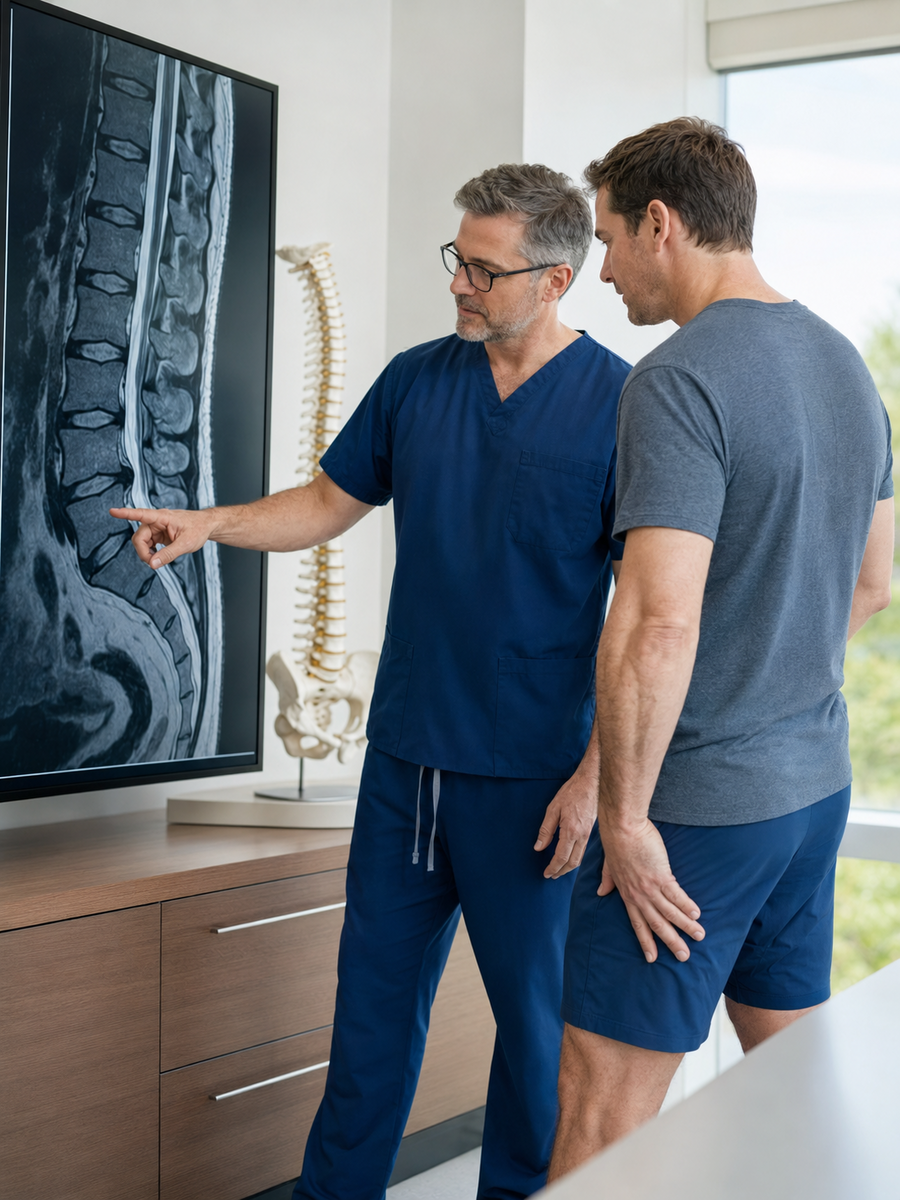
A herniated disc or stenosis may appear on the MRI without being responsible for the pain. Before an operation, the surgeon seeks to confirm that the visible structure explains the leg path, the affected side, and the observed deficits.
- Does the side of compression correspond to the painful side?
- Is the L4-L5 or L5-S1 level compatible with the path and weakness?
- Does leg pain dominate over diffuse low back pain?
- Does the examination of strength, sensitivity, and reflexes support the same root?
- Have symptoms changed since the imaging?
- Does another cause – hip, peripheral neuropathy, referred pain – remain plausible?
What operations can be proposed?
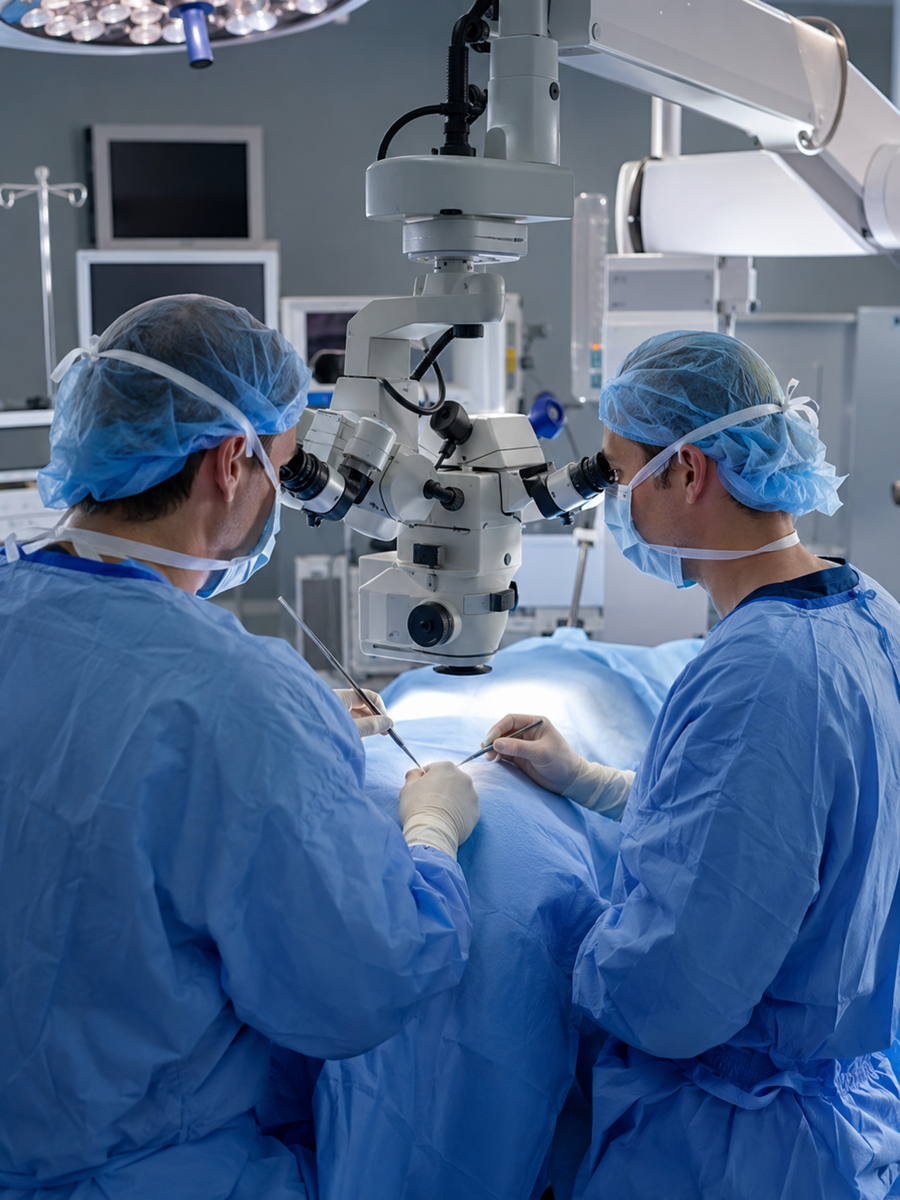
The name of the procedure describes the structure removed or the passage enlarged. A so-called minimally invasive approach utilizes a smaller incision and working corridor, but it remains surgery with real risks.
- Microdiscectomy or discectomy. Removal of the disk fragment that compresses the root.
- Laminotomy or laminectomy. Partial or more extensive removal of a posterior bony portion to enlarge the space.
- Foraminotomy. Enlargement of the foramen through which the nerve root exits.
- Multisegmental decompression. Treatment of multiple levels when stenosis affects them and the symptoms align.
- Instrumented fusion. Stabilization of vertebrae in selected situations; it is not the standard treatment for a simple disc herniation.
What benefits can be reasonably expected?
In a randomized trial involving severe sciatica lasting 6 to 12 weeks, early surgery provided faster relief from leg pain, but the one-year results were similar to those of a non-surgical strategy with surgery if needed. In another trial involving individuals with sciatica lasting 4 to 12 months and a concordant L4-L5 or L5-S1 herniation, microdiscectomy led to less leg pain at six months than standardized non-surgical care.
A systematic review in the BMJ concludes that discectomy may reduce leg pain more than non-surgical treatments in the short term, but the difference diminishes over time and becomes negligible after about a year; the certainty of the data is low to very low. These results support personalized decision-making, not a one-size-fits-all rule.
Faster relief
The main expected benefit is often a quicker reduction in radicular pain.
Variable neurological recovery
An old weakness or numbness may improve slowly, partially, or persist.
Less predictable low back pain
Decompressing a root does not necessarily resolve all causes of lower back pain.
What risks should be understood?
The risks depend on the intervention, the treated level, age, other illnesses, medications, smoking, and the experience of the team. The surgeon must explain the risks specific to the case and their frequency in their environment.
General risks
Infection, bleeding, thrombosis, reaction to anesthesia, or healing problems.
Neurological risks
Damage to a root, new weakness, numbness, or neuropathic pain, rarely more severe.
Dural breach
A leak of cerebrospinal fluid may require special measures or repair.
Recurrent herniation
A new fragment may compress the root at the same level and may sometimes require a redo.
Persistent symptoms
A root that has been compressed for a long time or an incomplete diagnosis may limit the outcome.
New intervention
A recurrence, stenosis, or subsequent instability may lead to another surgery.
Helpful questions to ask the surgeon
About the indication
- What root is compressed and by which structure?
- What elements from my examination and MRI are consistent?
- Why operate now rather than monitor further?
- What evolution is likely without surgery?
- Which symptom should the operation prioritize improving?
About the procedure and aftercare
- What intervention do you propose and why?
- What are your most common complications for this procedure?
- What is the likelihood of persistent pain or recurrence?
- When can I walk, drive, work, and resume my activities?
- What signs after the operation necessitate a call or emergency care?
How to prepare if the operation is confirmed?
Follow the instructions from the hospital and the surgeon, which take precedence over any general information. Never stop an anticoagulant, antiplatelet, or prescribed medication on your own.
Medications and allergies
Provide an up-to-date list, including natural products, previous reactions, and anticoagulants.
Tobacco and general health
Smoking, diabetes, and other illnesses can alter risks and healing.
Return home
Plan for transport, temporary assistance, meals, and task organization according to received instructions.
Work
Discuss actual physical requirements and a gradual return rather than an arbitrary date.
Realistic goals
Distinguish between leg pain, lower back pain, numbness, and weakness; their recovery may differ.
Warning signs
Ask who to call day and night in case of fever, wound, weakness, or sphincter trouble.
What does recovery look like?
Duration varies depending on the procedure, condition before surgery, and job requirements. After a simple microdiscectomy, walking is often encouraged early, but the schedule for loads, driving, and work must be individualized. Extensive decompression or fusion usually requires a longer recovery.
- First days. Pain control, wound care, short walks, and monitoring for warning signs.
- First weeks. Gradual increase in walking and authorized activities.
- Return to work. Adapted to symptoms, medication, and physical constraints of the position.
- Rehabilitation. Active plan according to the recommendations of the surgical team.
- Follow-up. Reevaluation of leg pain, strength, sensitivity, and function.

Neurovertebral decompression and surgical decompression: two different things
Surgical decompression removes or modifies a structure that compresses the root. The motorized neurovertebral decompression is a non-surgical approach applying controlled traction. It does not remove a herniation, does not replace an indicated surgery, and should never delay a neurological emergency.
NICE recommends against routinely offering traction for low back pain with or without sciatica. A cautious trial of motorized decompression can only be discussed in a selected context, after screening for contraindications, with measurable objectives and without a promise of results.
| Surgical decompression | Motorized neurovertebral decompression |
|---|---|
| Performed by a surgical team in a hospital. | Conservative approach performed in a clinic on selected patients. |
| Directly removes or relieves a compressive structure. | Applies controlled mechanical force without removing tissue. |
| Can be urgent in the case of cauda equina syndrome. | Is never a neurological emergency treatment. |
| Involves the risks of intervention and anesthesia. | Also has contraindications and may worsen certain symptoms. |
Non-surgical assessment at TAGMED Clinic
The TAGMED Clinic does not perform surgeries and does not replace a consultation in spinal surgery. An osteopathic evaluation can document the trajectory, function, movement tolerance, and signs requiring medical referral. It can also help interpret an imaging report within the limits of the practice scope.
When the situation does not present an emergency and surgery is not indicated or has not yet been considered, specific osteopathy or a cautious attempt at motorized neurovertebral decompression may sometimes be discussed. These approaches do not guarantee the avoidance of surgery and should not delay a recommended medical or surgical opinion.
TAGMED Clinic Terrebonne
1150 Lévis Street, Suite 200
Terrebonne, QC, J6W 5S6
Phone: 450-704-4447
Days: Monday, Wednesday, and Friday
TAGMED Clinic Montreal / Mont-Royal
1140 Beaumont Avenue
Mont-Royal, QC, H3P 3E5
Phone: 1-877-672-9060
Days: Tuesday and Thursday
Frequently Asked Questions about Sciatica Surgery
When should sciatica be treated surgically in an emergency?
A suspected cauda equina syndrome — urinary retention, incontinence, saddle anesthesia — or significant and rapidly progressive weakness requires urgent evaluation. The surgeon and hospital team determine if immediate decompression is necessary.
How long should you wait before consulting a surgeon?
There is no set timeline. Without severe deficits, a non-surgical treatment period is common. Persistent debilitating pain, unchanged function, or weakness warrants re-evaluation and sometimes a quicker consult.
Does microdiscectomy always cure sciatica?
No. It can quickly relieve leg pain caused by a concordant herniation, but pain, numbness, or weakness may persist. Recurrence is also possible.
Does a large herniation on MRI always require surgery?
No. Image size alone is not sufficient. Symptoms, deficits, side, level, and progression must be evaluated. Some large herniations improve without surgery.
Does surgery also relieve lower back pain?
A decompression primarily targets radicular pain in the leg. Back pain may improve, remain stable, or persist if it originates from other mechanisms. Ask which symptom the intervention specifically targets.
What is the difference between microdiscectomy and laminectomy?
Microdiscectomy primarily removes a fragment of disc that compresses a nerve root. Laminectomy removes a portion of bone from the back to enlarge the canal, often in the context of stenosis.
Is a fusion necessary with a disc herniation operation?
Usually not for a first simple disc herniation. A fusion may be discussed in the presence of instability, deformity, or another specific indication. It adds constraints and risks that must be explained.
When can one return to work after the operation?
The timeline depends on the procedure, symptoms, medication, and job requirements. Sedentary work and manual labor do not follow the same schedule. The surgeon must provide personalized restrictions.
Can sciatica return after the operation?
Yes. A herniation can recur at the same level, another area may become symptomatic, or the nerve root may remain sensitive. New sciatica requires an examination; it does not automatically mean a new operation.
Can neurovertebral decompression replace recommended surgery?
No. It never replaces urgent surgical decompression or a specialized opinion. In certain non-urgent situations, it may only be discussed as a cautious conservative option with the relevant professional and physician.
Sources and references
- NICE NG59 — Low back pain and sciatica: assessment and management.
- American Association of Neurological Surgeons — Herniated Disc.
- American Association of Neurological Surgeons — Cauda Equina Syndrome.
- Peul et al. — Surgery versus Prolonged Conservative Treatment for Sciatica, New England Journal of Medicine, 2007.
- Bailey et al. — Surgery versus Conservative Care for Persistent Sciatica, New England Journal of Medicine, 2020.
- BMJ — Surgical versus non-surgical treatment for sciatica: systematic review and meta-analysis, 2023.
Your sciatica persists and you want to clarify the next step?
An evaluation can help document the journey, function, and signs that justify a medical referral. TAGMED Clinic does not perform surgery but can discuss a non-surgical approach when appropriate and without delaying a recommended specialist opinion.
Dr Sylvain Desforges, B.Sc., D.O., N.D., osteopath
Editorial information, sources and limitations
This content is intended to inform patients about sciatica, possible causes, warning signs, and care options. It does not replace an individualized assessment.
Reference sources
References are selected according to the subject of the page: guidelines, systematic reviews, then institutional resources.
- NICE NG59 – Low back pain and sciatica in over 16s — National guideline
- HAS – Management of patients with common low back pain — French national guideline
- Cochrane – Corticosteroid injections for treatment of sciatica — Systematic review
- NCBI Bookshelf – Sciatica — Clinical institutional resource
Complementary resources from the TAGMED network
These internal resources complement the clinical information and thematic linking. They do not replace national guidelines or systematic reviews.
Editorial note on decompression
Clinical resource from the TAGMED network; it does not replace national guidelines. Some guidelines use the term “traction” and recommend caution for low back pain with or without sciatica. Any decompression option should therefore be presented as an individualized clinical approach, with limitations, indications, and contraindications clearly explained.
Limitations of this information
The information on this page is general. It does not constitute a diagnosis, prescription, or guarantee of results. Pain radiating into the leg may have several causes; assessment should consider clinical history, examination findings, symptom progression, and, when appropriate, complementary tests.
When to seek urgent medical care
Seek urgent medical care if you experience loss of bladder or bowel control, saddle anesthesia, major or progressive leg weakness, unexplained fever, pain after significant trauma, or severe pain that rapidly worsens.
