


Sciatica impact score: measure your limitations
Pain does not tell the whole story. This questionnaire also measures the impact of your symptoms on walking, sitting, sleep, personal care, and usual activities.
In ten questions, you will obtain a personal index from 0 to 100 that you can note and compare during your next self-assessment. This is neither a diagnosis nor a validated clinical questionnaire.

Calculate your personal impact index for sciatica
Respond based on the last 24 hours. Choose the answer that best describes your usual capability, even if your condition varies during the day.
How to interpret the impact score out of 100?
The index summarizes nine rated responses after the security question. The higher the number, the more declared symptoms disrupt various areas of daily life. The categories serve to make the result readable; they are not validated diagnostic or prognostic thresholds.
| Personal Index | Declared Impact | Educational Interpretation |
|---|---|---|
| 0 to 19 | Low | Few functional limitations declared today. |
| 20 to 39 | Mild | Some adaptations or breaks are necessary. |
| 40 to 59 | Moderate | Several activities are reduced or require significant adaptations. |
| 60 to 79 | Significant | The symptoms significantly disrupt autonomy or usual activities. |
| 80 to 100 | Very important | Most of the evaluated areas are heavily restricted. |

Walking, Standing, and Autonomy
Sciatica can alter stride length, speed, confidence in the leg, or tolerated distance. Some individuals feel better walking than remaining still; others must stop after a few minutes. The tool does not assume that one position is better for everyone: it asks what you can actually do.
A slight variation from one day to another is normal. To track a trend, redo the self-evaluation under similar conditions, for example at the same time of day and after a day of comparable activity. Also note any unusual use of a cane, support, or the appearance of a limp.
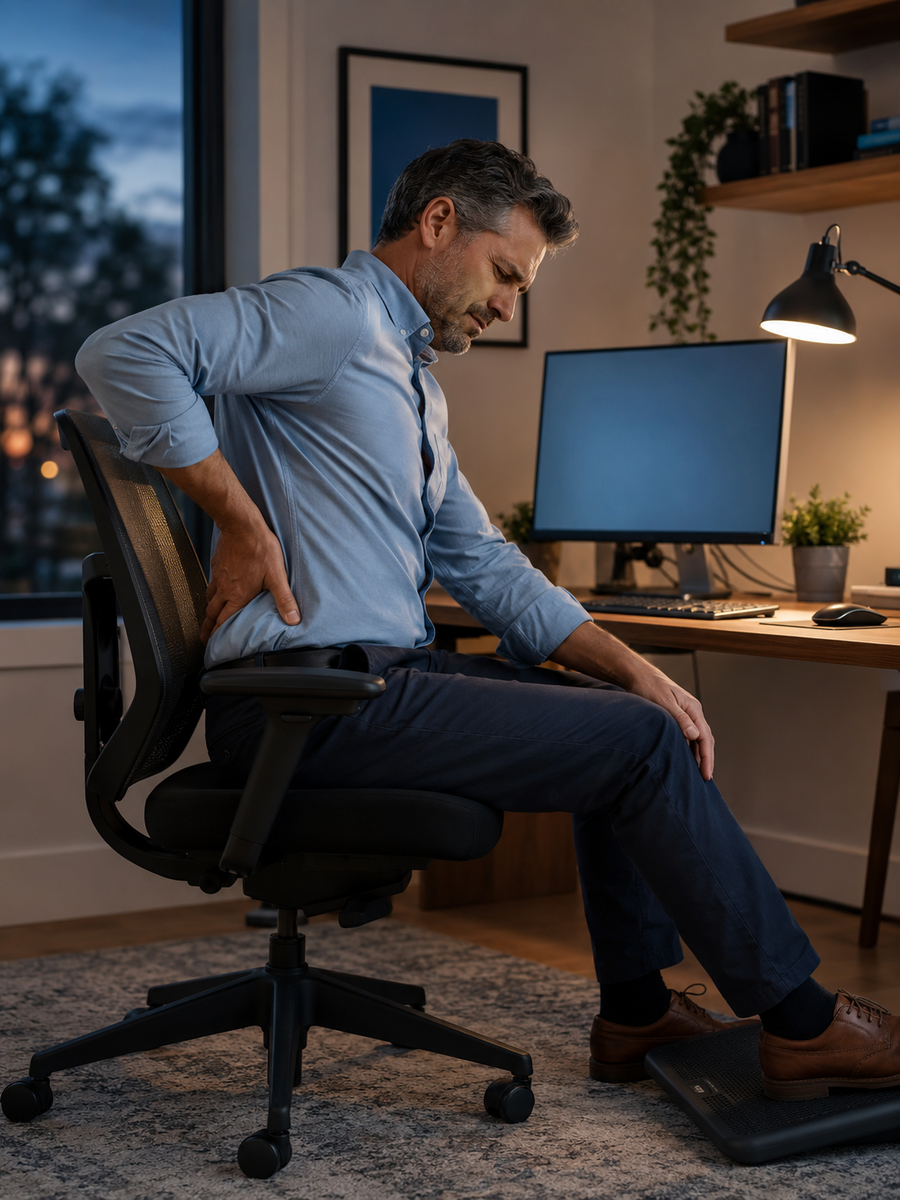
Sitting position, work and daily activities
The tolerance for sitting position influences driving, office work, meals, and movements. A specific duration is often easier to compare than a general impression. The questionnaire therefore uses simple intervals, from less than five minutes to more than an hour.
When symptoms allow, alternating positions and breaking up activities is generally more realistic than prolonged bed rest. However, recommendations must be adapted to the probable cause, general condition, and the person’s abilities.
The area ‘work and usual activities’ does not seek to determine professional capability. It only measures the proportion of activities that the person believes they can accomplish today. A certificate, restriction, or return to work must be decided by a qualified professional after a proper assessment.
Why does sleep matter in monitoring?
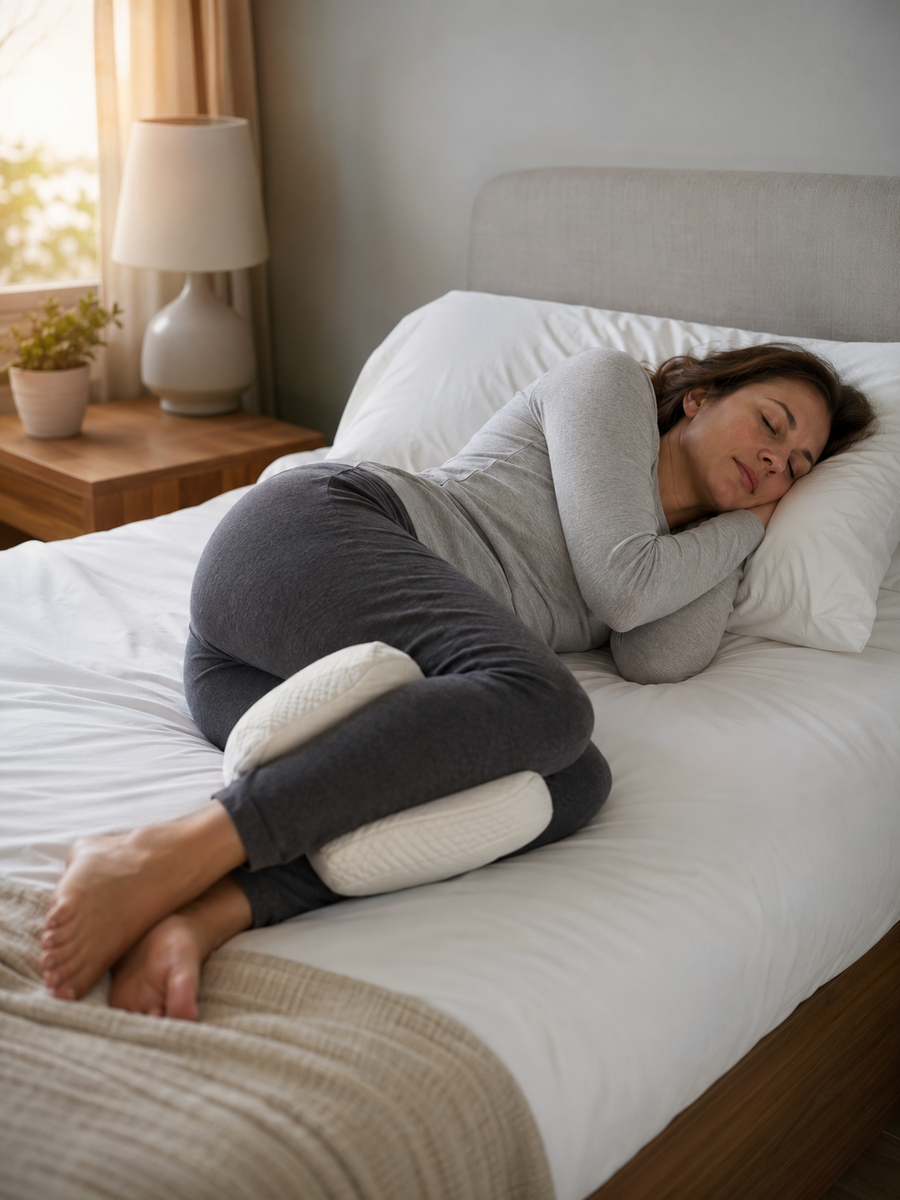
Night pain can fragment sleep, increase fatigue, and make the next day’s activities more difficult. Therefore, the sleep domain is included separately to avoid this effect being lost in the painful intensity alone.
The most comfortable position varies. Some people prefer to sleep on their side with a pillow between their knees; others feel better on their back with their legs supported. Pain that significantly worsens at night, becomes constant, or is accompanied by other unusual symptoms merits medical advice.
Compare representative nights. A single bad night caused by an external factor should not be interpreted as a definite worsening of sciatica.
How to use this score to track your progress?
1. Keep the same conditions
Respond at the same time of day and for the same 24-hour reference period.
2. Retain the result
Print or copy the date, the index, and the main limitations into a tracking notebook.
3. Observe the trend
Compare multiple measurements rather than concluding from a single isolated variation.
A decrease in the index may reflect better tolerance to activity, less disturbed sleep, or increased autonomy, even if residual pain persists. Conversely, an increase may stem from an exceptionally demanding day. Context must always accompany the number.
Bring your results to a consultation if you wish to describe the evolution precisely. They can help tell what you are experiencing, but the professional will use their own measurements, examination, and relevant clinical information.
Calculation Method and Limitations
After the safety question, seven areas are rated from 0 to 4: pain, walking, sitting position, standing, sleep, personal care, and usual activities. Stable strength receives from 0 to 3 points, and recent change from 0 to 3 points. The maximum gross total is 34. The formula total ÷ 34 × 100 produces the rounded index.
A response indicating a sign of neurological alert produces emergency guidance without displaying the index as the main conclusion. New or progressive weakness or rapid neurological deterioration generates a recommendation for swift medical advice.
Categories 0–19, 20–39, 40–59, 60–79, and 80–100 have been created for this site to facilitate personal tracking. They have not been validated as severity thresholds, do not allow predictions of recovery duration, and should not be directly compared to scores from other questionnaires.
Frequently Asked Questions about Sciatica Impact Score
Can this score diagnose sciatica?
No. It measures the limitations you report. To determine if the symptoms correspond to sciatica and to investigate the cause, a clinical evaluation is necessary.
Is this a validated medical questionnaire?
No. It is an educational index created for SOS Sciatica. It does not replace a validated instrument like PROMIS or a questionnaire chosen by a professional.
Why is the result expressed out of 100?
Converting to 100 makes tracking easier to read. It does not mean ‘percentage of disease,’ ‘percentage of disability,’ or probability of diagnosis.
How often can I retake the test?
To track a trend, a regular interval like once a week is generally more helpful than multiple measurements in a day. Use comparable conditions.
Does a small variation mean my condition is changing?
Not necessarily. Sleep, daytime activity, stress, and several factors can alter the responses. Observe multiple results and the context.
Does a high index mean I need surgery?
No. The index does not determine the cause or treatment. A surgical decision depends on the examination, neurological deficits, progression, imaging when indicated, and response to appropriate treatments.
Does a low index exclude an emergency?
No. Urinary or intestinal issues, perineal anesthesia, and significant or progressive weakness require priority attention, regardless of the number of reported limitations.
Why are walking and standing separated?
A person may tolerate movement but not stillness, or vice versa. Separating them allows for a more accurate description of the functional profile.
Why measure sleep?
Pain-related awakenings increase fatigue and may reduce function the next day. Sleep thus constitutes a distinct area of painful intensity.
Can I use this score for an insurance claim?
No. This tool was not designed or validated to determine disability, incapacity, work fitness, or compensation.
Are my responses saved on the site?
No. The calculation occurs in your browser and responses are not transmitted. Copy or print the result voluntarily if you wish to keep it.
What to do if the result increases week after week?
Check if the measurement conditions are comparable. Request an evaluation if the worsening persists, if activities become severely limited, or if weakness or decreased sensitivity appears.
Clinical sources and references
- Health Insurance — Sciatica: how to relieve it and when to consult?
- NICE NG59 — Low back pain and sciatica: assessment and management
- World Health Organization — International Classification of Functioning, Disability and Health
- HealthMeasures — Introduction to PROMIS
Dr. Sylvain Desforges, B.Sc., D.O., N.D., osteopath
The information on this page is educational. It does not replace the advice, diagnosis, or treatment of a physician or other qualified health professional.
Your sciatica limits several activities?
A planned assessment can clarify the most limited movements and positions, check strength and sensitivity, investigate causes that mimic sciatica, and determine if a non-surgical approach is relevant.
If the result indicates an emergency or a prompt medical opinion, follow that recommendation rather than scheduling a regular appointment.
Dr. Sylvain Desforges, B.Sc., D.O., N.D., osteopath
Editorial information, sources and limitations
This content is intended to inform patients about sciatica, possible causes, warning signs, and care options. It does not replace an individualized assessment.
Reference sources
References are selected according to the subject of the page: guidelines, systematic reviews, then institutional resources.
- NICE NG59 – Low back pain and sciatica in over 16s — National guideline
- HAS – Management of patients with common low back pain — French national guideline
- ameli – Sciatica — French institutional patient resource
Complementary resources from the TAGMED network
These internal resources complement the clinical information and thematic linking. They do not replace national guidelines or systematic reviews.
Limitations of this information
The information on this page is general. It does not constitute a diagnosis, prescription, or guarantee of results. Pain radiating into the leg may have several causes; assessment should consider clinical history, examination findings, symptom progression, and, when appropriate, complementary tests.
When to seek urgent medical care
Seek urgent medical care if you experience loss of bladder or bowel control, saddle anesthesia, major or progressive leg weakness, unexplained fever, pain after significant trauma, or severe pain that rapidly worsens.
