Disc bulge and diagnosis not to be simplified
23/11/2026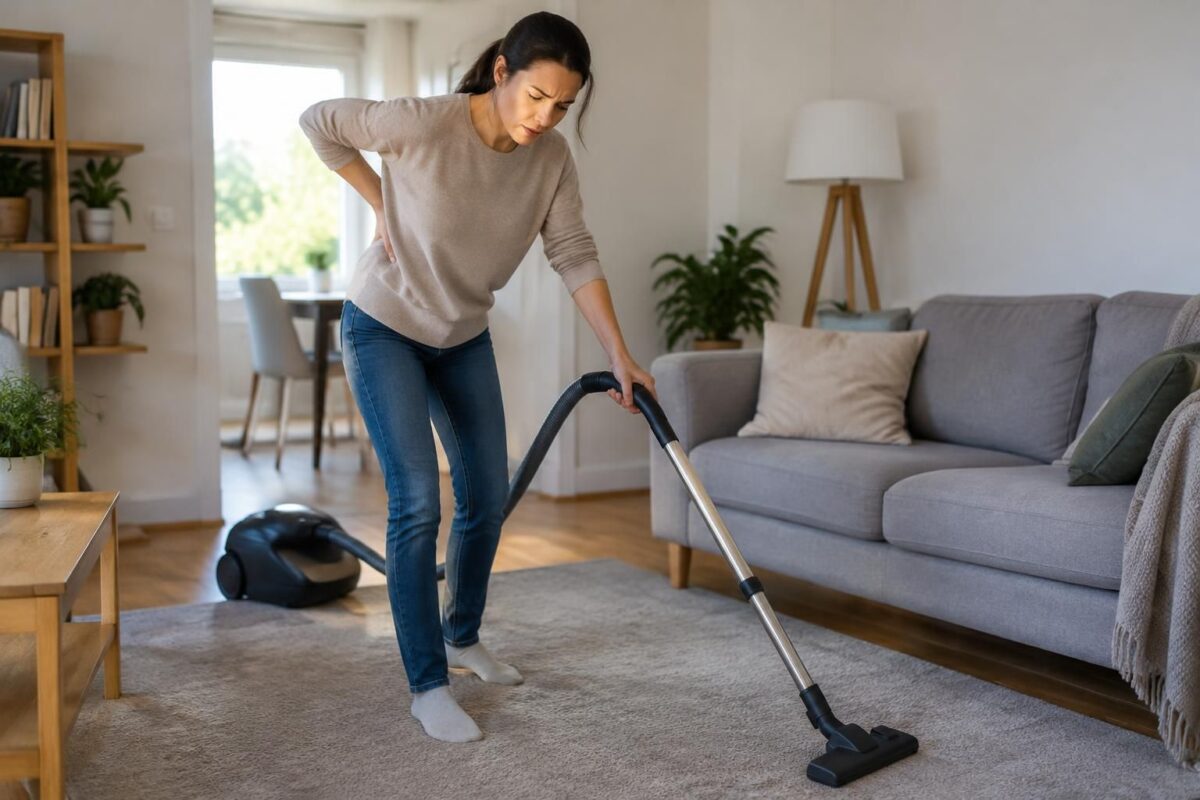
IN BRIEF Vacuuming with a sciatica can trigger pain because repeated bending and twisting strain the back. Break up the cleaning, keep the device close to you, and turn with your feet rather than twisting. Take a break if the pain travels further down the leg: these adjustments help you stay active without overexerting. |
Sciatica and vacuuming: repeated back-and-forth movements, especially when bending or twisting the torso, can exacerbate the pain. Move in small sequences, keep your back as straight as possible, and change positions regularly. If the pain travels further down the leg or if numbness appears, stop and rest in a comfortable position.
Vacuuming can trigger a sciatica, especially if you are repeating bends, twisting movements, or making long pushes. The task does not necessarily cause an injury, but it can temporarily increase pain. Reduce the duration, bring the vacuum closer to your body, and take breaks. Stop if the pain descends further into the leg or if weakness appears.
Sciatica refers to pain that follows the path of the nerve, often from the buttock down the thigh and sometimes all the way to the calf or foot. It can be accompanied by tingling or reduced sensitivity. Household gestures are not always the cause of this pain, but certain movements can exacerbate it.
Vacuuming stresses the back and legs through repeated pushes. The risk of discomfort increases if you lean too far forward, twist the torso while keeping your feet fixed, or vacuum for long periods without changing position. The response of your leg is an important indicator: pain that travels lower indicates that the movement is not tolerated well at the moment.
Why can vacuuming trigger pain?
The handle of the vacuum may encourage you to work with your arms extended and your back bent. Repeated back-and-forth movements can also cause you to twist your torso. These movements are not automatically dangerous, but they can increase symptoms in a person whose nerve is already irritated.
Pain limited to the lower back or buttock does not always behave like pain that reaches the foot. Especially monitor the progression of its path, any numbness, and the strength of the leg. A sharper pain alone is not sufficient to determine the severity of the situation.
How to vacuum while minimizing strain
Keep the device close to you
Shorten the distance between your body and the vacuum. Hold the handle without fully extending your arm and take a few steps forward rather than dragging the device from a distance. Adjust the handle to a height that allows you to keep your torso relatively straight.
Move your feet instead of twisting your back
To change direction, turn with your feet and hips. Avoid keeping your feet stationary while twisting your torso. Make short, controlled passes. You can also start with a small area and check how your leg reacts before continuing.
Take regular breaks
Do not try to clean the entire house at once. Alternate tasks and change positions regularly. If the pain increases, stop and adopt a comfortable posture. A short walk may be suitable if it doesn’t cause pain to travel further down the leg.
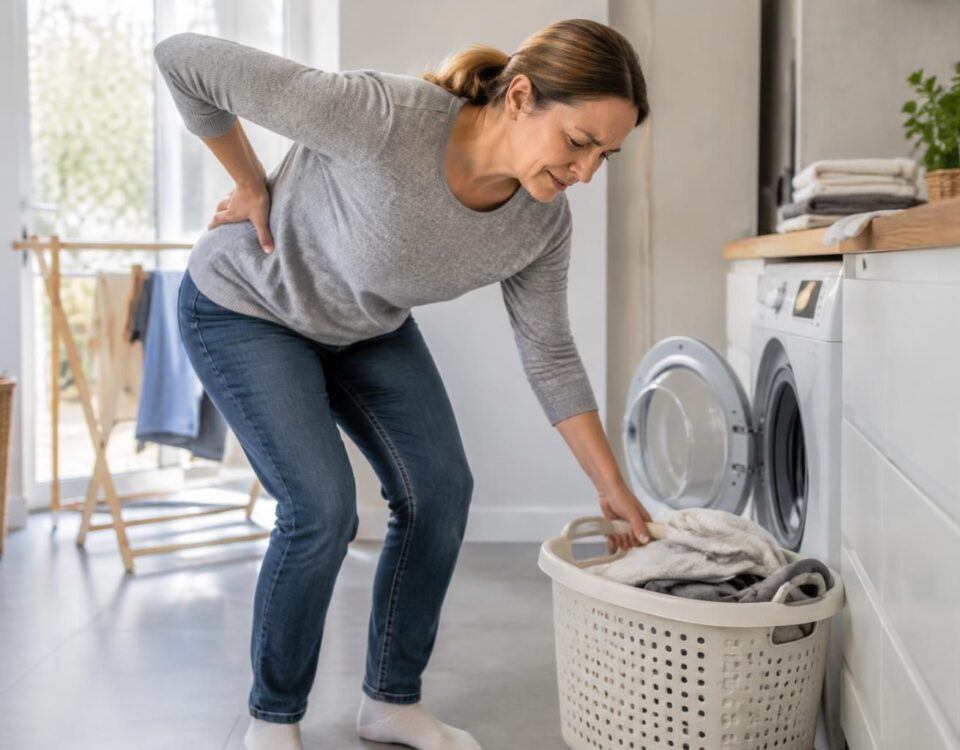
Bending, twisting, and lifting loads can also complicate household tasks. To identify movements to limit, refer to the advice on sciatica and household chores as well as recommendations on positions that may be difficult to tolerate.
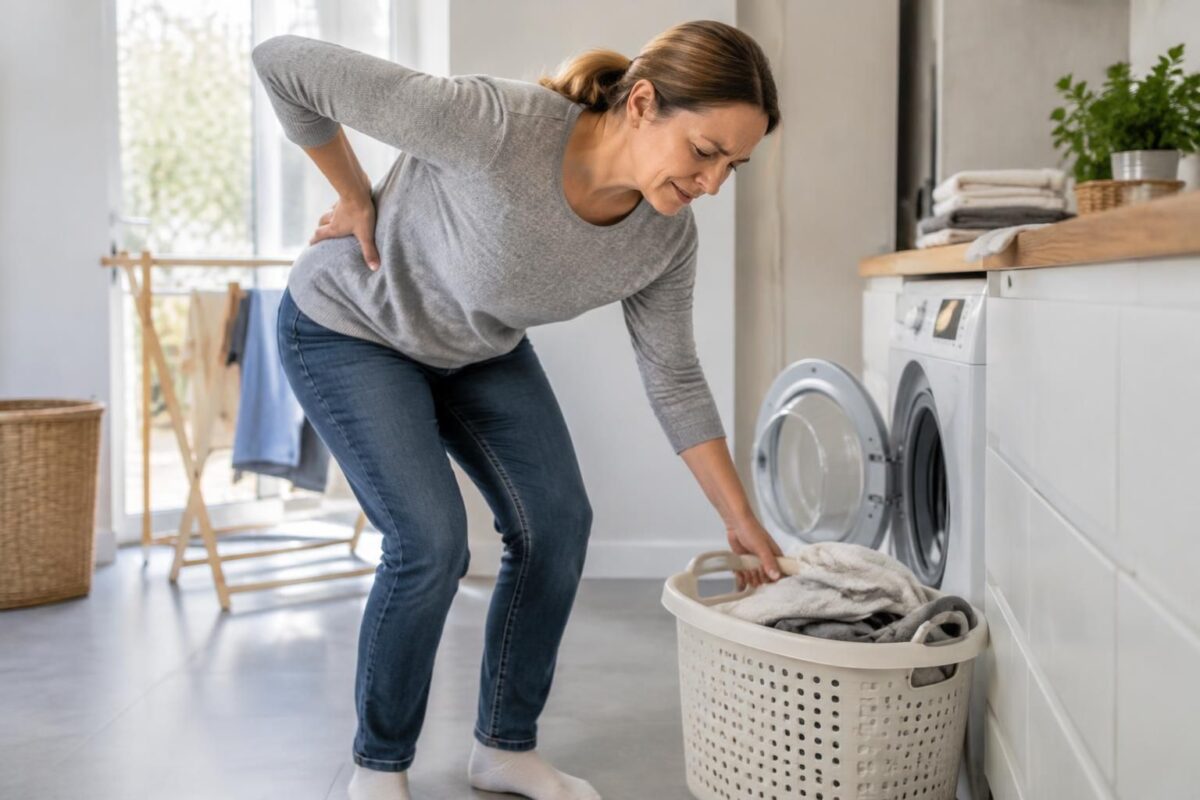
Sciatica and household chores: twists, bends, and loads
IN BRIEF Sciatica can be aggravated by bending, twisting, and carrying loads while doing housework. Breaking tasks into smaller parts, taking breaks, and adjusting movements help manage effort without necessarily stopping everything. In Montreal, an assessment can help tailor activity…
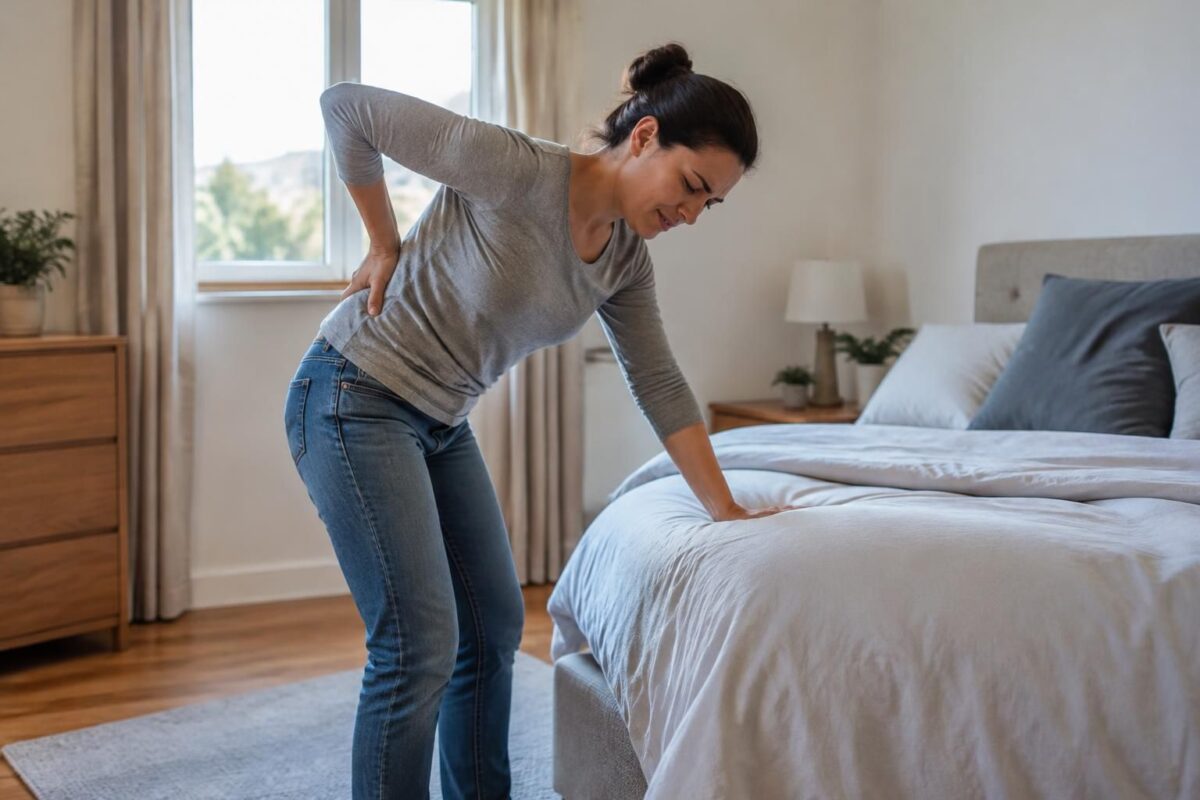
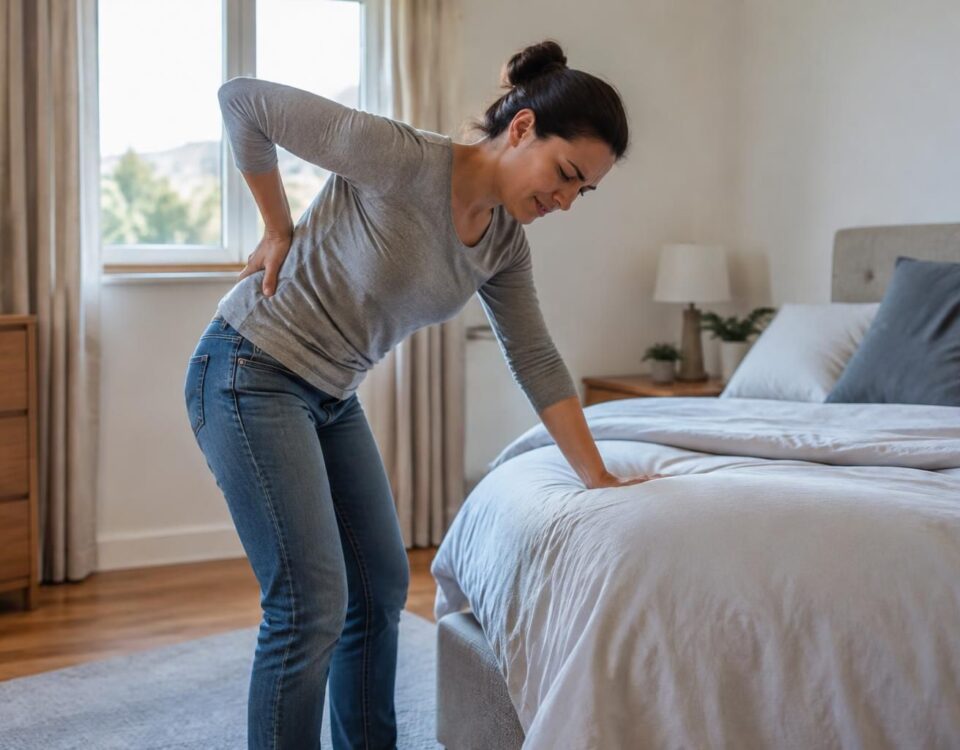
Sciatica and Making the Bed: Repeated Flexion and Lumbar Irritation
IN SHORT Sciatica is pain related to irritation or compression of the sciatic nerve. Making your bed can strain the lower back if bending is repeated, especially when rounding the back or twisting the torso. To limit lumbar irritation, bend…
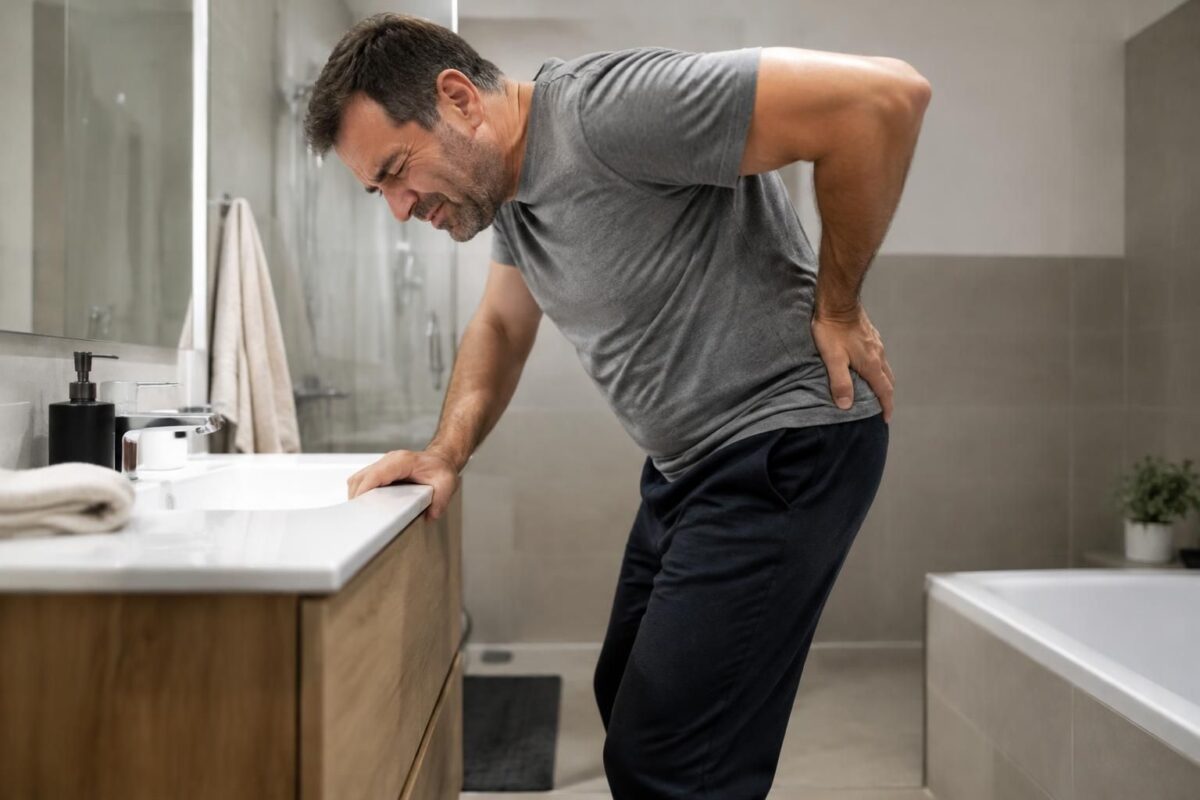
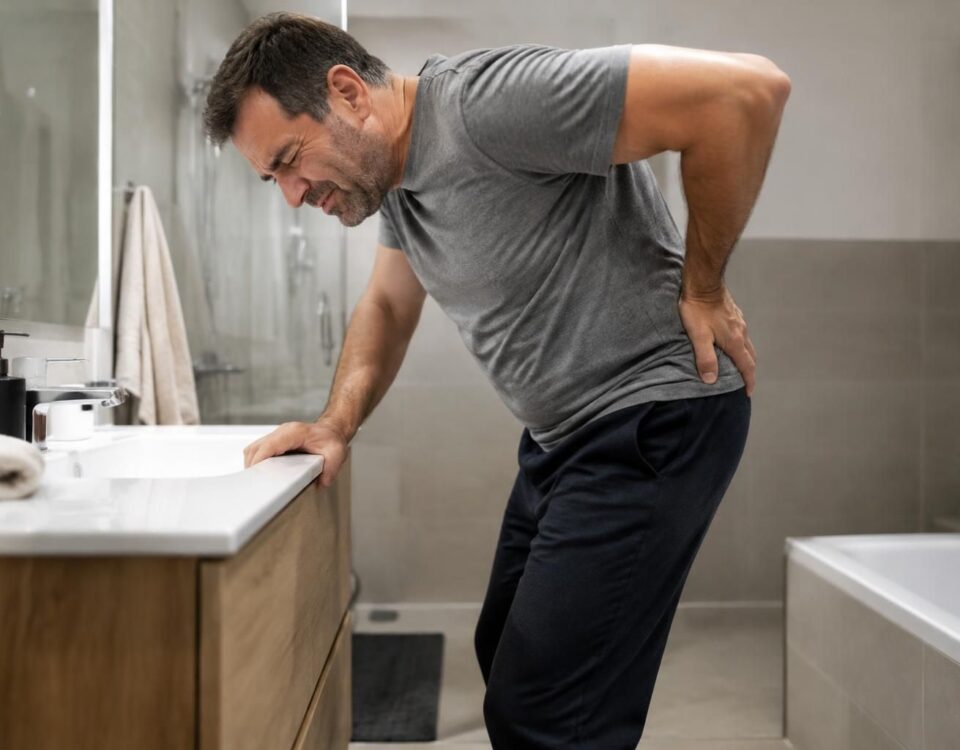
Sciatica and bending over the sink: pain in the leg
IN BRIEF Sciatica is pain related to irritation or compression of the sciatic nerve, which can extend from the lower back down to the leg. Bending over the sink can exacerbate the pain, especially if this position increases pressure on…
When to stop vacuuming?
Interrupt the task if the pain extends towards the calf or foot, if new tingling appears, or if your leg becomes numb. Also stop if you are limping or can no longer push the vacuum normally. Do not resume immediately to “test” the same movement repeatedly.
To track progress, note the lowest area affected by the pain, its intensity, and the tasks you can perform. Pain that moves up the leg towards the buttock or back can be a sign of improvement, but it does not alone confirm the cause.
If symptoms remain stable, resume tasks for short periods and gradually increase their duration. If each attempt clearly exacerbates the pain, consult a healthcare professional before continuing. Resources on appropriate actions for sciatica and movements to do or avoid can also help you better identify reactions to monitor.
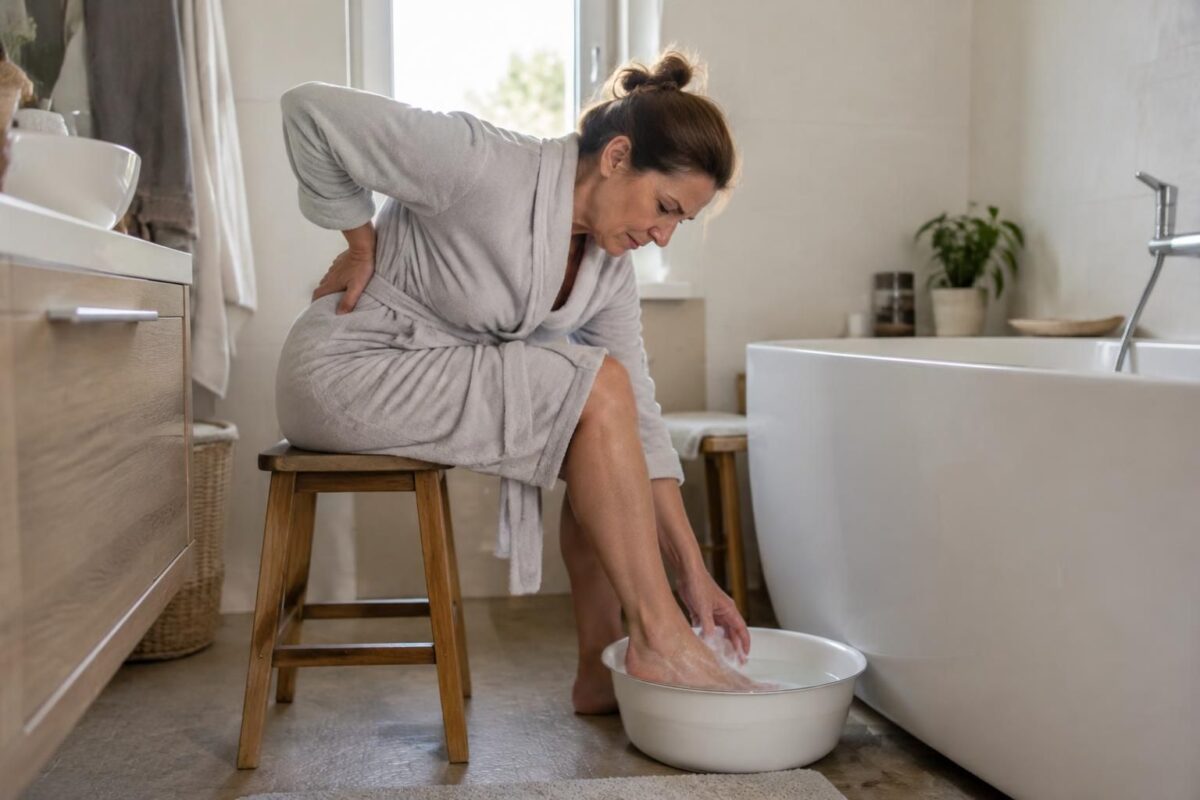
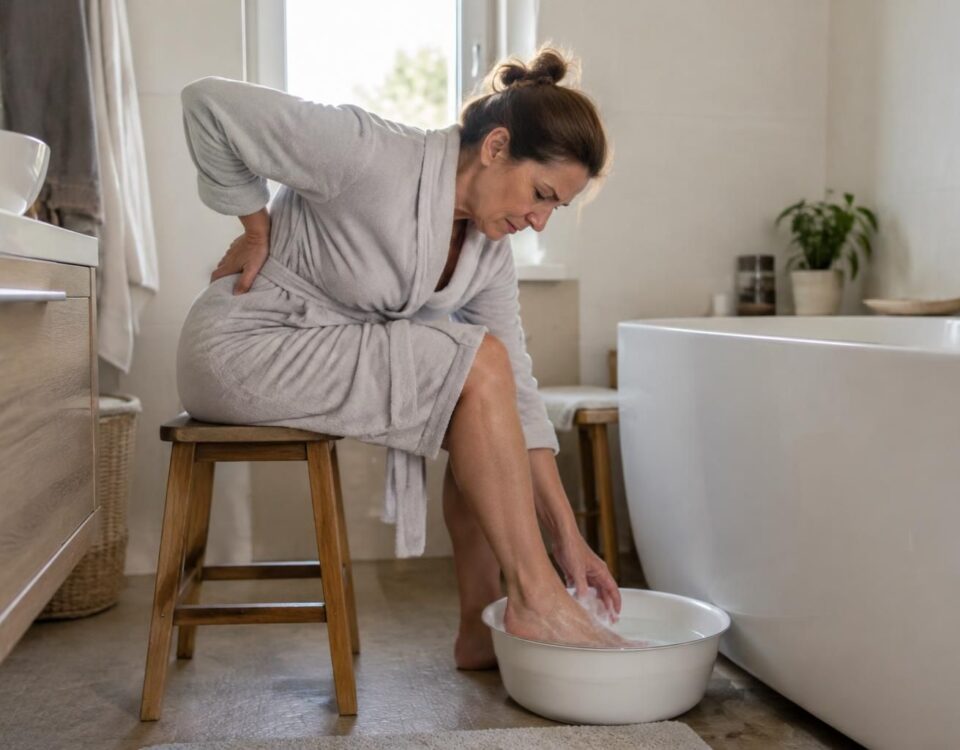
Sciatica and washing feet: lumbar flexion to monitor
IN BRIEF Sciatica can make washing your feet uncomfortable, as bending forward accentuates lumbar flexion and may trigger pain. To limit strain, sit down, bring your foot closer to you, or use a long-handled aid. These adjustments make personal hygiene…

Sciatica and dressing: daily gestures to adapt
IN BRIEF Sciatica can make dressing uncomfortable, but a few simple gestures help limit tension. Sit down to put on pants, socks, and shoes, choose easy-to-wear clothing, and avoid bending or twisting suddenly. These adjustments make daily dressing easier without…
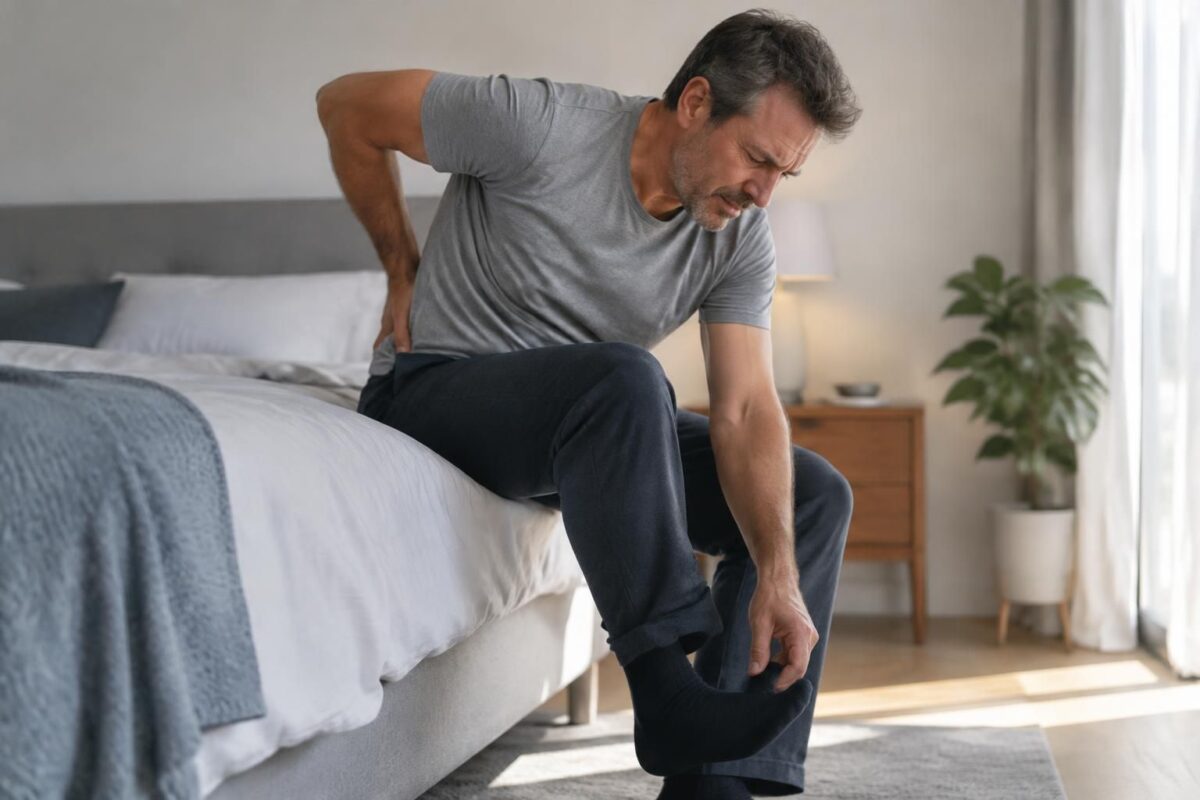
Sciatica and putting on socks: bending and pain in the leg
IN BRIEF Sciatica can make it difficult to put on your socks: bending over can increase the pain that radiates down the leg. Sitting down, using a sock aid, or avoiding painful bends can make this daily task easier. If…
When to seek medical advice
Consult promptly if you notice new or progressive weakness, for example, if your foot drags on the ground or if you have difficulty standing on your toes. Persistent, worsening pain or pain that significantly limits your activities also warrants medical advice.
A sudden difficulty in urinating, loss of bladder or bowel control, numbness between the legs, or symptoms in both legs require urgent medical evaluation. Call emergency services if these signs appear.
For more information on sciatica and its management, you can check out exercises presented by Tout pour ma santé and practical advice from PasseportSanté. These resources do not replace a medical evaluation, especially in the presence of weakness or numbness.
Medical disclaimer: The information and advice provided on this site do not replace the opinion, diagnosis, or treatment of a healthcare professional. Please note that Sylvain Desforges, B.Sc., D.O., N.D., doctor in osteopathy, is neither a medical doctor nor a physician and is not specialized in a medical specialty as defined by the Collège des médecins du Québec. Manual medicine, functional medicine, and sports medicine as described on this site exclude any treatment or medical diagnosis performed by a physician or specialist. Always consult your doctor for any medical questions. For more details, please read our full Legal Notice.
- Before — If the pain is already radiating down the leg, postpone vacuuming or ask for help.
- Preparation — Clear the path and choose a lightweight device.
- Posture — Keep your back as straight as possible, knees slightly bent, and the device close to your body.
- Movement — Move forward in small steps; avoid bending and twisting the torso at the same time.
- Duration — Vacuum in short sequences, with breaks and changes of position.
- Stop — Interrupt if the pain radiates further, if tingling appears, or if the leg weakens.

Vacuuming is not necessarily to be avoided with sciatica, but the back and forth motions, twisting, and long periods of bending can trigger pain. To limit strain, break up the cleaning, keep the device close to you, and favor short movements. If the pain radiates further down the leg, stop and adjust your activity.
Why can vacuuming trigger sciatica?
Cleaning often involves repetitive gestures: pushing and pulling the device, bending to reach a corner, twisting the torso, or staying in the same position for long periods. These movements are not necessarily dangerous, but they can increase discomfort when the back and leg are already sensitive.
The response of your symptoms is a useful indicator. A slight, localized discomfort in the back or buttock does not mean the same thing as pain that extends further down to the calf or foot. Do not try to finish the room at all costs: adjust your effort as soon as the painful journey intensifies.
How to vacuum while minimizing strain?
Prepare for a short session
Start with a small area rather than the entire home. Take a break before fatigue alters your movement, then resume only if symptoms remain stable. Alternating a few minutes of cleaning with another activity may be more comfortable than one long continuous session.
If the pain is sharp, take a few quiet steps or change position first to check what you can tolerate. You can also postpone non-urgent tasks. However, avoid remaining immobile in bed all day: short and regular movements are generally preferable to prolonged rest.
Keep the device close to you
Move forward in small steps and shift your feet to change direction, instead of twisting the torso while keeping the legs fixed. Keep the handle close to your body and avoid bending far forward. To reach a distant area, get closer instead of stretching your arm out too far.
If the vacuum is heavy or difficult to handle, choose a lighter device, ask for help, or break down the task further. On stairs, do not carry a load if it forces you to bend or twist. Safety comes before finishing the cleaning.
When should you stop?
Stop the action if the pain radiates significantly further down the leg, if tingling or numbness appears, or if the increase in pain persists after stopping. Rest in a comfortable position, such as on your back with your calves supported by a chair, then resume only an activity that is better tolerated.
Consult quickly if you notice any new weakness, for example, a foot dragging on the ground or a change in your gait. Sudden difficulties urinating, loss of bladder or bowel control, or numbness between the legs require urgent medical evaluation.
How to gradually resume cleaning?
When symptoms calm down, increase the duration in small steps rather than immediately resuming a full session. Note what you did, the duration, and the reaction of the leg in the following hours. If there is no improvement after several days, or if the pain extends, consult a healthcare professional. If in doubt about a pain medication, consult a doctor or pharmacist.
| Situation | Practical Indicator |
|---|---|
| Before you start | Check that the pain remains stable at rest. |
| Repeated passes | Make short sequences, with regular breaks. |
| Moving the vacuum | Move forward in small steps rather than twisting the torso. |
| Difficult-to-reach areas | Avoid bending and pivoting at the same time. |
| Pain radiating further | Stop the task and adopt a comfortable position. |
| Numbness or weakness | Stop the activity and seek medical advice. |
Sciatica and vacuuming: testimonials to better manage repetitive movements
Claire, 42: “When my sciatica flared up, vacuuming the entire house at once was too difficult. The pain radiated further down my leg, especially when I bent over or twisted my torso. I started with a few minutes in one room, keeping the vacuum close to me and taking breaks.”
Marc, 56: “I thought I had to finish the cleaning despite the pain. By moving through small areas and changing position regularly, it became more bearable. I now avoid bending forward while reaching my arm far out in front of me.”
Élodie, 35 years old: “The action that bothered me the most was pulling the vacuum cleaner behind me while twisting my back. I tried to move my feet and turn my whole body instead of twisting my torso. If the pain starts to go lower in my leg, I stop and walk gently for a few minutes.”
Yanis, 49 years old: “I break up housework: a few minutes and then a break or another activity. The vacuum cleaner doesn’t need to be used everywhere on the same day. This organization helps me stay active without trying to force the range of motion.”
Takeaway: with sciatica, vacuuming can strain the back due to bending, twisting, and repeated actions. Try to keep the device close to you, take small steps to change direction, and break the task into smaller parts. Reduce or stop the action if the pain extends towards the foot, if numbness appears, or if symptoms increase significantly.
These experiences are examples and do not replace medical advice. In case of loss of strength, sudden difficulty urinating, or loss of sensitivity between the legs, seek urgent medical evaluation.
Sylvain Desforges: understanding sciatica and repetitive actions like vacuuming
Sylvain Desforges is a professional specialized in osteopathy, naturopathy, and manual medicine. He is the founding president of the TAGMED clinics and the ACMA association. His career is dedicated to innovation in health and the management of chronic pain, with a particular focus on evidence-based approaches and patient well-being.
In this context, sciatica deserves special attention during daily activities. It corresponds to pain that typically follows the route of the sciatic nerve, from the buttock down the back of the thigh, and sometimes to the calf or foot. It may be accompanied by tingling or a burning sensation. Vacuuming doesn’t necessarily cause sciatica, but some repeated actions can trigger or intensify existing pain.
The vacuum cleaner often requires pushing and pulling the device, bending over, or twisting the torso. Repeating these movements, especially while keeping the back bent or working for long periods on one side, can increase lumbar discomfort in some individuals. The risk depends on individual circumstances: the duration of the task, the intensity of symptoms, and how the body tolerates movement are more important than a universal rule.
To limit strain, it can be helpful to break up housework into short sequences and take a break before the pain intensifies. Keeping the device close to the body, moving with small steps, and turning the feet instead of just pivoting the torso can facilitate movement. When possible, alternating hands and avoiding sudden pulls on the handle also helps to reduce repetitive actions on the same side.
The main reference point remains the reaction of the symptoms. A mild and stable discomfort doesn’t necessarily indicate that one must stop completely. However, if the pain travels further down the leg, if tingling appears, or if discomfort increases significantly, it’s better to interrupt the task and adopt a more comfortable position. A short tolerated walk or a change of position may be preferable to prolonged immobility.
Dr. Desforges’ approach combines the management of chronic pain with the integration of advanced technologies, including spinal decompression, laser, and shock waves. These options are part of a care process that must consider each person’s clinical situation. They do not replace a tailored evaluation and do not, on their own, determine the cause of sciatica pain.
A medical opinion is advised if symptoms persist, worsen, or limit ordinary activities. A loss of strength, altered gait, or a catching foot requires rapid evaluation. Sudden difficulties urinating, loss of bladder or bowel control, or numbness between the legs are signs of a medical emergency. For less alarming pain, noting what triggers it—duration of vacuuming, posture, side engaged, and painful route—can help the healthcare professional better understand the difficulties encountered daily.
Vacuuming with sciatica can strain the lower back due to bending, twisting, and repeated actions. However, you can adapt this task: proceed in short sequences, keep the vacuum cleaner close to you, and stop if the pain goes further down the leg.
Sciatica and vacuuming: the right reflexes
Before starting, check if you can walk for a few minutes without notable aggravation. If the pain is very severe or if your movements are limited, postpone housework rather than pushing it. When vacuuming, take short steps and move your feet to change direction instead of pivoting your torso while keeping your legs fixed. Repeated twists are particularly to be monitored: find out more tips on sciatica and back twists.
Keep the handle at a comfortable distance and alternate arms if it doesn’t trigger pain. Avoid leaning forward for long periods or pulling the device suddenly. Do a few minutes of housework, then change position or rest briefly. General recommendations for adapting one’s movements are detailed in this guide on what to do and avoid in case of sciatica.
Adapt the duration and intensity to your symptoms
Start with a small area, on a flat surface, and observe your reaction during the activity and then in the next 30 minutes. A mild and stable discomfort doesn’t necessarily warrant the same response as pain that extends towards the calf or foot. If the painful route lengthens, if tingling appears, or if the pain increases significantly and persists, stop and adopt a comfortable resting position. To better differentiate potentially irritating movements, consult these tips on exercises and actions to avoid with sciatica.
Do not try to compensate for an interrupted session by quickly finishing all the cleaning. Break down the task and ask for help to move furniture or clean hard-to-reach areas to limit repeated efforts. Other ways to relieve pain and stay active are presented in this file on sciatica, relief, and exercises, as well as in these practical tips for relieving sciatica.
When to interrupt cleaning and seek advice
Stop vacuuming immediately if you feel new weakness in your leg, if your foot drags on the ground, or if numbness appears or increases. A loss of strength warrants a quick medical evaluation. In case of sudden difficulty urinating, loss of urinary or fecal control, or numbness between the legs, contact emergency services. To choose suitable movements without pulling on the nerve, you can also consult these exercises suggested to relieve sciatica and seek the advice of a healthcare professional if you have any doubts.

Sciatica and tying your shoes: why the pain can radiate down
IN BRIEF Sciatica is pain related to the irritation of a nerve in the lower back, which can radiate into the buttock and leg. Leaning down to tie your shoes may accentuate the pain or cause it to descend further.…

Sciatica and picking up an object from the ground: movement to watch out for
IN BRIEF Sciatica is pain that follows the path of the sciatic nerve. To pick up an object from the ground, avoid bending abruptly while rounding your back or twisting: bend your knees, tilt your hips, and keep the object…

Sylvain Desforges, B.Sc., D.O., N.D., docteur en ostéopathie
Dr Sylvain Desforges, B.Sc., D.O., N.D., osteopath, is the founding president of TAGMED and of the ACMA association. He dedicates his practice to chronic spinal pain, low back pain and symptoms compatible with sciatica, particularly when pain radiates toward the buttock, leg, calf, foot or toes.
Through SOS Sciatique, he publishes educational content on sciatica symptoms, possible causes such as disc herniation, disc narrowing, foraminal stenosis or irritation of a lumbar nerve root, as well as non-surgical approaches that may be considered according to the evaluation. At Clinique TAGMED, care may include, depending on the case, motorized neurovertebral decompression, specific osteopathic care or precision percussion.
For an evaluation related to sciatica treatment in Montreal / Mount Royal or sciatica treatment in Terrebonne, please consult the services available at Clinique TAGMED.
Medical disclaimer
The information published on SOS Sciatique is provided for educational purposes only and does not replace a consultation, diagnosis, opinion or treatment provided by a physician or another authorized healthcare professional. The author of this article is neither a medical doctor nor a specialist in a medical specialty recognized by the Collège des médecins du Québec. The osteopathic, manual medicine or functional support approaches described on this site do not constitute medical acts and are not intended to replace medical follow-up.
Consult a physician or emergency service in cases of loss of bladder or bowel control, anesthesia in the saddle area, significant or progressive weakness in the leg or foot, fever, recent trauma, severe pain or rapid worsening of symptoms. For more details, please read our Legal Notice.