
Disc bulge and tingling in the foot
15/11/2026
Sciatica in Montreal: lumbar disc and inflammation of the nerve root
16/11/2026
IN BRIEF Sciatica is pain that follows the path of the sciatic nerve. To pick up an object from the ground, avoid bending abruptly while rounding your back or twisting: bend your knees, tilt your hips, and keep the object close to your body. This movement helps limit strain on the lower back without addressing the cause of sciatica. If the pain increases or persists, seek advice from a healthcare professional. |
With sciatica, bending abruptly to pick up an object—especially while keeping your legs straight or twisting your torso—can worsen the pain. Approach the object, bend your knees and hips, keep your back as comfortable as possible, and hold the object close to your body. If the movement triggers sharp pain or increases tingling, stop and consult a healthcare professional. Seek emergency care in case of significant weakness in one leg or loss of control of the bladder or intestines.
Picking up an object from the ground can trigger sciatic pain, especially if the movement combines bending the back and rotation. Keep the object close to you, bend at the hips and knees, then stand up without twisting your torso. If the pain increases, stop the movement and monitor your symptoms.
Sciatica refers to pain that sometimes follows the path of the sciatic nerve, from the buttock down the leg. It can be related to irritation of a nerve root in the lower back. A trunk flexion, rotation, or lifting a load far from the body can increase symptoms in some individuals.
The movement itself does not determine the cause of the pain. Leg pain can have various origins. To better understand the possible role of lumbar nerve roots, consult this article on sciatica and lumbar roots.
Why can this movement trigger pain?
When you bend, the muscles and structures in your lower back change position. If you add a rotation or extend your arm far in front of you, the strain on the back increases. Pain may then appear in the lower back, buttock, or leg.
A protrusion or herniated disc can sometimes irritate a nerve root, but that is not the only possible explanation. Therefore, the presence of pain does not alone confirm a disc problem. To distinguish between these terms, read the article on disc protrusion and herniated disc.
How to pick up an object with more control
Before moving, look at the object and check its weight. Get closer to it instead of reaching out. Place your feet steadily, bend at the hips and knees, and keep your back in a comfortable position. Lift the object close to your body and stand up slowly.
Avoid twisting while you stand up. If you need to change direction, move your feet instead of just turning your torso. For a heavy or cumbersome object, ask for help or use another method to move it.
When should you stop the movement?
Stop if the movement causes sharp pain, a significant worsening of pain in the leg, new numbness, or weakness. Do not repeat the movement to see if the pain returns. Instead, note what happened and discuss it with a healthcare professional if the symptoms persist or worsen.
Pain during an activity does not always mean that an injury is worsening. However, certain signs require special attention. The article on sciatic pain during exercise identifies elements to watch. It does not replace an assessment tailored to your situation.
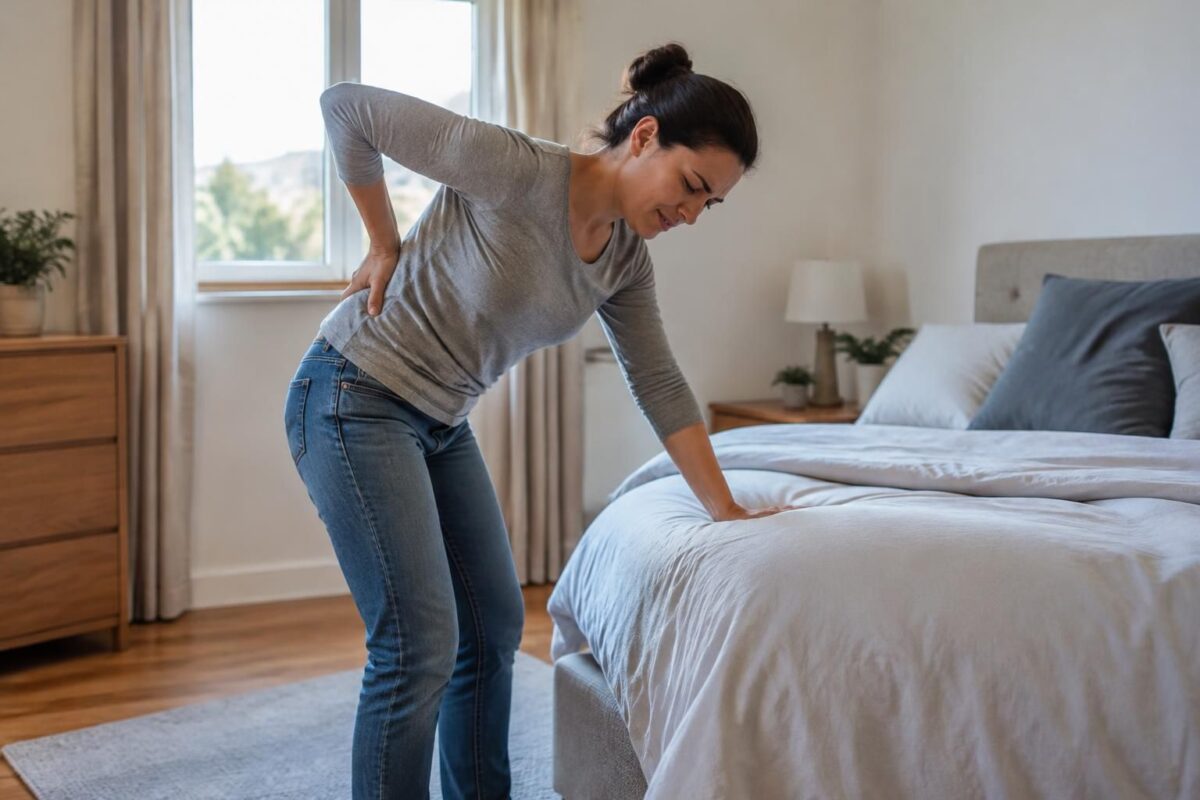
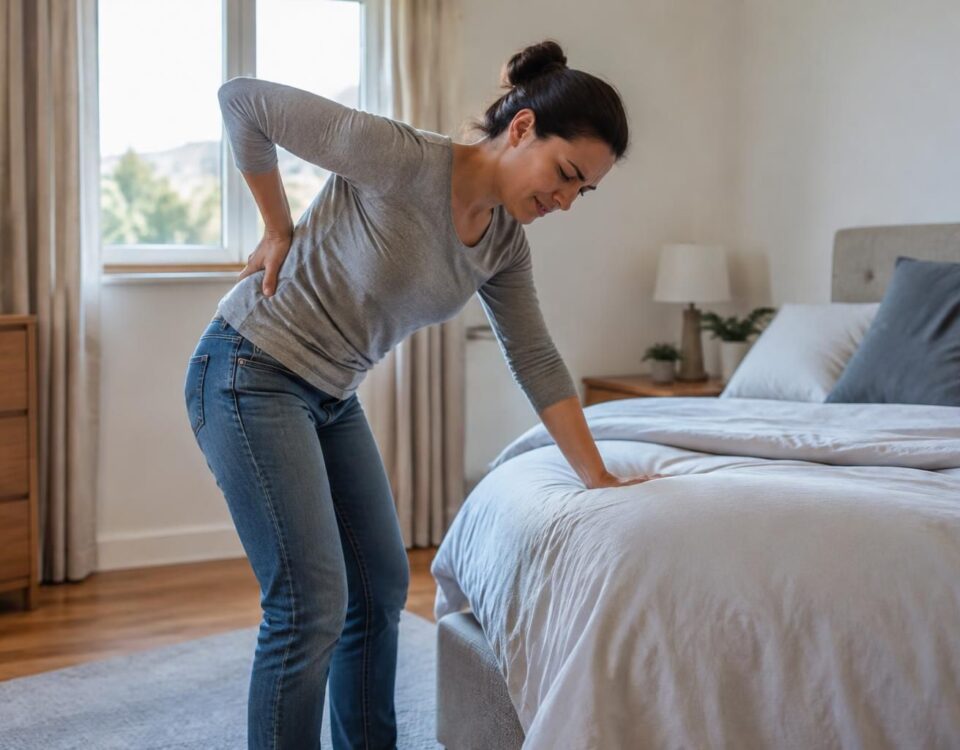
Sciatica and Making the Bed: Repeated Flexion and Lumbar Irritation
IN SHORT Sciatica is pain related to irritation or compression of the sciatic nerve. Making your bed can strain the lower back if bending is repeated, especially when rounding the back or twisting the torso. To limit lumbar irritation, bend…
Don’t let fear guide all your movements
After a painful episode, it’s understandable to hesitate to bend down. But avoiding all movements can increase fear and reduce confidence in everyday tasks. Resume your activities cautiously, depending on your tolerance, without pushing through significant pain.
You can also temporarily modify your environment: place frequently used items at an accessible height and avoid leaving loads on the ground. To understand the link between fear of movement and pain, check the article on sciatica and fear of movement.
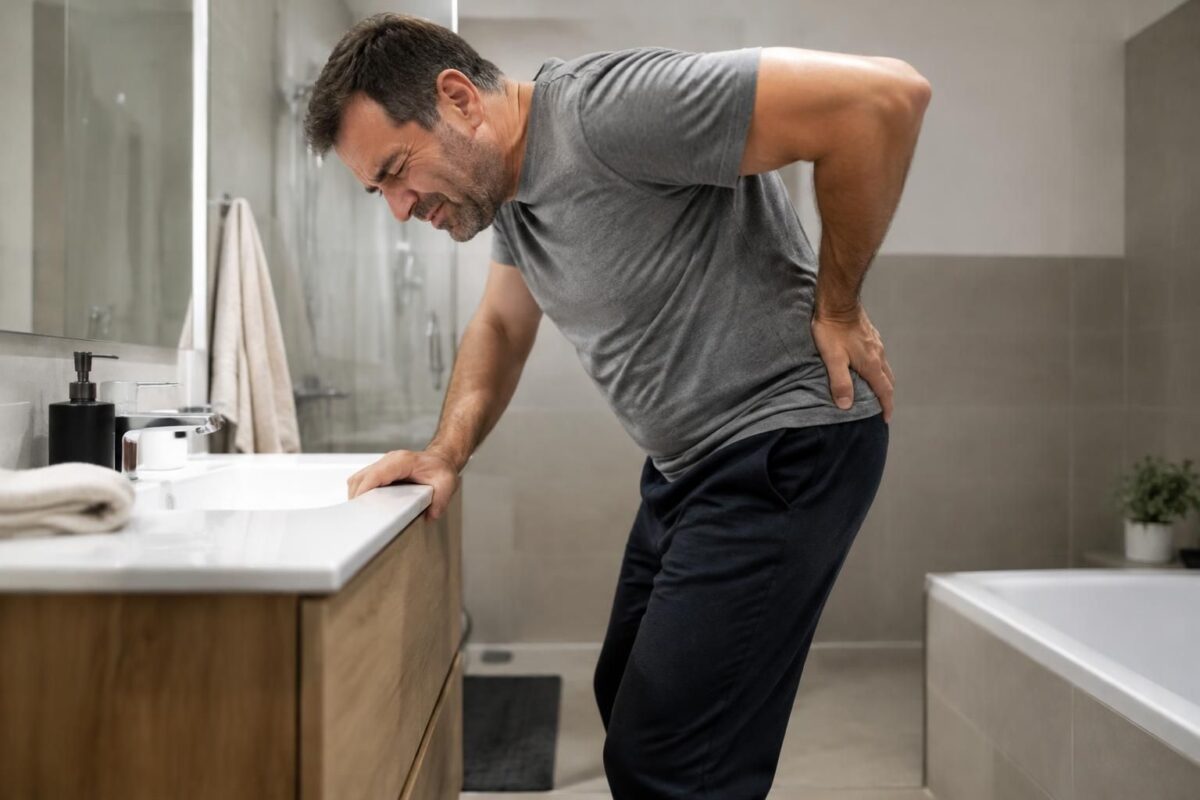
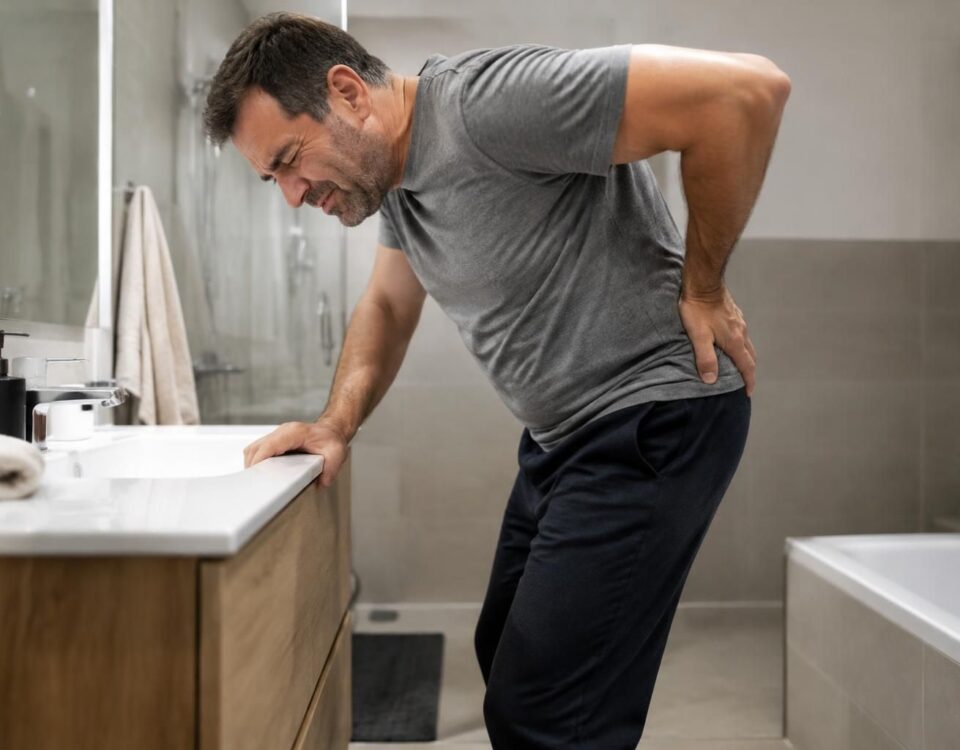
Sciatica and bending over the sink: pain in the leg
IN BRIEF Sciatica is pain related to irritation or compression of the sciatic nerve, which can extend from the lower back down to the leg. Bending over the sink can exacerbate the pain, especially if this position increases pressure on…
When to seek an evaluation
A healthcare professional can evaluate your symptoms, mobility, and factors that worsen the pain. Consult promptly if you notice weakness that appears or increases, significant loss of sensation, or new difficulty controlling your bladder or bowels. These signs require urgent medical evaluation.
Severe, persistent, or worsening pain also merits evaluation. Check the page on severe sciatica signs to know certain situations that require prompt attention.
At TAGMED clinic, in Montreal or Terrebonne, an evaluation can help clarify management options. The choice of treatment depends on symptoms, evaluation results, and the individual’s goals. No treatment guarantees an outcome, and a consultation does not replace medical advice when needed.
Disclaimer: The information and advice provided on this site do not replace the opinion, diagnosis, or treatment of a healthcare professional. Please note that Sylvain Desforges, B.Sc., D.O., N.D., doctor of osteopathy, is neither a doctor of medicine nor a physician, and is not specialized in a medical specialty as defined by the Collège des médecins du Québec. Manual therapy, functional medicine, and sports medicine as described on this site exclude any medical treatment or diagnosis by a physician or specialist. Always consult your doctor for any medical questions. For more details, please read our complete Legal Disclaimer.
- To monitor: bending with straight legs and rounding the back.
- To monitor: twisting the torso while grabbing the object.
- Preferred : bend your knees and bring the object closer to your body.
- Preferred : lean if necessary and avoid sudden movements.

With sciatica, picking up an object from the floor can trigger or intensify pain if the movement rounds the back, suddenly strains the leg, or involves twisting. Some simple movements can help limit strain: get close to the object, bend at the hips and knees, keep your back as comfortable as possible, and stand up smoothly.

Sciatica and washing feet: lumbar flexion to monitor
IN BRIEF Sciatica can make washing your feet uncomfortable, as bending forward accentuates lumbar flexion and may trigger pain. To limit strain, sit down, bring your foot closer to you, or use a long-handled aid. These adjustments make personal hygiene…
Why this movement deserves your attention
Sciatica refers to pain related to irritation of a nerve or one of its roots. It can start in the lower back and radiate into the buttock, thigh, or leg. Bending to pick up an object often combines trunk flexion and tension in the back of the leg; twisting the torso or lifting a heavy load can also make the movement more uncomfortable.
However, there is not a single movement that is dangerous for everyone. Pain and tolerance vary from person to person and from day to day. The goal is not to systematically avoid movement but to choose a method that is better controlled and not to push through intensifying pain.

Sciatica and dressing: daily gestures to adapt
IN BRIEF Sciatica can make dressing uncomfortable, but a few simple gestures help limit tension. Sit down to put on pants, socks, and shoes, choose easy-to-wear clothing, and avoid bending or twisting suddenly. These adjustments make daily dressing easier without…
Picking up an object while limiting strain
Get closer before bending
Position yourself near the object rather than reaching out from a distance. Keep it close to your body when lifting. If you are unsteady or if the object is heavy, ask for help or use a suitable grabbing tool.
Bend at the hips and knees
Spread your feet slightly for a stable base. Bend your knees and tilt from your hips, within a comfortable range. Avoid bending quickly with straight legs, especially if this position triggers pain that radiates down the leg.
Avoid twisting while lifting
Position your feet and body toward the object, then stand up while keeping the object close to you. Avoid twisting your torso while lifting: if you need to change direction, move your feet instead. Take your time, breathe normally, and favor a smooth movement without jerking.

Sciatica and putting on socks: bending and pain in the leg
IN BRIEF Sciatica can make it difficult to put on your socks: bending over can increase the pain that radiates down the leg. Sitting down, using a sock aid, or avoiding painful bends can make this daily task easier. If…
Adapt the movement to your symptoms
If the squatting position is uncomfortable, try another strategy: place one knee on the ground while leaning on a stable support, or sit on a low chair if that’s easier. You can also move the object to a reachable height before lifting it. The best option is one that allows you to move without significantly worsening your symptoms.
After the movement, observe how the pain evolves. A slight and temporary discomfort does not necessarily mean you have caused an injury, but pain that significantly increases, persists, or is accompanied by new numbness warrants medical advice. A healthcare professional can help you adapt your movements and choose appropriate exercises.

Sciatica and tying your shoes: why the pain can radiate down
IN BRIEF Sciatica is pain related to the irritation of a nerve in the lower back, which can radiate into the buttock and leg. Leaning down to tie your shoes may accentuate the pain or cause it to descend further.…
When to seek medical advice promptly
Consult without delay in case of new or increasing weakness in one leg, loss of sensation around the genital area or anus, or difficulty controlling the bladder or intestines. These signs require urgent evaluation. If the pain persists, worsens, or limits your activities, seek advice from a doctor or physiotherapist rather than repeatedly performing movements that trigger it.
| Moment | To watch out for |
|---|---|
| Before bending | Get closer to the object. |
| Descent | Bend at the hips and knees without rounding your back. |
| Grasping the object | Keep it close to your body. |
| Ascent | Push through your legs, smoothly. |
| Rotation | Avoid pivoting the torso; move your feet instead. |
| Increased pain | Stop the movement and change position. |

Sciatica and bending forward: lumbar disc or nerve tension?
IN BRIEF Forward-bending sciatica may be related to irritation of the lumbar disc or tension on the sciatic nerve. This movement alone does not allow for determining the cause. Identifying the movements that trigger the pain helps guide the evaluation…
Sciatica and picking up an object from the floor: testimonials and movements to watch for
Fictional testimonial examples: they illustrate possible situations and do not correspond to verified opinions. Sciatica can manifest differently in different individuals.
“I was bending over suddenly, legs straight.” A person describes pain that would become apparent when they quickly bent down to pick up something. The movement to watch for: rounding the back and suddenly pulling on the object, especially if it intensifies pain.
“I was turning while bending down.” In this example, the person notices that pivoting the torso while grabbing an object made the action uncomfortable. If you need to bend down, avoid combining bending and twisting whenever possible.
“I brought the object closer and took my time.” Another person says they found the movement easier by getting close to the object, bending their knees, and keeping it close to their body. These adjustments do not guarantee the absence of pain: stop the movement if it worsens your symptoms.
To pick up an object, favor a slow and controlled movement, without sudden twisting. If the pain is significant, persistent, or accompanied by marked weakness, numbness, or bladder or intestinal issues, seek medical advice promptly.

Sciatica and trunk flexion: why bending over can make it worse
IN BRIEF Sciatica is pain related to irritation of the sciatic nerve, sometimes worsened by trunk flexion. Bending forward can increase tension in the lower back and reproduce pain in the buttock or leg. Identifying trigger movements helps adjust actions…
Sciatica and picking up an object from the floor: the movement to watch according to Sylvain Desforges
Sylvain Desforges is a health professional specializing in osteopathy, naturopathy, and manual therapy. Founder and president of the TAGMED clinics and the ACMA association, he dedicates his career to health innovation and the management of chronic pain. His approach is based on evidence-based care and aims to support the health and well-being of his patients.
Among the situations that can worry a person affected by sciatica, bending to pick up an object from the floor frequently arises. This movement may seem trivial, but it combines several actions: tilting the trunk, bending at the hips and knees, and then standing up while sometimes carrying a load. When the back rounds significantly or the movement is abrupt, some individuals may experience an increase in pain in the lower back, buttock, or leg.
The movement to watch is not necessarily the bending itself. Rather, it is the way it is performed, as well as the body’s reaction. Pain that radiates more into the leg, sharp pains or tingling that intensify may indicate that the motion is poorly tolerated at that moment. Sensitivity, however, varies from person to person: there is no single posture that suits all sciatica cases.
To pick up an object, a commonly suggested adaptation is to get closer to it, slightly spread the feet, and bend the hips and knees rather than merely bending from the waist. Keeping the object close to the body when rising can also limit effort. It is best to avoid hurried movements and not to twist the trunk while lifting a load. If the pain increases, stopping the motion and seeking a more comfortable position is generally wiser than forcing it.
In his practice dedicated to managing chronic pain, Dr. Desforges focuses on assessing the situation and looking for solutions tailored to each patient’s needs. Symptoms, their evolution, daily activities, and the actions that worsen or alleviate them can help guide care. His work incorporates, when appropriate, advanced technologies such as spinal decompression, laser, and shockwave therapy.
Persistent or recurrent sciatic pain deserves assessment by a healthcare professional, particularly to determine appropriate measures and check that no other issue requires special attention. Marked weakness in the leg, significant loss of sensitivity, or new difficulties controlling the bladder or intestines warrant urgent medical consultation. Dr. Desforges’ approach, centered on innovation and evidence-based care, aligns with the desire to provide considered management of pain and functional limitations.
Picking up an object from the ground can strain the lower back and reactivate pain related to sciatica, especially if the movement is abrupt or done with a rounded back. By observing your posture, bringing the object closer to you, and adjusting your movements to your symptoms, you can better manage this daily activity.
Picking Up an Object from the Ground: The Movement to Watch
The movement to watch is one that combines bending of the trunk, twisting, and holding a load away from the body. This position can increase discomfort in some individuals, without necessarily meaning that an injury has worsened. To pick up an object, get close to it, slightly spread your feet, and bend your hips and knees as much as is comfortable. Keep the object close to you and avoid twisting abruptly: instead, move your feet to change direction.
There is no one way of moving that suits everyone. The important thing is to choose a controlled gesture, breathe normally, and avoid forcing yourself into a position that significantly increases your symptoms. To find the right balance between movement and rest, consult these tips on sciatica and the dosing of daily activities.
After bending, pain that radiates down the leg or appears later can raise questions. Its evolution, intensity, and the circumstances in which it appears matter more than an isolated gesture. Discover what may explain a pain that slowly radiates down the leg and observe how your symptoms evolve after your activities.
If discomfort occurs after picking up multiple objects or resuming exercise, it may be helpful to distinguish a muscular response from a nerve irritation. Avoid jumping to conclusions based on a single sensation: the duration, location, and evolution of the pain provide helpful clues. This guide helps you compare soreness and nerve irritation after exercise.
An imaging exam may sometimes show a disc bulge, but this finding does not alone prove that it is the cause of your sciatica. The images must be interpreted alongside your symptoms and an assessment by a healthcare professional. To better understand this distinction, read the article on disc bulge and sciatica.
When pain involves the lower back and leg, symptoms can vary depending on the individual and the level of the spine involved. To learn more about certain signs associated with the L5-S1 region, refer to this resource on L5-S1 disc herniation and common sciatica symptoms. If the pain worsens, severely limits your movements, or is accompanied by significant weakness, seek advice from a healthcare professional.

Sylvain Desforges, B.Sc., D.O., N.D., docteur en ostéopathie
Dr Sylvain Desforges, B.Sc., D.O., N.D., osteopath, is the founding president of TAGMED and of the ACMA association. He dedicates his practice to chronic spinal pain, low back pain and symptoms compatible with sciatica, particularly when pain radiates toward the buttock, leg, calf, foot or toes.
Through SOS Sciatique, he publishes educational content on sciatica symptoms, possible causes such as disc herniation, disc narrowing, foraminal stenosis or irritation of a lumbar nerve root, as well as non-surgical approaches that may be considered according to the evaluation. At Clinique TAGMED, care may include, depending on the case, motorized neurovertebral decompression, specific osteopathic care or precision percussion.
For an evaluation related to sciatica treatment in Montreal / Mount Royal or sciatica treatment in Terrebonne, please consult the services available at Clinique TAGMED.
Medical disclaimer
The information published on SOS Sciatique is provided for educational purposes only and does not replace a consultation, diagnosis, opinion or treatment provided by a physician or another authorized healthcare professional. The author of this article is neither a medical doctor nor a specialist in a medical specialty recognized by the Collège des médecins du Québec. The osteopathic, manual medicine or functional support approaches described on this site do not constitute medical acts and are not intended to replace medical follow-up.
Consult a physician or emergency service in cases of loss of bladder or bowel control, anesthesia in the saddle area, significant or progressive weakness in the leg or foot, fever, recent trauma, severe pain or rapid worsening of symptoms. For more details, please read our Legal Notice.