

Disc bulge and buttock pain
13/11/2026
Sciatica and disc bulge in Montreal: possible cause of nerve irritation
14/11/2026
IN BRIEF Sciatica is pain related to irritation of the sciatic nerve, sometimes worsened by trunk flexion. Bending forward can increase tension in the lower back and reproduce pain in the buttock or leg. Identifying trigger movements helps adjust actions and choose appropriate exercises without systematically avoiding all bending. |
In the case of sciatica, bending forward can increase pressure on the lumbar discs and put more tension on the irritated nerve. The pain may then intensify or radiate further down the leg. If this movement exacerbates your symptoms, avoid forcing it and seek advice from a healthcare professional.
Trunk flexion can worsen sciatica in some individuals, especially if it increases pressure on a disc or tension around an irritated nerve. However, bending does not always cause injury and cannot solely identify the source of the pain. Symptoms, their progression, and associated signs help determine when to seek an evaluation.
Sciatica refers to pain that follows the path of the sciatic nerve, often from the buttock down the leg. It can also be accompanied by tingling, numbness, or weakness. Irritation of a nerve root in the lower back can trigger these symptoms.
Bending forward changes the position of the lower back. In some individuals, this movement increases pressure on the lumbar structures or the tension around a sensitive nerve. Pain may then appear or intensify in the back, buttock, or leg.
The Possible Role of a Herniated Disc
A disc between two vertebrae can sometimes irritate a nerve root. Flexion may make symptoms more sensitive in some people, but it does not necessarily worsen the disc with every movement. Pain triggered by bending is not sufficient to confirm a herniated disc.
To better understand the symptoms that may accompany an issue between L5 and S1, please see our page on L5-S1 herniated disc and sciatica in Terrebonne.
Why Symptoms Vary from Person to Person
The reaction to flexion depends on several factors, such as the cause of irritation, the intensity of the pain, and the sensitivity of the tissues. Some individuals primarily experience lower back pain. Others feel pain that radiates down the leg or changes in sensitivity.
The painful area can provide clues without establishing a diagnosis on its own. To learn more about nerve pain and the sensitive territory, check this page on sciatica in Montreal. Differences between levels L4, L5, and S1 are also presented in our guide on sciatica in Terrebonne and the L4-L5-S1 levels.
Everyday Movements That Can Trigger Pain
Movement matters, but the task and the way it’s done also play a role. Bending down to pick up an object, staying bent for a long time, or lifting a load while twisting the trunk can increase symptoms in some individuals.
If bending triggers pain in the leg, avoid repeating the action to “test” your back. For necessary tasks, bring the object closer to your body and ask for help if pain makes movement difficult. These precautions do not substitute for an evaluation and do not determine the cause of the problem.
Complete bed rest is not automatically the best response. It is better to adapt activities to symptoms and seek advice if pain persists or limits everyday movements. Our article explains why caution is needed with bed rest in case of sciatica.

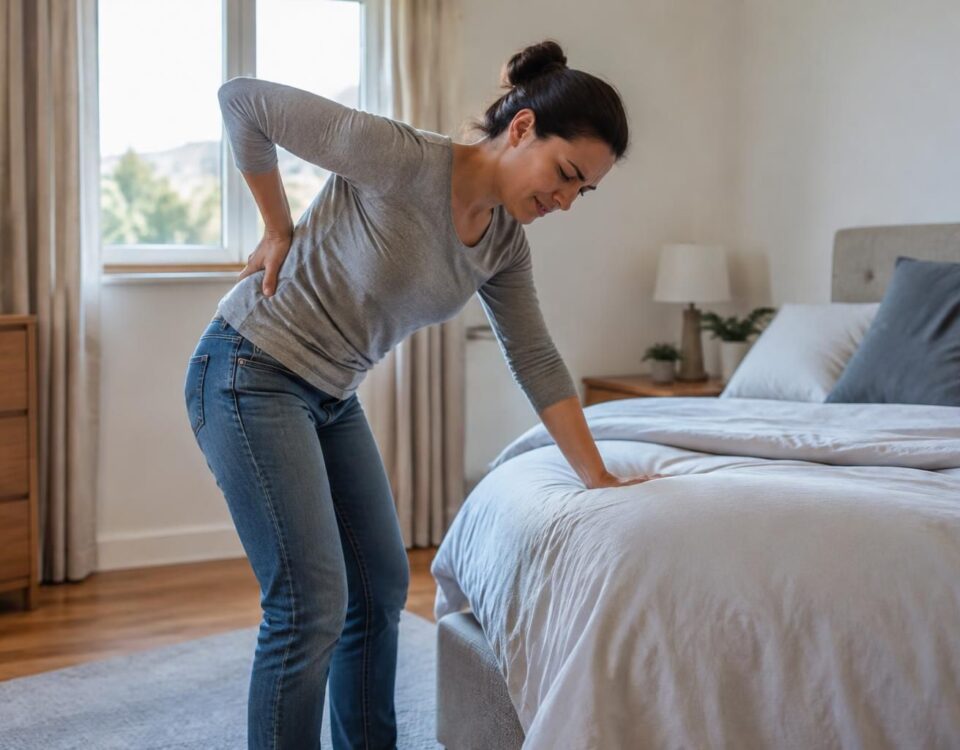
Sciatica and Making the Bed: Repeated Flexion and Lumbar Irritation
IN SHORT Sciatica is pain related to irritation or compression of the sciatic nerve. Making your bed can strain the lower back if bending is repeated, especially when rounding the back or twisting the torso. To limit lumbar irritation, bend…
When to Seek an Evaluation
An evaluation can help distinguish pain related to nerve irritation from other possible causes. A healthcare professional can examine the symptoms, their distribution, and evolution, and then determine if medical advice or further tests are needed.
Consult quickly if pain increases, if numbness spreads, or if you notice new weakness in the leg or foot. Loss of control over the bladder or bowels, difficulty urinating, or numbness around the genital area or anus require urgent medical evaluation. Also, consult our page on severe sciatica signs that merit evaluation.
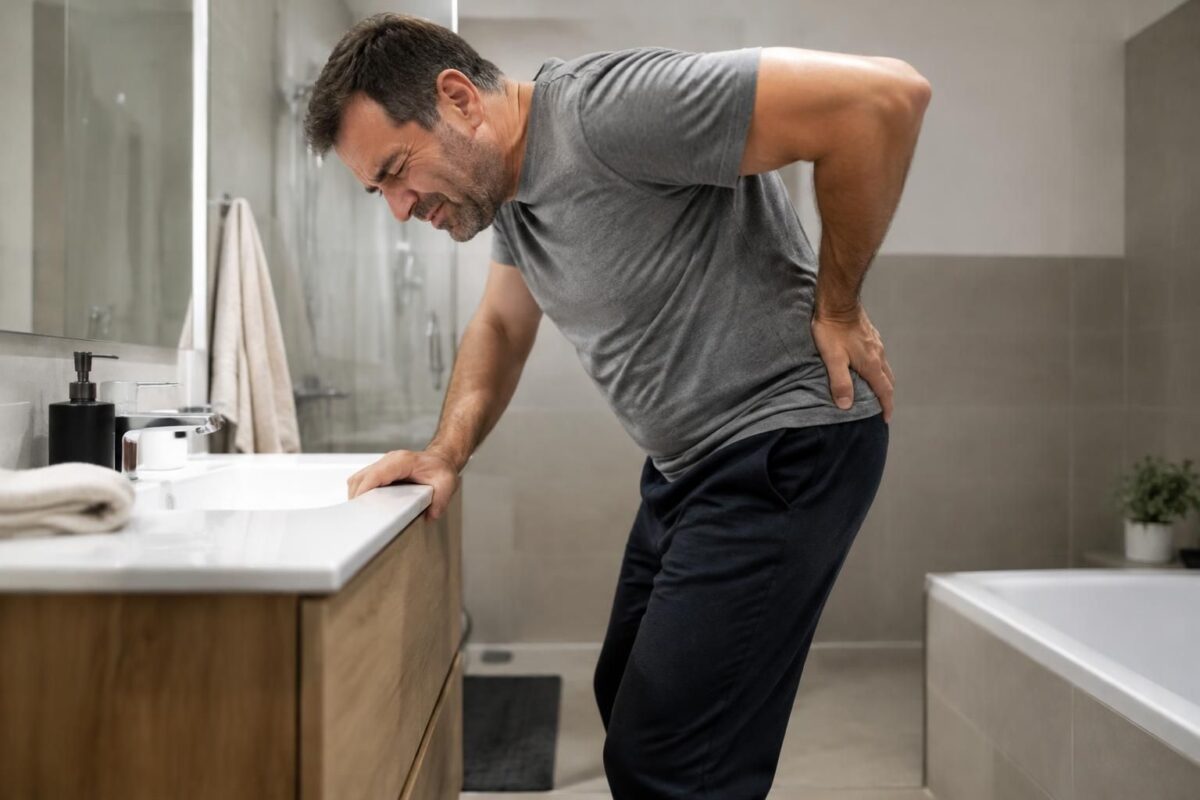
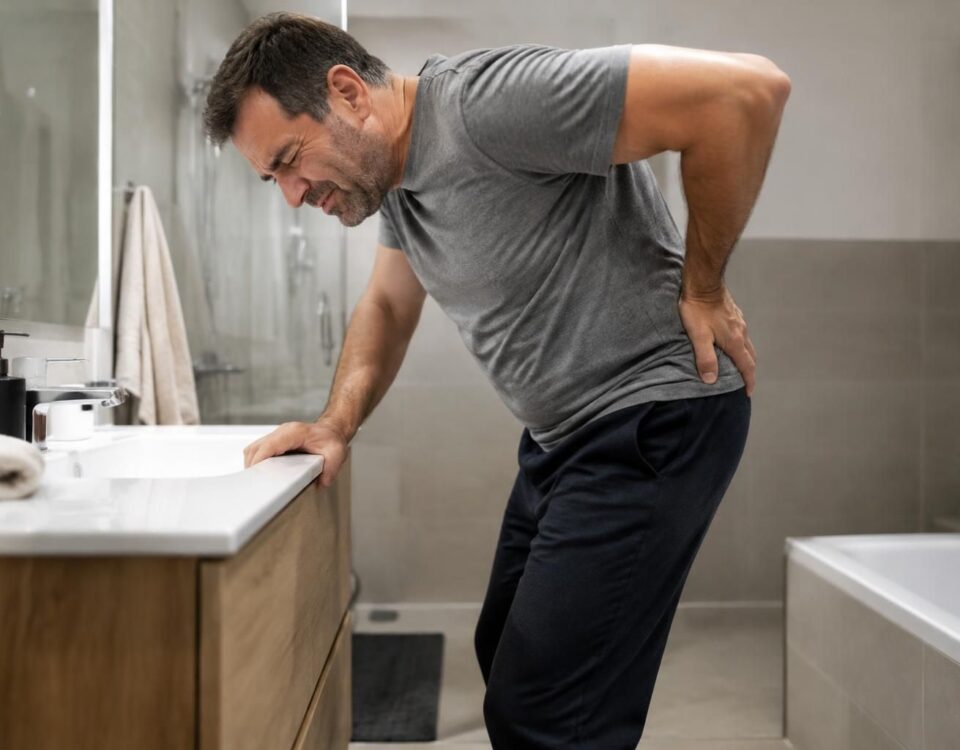
Sciatica and bending over the sink: pain in the leg
IN BRIEF Sciatica is pain related to irritation or compression of the sciatic nerve, which can extend from the lower back down to the leg. Bending over the sink can exacerbate the pain, especially if this position increases pressure on…
A Management Approach Tailored to Your Symptoms
Management depends on the possible cause, the intensity of symptoms, and your health status. A consultation allows discussion of appropriate options without assuming that every pain triggered by flexion comes from a herniated disc.
For individuals interested in exploring services offered in Montreal or Terrebonne, TAGMED clinic offers evaluations and management options. The relevance of these options should be determined on a case-by-case basis by a qualified professional.
Medical Disclaimer: The information and advice provided on this site do not replace the opinion, diagnosis, or treatment of a healthcare professional. Note that Sylvain Desforges, B.Sc., D.O., N.D., doctor of osteopathy, is neither a medical doctor nor a physician, and is not a specialist in a medical specialty as defined by the Collège des médecins du Québec. Manual medicine, functional medicine, and sports medicine as described on this site exclude any treatment or medical diagnosis made by a physician or specialist doctor. Always consult your physician for any medical questions. For further details, please read our Full Legal Disclaimer.
Why Bending Can Intensify Pain
- Bending can increase tension on the sciatic nerve.
- The position can further irritate a nerve root that is already sensitive.
- Bending over to pick up an object can intensify symptoms.
How to Spare Your Back
- Bend the knees and hips rather than rounding the back.
- Keep the object close to the body and avoid sudden movements.
- Adapt movements according to pain, without forcing into an aggravating position.

In case of sciatica, leaning forward can sometimes exacerbate the pain by increasing tension on the sciatic nerve and lower back structures. This does not mean you should avoid all movement: the goal is to identify movements that trigger your symptoms, adapt how you move, and remain active without forcing yourself. Here are recommendations to better understand trunk flexion and limit aggravations.

Sciatica and washing feet: lumbar flexion to monitor
IN BRIEF Sciatica can make washing your feet uncomfortable, as bending forward accentuates lumbar flexion and may trigger pain. To limit strain, sit down, bring your foot closer to you, or use a long-handled aid. These adjustments make personal hygiene…
Why can bending exacerbate sciatica?
Increased tension on sensitive structures
Sciatica refers to pain that follows the path of the sciatic nerve, generally from the lower back or buttock down the leg. It can be related to various causes, including irritation or compression of a nerve root. By leaning forward, especially with straight legs, you may increase tension on the tissues located at the back of the back and leg. If a nerve root is already sensitive, this movement can awaken or intensify the pain.
Trunk flexion can also stress the discs between the vertebrae. For some people, this position increases pressure in an already irritated area. The pain can then spread further into the buttock or leg, sometimes with tingling. However, flexion is not systematically harmful and cannot solely identify the cause of sciatica.
The role of posture and load
The risk of irritation sometimes increases when you bend quickly, when you turn simultaneously, or when you lift a load far from your body. Repeating these movements, especially at work or during household tasks, can also maintain symptoms. It is often the combination of position, effort, and momentary sensitivity that matters.

Sciatica and dressing: daily gestures to adapt
IN BRIEF Sciatica can make dressing uncomfortable, but a few simple gestures help limit tension. Sit down to put on pants, socks, and shoes, choose easy-to-wear clothing, and avoid bending or twisting suddenly. These adjustments make daily dressing easier without…
How to bend more cautiously
Adapt the movement rather than completely avoiding it
To pick up an object, get close to it before grabbing it. Bend your knees and hips as much as possible, keep the object close to your body, and avoid twisting your trunk under strain. You can also lean on a stable support. If a movement triggers a sharp pain or causes pain to radiate further down the leg, gently straighten up and choose another way to complete the task.
Avoid staying in a bent position for long periods. Alternate postures and take short breaks to walk or straighten up. Gentle activity, such as walking if it remains tolerable, can help maintain your mobility. Prolonged bed rest is generally not recommended unless advised by a medical professional.
Observe your symptoms’ reactions
Note the movements that aggravate or relieve your symptoms, as well as their duration. Do not try to force a stretch or repeat a painful bend to “release” your back. Appropriate exercises vary from person to person: a doctor or physiotherapist can help you determine the right movements and gradually resume your activities.
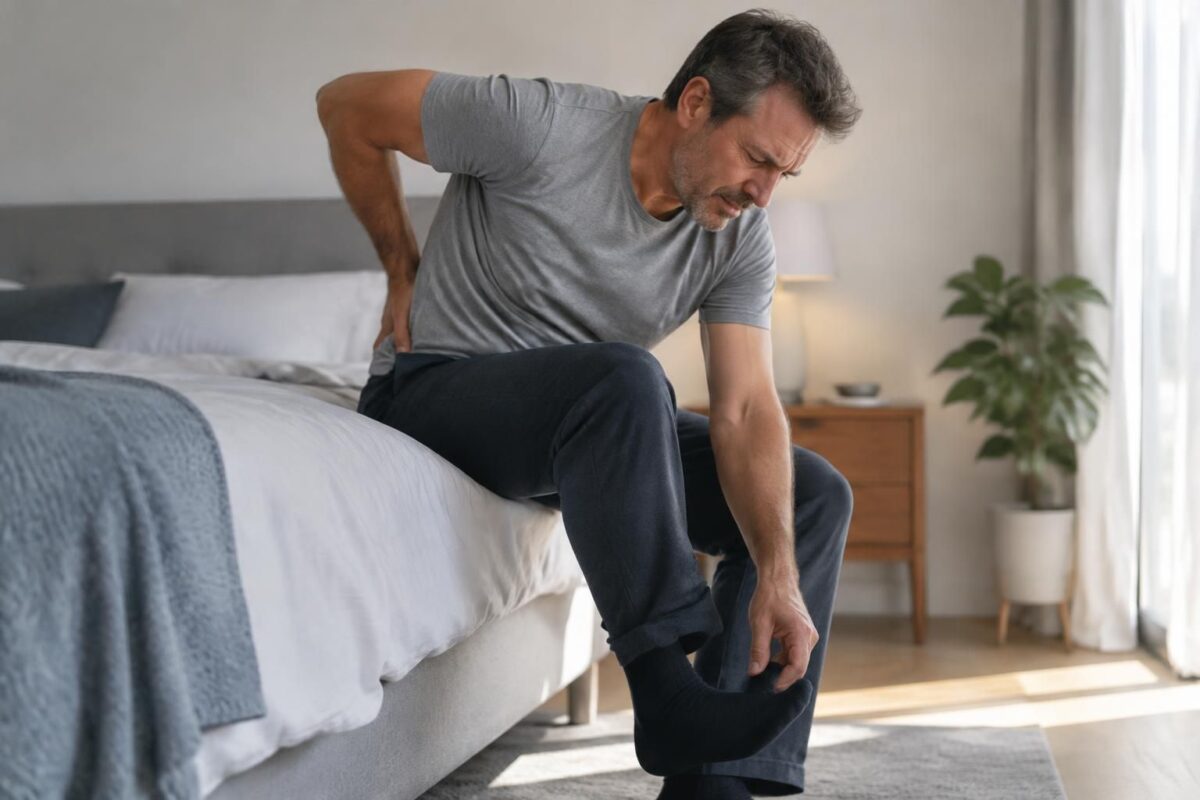
Sciatica and putting on socks: bending and pain in the leg
IN BRIEF Sciatica can make it difficult to put on your socks: bending over can increase the pain that radiates down the leg. Sitting down, using a sock aid, or avoiding painful bends can make this daily task easier. If…
When to seek medical advice
Consult a healthcare professional if the pain is significant, persistent, worsens, or limits your activities, or if you experience weakness in the leg. Seek urgent medical help if you have difficulty controlling your bladder or bowels, numbness around the genitals or anus, or sudden and marked weakness. These signs require prompt evaluation.
| Why bending can worsen | Possible effect |
|---|---|
| Pressure on an irritated disc | Leaning can increase pressure and irritate a nerve root. |
| Stretching of the sciatic nerve | Bending can increase tension and awaken pain in the leg. |
| Maintained position | Staying bent for a long time can amplify symptoms. |
| Added load | Bending while carrying an object puts more stress on the lower back. |
| Variable reaction | Bending does not worsen all cases of sciatica: adapt the movement to your symptoms. |
“As soon as I bend down to put on my shoes, the pain radiates down my leg.” — Fictional testimony inspired by common situations. For some individuals, bending the trunk can increase the tension on the nerve structures of the lower back or irritate an already sensitive area. The pain can then spread to the buttock or leg.
“Picking something up from the floor gives me a shock right behind the knee.” Bending, especially when repeated or associated with carrying a load, can increase stress on the discs and lumbar tissues. If a nerve root is irritated, this movement can awaken or amplify symptoms. However, the effect varies from person to person and depends on the cause of the pain.
“I tried to keep my back straight, but some movements remain painful.” Completely avoiding any bending is not necessarily the solution. A reduced range, a slower movement, or bending your knees may sometimes be better tolerated. It is best not to force a movement that intensifies pain significantly and to seek advice from a healthcare professional if symptoms persist.
“The pain does not always react the same way: sometimes I can bend, sometimes I cannot.” This is possible: sensitivity can vary based on fatigue, the duration of the position, the load carried, and irritation of the nerve. These testimonies are fictional and do not establish a diagnosis. Significant or progressive weakness, numbness in the area between the legs, or difficulties controlling the bladder or bowels require urgent medical evaluation.
Sylvain Desforges is a healthcare professional specializing in osteopathy, naturopathy, and manual medicine. Founder and president of TAGMED clinics and the ACMA association, he dedicates his career to innovation in care and the management of chronic pain. His approach particularly focuses on individuals suffering from sciatica, for whom ordinary movements — such as bending to put on a shoe or picking up an object — can sometimes exacerbate symptoms.
Sciatica refers to pain that follows the path of the sciatic nerve, typically from the lower back or buttock down into the leg. It may be accompanied by tingling, numbness, or a feeling of weakness. Trunk flexion does not systematically worsen the pain for everyone: its effect depends on the cause of the symptoms and individual sensitivity. However, some people find that bending forward intensifies their pain or causes it to radiate further down the leg.
A possible explanation lies in the strain placed on the lumbar region. When bending, the tissues in the lower back change position and are subjected to different tension. If a structure near a nerve root is already irritated — for example, in the context of a herniated disc — certain flexions may increase discomfort. The nerve and the surrounding tissues may also be more sensitive to stretching or movement. This does not mean that every flexion causes injury, but that a repeated action or one performed despite increasing pain can perpetuate symptoms in some people.
For Dr. Desforges, understanding the circumstances that trigger the pain is an important step in individualized care. The depth of the flexion, posture, weight lifted, and the duration spent in one position can alter the body’s response. Bending quickly with straight legs to lift a heavy object does not impose the same strain as a slow, careful flexion. Therefore, it is useful to observe which movements genuinely aggravate symptoms, rather than avoiding all activity out of fear of movement.
His work in chronic pain management is based on an approach aimed at adapting care to each patient’s situation and prioritizing informed decisions. Depending on their needs, TAGMED clinics offer manual approaches and technologies such as spinal decompression, laser therapy, or shockwave therapy. These options may not necessarily suit everyone: an evaluation allows for discussing their relevance and limitations, considering symptoms and history.
During periods of pain, it may be preferable to temporarily reduce movements that cause a significant exacerbation while maintaining adapted activity if it remains tolerable. A professional can help determine how to modify daily movements, gradually resume certain actions, and choose appropriate management strategies. New or worsening weakness in the leg, significant loss of sensation, or urinary or bowel issues require urgent medical evaluation.
Bending forward can exacerbate sciatica-like pain because trunk flexion alters the stress around the lumbar discs and nerve structures. However, the reaction varies from person to person: understanding what triggers your symptoms helps in choosing a cautious and appropriate approach.

Sciatica and tying your shoes: why the pain can radiate down
IN BRIEF Sciatica is pain related to the irritation of a nerve in the lower back, which can radiate into the buttock and leg. Leaning down to tie your shoes may accentuate the pain or cause it to descend further.…
Why bending can worsen sciatica
When you flex the trunk, especially to pick up an object or remain seated in a hunched position for a long time, the tissues in the lower back are stressed differently. For some people, this movement can increase irritation around a nerve root and cause pain that travels down into the buttock or leg. Pain that radiates further towards the foot merits particular attention, though it is not sufficient on its own to establish a diagnosis.
Flexion is not necessarily harmful for everyone. Its effect depends on the cause of the symptoms, their intensity, and how the movement is performed. To better understand possible origins of lower back pain radiating into the leg, consult the information on lumbar roots and the choice of a cautious treatment in Terrebonne.

Sciatica and picking up an object from the ground: movement to watch out for
IN BRIEF Sciatica is pain that follows the path of the sciatic nerve. To pick up an object from the ground, avoid bending abruptly while rounding your back or twisting: bend your knees, tilt your hips, and keep the object…
Symptoms to observe during movement
Notice if bending triggers pain, tingling, numbness, or a feeling of weakness, and whether these signs remain localized or extend along the leg. The timing of symptom onset and their evolution after the movement is also helpful to describe to a healthcare professional. In the case of persistent or changing symptoms, discover the signs to monitor when sciatica becomes chronic.
Some lumbar problems, including a herniated disc, may be associated with radiating pain, but only a professional can evaluate your situation. You can read explanations about L4-L5 herniated disc and pain towards the foot, as well as the potential issues related to L5-S1, the canal, and foramen.

Sciatica and bending forward: lumbar disc or nerve tension?
IN BRIEF Forward-bending sciatica may be related to irritation of the lumbar disc or tension on the sciatic nerve. This movement alone does not allow for determining the cause. Identifying the movements that trigger the pain helps guide the evaluation…
Adapting your movements without avoiding all motion
If you notice that bending exacerbates your symptoms, temporarily avoid sudden or repetitive movements that trigger them. To pick up an object, you might try to bring it closer to your body and bend your knees, keeping the movement comfortable. The goal is not to eliminate all activity but to limit gestures that clearly worsen pain and gradually resume tolerated movements.
The response to exercise can also provide indications of your current tolerance for exertion. If an activity significantly increases pain or causes it to radiate further down the leg, stop it and seek advice. To learn more, consult these guidelines on pain during exercise and signs to monitor.
When to seek professional advice
Request an evaluation if the pain intensifies, persists, limits your activities, or is accompanied by numbness or weakness. Significant or worsening weakness, loss of sensation in the groin area, or new difficulties in controlling the bladder or bowels require urgent medical attention. A professional can examine your symptoms and guide you towards suitable measures rather than relying solely on the reaction to a movement.

Sylvain Desforges, B.Sc., D.O., N.D., docteur en ostéopathie
Dr Sylvain Desforges, B.Sc., D.O., N.D., osteopath, is the founding president of TAGMED and of the ACMA association. He dedicates his practice to chronic spinal pain, low back pain and symptoms compatible with sciatica, particularly when pain radiates toward the buttock, leg, calf, foot or toes.
Through SOS Sciatique, he publishes educational content on sciatica symptoms, possible causes such as disc herniation, disc narrowing, foraminal stenosis or irritation of a lumbar nerve root, as well as non-surgical approaches that may be considered according to the evaluation. At Clinique TAGMED, care may include, depending on the case, motorized neurovertebral decompression, specific osteopathic care or precision percussion.
For an evaluation related to sciatica treatment in Montreal / Mount Royal or sciatica treatment in Terrebonne, please consult the services available at Clinique TAGMED.
Medical disclaimer
The information published on SOS Sciatique is provided for educational purposes only and does not replace a consultation, diagnosis, opinion or treatment provided by a physician or another authorized healthcare professional. The author of this article is neither a medical doctor nor a specialist in a medical specialty recognized by the Collège des médecins du Québec. The osteopathic, manual medicine or functional support approaches described on this site do not constitute medical acts and are not intended to replace medical follow-up.
Consult a physician or emergency service in cases of loss of bladder or bowel control, anesthesia in the saddle area, significant or progressive weakness in the leg or foot, fever, recent trauma, severe pain or rapid worsening of symptoms. For more details, please read our Legal Notice.