


Disc bulge and narrowed foramen
21/11/2026
Sciatica in Montreal: pain worsened when sitting and lumbar disc
22/11/2026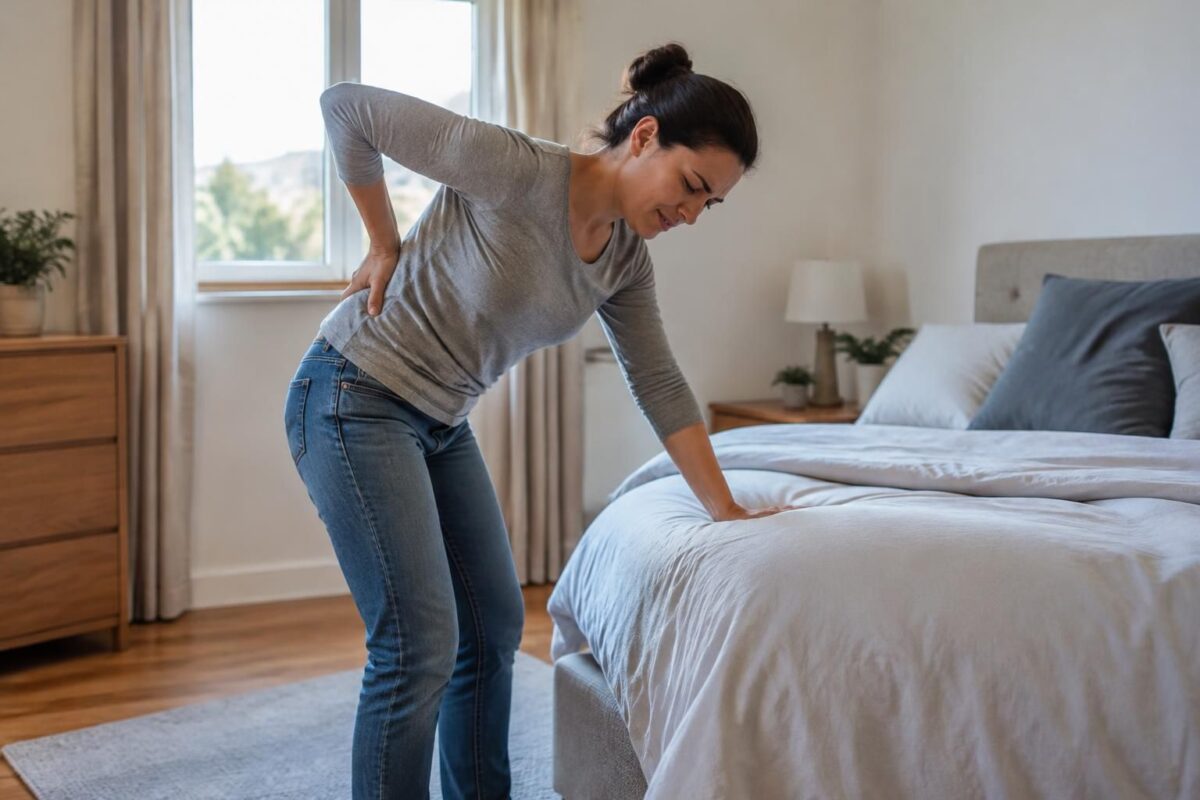
IN SHORT Sciatica is pain related to irritation or compression of the sciatic nerve. Making your bed can strain the lower back if bending is repeated, especially when rounding the back or twisting the torso. To limit lumbar irritation, bend your knees, get close to the bed, and alternate sides. These actions reduce strain without guaranteeing the disappearance of pain. If it worsens or persists, seek advice from a healthcare professional. |
In case of sciatica, making the bed can awaken or intensify the pain: repeated bending of the back and twisting can irritate the lumbar region. To limit strain, get close to the bed, bend your knees rather than rounding your back, and avoid sudden movements. If the pain increases, stop the activity and seek advice from a healthcare professional.
Making the bed often requires bending, stretching out the arms, and repeating the same movements. In case of sciatica, these movements can awaken or intensify lower back pain or radiate into the leg. Adapting the way to make the bed, reducing repeated bending, and respecting the pain can help limit irritation, without replacing medical advice.
Sciatica refers to pain associated with irritation or compression of a nerve root in the lower back. It can radiate into the buttock and leg, sometimes down to the foot. A herniated disc may be a cause, but other lumbar issues can also provoke similar symptoms.
Making the bed can strain the lower back. The person bends forward, pulls on the sheets, turns to one side and then the other, and repeats these actions around the mattress. If these movements increase pain, they may make symptoms more sensitive during activity or after it. This does not automatically mean they have aggravated an injury.
Why bending can awaken pain
Bending the trunk brings the upper body closer to the mattress. The action becomes more demanding if the person keeps the legs straight, stretches the arms far in front, or twists the torso at the same time. Repetition and effort can then irritate an already painful lumbar region.
The reaction varies depending on the cause of the sciatica and the individual. Some people tolerate short bends, while others feel stronger pain or more pronounced radiation. Pain that descends slowly into the leg deserves special attention: this article on sciatica and pain that descends into the leg describes this type of symptom.
Actions to adapt when making the bed
You can modify the task without forcing your back. Get close to the side of the bed before pulling the sheets. Move along the mattress rather than stretching your arm to the maximum. Move your feet to change sides and avoid twisting your torso while keeping the pelvis still.
You can also make the bed in several steps. For example, adjust one side at a time and take a break if the pain increases. If the mattress is low or hard to reach, ask for help during a painful push. A sheet that is easy to put on or lighter bedding can also reduce effort.
There is no single posture that suits everyone. The goal is to reduce movements that clearly trigger pain, without remaining still all day. If a movement causes sharp pain, new radiation, or increasing numbness, stop the task and seek advice from a healthcare professional.
Recognizing pain related to sciatica
Sciatica often causes pain that starts in the lower back or buttock and follows part of the leg. It may be accompanied by tingling, numbness, or weakness. The pain may increase with certain movements, but an examination is necessary to determine its cause.
Numbness in the foot can have several origins and should be evaluated according to its intensity and evolution. To better understand this symptom, consult the information on sciatica associated with numbness in the foot. A piece on disc-related sciatica and stretches that can worsen symptoms also reminds that a movement presented as a stretch is not suitable for all situations.
Repeated bending during a daily task alone does not diagnose a herniated disc or another condition. Similarly, lower back pain does not always mean that a disc is displaced. Information on the difference between disc protrusion and herniated disc can help clarify the terms, but only a professional can interpret them in your situation.
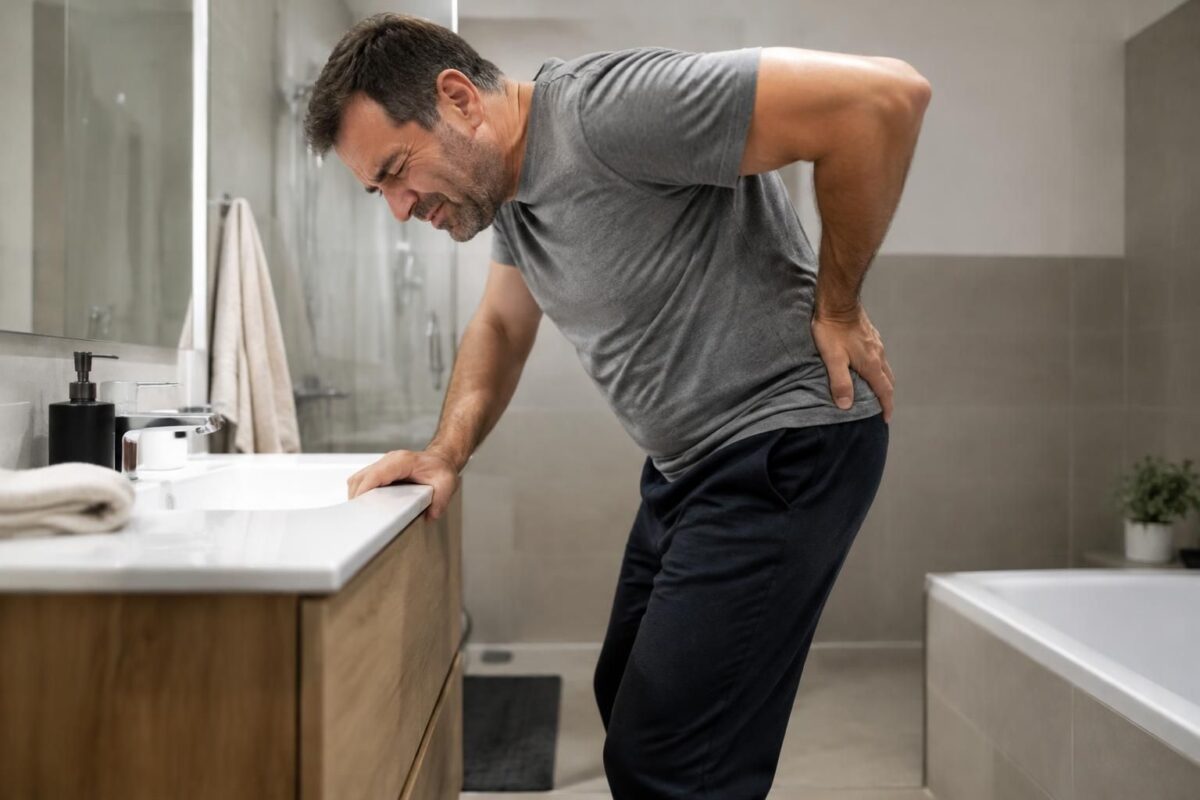
Sciatica and bending over the sink: pain in the leg
IN BRIEF Sciatica is pain related to irritation or compression of the sciatic nerve, which can extend from the lower back down to the leg. Bending over the sink can exacerbate the pain, especially if this position increases pressure on…
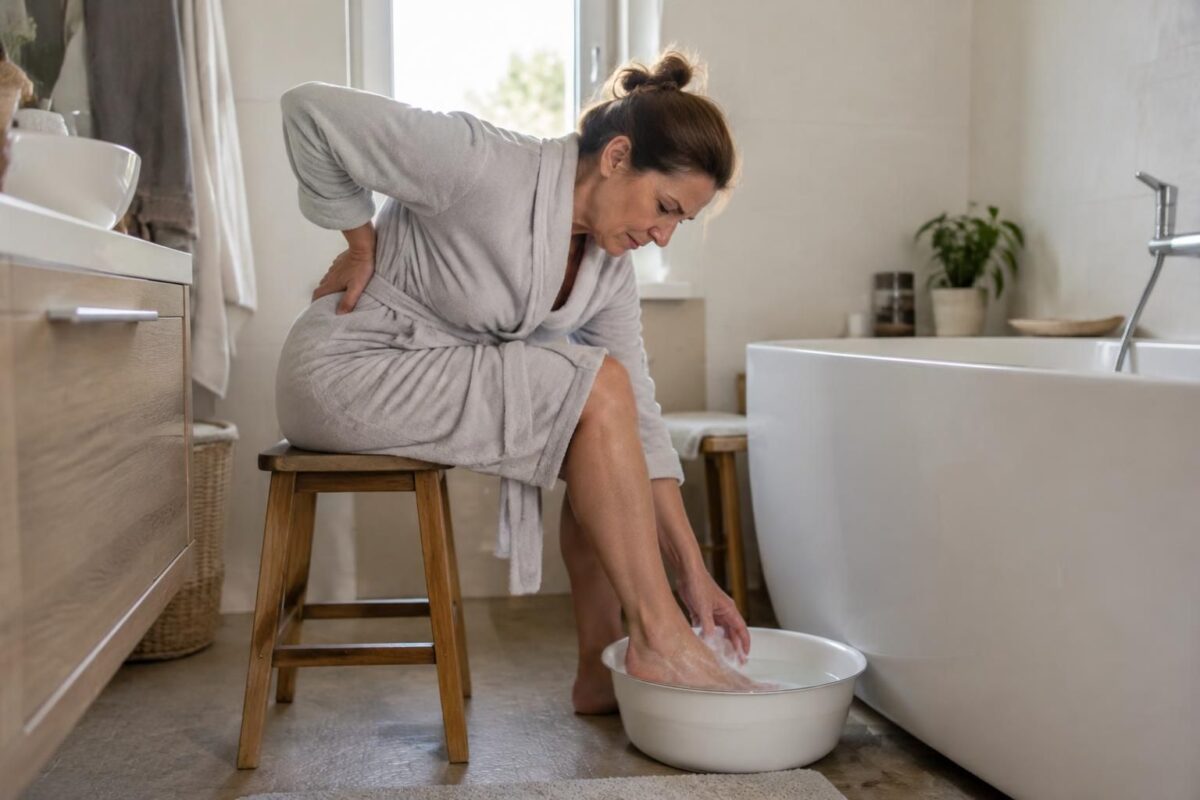
Sciatica and washing feet: lumbar flexion to monitor
IN BRIEF Sciatica can make washing your feet uncomfortable, as bending forward accentuates lumbar flexion and may trigger pain. To limit strain, sit down, bring your foot closer to you, or use a long-handled aid. These adjustments make personal hygiene…

Sciatica and dressing: daily gestures to adapt
IN BRIEF Sciatica can make dressing uncomfortable, but a few simple gestures help limit tension. Sit down to put on pants, socks, and shoes, choose easy-to-wear clothing, and avoid bending or twisting suddenly. These adjustments make daily dressing easier without…
Reducing irritation during a painful episode
When the pain is strong, temporarily limit tasks that trigger it. You can assign the bed preparation to someone else or postpone this task. Complete and prolonged rest is generally not a sustainable solution: as soon as the pain allows, gradually return to your usual activities, according to the advice received.
Observe your body’s reactions during and after the task. Mild discomfort that disappears quickly does not have the same meaning as pain that intensifies, descends further down the leg, or is accompanied by weakness. Note the movements involved and the duration of symptoms to discuss with your doctor.
Do not start stretches or exercises found online without checking that they are suitable for your situation, especially if a herniated disc or another lumbar issue is suspected. Resources dedicated to exercises for sciatica, movements to do or avoid, and stretches in bed do not replace individual evaluation. A video on sciatica may also present movements that do not match your symptoms: watch the video dedicated to sciatica.

Sciatica and putting on socks: bending and pain in the leg
IN BRIEF Sciatica can make it difficult to put on your socks: bending over can increase the pain that radiates down the leg. Sitting down, using a sock aid, or avoiding painful bends can make this daily task easier. If…

Sciatica and tying your shoes: why the pain can radiate down
IN BRIEF Sciatica is pain related to the irritation of a nerve in the lower back, which can radiate into the buttock and leg. Leaning down to tie your shoes may accentuate the pain or cause it to descend further.…

Sciatica and picking up an object from the ground: movement to watch out for
IN BRIEF Sciatica is pain that follows the path of the sciatic nerve. To pick up an object from the ground, avoid bending abruptly while rounding your back or twisting: bend your knees, tilt your hips, and keep the object…
When to seek medical advice
Consult a doctor if the pain is intense, persists, recurs frequently, or limits walking and daily activities. A healthcare professional can investigate the cause of the symptoms and propose an appropriate management plan. Do not take anti-inflammatories or other medications without confirming that they are suitable for you, especially in the case of chronic illness, pregnancy, or ongoing treatment.
A weakness that worsens in one leg, significant loss of sensation, or difficulties controlling the bladder or bowels require urgent medical evaluation. If in doubt about what to do, quickly contact a health service.
To understand care options and precautions to be aware of, you can read this information on sciatic nerve irritation and on adjusting daily gestures in case of sciatica. These resources do not replace a diagnosis or a personalized medical opinion.
Medical disclaimer: The information and advice provided on this site do not replace the opinion, diagnosis, or treatment of a health professional. Please note that Sylvain Desforges, B.Sc., D.O., N.D., doctor of osteopathy, is neither a medical doctor nor a physician, and is not a specialist in any medical specialty as defined by the Collège des médecins du Québec. Manual medicine, functional medicine, and sports medicine as described on this site exclude any treatment or diagnosis made by a medical doctor or specialist. Always consult your doctor for any medical questions. For more details, please read our full Legal Notice.
Sciatica and making the bed: limit repeated bends
- What can irritate: bending often, especially while rounding the lower back.
- To monitor: pain that intensifies or travels down the leg.
- To spare the back: get close to the bed and bend your knees rather than your back.
- Good reflex: change sides and take a break if the pain increases.

Making your bed often involves bending, stretching your arms, and repeating the same gestures. In the case of sciatica, these repeated bends can irritate the lower back or temporarily amplify the pain that travels down into the buttock and leg. Some simple adjustments can help limit the strain, without stopping movement or forcing through the pain.
Why making the bed can trigger sciatica
Sciatica corresponds to pain related to the irritation or compression of a root of the sciatic nerve. A herniated disc or osteoarthritis may be involved. Bending multiple times, especially while rounding the back or turning sharply, can strain the lumbar region and worsen symptoms in some individuals. This does not mean that making the bed created the problem: the gesture can simply become an irritating factor.
The reaction varies depending on the cause and the person. If the pain increases, extends further down the leg, or is accompanied by more pronounced tingling, adapt your way of doing or stop the task. The goal is to reduce the gestures that trigger symptoms, not to stay in bed.
Adapting gestures to protect the lower back
Limit bending and twisting
Position yourself near the bed rather than bending from the edge. Move around the bed to reach each side, instead of twisting your torso with your arms outstretched. To tuck in the sheets, slightly bend your hips and knees while keeping your back as comfortable as possible. Avoid sudden movements and simultaneous rotations of the back when you are bent over.
If the bed is low, you can support yourself with one hand on the mattress to change position more easily. When you need to reach the opposite side, move your feet and body rather than pulling the sheet while forcing. An easily fitted fitted sheet or a lightweight duvet can also reduce repeated gestures.
Break the task into steps
Prepare the sheets and duvet within reach before starting. Do one side at a time, then stand up for a moment before continuing. If your pain is intense, ask for temporary help or postpone this task. During a flare-up, avoid movements that significantly increase pain but gradually return to regular activities as soon as they become bearable.
What to do if pain arises while performing the task?
Stop and find a comfortable position, standing or lying on your side. A short break can help, but prolonged bed rest is generally not advisable. When the pain allows, a gentle walk and soft movements are often preferable to immobility. Do not impose stretching: an exercise that increases pain in the leg is not suitable at that moment. A doctor or physiotherapist can advise you on movements based on your situation.
Seek medical advice if the pain is intense, persists, or recurs frequently, or if you need assistance in adapting your activities. Consult urgently in cases of significant weakness or worsening in one leg, loss of sensation between the legs, or difficulty controlling the bladder or bowels. These signs require prompt evaluation.
| Situation when making the bed | Gesture to prioritize |
|---|---|
| Bending several times from the waist | Keep your knees bent and your back as neutral as possible. |
| Tucking in the bed by stretching the arm | Walk around the bed instead of stretching far. |
| Lifting or pulling a mattress | Avoid effort during a painful flare-up; ask for help if necessary. |
| Pain increasing while bending | Alternate gestures, slow down, and stop if they worsen the symptoms. |
| Need to make the bed despite discomfort | Proceed in steps and change positions regularly. |
| Pain radiating down the leg | Repeated bending may exacerbate symptoms, but it is not necessarily the cause. |
| Significant weakness or urinary issues | Quickly consult a health professional; some signs require urgent care. |
Testimonials: sciatica and making the bed, when repeated bends irritate the lower back
“Making the bed triggered a pain that radiated down my leg” — For several weeks, bending over repeatedly to tuck in the sheets awakened a pain in my lower back, then in my hip. My doctor advised me to avoid sudden movements and to break tasks into smaller parts. Taking the time to bend my knees and consulting a physiotherapist, I learned to move with less apprehension.
“I didn’t think such a mundane task could bother me so much” — In the morning, making the bed forced me to bend several times, and I then felt tingling in my leg. I tried to keep my back more neutral, bring the sheets closer to me, and take a break if the pain increased. These adjustments helped me better manage daily movements, without replacing the advice of my healthcare professional.
“I learned not to push during a flare-up” — During a sciatica flare, tucking in the corners of the mattress was particularly uncomfortable. I now made the bed in several steps and avoided turning while keeping my back bent. When the pain became too strong, I stopped and discussed it with my doctor rather than continuing despite the symptoms.
“Adapting my movement allowed me to gradually resume” — After a period where every bend made me fear new pain, I consulted a physiotherapist. He helped me adapt my movements and gradually resume gentle activities according to my tolerance. To make the bed, I approach the mattress and switch sides rather than repeating twists, while remaining attentive to my back’s reactions.
To remember: bending frequently or twisting the trunk at the same time can worsen lumbar irritation in some individuals, but it alone does not identify the cause of sciatica. These testimonies are fictional examples and do not replace medical advice. In the case of significant weakness, progressive numbness, or urinary or bowel issues, seek medical help quickly.
Sciatica and making the bed: understanding the effect of repeated bends
Sylvain Desforges is an expert in osteopathy, naturopathy, and manual medicine. Founder and president of TAGMED clinics and the ACMA association, he dedicates his career to innovation in health and the management of chronic pain. His approach is based on evidence-based care and assessments of each individual’s specific needs. Sciatica, which can be influenced by daily movements, is among the issues where understanding movement habits can help better direct care.
Making the bed seems like a light task, but the action can strain the lower back when repeated multiple times. Bending to tuck in the sheets, straightening up, twisting the trunk, and starting again on the other side leads to repeated bends, sometimes combined with rotations. If the back is already sensitive, fatigued, or not very mobile, these movements can increase discomfort in the lumbar region and irritate surrounding tissues. They are not necessarily the cause of sciatica, but can contribute to awakening or intensifying pre-existing pain.
Sciatica refers to a set of symptoms linked to irritation or compression of a nerve root participating in the sciatic nerve. Pain can start from the lower back or the hip and radiate down the leg, sometimes all the way to the foot. Tingling, numbness, or a feeling of weakness may also occur. Therefore, experiencing lower back pain after making the bed does not automatically indicate sciatica: a healthcare professional must evaluate the symptoms and investigate their origin.
To limit strain during this task, it can be helpful to bring your body closer to the bed rather than stretching from the edge, to slightly bend your knees, and to keep objects close to you. Moving around the bed instead of pivoting the trunk while carrying something can also assist. Alternating sides, taking a short break if the back tires, and avoiding sudden movements are simple adaptations. The goal is not to remain immobile, but to reduce movements that clearly trigger pain and gradually resume tolerated activities.
In his practice, Dr. Desforges focuses on the management of chronic pain and the integration of technologies such as spinal decompression, laser, and shockwaves. However, the choice of intervention depends on clinical evaluation and the individual’s situation. In case of persistent or recurrent pain, a doctor or qualified professional can determine whether rehabilitation, adapted exercises, or another treatment is indicated. Stretching and manipulations are not universally suitable for everyone and should not cause significant aggravation.
A quick consultation is necessary if the pain is accompanied by significant weakness or worsening in the leg, loss of sensitivity around the groin, or difficulties in controlling the bladder or bowels. These signs require urgent medical evaluation. For less alarming symptoms, noting the movements that trigger pain, their duration, and frequency can help the professional better understand the possible link between daily tasks, repeated lumbar bends, and the irritation felt.
Making the bed often requires bending, pulling the sheets, and straightening up repeatedly. In the case of sciatica or lumbar irritation, these repeated bends can revive symptoms, especially if combined with a twist or sudden effort. Adapting the movement, rather than remaining still, helps better manage activity.
Making the bed without overstraining the back
To tuck in the sheets, get closer to the bed instead of stretching out your arms. Slightly bend your knees and hips, keep your back in a comfortable position, and avoid twisting your torso while carrying or pulling the bedding. You can also do one side of the bed at a time, straighten up between steps, and ask for help with tasks that clearly heighten the pain.
Bending is not necessarily dangerous in itself: it’s the range, repetition, and how your back reacts that matter. If you find that bending forward intensifies the pain or radiates it down the leg, temporarily reduce this movement and prioritize a tolerable range. To better understand this symptom profile, consult explanations on pain aggravated by bending and disc-related causes, as well as those dedicated to sciatica aggravated by bending.
A controlled movement that suits your symptoms is generally more beneficial than prolonged immobility. Alternate gestures, take breaks, and resume your activities as tolerated, without trying to “unblock” the nerve by forcing it. These pointers on controlled movement and the dosage of daily activities can help you adjust your routine. You can also identify the positions that may worsen the pain.
Stretches are not necessarily suitable for all sciatica cases, especially when certain movements increase radiation or numbness. Before integrating them into your morning routine, seek advice from a healthcare professional, especially if your symptoms are recent or significant. Examples of exercises are presented in these resources on stretches for sciatica, movements to do in bed, stretches upon waking, and exercises to soothe pain.
If the pain appeared after a fall, shock, or other accident, get evaluated rather than resuming exercises or manipulations on your own. A consultation is also recommended if symptoms worsen, persist, or severely limit walking. Significant or progressive weakness in the leg, loss of sensitivity in the perineum, or difficulty controlling the bladder or intestines require urgent medical attention. To learn more about symptoms after trauma, check the information on sciatica after an accident.

Sciatica and bending forward: lumbar disc or nerve tension?
IN BRIEF Forward-bending sciatica may be related to irritation of the lumbar disc or tension on the sciatic nerve. This movement alone does not allow for determining the cause. Identifying the movements that trigger the pain helps guide the evaluation…

Sciatica and trunk flexion: why bending over can make it worse
IN BRIEF Sciatica is pain related to irritation of the sciatic nerve, sometimes worsened by trunk flexion. Bending forward can increase tension in the lower back and reproduce pain in the buttock or leg. Identifying trigger movements helps adjust actions…

Sylvain Desforges, B.Sc., D.O., N.D., docteur en ostéopathie
Dr Sylvain Desforges, B.Sc., D.O., N.D., osteopath, is the founding president of TAGMED and of the ACMA association. He dedicates his practice to chronic spinal pain, low back pain and symptoms compatible with sciatica, particularly when pain radiates toward the buttock, leg, calf, foot or toes.
Through SOS Sciatique, he publishes educational content on sciatica symptoms, possible causes such as disc herniation, disc narrowing, foraminal stenosis or irritation of a lumbar nerve root, as well as non-surgical approaches that may be considered according to the evaluation. At Clinique TAGMED, care may include, depending on the case, motorized neurovertebral decompression, specific osteopathic care or precision percussion.
For an evaluation related to sciatica treatment in Montreal / Mount Royal or sciatica treatment in Terrebonne, please consult the services available at Clinique TAGMED.
Medical disclaimer
The information published on SOS Sciatique is provided for educational purposes only and does not replace a consultation, diagnosis, opinion or treatment provided by a physician or another authorized healthcare professional. The author of this article is neither a medical doctor nor a specialist in a medical specialty recognized by the Collège des médecins du Québec. The osteopathic, manual medicine or functional support approaches described on this site do not constitute medical acts and are not intended to replace medical follow-up.
Consult a physician or emergency service in cases of loss of bladder or bowel control, anesthesia in the saddle area, significant or progressive weakness in the leg or foot, fever, recent trauma, severe pain or rapid worsening of symptoms. For more details, please read our Legal Notice.