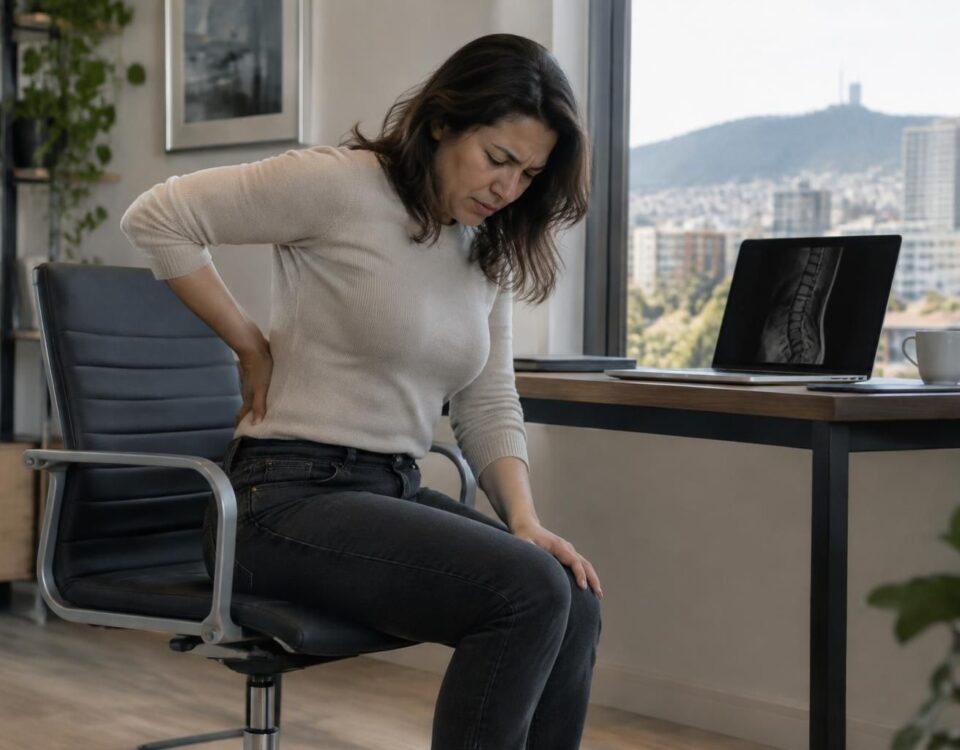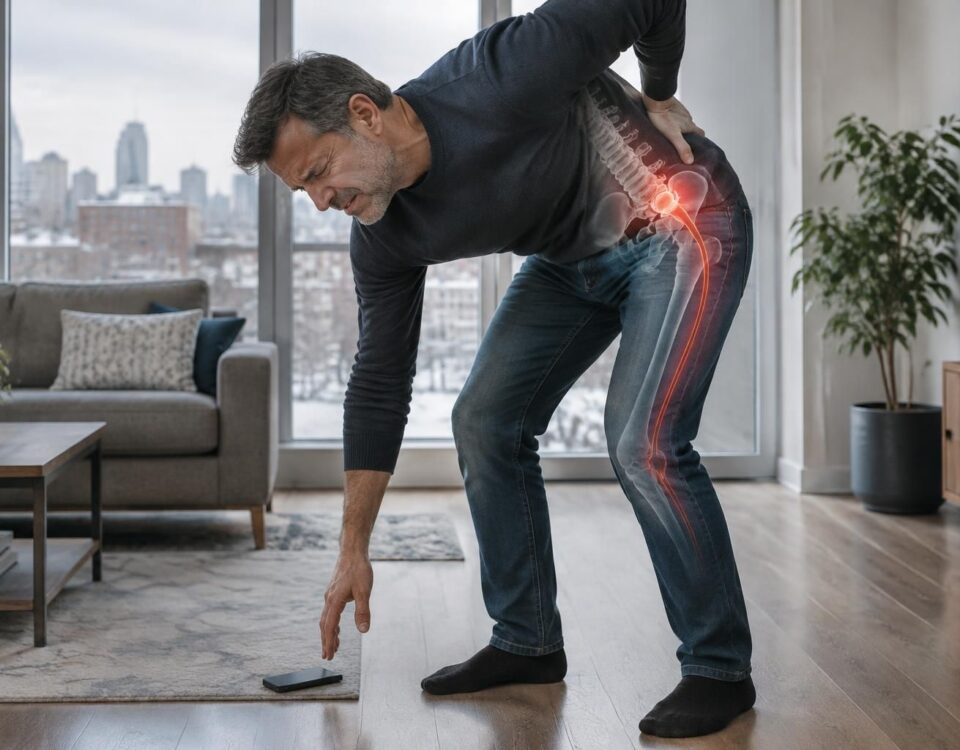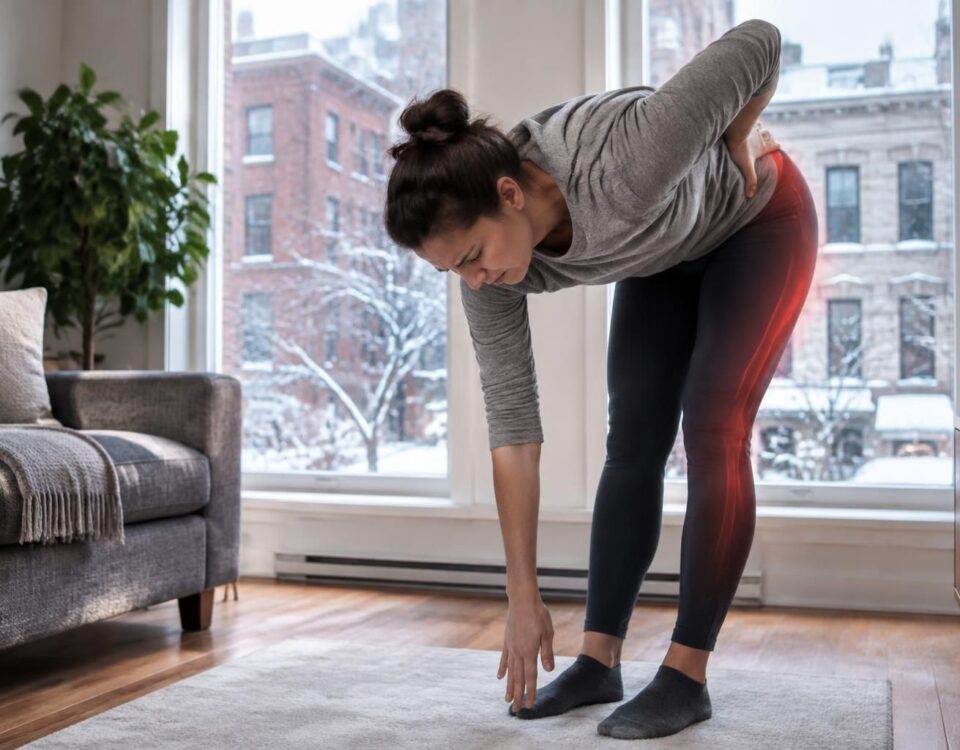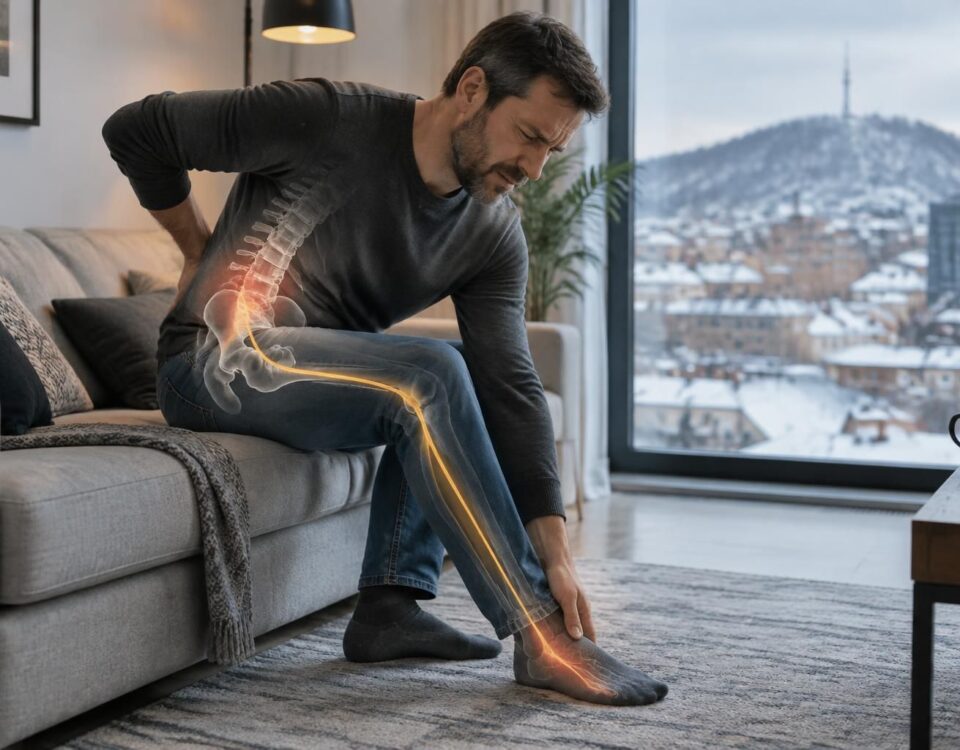


Sciatica and daily activity: finding the right balance
12/11/2026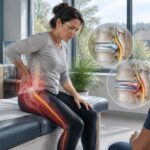
Sciatica in Terrebonne: disc protrusion or disc herniation?
13/11/2026
IN BRIEF Sciatica in Montreal may be related to a disc protrusion or a herniated disc, but these terms describe different changes in the disc and are not sufficient on their own to explain the pain. An assessment helps to link the symptoms — pain in the buttock or leg, tingling or weakness — to examination findings and guide management. It allows for consideration of appropriate non-surgical approaches when indicated. |
In Montreal, a disc protrusion or a herniated disc can irritate a nerve root and cause sciatica, with pain in the buttock or leg, sometimes accompanied by tingling or numbness. These terms describe different changes in the disc, but do not alone explain the symptoms: an assessment can help clarify their relationship to the pain and consider appropriate non-surgical approaches tailored to your situation.
In Montreal, both a disc protrusion and a herniated disc can irritate a nerve root and cause sciatic-type pain. The difference mainly lies in the shape of the disc observed on imaging. The term “herniated disc” sometimes refers to several forms of disc displacement, including protrusion. Therefore, the result of an MRI must be interpreted in conjunction with symptoms and clinical examination, rather than in isolation.
The discs are located between the vertebrae. They absorb some of the stresses and allow for movement of the spine. Over time, a tear or change in the disc can cause part of its contents to protrude beyond its usual boundaries.
A disc protrusion generally describes a disc that bulges over a fairly wide area, while its outer layer remains largely containing. A herniated disc is a more general term. It can refer to a protrusion, but also to an extrusion, where the disc material protrudes further through a tear in the outer casing.
Imaging reports do not always use these terms uniformly. The professional evaluating your situation can help you understand the report and verify if their observations are consistent with your symptoms.
An image is not enough to explain the pain
A protrusion or herniation visible on an MRI does not always cause pain. Conversely, nerve irritation can produce significant symptoms even if the report does not describe a large herniation. The location of the disc, the affected nerve root, and clinical signs also matter.
The affected root can alter the path of the pain. To better understand this link, refer to our article on the nerve root and the path of sciatic pain in Montreal.
What symptoms may accompany a disc protrusion or herniation?
Irritation of a lumbar nerve root can lead to pain in the lower back, buttock, or leg. The pain may radiate down to the calf, foot, or toes. Some people may also experience tingling, numbness, or weakness.
Symptoms vary depending on the affected root and the degree of irritation. Pain may be intermittent or constant, and its intensity may change throughout the day. Refer to our page on sciatica in Montreal and the neurological symptoms not to underestimate to identify signs that deserve evaluation.
Pain may also be more pronounced upon waking. This symptom cannot confirm a herniation or protrusion on its own. Our article on pain that radiates down the leg upon waking outlines elements to observe.
Intermittent pain or constant pain
Intermittent pain may occur in certain positions or during specific activities. Constant pain may persist even at rest. These profiles do not solely determine the cause of the problem or the severity of a disc affliction. It is necessary to take into account the progression of symptoms, sensitivity, and leg strength.
To learn more, refer to our article on intermittent or constant pain related to sciatica in Montreal.

Sciatica in Montreal: pain worsened when sitting and lumbar disc
IN BRIEF Worsening sciatica in a sitting position may be related to lower back irritation, sometimes associated with a disc, without this sign being sufficient to establish the cause. In Montreal, an evaluation that considers symptoms, strength, sensitivity, and function…

Sciatica in Montreal: pain worsened by flexion and disc-related cause
IN BRIEF Flexion-Aggravated Sciatica is pain that starts in the lower back and may radiate into the buttock or leg; irritation related to a lumbar disc can be a possible cause. In Montreal, an assessment helps clarify the origin of…
The role of the nerve root and foramen
Nerves exit the spine through small passages called foramens. A protrusion, herniation, or other changes can reduce the space around a nerve root. Irritation or compression in this area can contribute to pain radiating down the leg.
Involvement near the L5 or S1 levels can sometimes produce symptoms in the buttock, calf, foot, or toes. The path varies from person to person. To better understand this mechanism, read our article on L5-S1 foraminal compression.

Discogenic sciatica in Montreal: why some stretches worsen
IN BRIEF Disc-related sciatica refers to pain related to the irritation of a nerve root, often near a herniated disc. Certain stretches, especially those that emphasize bending or pull on the leg, can worsen symptoms rather than relieve them. In…

Sciatica disc in Montreal: movements to avoid at the start
IN BRIEF Disc-related sciatica refers to pain related to the irritation of a nerve, sometimes associated with a lumbar disk. Initially, avoid movements that worsen your symptoms, such as lifting a load by bending over or performing repeated twists. Adjusting…
How to evaluate a disc protrusion or herniation in Montreal?
The evaluation considers your symptoms, their progression, your history, and results of previous examinations. Imaging may be helpful when the healthcare professional deems it necessary. An MRI is not always required for every lumbar or sciatic pain.
The report must be correlated with what you are experiencing. For example, an abnormality at a given level does not automatically prove that it causes pain in the leg. An evaluation helps to determine if the described signs correspond to the observed area.

Sciatica in Montreal: disc herniation with leg weakness
IN BRIEF Sciatica related to a herniated disc can irritate a nerve root and cause pain that travels down the leg, sometimes accompanied by weakness. In Montreal, an evaluation helps clarify the cause and guide appropriate care; nonsurgical approaches can…

Sciatica in Montreal: herniated disc with foot numbness
IN BRIEF Sciatica related to a herniated disc can cause pain that radiates down the leg and numbness in the foot. In Montreal, an assessment helps to investigate the cause of the symptoms and consider appropriate management without assuming the…
What non-surgical options can be considered?
Management depends on the evaluation and your situation. It may include manual or functional support. At the TAGMED Clinic, the approach may involve, as appropriate, specific osteopathy, a precision thrust tool, or motorized neurovertebral decompression. These options may not be suitable for everyone and do not replace a medical diagnosis or follow-up by a physician.
To discuss an assessment related to sciatica, consult the services of sciatica treatment in Montreal and Mont-Royal or sciatica treatment in Terrebonne at TAGMED Clinic. An evaluation allows you to check if the services offered meet your needs.
When to consult quickly?
Consult a doctor or emergency service in case of loss of urinary or bowel control, numbness in the saddle area, significant or progressive weakness in the leg or foot, fever, recent trauma, severe pain, or rapid worsening. These signs require immediate medical evaluation.
About the author
Sylvain Desforges, B.Sc., D.O., N.D., Doctor of Osteopathy and Naturopath, is the founding president of TAGMED and the ACMA association. He devotes his practice to chronic spinal pain, lower back pain, and pain compatible with sciatica, especially when the pain radiates to the buttock, leg, calf, foot, or toes.
Through SOS Sciatique, he publishes educational content on the symptoms of sciatica, possible causes such as herniated disc, disc pinch, foraminal stenosis, or irritation of a lumbar nerve root, as well as on non-surgical approaches that may be considered based on the evaluation. At TAGMED Clinic, care may include, as applicable, motorized neurovertebral decompression, specific osteopathy, or precision impactor.
For an assessment related to sciatica treatment in Montreal / Mont-Royal or sciatica treatment in Terrebonne, consult the available services at TAGMED Clinic.
Medical Disclaimer
Medical Disclaimer: The information and advice provided on this site do not replace the opinion, diagnosis, or treatment of a health professional. Please note that Sylvain Desforges, B.Sc., D.O., N.D., Doctor of osteopathy, is neither a medical doctor nor a physician, and is not a specialist in a medical specialty as defined by the Collège des médecins du Québec. Manual medicine, functional medicine, and sports medicine as described on this site exclude any medical treatment or diagnosis made by a physician or medical specialist. Always consult your doctor for any medical questions. For more details, please read our Complete Legal Notice.
Disc Protrusion
- The disc bulges, without necessarily rupturing.
- May irritate a nerve root and cause sciatica.
- Its appearance on imaging is not enough to explain the pain.
Herniated Disc
- A part of the disc extends beyond its usual contour.
- May compress or irritate a nerve root.
- Symptoms and clinical examination guide the evaluation.
In Montreal: both diagnoses may present with pain that radiates into the buttock or leg. An evaluation helps better guide the management options.

In Montreal, pain radiating from the buttock to the leg may be compatible with sciatica, but it does not by itself distinguish a disc protrusion from a herniated disc. These terms describe forms of disc displacement; the significance of symptoms, their progression, and their concordance with clinical examination are as important as the findings from an X-ray or MRI. A personalized evaluation helps choose the next steps without jumping to conclusions.
Disc Protrusion and Herniated Disc: What’s the Difference?
The discs located between the vertebrae serve to distribute loads and allow movements of the spine. Over time or under various stresses, their contour may change. A disc protrusion generally refers to a disc that bulges more extensively, while herniation may describe a more localized protrusion of disc material. Definitions may vary according to imaging reports; a protrusion is sometimes considered a form of herniated disc.
These changes do not always cause pain. Some individuals have an abnormality on an MRI without symptoms, while others experience significant pain with unremarkable imaging. Diagnosis thus does not solely rely on the name entered in the report.
When can a disc injury be related to sciatica?
A protrusion or herniation may contribute to irritate or compress a nerve root in the lower back. The pain may then radiate to the buttock and leg, sometimes as far as the calf, foot, or toes. Tingling, numbness, or weakness may also appear. However, other causes may produce similar symptoms: the examination should consider their pattern, intensity, and the movements that aggravate or relieve them.
What the evaluation should check
During a consultation, it is useful to clarify when the pain started, where it radiates, and whether it changes with walking, sitting, or certain movements. A health professional can also assess mobility, sensitivity, and strength, then determine whether medical investigation or imaging is relevant. In Montreal, prioritize an approach that links symptoms to examination results rather than treating an image in isolation.
Recommendations for the next steps
If the symptoms are moderate and recent, avoid staying immobile for long periods. Adapted daily activities and tolerated movements can help maintain function, without forcing into a pain that significantly intensifies. Consult a professional before resuming an exercise that triggers marked symptoms in the leg.
Non-surgical support may be considered based on assessment and progress. At TAGMED Clinic, options may include specific osteopathy or motorized neurovertebral decompression, depending on the case. These approaches are not suitable for everyone and do not guarantee results; discuss the benefits, limitations, and other options with a licensed professional.
When to consult quickly
Seek immediate medical attention or go to an emergency service in case of loss of bladder or bowel control, numbness in the saddle area, significant or progressive weakness of the leg or foot, fever, recent trauma, severe pain, or rapid deterioration. These signs require urgent medical evaluation.
About the author
Sylvain Desforges, B.Sc., D.O., N.D., Doctor of Osteopathy and naturopath, is the founding president of TAGMED and the ACMA association. He dedicates his practice to chronic spinal pain and publishes educational content on sciatica and non-surgical options. This information is educational and does not replace a consultation, diagnosis, or treatment by a licensed healthcare professional. The author is neither a doctor nor a specialist in a medical specialty recognized by the Collège des médecins du Québec.
| Disc protrusion | Herniated disc |
|---|---|
| The disc bulges without complete rupture of its outer layer. | A part of the disc protrudes through a tear in its outer layer. |
| Can irritate a nerve root and contribute to sciatica. | Can compress or irritate a nerve root and cause sciatica. |
| May be present without pain or symptoms. | May also be present without symptoms. |
| Imaging must be interpreted in conjunction with symptoms and clinical examination. | The term herniation alone does not determine the cause of pain. |
| Management depends on assessment and symptoms. | Management depends on assessment and symptoms. |
A disc protrusion and a herniated disc do not automatically mean the same thing or the same pain experience. In both cases, an intervertebral disc can bulge. A herniation generally corresponds to a more pronounced distortion of the disc, but only a clinical evaluation, sometimes supplemented by imaging prescribed by a healthcare professional, can help interpret the symptoms.
Important note: the testimonies below are fictional examples, written for illustrative purposes. They do not correspond to real patients and do not describe guaranteed outcomes.
“My exam mentioned a protrusion, but my leg was really hurting.” In Montreal, a fictional person describes pain radiating from the lower back down to the buttock and then to the calf. They wondered if a protrusion could explain their symptoms. The example illustrates that an imaging result must be related to the location of the pain, clinical examination, and symptom progression.
“I was told herniated disc, and I immediately thought of surgery.” In this fictional scenario, the person discovers that a radiological diagnosis does not, on its own, determine the appropriate treatment. Options depend notably on their symptoms, neurological status, and the advice of the professionals involved. A non-surgical approach may be discussed when the situation permits, without replacing medical follow-up.
“I experienced tingling in my foot, but I didn’t know if it was related to my back.” This fictional testimony reminds us that sensations of burning, numbness, or tingling can accompany nerve irritation, but they can also have other causes. An evaluation is useful to determine the next steps and check if a medical examination is necessary.
“I wanted to understand my MRI report before deciding what to do.” In this fictional example, the person wishes to differentiate the terms “protrusion” and “herniation” and know if they correspond to their pain. The imaging report does not always suffice to explain the symptoms: its reading must take into account the clinical history and examination, with the assistance of a qualified professional.
In Montreal or Mont-Royal, an evaluation can help clarify the characteristics of pain compatible with sciatica and discuss options suited to the situation. Depending on the case and the assessment, support may include specific osteopathy or motorized neurovertebral decompression. These approaches are not suitable for everyone and do not replace a diagnosis or medical follow-up.
About the author
Sylvain Desforges, B.Sc., D.O., N.D., Doctor of Osteopathy and naturopath, is the founding president of TAGMED and the ACMA association. His practice is dedicated to chronic spinal pain, low back pain, and pain compatible with sciatica, particularly when the pain radiates down to the buttock, leg, calf, foot, or toes.
Through SOS Sciatique, he publishes educational content on the symptoms of sciatica, possible causes — such as herniated disc, disc pinching, foraminal stenosis, or irritation of a lumbar nerve root — and non-surgical approaches that may be considered based on the assessment. At TAGMED Clinic, care may include, depending on the case, motorized neurovertebral decompression, specific osteopathy, or precision impactor.
Medical Disclaimer
The information published on SOS Sciatique is provided for educational purposes and does not replace a consultation, diagnosis, advice, or treatment performed by a doctor or another licensed healthcare professional. The author of this article is neither a doctor nor a specialist in a medical specialty recognized by the Collège des médecins du Québec. The approaches of osteopathy, manual medicine, or functional support described do not constitute medical acts and are not intended to replace medical follow-up.
Consult a doctor or an emergency service in case of loss of bladder or bowel control, anesthesia in the saddle area, significant or progressive weakness of the leg or foot, fever, recent trauma, severe pain, or rapid deterioration.
Sylvain Desforges, B.Sc., D.O., N.D., doctor of osteopathy and naturopath, is the founding president of TAGMED clinics and the ACMA association. For several decades, he has focused on innovation in health and supporting people living with persistent pain, particularly in the back and leg. His practice is particularly focused on lumbar pain and symptoms compatible with sciatica, when the pain may radiate down to the buttock, thigh, calf, or foot.
In his educational content, he helps to better understand the terms often used during an assessment or imaging examination. A disc protrusion refers to an intervertebral disc that extends beyond its usual contour, while a disc herniation generally refers to a more pronounced protrusion of disc material. However, the definitions may vary depending on reports and professionals. These terms describe the appearance of the disc: they do not, on their own, determine the intensity of the pain or explain each symptom.
A protrusion or herniation may sometimes irritate a nerve root in the lower back. This irritation can contribute to sciatica-like pain, tingling, or a feeling of numbness in part of the leg. However, any visible abnormality on imaging is not necessarily the cause of the symptoms. Some people have disc changes without pain, while others experience significant symptoms for which imaging does not fully explain the origin.
In Montreal and surrounding areas, individuals looking to understand the difference between these diagnoses can benefit from an individualized evaluation. This takes into account the history of symptoms, their evolution, movements or positions that modify them, and the results of available examinations. Medical imaging, when indicated, is interpreted with clinical signs and the judgment of an authorized professional; it does not replace the assessment of the person as a whole.
At TAGMED Clinic, the care provided is tailored to the situation and goals of each individual. Depending on the assessment and needs, support may include specific osteopathy, motorized neurovertebral decompression, or other functional approaches. Technologies such as laser therapy or shockwaves may also be considered in certain contexts. The choice of an approach must take into account symptoms, history, possible contraindications, and available data; no treatment guarantees the same result for everyone.
Sylvain Desforges’s mission is to contribute to thoughtful care, focused on information, safety, and well-being. The content published about sciatica aims to clarify possible causes, including disc herniation, protrusion, disc pinching, or foraminal stenosis, and to explain non-surgical options that can be discussed after evaluation. They do not replace a medical diagnosis or appropriate follow-up.
Medical warning: this information is provided for educational purposes. The author is neither a doctor nor a specialist in a medical specialty recognized by the College of Physicians of Quebec. Consult a doctor or an emergency service quickly in case of loss of bowel or bladder control, anesthesia in the saddle region, significant or progressive weakness, fever, recent trauma, severe pain, or rapid worsening.
In Montreal, a disc protrusion and a disc herniation refer to changes in an intervertebral disc, but they do not, on their own, determine the cause of leg pain. Symptoms, clinical examination, and, when indicated, imaging must be considered together to guide management.
Disc protrusion and disc herniation: helpful guidelines
A protrusion generally refers to a disc that bulges beyond its usual contour, without its content necessarily having breached the outer envelope. The term disc herniation refers to a more pronounced bulging or extrusion of disc material. These terms describe aspects observed on imaging: they do not automatically prove that the disc is responsible for the symptoms.
When the disc or nearby tissues irritate a nerve root, the pain may originate from the lower back or buttock and radiate down the leg. Its pathway, the presence of tingling or numbness, and any weakness may help the professional clarify hypotheses. To better understand the possible link between an L4-L5 protrusion and pain that radiates down the leg, consult this article on L4-L5 protrusion and leg pain.
The disc level alone does not allow for an exact prediction of symptoms. For example, pain in the big toe may be compatible with the irritation of certain roots, but other causes are also possible. The article on big toe pain and the L5 root presents these distinctions. Similarly, the comparison between L4-L5 and L5-S1 can help to understand why manifestations vary from one person to another.
A muscle weakness deserves special attention, especially if it appears or worsens. The affected movements may provide clues about the nerve root involved, but this does not replace an assessment. For more information, consult the guidelines on muscle weakness according to the affected root.
Walking can also highlight or exacerbate pain, tingling, or numbness. These symptoms are not necessarily due to a disc herniation: their evolution, duration, and the circumstances in which they appear are important to specify. The article on pain and numbness after walking addresses several elements to observe.
For an assessment in Montreal or Mont-Royal, services related to sciatica treatment are offered by TAGMED Clinic. Depending on the assessment and situation, proposed approaches may include motorized neurovertebral decompression, specific osteopathy, or precision impactor. These services do not replace a medical diagnosis when necessary.
Consult a doctor or emergency service quickly in case of loss of bowel or bladder control, anesthesia in the saddle region, significant or progressive weakness of the leg or foot, fever, recent trauma, severe pain, or rapid worsening.
About the author
Sylvain Desforges, B.Sc., D.O., N.D., Doctor of Osteopathy and Naturopath is the founding president of TAGMED and the ACMA association. His practice is dedicated to chronic spinal pain, lower back pain, and pain compatible with sciatica.
Medical Warning
The information published on SOS Sciatique is provided for educational purposes and does not replace a consultation, diagnosis, advice, or treatment by a doctor or other licensed health professional. The author is neither a doctor nor a specialist in a medical specialty recognized by the Collège des médecins du Québec. The approaches to osteopathy, manual medicine, or functional support described on this site do not constitute medical acts and are not intended to replace medical follow-up. For more details, please read the Legal Notice.

Sciatica in Montreal: lumbar disc and inflammation of the nerve root
IN BRIEF Disc-related sciatica occurs when irritation of the nerve root causes pain that may radiate down into the buttock and leg. In Montreal, an assessment helps identify the cause of the symptoms and consider appropriate non-surgical care based on…

Sciatica and disc pinching in Montreal: when space decreases
IN BRIEF The disc herniation refers to a decrease in space between two vertebrae; it can irritate a nerve root and contribute to sciatica, with pain that radiates into the buttock or leg. In Montreal, an assessment helps specify the…

Sylvain Desforges, B.Sc., D.O., N.D., docteur en ostéopathie
Dr Sylvain Desforges, B.Sc., D.O., N.D., osteopath, is the founding president of TAGMED and of the ACMA association. He dedicates his practice to chronic spinal pain, low back pain and symptoms compatible with sciatica, particularly when pain radiates toward the buttock, leg, calf, foot or toes.
Through SOS Sciatique, he publishes educational content on sciatica symptoms, possible causes such as disc herniation, disc narrowing, foraminal stenosis or irritation of a lumbar nerve root, as well as non-surgical approaches that may be considered according to the evaluation. At Clinique TAGMED, care may include, depending on the case, motorized neurovertebral decompression, specific osteopathic care or precision percussion.
For an evaluation related to sciatica treatment in Montreal / Mount Royal or sciatica treatment in Terrebonne, please consult the services available at Clinique TAGMED.
Medical disclaimer
The information published on SOS Sciatique is provided for educational purposes only and does not replace a consultation, diagnosis, opinion or treatment provided by a physician or another authorized healthcare professional. The author of this article is neither a medical doctor nor a specialist in a medical specialty recognized by the Collège des médecins du Québec. The osteopathic, manual medicine or functional support approaches described on this site do not constitute medical acts and are not intended to replace medical follow-up.
Consult a physician or emergency service in cases of loss of bladder or bowel control, anesthesia in the saddle area, significant or progressive weakness in the leg or foot, fever, recent trauma, severe pain or rapid worsening of symptoms. For more details, please read our Legal Notice.