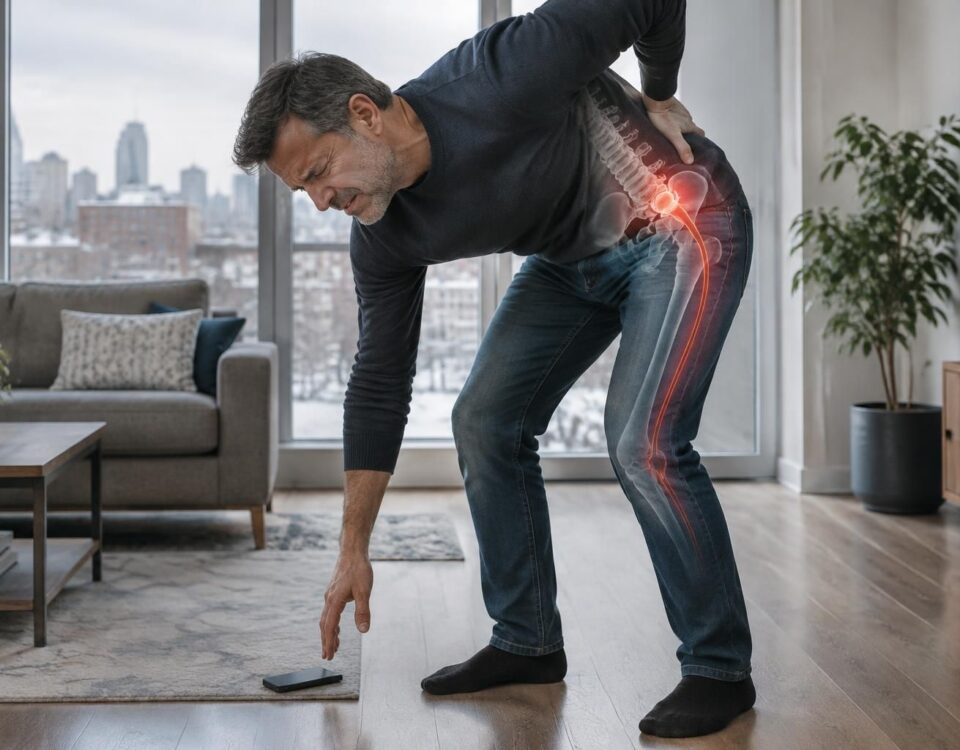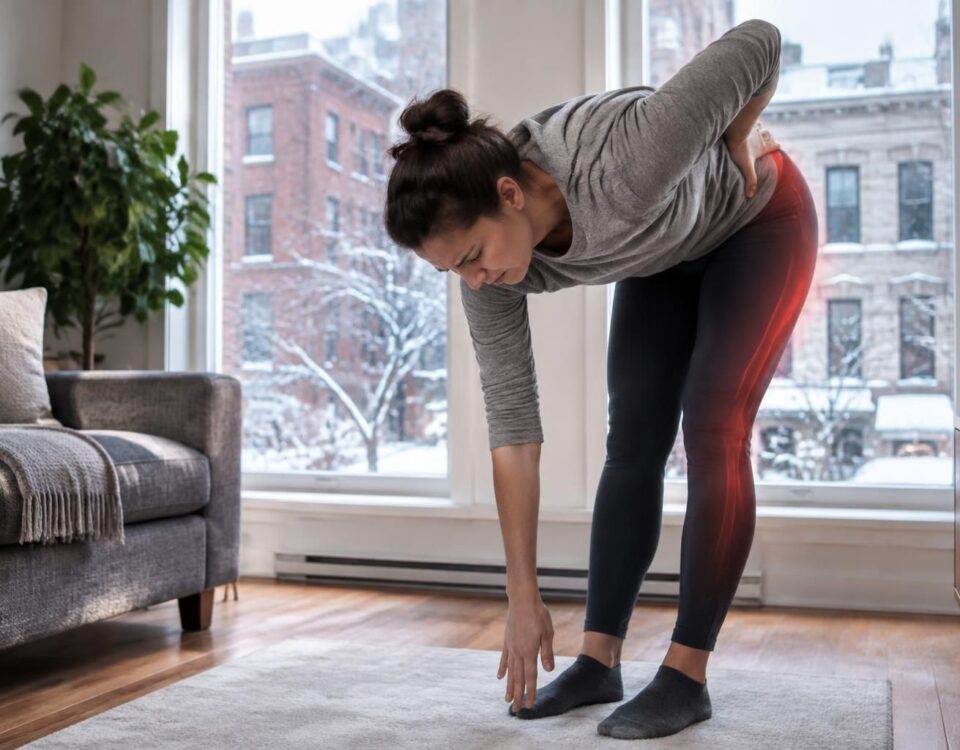


Sciatica and Making the Bed: Repeated Flexion and Lumbar Irritation
21/11/2026
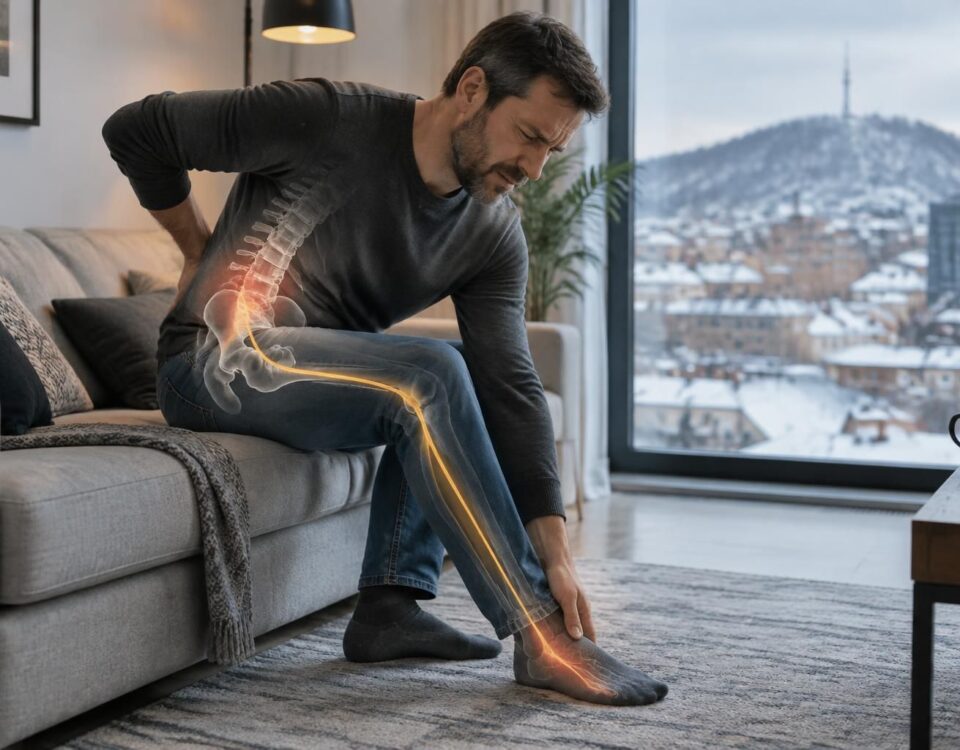
Sciatica in Terrebonne: pain worsened in sitting position and lumbar disc
22/11/2026
IN BRIEF
| Worsening sciatica in a sitting position may be related to lower back irritation, sometimes associated with a disc, without this sign being sufficient to establish the cause. In Montreal, an evaluation that considers symptoms, strength, sensitivity, and function helps guide the next steps. Alternating positions and moving according to tolerance can help manage discomfort more effectively. |
Pain that increases while sitting and radiates into the buttock or leg may be consistent with disc or nerve irritation, but does not allow for a sole determination of the cause. Time spent sitting, posture, and lack of movement can also contribute to symptoms. At TAGMED Clinic in Mont-Royal, an evaluation can relate the pain trajectory, strength, sensitivity, and, if necessary, imaging results to guide the next steps. New or progressive weakness, significant loss of sensitivity, or urinary or bowel issues require urgent medical evaluation.
Sciatic pain that worsens in a sitting position may be related to irritation of a lumbar nerve, sometimes associated with a lumbar disc. Position, duration of sitting, and sensations felt in the leg provide clues but are not sufficient to establish a diagnosis. In Montreal, a clinical evaluation can help connect symptoms, function, and imaging studies when relevant, and then determine the appropriate next steps. Sciatica describes pain that follows part of the sciatic nerve pathway. It can start from the lower back or buttock and radiate into the thigh, calf, or foot. Some people also experience tingling, numbness, or weakness. Pain while sitting may be compatible with irritation of a lumbar nerve root or disc-related sensitivity. However, this sign does not confirm a herniated disc or any other specific condition. Other structures of the back, hip, or leg can also contribute to symptoms. The bending of the lower back, pressure on the discs, and time spent without changing position can influence pain in some individuals. Sitting posture in a vehicle may also play a role, as vibrations and prolonged maintenance in one position limit movement options. The sitting position alters the load on the lower back. A bent or held position for a long time can make an already sensitive area more irritable. The response varies from person to person: some tolerate a chair but react after a long journey; others feel discomfort as soon as they sit down. Duration often matters as much as position. There is no universal limit to sitting time. A practical approach is to observe how long a position remains tolerable and whether symptoms decrease after a change of position. Generally, it is not necessary to avoid sitting completely. It can be helpful to alternate positions according to tolerance. A lumbar cushion or a modification of seating may help some people, but may not suit everyone. For general advice on sitting position, check out this article on sciatica and sitting positions. A lumbar disc may contribute to radicular pain if it irritates or compresses a nerve root. A herniation, protrusion, or narrowing of the opening through which the nerve exits can be among the possible causes. However, an MRI image alone does not explain the symptoms: some disc changes also appear in people without pain. The evaluation must therefore compare several elements: the pain trajectory, the affected side, changes in sensitivity or strength, effects on walking, and available imaging results. To better understand a possible link between the L5-S1 region and the symptoms, read the guidelines on L5-S1 foraminal compression. Pain that appears after exertion may also require an analysis of the context and its evolution. Pain that radiates further down the leg, becomes more frequent, or is accompanied by weakness should be reported during a consultation. A loss of sensitivity in the toes should also be evaluated based on its intensity, location, and progression. A useful evaluation does not rely solely on the result of an X-ray or MRI. It takes into account the symptoms and their impact on daily activities. At TAGMED Clinic in Mont-Royal, the steps may include: Based on the observed signs, a professional may recommend a medical consultation or further investigation. Imaging examinations are not necessary in all situations. Their usefulness depends on the clinical picture and the evolution. The options depend on the suspected cause, the duration of symptoms, their intensity, and neurological signs. A conservative approach may involve maintaining tolerated activities and a progression adapted to the situation. The choice should be reconsidered if symptoms worsen or function declines. Motorized neurovertebral decompression may be discussed for some individuals after an evaluation. It does not suit all profiles and does not guarantee a result. The professional should monitor the response to treatment with objective benchmarks and revise the plan if the expected progress is not observed. Injections, medical investigation, or specialist advice may be relevant depending on severity, duration, imaging results, and the evolution of neurological signs. Services offered at TAGMED Clinic in Montreal / Mont-Royal are detailed on the page dedicated to sciatica treatment in Montreal. An evaluation may also be requested at TAGMED Clinic, at 1140 Beaumont Avenue, Mont-Royal, QC H3P 3E5. Certain signs require urgent medical evaluation and should not wait for a routine appointment: Night pain that regularly wakes you up, decreased tolerance for sitting, or pain extending further down the leg also warrants reevaluation. These elements do not automatically mean there is a serious condition, but they must be interpreted in context. No. Pain worsened by sitting may be consistent with disc or nerve irritation, but is not sufficient to confirm a herniation. The evaluation takes into account the examination, symptoms, and imaging when required. In general, the goal is not to avoid all sitting. It is better to observe your tolerance and vary positions when it helps limit irritation. There is no identical sitting duration for everyone. The drive combines prolonged posture, vibrations, and few opportunities to change position. These factors can increase symptoms in some individuals. Persistent pain or pain that radiates further down the leg should be mentioned during the evaluation. Its significance depends on its pattern, progression, and associated signs. Pain accompanied by numbness or weakness warrants evaluation. If weakness appears suddenly or progresses, seek medical evaluation promptly. Sylvain Desforges, B.Sc., D.O., N.D., Doctor of Osteopathy and Naturopath, is the founding president of TAGMED and the ACMA association. His practice focuses on chronic pain of the spine, low back pain, and pain that may correspond to sciatica, especially when radiating to the buttock, leg, or foot. Through SOS Sciatique, he publishes educational content on sciatica symptoms, possible causes, and non-surgical approaches that may be considered based on evaluation. Care offered at TAGMED Clinic may include, as appropriate, motorized spinal decompression, specific osteopathy, or precision percussion therapy. To learn more about services in Montreal / Mont-Royal, visit the page on sciatica treatment in Montreal. Services in Terrebonne are described on the page dedicated to sciatica treatment in Terrebonne. Medical disclaimer: The information and advice provided on this site do not replace the opinion, diagnosis, or treatment of a healthcare professional. Please note that Sylvain Desforges, B.Sc., D.O., N.D., Doctor of osteopathy, is neither a medical doctor nor a physician, and is not a specialist in a medical specialty as defined by the College of Physicians of Quebec. Manual medicine, functional medicine, and sports medicine as described on this site exclude any medical treatment or diagnosis made by a physician or medical specialist. Always consult your physician for any medical questions. For more details, please read our complete legal notice. Consult a doctor or urgent care service in case of loss of bowel or bladder control, numbness in the saddle region, significant or progressive weakness, fever, recent trauma, severe pain, or rapid worsening. Osteopathic, manual medicine, or functional support approaches do not replace medical follow-up.Why can sitting increase pain?
Lumbar disc, herniation, and pain that radiates down the leg
How is an evaluation conducted in Montreal?
What options may be considered?
When should you seek prompt consultation?
Frequently Asked Questions About Sciatica While Sitting
Does sitting pain mean I have a herniated disc?
Should I completely avoid sitting?
Why does riding in a car sometimes increase pain?
Is pain that radiates into the foot a significant sign?
About the Author
Medical Disclaimer
Sciatica in Montreal: Pain While Sitting and Lumbar Disc
Practical Tips: understand what may aggravate symptoms and know when to seek an evaluation.
What Pain May Indicate
- Pain in the buttock or leg may increase after a prolonged sitting position.
- Bending the back and sensitivity of a lumbar disc may contribute to symptoms.
- This sign alone does not confirm a herniated disc or sciatica.
- Pain that radiates lower down the leg or weakness warrants reevaluation.
Useful Next Steps
- Break up sitting periods and alternate with walking or standing, based on tolerance.
- An evaluation may consider the pain pattern, strength, sensitivity, and function.
- Imaging, if pertinent, must be related to symptoms and examination.
- Consult quickly in case of progressive weakness; urinary or bowel dysfunction and numbness in the saddle region require urgent evaluation.
Evaluation in Montreal / Mont-Royal: TAGMED Clinic, 1140 Beaumont Avenue, Mont-Royal, QC H3P 3E5. Care is determined based on the evaluation and does not replace medical advice.

Pain that increases while sitting and radiates into the buttock or leg may be consistent with irritation of a lumbar nerve root, sometimes associated with a disc. However, this sign alone is not sufficient to identify the cause. In Montreal / Mont-Royal, a useful evaluation takes into account the pain pattern, strength, sensitivity, and your activities to make appropriate recommendations.

Sciatica in Montreal: pain worsened by flexion and disc-related cause
IN BRIEF Flexion-Aggravated Sciatica is pain that starts in the lower back and may radiate into the buttock or leg; irritation related to a lumbar disc can be a possible cause. In Montreal, an assessment helps clarify the origin of…

Discogenic sciatica in Montreal: why some stretches worsen
IN BRIEF Disc-related sciatica refers to pain related to the irritation of a nerve root, often near a herniated disc. Certain stretches, especially those that emphasize bending or pull on the leg, can worsen symptoms rather than relieve them. In…
Why Can Sitting Position Worsen Pain?
When sitting, the lower back is often bent and remains still for a prolonged period. In some individuals, this posture or the duration spent sitting increases the sensitivity of lumbar structures and the tension felt along the leg. The car can be particularly uncomfortable due to vibrations and difficulty changing position.
Pain aggravated by sitting may align with a disc component, but does not confirm a herniated disc. Other structures or conditions may cause similar symptoms. Likewise, a visible abnormality on imaging does not, by itself, prove it explains the pain: results must correspond to the side, level, and observed signs.

Sciatica disc in Montreal: movements to avoid at the start
IN BRIEF Disc-related sciatica refers to pain related to the irritation of a nerve, sometimes associated with a lumbar disk. Initially, avoid movements that worsen your symptoms, such as lifting a load by bending over or performing repeated twists. Adjusting…

Sciatica in Montreal: disc herniation with leg weakness
IN BRIEF Sciatica related to a herniated disc can irritate a nerve root and cause pain that travels down the leg, sometimes accompanied by weakness. In Montreal, an evaluation helps clarify the cause and guide appropriate care; nonsurgical approaches can…
Simple Gestures to Try Daily
Break Up Sitting Time
There is no ideal duration that applies to everyone. If the pain increases, get up before it becomes severely disabling, walk for a moment, or change your posture. Alternating between sitting, standing, and light walking is generally wiser than avoiding sitting altogether.
Adjust your setup
Try to keep your feet on the ground and bring your chair closer to the work surface to avoid leaning forward. A small lumbar support may be helpful for some people, but it does not replace position changes. When driving, plan breaks when the trip allows and adjust the seat to remain comfortably supported.
Stay active according to your tolerance
Continue, if possible, activities that do not significantly increase your symptoms. A gradual progression of walking and tailored exercises can help maintain function. Avoid forcing a movement that causes pain to travel further down the leg or results in new weakness; seek advice to adapt your activities.

Sciatica in Montreal: herniated disc with foot numbness
IN BRIEF Sciatica related to a herniated disc can cause pain that radiates down the leg and numbness in the foot. In Montreal, an assessment helps to investigate the cause of the symptoms and consider appropriate management without assuming the…

Sciatica in Montreal: lumbar disc and inflammation of the nerve root
IN BRIEF Disc-related sciatica occurs when irritation of the nerve root causes pain that may radiate down into the buttock and leg. In Montreal, an assessment helps identify the cause of the symptoms and consider appropriate non-surgical care based on…
When to seek an evaluation?
Consult a professional if the pain persists, limits sleep or walking, if your tolerance for sitting decreases rapidly, or if symptoms extend towards the calf or foot. The evaluation may include the history of symptoms, observation of gait, strength and sensitivity tests, as well as, when relevant, review of existing imaging studies. Imaging exams are not necessary in all cases.
At TAGMED Clinic, located at 1140 Beaumont Avenue, Mont-Royal, options are discussed based on the evaluation results and your functional goals. A conservative approach may include maintaining tolerated activities and a gradual progression of rehabilitation. Motorized neurovertebral decompression may be considered for certain profiles, but it is neither indicated for everyone nor guaranteed to yield results; the plan should be reassessed based on your response.

Sciatica and disc pinching in Montreal: when space decreases
IN BRIEF The disc herniation refers to a decrease in space between two vertebrae; it can irritate a nerve root and contribute to sciatica, with pain that radiates into the buttock or leg. In Montreal, an assessment helps specify the…

Sciatica and disc bulge in Montreal: possible cause of nerve irritation
IN BRIEF A disc bulge can sometimes irritate a nerve root and contribute to sciatica, with pain in the buttock or leg. Evaluation helps to identify the cause of the symptoms and guide appropriate care; in Montreal, a consultation can…
Signs that should not wait
A new or progressive weakness, a foot drop, a leg giving way, loss of bladder or bowel control, or numbness in the saddle area require urgent medical evaluation. Also consult promptly in the case of significant trauma, fever, or general deterioration. These signs should not wait for a routine appointment.
About the author
Sylvain Desforges, B.Sc., D.O., N.D., Doctor of Osteopathy and naturopath, is the founding president of TAGMED and the ACMA association. His practice focuses on chronic spinal pain and pain compatible with sciatica. Services and care are determined based on the evaluation and the qualifications of the respective professionals.
Medical disclaimer
This content is provided for educational purposes and does not replace a consultation, diagnosis, or treatment by a licensed healthcare professional. The author is neither a physician nor a specialist in a medical specialty recognized by the Collège des médecins du Québec. The approaches described do not constitute medical acts and do not replace medical follow-up.
| Marker | To remember |
|---|---|
| Pain while sitting | May accompany lumbar or disc irritation without confirming it. |
| Time spent without moving | Break up sitting periods and change positions as tolerated. |
| Pain in the buttock or leg | Note its route, evolution, and effect on activities. |
| Pain that goes lower | If it persists or progresses, request a reevaluation. |
| Numbness or weakness | Have neurological signs evaluated; new weakness requires prompt attention. |
| Disc imaging | To be interpreted with symptoms and the examination, not in isolation. |
| Car or long trips | Posture, vibrations, and immobility may exacerbate symptoms. |
| Loss of bladder or bowel control | Consult urgently, without waiting for a routine appointment. |
Illustrative testimonials: sciatica in Montreal, sitting pain, and lumbar disc
Important: the stories below are fictitious and composite examples created for educational purposes. They do not come from real patients and do not guarantee results. Pain that increases while sitting can have several causes; it does not alone confirm a lumbar disc problem or sciatica.
“After about twenty minutes sitting, the pain started in my buttock and went down the back of my thigh.” In this example, the person notices that long car trips and extended workdays worsen their symptoms. The evaluation considers their route, duration, positions that modify it, and their effect on walking and sleeping, rather than drawing a conclusion from a single sign.
“My MRI mentioned a lumbar disc, but I didn’t know if it was really the cause of my pain.” A medical image must be interpreted with the symptoms and examination. The level and side observed in the imaging must match the pain, sensitivity changes, or potential weakness. A visible disc abnormality alone is not sufficient to establish the source of the symptoms.
“I thought I had to completely avoid sitting.” In this example, the person tries instead to break up sitting periods and alternate with short periods of standing or walking, according to their tolerance. There is no universal duration suitable for everyone; the important thing is to monitor the reaction of the symptoms and their recovery after a position change.
“In the car, the pain seemed harder to manage.” A sustained posture, vibrations, and limited opportunities to move may contribute to discomfort in some people. Adapting the setup and planning breaks when possible can help manage the position better, without replacing an evaluation if the pain persists or worsens.
During an evaluation at TAGMED Clinic in Montreal / Mont-Royal, the history of symptoms, walking, strength, sensitivity, and relevant movements can be examined. Existing imaging studies are considered when necessary and correlated with clinical signs. A plan may include tolerated activities, gradual progression, and reevaluation; motorized neurovertebral decompression may be discussed for selected individuals, without guaranteed results.
Pain that radiates further down the leg, a progressing numbness, or new weakness should be reported promptly to a healthcare professional. In cases of new urinary or bowel issues, numbness in the saddle region, significant or rapidly increasing weakness, or recent foot drop, seek urgent medical evaluation rather than waiting for a routine appointment.
Sylvain Desforges, B.Sc., D.O., N.D., Doctor of Osteopathy and naturopath, is the founding president of TAGMED and the ACMA association. He publishes educational content on spinal pain and symptoms compatible with sciatica.
Medical warning: this information is provided for educational purposes and does not replace consultation, diagnosis, or treatment by a licensed healthcare professional. The author is neither a physician nor a specialist in a medical field recognized by the Collège des médecins du Québec. Osteopathy and functional support approaches do not replace medical follow-up.
Sciatica in Montreal: pain aggravated in sitting position and role of the lumbar disc
In Montreal, many people consult for pain that starts from the lower back or buttock and radiates down the leg. When it intensifies in a sitting position, the lumbar disc and possible irritation of a nerve root may be among the factors to examine. However, this symptom alone is not sufficient to establish a diagnosis: other structures in the back, hip, or leg may also contribute to the pain.
While seated, the lower back is often flexed and remains still for a period of time. In some individuals, this posture may increase sensitivity in the lumbar region or tension felt along the nervous system. The duration spent immobile can be as important as the posture itself. A car ride can also be uncomfortable, especially due to vibrations and the difficulty of frequently changing position.
Pain compatible with sciatica may manifest in the buttock, thigh, calf, or foot. Tingling, numbness, or weakness may also be present. If the pain radiates further down the leg, becomes more frequent, or further limits walking and daily activities, it is important to report this to a healthcare professional. The distribution of symptoms and their evolution help guide the evaluation.
A medical image alone cannot determine the cause of symptoms. A visible disc anomaly on imaging may not correspond to the perceived pain. The analysis should instead relate symptoms to function, physical examination, and, when relevant, imaging results. The evaluation may focus on walking, strength, sensitivity, and tests tailored to the presentation. Previous examinations are studied considering the affected side and the pain trajectory.
Sylvain Desforges, osteopath and naturopath, is the founding president of TAGMED clinics and the ACMA association. His career is dedicated to managing chronic pain and integrating care approaches and technologies in patient support. At TAGMED Clinic, the options considered depend on the evaluation and individual needs. They may include a conservative approach, specific osteopathy, or, for selected individuals, a discussion about motorized neurovertebral decompression. This option is not suitable for everyone nor a guarantee of results; the response must be monitored and re-evaluated.
While awaiting evaluation, it may be helpful to alternate sitting periods with short standing breaks or walking, depending on tolerance. A lumbar cushion may sometimes help, but there is no universal duration for which everyone can remain seated. The aim is generally to adapt and break up activities rather than completely avoid sitting. If tolerance decreases rapidly or symptoms progress, request a re-evaluation.
Quickly consult a doctor or emergency service in case of new, significant, or progressive weakness, foot drop, leg giving way, urinary or bowel disturbances, or numbness in the saddle region. Severe pain that rapidly worsens, significant trauma, fever, or general deterioration also require medical attention without waiting for a routine appointment.
Medical warning: this content is provided for educational purposes and does not replace consultation, diagnosis, or treatment by a licensed healthcare professional. Sylvain Desforges is neither a physician nor a specialist in a medical field recognized by the Collège des médecins du Québec. Osteopathy and functional support approaches do not replace medical follow-up.
In Montreal, pain that worsens in a sitting position and radiates down the buttock or leg may be compatible with irritation of a lumbar nerve root, sometimes associated with a sensitive disc or herniation. However, the sitting posture does not establish the cause by itself: the evolution of symptoms, function, and neurological signs must also be considered.
Understanding the effect of sitting position
Prolonged sitting, especially without changing position, can exacerbate symptoms in some individuals. Flexion of the lower back, pressure on lumbar structures, and sensitivity of nerve tissues can contribute to discomfort. Being in a car can also be difficult to tolerate due to vibrations and limited opportunities to move. To better understand these factors, consult this page on sciatica aggravated in sitting position.
Generally, it is not necessary to completely avoid sitting. Instead, try to alternate, depending on your tolerance, between sitting, standing, and walking. A lumbar cushion may provide comfort for some individuals, but it does not replace position changes. There is no universal sitting duration: observe how symptoms evolve during and after activity.
The lumbar disc and symptoms in the leg
Pain radiating below the knee, tingling, or numbness may warrant evaluation, but do not prove alone that a disc herniation is present. An MRI image should be interpreted based on the side, vertebral level, and the observed symptoms. To differentiate the terms, consult the article on disc protrusion and disc herniation.
The distribution of sensations and their evolution also matter. Numbness in the big toe, pain in the buttock without back pain, or difficulty in lifting the foot are different presentations that must be described precisely to the consulted professional. You can learn more about these examples: numbness in the big toe and lower back pain, pain in the buttock without back pain, and difficulty in lifting the foot.
Choosing the Next Steps in Montreal
A relevant evaluation takes into account the trajectory of pain, its duration, its impact on sleep and activities, as well as strength, sensitivity, and gait. Existing imaging studies can be correlated with clinical observations when useful. A plan may then provide for the maintenance of tolerated activities, gradual progression, and a reevaluation of goals. Motorized neurovertebral decompression may be discussed for select individuals, without a guarantee of results and with monitoring of the response.
At the TAGMED Clinic, located at 1140 Beaumont Avenue, Mont-Royal, the evaluation aims to relate symptoms, function, and available information before considering care. To learn about services related to sciatica treatment in Montreal / Mont-Royal, consult the clinic’s resources. Additional information on sciatica and osteopathy in Montreal as well as on lower back pain and sciatica is also available.
Consult a professional quickly if the pain spreads further down the leg, if your tolerance for walking or sitting decreases, or if numbness or weakness appears or progresses. Significant or rapidly increasing weakness, recent foot drop, loss of bladder or bowel control, or numbness in the saddle region require urgent medical evaluation rather than a routine appointment.

Sylvain Desforges, B.Sc., D.O., N.D., docteur en ostéopathie
Dr Sylvain Desforges, B.Sc., D.O., N.D., osteopath, is the founding president of TAGMED and of the ACMA association. He dedicates his practice to chronic spinal pain, low back pain and symptoms compatible with sciatica, particularly when pain radiates toward the buttock, leg, calf, foot or toes.
Through SOS Sciatique, he publishes educational content on sciatica symptoms, possible causes such as disc herniation, disc narrowing, foraminal stenosis or irritation of a lumbar nerve root, as well as non-surgical approaches that may be considered according to the evaluation. At Clinique TAGMED, care may include, depending on the case, motorized neurovertebral decompression, specific osteopathic care or precision percussion.
For an evaluation related to sciatica treatment in Montreal / Mount Royal or sciatica treatment in Terrebonne, please consult the services available at Clinique TAGMED.
Medical disclaimer
The information published on SOS Sciatique is provided for educational purposes only and does not replace a consultation, diagnosis, opinion or treatment provided by a physician or another authorized healthcare professional. The author of this article is neither a medical doctor nor a specialist in a medical specialty recognized by the Collège des médecins du Québec. The osteopathic, manual medicine or functional support approaches described on this site do not constitute medical acts and are not intended to replace medical follow-up.
Consult a physician or emergency service in cases of loss of bladder or bowel control, anesthesia in the saddle area, significant or progressive weakness in the leg or foot, fever, recent trauma, severe pain or rapid worsening of symptoms. For more details, please read our Legal Notice.