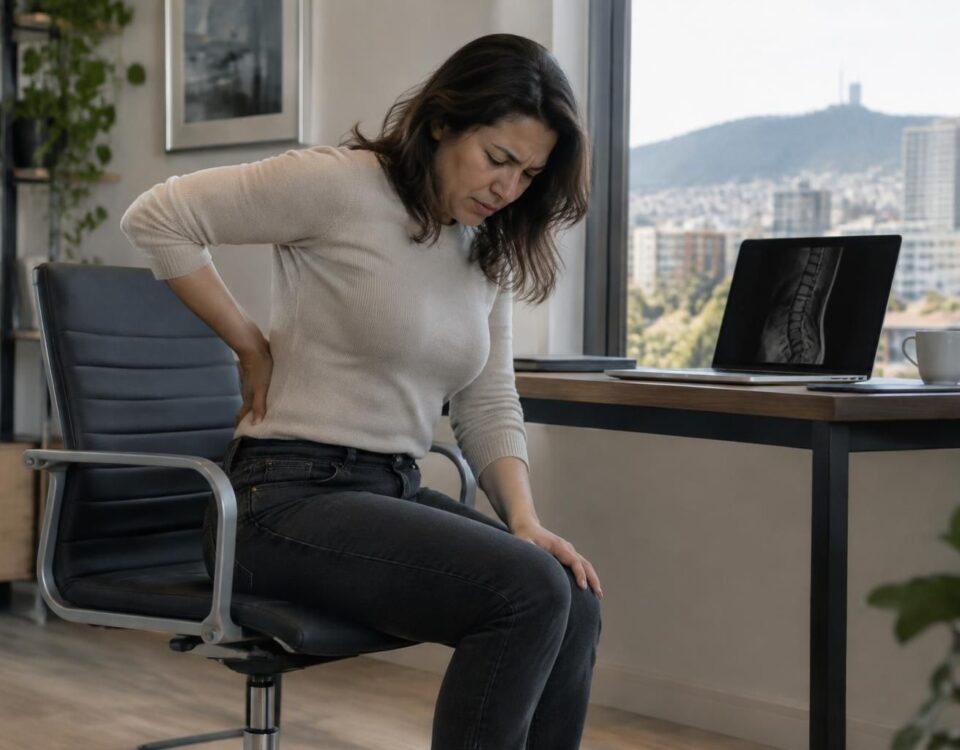
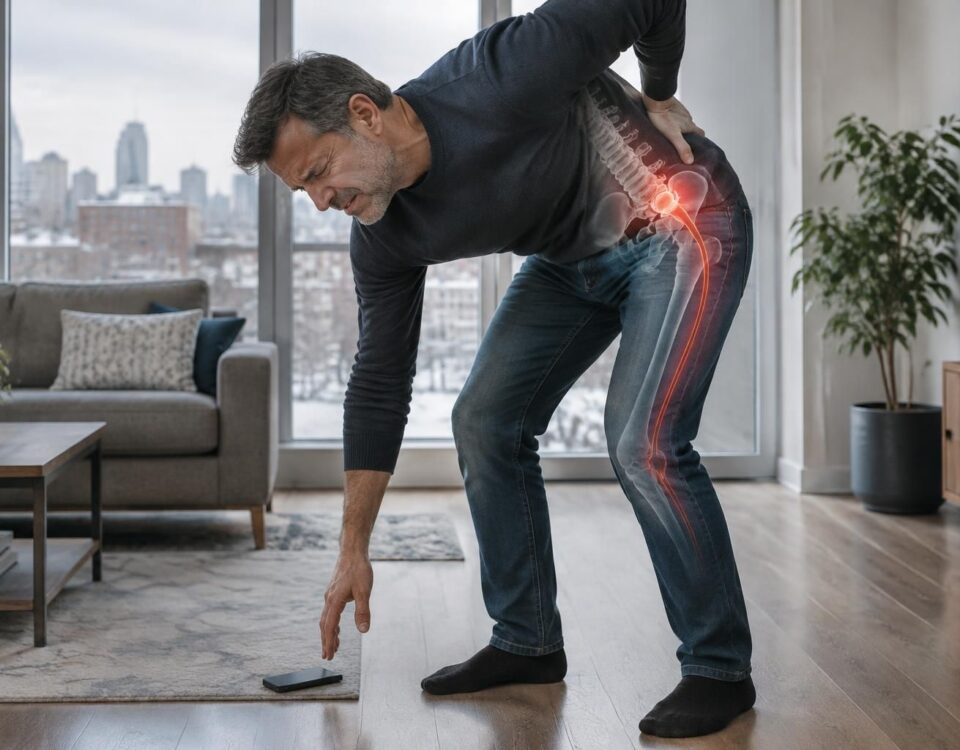
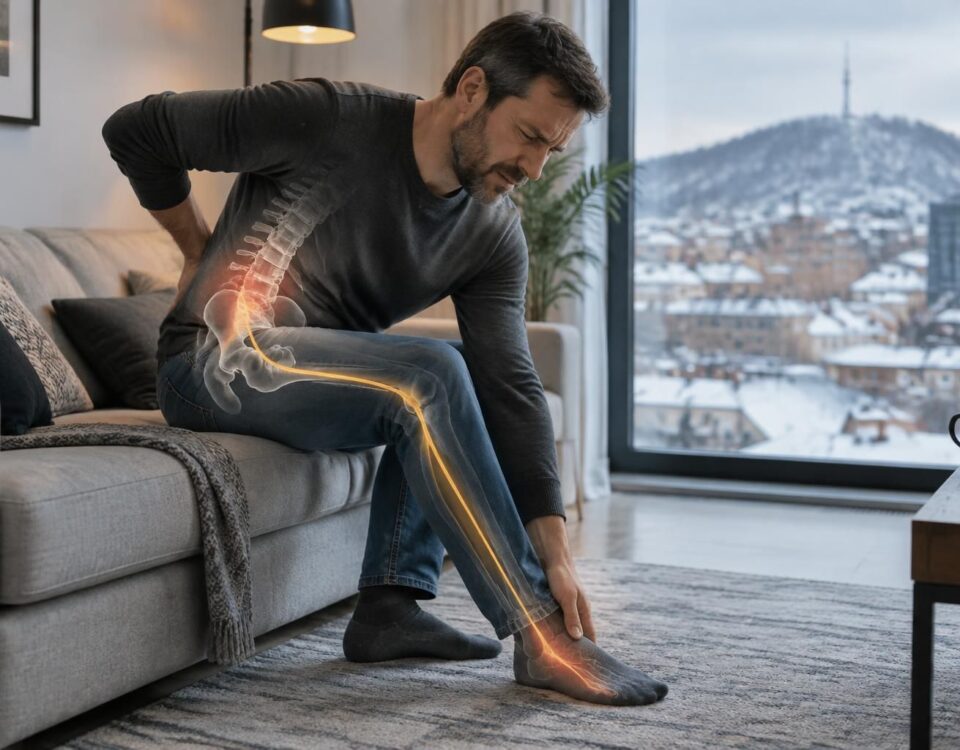
Sciatica and washing feet: lumbar flexion to monitor
19/11/2026
Disc herniation in Terrebonne: why some stretches worsen
20/11/2026
IN BRIEF Disc-related sciatica refers to pain related to the irritation of a nerve root, often near a herniated disc. Certain stretches, especially those that emphasize bending or pull on the leg, can worsen symptoms rather than relieve them. In Montreal, prioritize gentle movements appropriate to your tolerance and stop if the pain travels further down the leg, increases, or is accompanied by numbness. A healthcare professional can help you choose the appropriate exercises. |
In the case of disc-related sciatica in Montreal, certain stretches may worsen the irritation of a nerve root, especially if they increase pressure on the disc or cause pain to travel further down the leg. Back bends and intense stretches may not be suitable for everyone. Prioritize gentle movements, only if they relieve, and stop if there is increased radiating pain, tingling, or weakness. A healthcare professional can help you select exercises appropriate for your situation.
A disc-related sciatica can worsen with certain stretches because a movement that pulls on the leg or bends the lower back can further irritate an already sensitive nerve root. The reaction varies depending on the cause and symptoms. In Montreal, a professional assessment can help clarify the origin of the pain and avoid movements that exacerbate it.
Sciatica refers to pain that follows the path of a nerve in the buttock and leg. A lumbar herniated disc can irritate or compress a nerve root and cause this pain. Symptoms may include shooting pains, burning sensations, tingling, or numbness. They can sometimes reach the calf, foot, or toes.
A stretch may seem helpful when a muscle feels tight. However, this sensation does not always mean the muscle needs to be stretched. Tension can also come from the irritated nerve or the tissues surrounding it. Pulling harder may then increase pain instead of relieving it.
Movement can pull on a sensitive nerve
Some movements combine bending of the lower back and stretching of the back of the thigh. This position can increase tension along the nervous system. In some individuals, pain may then extend further down the leg. Pain that extends toward the foot, or is accompanied by new tingling, indicates that the movement should be stopped.
The reaction depends on the cause, the location of the irritation, and each individual’s sensitivity. A stretch that feels comfortable for one person may worsen the symptoms of another. Therefore, there is no universal movement for disc-related sciatica.
Bending is not suitable for all cases
Movements that round the lower back may increase symptoms in some people with a herniated disc. Other causes of nerve pain may react differently. Diagnosis and examination of symptoms help understand which movements are poorly tolerated. To learn more, check this information on the link between herniated disc and sciatica.
A bulging or degenerative disc does not automatically cause sciatica. Imaging results must be correlated with symptoms and clinical examination. You can read this content about bulging disc and disc degeneration.
How to recognize that a stretch worsens symptoms
A movement should be stopped if it increases pain traveling down the leg, triggers an electric sensation, or intensifies tingling and numbness. New weakness is also a warning sign. Do not force a stretch in hopes of “unlocking” the nerve.
Also, observe the area where the pain manifests. If it moves away from the buttock and travels further toward the calf or foot, the movement may irritate the nerve. If symptoms change repeatedly or persist after the movement, seek the advice of a healthcare professional.
Slight muscle sensitivity is not the same as intensifying nerve pain. When in doubt, avoid testing multiple stretches alone. An assessment can help differentiate muscle tension from nerve irritation.

Sciatica in Montreal: herniated disc and painful cough
IN BRIEF Sciatica is a pain that extends from the lower back to the buttock and leg; a herniated disc can irritate a nerve root. Coughing can exacerbate the pain by increasing pressure in the back. In Montreal, an evaluation…
Why an accurate diagnosis matters in Montreal
Pain in the leg can have several causes. A herniated disc, narrowing of nerve openings, or other changes in the spine may contribute to symptoms. The presence of a herniation on imaging alone is insufficient to explain the intensity of the pain. The healthcare professional considers the location of symptoms, their evolution, and examination results.
Some cases involve a herniation located between the L5 and S1 vertebrae. Symptoms vary based on the affected nerve root. Consult this resource on the possible symptoms of an L5-S1 herniated disc.
The shape of the herniation and its location can also influence the assessment. An extruded herniated disc must be interpreted with clinical signs. To better understand the role of diagnosis, also consult this article on the importance of an accurate diagnosis.

Sciatica in Montreal: pain worsened when sitting and lumbar disc
IN BRIEF Worsening sciatica in a sitting position may be related to lower back irritation, sometimes associated with a disc, without this sign being sufficient to establish the cause. In Montreal, an evaluation that considers symptoms, strength, sensitivity, and function…
What precautions to take when pain travels down the leg
While waiting for an evaluation, avoid movements that clearly intensify symptoms. Do not try to gain range of motion and do not hold a painful position. Alternate positions according to your tolerance and avoid staying too long in a posture that increases pain. These measures do not replace a diagnosis.
Persistent or recurring pain merits evaluation, especially if it limits sleep, walking, or usual activities. The professional can examine strength, sensitivity, and reflexes, then determine if further examinations are needed. To better understand possible mechanisms, consult this resource on the herniated disc and sciatica in Montreal.

Sciatica in Montreal: pain worsened by flexion and disc-related cause
IN BRIEF Flexion-Aggravated Sciatica is pain that starts in the lower back and may radiate into the buttock or leg; irritation related to a lumbar disc can be a possible cause. In Montreal, an assessment helps clarify the origin of…
What management options to discuss
Care depends on the cause, the intensity of symptoms, and the examination. A professional can explain the options suitable for your situation and determine if a non-surgical approach can be considered. No method guarantees relief, and any intervention should not replace medical follow-up when necessary.
At the TAGMED Clinic, the assessment can guide towards treatments such as specific osteopathy or, as applicable, motorized neurovertebral decompression and precision impactors. These approaches should be considered based on your condition and do not constitute a medical diagnosis or replace care prescribed by a physician. Also, discover the clinic’s information on disc herniation and chronic sciatica.

Sciatica disc in Montreal: movements to avoid at the start
IN BRIEF Disc-related sciatica refers to pain related to the irritation of a nerve, sometimes associated with a lumbar disk. Initially, avoid movements that worsen your symptoms, such as lifting a load by bending over or performing repeated twists. Adjusting…
When to seek prompt medical attention
Consult a doctor if the pain worsens, persists, or prevents your usual activities. Seek urgent help in case of significant or progressive weakness in the leg or foot, new difficulty in lifting the foot, or loss of bladder or bowel control.
Numbness in the saddle area, around the genitals or anus, also requires urgent evaluation. Fever, recent trauma, severe pain, or rapid worsening also warrant prompt consultation.
About the author
Sylvain Desforges, B.Sc., D.O., N.D., Doctor of Osteopathy and Naturopath, is the founding president of TAGMED and the ACMA association. His practice focuses on chronic pain of the spine, lower back pain, and pain compatible with sciatica, especially when radiating down to the buttock, leg, calf, foot, or toes.
Through SOS Sciatique, he publishes educational content on the symptoms of sciatica, its possible causes, and non-surgical approaches that may be considered after an evaluation. For an assessment in Montreal or Mont-Royal, check the information on the treatment of sciatica in Montreal / Mont-Royal. For Terrebonne, refer to the page on the treatment of sciatica in Terrebonne.
Medical Disclaimer
The information published on SOS Sciatique is provided for educational purposes. It does not replace a consultation, diagnosis, advice, or treatment performed by a physician or another authorized healthcare professional. The author of this article is neither a physician nor a specialist in a medical specialty recognized by the Collège des médecins du Québec. The osteopathy, manual medicine, or functional support approaches described on this site do not constitute medical acts and are not intended to replace medical follow-up. Consult a physician or an emergency service in case of loss of bladder or bowel control, anesthesia in the saddle region, significant or progressive weakness in the leg or foot, fever, recent trauma, severe pain, or rapid worsening. Please see our Legal Notice for more details.
Medical Disclaimer: The information and advice provided on this site do not replace the advice, diagnosis, or treatment by a healthcare professional. Please note that Sylvain Desforges, B.Sc., D.O., N.D., Doctor of osteopathy, is neither a medical doctor nor a physician and is not a specialist in a medical specialty as defined by the Collège des médecins du Québec. Manual medicine, functional medicine, and sports medicine as described on this site exclude any medical treatment or diagnosis made by a physician or specialist. Always consult your doctor for any medical questions. For more details, please read our complete Legal Notice.
Appropriate exercises depend on the cause of the symptoms and their reaction to movement. In case of persistent or worsening pain, seek advice from a healthcare professional.


Sciatica in Montreal: disc herniation with leg weakness
IN BRIEF Sciatica related to a herniated disc can irritate a nerve root and cause pain that travels down the leg, sometimes accompanied by weakness. In Montreal, an evaluation helps clarify the cause and guide appropriate care; nonsurgical approaches can…
Disc herniation sciatica in Montreal: why some stretches worsen pain
In case of disc herniation sciatica, a stretch is not automatically beneficial: depending on the direction of movement and irritation of the nerve, it can exacerbate the pain or cause it to radiate further down the leg. In Montreal, as elsewhere, prioritize gentle movements, observe your symptoms’ reaction, and stop any exercise that increases radiation, tingling, or numbness.

Sciatica in Montreal: herniated disc with foot numbness
IN BRIEF Sciatica related to a herniated disc can cause pain that radiates down the leg and numbness in the foot. In Montreal, an assessment helps to investigate the cause of the symptoms and consider appropriate management without assuming the…
Why can stretching irritate the sciatic nerve?
Sciatica describes pain that follows the path of the nerve, often from the buttock to the thigh, calf, or foot. When irritation of a nerve root is linked to a lumbar disc, certain movements place more strain on the tissues around the nerve. A deep bending of the back, for example, may be poorly tolerated by some individuals. Others may experience worsening when arching the lower back.
A muscle that feels tense does not necessarily mean it needs to be strongly stretched. The sensation may also come from a sensitized nerve. Pulling insistently on the back of the thigh or buttock may then reproduce an electric or burning pain. Do not try to force to “unwind” the area.

Sciatica in Montreal: lumbar disc and inflammation of the nerve root
IN BRIEF Disc-related sciatica occurs when irritation of the nerve root causes pain that may radiate down into the buttock and leg. In Montreal, an assessment helps identify the cause of the symptoms and consider appropriate non-surgical care based on…
How to recognize a poorly tolerated movement?
During exercise, a slight sensation of stretching or moderate soreness may occur. However, stop the movement if the pain significantly increases, travels lower down the leg, or is accompanied by new tingling, increased numbness, or weakness.
On the other hand, if the pain in the leg decreases and moves closer to the buttock or lower back, the movement may be better tolerated. However, this change alone does not determine the cause or the appropriate treatment. Note the movements that improve or worsen your symptoms to discuss with a healthcare professional.

Sciatica and disc pinching in Montreal: when space decreases
IN BRIEF The disc herniation refers to a decrease in space between two vertebrae; it can irritate a nerve root and contribute to sciatica, with pain that radiates into the buttock or leg. In Montreal, an assessment helps specify the…
Recommendations for Moving Cautiously
Start Slowly
Choose an easy movement and do a few repetitions without jerking. For a knee-to-chest stretch, for example, bring one knee toward you only within a comfortable range. Avoid it if bending increases the pain in your leg. Similarly, the piriformis stretch, seated twist, or child’s pose may not be suitable for everyone: stop them if symptoms intensify.
Avoid Intense Stretching
Regularity and gentleness are preferable to long holds or strong pulls. Don’t do all the proposed exercises just because they are popular. The appropriate movement depends, in part, on the cause of the symptoms and how your body reacts. A physiotherapist or another qualified professional can help you choose and adjust exercises.
Stay Active Without Causing a Flare-Up
Short and frequent walks may be easier than a long outing. Change positions regularly and avoid lifting a load while twisting your torso. Reduce activity if every step gradually worsens the pain. Don’t continue an exercise in the hope that nerve pain will eventually “go away.”
When to Seek Medical Evaluation?
Consult a professional if the pain persists, worsens, or limits your activities. A new or progressive weakness, difficulty lifting the foot, loss of bladder or bowel control, or numbness in the saddle area require urgent evaluation.
About the Author
Sylvain Desforges, B.Sc., D.O., N.D., is a doctor of osteopathy and naturopath, founding president of TAGMED and the ACMA association. His practice focuses on chronic spinal pain and pain compatible with sciatica. The information presented is educational and does not replace a consultation or medical advice. The author is neither a physician nor a specialist in a medical specialty recognized by the Collège des médecins du Québec.
| Stretch or Movement | Why It May Worsen a Disc-Related Sciatica |
|---|---|
| Knee to Chest | Bending the lower back may accentuate symptoms in some individuals. |
| Child’s Pose | It rounds the back and may further irritate the nerve root. |
| Intense Hamstring Stretch | The tension may pull on an already sensitive nerve and cause pain to travel down the leg. |
| Seated Torso Twist | Forced rotation may increase low back or radiating pain. |
| Piriformis Stretch | It may cause irritation if the position triggers or accentuates symptoms in the leg. |
| Quick or Forced Repetitions | A sudden movement may intensify symptoms; prioritize a comfortable range. |
| Pain Traveling Lower in the Leg | This is a signal to stop exercising and seek advice from a healthcare professional. |
Disc-related Sciatica in Montreal: Illustrative Testimonials on Stretches That Worsen Pain
The situations below are fictional and composite examples, designed to illustrate possible experiences. They do not represent verified patient testimonials and do not allow for a diagnosis. In cases of disc-related sciatica, a stretch that relieves one person may worsen the symptoms of another.
“I thought I needed to stretch more” — In Montreal, Marc, 42, feels pain that starts from the lower back and travels down the back of the thigh to the calf. He tries to stretch the back of his leg intensely, believing that a tight muscle is the cause. Each time, the pain radiates further down, and tingling appears. In such situations, pulling harder can irritate an already sensitive nerve root rather than simply loosen a muscle.
“Knee to chest made my discomfort worse” — Sophie, 51, notices that bringing her knees toward her chest increases her lower back discomfort and shooting pains in her leg. Some bending movements can be poorly tolerated, especially in individuals whose symptoms are associated with a disc herniation. This does not mean that this exercise is always inappropriate, but rather that individual reactions must be taken into account and it should not be continued if the pain intensifies or travels further down the leg.
“Seated twisting triggered my symptoms” — Jean, 60, tries a seated stretch with the torso twisted toward a crossed leg. He then feels a jolt in the buttock and calf. A twist combined with a bend can be uncomfortable for some people; trying to increase range or maintain the posture despite pain is not a good strategy. Movement should remain gentle and not provoke increasing nerve pain.
“I replaced forced stretches with gradual movements” — Nadia, 47, discovers that intense stretches do not help her during a painful flare-up. Instead, she chooses to change positions regularly and take short walks, according to her tolerance. For some, staying gently active is easier to manage than holding a stretch position for long periods. However, the level of activity should be adapted to symptoms and evaluated by a healthcare professional.
These examples highlight a useful rule: do not force a stretch that increases pain, burning, tingling, or numbness. If the pain seems to travel from the leg to the buttock or lower back, this may indicate better tolerance to movement; if it travels further down the leg or intensifies, stop the exercise and seek advice. The response to movements varies based on the cause of the symptoms, their intensity, and each person’s situation.
In cases of persistent pain or pain that limits activities, a doctor or another authorized healthcare professional can evaluate symptoms and guide the next steps. Seek urgent medical attention in cases of significant or progressive weakness in the leg or foot, loss of urinary or bowel control, or numbness in the saddle area.
Medical warning: this content is provided for educational purposes and does not replace a consultation, diagnosis, or treatment by a licensed health professional. The exercises may not be suitable for all causes of sciatica. Do not pursue a movement that aggravates your symptoms.
Disc herniation sciatica in Montreal: why some stretches worsen the pain
Disc herniation sciatica refers to pain that follows the course of the sciatic nerve and may be related to irritation of a nerve root in the lower back, particularly in the presence of a herniated disc. The pain may start in the lumbar region or the buttock, then descend into the thigh, calf, or down to the foot. Tingling, a burning sensation, or numbness may also occur. The term “sciatica” describes a set of symptoms: it is not enough to determine their cause or the exercise that will be appropriate.
In Montreal, as elsewhere, people seeking relief from their pain sometimes try to stretch the back of the thigh, the buttocks, or the lower back intensely. However, a stretch is not automatically beneficial. When the nerve is irritated, putting more tension on the tissues around it can exacerbate symptoms. The feeling of stiffness behind the thigh may thus be related, in part, to nerve sensitivity rather than a muscle simply needing to be strongly stretched.
Some movements of lumbar flexion, such as bringing the knee towards the chest or holding the child’s pose for long periods, may worsen symptoms in some people with a herniated disc. They are not necessarily bad for everyone: their effect depends on the situation and the body’s response. If the pain increases, travels further down the leg, or is accompanied by new tingling, it is better to stop the movement rather than trying to “push through”.
Conversely, some people find a more comfortable position by leaning slightly forward, while others feel better with a gentle back extension. There is therefore no universal series of exercises. A useful indicator is to observe the evolution of the pain: if it moves from the leg to the buttock or lower back, it may represent a favorable response. If it progresses towards the calf or foot, or if numbness increases, stop the exercise and seek advice from a health professional.
A gentle stretch of the piriformis, a knee-to-chest movement, or a four-point mobilization can be considered only if they remain comfortable and suitable for the individual. Practice slowly, without bouncing or forcing the range. Walking in short bursts and frequently changing position can also help maintain tolerable activity. However, avoid twisting the back while lifting a load and exercises that repeatedly trigger pain radiating into the leg.
A personalized assessment can check strength, sensitivity, movements that worsen symptoms, and those that seem better tolerated. A physiotherapist or doctor can guide the progression of exercises and determine if further investigation is necessary. Manual therapy or functional approaches can be discussed based on the assessment but do not replace a medical diagnosis. Medications, injections, or possible surgery also involve discussions with a licensed professional, depending on the symptoms and examination results.
Sylvain Desforges, B.Sc., D.O., N.D., is an osteopath and naturopath, and founder president of TAGMED clinics and the ACMA association. His practice focuses on the management of chronic pain and the use of approaches and technologies such as neurovertebral decompression, laser, and shock waves. He is neither a doctor nor a specialist in a medical specialty recognized by the Collège des médecins du Québec. The information presented is educational and does not replace a medical consultation.
Quickly consult an emergency service in case of loss of control of the bladder or bowels, numbness in the saddle area, or significant or progressive weakness of the leg or foot. Severe pain, rapid escalation, fever, or recent trauma also warrant medical evaluation.
In Montreal, disc herniation sciatica can make walking, sleeping, and daily activities difficult. Some stretches, although often presented as beneficial, can exacerbate symptoms if they increase tension on an already irritated nerve or stress the back in a poorly tolerated direction. Therefore, there is no universal movement: exercise must be adapted to the likely cause of the pain and discontinued if it causes the pain to descend further into the leg.
Why some stretches can worsen disc herniation sciatica
Sciatica describes pain that follows the course of the nerve, often from the buttock to the thigh, calf, or foot. It may be associated with a protrusion or herniated disc, but its intensity alone does not measure the size of an anomaly observed on imaging. To better understand this distinction, refer to the explanations on disc protrusion or herniation in Montreal, as well as those on sciatica associated with a protrusion or herniated disc in Terrebonne. A small protrusion can sometimes accompany significant pain, as explained in this article on sciatic pain despite a small protrusion.
A stretch may be poorly tolerated if it puts tension on the nerve or increases pressure in an already sensitive area. For example, bringing the knee to the chest, rounding the lower back, or leaning forward may worsen symptoms in some people whose pain is sensitive to flexing. Conversely, other people find these positions comfortable. Individual reaction matters more than the name of the exercise or whether it is advised for someone else.
Stretches of the piriformis or glutes, seated twists, and yoga poses in flexion deserve the same caution. If a movement causes a jolt, burning, tingling, or pain that radiates further into the calf or foot, stop it and do not force to “relax” the area. General advice on stretches for sciatica must be adapted to each person’s situation. An explanation of actions that may exacerbate symptoms is also available in this article on mistakes that can worsen sciatica.
A useful marker is the evolution of pain during and after exercise. If it moves up from the leg to the buttock or lower back, it may indicate that the movement is better tolerated; if it extends further down the leg, the exercise may irritate the symptoms more. However, this marker does not replace a professional evaluation. Pain that recurs regularly also deserves examination of activities, prolonged positions, and factors that may maintain irritation, as detailed in this article on the reasons why sciatic pain often returns.
In Montreal, symptoms and their possible causes can vary from person to person and from neighborhood to neighborhood; this presentation of the Montreal neighborhoods affected by sciatica provides local context, without allowing for an individual diagnosis. The location of a herniation, especially when it is central, can also influence the presentation of symptoms: see the explanations on central disc herniation and sciatic pain.
In practice, prioritize slow, small-amplitude movements and tolerable activity rather than intense stretching. Short walks or regular position changes may suit some individuals, while a healthcare professional can choose and adjust exercises based on the examination, symptoms, and their evolution. For a complementary overview of measures to try or avoid, consult these tips for relieving sciatica.
A consultation is indicated if the pain persists, intensifies, or limits usual activities. Quickly evaluate any new or progressive weakness, especially difficulty lifting the foot; loss of bowel or bladder control, or numbness in the saddle area, requires urgent care. Information specific to disc herniation with leg weakness in Montreal is also available. To spot other warning signs, consult a doctor or emergency service without delay in case of significant symptoms or rapid worsening.
About the Author
Sylvain Desforges, B.Sc., D.O., N.D., Doctor of Osteopathy and naturopath, is the founding president of TAGMED and the ACMA association. His practice focuses on chronic spinal pain, lower back pain, and pain compatible with sciatica. The care offered at TAGMED Clinic may include, depending on the evaluation, motorized neuro-vertebral decompression, specific osteopathy, or precision percussion.
Medical Disclaimer
This content is provided for educational purposes and does not replace a consultation, diagnosis, advice, or treatment by a physician or other licensed healthcare professional. The author is neither a physician nor a specialist in a medical specialty recognized by the Collège des médecins du Québec. Osteopathy, manual medicine, or functional support approaches do not constitute medical acts and do not replace medical follow-up. In case of loss of bowel or bladder control, numbness in the saddle area, significant or progressive weakness, fever, recent trauma, severe pain, or rapid worsening, consult a physician or emergency service. For more details, read the Legal Notice.

Sylvain Desforges, B.Sc., D.O., N.D., docteur en ostéopathie
Dr Sylvain Desforges, B.Sc., D.O., N.D., osteopath, is the founding president of TAGMED and of the ACMA association. He dedicates his practice to chronic spinal pain, low back pain and symptoms compatible with sciatica, particularly when pain radiates toward the buttock, leg, calf, foot or toes.
Through SOS Sciatique, he publishes educational content on sciatica symptoms, possible causes such as disc herniation, disc narrowing, foraminal stenosis or irritation of a lumbar nerve root, as well as non-surgical approaches that may be considered according to the evaluation. At Clinique TAGMED, care may include, depending on the case, motorized neurovertebral decompression, specific osteopathic care or precision percussion.
For an evaluation related to sciatica treatment in Montreal / Mount Royal or sciatica treatment in Terrebonne, please consult the services available at Clinique TAGMED.
Medical disclaimer
The information published on SOS Sciatique is provided for educational purposes only and does not replace a consultation, diagnosis, opinion or treatment provided by a physician or another authorized healthcare professional. The author of this article is neither a medical doctor nor a specialist in a medical specialty recognized by the Collège des médecins du Québec. The osteopathic, manual medicine or functional support approaches described on this site do not constitute medical acts and are not intended to replace medical follow-up.
Consult a physician or emergency service in cases of loss of bladder or bowel control, anesthesia in the saddle area, significant or progressive weakness in the leg or foot, fever, recent trauma, severe pain or rapid worsening of symptoms. For more details, please read our Legal Notice.