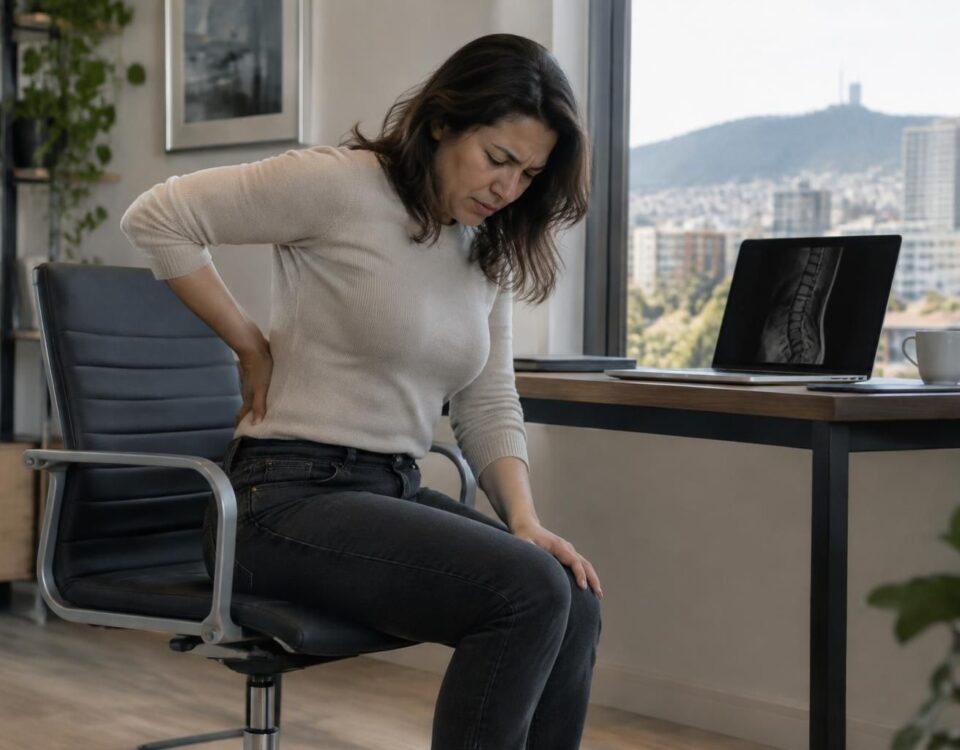


Sciatica and prolonged immobility: possible effect on pain
09/11/2026
Lumbar disc herniation L5-S1 and sciatica in Terrebonne: common symptoms
10/11/2026
IN BRIEF
| A L5-S1 disc herniation is a displacement of the disc located between the last two lumbar vertebrae and the sacrum; if it irritates a nerve root, it can cause sciatica. The pain often radiates from the buttock down the leg, sometimes all the way to the foot, with tingling or numbness. In Montreal, an assessment helps link symptoms to examinations and consider appropriate management; however, a herniation visible on imaging does not always cause pain. Consult quickly if you experience progressive weakness or severe pain. |
A L5-S1 disc herniation can irritate or compress a nerve root and cause sciatica. Common symptoms include lower back pain that radiates to the buttock and back of the leg, sometimes down to the foot, as well as tingling, numbness, or weakness. Pain may be exacerbated by sitting, bending, coughing, or straining. However, a herniation visible on imaging does not always produce symptoms: a clinical evaluation helps clarify their origin.
Consult promptly if you have progressive weakness. Loss of bladder or bowel control, or numbness in the saddle area, requires urgent medical evaluation.
A L5-S1 disc herniation can irritate a nerve root and cause pain that radiates from the lower back to the buttock and leg. In Montreal, symptoms vary from person to person: some primarily feel pain in the calf or foot, while others notice tingling or weakness. An MRI alone is not sufficient to confirm the cause of the pain; a professional must also evaluate the symptoms and their progression.
What do L5-S1, disc herniation, and sciatica mean?
L5-S1 refers to the disc located between the last lumbar vertebra, L5, and the first sacral vertebra, S1. A herniation occurs when a portion of the disc bulges through a weakened area. It can then irritate a nearby nerve root.
The term sciatica describes pain related to irritation of a nerve root contributing to the sciatic nerve. Therefore, a disc herniation is a possible cause of sciatica, but the two terms do not refer to the same thing. A herniation visible on imaging may also cause no symptoms.
The L5-S1 area is often associated with pain following the S1 root, but the L5 root may also be affected depending on the position of the herniation and the involved structures. To learn more about the difference between herniation and sciatica, check out this guide on sciatica and disc herniation.

Sciatica in Montreal: pain worsened when sitting and lumbar disc
IN BRIEF Worsening sciatica in a sitting position may be related to lower back irritation, sometimes associated with a disc, without this sign being sufficient to establish the cause. In Montreal, an evaluation that considers symptoms, strength, sensitivity, and function…

Sciatica in Montreal: pain worsened by flexion and disc-related cause
IN BRIEF Flexion-Aggravated Sciatica is pain that starts in the lower back and may radiate into the buttock or leg; irritation related to a lumbar disc can be a possible cause. In Montreal, an assessment helps clarify the origin of…
Common symptoms of a L5-S1 disc herniation with sciatica
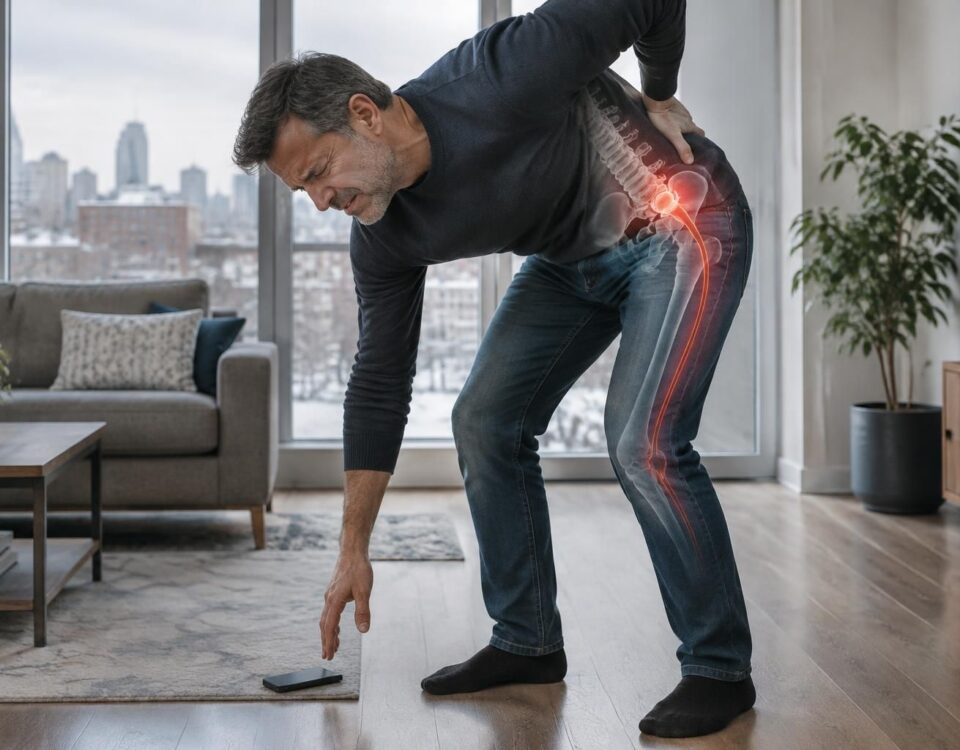
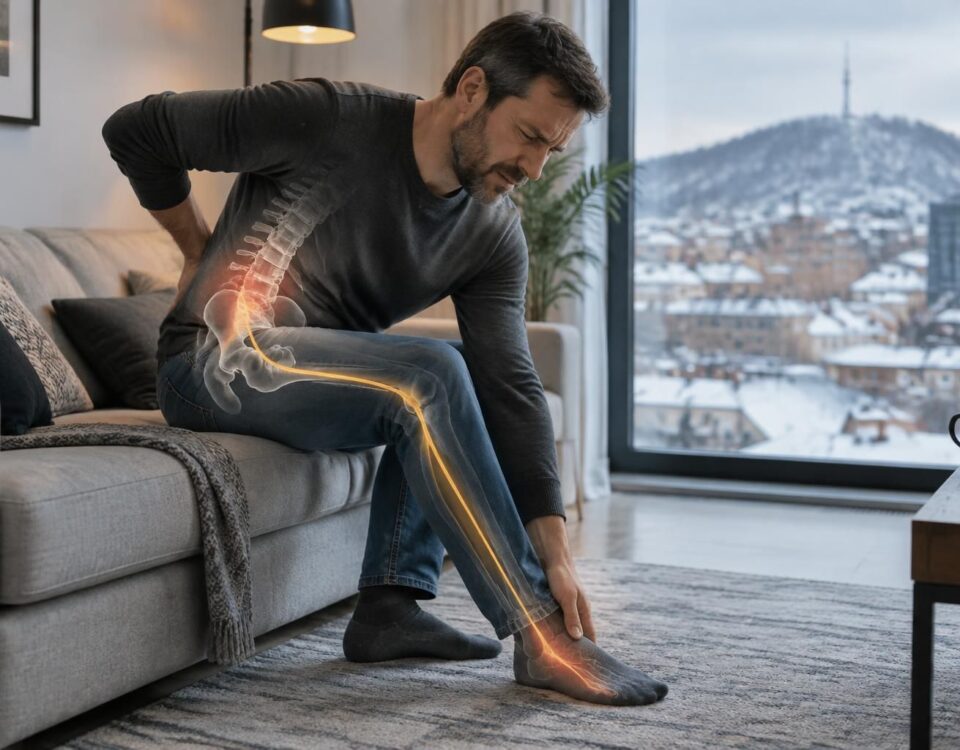
The most indicative symptom is pain that starts from the buttock and radiates down one leg. It may reach the calf, heel, or foot. It often affects one side only, but its path and intensity can vary.
Pain radiating to the foot
The pain may be sharp, burning, stabbing, or accompanied by jolts. Pain in the foot or toes may correspond to irritation of a nerve root, but it does not allow for identification of the cause on its own. Pain in the big toe may sometimes be associated with the L5 root; pain in the heel may sometimes concern the S1 root. Consult these pages on pain in the big toe and the L5 root and on pain in the heel and the S1 root.
For information related to L5-S1 herniation and pain radiating to the foot in Montreal, also consult our article dedicated to this pattern of pain.
Tingling and numbness
An irritated nerve root can cause tingling, a burning sensation, or decreased sensitivity in the leg or foot. These sensations may remain stable or change over time. Report any progressing numbness or that limits your activities to a professional.
Weakness in the leg or foot
Weakness can make certain movements difficult, such as lifting the foot or walking normally. New, significant, or progressive weakness requires rapid medical evaluation. It should not be interpreted solely based on an image or an online description.

Discogenic sciatica in Montreal: why some stretches worsen
IN BRIEF Disc-related sciatica refers to pain related to the irritation of a nerve root, often near a herniated disc. Certain stretches, especially those that emphasize bending or pull on the leg, can worsen symptoms rather than relieve them. In…

Sciatica disc in Montreal: movements to avoid at the start
IN BRIEF Disc-related sciatica refers to pain related to the irritation of a nerve, sometimes associated with a lumbar disk. Initially, avoid movements that worsen your symptoms, such as lifting a load by bending over or performing repeated twists. Adjusting…
What can modify sciatic pain
Prolonged sitting, certain movements of the lower back, coughing, or straining can exacerbate symptoms in some people. Others notice increased pain at night or after a period of activity. These reactions are not the same for everyone and do not alone confirm the presence of a disc herniation.
Disc wear, narrowing of a nerve root exit space, or other changes in the spine can also contribute to symptoms. A protrusion or disc pinching is not exactly the same as a herniation; the evaluation must take into account the entire picture.

Sciatica in Montreal: disc herniation with leg weakness
IN BRIEF Sciatica related to a herniated disc can irritate a nerve root and cause pain that travels down the leg, sometimes accompanied by weakness. In Montreal, an evaluation helps clarify the cause and guide appropriate care; nonsurgical approaches can…

Sciatica in Montreal: herniated disc with foot numbness
IN BRIEF Sciatica related to a herniated disc can cause pain that radiates down the leg and numbness in the foot. In Montreal, an assessment helps to investigate the cause of the symptoms and consider appropriate management without assuming the…
How to assess a possible L5-S1 herniation in Montreal
The assessment begins with a discussion regarding the pain, its path, its evolution, and the difficulties it causes. The professional may also examine sensitivity, strength, and certain movements. These factors help determine if a medical consultation or further examinations are warranted.
An MRI may be requested by an authorized professional when the symptoms, their duration, or observed signs justify it. The result should be correlated with the clinical examination: an anomaly on the image does not necessarily prove that it causes the pain. For a local presentation of the topic, see the page on L5-S1 disc herniation and sciatica.

Sciatica in Montreal: lumbar disc and inflammation of the nerve root
IN BRIEF Disc-related sciatica occurs when irritation of the nerve root causes pain that may radiate down into the buttock and leg. In Montreal, an assessment helps identify the cause of the symptoms and consider appropriate non-surgical care based on…

Sciatica and disc pinching in Montreal: when space decreases
IN BRIEF The disc herniation refers to a decrease in space between two vertebrae; it can irritate a nerve root and contribute to sciatica, with pain that radiates into the buttock or leg. In Montreal, an assessment helps specify the…
When to seek immediate consultation
Seek medical advice quickly if the pain persists, worsens, or increasingly limits walking and daily activities. A consultation is also important in cases of increasing numbness or weakness in the leg or foot.
Go to the emergency room in case of loss of control of the bladder or bowels, numbness in the saddle area, significant or rapidly progressive weakness, fever with back pain, or severe pain following trauma. These signs require immediate evaluation.
Support Options in Montreal and Terrebonne
Care depends on the symptoms, examination, and advice of the relevant professionals. It may include medical follow-up and conservative approaches tailored to the situation. Medications, injections, or surgery are topics for discussion with the professionals authorized to prescribe or perform them.
At the TAGMED Clinic, the evaluation can help determine if treatments such as specific osteopathy or motorized neurovertebral decompression may be considered. Decompression is not suitable for everyone and does not replace a medical diagnosis or consultation. Results and the number of sessions vary by individual. For information about the services, check the pages on sciatica treatment in Montreal and Mont-Royal or in Terrebonne.
Frequently Asked Questions about L5-S1 Herniated Disc and Sciatica
Does an L5-S1 herniated disc always cause sciatica?
No. A herniated disc can be visible on imaging without causing pain. The presence of sciatica depends on nerve root irritation and must be evaluated based on the symptoms and examination.
Can pain radiating to the foot come from L5-S1?
Yes, nerve irritation in this area can cause pain that radiates down to the foot. However, the pain’s pathway alone does not confirm the problem’s origin.
Is neurovertebral decompression suitable for all cases of sciatica?
No. This approach may be considered for some individuals after evaluation, but it is not indicated in every case. A professional must verify its suitability and account for any necessary medical follow-up.
About the Author
Sylvain Desforges, B.Sc., D.O., N.D., Doctor of Osteopathy and Naturopath, is the founding president of TAGMED and the ACMA association. His practice focuses particularly on chronic pain of the spine, lower back pain, and pain related to sciatica.
Through SOS Sciatique, he publishes educational content on the symptoms of sciatica, its possible causes, and non-surgical approaches that can be evaluated for each situation. The care provided at the TAGMED Clinic may include, depending on the case, motorized neurovertebral decompression, specific osteopathy, or precise percussion.
Medical Disclaimer: The information and advice provided on this site do not replace the advice, diagnosis, or treatment of a health professional. Please note that Sylvain Desforges, B.Sc., D.O., N.D., Doctor of Osteopathy, is neither a medical doctor nor a physician, and is not specialized in a medical specialty as defined by the Collège des médecins du Québec. Manual medicine, functional medicine, and sports medicine as described on this site exclude any treatment or medical diagnosis made by a physician or medical specialist. Always consult your doctor for any medical questions. For more details, please read our Complete Legal Disclaimer.
Pain and Sensations
- Pain from the lower back to the buttock and back of the leg.
- Radiating sometimes down to the calf, foot, or toes.
- Tingling or numbness in the leg or foot.
Movements and Function
- Pain sometimes worsened by sitting, bending, or coughing.
- Walking or daily activities may be limited.
- Weakness in the foot or leg possible in case of nerve involvement.

An L5-S1 herniated disc can irritate a nerve root and cause sciatica-like pain, often felt in the buttock and along the leg. In Montreal, as elsewhere, symptoms vary by individual: pain, tingling, numbness, or weakness may be present, but only a clinical evaluation can clarify the cause and guide the next steps.
L5-S1 Herniated Disc and Sciatica: What’s the Difference?
A herniated disc refers to a change in a disc located between two vertebrae. At the L5-S1 level, the disc is located between the last lumbar vertebra and the sacrum. If the disc material irritates or compresses a nerve root, pain may radiate down the leg: this is referred to as radicular pain or sciatica.
These terms do not therefore refer to the same thing. A herniation visible on imaging does not necessarily cause symptoms, and pain radiating down the leg is not always caused by a hernia. The interpretation of an MRI must be done by a healthcare professional, taking into account the symptoms and clinical examination.
Common Symptoms of Sciatica Related to L5-S1
Pain in the Buttock and Leg
Pain may start in the lower back or buttock and radiate down the back of the thigh, sometimes reaching the calf, foot, or toes. It is often more pronounced on one side. Some people describe it as burning, an electric shock, or a sharp pain. Its pathway and intensity vary depending on the affected nerve root.
Tingling, Numbness, or Weakness
Tingling or a decrease in sensitivity may accompany pain. Weakness may also manifest, for example, as difficulty pushing off with the foot or walking normally. Note when the symptoms occur, their distribution, and the movements or positions that seem to modify them: these observations can assist during the evaluation.
What can modify the symptoms
Prolonged sitting, certain back flexion movements, coughing, or exertion can worsen symptoms in some individuals. The reaction, however, remains individual. Avoid imposing exercises or stretches that significantly increase pain in the leg. When tolerated and safe, maintaining adapted daily activities may be preferable to prolonged immobility.
When to seek an evaluation in Montreal?
Consult a healthcare professional if the pain persists, returns frequently, limits walking, or disrupts sleep, or if numbness and weakness progress. An evaluation checks for neurological signs and determines if further tests or treatments are needed. Options can be discussed based on your situation and may include a gradual return to activities, supervised exercises, or other conservative approaches. Motorized neurovertebral decompression, when considered, is not suitable for everyone and requires prior evaluation.
Seek urgent medical help in cases of loss of bladder or bowel control, numbness in the saddle area, significant or rapidly worsening weakness, fever, or intense pain following trauma.
About the author
Sylvain Desforges, B.Sc., D.O., N.D., doctor in osteopathy and naturopath, is the founding president of TAGMED and the ACMA association. His practice focuses notably on chronic spinal pain, lower back pain, and pain compatible with sciatica. Depending on the evaluation, the care proposed at the TAGMED Clinic may include specific osteopathy, motorized neurovertebral decompression, or precision impactor.
Medical disclaimer: This content is provided for educational purposes and does not replace a consultation, diagnosis, or treatment by a physician or other licensed healthcare professional. The author is neither a physician nor a specialist in a medical specialty recognized by the Collège des médecins du Québec. The approaches described do not replace medical follow-up.
| Manifestation | Common Symptoms |
|---|---|
| Radiating pain | Pain starting from the lower back or buttock and sometimes descending to the foot. |
| Numbness | Reduced sensation or tingling in a part of the leg or foot. |
| Weakness | Difficulty pushing off with the foot or walking on tiptoes. |
| Lower back pain | Discomfort in the lower back, sometimes associated with stiffness. |
| Aggrevating factors | The sitting position, bending, coughing, or certain exertions can worsen symptoms. |
| Takeaway | A visible herniation on imaging does not always mean it causes sciatica. |
L5-S1 disc herniation and sciatica in Montreal: illustrative testimonials and common symptoms
Important: The testimonials below are fictional examples inspired by commonly reported symptoms. They do not come from identifiable patients and cannot lead to a diagnosis. Pain in the leg can have various causes, and a visible herniation on imaging does not always cause symptoms.
“The pain started from the lower back and went down to the buttock, then down the back of the leg to the calf.” This illustrative account describes irradiation sometimes associated with irritation of a nerve root near the L5-S1 disc. The pain may be felt as a burning sensation, a jolt, or a sharp pain, typically on one side.
“I had tingling in my foot and an area that was a bit numb.” Tingling sensations or a decrease in sensitivity may accompany sciatica. Their location varies depending on the affected nerve root; alone, they are not sufficient to confirm a disc herniation.
“Sitting for a long time made the pain harder to bear.” Prolonged sitting, certain back flexion movements, coughing, or exertion can aggravate symptoms in some individuals. In daily life in Montreal, commuting, office work, or long trips can make these periods of immobility more frequent.
“I felt like my leg was weaker.” Weakness may manifest as difficulty walking on tiptoes or heels, depending on the affected muscles. New, significant, or progressive weakness should be evaluated quickly by a healthcare professional.
The symptoms of an L5-S1 condition are not identical for everyone. Some people primarily experience lower back pain, while others mainly feel pain radiating from the buttock down the leg, sometimes to the foot. A clinical examination contextualizes the symptoms; imaging is requested when deemed relevant.
If the pain persists, limits walking, or disrupts sleep, an evaluation can help clarify the next steps. Depending on the situation, management may include a gradual return to activities, adapted exercises, and other measures determined with a healthcare professional. Manual approaches or neurovertebral decompression are not suitable for everyone and do not replace medical evaluation.
Consult a physician or emergency service without delay in cases of loss of bladder or bowel control, numbness in the saddle area, significant or rapidly progressive weakness, fever, recent trauma, or rapidly worsening pain. The information presented here is educational and does not replace a professional diagnosis or treatment.
A L5-S1 disc herniation involves the disc located between the fifth lumbar vertebra and the first sacral vertebra, at the base of the back. This disc helps absorb stress and facilitate movements of the spine. Over time, a crack in its outer covering may allow part of its inner content to protrude. This change can irritate a nearby nerve root and cause pain compatible with sciatica. However, a herniation seen on imaging does not automatically mean it is the cause of the symptoms.
Sciatica often manifests as pain that starts from the lower back or buttock and descends into the leg. It can travel along the back of the thigh and calf, sometimes all the way to the foot or toes. Some people experience sharp, electric, or burning pain; others describe a more persistent discomfort or stabbing sensations. Symptoms often affect one side only, but their path and intensity vary depending on the irritated nerve root and the individual’s situation.
Tingling, numbness, or reduced sensitivity may accompany the pain, particularly in the calf or foot. Weakness may also appear: difficulty lifting the front of the foot, walking on heels, or pushing with the toes. These signs alone do not confirm a herniated disc. A healthcare professional assesses their evolution and relates them to the history of symptoms and a clinical examination.
The pain may be influenced by daily activities. Sitting for long periods, bending, lifting a load, or performing certain movements can exacerbate symptoms in some individuals. Coughing or straining may also make them more sensitive. In Montreal, commuting, sitting at work, and long periods without changing position can complicate managing discomfort. Conversely, mild and adapted activity is sometimes better tolerated than prolonged immobility; the response varies from person to person.
A medical consultation should be considered if the pain persists, radiates below the knee, disrupts sleep, or progressively limits walking and usual activities. Imaging, such as an MRI, is not necessary in all situations: its usefulness depends on symptom duration, examination, and present signs. The doctor can determine if further examination is warranted and discuss management options. These may include gradually maintaining tolerated activities, supervised exercises, or other interventions tailored to the clinical assessment.
Consult a medical service immediately if you experience significant or rapidly progressing weakness, loss of bladder or bowel control, or numbness in the saddle region. Fever, recent trauma, or rapidly worsening pain also warrant urgent evaluation. These signs require special attention and should not be addressed solely by manual therapy.
About the author
Sylvain Desforges, B.Sc., D.O., N.D., Doctor of Osteopathy and naturopath, is the founding president of TAGMED and the ACMA association. His practice focuses on chronic spinal pain and lower back pain that may be accompanied by symptoms in the leg. Depending on the assessment and situation, the care offered at the TAGMED Clinic may include specific osteopathy, motorized neurovertebral decompression, or precision impact therapy. His approach is part of a personalized support process; manual care does not replace a diagnosis or medical follow-up.
Medical Disclaimer
This text is provided for educational purposes and does not replace a consultation, diagnosis, advice, or treatment by a doctor or other licensed healthcare professional. The author is neither a doctor nor a specialist in a medical specialty recognized by the College of Physicians of Quebec. In the case of loss of bladder or bowel control, numbness in the saddle area, significant or progressive weakness, fever, recent trauma, or rapid worsening, consult a doctor or emergency service.
A L5-S1 herniated disc can irritate or compress a nerve root and cause sciatica, meaning pain that starts from the lower back or buttock and descends into the leg, sometimes all the way to the foot. In Montreal, as elsewhere, symptoms vary depending on the structures involved and cannot be attributed to a hernia based solely on an MRI image: assessing symptoms and neurological function remains essential.
L5-S1 Herniated Disc: Common Symptoms
The pain may be felt in the buttock, at the back of the thigh and calf, and sometimes in the outer edge or sole of the foot. Tingling, numbness, or a burning sensation may accompany the radiation. Some people primarily have back pain; others feel pain more pronounced in the leg. Resources describe the possible characteristics of an issue at this level, including the symptoms and management options for a L5-S1 herniated disc and features of the L5-S1 region.
A hernia occurs when part of the disc bulges through a weakening of its casing. This anatomical change can contribute to irritating a nerve root, but a hernia visible on imaging does not necessarily cause pain. Sciatica rather refers to a set of symptoms following the nerve path. To better distinguish these notions, consult the explanations on sciatica related to a lumbar herniated disc and on sciatica.
Factors that May Alter Pain
Prolonged sitting, certain back-bending movements, or exertion can exacerbate symptoms in some individuals. Coughing may also temporarily increase pain when a nerve root is irritated; however, this alone does not confirm a hernia. Additional information explains the possible link between painful cough and nerve irritation. A disc protrusion may also be associated with sciatica if a nerve root is irritated; numbness in the foot should be interpreted in the context of the clinical examination.
Symptoms of an L5-S1 issue are not identical to those that occur at L4-L5. Their location may guide the evaluation, though it is not sufficient to establish a diagnosis. To compare these lumbar levels, you can consult pages on L4-L5 and L5-S1 herniated discs in Montreal and on the possible differences between L4-L5 and L5-S1.
When to Seek an Evaluation
A consultation is indicated if the pain persists, intensifies, limits walking or daily activities, or is accompanied by numbness or weakness. A decrease in reflexes may be part of the neurological signs to be assessed by a professional. Seek medical help promptly in case of significant or progressive weakness, loss of urinary or bowel control, or numbness in the saddle area.
The management depends on the examination, evolution, and needs of the person. It may include a temporary adjustment of activities, exercises, or rehabilitation care; other options can be discussed by the relevant professionals. At the TAGMED Clinic, an evaluation can help determine if non-surgical approaches, such as specific osteopathy or motorized neurovertebral decompression, are feasible in the case being examined. These treatments are not suitable for everyone and do not replace a medical evaluation when necessary.

Sylvain Desforges, B.Sc., D.O., N.D., docteur en ostéopathie
Dr Sylvain Desforges, B.Sc., D.O., N.D., osteopath, is the founding president of TAGMED and of the ACMA association. He dedicates his practice to chronic spinal pain, low back pain and symptoms compatible with sciatica, particularly when pain radiates toward the buttock, leg, calf, foot or toes.
Through SOS Sciatique, he publishes educational content on sciatica symptoms, possible causes such as disc herniation, disc narrowing, foraminal stenosis or irritation of a lumbar nerve root, as well as non-surgical approaches that may be considered according to the evaluation. At Clinique TAGMED, care may include, depending on the case, motorized neurovertebral decompression, specific osteopathic care or precision percussion.
For an evaluation related to sciatica treatment in Montreal / Mount Royal or sciatica treatment in Terrebonne, please consult the services available at Clinique TAGMED.
Medical disclaimer
The information published on SOS Sciatique is provided for educational purposes only and does not replace a consultation, diagnosis, opinion or treatment provided by a physician or another authorized healthcare professional. The author of this article is neither a medical doctor nor a specialist in a medical specialty recognized by the Collège des médecins du Québec. The osteopathic, manual medicine or functional support approaches described on this site do not constitute medical acts and are not intended to replace medical follow-up.
Consult a physician or emergency service in cases of loss of bladder or bowel control, anesthesia in the saddle area, significant or progressive weakness in the leg or foot, fever, recent trauma, severe pain or rapid worsening of symptoms. For more details, please read our Legal Notice.