



<!–
DEDICATED PAGE — SOS SCIATICA TOOL 01
Editorial Title: Online sciatic urgency test: should you consult quickly?
Slug: sciatic-urgency-test
Canonical URL: https://www.sossciatique.com/test-urgence-sciatique
Featured Image: https://www.sossciatique.com/wp-content/uploads/2026/07/test-urgence-sciatique-hero.png
Page Images:
– https://www.sossciatique.com/wp-content/uploads/2026/07/test-urgence-sciatique-hero.png
– https://www.sossciatique.com/wp-content/uploads/2026/07/test-urgence-sciatique-signes-alerte.png
– https://www.sossciatique.com/wp-content/uploads/2026/07/test-urgence-sciatique-examen-neurologique.png
– https://www.sossciatique.com/wp-content/uploads/2026/07/test-urgence-sciatique-questionnaire.png
– https://www.sossciatique.com/wp-content/uploads/2026/07/test-urgence-sciatique-cta.png
CSS: no CSS is included on this page; it uses the SOS Sciatica template and BeTheme form styles.
RANK MATH — FRENCH
SEO Title: Online sciatic urgency test: should you consult?
Meta description: Test in 9 questions the warning signs of sciatica and find out if an urgent, rapid, or scheduled consultation may be needed.
Focus Keywords: sciatic urgency test, online sciatic test, sciatic urgency, warning signs of sciatica, leg weakness from sciatica
Tags: sciatica, sciatic test, sciatic urgency, neurological signs, cauda equina syndrome, foot weakness, numbness, lower back pain
RANK MATH — ENGLISH
SEO Title : Online sciatica emergency test: should you seek care?
Meta Description : Answer 9 questions to identify sciatica warning signs and learn whether emergency, prompt or planned assessment may be appropriate.
Focus Keywords : sciatica emergency test, online sciatica test, sciatica emergency, sciatica red flags, leg weakness sciatica
Tags : sciatica, sciatica test, sciatica emergency, neurological warning signs, cauda equina syndrome, foot weakness, numbness, low back pain
–>
Online sciatica emergency test: should you consult quickly?
Pain radiating down the leg is not always urgent, but certain neurological or general symptoms should never be trivialized. This interactive test helps you identify the main warning signs associated with sciatica pain.
In nine questions, the tool distinguishes five levels of caution: immediate urgency, medical consultation today, quick professional advice, planned evaluation or cautious monitoring. It does not provide any diagnosis and does not replace a clinical examination.

First, check for signs that require urgent consultation
Answer nine simple questions. The tool will indicate the most cautious priority level based on your answers, without making a diagnosis.
Question 1 of 9
Please select an answer before continuing.
How does the test classify the priority level?
The result does not correspond to a severity score. A single important sign may be enough to escalate the triage to red or orange level. For example, moderate pain accompanied by new urinary retention may be more concerning than intense pain without neurological deficit.
The algorithm always retains the response associated with the highest caution level. It does not average the symptoms and does not attempt to artificially reassure the user when a red flag is selected.
| Obtained level | What it means | Cautious orientation |
|---|---|---|
| Red — now | A major or rapidly progressive neurological sign has been reported. | Call 911 or go to the emergency department without waiting for a regular appointment. |
| Orange — today | The context may require urgent medical evaluation: extreme pain, fever, infection, or trauma. | Communicate today with a doctor, a medical clinic, or Info-Santé 811. |
| Yellow — urgent | A progressive neurological symptom or a concerning medical background must be verified. | Obtain a professional opinion quickly and monitor any worsening. |
| Blue — planned evaluation | Symptoms persist, recur, or severely limit sleep and activities. | Plan a structured assessment to clarify the likely cause and management options. |
| Green — cautious monitoring | None of the sought-after warning signs have been selected, and symptoms are recent and stable. | Monitor the progression and consult if pain, sensitivity, strength, or function deteriorate. |
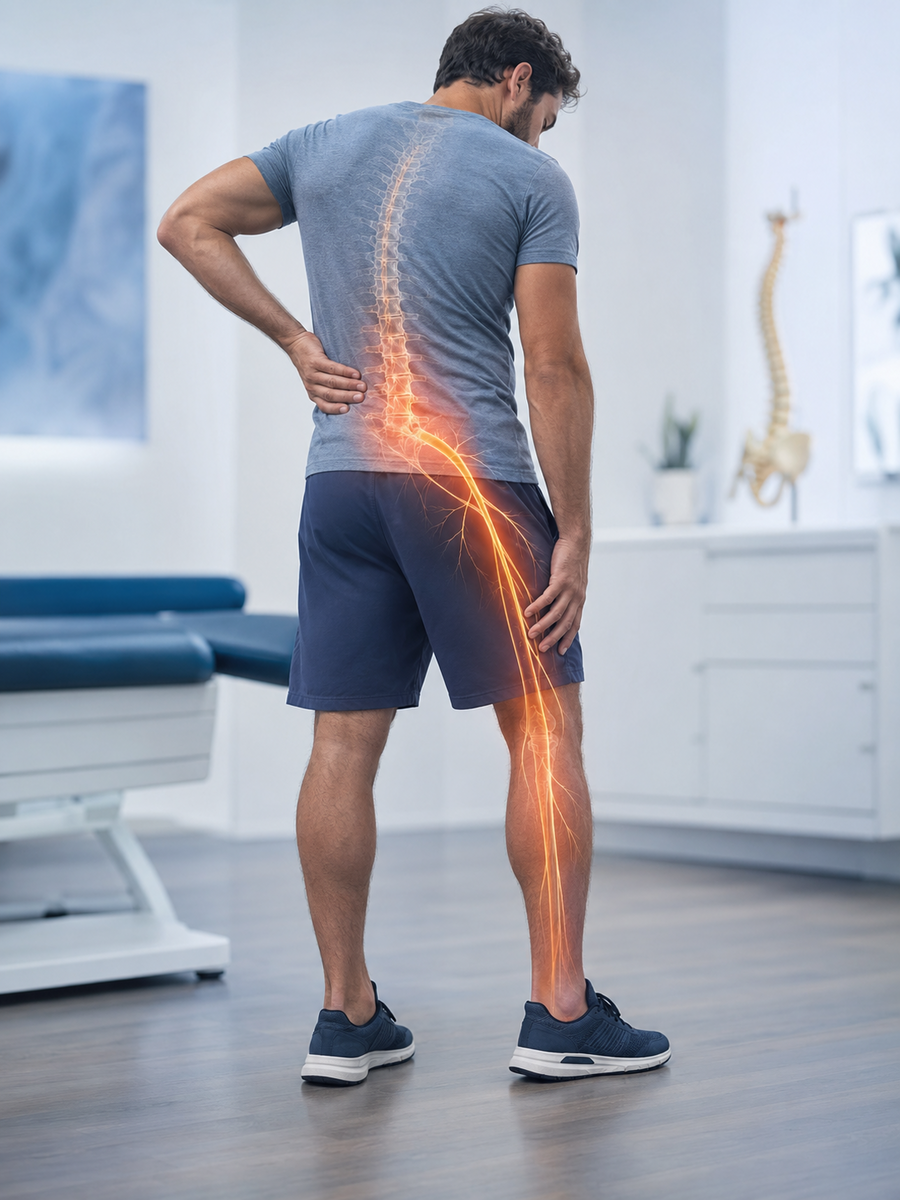
What warning signs are being sought?
Sciatica generally refers to pain associated with the irritation of a lumbar nerve root. The pain can radiate into the buttock, thigh, calf, heel, foot, or toes. However, the pathway of the pain alone is not sufficient to determine the urgency.
The test places additional emphasis on neurological changes, urinary and intestinal functions, rapid evolution, and the overall context. These elements may indicate that a seemingly sciatica pain needs to be evaluated in a medical setting.
- Urinary or intestinal control: new difficulty urinating, retention, leaks, or loss of control.
- Perineal sensitivity: numbness between the legs, around the genital organs, or in the saddle area.
- Muscle strength: foot drop, difficulty raising the foot, walking on heels, or on toes.
- Bilateral involvement: new symptoms in both legs or rapid neurological deterioration.
- Systemic context: fever, chills, recent infection, immunosuppression, or significant alteration in the overall condition.
- Trauma or fracture: fall, collision, significant shock, osteoporosis, or prolonged use of corticosteroids.
- Atypical evolution: unexplained weight loss, history of cancer, or unusual and increasing nighttime pain.
What an online sciatica test can — and cannot — determine
An online questionnaire can organize symptoms and remind you of caution thresholds. It cannot objectively test strength, reflexes, sensitivity, coordination, pulse, temperature of a limb, or reaction to clinical maneuvers.
What the tool can do
- make you think about sometimes overlooked symptoms;
- identify a response that raises your caution level;
- direct you to 911, 811, or a scheduled assessment;
- summarize responses that influenced the result;
- guide you to relevant resources on the site.
What the tool cannot do
- confirm a herniated disc or a nerve compression;
- diagnose cauda equina syndrome;
- exclude a fracture, infection, tumor, or vascular problem;
- determine on its own if an MRI is necessary;
- prescribe medication, exercises, or personalized treatment.
Why must triage precede the choice of treatment?
The term « sciatique » describes a set of symptoms and not a single cause. Pain that radiates down the leg may be associated with a herniated disc, a protrusion, a disc pinching, foraminal stenosis, spinal stenosis, or nerve irritation from another context.
Before suggesting a neurovertebral decompression, a manual intervention, or an exercise program, it is necessary to check for contraindications and determine whether the situation primarily requires medical management. The red, orange, or yellow flags are not a commercial outcome: they aim to prevent a conservative treatment from delaying necessary evaluation.
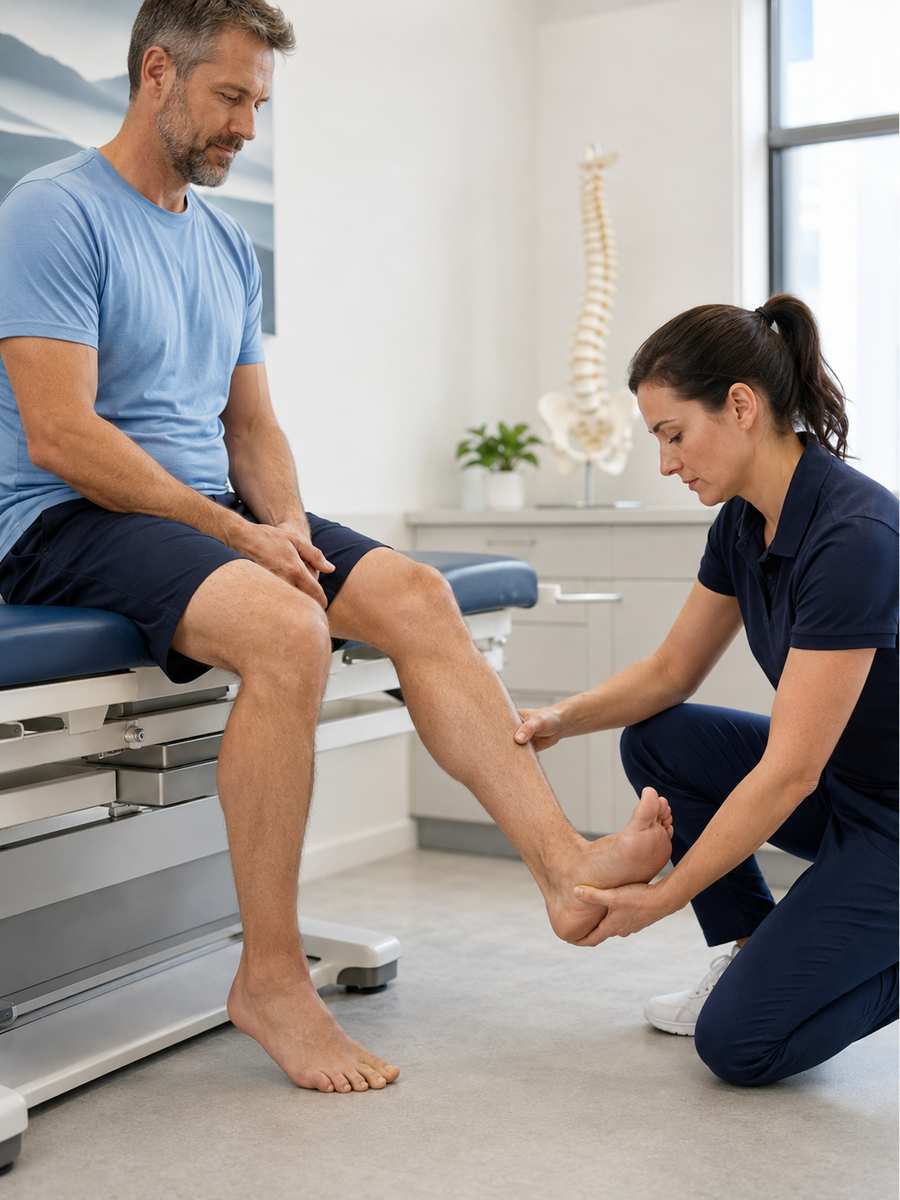
When the result allows for a planned assessment, the professional can then analyze the pain pathway, strength, sensitivity, aggravating positions, available examinations, and the relevance of a non-surgical approach.
Privacy, Functioning, and Revision of the Tool
The test functions entirely in the browser. Choices are not sent to SOS Sciatique, the TAGMED Clinic, or any artificial intelligence service. No name, email, phone number, or health information is requested to obtain the result.
The algorithm is deterministic: the same set of responses always produces the same priority level. The system selects the highest level of caution and displays the responses that influenced this direction. It does not use a probabilistic model and does not calculate a diagnostic percentage.
The questions are based on categories of warning signs described in recognized clinical resources. The content must be periodically revised to keep up with the evolution of recommendations and Québec health orientation services.

Frequently Asked Questions about the Sciatic Emergency Test
Can this test confirm that I have sciatica?
No. It only analyzes certain warning signs and priority factors. Diagnosing sciatic pain requires correlating symptoms with the clinical examination and, in some cases, with imaging results.
Does a green result mean I don’t have anything serious?
No. It just means that you did not select any of the specific signs sought by the questionnaire. Consult if your condition is concerning you, if the pain worsens, or if a new symptom appears.
Why are urinary or intestinal issues considered urgent?
When they occur with lower back or sciatic pain, they may be associated with significant neurological impairment. New difficulty urinating, loss of control, or saddle anesthesia should not be passively monitored.
Is foot weakness more concerning than intense pain?
It can be. Very intense pain does not necessarily indicate a more serious injury, whereas a loss of strength that is objective or rapidly progressive can signal a motor deficit requiring prompt evaluation.
What should I answer if I’m not sure I have a fever or weakness?
Select the cautious option when available and contact Info-Santé 811 or a professional. The questionnaire cannot measure your temperature or test your strength.
Is pain in both legs always an emergency?
Not necessarily, but a new or rapidly progressive bilateral involvement increases the level of caution, especially if accompanied by weakness, loss of bowel control, or urinary or intestinal issues.
Can the test tell me if I need an MRI?
No. It can only identify situations where a medical evaluation becomes more important. The decision to perform an MRI depends on the examination, progression, neurological signs, and the clinical question to be resolved.
Can I start exercising after a green result?
A green result does not automatically allow for the choice of exercise. Movements must be adapted to the probable cause and the symptom response. Stop any exercise that increases pain, intensifies numbness, or decreases strength.
Are my test responses recorded?
No. The questionnaire is executed locally in your browser. It does not request any identifying information and does not transmit your choices to the server.
Can I retake the test if my symptoms change?
Yes. It is relevant to retake it if the pain worsens, becomes bilateral, if numbness spreads, or if weakness or urinary changes occur. In the presence of a major sign, consult immediately rather than waiting for a new result.
References and editorial information
The caution criteria used in this tool are based, in particular, on the resources of the Health Insurance regarding sciatica, the recommendations of the High Authority of Health on low back pain, and the orientation services of the Government of Quebec.
- Health Insurance — Sciatica: how to relieve it and when to consult?
- High Authority of Health — Management of a patient with common low back pain
- Government of Quebec — Find a health resource and Info-Santé 811
Sylvain Desforges, B.Sc., D.O., N.D., Doctor of Osteopathy
The information on this page is educational. It does not replace the advice, diagnosis, or treatment of a doctor or other qualified health professional.
Does your result recommend a planned evaluation?
If no red, orange, or yellow result has been obtained, an evaluation may help clarify the pain trajectory, aggravating factors, strength, sensitivity, and the relevance of a personalized non-surgical approach.
An urgent result must be directed to the medical services indicated by the tool and not to a regular appointment at the TAGMED Clinic.
Sylvain Desforges, B.Sc., D.O., N.D., Doctor of Osteopathy

(function () {
“use strict”;
var root = document.getElementById(“sos-urgence-sciatique”);
if (!root) {
return;
}
var form = root.querySelector(“#sos-urgence-form”);
var steps = Array.prototype.slice.call(root.querySelectorAll(“[data-sos-step]”));
var progress = root.querySelector(“#sos-urgence-progress”);
var progressText = root.querySelector(“#sos-urgence-progress-text”);
var error = root.querySelector(“#sos-urgence-error”);
var backButton = root.querySelector(“#sos-urgence-back”);
var nextButton = root.querySelector(“#sos-urgence-next”);
var submitButton = root.querySelector(“#sos-urgence-submit”);
var result = root.querySelector(“#sos-urgence-result”);
var resultKicker = root.querySelector(“#sos-urgence-result-kicker”);
var resultTitle = root.querySelector(“#sos-urgence-result-title”);
var resultBody = root.querySelector(“#sos-urgence-result-body”);
var resultActions = root.querySelector(“#sos-urgence-result-actions”);
var restartButton = root.querySelector(“#sos-urgence-restart”);
var currentStep = 0;
var rank = {
none: 0,
consult: 1,
prompt: 2,
urgent: 3,
emergency: 4
};
function selectedInput(step) {
return step.querySelector(“input[type=’radio’]:checked”);
}
function updateStep() {
steps.forEach(function (step, index) {
step.hidden = index !== currentStep;
});
progress.value = currentStep + 1;
progress.textContent = String(currentStep + 1) + ” out of ” + String(steps.length);
progressText.innerHTML = “Question ” + String(currentStep + 1) + ” out of ” + String(steps.length) + ““;
backButton.hidden = currentStep === 0;
nextButton.hidden = currentStep === steps.length – 1;
submitButton.hidden = currentStep !== steps.length – 1;
error.hidden = true;
var legend = steps[currentStep].querySelector(“legend”);
if (legend) {
legend.setAttribute(“tabindex”, “-1”);
legend.focus();
legend.removeAttribute(“tabindex”);
}
}
function requireAnswer() {
if (selectedInput(steps[currentStep])) {
error.hidden = true;
return true;
}
error.hidden = false;
return false;
}
function actionLink(href, label, primary, external) {
var link = document.createElement(“a”);
link.className = “btn ” + (primary ? “btn-primary sos-btn-primary” : “sos-btn-secondary”) + ” sos-btn sos-btn-auto”;
link.href = href;
if (external) {
link.target = “_blank”;
link.rel = “noopener”;
}
var span = document.createElement(“span”);
span.className = “sos-btn-text”;
span.textContent = label;
link.appendChild(span);
return link;
}
function resultCopy(level) {
if (level === “emergency”) {
return {
kicker: “Red priority — now”,
title: “Your responses indicate a warning sign requiring immediate evaluation”,
paragraphs: [
Don’t wait for a regular clinic appointment. Call 911 or go to the nearest emergency room. If you feel weak, dizzy, or unable to drive safely, ask someone to accompany you or call emergency services.
New urinary or bowel issues, loss of sensitivity in the anal area, significant weakness, or rapidly progressing symptoms may require urgent care.
],
actions: [
{ href: “tel:911”, label: “Call 911”, primary: true, external: false },
{ href: “https://www.quebec.ca/sante/trouver-une-ressource”, label: “Find a resource”, primary: false, external: true }
]
};
}
if (level === “urgent”) {
return {
kicker: “Orange priority — today”,
title: “An urgent medical consultation is recommended”,
paragraphs: [
“Contact a doctor, medical clinic, or Info-Santé 811 today. If your condition worsens, if weakness appears, or if you lose control of your bladder or bowels, go to the emergency room.”,
“Extreme pain or rapidly worsening pain, fever with back pain, or recent trauma should not be evaluated solely through an online questionnaire.”,
],
actions: [
{ href: “tel:811”, label: “Call Info-Santé 811”, primary: true, external: false },
{ href: “https://www.quebec.ca/sante/trouver-une-ressource”, label: “Find a resource”, primary: false, external: true }
]
};
}
if (level === “prompt”) {
return {
kicker: “Yellow priority — promptly”,
title: “A quick professional opinion is recommended”,
paragraphs: [
“Your responses do not necessarily indicate a life-threatening emergency, but they warrant a quick assessment to check strength, sensitivity, and other possible causes.”,
“If weakness or numbness progresses, if both legs are affected, or if urinary or intestinal issues arise, proceed immediately to the emergency level.”
],
actions: [
{ href: “tel:811”, label: “Call Info-Santé 811”, primary: true, external: false },
{ href: “https://www.sossciatique.com/en/sciatica-when-to-consult”, label: “Understand when to consult”, primary: false, external: false }
]
};
}
if (level === “consult”) {
return {
kicker: “Blue priority — plan an assessment”,
title: “An assessment is indicated as symptoms persist or limit your activities”,
paragraphs: [
“None of the most urgent signs have been reported, but the lack of improvement, recurrences, or significant limitations in sleep and activities merit a clinical assessment.”,
“Prepare the start date, pain trajectory, what aggravates it, what relieves it, and the treatments already tried.”
],
actions: [
{ href: “https://www.sossciatique.com/en/sciatica-treatment”, label: “See possible treatments”, primary: true, external: false },
{ href: “https://www.sossciatique.com/en/contact”, label: “Request an assessment”, primary: false, external: false }
]
};
}
return {
kicker: “Green priority — cautious monitoring”,
title: “You have not reported any of the warning signs sought by this tool”,
paragraphs: [
“This result is reassuring without excluding all possible causes. Only maintain activities you tolerate and monitor the evolution of pain, sensitivity, and strength.”,
“Consult if you do not improve, if your activities become very limited, or if a new symptom appears.”
],
actions: [
{ href: “https://www.sossciatique.com/en/sciatica-when-to-consult”, label: “See the signs to watch out for”, primary: true, external: false },
{ href: “https://www.sossciatique.com/en/sciatica-treatment”, label: “See possible treatments”, primary: false, external: false }
]
};
}
function showResult() {
var highest = “none”;
var summaries = [];
steps.forEach(function (step) {
var input = selectedInput(step);
if (!input) {
return;
}
if (rank[input.value] > rank[highest]) {
highest = input.value;
}
if (input.dataset.summary) {
summaries.push(input.dataset.summary);
}
});
var copy = resultCopy(highest);
resultKicker.textContent = copy.kicker;
resultTitle.textContent = copy.title;
resultBody.replaceChildren();
copy.paragraphs.forEach(function (paragraph) {
var p = document.createElement(“p”);
p.textContent = paragraph;
resultBody.appendChild(p);
});
if (summaries.length > 0) {
var heading = document.createElement(“p”);
heading.innerHTML = “Responses that influenced this orientation :“;
resultBody.appendChild(heading);
var list = document.createElement(“ul”);
list.className = “sos-list”;
summaries.forEach(function (summary) {
var item = document.createElement(“li”);
item.textContent = summary;
list.appendChild(item);
});
resultBody.appendChild(list);
}
resultActions.replaceChildren();
copy.actions.forEach(function (action) {
resultActions.appendChild(actionLink(action.href, action.label, action.primary, action.external));
});
form.hidden = true;
result.hidden = false;
result.setAttribute(“tabindex”, “-1”);
result.focus();
result.removeAttribute(“tabindex”);
}
nextButton.addEventListener(“click”, function () {
if (!requireAnswer()) {
return;
}
currentStep += 1;
updateStep();
});
backButton.addEventListener(“click”, function () {
if (currentStep > 0) {
currentStep -= 1;
updateStep();
}
});
form.addEventListener(“submit”, function (event) {
event.preventDefault();
if (!requireAnswer()) {
return;
}
showResult();
});
restartButton.addEventListener(“click”, function () {
form.reset();
currentStep = 0;
result.hidden = true;
form.hidden = false;
updateStep();
});
updateStep();
}());
Editorial information, sources and limitations
This content is intended to inform patients about sciatica, possible causes, warning signs, and care options. It does not replace an individualized assessment.
Reference sources
References are selected according to the subject of the page: guidelines, systematic reviews, then institutional resources.
- NICE NG59 – Low back pain and sciatica in over 16s — National guideline
- HAS – Management of patients with common low back pain — French national guideline
- Cochrane – Corticosteroid injections for treatment of sciatica — Systematic review
- NCBI Bookshelf – Sciatica — Clinical institutional resource
Complementary resources from the TAGMED network
These internal resources complement the clinical information and thematic linking. They do not replace national guidelines or systematic reviews.
Editorial note on decompression
Clinical resource from the TAGMED network; it does not replace national guidelines. Some guidelines use the term “traction” and recommend caution for low back pain with or without sciatica. Any decompression option should therefore be presented as an individualized clinical approach, with limitations, indications, and contraindications clearly explained.
Limitations of this information
The information on this page is general. It does not constitute a diagnosis, prescription, or guarantee of results. Pain radiating into the leg may have several causes; assessment should consider clinical history, examination findings, symptom progression, and, when appropriate, complementary tests.
When to seek urgent medical care
Seek urgent medical care if you experience loss of bladder or bowel control, saddle anesthesia, major or progressive leg weakness, unexplained fever, pain after significant trauma, or severe pain that rapidly worsens.
