

Positions to sleep and sit with sciatica: how to better tolerate pain
When sciatic pain is present, sleep and sitting often become difficult. Some positions can sometimes help to tolerate pain better, while others tend to increase it, especially if the pain goes down into the buttocks, thigh, calf or foot.
However, there is not one perfect position for everyone. The best position often depends on the path of pain, the likely cause, the patient’s tolerance and movements that aggravate or relieve symptoms. A position that helps one person can be poorly tolerated by another.
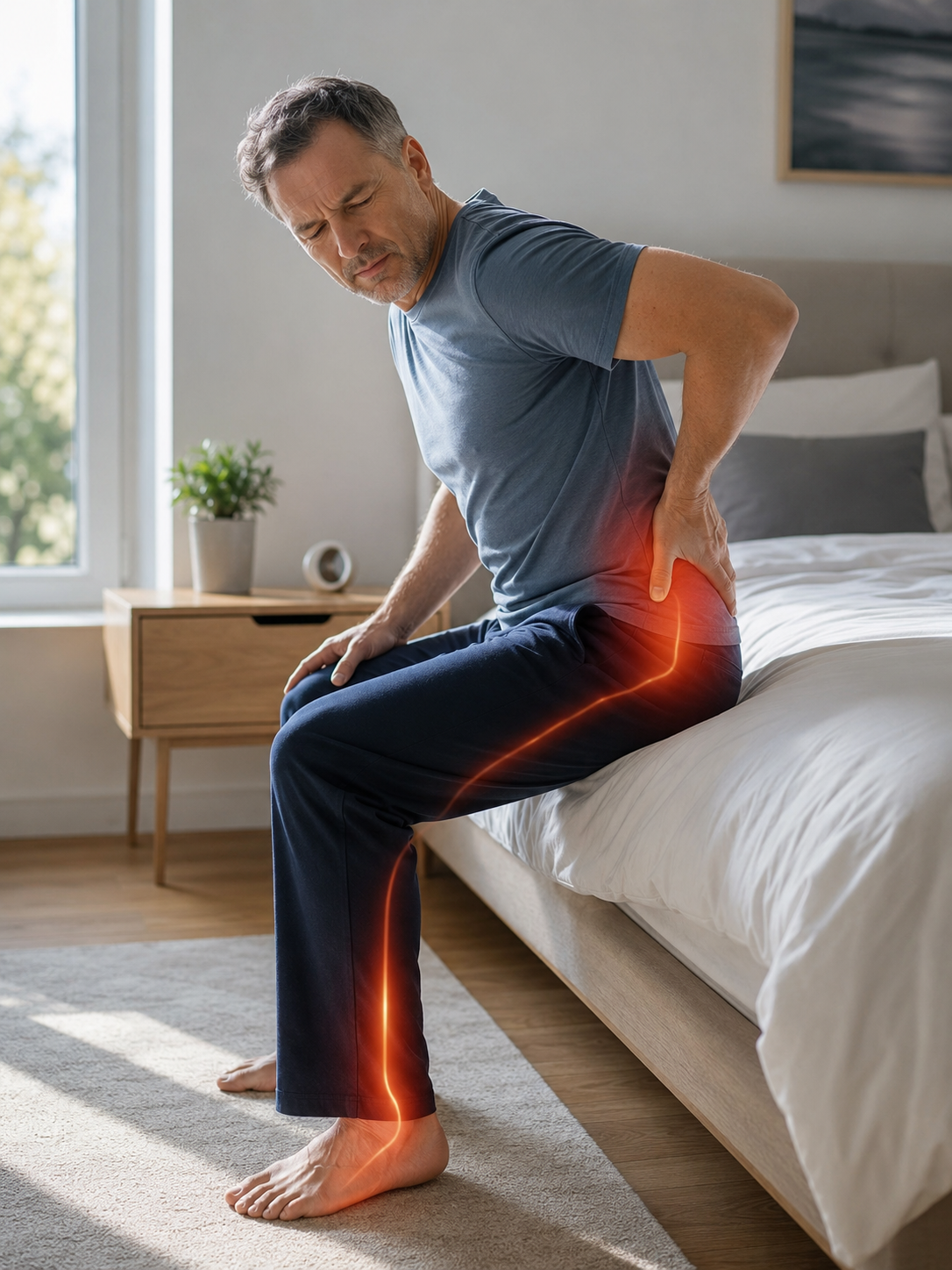
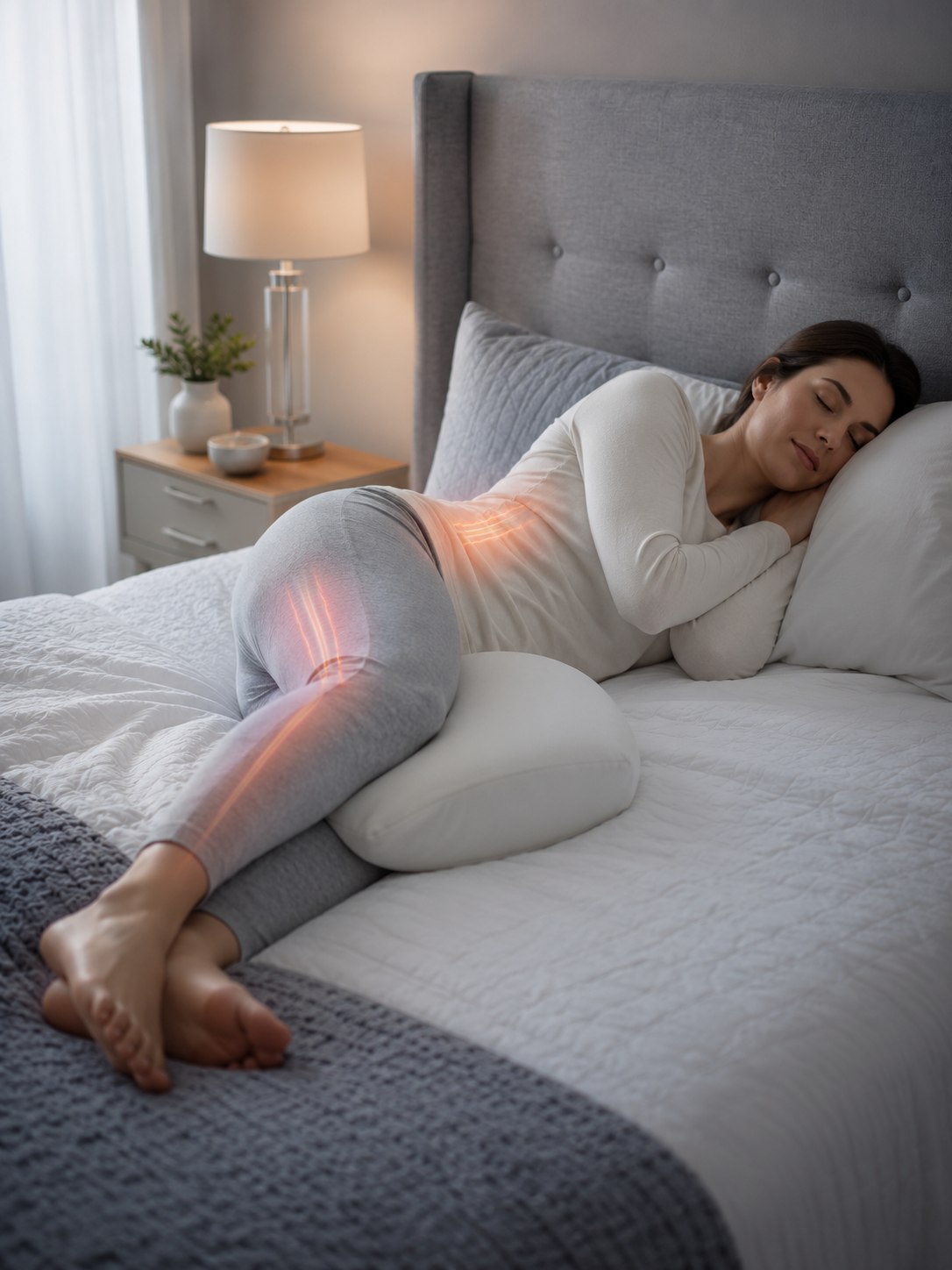
How to sleep with sciatica?
Sleep is often disturbed when sciatica pain is severe. Some people feel better lying on their sides with their knees slightly bent. Others tolerate the position on the back better with support under the knees. In some cases, these adjustments can reduce the tension felt in the lower back or in the leg.
The goal is not to follow a rigid rule, but to find a position that increases the symptoms as little as possible. If a position causes pain that goes further into the leg, increases numbness or makes turning very painful, it is probably not well tolerated in the current context.
| Position to sleep | sometimes sought effect | Caution to keep |
|---|---|---|
| On the side with slightly bent legs | can sometimes reduce tension in the lower back and promote better tolerance. | Avoid if this position increases pain in the hip, thigh or leg. |
| On the back with support under the knees | can sometimes reduce some lumbar stresses in some people. | Not necessarily tolerated if lumbar extension worsens symptoms. |
| Side change with caution | Avoid staying frozen for too long in an uncomfortable position. | Turning too abruptly can cause a clear increase in pain. |
| Semi-sitting position | can sometimes be better tolerated when the fully lying position increases the pain. | Not suitable for all profiles and can be tiring if maintained for a long time. |
How to sit with sciatica?
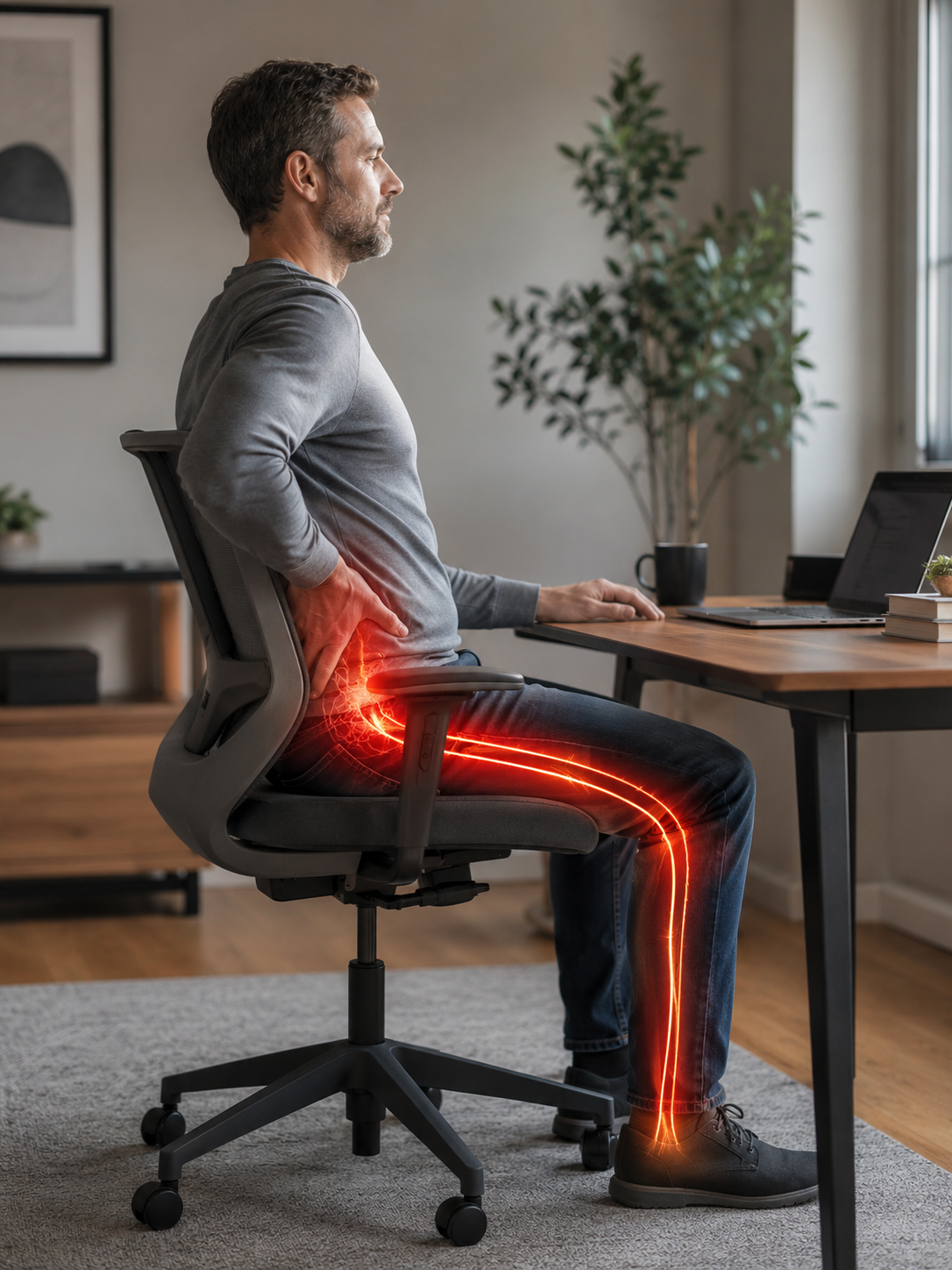
The sitting position is one of the most common triggers in some sciatica, especially when the pain appears to be influenced by a disc component. Sitting for too long, sag, gliding forward or bending can sometimes increase pain in the lower back, buttock or leg.
In this context, it is often preferable to seek a more stable, less sagging and above all less prolonged sitting position. Duration is sometimes as important as the posture itself.
Avoid prolonged sitting
Sitting for a long time is often more irritating than a brief, even correct sitting position.
Limit sag
A very slumped posture can increase certain constraints on the lumbar region.
Find a stable seat
A position where the pelvis is more stable is sometimes better tolerated than a soft or very deep seat.
Take frequent breaks
Getting up regularly can sometimes be better tolerated than looking for the perfect posture for a long time.
Observe the direction of pain
If the pain drops lower in the leg while sitting, the posture or duration is probably poorly tolerated.
Adapt according to work
Driving, office, meal or rest do not always pose the same constraints and must be evaluated separately.
What precautions to take while sitting?
When sciatica is irritated, it can be useful to avoid too deep, too soft or forcing the lower back to be strongly rounded. Some people better tolerate a firmer chair, a lower seat or a position where they can vary more easily.
Driving, prolonged meals, office work, or seated movements can become difficult. In these situations, it is often better to split the sitting periods rather than waiting for the pain to become very intense. Pain that increases while sitting and decreasing once standing provides a useful clue to the patient’s tolerance.
- Avoid sitting for too long without a break.
- Limit sagging or very rounded positions if they aggravate the pain.
- Change position before the pain increases sharply.
- Observe if the pain drops further into the leg while sitting.
- Quickly re-evaluate whether sitting is accompanied by weakness or progressive numbness.
Practical table: Sleeping and sitting with sciatica
The following table summarizes some useful benchmarks. It does not replace an evaluation, but it can help to better observe body reactions and avoid some frequent errors.
| Situation | which is sometimes better tolerated | What to watch out for |
|---|---|---|
| To sleep | Position on the side or on the back with adaptation of the support according to tolerance. | Pain that increases with turning, goes down lower or completely prevents sleep. |
| To get up from bed | more progressive and controlled movement. | sudden movement that causes a discharge in the leg. |
| To stay seated | more stable, less prolonged seat, with frequent breaks. | Increased pain after a few minutes or worsening while sitting. |
| For driving | Shorter trips or more frequent breaks when possible. | Net increase in pain in the buttocks, thigh or calf. |
| For office work | Alternation between sitting and standing according to tolerance. | Progressive numbness, persistent pain or difficulty straightening. |

Why Evaluation Is Important If No Position Is Tolerable
When pain prevents sleep, makes sitting almost impossible or forces the person to constantly change posture without relief, it becomes important to understand the probable cause of symptoms. A very sensitive position pain can be linked to different mechanisms, and the choice of advice depends on this understanding.
At TagMed Clinic, the assessment aims to link pain path, aggravating positions, sleep tolerance, sitting, walking, muscle strength and neurological signs. This approach helps to determine whether a non-surgical approach may be relevant depending on the patient’s profile.
Aggravating positions
Identify what actually increases the pain: sitting, lying, turned sideways, driving or transfers.
Associated signs
Check if postural discomfort is also accompanied by numbness, weakness or loss of function.
When does a difficulty sleeping or sitting deserve more than just an adjustment?
A temporary difficulty can sometimes be linked to an acute painful phase. But if the sleep remains very disturbed, if the sitting position becomes almost impossible, if the pain gradually goes lower in the leg or if neurological symptoms appear, the situation deserves more than just postural advice.
According to the evaluation, certain non-surgical and non-invasive approaches can be discussed, including neurovertebral decompression motorized, specific osteopathy or the precision striker. In other cases, a medical reference or further reassessment may be necessary.
| Approach | Possible role | When to consider it |
|---|---|---|
| Motorized neurovertebral decompression | Reduce some mechanical stress on discs and nerve roots. | Pain compatible with a disc or mechanical origin, without an emergency sign. |
| osteopathy specific | Adapt interventions to patient restrictions, compensation and tolerance. | Mechanical pain associated with stiffness, overload or limitation of mobility. |
| Precision striker | Instrument assisted intervention, targeted and low amplitude. | Accurate mechanical dysfunction depending on the evaluation. |
| Medical reference | Orientation when the profile is beyond the scope of a conservative approach. | Progressive weakness, red flags, uncontrollable pain or significant neurological impairment. |
Painful positions and Tagmed clinic
The TagMed Clinic receives patients with pain consistent with recent, persistent or recurrent sciatica, including when sleep or sitting are severely disturbed. The objective is to understand if this difficulty is linked to a disc, mechanical, foraminal cause or to another factor maintaining the symptoms.
The typical rate is $140 per consultation or treatment. The services are not covered by the RAMQ, but osteopathy receipts may be provided and are eligible for reimbursement by several private insurance plans according to your contract.
Please note that we do not offer physiotherapy, chiropractic, injection, naturopathic or functional medicine services at the TagMed Clinic.
Tagmed Terrebonne Clinic
1150 rue Lévis, Suite 200
Terrebonne, QC, J6W 5S6
Phone: 450-704-4447
Days: Monday, Wednesday and Friday
Clinic Tagmed Montreal / Mont-Royal
1140 Avenue Beaumont
Mount Royal, QC, H3P 3E5
Phone: 1-877-672-9060
Days: Tuesday and Thursday
Frequently asked questions about sleeping and sitting with sciatica
What is the best position to sleep with sciatica?
There isn’t a single ideal position for everyone. Some people better tolerate the position on the side, others the position on the back with adaptation. The best position is the one that increases the symptoms the least.
Why is sciatica often worse at night?
The pain may seem stronger at night because of immobility, position changes, increased sensitivity to rest or difficulty in finding a tolerable position.
Is it bad to sleep on your stomach with sciatica?
This position can be poorly tolerated in some people, especially if it accentuates the lumbar stresses. However, tolerance varies according to the clinical profile and the probable cause.
How to get out of bed with sciatica?
It is often better to avoid sudden movements and to get up more gradually, especially if transfers trigger sharp pain in the leg.
Why does sitting often make sciatica worse?
In some people, prolonged sitting increases certain stresses on the lumbar region or on nerve structures, especially if the pain appears to be linked to a disc component.
How long can you sit with sciatica?
There is no universal duration. If the pain increases while sitting, it is often better to split the sitting periods and alternate with breaks.
Is a firmer chair better?
It can be better tolerated in some people, especially if a very soft or very deep seat increases the pain. The important thing remains the reaction of the symptoms.
What does a pain that descends into a sitting position mean more?
This may suggest that the sitting position or its duration is poorly tolerated. If the pain goes further into the leg or is accompanied by numbness, a reassessment is useful.
When should you consult if no position is tolerable?
If sleep is almost impossible, if the sitting position becomes very difficult, if the pain gets worse or if a weakness appears, you must consult without waiting too long.
Can the TagMed clinic assess sciatica aggravated by certain positions?
Yes I do. The evaluation aims precisely to link the aggravating positions, the path of pain, the strength, the sensitivity and the probable cause in order to guide the continuation of the treatment.
You no longer know how to sleep or sit with your sciatica?
A personalized assessment can help to understand why certain positions make your symptoms worse and to determine whether your pain corresponds to nervous, disc or mechanical irritation requiring a more targeted approach.
Dr Sylvain Desforges, B.Sc., D.O., N.D., Osteopath
Editorial information, sources and limitations
This content is intended to inform patients about sciatica, possible causes, warning signs, and care options. It does not replace an individualized assessment.
Reference sources
References are selected according to the subject of the page: guidelines, systematic reviews, then institutional resources.
- NICE NG59 – Low back pain and sciatica in over 16s — National guideline
- HAS – Management of patients with common low back pain — French national guideline
- Cochrane – Corticosteroid injections for treatment of sciatica — Systematic review
- NCBI Bookshelf – Sciatica — Clinical institutional resource
Complementary resources from the TAGMED network
These internal resources complement the clinical information and thematic linking. They do not replace national guidelines or systematic reviews.
Editorial note on decompression
Clinical resource from the TAGMED network; it does not replace national guidelines. Some guidelines use the term “traction” and recommend caution for low back pain with or without sciatica. Any decompression option should therefore be presented as an individualized clinical approach, with limitations, indications, and contraindications clearly explained.
Limitations of this information
The information on this page is general. It does not constitute a diagnosis, prescription, or guarantee of results. Pain radiating into the leg may have several causes; assessment should consider clinical history, examination findings, symptom progression, and, when appropriate, complementary tests.
When to seek urgent medical care
Seek urgent medical care if you experience loss of bladder or bowel control, saddle anesthesia, major or progressive leg weakness, unexplained fever, pain after significant trauma, or severe pain that rapidly worsens.
