


Sciatica L4-L5 and L5-S1: Understanding the L5 and S1 roots
When a person receives an imaging result mentioning L4-L5, L5-S1, a herniated disc, protrusion, or nerve compression, it can be difficult to understand the connection to the pain going down the leg.
The terms L4-L5 and L5-S1 denote levels of the lumbar spine. The terms L5 and S1 refer rather to nerve roots. This distinction is essential, because an attack at the L4-L5 level can often irritate the L5 root, while an attack at the L5-S1 level can often irritate the S1 root.
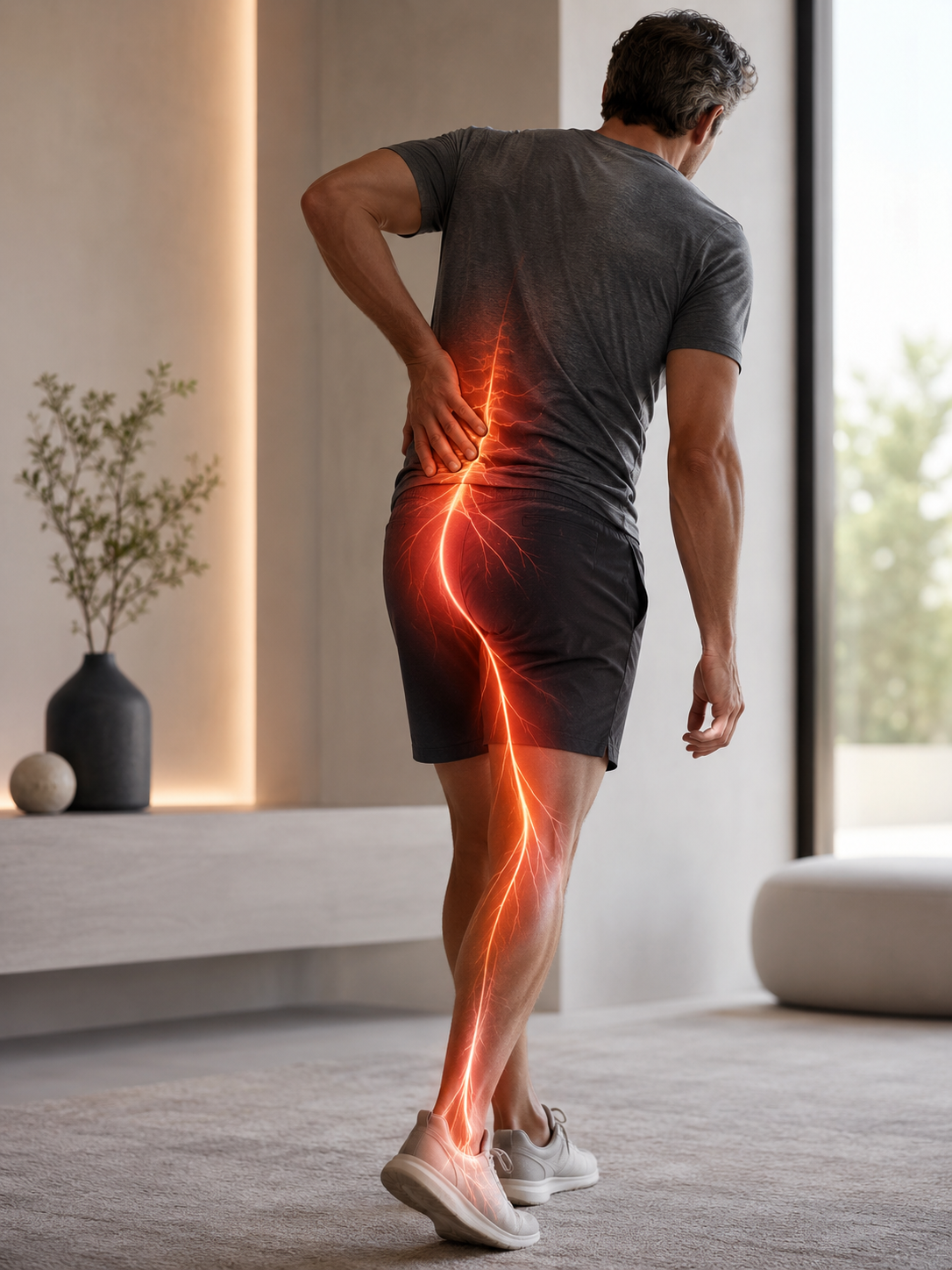
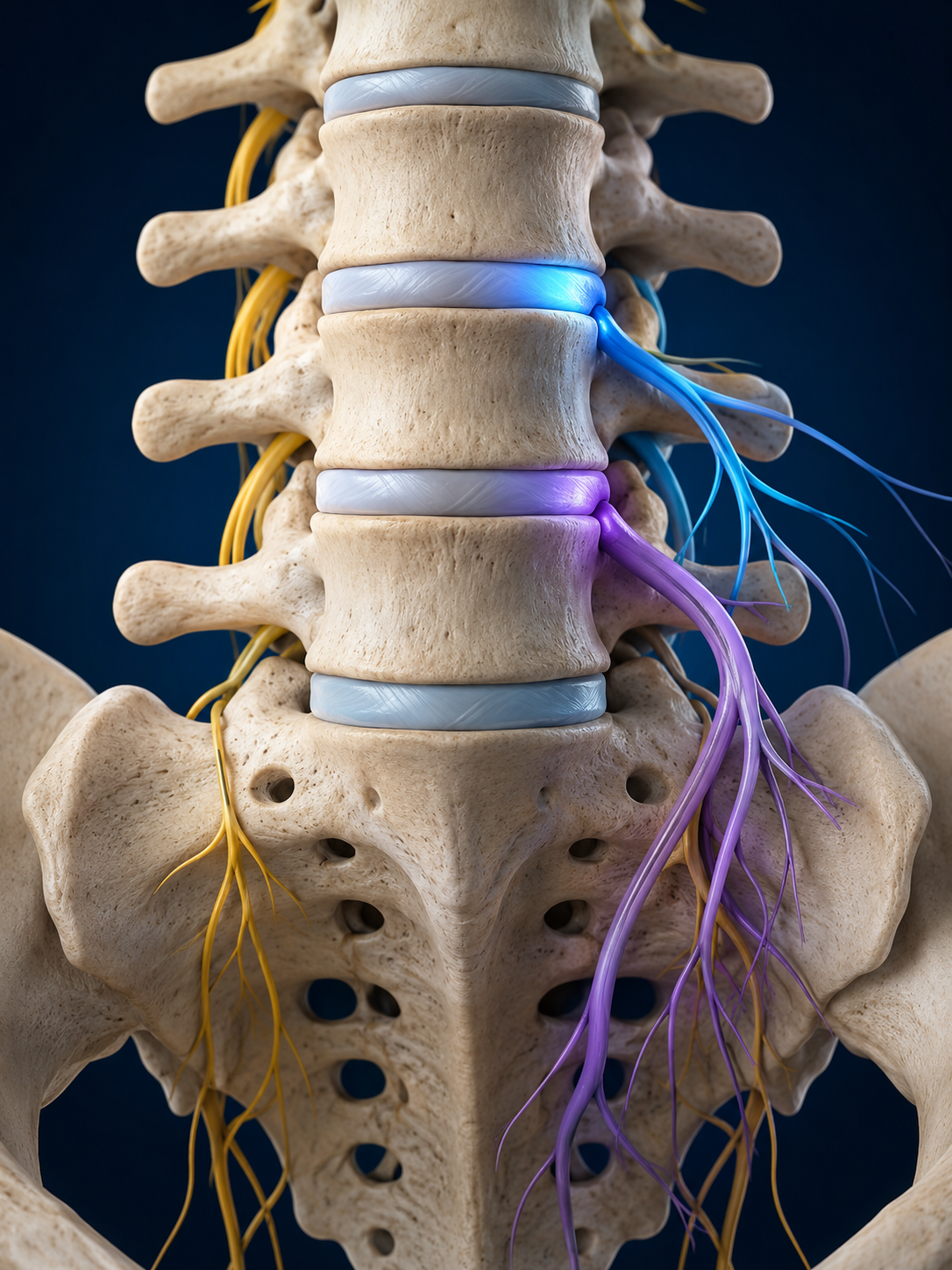
L4-L5 and L5-S1: What exactly are we talking about?
The lumbar spine includes five main vertebrae, called L1 to L5. Under L5 is the sacrum, the first part of which is called S1. The L4-L5 disc is therefore located between L4 and L5. The L5-S1 disc is located between L5 and the sacrum.
When a disk bombs, cracks, sags or forms a hernia, it can reduce the space around a nerve root. The pain felt in the leg often depends on the irritated root, not just the disc level written in the imaging report.
| mentioned level | Root often concerned | Possible journey or symptom |
|---|---|---|
| L4-L5 | L5 | Pain towards the buttocks, the side of the leg, the top of the foot or the big toe. |
| L5-S1 | S1 | Pain towards the buttocks, the back of the thigh, the calf, the heel or the outer edge of the foot. |
| L3-L4 | L4 | Pain that can be felt more towards the front of the thigh or knee. |
| Multiple attacks | Several possible roots | Less clear journey, mixed symptoms or pain difficult to attribute to a single root. |
Difference Between L5 Pain and S1 Pain
The path of pain can give clues, but it does not always allow to conclude with certainty. Pain compatible with L5 or S1 should be interpreted with all the symptoms: numbness, tingling, weakness, reflexes, reaction to positions and evolution over time.
Pain compatible with L5
The pain can go down to the buttocks, the side of the thigh, the side of the leg, the top of the foot or the big toe. It can be associated with difficulty in raising the foot or toes.
Pain compatible with S1
The pain can go down to the back of the thigh, calf, heel, outer edge of the foot or small toe. It can be associated with difficulty getting on tiptoe.
Pain compatible with L4
The pain may be more towards the front of the thigh, knee or inner side of the leg. This painting may be closer to cruralgia than to classic sciatica.
Numbness
The location of the numbness can sometimes be more revealing than the pain itself, especially if it follows a specific nervous territory.
Weakness
Weakness of the foot, calf or leg is more worrying than isolated pain. It needs to be assessed quickly, especially if it progresses.
Mixed pain
A person may have multiple levels affected or pain that does not perfectly follow a single territory. The evaluation then becomes even more important.
How to interpret the path of pain in the leg?
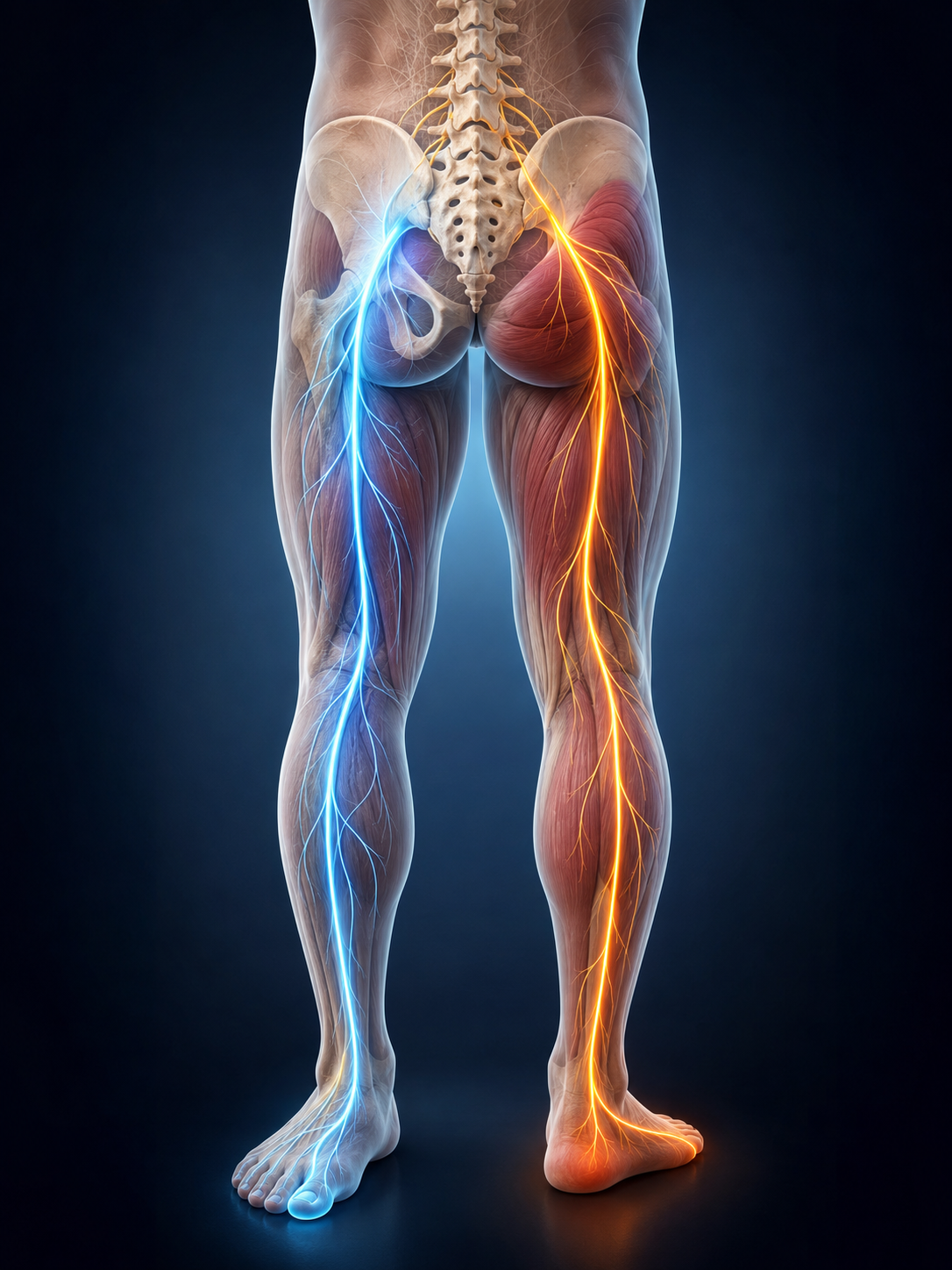
The pain path helps to formulate a hypothesis, but it does not replace the evaluation. Pain towards the big toe can evoke L5, while pain towards the heel or the outer edge of the foot can evoke S1. However, anatomical variations and multiple attacks can make the picture less clear.
It is also necessary to take into account what aggravates or relieves the pain. Some disc pains are aggravated by sitting or flexing the trunk. Some stenosis-related pain can be aggravated by prolonged walking or standing. These reactions sometimes give additional clues.
- Pain towards the big toe: often compatible with L5.
- Pain towards the heel or the outer edge of the foot: often compatible with S1.
- Pain in front of the thigh: may evoke L3-L4 or cruralgia.
- Weakness of the foot: Sign to be assessed quickly.
- Progressive aggravation: should not be trivialized.
How to read a report that mentions L4-L5 or L5-S1?
An MRI or CT scan report may mention terms like protrusion, bulge, disc herniation, disc pinch, foraminal stenosis or spinal stenosis. These words describe visible changes, but they alone are not enough to confirm the exact cause of the symptoms.
Always compare the image with the clinical picture. A visible abnormality can be significant if it corresponds to the path of pain, numbness, weakness or signs found at evaluation. Conversely, an abnormality can be present without fully explaining the symptoms.
| Report term | what it can mean | Why assessment remains necessary |
|---|---|---|
| herniated disc L4-L5 | The L4-L5 disc protrudes or migrates and may irritate a nerve root. | It is necessary to check whether the symptoms correspond to an L5 territory. |
| herniated disc L5-S1 | The L5-S1 disk can irritate a root, often S1 depending on the context. | It is necessary to check whether the pain goes towards the heel or the outer edge of the foot. |
| Foraminal stenosis | The exit passage of a nerve root is narrowed. | Position, walking and extension can influence symptoms. |
| disc pinch | The height of the disc is decreased. | This can change the available space around the nerve roots. |
| Lumbar osteoarthritis | Joints and bony structures can help reduce certain spaces. | The actual impact depends on the level, side and associated symptoms. |

Why a personalized evaluation is essential
Two people may have L5-S1 disc herniation, but have very different symptoms. One may experience sharp pain in the leg, the other more diffuse pain, numbness or weakness. The imaging should therefore be interpreted with caution.
At TagMed Clinic, the evaluation aims to link the level mentioned in the report, the path of pain, the location of numbness, muscle strength and aggravating factors. This approach makes it possible to determine whether a non-surgical and non-invasive approach may be relevant depending on the patient’s profile.
Journey Analysis
Compare pain with L5, S1 or other possible roots.
Functional verification
Observe walking, strength, sensitivity and position tolerance.
What approaches can be considered for L4-L5 or L5-S1 sciatica?
The choice of an approach depends on the probable cause, the severity of the symptoms, the presence or absence of weakness, the evolution over time and the tolerance of the patient. Sciatica associated with L4-L5 or L5-S1 should not automatically lead to the same recommendations for everyone.
When the clinical profile is compatible with a mechanical or disc cause, certain non-surgical approaches may be considered, including neurovertebral decompression motorized, specific osteopathy or the precision striker, depending on the evaluation.
| Approach | Possible role | Profile where it can be discussed |
|---|---|---|
| Motorized neurovertebral decompression | Reduce some mechanical stress on discs and nerve roots. | Pain compatible with a disc origin or mechanical compression. |
| osteopathy specific | Adapt interventions to patient restrictions, compensation and tolerance. | Pain with stiffness, limitation or associated mechanical overload. |
| Precision striker | Instrument assisted intervention, targeted and low amplitude. | Accurate mechanical dysfunction depending on the evaluation. |
| Medical reference | Orientation when the signs go beyond the scope of conservative care. | Progressive weakness, severe neurological signs, uncontrollable pain or red flags. |
Sciatica L4-L5, L5-S1 and Clinic Tagmed
TagMed Clinic receives patients with pain consistent with lumbar nerve irritation, especially when imaging reports mention L4-L5, L5-S1, disc herniation, protrusion, disc or Foraminal stenosis.
The typical rate is $140 per consultation or treatment. The services are not covered by the RAMQ, but osteopathy receipts may be provided and are eligible for reimbursement by several private insurance plans according to your contract.
Please note that we do not offer physiotherapy, chiropractic, injection, naturopathic or functional medicine services at the TagMed Clinic.
Tagmed Terrebonne Clinic
1150 rue Lévis, Suite 200
Terrebonne, QC, J6W 5S6
Phone: 450-704-4447
Days: Monday, Wednesday and Friday
Clinic Tagmed Montreal / Mont-Royal
1140 Avenue Beaumont
Mount Royal, QC, H3P 3E5
Phone: 1-877-672-9060
Days: Tuesday and Thursday
Frequently Asked Questions about L4-L5 and L5-S1 Sciatica
What is the difference between L4-L5 and L5-S1?
L4-L5 denotes the disc between the fourth and fifth lumbar vertebrae. L5-S1 denotes the disc between the fifth lumbar vertebra and the sacrum. These are disc levels, not nerve roots.
What is the difference between L5 and S1?
L5 and S1 are nerve roots. L5 irritation may give symptoms to the top of the foot or the big toe. S1 irritation may cause symptoms towards the heel, outer edge of the foot or small toe.
Does an L4-L5 hernia still affect the L5 root?
Not always, but L4-L5 level damage can often be associated with L5 root irritation depending on the location of the hernia, its size and available space around the nerve structures.
Does an L5-S1 hernia still affect the root S1?
Not always, but L5-S1 damage can often be associated with S1 root irritation. The assessment should check whether the symptoms actually match this territory.
Is big toe pain more compatible with L5?
Yes, pain, numbness or tingling to the big toe may be compatible with L5 root irritation, but this must be confirmed by the entire clinical picture.
Is heel pain more compatible with S1?
Yes, pain towards the heel, the outer edge of the foot or the small toe may be compatible with root irritation S1, especially if it is associated with an attack at the L5-S1 level.
Is an MRI report sufficient to choose treatment?
No. Imaging should be related to symptoms, examination, muscle strength, sensitivity and progression of pain. A visible abnormality is not always enough to explain the pain.
When should you consult quickly?
It is necessary to consult quickly in the presence of a progressive weakness, a numbness that extends, a loss of function, a pain that worsens quickly, or urinary or intestinal disorders.
Can neurovertebral decompression be considered?
It can be considered in certain pain profiles compatible with a disc or mechanical origin, in particular when the evaluation suggests nervous irritation without an emergency.
Does the TAGMED clinic treat all L4-L5 or L5-S1 sciatica?
No. The relevance of care depends on the assessment. Some situations require a medical reference or different management, especially in the presence of important neurological signs.
Treatment pages by clinic
SOS Sciatique and TAGMED clinics are part of the same website portfolio.
Your report mentions L4-L5 or L5-S1?
A personalized assessment can help link your imaging report, the path of your pain, and the neurological signs present to determine if a non-surgical approach may be relevant.
Dr Sylvain Desforges, B.Sc., D.O., N.D., Osteopath

Editorial information, sources and limitations
This content is intended to inform patients about sciatica, possible causes, warning signs, and care options. It does not replace an individualized assessment.
Reference sources
References are selected according to the subject of the page: guidelines, systematic reviews, then institutional resources.
- NICE NG59 – Low back pain and sciatica in over 16s — National guideline
- HAS – Management of patients with common low back pain — French national guideline
- Cochrane – Corticosteroid injections for treatment of sciatica — Systematic review
- NCBI Bookshelf – Sciatica — Clinical institutional resource
Complementary resources from the TAGMED network
These internal resources complement the clinical information and thematic linking. They do not replace national guidelines or systematic reviews.
Editorial note on decompression
Clinical resource from the TAGMED network; it does not replace national guidelines. Some guidelines use the term “traction” and recommend caution for low back pain with or without sciatica. Any decompression option should therefore be presented as an individualized clinical approach, with limitations, indications, and contraindications clearly explained.
Editorial note on imaging
Imaging is mainly considered when the presentation is complicated, prolonged, or likely to change management. Routine imaging is generally not necessary for every simple and recent sciatica-like pain presentation.
Limitations of this information
The information on this page is general. It does not constitute a diagnosis, prescription, or guarantee of results. Pain radiating into the leg may have several causes; assessment should consider clinical history, examination findings, symptom progression, and, when appropriate, complementary tests.
When to seek urgent medical care
Seek urgent medical care if you experience loss of bladder or bowel control, saddle anesthesia, major or progressive leg weakness, unexplained fever, pain after significant trauma, or severe pain that rapidly worsens.
