


Sciatica or sacroiliac pain: how to differentiate pelvic pain from nerve pain?
A pain in the buttock, lower back, or back of the pelvis can sometimes suggest sciatica. However, some pains originate more from the sacroiliac joint, located between the sacrum and the pelvis.
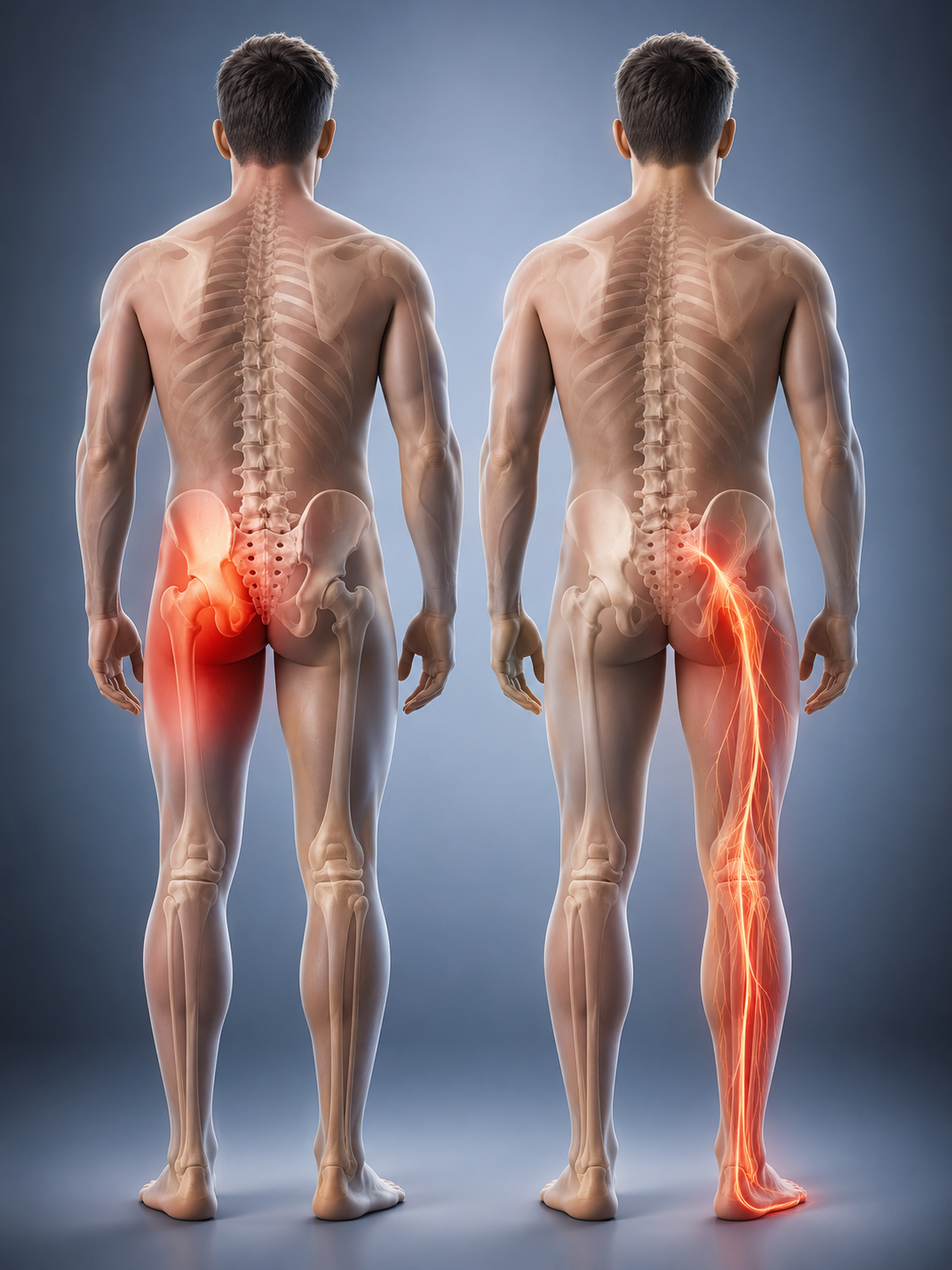
The difficulty arises from the fact that sacroiliac pain can mimic sciatica, especially when it radiates into the buttock, hip, or upper thigh. However, true sciatica pain more often follows a nerve path down the back of the thigh, calf, foot, or toes, sometimes with numbness, tingling, or weakness.
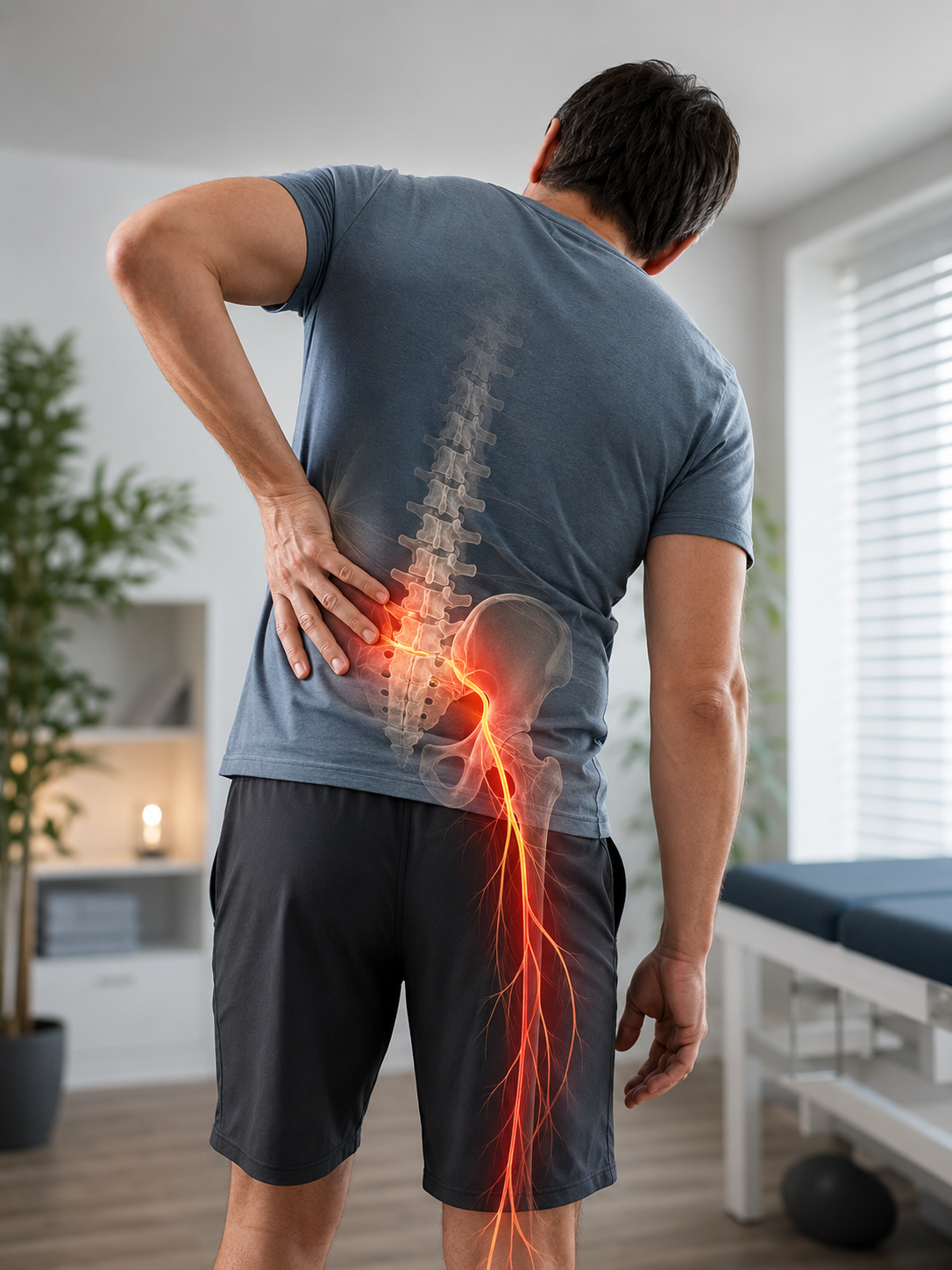
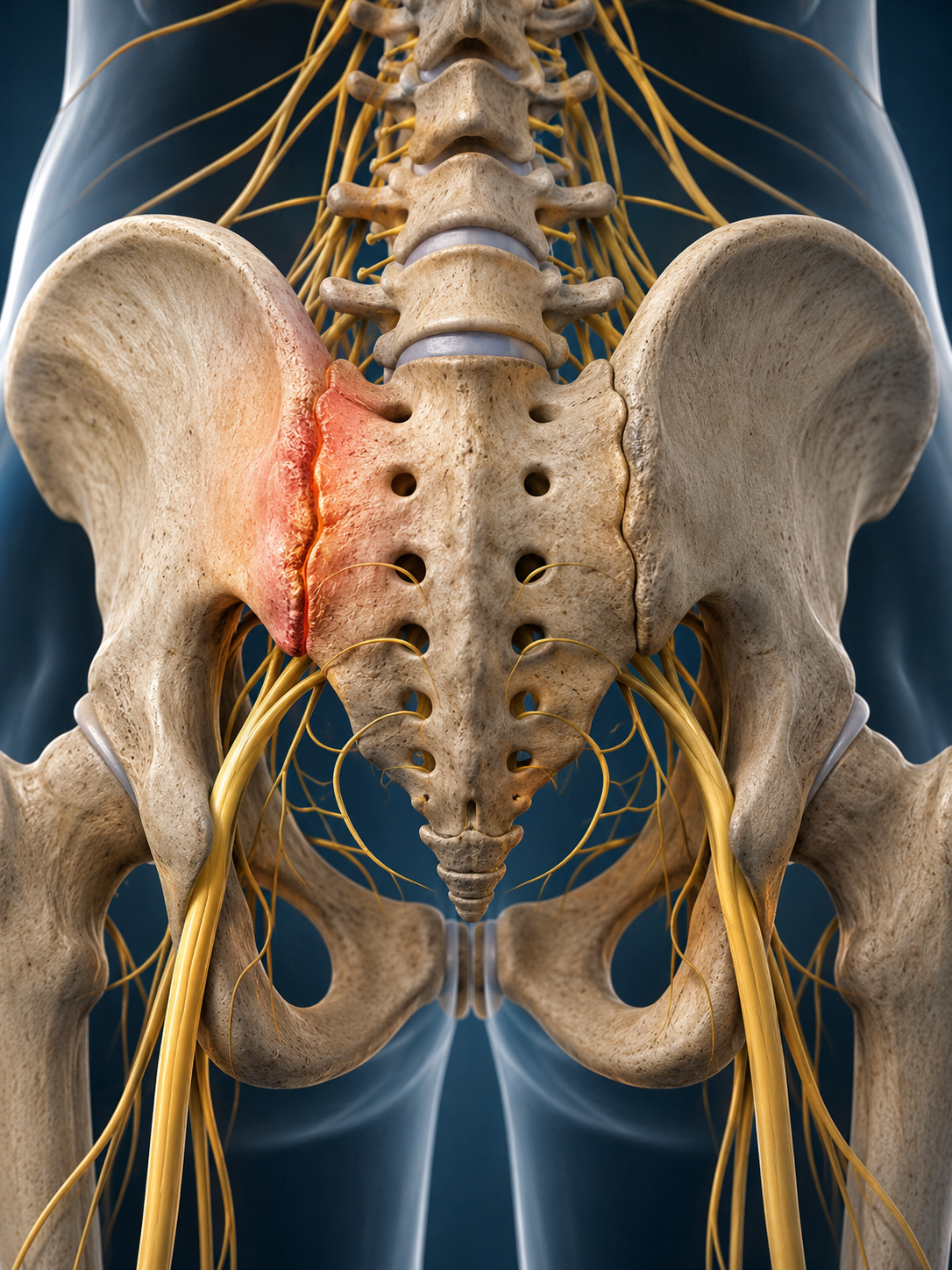
Where is the sacroiliac joint located?
The sacroiliac joint is found on either side of the sacrum, between the spine and the pelvis. It transmits loads between the trunk and the lower limbs. Irritation in this region can produce localized, deep pain, sometimes difficult to distinguish from lower back or buttock pain.
Sacroiliac pain does not always follow a clear nerve territory. It may remain around the back of the pelvis or buttock. Sciatica, on the other hand, becomes more likely when the pain follows a clearer downward path, especially below the knee or towards the foot.
| Compared Element | Sacroiliac Pain More Likely | Sciatica More Likely |
|---|---|---|
| Main Point | Back of the pelvis, near the sacrum, often on one side only. | Lower back or buttock with descending radiation into the leg. |
| Path | Buttock, hip, or upper thigh, often without a precise path to the foot. | Buttock, back of thigh, calf, heel, foot, or toes. |
| Numbness | Usually less typical as a clear nerve territory. | May follow an L4, L5, or S1 territory. |
| Weakness | Less typical as a real neurological deficit. | More concerning if the foot catches or there is loss of strength. |
| Reaction to positions | May vary with load-bearing, walking, transitioning from sitting to standing, or certain supports. | May vary with sitting, bending, walking, coughing, effort, or position depending on the lumbar cause. |
Signs that point towards sciatica rather than sacroiliac pain
Pain in the buttock is not enough to make a diagnosis. It is mainly the descending route, neurological sensations, and loss of function that point towards lumbar nerve irritation.
Pain below the knee
Pain that descends towards the calf, heel, foot, or toes is more compatible with nerve irritation.
Burning or electric shock
A sensation of current, burning, or shock in the leg may evoke a nerve component.
Tingling
Tingling in the calf, foot, or toes should be interpreted with caution.
Localized numbness
Localized numbness above the foot, in the big toe, heel, or outer edge of the foot may indicate a nerve root.
Weakness in the foot or calf
A foot that drags or difficulty pushing off the toes should be evaluated promptly.
Increased pain in the leg
When the leg becomes more painful than the hip or back, a root component should be considered.
Pain in the buttock: hip or nerve root?
The buttock is a common projection area. Pain originating from the sacroiliac region, a lumbar joint, a disc, a nerve root, the hip, or a deep muscle can be felt there. This is why it is risky to conclude too quickly to sciatic or sacroiliac pain based solely on location.
The complete pathway must be analyzed. Pain that remains near the hip may be compatible with a sacroiliac or localized cause. Pain that clearly travels down the back of the thigh, calf, or foot should prompt investigation for a lumbar root origin unless proven otherwise.
- Pain near the back of the hip: possible sacroiliac, but not automatic.
- Buttock + calf + foot pain: more suspicious for lumbar sciatica.
- Pain in the big toe: possible L5 irritation.
- Pain in the heel or outer edge of the foot: possible S1 irritation.
- Progressive weakness or numbness: rapid reevaluation recommended.
Diagnoses often confused with sacroiliac pain
Sacroiliac pain is one possible cause of buttock pain, but it should not mask more common or concerning lumbar causes when there is a clear nerve pathway.
| Possible cause | Why it may resemble sacroiliac pain | What to check |
|---|---|---|
| Lumbar disc herniation | Can cause pain in the lower back, buttock, and leg. | Pain below the knee, numbness, weakness, L5 or S1 pathway. |
| Foraminal stenosis | Can produce unilateral pain in the buttock or leg. | Specific territory, foot pain, symptoms depending on positions. |
| Spinal stenosis | Can cause heaviness, pain, or numbness in the legs. | Walking distance, relief while sitting, symptoms sometimes bilateral. |
| Hip pain | Can refer to the buttock, thigh, or groin. | Reaction to hip movements, load bearing, and walking. |
| Piriformis syndrome | Can cause buttock pain near the path of the sciatic nerve. | Diagnosis should be made cautiously, especially if the pain radiates to the foot. |

Why personalized evaluation is essential
Pain around the sacroiliac region alone is not sufficient to determine the cause. It is necessary to compare the path of the pain, the reaction to movements of the pelvis, hip, and back, the presence of numbness, muscle strength, walking, and warning signs.
The evaluation aims to distinguish between sacroiliac pain, referred low back pain, irritation of a nerve root, hip pain, local buttock pain, or a combination of factors. This distinction is important because precautions, exercises, and directions differ.
Locate the pain
Identify whether the pain stays near the pelvis or follows a descending nerve path.
Check for nerve signs
Compare pain, sensitivity, strength, walking, numbness, and tingling.
What to do if you’re unsure between sciatica and sacroiliac pain?
The first step is not to jump to conclusions too quickly. Pain in the buttock or lower back can have multiple origins. It’s important to observe if the pain is localized, if it extends below the knee, if it reaches the foot, if it appears with certain movements, or if it is accompanied by neurological signs.
Depending on the assessment, non-surgical and non-invasive approaches can be discussed. If the evaluation suggests a lumbar or radicular origin, the approach should target the likely cause: disc, foramen, lumbar canal, disc herniation, stenosis, or another mechanical factor. If the pain seems to be sacroiliac or gluteal, precautions should be tailored to this reality.
| Pain Profile | Priority | Why |
|---|---|---|
| Pain near the pelvis only | Assess sacroiliac, hip, lumbar, and deep muscles. | Location alone does not confirm the cause. |
| Buttock pain + calf or foot | Look for lumbar nerve irritation. | The descending path increases the likelihood of sciatica. |
| Numbness or tingling | Identify the sensitive area. | These signs lean more towards a neurological component. |
| Weakness or stumbling foot | Rapid assessment. | The loss of strength changes the level of safety. |
Sacroiliac pain, sciatica, and clinical orientation
An educational page like this serves to better understand possible differences, but it does not replace an assessment. Buttock or sacroiliac pain should be interpreted based on its trajectory, duration, reaction to positions, neurological signs, and aggravating factors.
For a local appointment or a geolocated treatment page, the main conversion page should be hosted on the TAGMED Clinic’s site to avoid SEO cannibalization with SOS Sciatica’s educational content.
SOS Sciatica’s educational pages should explain the causes and guide the reader. Local treatment, appointment, and conversion pages should remain on the TAGMED Clinic’s site.
Understanding the trajectory
A localized pain near the pelvis and pain that travels to the foot do not have the same significance.
Avoid hasty conclusions
Sacroiliac pain is possible, but lumbar causes should be considered if the signs are neurological.
Frequently Asked Questions about Sciatica and Sacroiliac Pain
Can sacroiliac pain mimic sciatica?
Yes. Sacroiliac pain can cause pain in the buttock or the upper thigh, which can initially resemble sciatica.
How to distinguish between sciatica and sacroiliac pain?
Sciatica often radiates below the knee towards the calf, foot, or toes. Sacroiliac pain tends to stay more around the back of the pelvis or the buttock.
Is pain in the buttock always sciatica?
No. The buttock can be painful in sciatica, but also in sacroiliac pain, hip pain, referred low back pain, or localized gluteal pain.
Does sacroiliac pain radiate down to the foot?
It generally radiates less clearly to the foot. Pain in the foot, heel, or toes is more suggestive of lumbar nerve irritation.
What signs indicate true sciatica?
Pain below the knee, burning, electric shock sensations, numbness, tingling, foot pain, or foot weakness may suggest sciatica.
Can sacroiliac pain occur while walking?
Yes. Walking or certain positions can aggravate sacroiliac pain, but pain that radiates with numbness or weakness should be evaluated differently.
Can pain when getting up from a chair be sacroiliac?
Yes, but it can also be lumbar, disc-related, or radicular. The response when getting up should be interpreted along with the trajectory and associated signs.
When should you consult quickly?
You should consult quickly if the pain radiates to the foot, if the numbness increases, if weakness occurs, if walking changes, or if symptoms progress rapidly.
Is neurovertebral decompression indicated for sacroiliac pain?
It primarily targets certain lumbar or radicular profiles. If the pain is mainly sacroiliac, the assessment must determine if another approach or direction is more appropriate.
Why should we avoid jumping to conclusions too quickly?
Because several types of pain can resemble each other in the buttock. A misinterpretation can delay the identification of a lumbar, neurological, sacroiliac, or hip-related cause.
Does your pain come from the sciatic nerve or the sacroiliac joint?
A personalized evaluation can help distinguish between local buttock pain, sacroiliac pain, and lumbar nerve irritation, especially if the pain radiates below the knee or reaches the foot.
Dr Sylvain Desforges, B.Sc., D.O., N.D., osteopath

Editorial information, sources and limitations
This content is intended to inform patients about sciatica, possible causes, warning signs, and care options. It does not replace an individualized assessment.
Reference sources
References are selected according to the subject of the page: guidelines, systematic reviews, then institutional resources.
- NICE NG59 – Low back pain and sciatica in over 16s — National guideline
- HAS – Management of patients with common low back pain — French national guideline
- Cochrane – Corticosteroid injections for treatment of sciatica — Systematic review
- NCBI Bookshelf – Sciatica — Clinical institutional resource
Complementary resources from the TAGMED network
These internal resources complement the clinical information and thematic linking. They do not replace national guidelines or systematic reviews.
Editorial note on decompression
Clinical resource from the TAGMED network; it does not replace national guidelines. Some guidelines use the term “traction” and recommend caution for low back pain with or without sciatica. Any decompression option should therefore be presented as an individualized clinical approach, with limitations, indications, and contraindications clearly explained.
Limitations of this information
The information on this page is general. It does not constitute a diagnosis, prescription, or guarantee of results. Pain radiating into the leg may have several causes; assessment should consider clinical history, examination findings, symptom progression, and, when appropriate, complementary tests.
When to seek urgent medical care
Seek urgent medical care if you experience loss of bladder or bowel control, saddle anesthesia, major or progressive leg weakness, unexplained fever, pain after significant trauma, or severe pain that rapidly worsens.