


Can you have sciatica without a herniated disc?
Yes. A herniated disc is a common cause of sciatica, but it is not the only one. A nerve root can be irritated or compressed by a foraminal stenosis, lumbar stenosis, arthritic changes, spondylolisthesis, or, more rarely, another condition.
The absence of a visible hernia on an MRI does not automatically mean that the pain in the leg is imaginary or does not come from a nerve root. It mainly means that the correlation between the symptoms, clinical examination, and all the imaging needs to be verified.
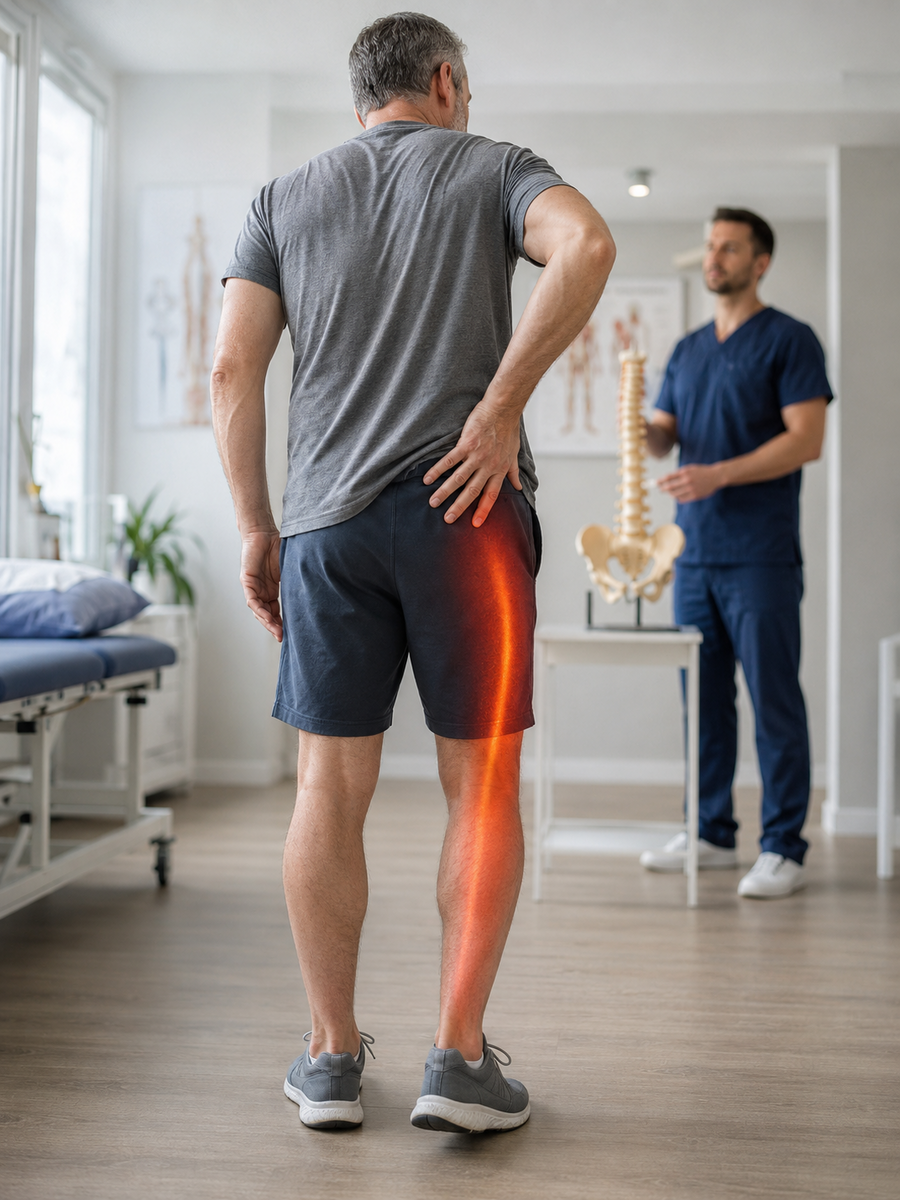
What is the difference between sciatica and disc herniation?
Sciatica is a painful or neurological syndrome compatible with the irritation of the roots forming the sciatic nerve, most often L5 or S1. A disc herniation is an anatomical alteration of an intervertebral disc. The two can be related, but they are not synonymous.
Sciatica
Radiating pain, burning sensations, shocks, tingling, numbness, or weakness following a path through the buttock and leg.
Herniated disk
Localized displacement of disc material that can irritate a root but may also be present without symptoms.
Radiculopathy
Affecting a root associated with an observable neurological deficit, such as weakness, altered sensitivity, or decreased reflexes.
What causes can lead to sciatica without a herniated disk?
Several mechanisms can reduce the available space around a root or irritate the nerve tissue. Their significance must be interpreted based on age, the onset of symptoms, aggravating positions, and the neurological examination.
| Possible cause | Mechanism | Possible indicators |
|---|---|---|
| Foraminal stenosis | The lateral passage through which the root exits becomes narrower due to joint, disc, or bony changes. | Unilateral pain or numbness that may vary with trunk position. |
| Lumbar canal stenosis | The central canal narrows and can affect several roots. | Symptoms while walking or standing, sometimes relieved by sitting or leaning forward. |
| Osteoarthritis and bone spurs | The joints and nearby structures can gradually reduce the nerve space. | Often progressive condition, sometimes accompanied by stiffness and reduced tolerance in certain positions. |
| Spondylolisthesis | A vertebra slips relative to the next one and can narrow the canal or foramina. | Lower back, buttock, or leg pain, sometimes worsened by standing or walking. |
| Inflammation or sensitivity of the nerve root | A chemical or inflammatory irritation can contribute to symptoms even when visible compression appears mild. | Radicular pain whose intensity does not always correspond to the apparent significance of the images. |
| Extraspinal involvement of the sciatic nerve | The nerve can be irritated in the buttock or pelvic region; these situations are less frequent than lumbar causes. | Buttock or posterior thigh pain whose profile does not clearly match a lumbar root. |
| Less common serious cause | Infection, tumor, fracture, hematoma, or inflammatory disease can affect the nerve structures. | Fever, unexplained weight loss, known cancer, immunosuppression, trauma, or unusual general pain. |

Can lumbar stenosis cause true sciatica?
Yes. When the central canal or a foramen becomes too narrow, one or more roots may lack space. Symptoms can manifest as pain in the buttock or leg, tingling, numbness, heaviness, or weakness.
In certain profiles of central stenosis, walking and standing worsen symptoms, while sitting or a slight bend can alleviate them. This condition is called neurogenic claudication. It should not be confused with vascular claudication.
- Walking distance may gradually decrease.
- Symptoms may affect one or both legs.
- Low back pain may be mild or absent.
- Biking or walking leaned over a cart may be better tolerated.
- These clues are not sufficient for a diagnosis without evaluation.
How to evaluate sciatica when the MRI shows no herniation?
The evaluation begins with the narrative and examination, not with a single line from the radiology report. The professional seeks to determine if the symptoms follow a root, if they suggest a peripheral nerve, or if they correspond more closely to another structure.
- Exact path of pain, numbness, and tingling.
- Strength of the big toe, foot, calf, knee, and hip.
- Patellar and Achilles reflexes, depending on the context.
- Sensitivity of the leg, foot, and toes.
- Walking on heels and tiptoes when it is safe.
- Reaction to sitting, walking, bending, and extending.
- Examination of the hip, peripheral nerves, and circulation if necessary.

What does a “normal” MRI or one without a herniation mean?
An MRI without significant herniation may be reassuring, but its interpretation depends on the clinical question. A foraminal stenosis, positional narrowing, extraspinal involvement, or another cause may require a different analysis. Conversely, many visible abnormalities in pain-free individuals do not prove they explain the symptoms.
Check the full report
Look for foramina, the canal, lateral recesses, arthritis, and vertebral slipping, not just the word ‘herniation’.
Compare with clinical findings
The level and side must be consistent with the path, strength, sensitivity, and reflexes.
Reassess if necessary
A doctor may sometimes consider new imaging, electromyography, or another examination if the diagnosis remains uncertain.
What conditions can mimic sciatica?
When lumbar imaging and examination do not match, one should avoid forcing the diagnosis of sciatica. Several issues can cause pain in the buttock or leg.
Hip
Arthritis, conflict, or tendon involvement can refer pain to the buttock, groin, or thigh.
Peripheral nerve
The fibular nerve, tibial nerve, or sciatic nerve may be irritated far from the spine.
Thigh Pain
A pain in the front of the thigh often involves the roots L2 to L4 or the femoral nerve.
Muscle or Tendon Pain
A localized pain may sometimes radiate without resulting in a true radicular neurological deficit.
Neuropathy
Diabetes, certain deficiencies, or other diseases can produce distal symptoms often different from a single root.
Circulation
An arterial or venous condition can cause pain, heaviness, color change, or swelling and requires appropriate direction.
How do we treat sciatica without a herniated disc?
The treatment targets the likely cause, function, and observed deficits. It may include information, adapted activity, a personalized exercise program, a review of medications with a doctor or pharmacist, and, in some cases, an injection or surgical advice.
| Situation | Approach that can be discussed | When to re-evaluate |
|---|---|---|
| Recent symptoms without significant deficit | Maintain tolerated activities, provide information, gradual progression, and monitoring. | Worsening, pain that radiates further, increasing numbness, or declining function. |
| Stenosis or degenerative changes | Exercises and activities tailored to the profile, load management, and medical discussion of options if disability persists. | Decreased walking distance, weakness, or increasing bilateral symptoms. |
| Spondylolisthesis | Personalized plan based on stability, neurological symptoms, and imaging. | Persistent pain, deficit, or signs of instability requiring a specialist opinion. |
| Uncertain diagnosis | Medical reevaluation and targeted investigation rather than increasing generic treatments. | No improvement, new signs, or persistent discordance. |
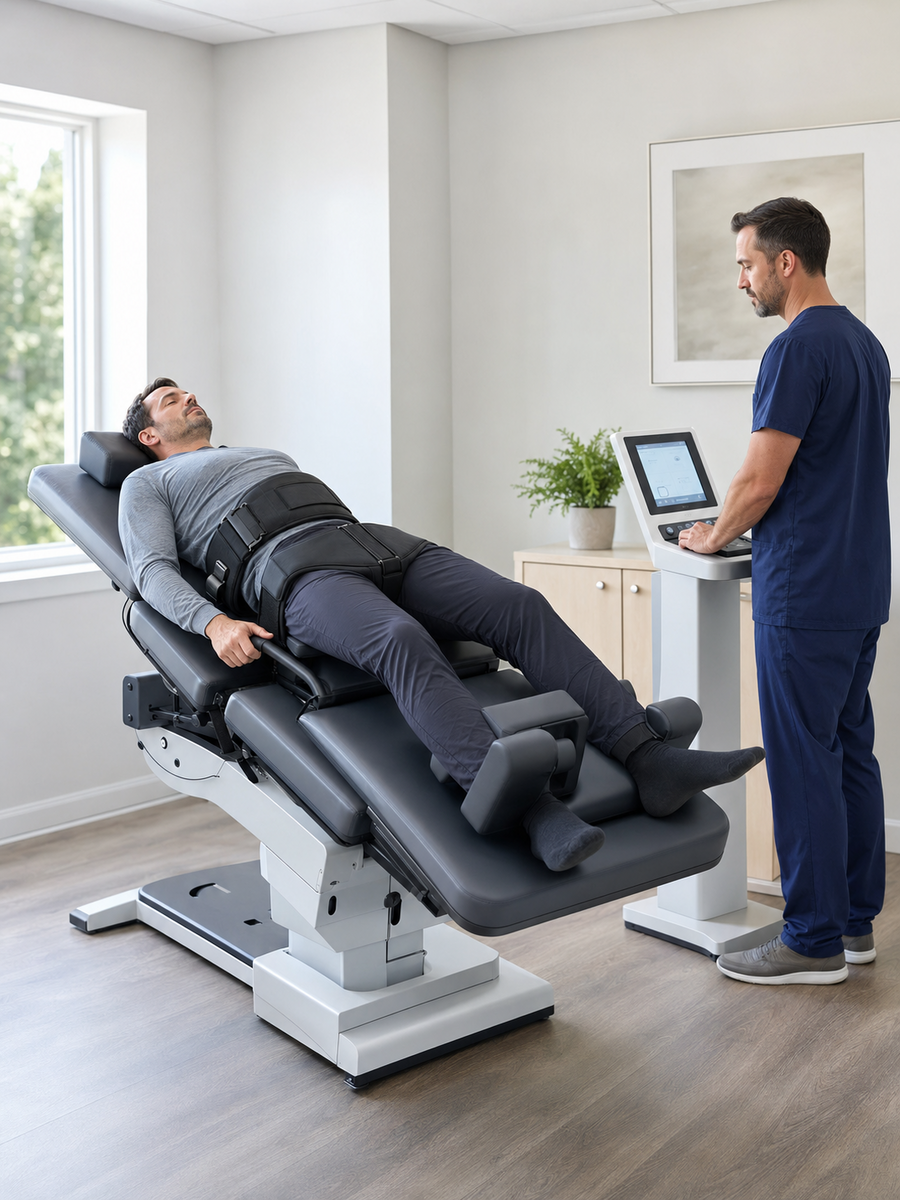
Can neurovertebral decompression be considered without a hernia?
The neurovertebral decompression is a form of controlled mechanical traction. At the TAGMED Clinic, a trial may be discussed after evaluation in certain profiles involving disc or foraminal narrowing, provided that no contraindication or urgency is identified.
The absence of a hernia does not constitute either an automatic indication or an automatic exclusion. The probable cause, type of stenosis, vertebral stability, neurological deficits, and reaction to positions must be considered.
When should you seek immediate consultation?
Immediate emergency
New urinary or bowel issues, loss of bowel sensation, severe or rapidly progressive weakness, or significant symptoms on both sides.
Rapid assessment
Dropped foot, leg giving way, numbness spreading, increasingly difficult walking, or uncontrollable pain.
Concerning context
Fever, recent infection, known cancer, unexplained weight loss, immunosuppression, trauma, or unusual nighttime pain.
Assessment of sciatic pain at the TAGMED Clinic
The TAGMED Clinic offers an osteopathic assessment and non-surgical, non-invasive approaches for certain lower back pain and symptoms compatible with sciatica. The goal is to clarify the functional profile, identify signs requiring medical referral, and determine if a trial of conservative care seems reasonable.
This assessment does not replace a medical diagnosis, prescription, imaging, infiltration, or surgical consultation. A medical referral is recommended when the situation exceeds the scope of osteopathy practice.
TAGMED Clinic Terrebonne
1150 Lévis Street, Suite 200
Terrebonne, QC, J6W 5S6
Phone: 450-704-4447
Days: Monday, Wednesday, and Friday
TAGMED Clinic Montreal / Mont-Royal
1140 Beaumont Avenue
Mont-Royal, QC, H3P 3E5
Phone: 1-877-672-9060
Days: Tuesday and Thursday
Frequently Asked Questions about Sciatica without a Herniated Disc
Can you really have sciatica without a herniated disc?
Yes. Foraminal stenosis, central stenosis, arthritis, spondylolisthesis, or extraspinal issues can cause symptoms consistent with sciatica.
Does a normal MRI rule out sciatica?
No. It reduces the likelihood of certain visible causes, but the diagnosis must also consider the course, strength, sensitivity, reflexes, and other possible diagnoses.
Can arthritis irritate the sciatic nerve?
Arthritic changes can contribute to narrowing of the canal or foramina and irritate the roots that form the sciatic nerve.
How can one recognize lumbar stenosis?
Pain, heaviness, or numbness occurring while standing or walking and decreasing when sitting or leaning forward may suggest it, but an evaluation is necessary.
Is piriformis syndrome common?
Irritation of the nerve in the buttock region is possible, but it is less common than lumbar causes and must be distinguished from hip, tendon, and nerve root issues.
Do I need to repeat the MRI?
Not automatically. A doctor may consider new imaging if symptoms change, if a deficit appears, or if the result is likely to modify treatment.
Is the treatment different when there isn’t a hernia?
Often yes, as tolerated movements, prognosis, and options may differ depending on whether it is stenosis, spondylolisthesis, or another cause.
Does neurovertbral decompression suit all cases without a hernia?
No. It may be discussed in certain profiles after evaluation, but traction is not routinely recommended by NICE, and no result can be guaranteed.
Sources and references
- NICE NG59 — Low back pain and sciatica: assessment and management.
- NHS — Sciatica.
- NHS — Spondylolisthesis.
- American College of Radiology — Appropriateness Criteria: Low Back Pain.
Your pain feels like sciatica, but no herniation has been found?
An evaluation can help compare the course, neurological function, aggravating factors, and other possible causes. When concerning signs are present, medical guidance remains a priority.
Dr Sylvain Desforges, B.Sc., D.O., N.D., osteopath
Editorial information, sources and limitations
This content is intended to inform patients about sciatica, possible causes, warning signs, and care options. It does not replace an individualized assessment.
Reference sources
References are selected according to the subject of the page: guidelines, systematic reviews, then institutional resources.
- NICE NG59 – Low back pain and sciatica in over 16s — National guideline
- HAS – Management of patients with common low back pain — French national guideline
- Cochrane – Corticosteroid injections for treatment of sciatica — Systematic review
- NCBI Bookshelf – Sciatica — Clinical institutional resource
Complementary resources from the TAGMED network
These internal resources complement the clinical information and thematic linking. They do not replace national guidelines or systematic reviews.
Editorial note on decompression
Clinical resource from the TAGMED network; it does not replace national guidelines. Some guidelines use the term “traction” and recommend caution for low back pain with or without sciatica. Any decompression option should therefore be presented as an individualized clinical approach, with limitations, indications, and contraindications clearly explained.
Limitations of this information
The information on this page is general. It does not constitute a diagnosis, prescription, or guarantee of results. Pain radiating into the leg may have several causes; assessment should consider clinical history, examination findings, symptom progression, and, when appropriate, complementary tests.
When to seek urgent medical care
Seek urgent medical care if you experience loss of bladder or bowel control, saddle anesthesia, major or progressive leg weakness, unexplained fever, pain after significant trauma, or severe pain that rapidly worsens.
