Sciatica and aggressive stretches: possible sign of worsening
26/10/2026
Sciatica in Terrebonne: radicular pain versus referred pain
27/10/2026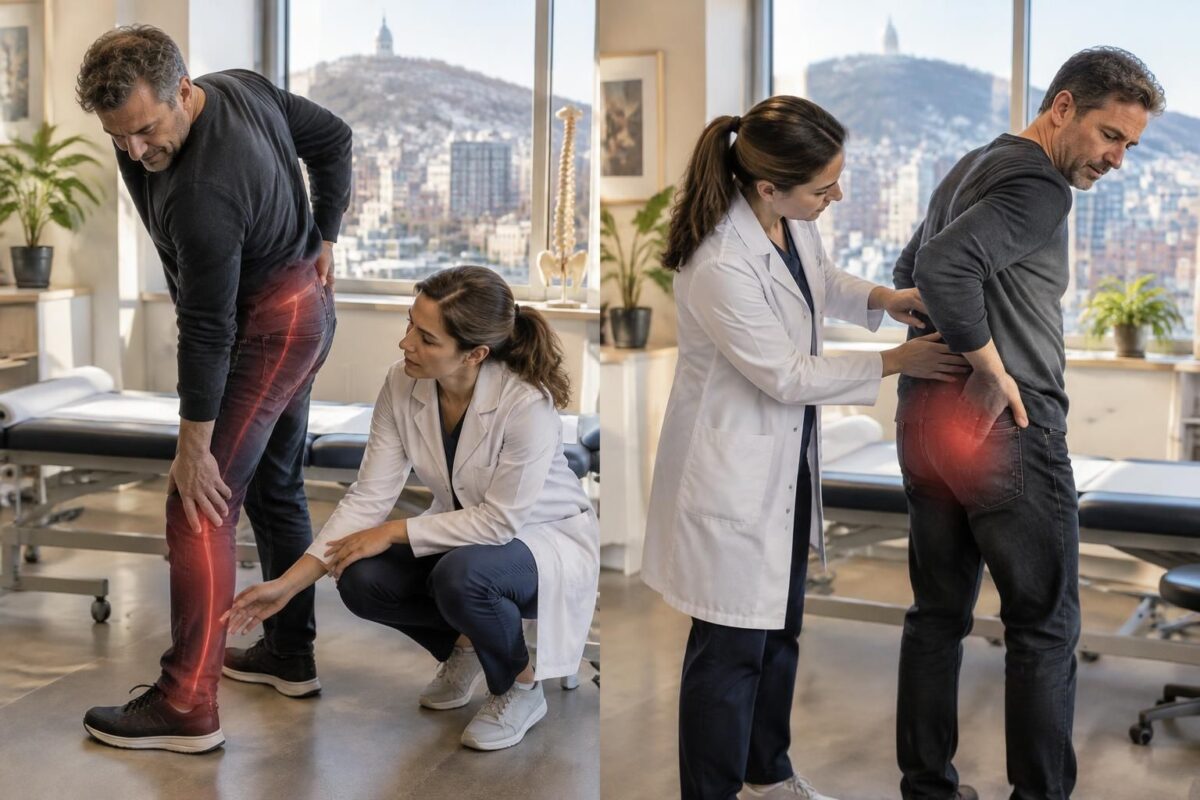
IN BRIEF
| Radicular sciatica corresponds to irritation of a nerve root, while referred pain can spread to the buttock or leg without direct nerve involvement. In Montreal, distinguishing these pains helps guide the evaluation by linking the symptom route to strength, sensitivity, and function. Significant or progressive weakness, saddle anesthesia, or urinary or intestinal disorders require urgent assessment. |
In Montreal, pain that descends into the buttock or leg is not necessarily radicular sciatica. It may arise from irritation of a nerve root, often accompanied by tingling, numbness, or weakness, or be a referred pain coming from another structure without direct nerve involvement. The symptom route, examination of strength, sensitivity, and reflexes, as well as their evolution, help differentiate them.
An individualized assessment allows for linking symptoms to function and, if available, imaging, without assuming that an observed anomaly necessarily explains the pain. A new or progressive weakness, saddle anesthesia, or urinary or intestinal disturbances require an urgent assessment.
Pain that starts from the lower back or buttock and descends into the leg is not always sciatica caused by a nerve root. In Montreal, the assessment distinguishes radicular pain, related to irritation of a nerve root, from referred pain, felt away from its origin without demonstrated nerve involvement. The pain’s route, sensitivity, strength, and reflexes help guide this distinction; no isolated symptom is sufficient to make a diagnosis.
What does “radicular pain” mean?
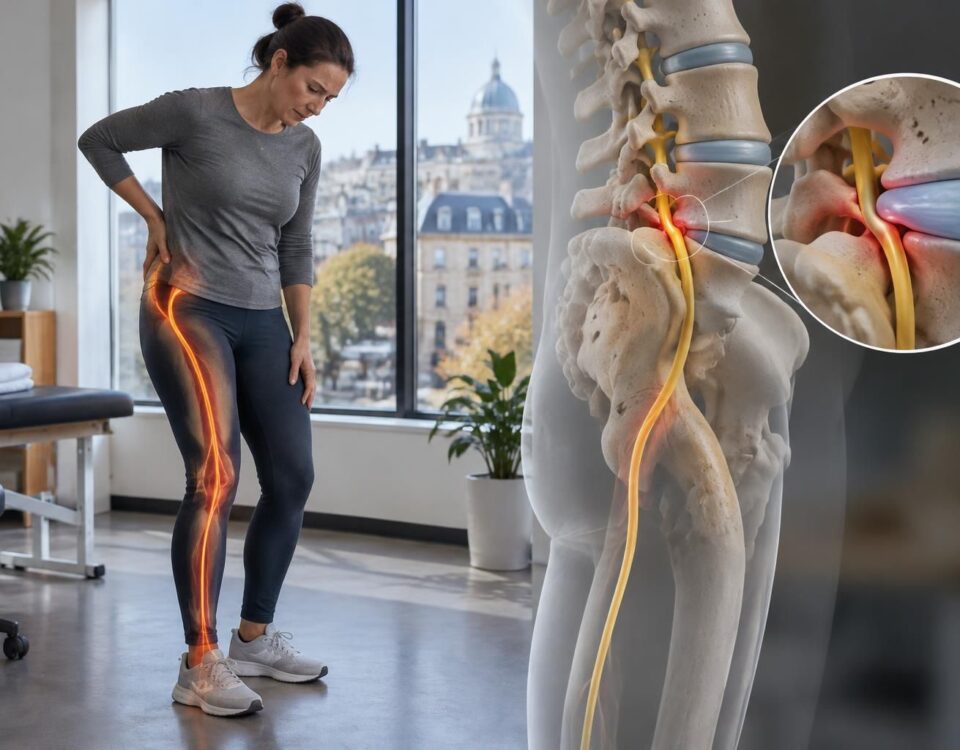
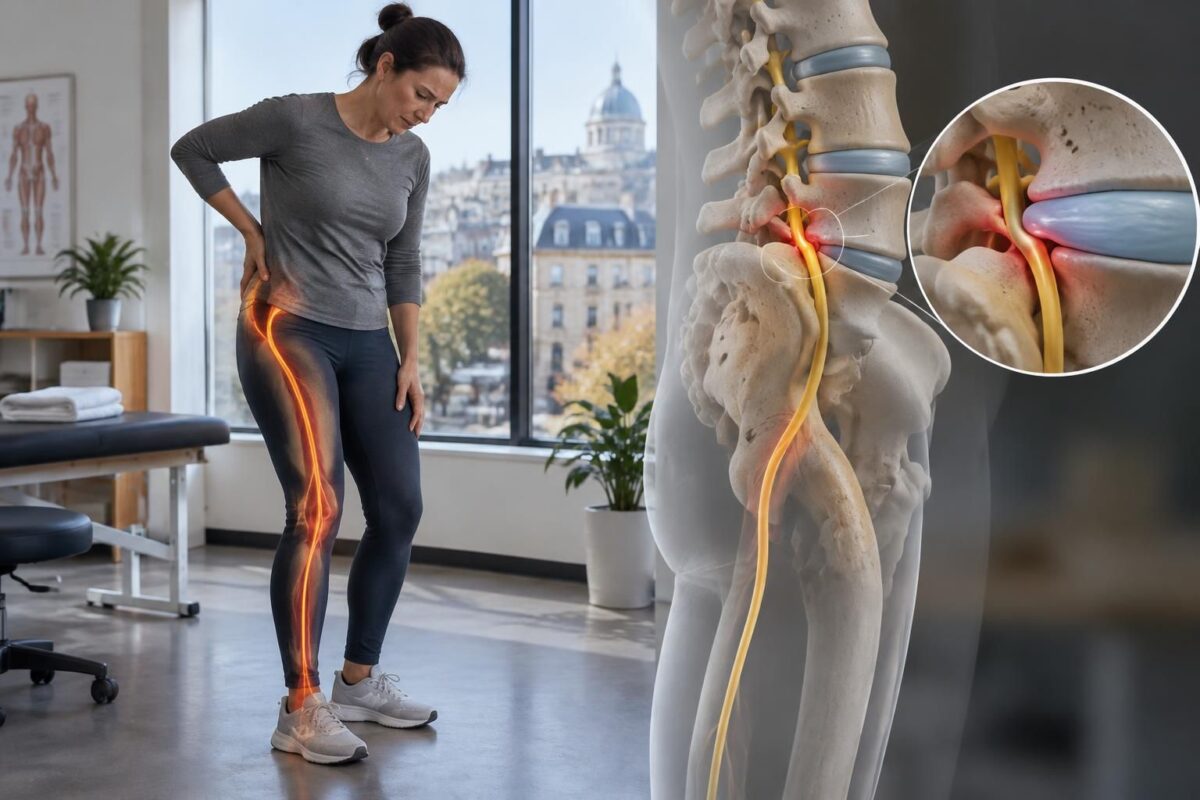
Radicular pain appears when a nerve root is irritated or compressed near the spine. It can be associated with a disc herniation or narrowing of the canal or foramen. The term “sciatica” is often used to describe pain that follows part of the path of the sciatic nerve, from the buttock down to the leg.
The pain can be sharp, burning, or comparable to an electric shock. It can descend below the knee to the foot or toes. The person may also experience tingling, numbness, or weakness. These signs can guide the assessment, but they do not alone confirm which root is affected.
Radicular pain and radiculopathy: a useful distinction
Radicular pain describes pain associated with an irritated nerve root. The term radiculopathy more specifically refers to an involvement that can also lead to loss of sensation, muscle weakness, or a change in a reflex. A person can have radicular pain without measurable neurological deficit.
Nerve pathways overlap. An involvement of the L5 root can cause pain on the side of the leg or the top of the foot. An S1 involvement can affect the back of the calf or the outer edge of the foot. These landmarks guide the examination, but symptoms vary from person to person. To better understand certain signs, refer to the pages on loss of sensation in the toes and heel pain associated with sciatica.
Sciatica in Montreal: nerve root, disc, and foramen explained simply
IN BRIEF Sciatica corresponds to pain linked to the irritation of a nerve root, sometimes near a lumbar disc or a narrowed foramen. In Montreal, distinguishing an L4-L5 issue that may affect the L5 root from an L5-S1 problem that…

Sciatica in Montreal: understanding L5-S1 foraminal compression
IN BRIEF L5-S1 foraminal compression is a narrowing of the opening where a nerve root exits, which can cause sciatica with pain, tingling, or weakness in the buttock and leg. In Montreal, an assessment allows for correlating symptoms, clinical examination,…
What is referred pain?
Referred pain is felt in a region distant from its source. It can originate from muscles, joints, ligaments, or other structures. It often occurs in the lower back, buttock, or thigh, but its location does not always allow for identifying its origin.
Referred pain does not necessarily follow the territory of a nerve root. It does not always accompany tingling, loss of sensation, or weakness. However, the absence of these signs alone does not exclude nerve irritation. Hip pain or another condition can also resemble sciatica. To compare these possibilities, read this article on hip pain and nerve radiation.

Sciatica in Montreal: why L5-S1 is often involved
IN BRIEF The sciatica L5-S1 often corresponds to irritation of the S1 root, sometimes related to a herniated disc. The pain may start in the buttock and descend behind the thigh to the calf or the foot. In Montreal, understanding…

Sciatica in Montreal: L5 and difficulty lifting the foot
IN BRIEF The difficulty in lifting the foot with sciatica can indicate weakness related to the involvement of the L5 root, sometimes caused by a herniated disc. This foot drop increases the risk of falling and requires prompt medical evaluation;…
The differences that guide assessment
The practitioner takes into account the route of the pain, its evolution, and associated symptoms. They also examine strength, sensitivity, reflexes, and gait, depending on the situation. Here are general pointers, which do not replace a clinical exam:
- Possible radicular pain: pain that descends into the leg along a path compatible with a nerve root; burning or shooting sensations possible; numbness or weakness may sometimes be present.
- Possible referred pain: pain felt in the buttock or thigh, sometimes without clear nerve pathway; possible absence of strength or sensitivity deficit.
- Frequent overlap: both types of pain can coexist. Pain that descends below the knee does not alone confirm radiculopathy.
A burning sensation in the foot or numbness deserves special attention, especially if these signs are new or worsening. Refer to the information on burning in the foot and possible nerve irritation as well as nerve symptoms not to be taken lightly.

Sciatica in Montreal: S1 and difficulty rising up on the toes
IN BRIEF S1 sciatica can cause pain from the buttock to the calf and foot, as well as difficulty getting on tiptoe. This weakness may suggest irritation of the S1 nerve root, but is not sufficient to establish a diagnosis.…

Sciatica in Montreal: L4-L5 and pain towards the top of the foot
IN BRIEF The sciatica related to L4-L5 can radiate from the lower back to the buttock and the leg; pain on the top of the foot may suggest involvement of the L5 root, but the pathways vary and symptoms overlap.…
How is the assessment conducted in Montreal?
The assessment begins with questions about the onset of the pain, its side, its route, and the factors that worsen or relieve it. The practitioner also asks if the person has noticed weakness, loss of sensation, or changes in their gait. Medical history and previous care can also guide the next steps.
The examination may compare leg strength, sensitivity, reflexes, and certain functional tasks. A nerve tension test, such as the Lasègue sign, may be part of the examination. A result must always be interpreted with other observations; it does not confirm a diagnosis on its own.
X-rays do not directly show the nerve roots. An MRI may be considered if symptoms persist, if the exam reveals a neurological deficit, or if the result could change management. The images should be correlated with the symptoms and examination, as a visible anomaly is not necessarily the cause of pain.

Sciatica in Montreal: pain in the big toe, L5 root or another cause?
IN BRIEF Pain that radiates toward the big toe may indicate irritation of the L5 root, sometimes related to a herniated disc, but other causes are possible. In Montreal, evaluating the pain pathway, strength, sensitivity, and walking helps guide management…

Sciatica in Montreal: why the affected root changes the pain pathway
IN BRIEF Sciatica refers to pain or nerve symptoms that vary depending on the affected lumbar root. Pain, tingling, or numbness may manifest in the buttock, thigh, calf, or foot. Understanding this distribution helps guide the assessment, without diagnosing based…
Why is imaging not sufficient?
An image may show a disc anomaly or narrowing without explaining the symptoms. The level of the disc described in a report does not automatically indicate the responsible root. For example, a disc issue at L4-L5 may irritate the L5 root, but the examination must confirm whether the signs match.
The professional therefore compares the affected side, the painful pathway, the strength, sensitivity, and reflexes with the available imaging results. This approach also helps to consider other possible causes, such as a hip problem or irritation of another nerve. To learn more about these differences, consult this resource on the differential diagnosis of leg pain.
What can a care plan include?
The plan depends on the likely cause, symptom intensity, function, and neurological signs. It should specify the objectives being followed, the re-evaluation date, and the signs that would require altering the approach or consulting a doctor. Medications, imaging, or a specialized consultation fall under the professionals authorized to prescribe or perform them.
At TAGMED Clinic, an evaluation using an osteopathic approach can help examine mobility and functional repercussions when this type of service is suitable for the situation. Non-surgical treatments, including motorized neurovertebral decompression, can be discussed after an evaluation and based on indications. They do not replace a medical diagnosis and are not suitable for everyone. You can consult the services of the TAGMED Clinic in Montreal or Terrebonne.
A useful plan follows several elements: pain, symptom distribution, strength, sensitivity, walking, sleep, and daily activities. A decrease in pain does not always mean that nerve function is fully restored. Any significant change in strength or sensitivity should be reported promptly.
When should urgent help be sought?
An urgent evaluation is necessary in case of loss of control over the bladder or bowels, new difficulty urinating, perineal numbness, or significant or rapidly increasing weakness in a leg. These signs may indicate severe nerve compression.
A fever accompanied by back pain, a recent major trauma, or rapid worsening also justifies quick medical evaluation. In the case of severe or sudden symptoms, go to the emergency room or call 911.
Frequently asked questions about radicular pain and referred pain
Is pain that radiates down the leg always sciatica?
No. Referred pain, a hip problem, or another cause can also cause pain in the leg. The pathway and neurological examination help distinguish these possibilities.
Does sciatica have to reach the foot?
No. The pain can remain in the buttock, thigh, or calf. The pathway depends on the cause and the individual. The location alone does not confirm an affected root.
Do tingles prove nerve compression?
No. Tingling can accompany nerve irritation, but other causes are possible. A professional must interpret them alongside other symptoms and examination results.
Should I get an MRI before any consultation?
Not necessarily. An MRI is useful in certain cases, especially if symptoms persist or concerning neurological signs appear. The professional determines whether this exam can help guide the care.
About the author
Sylvain Desforges, B.Sc., D.O., N.D., osteopath and naturopath, is the founding president of TAGMED and the ACMA association. He devotes his practice to chronic pain of the spine, lower back pain, and pain compatible with sciatica, particularly when the pain radiates toward the buttock, leg, calf, foot, or toes.
Through SOS Sciatique, he publishes educational content on sciatica symptoms, possible causes like herniated discs, disc pinching, foraminal stenosis, or irritation of a lumbar nerve root, as well as non-surgical approaches that may be considered based on evaluation. At TAGMED Clinic, care may include, depending on the case, motorized neurovertebral decompression, specific osteopathy, or a precision impactor.
For an evaluation related to the treatment of sciatica in Montreal / Mont-Royal or to the treatment of sciatica in Terrebonne, consult the services available at the TAGMED Clinic.
Medical disclaimer
Medical disclaimer: The information and advice provided on this site do not replace the opinion, diagnosis, or treatment of a healthcare professional. Please note that Dr. Sylvain Desforges, osteopath, is neither a doctor of medicine nor a physician, and is not a specialist in any medical specialty as defined by the Collège des médecins du Québec. Manual medicine, functional medicine, and sports medicine as described on this site exclude any treatment or medical diagnosis made by a physician or specialist. Always consult your doctor for any medical questions. For more details, please read our Full Legal Notice.
Radicular pain (sciatica)
- Pain often electric or burning, following a pathway down the leg.
- May be accompanied by numbness, tingling, or weakness.
- May be related to irritation or compression of a nerve root.
- The neurological exam helps clarify the involvement; imaging depends on the context.
Referred pain
- Pain felt distant from its source, often in the buttock or thigh.
- Often diffuse or dull, without a clear nerve pathway.
- Usually without loss of sensitivity or weakness linked to a nerve root.
- Can originate from structures of the back, hip, or other tissues.
In Montreal as elsewhere: the location of pain is not enough to make a diagnosis; the evaluation must take into account symptoms, strength, and sensitivity.

In Montreal, pain that radiates from the lower back to the leg can be a radicular pain, related to irritation of a nerve root, or a referred pain, felt at a distance without confirmed nerve involvement. The course of symptoms, the presence of numbness or weakness, and the clinical examination help to distinguish them. As these causes can resemble each other, it is advisable to avoid self-diagnosis and seek an evaluation tailored to your situation.
Recognizing the two types of pain
Radicular pain: a nerve may be irritated
Radicular pain appears when a lumbar nerve root is irritated or compressed. A disc herniation is a possible cause, but it is not the only one: narrowing of the canal or foramen may also be involved. The pain can radiate from the buttock down to the thigh, calf, or foot, sometimes accompanied by burning sensations, electric shocks, tingling, or an area with reduced sensitivity.
The path gives clues, but cannot alone identify the affected root. For example, pain on the top of the foot or difficulty in lifting the big toe may direct the assessment towards certain lumbar roots. Pain behind the calf, accompanied by difficulty in standing on tiptoes, may indicate another. These pointers must be correlated with strength, sensitivity, reflexes, and gait.
Referred pain: pain felt at a distance
Referred pain may originate from the muscles, joints, or other tissues in the lower back or hip, and then be felt in the buttock or thigh. It does not automatically mean that a nerve is compressed. It often descends less sharply below the knee, but presentations vary: the location alone does not provide a definitive answer.
Recommendations for evaluation in Montreal
During a consultation, describe precisely the onset of symptoms, their side, their path, and the positions that worsen or relieve them. Also mention any numbness, changes in strength, previous episodes, treatments tried, or impact on sleep, walking, work, and driving. A useful evaluation links this information to a neurological and functional examination; it does not solely rely on the intensity of the pain.
X-rays do not directly show nerve roots or discs. An MRI is not necessary for every leg pain: a professional may consider it if symptoms persist, if the examination reveals a deficit, or if the result may change management. Visible anomalies on imaging must correspond to symptoms and examination findings before being considered relevant.
While waiting for an opinion, avoid strict bed rest. If your condition allows, maintain gentle activity and adjust it according to your tolerance. Temporarily reduce actions that cause lasting aggravation, then seek advice before resuming intense exercises. A serious plan sets functional goals and a time for reevaluation; it also specifies when the approach should be modified or when a medical referral becomes a priority.
When to consult quickly
Consult immediately in case of new or rapidly progressive weakness, loss of urinary or bowel control, difficulty urinating, or numbness of the perineum and groin. These signs may require urgent assessment. Fever associated with spinal pain, significant trauma, or rapid deterioration also justifies prompt medical attention.
About the author
Sylvain Desforges, B.Sc., D.O., N.D., osteopath and naturopath, is the founding president of TAGMED and the ACMA association. His practice focuses on chronic spinal pain and pain consistent with sciatica. At the TAGMED Clinic, treatments may include, depending on the evaluation, specific osteopathy, motorized neurovertebral decompression, or a precision impactor.
Medical disclaimer
This content is provided for educational purposes and does not replace a consultation, diagnosis, or treatment by a licensed healthcare professional. The author is neither a doctor nor a specialist in a medical specialty recognized by the Collège des médecins du Québec. The approaches described do not constitute medical acts and do not replace medical follow-up.
| Clinical marker | Concise difference |
|---|---|
| Probable origin | Radicular: irritation of a nerve root; referred: pain projected from another structure. |
| Path | Radicular: often a nerve path; referred: pain more diffuse, sometimes limited to the buttock or thigh. |
| Leg and foot | Radicular pain may descend below the knee to the foot; referred pain typically extends less to it. |
| Numbness | More suggestive of radicular involvement, especially if it follows a specific area. |
| Weakness | A measurable weakness may accompany radicular involvement; it is less characteristic of referred pain. |
| Reflexes | A decrease in a reflex may support the radicular hypothesis; reflexes usually remain preserved in referred pain. |
| Movements | Certain movements or nerve tension tests may reproduce radicular pain; other actions may provoke referred pain. |
| Evaluation in Montreal | The professional correlates symptoms, neurological examination, and imaging if indicated; an image alone does not confirm the cause. |
Sciatica in Montreal: illustrative testimonials on radicular pain and referred pain
The testimonials below are fictitious and serve only to illustrate possible experiences. Pain radiating down the buttock or leg alone does not confirm sciatica or identify the affected nerve root. The evaluation takes into account the path of symptoms, strength, sensitivity, reflexes, and function.
“The electric pain radiated down to my foot” — example of pain consistent with radicular involvement. “In Montreal, I started feeling pain in my lower back and hip, then electric shocks in my leg down to my foot. I also had tingling sensations. The professional explained to me that this type of pattern could be compatible with irritation of a nerve root, but I needed to check my strength and sensitivity before drawing a conclusion.”
“My pain mostly stayed in my hip and thigh” — example of possible referred pain. “I thought I definitely had sciatica because my leg hurt. However, the pain was rather dull and diffuse, and did not always follow the same path. I was explained that pain coming from the back or other structures could be felt in the hip or thigh without necessarily corresponding to a nerve compression.”
“The MRI showed several abnormalities, but they needed to be put into context” — symptoms and imaging. “My imaging examination mentioned changes at several levels. I understood that the result did not automatically indicate the cause of my pain. The affected side, the painful pathway, the sensations, strength, and reflexes had to be compared with the images.”
“Numbness mattered as much as the pain” — neurological evaluation. “In addition to the pain, I had a less sensitive area on my foot. The evaluation focused on my walking and certain movements of my leg and foot. This helped me understand why follow-up should not only measure the intensity of the pain but also function and the evolution of neurological signs.”
“The pathway changed according to my activities” — importance of follow-up. “Sitting position and certain movements altered my symptoms. We discussed what aggravated them, what relieved them, and my goals, like walking and sleeping more comfortably. A useful plan should include when to reassess the situation and what changes to report.”
A radicular pain can be accompanied by burning, shocks, tingling, or weakness in part of the leg. A referred pain can also be felt distant from its origin, but it does not necessarily mean that a nerve root is compressed. The pathways may overlap: only a clinical examination can help distinguish possible causes and determine if complementary examinations are useful.
In Montreal, an individualized assessment can help link symptoms to function and examination results, and then discuss appropriate options. The plan should specify the tracked objectives, the timing for reassessment, and the circumstances that would warrant a referral to a physician or another health professional.
Significant or rapidly progressive weakness, loss of bladder or bowel control, perineal numbness, fever associated with back pain, or recent trauma require urgent medical evaluation.
Sciatica in Montreal: distinguishing radicular pain from referred pain
Pain that starts from the lower back or hip and radiates down the leg is often called sciatica. However, not all leg pain necessarily originates from a nerve root. In Montreal, as elsewhere, distinguishing between radicular pain and referred pain helps guide the assessment and choose the next steps, without drawing conclusions based solely on the painful pathway.
Radicular pain appears when a lumbar or sacral nerve root is irritated or compressed. It can be associated, among other things, with a herniated disc or narrowing of the spaces through which the nerves pass. The pain sometimes follows a relatively precise pathway: it can go from the hip to the thigh, calf, or foot. Burning sensations, electric shocks, tingling, or numbness may accompany it. In some cases, the person may also notice weakness, for example, difficulty in lifting the foot or standing on tiptoes.
Referred pain, on the other hand, is felt distant from the structure that triggers it, without necessarily meaning that a nerve root is affected. Joints, muscles, or other tissues in the lower back and hip area may contribute to pain felt in the hip or thigh. The pathway is sometimes less regular and may vary with positions or movements. The absence of weakness or change in sensitivity can guide the evaluation but is not sufficient to confirm the cause.
These patterns can resemble each other and sometimes coexist. Maps of nerve territories are guidelines, not exact borders: symptoms overlap from person to person. Moreover, a visible abnormality on imaging does not automatically prove that it explains the pain. For example, an issue observed at a disc level must be correlated with the affected side, the pathway of symptoms, strength, sensitivity, reflexes, and functional abilities.
A useful assessment should specify how long the pain has been present, where it starts, how far it radiates down, and what aggravates or relieves it. The examination can compare the strength of the legs and feet, sensitivity, reflexes, and gait. It also takes into account sleep, work, driving, and daily activities. An X-ray does not directly show the nerve roots like an MRI would; however, it is not necessary in all cases, and its usefulness depends on the clinical context.
A coherent care plan should include understandable objectives, follow-up measures, and a time for reassessing the situation. Depending on the evaluation, options may include adapted activity, progressive exercises, selected manual therapy, or medical consultation. At the TAGMED Clinic, the approaches offered may include, as appropriate, specific osteopathy, motorized neurovertebral decompression, or precision percussion. These options do not replace a medical examination when indicated.
A new or rapidly progressive weakness, loss of bladder or bowel control, significant difficulty urinating, perineal or groin numbness, fever with back pain, or recent trauma require urgent evaluation. These signs should not wait for a non-urgent care appointment.
About the author
Sylvain Desforges, B.Sc., D.O., N.D., osteopath and naturopath, is the founding president of TAGMED and the ACMA association. His practice focuses particularly on chronic spinal pain, lower back pain, and symptoms consistent with sciatica. He is interested in integrating manual approaches and advanced technologies in pain management, according to the evaluation of each situation.
Medical warning: this content is provided for educational purposes and does not replace a consultation, diagnosis, or treatment by a licensed healthcare professional. Sylvain Desforges is neither a doctor nor a specialist in a medical field recognized by the Collège des médecins du Québec. The approaches described do not constitute medical acts and do not replace medical follow-up.
In Montreal, pain that starts from the lower back or buttock and radiates down the leg may correspond to radicular pain — often referred to as sciatica — or referred pain coming from the back, hip, or another structure. The pattern of symptoms, neurological signs, aggravating factors, and clinical examination help to distinguish these possibilities; an image alone is not always sufficient to identify the source.
Guidelines to Distinguish Pain
Radicular pain occurs when a nerve root is irritated or compressed. It can radiate into the buttock, thigh, calf, or foot, sometimes accompanied by sensations of burning, electric shock, numbness, or weakness. The pathway varies depending on the affected root: an L5 involvement may particularly be accompanied by pain toward the top of the foot or the big toe, while an S1 involvement may affect the back of the calf and the outer border of the foot. To explore these differences, check out the pages on nerve root and pain pathway, pain in the big toe, and pain on the top of the foot.
Referred pain, on the other hand, can project into the buttock or leg without direct involvement of a nerve root. It may be related, among other things, to the joints or muscles of the lower back, to the hip, or to other structures. It does not necessarily follow a precise nerve pathway and does not always accompany loss of sensitivity, weakness, or changes in reflexes. The comparison between sciatica and lumbar referred pain can help understand why these symptoms do not always overlap.
However, the pathway is not proof alone: sciatica may not extend down to the foot, and dermatomes overlap. Pain that appears mainly after prolonged standing, for example, also deserves interpretation in its context; discover the elements to consider in this article on pain in the leg after prolonged standing. An incomplete pathway does not, by itself, rule out nerve irritation: the page dedicated to sciatica with an incomplete pathway presents additional guidelines.
Evaluation benefits from linking several elements: the onset and evolution of pain, its side and distribution, the positions that exacerbate or relieve it, as well as strength, sensitivity, reflexes, and gait. The level observed in imaging does not automatically correspond to the symptomatic root; a radiological anomaly must be correlated with symptoms and examination. To better understand the L4-L5 and L5-S1 levels, consult the guide on sciatica L4-L5 and L5-S1 in Montreal, as well as the guidelines for evaluation of sciatica in Montreal.
Symptoms in the leg can also have other origins, including hip pain, neuropathy, or a vascular problem. A clinical evaluation serves to examine these possibilities and determine if imaging or medical advice may be indicated. Some lower back pains may also be associated with joint structures; the resource on facet syndrome and symptoms resembling sciatica addresses this distinction.
The management plan should be tailored to the symptoms and goals of the individual, then reevaluated based on concrete criteria: walking, sleep, work, tolerance to sitting, and evolution of neurological signs. An in-person or remote consultation may help determine the next steps according to the situation; the options offered by the Clinique Omicron for sciatica can be checked directly with that clinic. For evaluation and non-surgical care in Montreal or Mont-Royal, the services of the TAGMED Clinic are also presented online.
A new or rapidly progressive weakness, loss of control of the bladder or bowel, significant difficulty urinating, numbness of the perineum, fever accompanied by spinal pain, or significant trauma require urgent medical evaluation. These signs should not wait for a routine consultation.

Dr Sylvain Desforges, B.Sc., D.O., N.D., osteopath, is the founding president of TAGMED and of the ACMA association. He dedicates his practice to chronic spinal pain, low back pain and symptoms compatible with sciatica, particularly when pain radiates toward the buttock, leg, calf, foot or toes.
Through SOS Sciatique, he publishes educational content on sciatica symptoms, possible causes such as disc herniation, disc narrowing, foraminal stenosis or irritation of a lumbar nerve root, as well as non-surgical approaches that may be considered according to the evaluation. At Clinique TAGMED, care may include, depending on the case, motorized neurovertebral decompression, specific osteopathic care or precision percussion.
For an evaluation related to sciatica treatment in Montreal / Mount Royal or sciatica treatment in Terrebonne, please consult the services available at Clinique TAGMED.
Medical disclaimer
The information published on SOS Sciatique is provided for educational purposes only and does not replace a consultation, diagnosis, opinion or treatment provided by a physician or another authorized healthcare professional. The author of this article is neither a medical doctor nor a specialist in a medical specialty recognized by the Collège des médecins du Québec. The osteopathic, manual medicine or functional support approaches described on this site do not constitute medical acts and are not intended to replace medical follow-up.
Consult a physician or emergency service in cases of loss of bladder or bowel control, anesthesia in the saddle area, significant or progressive weakness in the leg or foot, fever, recent trauma, severe pain or rapid worsening of symptoms. For more details, please read our Legal Notice.