
Sciatica and calf stretching: when the pain increases
25/10/2026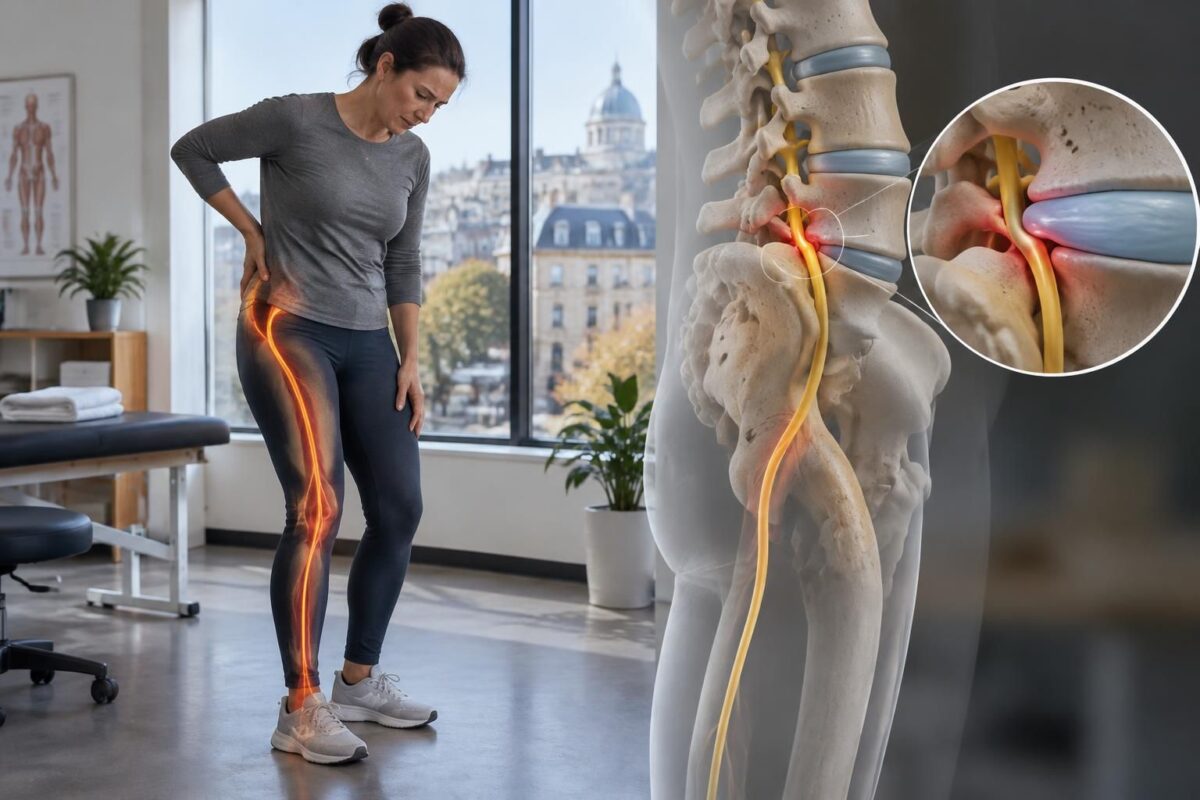
IN BRIEF
| Sciatica corresponds to pain linked to the irritation of a nerve root, sometimes near a lumbar disc or a narrowed foramen. In Montreal, distinguishing an L4-L5 issue that may affect the L5 root from an L5-S1 problem that may affect S1 aids in guiding the evaluation. The trajectory of the pain, strength, sensitivity, and reflexes must be correlated with imaging: a visible anomaly does not always explain the symptoms. |
A sciatica often corresponds to irritation of a nerve root in the lower back. The L4-L5 disc can particularly irritate the L5 root, while an L5-S1 issue may affect S1. The foramen is the opening through which the nerve exits the spine; its narrowing may sometimes contribute to symptoms. The trajectory of the pain, strength, sensitivity, and reflexes must be assessed together: imaging alone does not always allow for identification of the cause. In Montreal, an appropriate evaluation can help determine the next steps. New or progressive weakness, urinary or bowel issues, or numbness in the saddle region require urgent evaluation.
A sciatica can begin in the lower back, travel through the buttock, and descend into the leg. The disc, the nerve root, and the foramen can all contribute to the symptoms, but an abnormal image is not enough to identify their cause. In Montreal, the evaluation should correlate the pain trajectory, strength, sensitivity, reflexes, affected activities, and imaging results, when available.
What is sciatica?
The term sciatica generally describes pain that follows part of the trajectory of the sciatic nerve. It may be accompanied by tingling, numbness, or weakness. The sciatic nerve is formed from nerve roots located in the lower back, crosses the pelvis, and extends into the leg. Thus, pain felt in the leg may come from irritation near the spine. To learn more about its trajectory, refer to this guide on the link between the affected root and the pain’s trajectory.
The nerve root transmits messages
A nerve root connects the spinal cord to the nerves of the body. It helps transmit sensations and commands that enable muscles to move. If a root is irritated or compressed, pain, tingling, or a decrease in strength may appear in part of the leg. The trajectory varies according to the affected root and from person to person. Nerve maps serve as guides, but they alone do not confirm a diagnosis.
The lumbar disc and the nerve root
How can a disc irritate a root?
Discs are located between the vertebrae. They help distribute loads and allow movements of the spine. A herniated disc occurs when a part of the disc protrudes. Depending on its position, it may come close to a nerve root and irritate it. Other changes, such as pinching or disc degeneration, may also be visible on imaging without causing symptoms.
The level of the disc and the irritated root do not always directly correspond. For example, a hernia located between L4 and L5 may affect the L5 root when it is near the spinal canal. An issue between L5 and S1 may affect the S1 root, depending on its location. Therefore, the exact position of the anomaly is as important as the level stated in the imaging report.
Possible trajectories for L5 and S1
irritation of the L5 root may be accompanied by pain on the side of the leg and the top of the foot. Irritation of S1 may produce pain at the back of the leg, in the calf, or on the outer edge of the foot. These descriptions are guides, not absolute rules. Pain may stop in the buttock or thigh, and multiple territories may overlap.
The strength of the foot or big toe, sensitivity, reflexes, and walking help complete the evaluation. The page on irritation of the S1 root provides additional references. You can also check information about the frequent issue in the L5-S1 region.

Sciatica in Montreal: understanding L5-S1 foraminal compression
IN BRIEF L5-S1 foraminal compression is a narrowing of the opening where a nerve root exits, which can cause sciatica with pain, tingling, or weakness in the buttock and leg. In Montreal, an assessment allows for correlating symptoms, clinical examination,…

Sciatica in Montreal: why L5-S1 is often involved
IN BRIEF The sciatica L5-S1 often corresponds to irritation of the S1 root, sometimes related to a herniated disc. The pain may start in the buttock and descend behind the thigh to the calf or the foot. In Montreal, understanding…
The foramen: the nerve exit opening
What is a foramen?
A foramen is an opening between two vertebrae. A nerve root passes through this opening to exit the spinal column. If the space narrows, the root may become irritated, especially in certain positions. This narrowing is called foraminal stenosis. It can be linked to several changes in the spine, including wear of the joints or discs.
Foraminal stenosis does not always cause pain. The result of imaging must be compared to the symptoms and examination. To better understand this mechanism, refer to the guide on lumbar stenosis and sciatica or this page on pain in a sitting position with tingling in the foot.

Sciatica in Montreal: L5 and difficulty lifting the foot
IN BRIEF The difficulty in lifting the foot with sciatica can indicate weakness related to the involvement of the L5 root, sometimes caused by a herniated disc. This foot drop increases the risk of falling and requires prompt medical evaluation;…

Sciatica in Montreal: S1 and difficulty rising up on the toes
IN BRIEF S1 sciatica can cause pain from the buttock to the calf and foot, as well as difficulty getting on tiptoe. This weakness may suggest irritation of the S1 nerve root, but is not sufficient to establish a diagnosis.…
Why images are not sufficient to make a diagnosis
An X-ray primarily shows bones and their alignment. An MRI can show the discs and tissues around the nerve roots. However, several anomalies may appear without explaining the symptoms. Conversely, clinical decision-making does not always rely on imaging if it does not change the course of action.
A comprehensive evaluation specifies the onset of pain, its side, trajectory, positions that worsen or relieve it, and treatments already attempted. The professional can also check strength, sensitivity, reflexes, and walking. Pain that descends into the leg may have other causes than root irritation, including a hip problem, neuropathy, or vascular issues.

Sciatica in Montreal: L4-L5 and pain towards the top of the foot
IN BRIEF The sciatica related to L4-L5 can radiate from the lower back to the buttock and the leg; pain on the top of the foot may suggest involvement of the L5 root, but the pathways vary and symptoms overlap.…

Sciatica in Montreal: pain in the big toe, L5 root or another cause?
IN BRIEF Pain that radiates toward the big toe may indicate irritation of the L5 root, sometimes related to a herniated disc, but other causes are possible. In Montreal, evaluating the pain pathway, strength, sensitivity, and walking helps guide management…
How to prepare for an evaluation in Montreal
To make the consultation more useful, note any changes in symptoms and activities that have become difficult. Is the pain disrupting sleep, work, driving, or walking? Is it always in the same place? Has sensitivity or strength changed? This information helps to track progression and determine whether the approach should continue, be modified, or be reassessed.
A plan should specify the functional objectives, monitoring measures, and signs that would necessitate a medical consultation. Depending on the situation, management may include information, activity adjustments, selected manual therapies, or a medical evaluation. The options must be clearly explained, along with their limitations and the criteria that will allow for judging their relevance.
The TAGMED Clinic provides information on evaluation and certain non-surgical treatments for pain consistent with sciatica in Montreal and Mont-Royal as well as in Terrebonne. Services, eligibility criteria, and practical information should be confirmed directly with the clinic. A care option does not replace a medical diagnosis when indicated.
When to seek urgent evaluation
Quickly consult a medical service in the event of loss of bladder or bowel control, saddle anesthesia, significant or rapidly progressive weakness in the leg or foot, fever accompanied by back pain, or pain after a significant trauma. These signs require rapid evaluation and should not wait for a routine follow-up appointment.
Frequently asked questions about sciatica, the disc, and the foramen
Does a herniated disc always cause sciatica?
No. A hernia may be visible without causing symptoms. For it to explain sciatica, its location must correspond to the symptoms and observations from the examination. Other causes, such as foraminal stenosis, can also irritate a nerve root.
Must the pain descend to the foot?
No. It may stop in the buttock, thigh, or calf. The presence or absence of pain in the foot is not sufficient to identify the affected root.
Does pain while sitting indicate a specific root?
Not by itself. Sitting position may modify symptoms, but the professional must also consider the painful pathway, strength, sensitivity, reflexes, and other possible causes.
Is it always necessary to undergo an MRI?
No. Imaging is most useful when it can alter management, when a neurological deficit is present, when symptoms persist, or when another cause needs clarification. The professional decides on its relevance based on the context.
About the author
Sylvain Desforges, B.Sc., D.O., N.D., osteopath and naturopath, is the founding president of TAGMED and the ACMA association. His practice focuses on chronic pain of the spine, lower back pain, and pain consistent with sciatica. He publishes educational content on symptoms, possible causes, and non-surgical approaches that can be considered after evaluation.
Medical disclaimer: The information and advice provided on this site do not replace the opinion, diagnosis, or treatment of a healthcare professional. Please note that Dr. Sylvain Desforges, osteopath, is neither a physician nor a doctor and is not a specialist in a medical specialty as defined by the Collège des médecins du Québec. Manual medicine, functional medicine, and sports medicine as described on this site exclude any treatment or medical diagnosis made by a physician or a specialist. Always consult your doctor for any medical questions. For more details, please read our Complete Legal Notice.
Sciatica in Montreal: understanding the link between the disc and nerve root
- The disc cushions the vertebrae; a hernia can irritate a neighboring nerve root.
- L4-L5 may affect the L5 root, often associated with symptoms on the side of the leg or the top of the foot.
- L5-S1 may affect the S1 root, sometimes related to pain behind the leg or towards the outer edge of the foot.
- The foramen is the opening between the vertebrae through which a nerve root exits. Its narrowing can irritate it.
- The painful pathway is not sufficient to confirm the affected root: the examination also evaluates strength, sensitivity, reflexes, and walking.
- In Montreal as elsewhere, imaging must be related to symptoms and function; a visible anomaly is not always the cause of pain.
Urgent evaluation: new or progressive weakness, loss of bladder or bowel control, saddle anesthesia, fever with back pain or significant trauma.

In Montreal, pain that starts in the lower back and radiates into the buttock or leg may be related to irritation of a nerve root. To understand what is happening, it is necessary to distinguish the disc, the foramen — the opening through which the nerve exits — and the affected root. The level observed in imaging is not sufficient to make a diagnosis: symptoms, neurological examination, and function must also be taken into account.
Simply understand the disc, the foramen, and the nerve root
Between the vertebrae lie discs that help distribute loads and allow for back movements. If a disc deforms or herniates, it can contribute to irritating a neighboring nerve root. However, the presence of an anomaly on imaging does not automatically mean it is the cause of the pain.
The foramen, also called the foraminal opening, is a passage between the vertebrae. Nerve roots pass through it to reach the leg. A narrowing of this space can sometimes reduce the available space around a root. A herniated disc or wear-related changes may contribute to this narrowing, but their significance must be interpreted in the context of symptoms.
L4-L5 and L5-S1: the disc level does not always indicate the root
The expressions “sciatica L4-L5” and “sciatica L5-S1” often describe a level between two vertebrae, rather than the specific nerve root involved. For example, a herniation at L4-L5 may irritate the L5 root, while an issue at L5-S1 may affect the S1 root. Pain pathways sometimes overlap: therefore, pain alone cannot confirm which root is affected.
What elements to evaluate in Montreal?
During an evaluation, describe the onset and duration of symptoms, the affected side, their pathway, and the positions that aggravate or relieve them. Also mention numbness, tingling, treatments already attempted, and relevant medical history. Pain may extend down to the foot, but it may also stop in the buttock, thigh, or calf.
The examination may compare strength, sensation, reflexes, and gait, depending on the situation. It is also useful to specify what the symptoms limit: sleep, work, driving, walking, or daily activities. If imaging is available, it should be correlated with these observations. Several anomalies may appear on an MRI without all being responsible for the symptoms.
Recommendations for a cautious follow-up plan
Define measurable goals
Ask what the working diagnosis is, what other causes are being considered, and what outcome will be tracked. A plan may include information, an adapted activity, progressive exercises, or care chosen based on the evaluation. Set a time for re-evaluation and criteria for continuing, modifying, or discontinuing the approach. Track not only pain, but also strength, sensation, gait, and participation in activities.
Imaging is not necessary in all cases. It may be considered when it is likely to change management, if symptoms persist, if neurological deficits are observed, or if another cause needs verification. A consultation with a professional authorized to evaluate symptoms and differential diagnoses can help guide the approach.
Recognize emergency signs
New or rapidly progressing weakness, loss of bladder or bowel control, numbness in the saddle region, fever accompanied by spinal pain, or significant trauma require prompt medical evaluation. Do not delay this process to try a non-urgent care approach.
Medical warning: this content is educational and does not replace a consultation, diagnosis, or treatment provided by a licensed healthcare professional. Manual or functional approaches do not replace medical follow-up when indicated.
| Element | Simple explanation |
|---|---|
| Disc L4-L5 | A herniation at this level can irritate the L5 root. |
| Disc L5-S1 | An issue at this level can affect the S1 root. |
| Root L5 | Pain may follow the side of the leg down to the top of the foot. |
| Root S1 | Pain may descend behind the calf towards the outer edge of the foot. |
| Foramen | This opening allows the nerve root to pass; its narrowing may irritate it. |
| Imaging | A visible anomaly is not necessarily the cause of the symptoms. |
| Evaluation in Montreal | The side, pathway, strength, sensation, and reflexes help interpret imaging. |
| Signs of emergency | Progressive weakness, saddle numbness, or sphincter disturbances require rapid evaluation. |
Sciatica in Montreal: illustrative testimonies to understand the nerve root, the disc, and the foramen
Important note: the narratives below are fictional scenarios, written for educational purposes. They do not correspond to real patient testimonies and do not allow for a diagnosis.
“My pain starts from my lower back and goes down to the top of my foot.” In this example, the description may suggest irritation of the L5 nerve root. This root may particularly be involved due to a disc herniation at the L4-L5 level. But the pain pathway alone is not enough to confirm which root is affected: a professional must also evaluate strength, sensation, reflexes, and gait.
“I mostly feel pain behind my thigh and in my calf.” Pain that descends towards the calf or the outer edge of the foot may be compatible with an issue involving the S1 root, sometimes associated with a problem of the L5-S1 disc. The Achilles reflex and the ability to stand on tiptoes can contribute to the evaluation, without determining it alone.
“My MRI shows a affected disc: is it necessarily the cause of my sciatica?” Not necessarily. A disc is a structure located between two vertebrae, while a nerve root is a nerve that exits the spinal column. A visible anomaly on imaging may be unrelated to the symptoms. The important thing is to check if the side and pathway of the pain match the clinical examination and imaging results.
“I was told about the foramen, but I don’t understand what it is.” The foramen, or intervertebral foramen, is a passage between the vertebrae through which a nerve root exits the column. If it narrows, for example due to wear-and-tear changes, the root may be irritated. However, an image showing a narrow foramen does not, by itself, prove that this area explains the pain.
Like elsewhere, in Montreal it is useful to distinguish the disc level from the symptomatic nerve root. A L4-L5 disc issue may irritate the L5 root, while an L5-S1 problem may pertain to S1. These correspondences serve as landmarks: symptoms may overlap sometimes and nerve maps are not absolute boundaries.
“I have several anomalies on my MRI. Which one should be treated?” The examination serves to establish if the images correspond to the symptoms and observed limitations. The evaluation takes into account the onset of the pain, its pathway, positions that aggravate or relieve it, and strength, sensation, reflexes, and gait. Other causes, like a hip problem, neuropathy, or a vascular disorder, may sometimes produce signs resembling radiculopathy.
A useful follow-up does not only measure the intensity of the pain. It can also document walking, sleep, tolerance to sitting, work, driving, and important activities. These markers help decide whether the plan should be continued, adjusted, or redirected. Any care option should be proposed with a clear understanding of the objective, reevaluation criteria, and clear thresholds for seeking medical advice.
Non-surgical care, progressive exercises, and manual therapy may be considered depending on the situation, but they are not necessarily suitable for everyone. Care should not rely solely on an image or the name of a spinal level. The decision depends on the evaluation, symptom progression, and the individual’s preferences.
Quickly consult a doctor or emergency service in case of significant or progressive weakness, loss of urinary or bowel control, anesthesia in the saddle area, fever accompanied by spinal pain, or after a major trauma. These signs require immediate evaluation.
Medical warning: this content is educational and does not replace a consultation, diagnosis, or treatment by a physician or other licensed health professional. Proximity to a service in Montreal does not replace a clinical evaluation, informed consent, or exploration of differential diagnoses.
Sciatica in Montreal: simply understanding the nerve root, the disc, and the foramen
A pain that starts in the lower back and radiates down into the buttock or leg may be compatible with sciatica. It may be accompanied by tingling, numbness, or a feeling of weakness. The path of the pain provides clues, but it is not sufficient on its own to determine which structure is involved. In Montreal, as elsewhere, the evaluation takes into account symptoms, function, neurological examination, and, when relevant, imaging results.
To understand the role of a nerve root, imagine the nerves as cables connecting the spine to the muscles and skin. The nerve roots exit from the lumbar region and combine to form, in particular, the sciatic nerve. If a root is irritated or compressed, symptoms may appear in the regions it serves. Therefore, the pain felt in the leg may originate from the lower back, even if that area does not seem the most painful.
Between the vertebrae are intervertebral discs, which help distribute loads and allow movements of the spine. A herniated disc occurs when a part of the disc bulges or shifts. Depending on its position, it may irritate a neighboring nerve root. However, the level of the disc and that of the affected root do not always share the same name: an anomaly at L4-L5 may involve the L5 root, while an issue at L5-S1 may affect the S1 root.
The foramen, also called the neural foramen, is an opening located between two vertebrae. Nerve roots pass through these openings to exit the spine. If the space narrows — for example, due to bony or disc changes — the root may become irritated. This narrowing is sometimes referred to as foraminal stenosis. However, the presence of an anomaly on imaging does not prove that it explains the symptoms: it must be verified if the side, pain pathway, and examination findings coincide.
An L5 issue may be associated with pain on the side of the leg or on the top of the foot. An S1 issue may rather be accompanied by pain in the back of the calf or toward the outer edge of the foot. These descriptions are guidelines, not absolute boundaries: the pathways overlap and vary from person to person. The evaluation may compare strength, sensitivity, reflexes, and gait, in addition to specifying which activities have become difficult, such as driving, sleeping, or working.
The management plan depends on the clinical picture and its evolution. It may include information, adapted activity, progressive exercises, or selected treatments based on the evaluation. Any approach should have understandable functional objectives and reevaluation criteria. At TAGMED Clinic, non-surgical options that may be considered depending on the case include specific osteopathy and motorized neurovertebral decompression. These do not replace a medical diagnosis or appropriate monitoring.
Sylvain Desforges, B.Sc., D.O., N.D., osteopath and naturopath, is the founding president of TAGMED and the ACMA association. He dedicates his practice to chronic spinal pain, particularly lower back pain and symptoms compatible with sciatica. His educational content aims to help readers better understand the possible causes and options to discuss with a health professional.
Quickly consult a medical service in case of significant or progressive weakness in the leg or foot, loss of urinary or bowel control, anesthesia in the saddle area, fever accompanied by spinal pain, or significant trauma. This information is educational and does not replace a consultation or diagnosis by a licensed professional.
In Montreal, pain that starts in the lower back and radiates down into the buttock or leg may be compatible with sciatica, but its path alone does not identify the nerve root involved. To understand the role of the disc and the foramen, one must correlate symptoms, the neurological examination, and, when relevant, imaging. A visible anomaly on MRI does not automatically explain the pain.
The nerve root, the disc, and the foramen: essential markers
The nerve roots exit from the lower part of the spine and participate in the formation of the sciatic nerve. The discs, located between the vertebrae, serve primarily to distribute stresses. The foramen is an opening between two vertebrae through which a nerve root exits the spinal canal. If this space narrows or if a disc bulges nearby, a root may become irritated. This can cause pain, numbness, tingling, or weakness in an area of the leg.
The terms “L4-L5 sciatica” and “L5-S1 sciatica” often refer to the level of the disc observed on imaging; they do not always specify which root is symptomatic. A herniation located between L4 and L5 may irritate the L5 root when it affects the root that descends behind the disc. An issue between L5 and S1 may likewise affect S1. However, the exact position of the anomaly matters: a foraminal issue may affect the root exiting at that level rather than the one continuing down.
To delve deeper into the difference between a disc level and a nerve root, refer to the guide on L4-L5 and L5-S1 sciatica in Montreal. General explanations about sciatica and radiculopathy as well as about the causes, symptoms, and treatments of sciatica can also help to situate these concepts.
The pathway of pain provides clues, not certainty
Irritation of L5 may be accompanied by pain on the side of the leg and the top of the foot; involvement of S1 may manifest more in the back of the calf or toward the outer edge of the foot. These pathways overlap and are not absolute borders. Some people feel pain that does not extend down to the foot, while others mainly describe tingling, a burning sensation, or a heavy leg. Resources address pain toward the outer edge of the foot, persistent pain in the heel, and the difference between heavy leg and painful leg.
Coughing or sneezing can sometimes exacerbate pain radiating down the leg, but this sign alone is not sufficient to establish a diagnosis. To better understand this phenomenon, you can consult the article on pain that descends into the leg when coughing. Sitting position may also affect symptoms in some individuals; the page on foot pain that worsens in sitting position provides additional insights.
The sciatic nerve follows a long pathway from the lumbar region to the buttock and leg. This anatomy helps to understand why irritation located near the spine can be felt lower down in the limb. An anatomical presentation is available in this article on the path of the sciatic nerve; another resource explains why pain can descend into the leg.
How to link symptoms to imaging in Montreal
A useful evaluation specifies the onset and duration of symptoms, the affected side, their pathway, and the positions that aggravate or relieve them. The professional may also examine, depending on the situation, the strength of the foot and toes, sensitivity, reflexes, walking, and tolerance to activities. These observations are then compared to the available imaging results. Several abnormalities may be visible, without each being responsible for the symptoms.
The decision should therefore not rest on a single number or isolated radiological level. It must take into account the concordance between the pain, neurological signs, function, and evolution. It is also important to consider other possible causes, such as hip involvement, neuropathy, or vascular problems, when the clinical picture justifies it.
A care plan should specify the objectives pursued—such as walking, sleeping, working, or driving—and the expected time for re-evaluating the situation. It should also explain what would lead to modifying the approach or seeking medical or specialized advice. A local consultation can facilitate access to an evaluation, but proximity does not replace clinical examination, informed consent, or verification of possible diagnoses.
When to request a rapid evaluation
New or rapidly progressive weakness of the leg or foot, loss of bladder or bowel control, numbness in the saddle area, fever associated with spinal pain, or significant trauma require prompt medical evaluation. In cases of severe symptoms or rapid worsening, contact a medical service without delay.
About the author
Sylvain Desforges, B.Sc., D.O., N.D., osteopath and naturopath, is the founding president of TAGMED and the ACMA association. He dedicates his practice to chronic spinal pain, low back pain, and pain compatible with sciatica, especially when the pain radiates toward the buttock, leg, calf, foot, or toes.
Through SOS Sciatique, he publishes educational content on the symptoms of sciatica, possible causes such as disc herniation, disc compression, foraminal stenosis, or irritation of a lumbar nerve root, as well as on non-surgical approaches that may be considered based on the evaluation. At Clinique TAGMED, care may include, depending on the case, motorized neurovertebral decompression, specific osteopathy, or precision impactor.
For an evaluation related to sciatica treatment in Montreal / Mont-Royal or sciatica treatment in Terrebonne, consult the available services at Clinique TAGMED.
Medical disclaimer
The information published on SOS Sciatique is provided for educational purposes and does not replace a consultation, diagnosis, advice, or treatment provided by a physician or other licensed healthcare professional. The author of this article is neither a physician nor a specialist in a medical specialty recognized by the Collège des médecins du Québec. The approaches of osteopathy, manual medicine, or functional support described on this site do not constitute medical acts and are not intended to replace medical follow-up.
Consult a physician or emergency service in case of loss of bladder or bowel control, numbness in the saddle area, significant or progressive weakness of the leg or foot, fever, recent trauma, severe pain, or rapid worsening. For more details, please read our Legal notice.

Sciatica in Montreal: why the affected root changes the pain pathway
IN BRIEF Sciatica refers to pain or nerve symptoms that vary depending on the affected lumbar root. Pain, tingling, or numbness may manifest in the buttock, thigh, calf, or foot. Understanding this distribution helps guide the assessment, without diagnosing based…

Sciatica in Montreal: L4-L5 disc, L5-S1 disc, and leg pain
IN BRIEF Sciatica refers to pain that can radiate from the lower back or buttock down the leg, sometimes related to nerve irritation near the L4-L5 or L5-S1 discs. The level of the disc alone is not sufficient to identify…

Dr Sylvain Desforges, B.Sc., D.O., N.D., osteopath, is the founding president of TAGMED and of the ACMA association. He dedicates his practice to chronic spinal pain, low back pain and symptoms compatible with sciatica, particularly when pain radiates toward the buttock, leg, calf, foot or toes.
Through SOS Sciatique, he publishes educational content on sciatica symptoms, possible causes such as disc herniation, disc narrowing, foraminal stenosis or irritation of a lumbar nerve root, as well as non-surgical approaches that may be considered according to the evaluation. At Clinique TAGMED, care may include, depending on the case, motorized neurovertebral decompression, specific osteopathic care or precision percussion.
For an evaluation related to sciatica treatment in Montreal / Mount Royal or sciatica treatment in Terrebonne, please consult the services available at Clinique TAGMED.
Medical disclaimer
The information published on SOS Sciatique is provided for educational purposes only and does not replace a consultation, diagnosis, opinion or treatment provided by a physician or another authorized healthcare professional. The author of this article is neither a medical doctor nor a specialist in a medical specialty recognized by the Collège des médecins du Québec. The osteopathic, manual medicine or functional support approaches described on this site do not constitute medical acts and are not intended to replace medical follow-up.
Consult a physician or emergency service in cases of loss of bladder or bowel control, anesthesia in the saddle area, significant or progressive weakness in the leg or foot, fever, recent trauma, severe pain or rapid worsening of symptoms. For more details, please read our Legal Notice.