


Sciatica and Lifting Heavy Loads: Why Carrying Heavy Can Worsen Pain
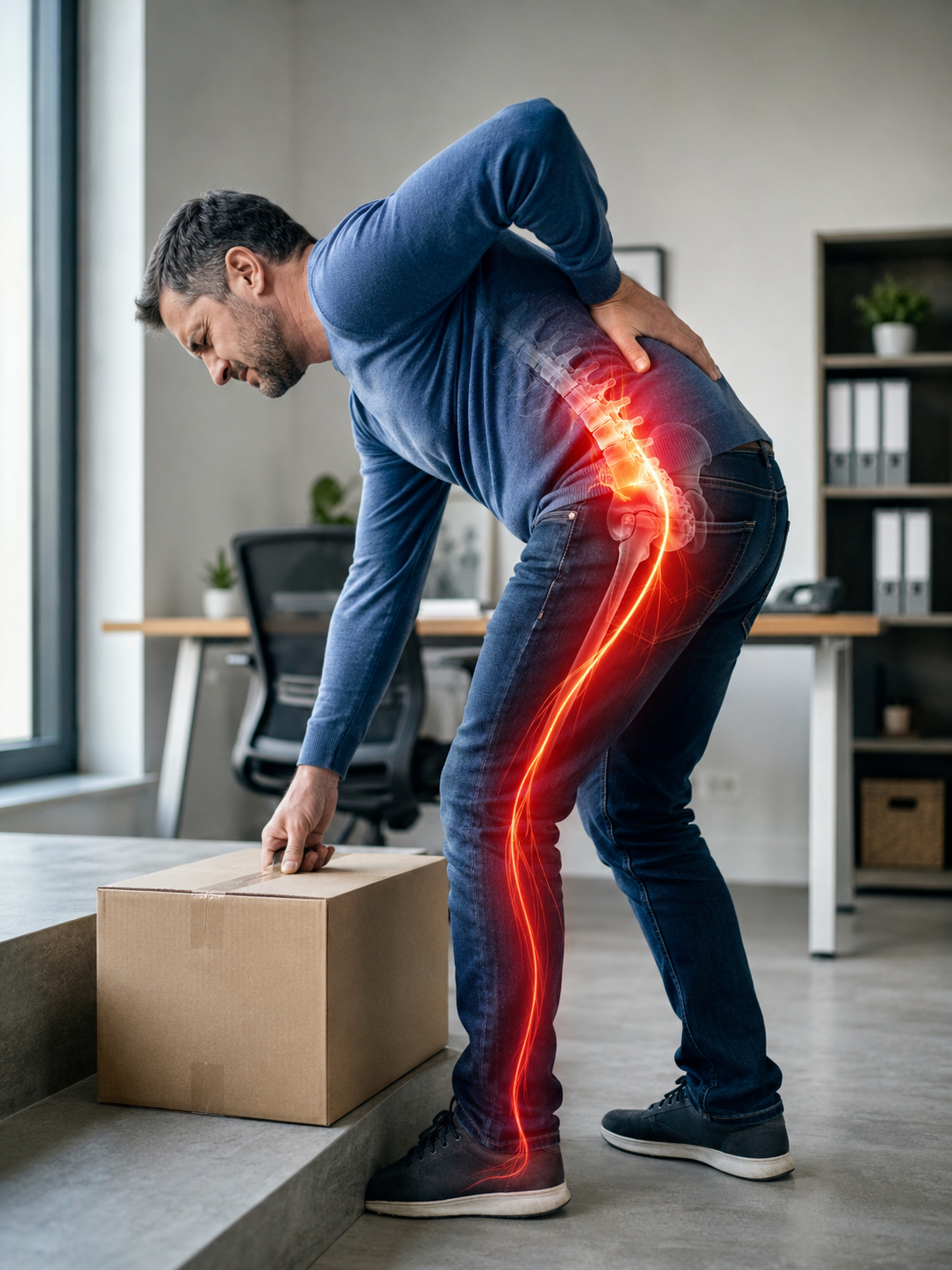
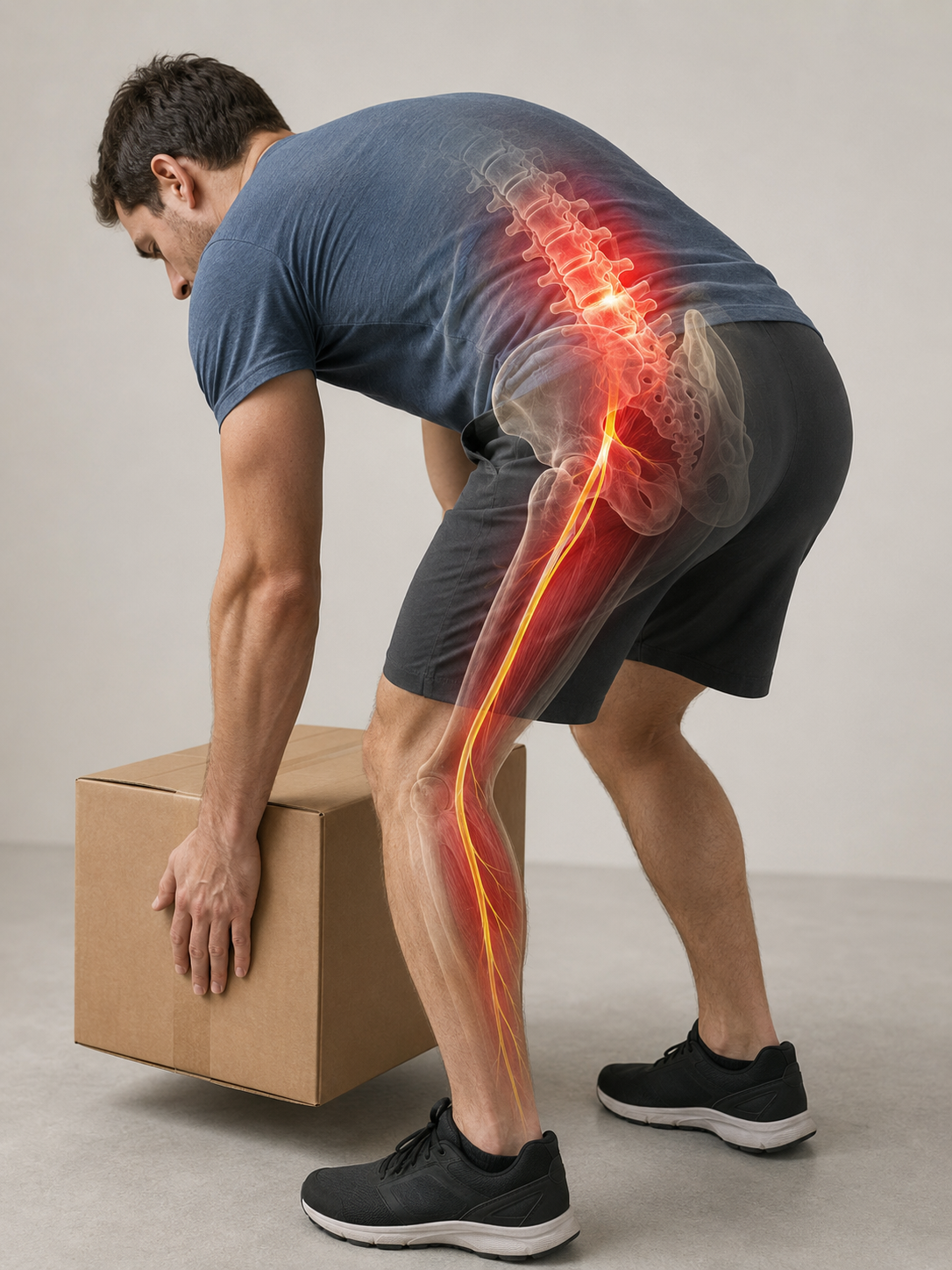
Lifting a load, carrying a heavy object, or picking something up from the ground can sometimes worsen sciatic pain, especially when the movement combines trunk bending, back twisting, sudden effort, or muscle fatigue.
The issue is not just the weight of the object. A light load can be poorly tolerated if lifted in the wrong position or if the nerve root is already irritated. Conversely, some individuals may tolerate certain efforts if the pain does not extend further down the leg and no neurological signs appear.
Common situations that can aggravate
Sciatica episodes after exertion often occur during simple actions: moving a box, retrieving an item from the car trunk, shoveling, gardening, moving furniture, picking up a grocery bag, carrying a child, or bending to lift a misplaced object.
The risk increases when the movement is sudden, when the object is far from the body, when the back is rounded, or when the torso twists during lifting. The most important sign to watch for is the direction of symptoms after exertion.
| Situation | Why this can aggravate | Sign to monitor |
|---|---|---|
| Picking up an object from the ground | Bending the trunk with load. | Pain that radiates towards the thigh, calf, or foot. |
| Lifting while turning | Combination of bending, twisting, and load. | Electric shock sensation or sudden pain in the leg. |
| Carrying far from the body | Increases the lever arm and lumbar demand. | Pain that intensifies during or after exertion. |
| Shoveling or gardening | Repetition of bending, rotation, and varied load. | Symptoms that worsen after repetition. |
| Moving | Multiple loads, fatigue, quick movements, and unexpected positions. | Persistent pain, numbness or weakness after exertion. |
Signs that the exertion has been poorly tolerated
Low back discomfort after exertion does not always indicate nerve aggravation. The most significant signal is the change in the pathway: if the pain travels lower into the leg or if neurological signs appear, caution increases.
Pain that radiates down
Pain that moves from the lower back to the buttock, then to the thigh or calf after exertion should be monitored.
Electric shock sensation
A tingling sensation in the leg during lifting may indicate nerve irritation.
Tingling
Pinpricks that appear in the foot or toes after exertion should be noted.
Numbness
Numbness that increases after carrying or lifting deserves a more cautious evaluation.
Weakness
A foot that drags, a leg that gives way, or difficulty pushing changes the level of safety.
Pain that persists
A worsening that persists for several hours or days after the action is more significant than a brief discomfort.
Load, lumbar disc, and nerve root
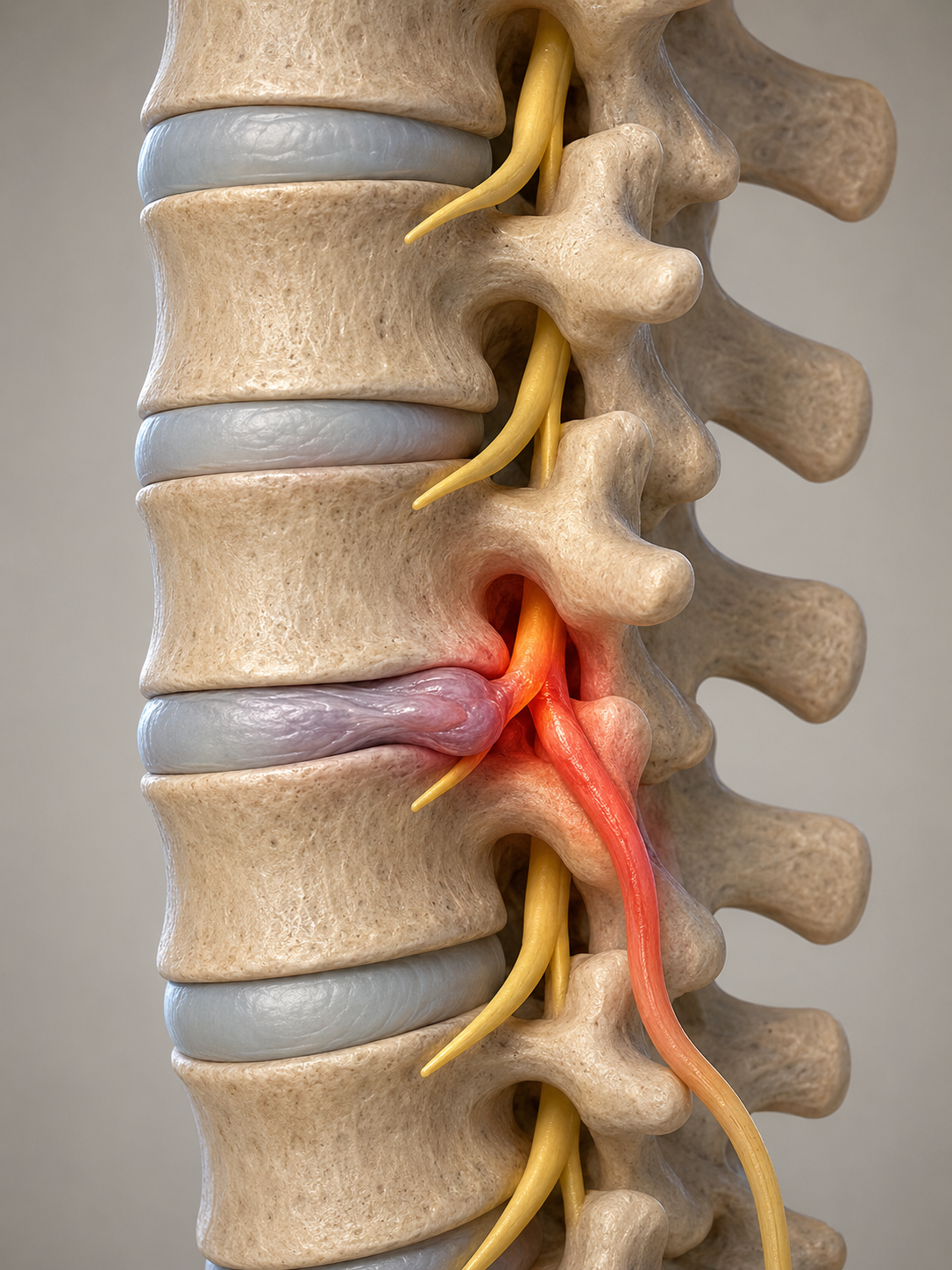
When sciatica is associated with a herniated disc, protrusion, or disc bulge, certain efforts can increase irritation around a nerve root. Lifting while bending or twisting may then be less tolerated.
The load can also influence the foramina, lumbar joints, or an already sensitive area. However, one should not automatically conclude a disc herniation because the pain started after an effort. The assessment must relate the action, the pain pathway, the strength, sensitivity, and available examinations.
- Load + bending: combination to monitor.
- Load + twisting: caution if the pain radiates down.
- Load held away from the body: higher mechanical demand.
- Repeated efforts: possible aggravation due to accumulation.
- Load with weakness after impact: quick evaluation recommended.
Pain after lifting: what could it suggest?
Pain triggered by exertion can have several causes: mechanical low back pain, disc pain, nerve root irritation, lumbar joint pain, hip, sacroiliac pain, or muscular pain. The pattern of symptoms helps distinguish these possibilities.
| Reaction after load | Possible interpretation | Important question |
|---|---|---|
| Localized pain in the lower back | Mechanical low back pain or possible local irritation. | Does the pain radiate down the leg? |
| Pain in the buttock | Possible lumbar, gluteal, or sacroiliac origin. | Does the pain radiate below the knee? |
| Calf or foot pain | More suspicious for lumbar nerve irritation. | Is there numbness or tingling? |
| Pain with locking | Spasm, mechanical irritation, or possible disc involvement. | Does the locking accompany a nerve path? |
| Pain with weakness | Possible neurological sign. | Is the foot dragging or has the walking pattern changed? |
Why personalized assessment is essential
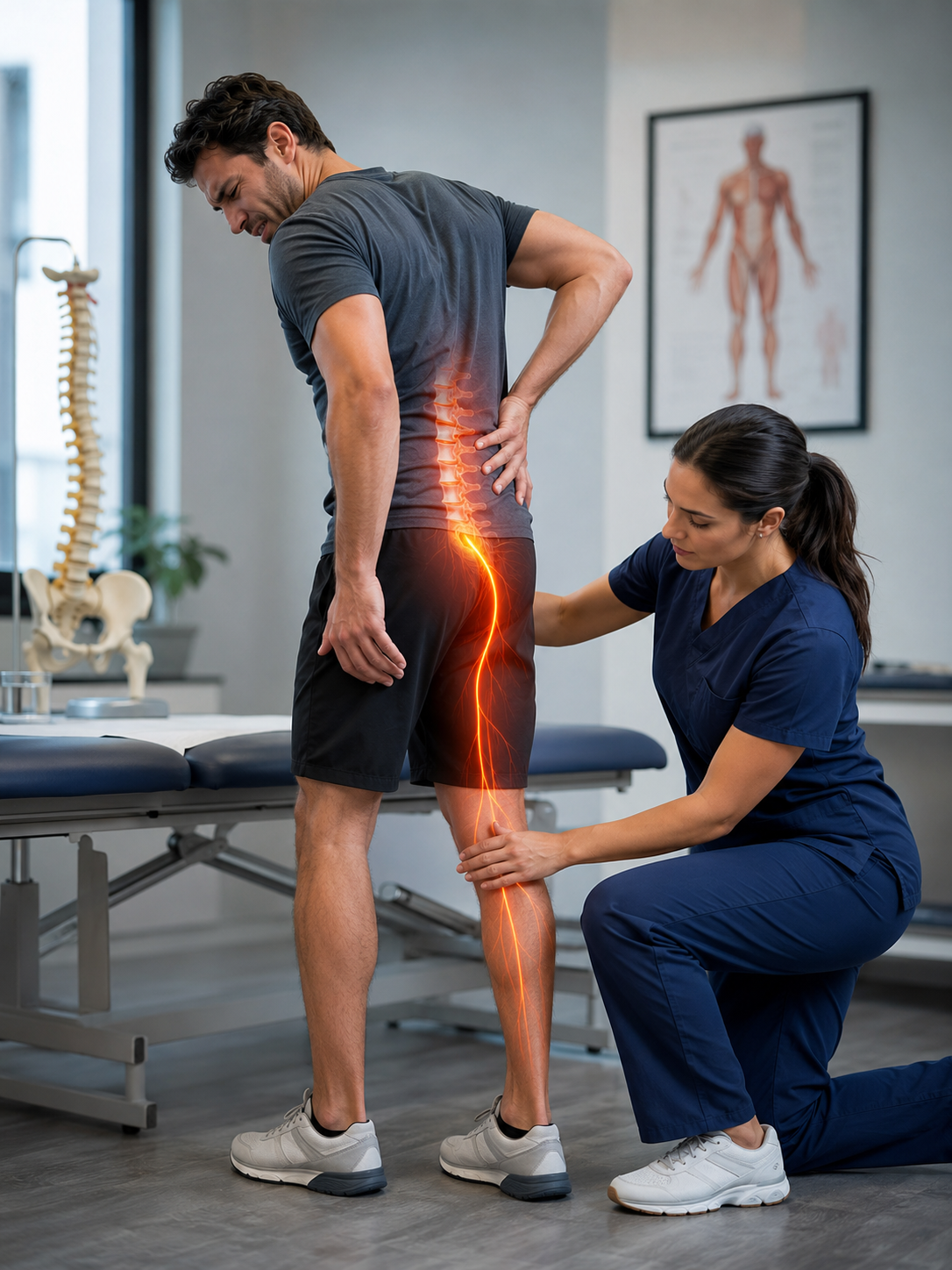
A pain that appears after lifting a load is not enough to determine the cause. It is necessary to analyze the type of load, posture, direction of movement, presence of twisting, pain trajectory, strength, sensitivity, and evolution in the hours or days that follow.
This approach helps avoid two mistakes: trivializing a real nerve irritation by saying “it’s just a false movement,” or concluding too quickly that it’s a disc herniation when it could be a local mechanical pain.
Gesture Analysis
Identify whether the effort combined bending, twisting, distant loading, or sudden movement.
Neurological Signs
Check strength, sensitivity, walking, and evolution after the effort.
What to do if lifting a load aggravates sciatica?
The first step is to temporarily avoid repeating the actions that cause the pain to move lower in the leg or that increase neurological symptoms. It may be useful to note the load, position, precise movement, duration of aggravation, and the painful area.
According to the assessment, non-surgical and non-invasive approaches can be discussed. If the table suggests a disc or nerve root origin, the approach should target the probable cause: disc, foramen, lumbar canal, disc pinch, stenosis, or other mechanical factors.
| Profile | Priority | Why |
|---|---|---|
| Local pain after exertion | Analyze the lumbar mechanics, hip, and pelvis. | This does not automatically indicate aggravated sciatica. |
| Pain that radiates down after exertion | Avoid repeating the aggravating movement. | The descending path increases caution. |
| Numbness after load | Identify the area and the evolution. | These signs may indicate nerve irritation. |
| Weakness after load | Quick reassessment. | Loss of strength changes the safety level. |
Load lifting and clinical orientation
An educational page like this helps to better understand potential reactions, but it does not replace an evaluation. Pain aggravated by a load should be interpreted according to the exact movement, the pain trajectory, neurological signs, strength, and aggravating factors.
For a local appointment or a geolocated treatment page, the main conversion page must be hosted on the TAGMED Clinic’s site to avoid SEO cannibalization with the educational content from SOS Sciatica.
The educational pages of SOS Sciatica must explain the causes and guide the reader. Local pages for treatment, appointments, and conversion should remain on the TAGMED Clinic site.
Understanding the movement
Weight, posture, twisting, and the speed of the movement influence the reaction.
Adjusting precautions
The probable cause should guide the advice, rather than a general prohibition on lifting.
Frequently asked questions about sciatica and lifting loads
Can lifting a load aggravate sciatica?
Yes, especially if the movement combines bending, twisting, loading away from the body or sudden effort, and if the pain descends lower in the leg.
Why did I feel pain after picking up an object?
Picking up an object can combine bending of the trunk, load, and sometimes rotation. In some profiles, this can irritate a lumbar structure or a nerve root.
Is it always a herniated disc after a sudden movement?
No. Pain after exertion can be caused by a hernia, but also by mechanical lower back pain, a joint issue, a muscle, or another cause.
What signs are more concerning after lifting?
Pain that radiates to the calf or foot, numbness, tingling, weakness, or a foot that catches should be evaluated with caution.
Should I avoid lifting any load with sciatica?
Not necessarily. It’s essential to avoid loads or movements that clearly aggravate the nerve pathway. Resuming activities should be adapted to the individual’s profile and tolerance.
Why is twisting with a load riskier?
Because it combines multiple stresses: rotation, load, sometimes bending, and speed. This combination can be poorly tolerated in certain discal or nerve profiles.
Should I bend my knees to lift?
Bending the knees can reduce certain stresses, but it’s not a universal solution. The load, distance to the body, twisting, and symptom reactions also matter.
When should I seek help after lifting a load?
You should consult if the pain radiates down, reaches the foot, is accompanied by numbness, weakness, alters your gait, or rapidly worsens.
Can I return to lifting after sciatica?
Yes, in some cases, but the return must be gradual and tailored to the likely cause, strength, sensitivity, and tolerance of the patient.
Is localized back pain after exertion sciatica?
Not necessarily. Local pain can be mechanical. Sciatica is more suspect if the pain radiates down the leg or is accompanied by neurological signs.
Did lifting a load make your pain worse?
A personalized assessment can help determine if the effort aggravated a nerve irritation or if the pain originates from another lumbar, gluteal, joint, or mechanical cause.
Dr. Sylvain Desforges, B.Sc., D.O., N.D., osteopath
Editorial information, sources and limitations
This content is intended to inform patients about sciatica, possible causes, warning signs, and care options. It does not replace an individualized assessment.
Reference sources
References are selected according to the subject of the page: guidelines, systematic reviews, then institutional resources.
- NICE NG59 – Low back pain and sciatica in over 16s — National guideline
- HAS – Management of patients with common low back pain — French national guideline
- Cochrane – Corticosteroid injections for treatment of sciatica — Systematic review
- NCBI Bookshelf – Sciatica — Clinical institutional resource
Complementary resources from the TAGMED network
These internal resources complement the clinical information and thematic linking. They do not replace national guidelines or systematic reviews.
Editorial note on decompression
Clinical resource from the TAGMED network; it does not replace national guidelines. Some guidelines use the term “traction” and recommend caution for low back pain with or without sciatica. Any decompression option should therefore be presented as an individualized clinical approach, with limitations, indications, and contraindications clearly explained.
Limitations of this information
The information on this page is general. It does not constitute a diagnosis, prescription, or guarantee of results. Pain radiating into the leg may have several causes; assessment should consider clinical history, examination findings, symptom progression, and, when appropriate, complementary tests.
When to seek urgent medical care
Seek urgent medical care if you experience loss of bladder or bowel control, saddle anesthesia, major or progressive leg weakness, unexplained fever, pain after significant trauma, or severe pain that rapidly worsens.
