Sciatica: when the foramen becomes too narrow
04/07/2026
Sciatica in Montreal: how to differentiate between lower back pain and nerve pain
05/07/2026
IN BRIEF |
| In brief, sciatica is pain that can intensify when sitting, often related to irritation of the sciatic nerve and increased pressure on the lumbar discs. This article explains the mechanisms and highlights the benefits of dynamically sitting: reducing pain, improving mobility, and preventing recurrences. The approach relies on simple actions: varying positions, using aids like a lumbar cushion and a footrest, standing up regularly, and promoting symmetrical supports to relieve the nerve and maintain a posture suitable for work, at home, or on the move. |
The sciatica can quickly become painful when sitting. The pressure on the lumbar discs and a misaligned pelvis can irritate the sciatic nerve, causing pain that starts from the lower back and may radiate to the buttock or thigh.
- Why sitting aggravates: pressure from the discs, poorly moving pelvis, lack of movement.
- Signs: pain that settles and extends when you stay seated.
- Quick solutions: alternate positions every 20–30 minutes, prioritize a dynamically sitting position, add a sciatic cushion and a lumbar support, and keep your feet flat.
This article, written by a health professional, explains why sciatic pain can worsen when sitting. It offers simple guidelines to sit, move, and adapt your environment to limit pain and reduce the risk of recurrence. It avoids exercises and relies on practical advice and accessible clinical information.
Why does pain increase when sitting?
The sciatic nerve originates in the lumbar area and runs through the pelvis and buttocks to reach the leg. When sitting, pressure on the lumbar discs increases. This pressure can irritate the nerve root and trigger pain.
The pelvis can become misaligned when sitting for a long time. This tilt creates uneven tensions on the spine and can increase the strain on the sciatic nerve.
The sciatic nerve needs movement. In prolonged sitting, the nerve glides less, and sensory information can become more painful. The lack of variation promotes the onset or worsening of symptoms.
To explore the mechanisms further, you can consult specialized resources on sciatica and sitting:
See Sciatica and sitting position to understand the stakes of prolonged sitting. For a clinical perspective and points of caution, consult clinical evaluation and treatment (general discussion). For a natural and sustainable approach, learn about osteopathy and sciatic pain.
Sciatica and pain that appears after a few minutes of walking
IN BRIEF Sciatica is a pain that follows the path of a nerve root from the lower back down to the leg. When it appears after a few minutes of walking, it indicates nerve irritation or compression, often due to…
Positions to avoid when sitting
Rounded and slumped back
A hunched back increases pressure on the lumbar structures and can worsen the irritation of the sciatic nerve.
Back too straight and rigid
Too tight a posture can block natural movements and promote lumbar tensions.
Crossed legs
Crossed legs can throw off the pelvis and may cause a twisting of the spine.
A foot under the chair
This position alters alignment and increases pressure in the lower back.
Prolonged sitting without a break
Static maintenance puts continuous tension on the sciatic nerve and increases pain over time.
For additional explanations on positions to avoid and the anatomical reasons, see the following resources: cliniquetagmed.com, sosherniediscale.com, and sosherniateddisc.com.

Sciatica and prolonged walking: why does the pain increase?
IN BRIEF In brief, sciatica is pain that follows the path of the sciatic nerve and can intensify during prolonged walking, especially in the presence of lumbar stenosis or a herniated disc. The goal is an active and tailored management…
How to sit and move to limit pain
Dynamically sitting and small but regular variations
There is no perfect position. There is a dynamic and adaptable sitting style. Alternate positions and move your pelvis every 20 to 30 minutes. The goal is to reduce tension on the nerve and promote normal circulation.
Position of the pelvis and legs
Feel the pelvis resting on the ischial tuberosities. Avoid leaning completely back or excessively arching the lower back. Keep your feet flat and your knees at hip height or slightly below. Maintain symmetrical supports.
Breathing and relaxation of the upper body
Relax your shoulders and breathe calmly. Smooth breathing helps reduce nerve tension and may lessen pain.

Sciatica and walking: helpful or aggravating?
IN BRIEF In brief, sciatica and walking is the analysis of whether walking can help or worsen pain related to the sciatic nerve. What is it? Sciatica is pain that radiates from the lower back down the leg, often due…
Adapting the environment and work
At the office, adjust the screen to eye level and use a chair that allows your feet to rest flat on the floor. Alternate sitting and standing periods or take short walks during breaks.
In the car, prefer a slightly reclined seat and position your pelvis properly. Take regular breaks every 30 to 45 minutes when possible.
To support sitting posture, a lumbar cushion can be helpful if it allows a slight curve without forcing a rigid position. A sciatic cushion can also help relieve pressure on the sciatic nerve when sitting on a chair. Practical resources on ergonomic solutions and design options can be found at Sciatica and sitting and at Sciatica and sitting position.

Sciatica and travel return: pain that travels down the leg
IN SHORT Sciatica is pain that runs down the leg, caused by irritation or compression of the sciatic nerve. In the context of return from travel, it may appear after long trips or repetitive movements. In practice, understanding this mechanism…
Devices and advice for clinical management
The neurovertebral decompression and other clinical approaches may be considered depending on the context. For general information and care options, you can consult specialized resources on decompression and herniated discs through sources such as Neurovertebral Decompression and Herniated Disc.
Complementary content on clinical approaches and evaluation can be consulted from specialized professional resources and dedicated clinics, such as preliminary clinical evaluation and link to back twists.
For additional information and options regarding ergonomics and management, also discover resources such as telecommuting and the chair and Hernia, stenosis or nerve irritation.
General information on approaches and seating aids can be consulted through Sciatica and Seating and Ergonomic Solutions.
For more resources and advice, check the pages below and pay attention to how your body reacts to each change in position. See notably Osteopathy and Sciatic Pain and Seating Position and Sciatica.
Medical Disclaimer: The information and advice provided on this site do not replace the opinion, diagnosis, or treatment of a healthcare professional. Please note that Dr Sylvain Desforges, osteopath, is neither a doctor of medicine nor a physician, and is not specialized in a medical specialty as defined by the Collège des médecins du Québec. Manual medicine, functional medicine, and sports medicine, as described on this site, exclude any treatment or medical diagnosis done by a doctor or specialist. Always consult your physician for any medical questions. For more details, please read our full Legal Notice.
Important note: In articles discussing neurovertebral decompression, herniated disc, protrusion, disc bulging, foraminal stenosis, spinal stenosis, disc pinching, or disc degeneration, avoid suggesting exercises or stretches.
Causes that increase pain
- Increased pressure on the lumbar discs while sitting.
- Misaligned pelvis and asymmetrical supports.
- Nerve immobilization and limited sliding.
- Prolonged sitting without breaks.
- Crosser legs causing pelvic twisting.
- Inappropriate chair (height or foam) that increases lower back pain.
Solutions to sit without worsening
- Chair adjustment for knees at 90° and feet flat on the floor.
- Lumbar cushion that supports without forcing the curve.
- Frequent breaks every 20–30 minutes and micro-movements of the pelvis.
- Switching between sitting/standing and walking when possible.
- Footrest to correct leg orientation.
- Posture and keyboard: screen at eye level, relaxed shoulders.
- Diaphragmatic breathing to release tension.
- Avoid crossing legs and promote pelvic stability.

This note offers clear recommendations to understand why sciatica can worsen when sitting down, and how to act at the office, at home, or while traveling to reduce pain and prevent recurrences. By prioritizing dynamic sitting and small habits, you can quickly regain comfort without changing your routine.
Sciatica and travel: how to recognize a worsening
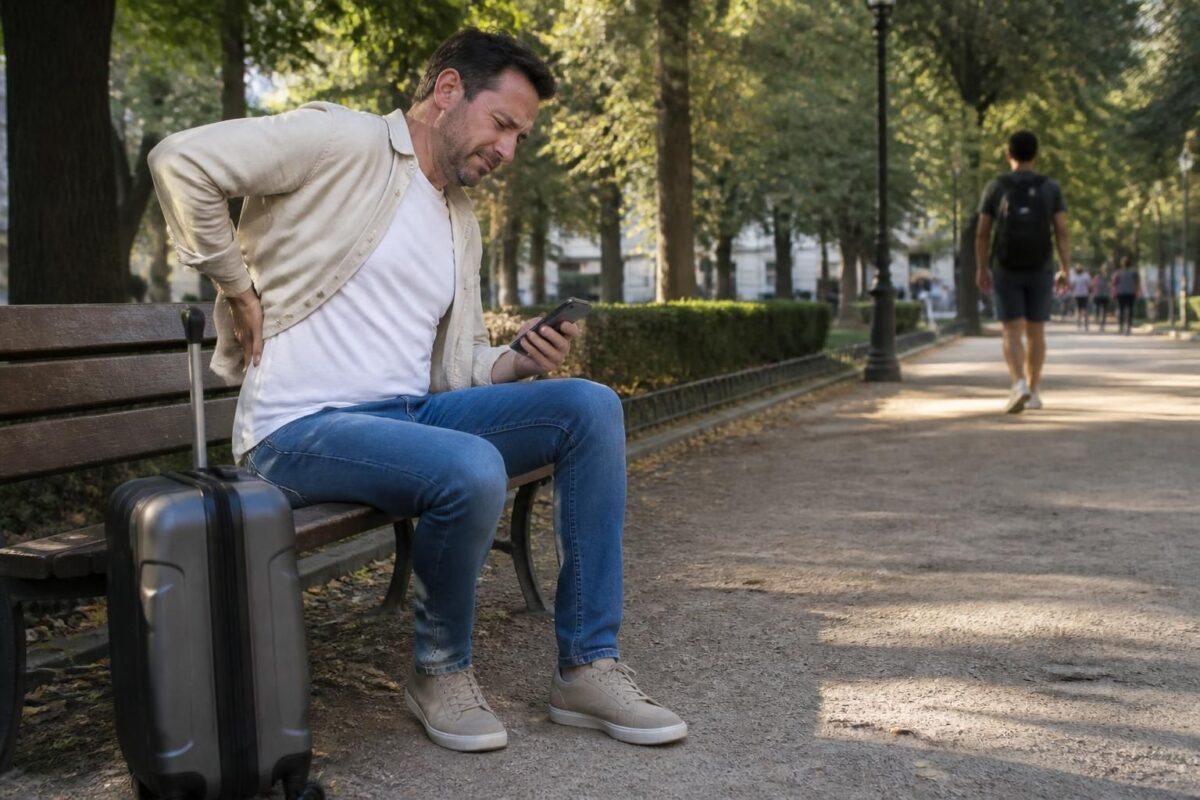
IN BRIEF In brief, sciatica and travel describe the worsening of sciatic pain during a trip, with radiation into the leg and radicular signs. Benefits: it allows for quick identification of warning signs, adjustment of breaks and movements, and traveling…
Why sitting aggravates sciatic pain
The sitting position increases pressure on the lumbar discs and can destabilize the pelvis. Prolonged sitting can cause the pelvis to tilt and pressure the sciatic nerve along its path. Immobility hinders the natural sliding of the nerve and can amplify the irritation already present. These mechanisms explain why certain daily actions, such as sitting too long, trigger or worsen pain.
Sciatica and airplane: prolonged sitting and leg pain
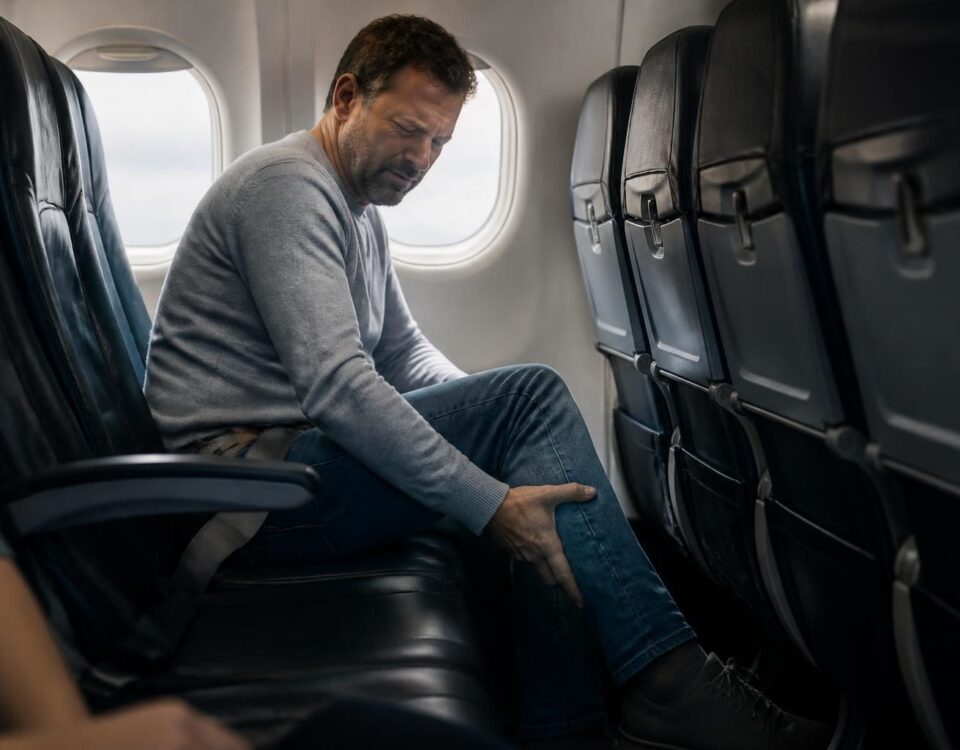
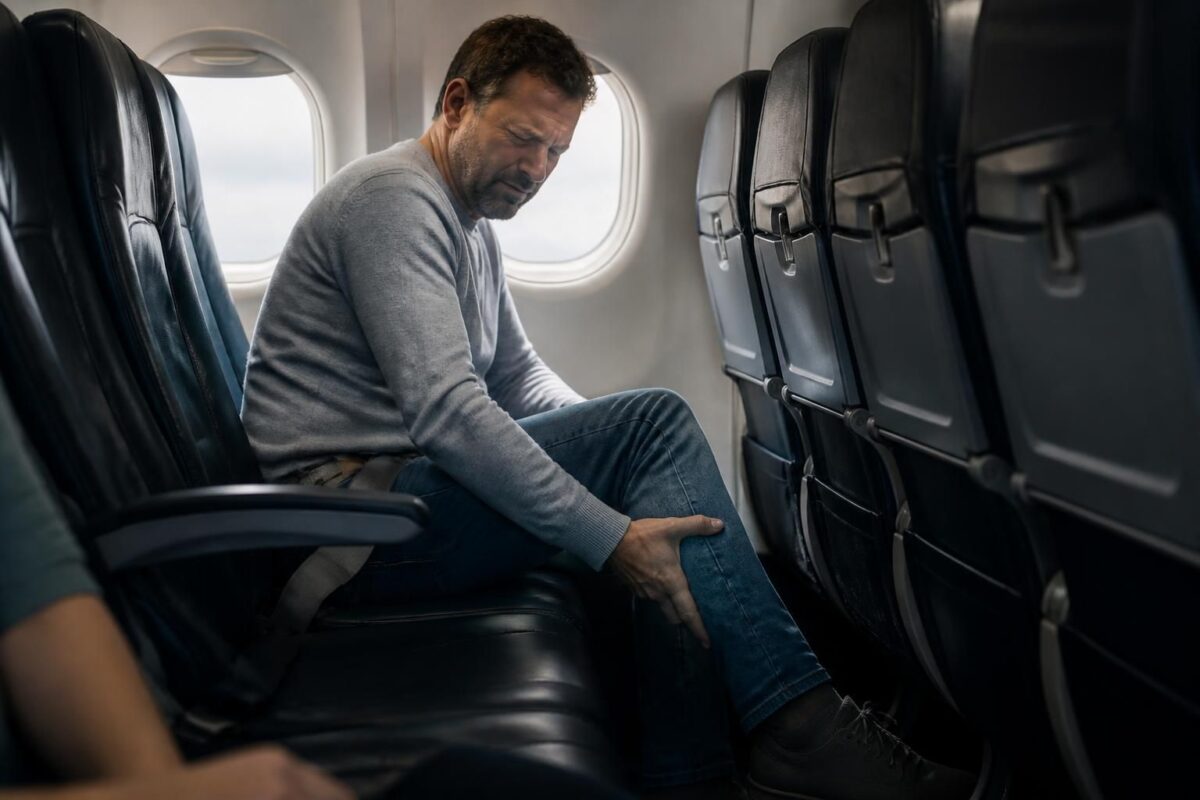
IN BRIEF In brief, sciatica related to prolonged sitting on the plane describes pain that arises or worsens when one remains seated for long periods during a flight, due to pressure on the lumbar discs and the sciatic nerve. How…
Common mistakes while sitting
Rounded or slumped back
A hunched back or, conversely, too rigid, increases tension on the lumbar area and further compresses the sciatic nerve. Adjusting the spine and shoulders helps to maintain a natural curve.
Crosser legs
Crossing legs destabilizes the pelvis and can cause twisting of the spine. This increases pressure on the nerve roots and perpetuates the pain.
Seat too low or too soft
An ill-fitted seat pushes the knees too high or too low compared to the pelvis, exacerbating the curvature and tension around the sciatic nerve. A stable support and appropriate height quickly reduce discomfort.
Prolonged inactivity
Remaining still without moving prevents the sciatic nerve from sliding, which increases pain over time. Micro-movements and regular breaks are essential.

Sciatica and train: pain after a long journey
IN BRIEF In brief, Sciatica after a long train journey is pain that radiates along the sciatic nerve after long periods of sitting. The problem often arises from an inadequate posture and a poorly mobilized pelvis during the trip. The…
How to sit correctly to relieve the sciatic nerve
There is no perfect position, but a dynamic seat that reduces nerve tension. Start by placing the pelvis on the ischions, avoid heavy leaning back, and do not try to excessively arch your back. Keep your knees at hip height and your feet flat on the floor for symmetrical support. Relax your shoulders, breathe calmly, and let your belly relax. The goal is a neutral spine and a reduction of pressure on the nerve.

Sciatica and subway: stay standing or seated?
IN BRIEF In short, sciatica and metro: staying standing or sitting is a practical question for daily commutes. The goal is to manage pain without restricting mobility, favoring appropriate postures and micro-breaks to avoid twists and asymmetrical loads. Main benefits:…
Adapting the environment and daily habits
At the office, favor an adjustable chair and a screen at eye level. Use a lumbar cushion and, if necessary, a sciatica cushion to relieve the area through which the nerve passes. In the car, opt for a slightly tilted seat and take breaks every 30 to 45 minutes to move your pelvis. On the couch or in bed, varying positions and placing cushions to distribute pressure points avoids tension areas. The goal is to make every position conducive to movement and rest for the nerve and muscle tissues, rather than forcing a rigid posture.
Micro-movements and rhythms to adopt
The key is to break immobility. Every 20 to 30 minutes, slightly change position, stand up for a few seconds, and take a few steps. By alternating sitting, standing, and light walking, you improve circulation, reduce pressure, and allow the sciatic nerve to gradually relieve itself of pain.
Comparison table: Sciatica and pain that increases when sitting
| Axis | Concise Impact |
|---|---|
| Prolonged sitting position | Increases pressure on the discs and can irritate the sciatic nerve. |
| Pelvic posture | Misalignment of the pelvis and possible traction of the sciatic nerve. |
| Back and curvatures | Rounded or overly rigid back ~> increases nerve tension along the path. |
| Crossed legs | Creates a disbalance of the pelvis and hinders circulation, worsening pain. |
| Leg alignment | Disrupted alignment increases lumbar pressure. |
| Seat and support | Seat that is too low or soft increases pelvic tilt and painful pressure points. |
| Postural variation | Immobility prevents nerve gliding and maintains pain. |
| Lumbar cushion | A poorly used cushion can worsen pain and limit movement. |
| Pause and micro-variations | Slightly change position every 20–30 minutes to reduce pain. |
Testimonials on sciatica and pain that worsens when sitting
“Before, I spent my days in front of the computer and my sciatic pain soared as soon as I was sitting for long. Each break seemed to relieve a bit, then the pain came back stronger than ever. By changing positions every 20 to 30 minutes and using a sciatica cushion and an ergonomic seat, I regained some of my mobility and the pain gradually decreased.”
“During my commutes and meetings, the sciatic pain quickly worsens when I remain sitting without moving. I started propping my pelvis with a footrest, adjusting the seat, and taking regular breaks every 30–45 minutes to walk a bit. Since then, the pain in my buttocks and along the path has eased and my days are less burdensome.”
“As a student, long sessions of classes and study sessions leave me stuck in a position that triggers sciatic pain. Every time I’m sitting, it intensifies and I lose my concentration. By alternating positions, slightly raising my feet, and practicing deep breathing, the pain has become more manageable. I also use a lumbar cushion and take frequent breaks to stand up and move.”
“While working from home, I learned to combine adjustable chair, screen at eye level, and small walks between tasks. My sciatic pain decreases when I stay active and do not impose a fixed position. Adopting a straight back and symmetrical support on the seat has really made a difference.”
“With age, staying too long sitting triggers painful episodes. Today, I favor micro-variations and movement rather than seeking a perfect position. I vary my postures, breathe calmly, and listen to my body to limit the tensions related to sciatic pain.”
Detailed biography of Dr. Sylvain Desforges and his work around sciatica and pain during sitting
Dr. Sylvain Desforges is a recognized practitioner in the fields of osteopathy, naturopathy, and manual medicine. At the head of the clinics TAGMED and ACMA, he embodies an integrated and innovative approach to care, centered on the patient and on the sustainable reduction of pain. His professional journey is guided by a simple belief: chronic pains, and particularly those associated with sciatica, require holistic management that combines traditional knowledge and cutting-edge technologies to optimize quality of life.
With several years of experience, he has developed a care philosophy that prioritizes listening, multidisciplinary assessment, and evidence-based protocols. In his practice, he focuses on understanding how pain that amplifies when sitting can be the result of a set of factors – posture, muscle constraints, circulation, and nerve dynamics – and he proposes treatment plans tailored to each patient. This approach aims to deploy sustainable solutions rather than limiting relief to isolated gestures.
At the heart of his action is the proactive management of sciatica, often triggered or worsened by prolonged periods of sitting. Dr. Desforges highlights the link between static positions, the pressure on the lumbar disks, and the pulling of the sciatic nerve, and he emphasizes the need for a change in posture and regular activity. His diagnosis is based on a keen observation of daily habits and simple clinical tests that identify aggravating factors and the most suitable solutions, without neglecting the emotional and motivational aspects of pain.
To treat the pain associated with sciatica, he relies on a varied and personalized therapeutic approach. He integrates manual techniques and natural approaches to release tension, stimulate mobility, and promote functional recovery. His arsenal includes spinal decompression methods, laser therapy, and shockwave therapy sessions, used when they provide real added value to reduce nerve irritation and accelerate tissue healing. Each protocol is tailored to the patient’s profile, lifestyle, and goals, with precise follow-ups and regular adjustments.
The mission of Dr. Desforges is to provide evidence-based and patient-centered care to improve not only pain but also mobility, confidence in the body, and the ability to resume daily activities. He advocates an approach that combines education, controlled movement, and relapse prevention, so that each individual can achieve lasting balance. In practice, this translates into personalized programs that integrate ergonomics, targeted exercises, and active lifestyle advice, all in a partnership logic with the patient and, when necessary, with multidisciplinary teams.
Through his role as president and founder of the TAGMED and ACMA entities, Dr. Desforges is also committed to training and the emergence of quality standards so that patients have access to consistent and effective clinical care. His work is driven by a strong belief: the pain associated with sitting can be reduced and then managed through a clear-sighted strategy that combines knowledge, technique, and sustainable follow-up, restoring everyone’s freedom to sit, walk, and live without limitation.
Sciatica can intensify when one remains sitting, as the pressure on the lumbar disks and the sciatic nerve evolves with posture and immobility. This article outlines why this pain manifests while sitting, which postures to avoid, and which alternatives to adopt to relieve, prevent recurrences, and stay active at the office, in the car, and in bed. It provides practical advice and simple tools such as the sciatic cushion and adjustable chair, while directing to specialized resources for further exploration.
To address worsening sciatic pain while remaining sitting, it is important to prioritize dynamism in sitting and limit tension through simple and regular adaptations. Varying positions, moving frequently, and practicing breathing and relaxation techniques can reduce inflammation and protect mobility.
Specifically, start with easy adjustments: use an adjustable chair, pair it with a footrest, and place a lumbar cushion to support the natural curvature of the back. The sciatic cushion can also be useful during prolonged periods, and avoiding crossed legs helps preserve the alignment of the pelvis and spine.
Incorporate active breaks every 20–30 minutes and focus on simple movements: standing, light walking, and micro-stretches. Regular walking stimulates circulation, eases tension, and encourages better mobility without worsening pain.
Nocturnal comfort matters too: prioritize a position that does not aggravate nerve compression, choose an appropriate mattress, and adapt your bedding with accessories like a pillow or leg lifter to improve spinal alignment. For more on positions to adopt and those to avoid, check specialized resources that address the topic from various angles and offer practical advice.
For further insights, consult guides like Sciatica: positions to avoid or Sciatica and prolonged sitting — what to understand. Other useful resources include How to relieve sciatica while sitting — simple stretches and Sciatica and sitting position — how to proceed. You can also explore practical advice on sitting position at the office, in the car, and on the couch and detailed advice on which positions to avoid to not worsen the pain.
Finally, to understand the manifestations and non-invasive treatment options, refer to resources like sciatica with burning in the leg, non-surgical treatment of sciatica, and the most common lumbar causes to know.

Dr Sylvain Desforges, B.Sc., D.O., N.D., osteopath, is the founding president of TAGMED and of the ACMA association. He dedicates his practice to chronic spinal pain, low back pain and symptoms compatible with sciatica, particularly when pain radiates toward the buttock, leg, calf, foot or toes.
Through SOS Sciatique, he publishes educational content on sciatica symptoms, possible causes such as disc herniation, disc narrowing, foraminal stenosis or irritation of a lumbar nerve root, as well as non-surgical approaches that may be considered according to the evaluation. At Clinique TAGMED, care may include, depending on the case, motorized neurovertebral decompression, specific osteopathic care or precision percussion.
For an evaluation related to sciatica treatment in Montreal / Mount Royal or sciatica treatment in Terrebonne, please consult the services available at Clinique TAGMED.
Medical disclaimer
The information published on SOS Sciatique is provided for educational purposes only and does not replace a consultation, diagnosis, opinion or treatment provided by a physician or another authorized healthcare professional. The author of this article is neither a medical doctor nor a specialist in a medical specialty recognized by the Collège des médecins du Québec. The osteopathic, manual medicine or functional support approaches described on this site do not constitute medical acts and are not intended to replace medical follow-up.
Consult a physician or emergency service in cases of loss of bladder or bowel control, anesthesia in the saddle area, significant or progressive weakness in the leg or foot, fever, recent trauma, severe pain or rapid worsening of symptoms. For more details, please read our Legal Notice.