


Weakness of the leg or foot and sciatica: a sign not to be trivialized
Weakness of the leg, calf or foot can sometimes be related to sciatica. Unlike simple pain, a loss of strength may indicate that a lumbar nerve root transmits motor controls less well to certain muscles.
Weakness can be manifested by a foot that hangs, difficulty lifting the toes, difficulty walking on the tip of the foot, a leg that lets go or a loss of stability when walking. This type of symptom should be assessed with caution, especially if it appears suddenly or if it progresses.


What types of weakness can accompany sciatica?
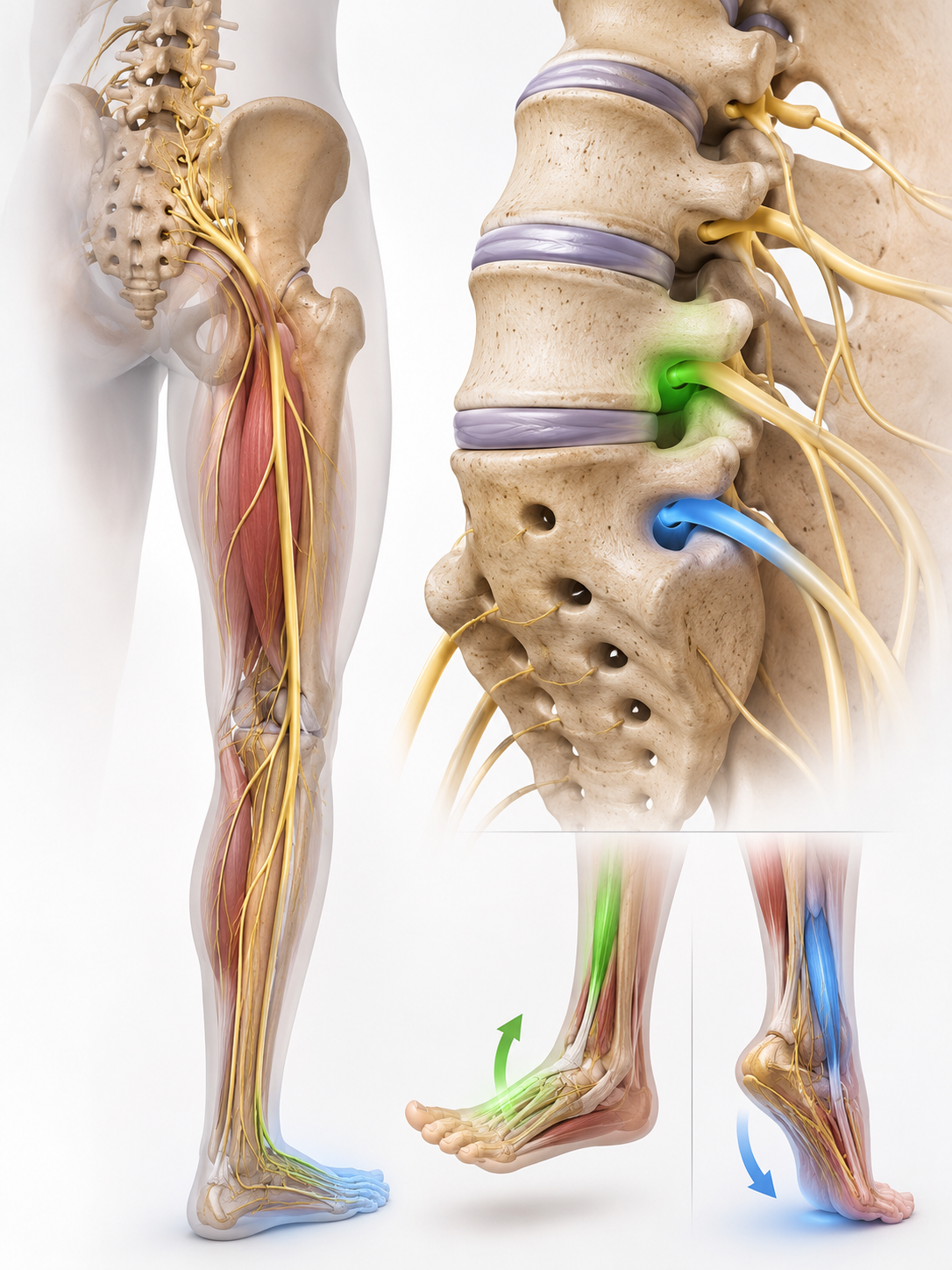
Weakness can affect different muscle groups depending on the nerve root involved. L5 may be associated with difficulty in raising the foot or big toe. S1 involvement can be associated with difficulty in pushing on the tip of the foot or with a weakness of the calf.
A real neurological weakness must be distinguished from a pain that simply prevents forcing. A person can avoid walking normally because the pain is intense, but a real loss of muscle control should be taken more seriously.
| Demonstration | Possible root | What to check |
|---|---|---|
| foot that hangs on the ground | L5 possible. | Ability to raise the foot, toes or big toe. |
| Difficulty walking on the heels | L5 possible. | Foot control, walking stability and progression. |
| Difficulty walking on tiptoe | S1 possible. | calf strength and ability to push. |
| loose leg | several possible causes. | Overall strength, balance, pain, knee, hip and neurological signs. |
| Weakness with numbness | more suspicious nervous irritation. | Territory of numbness and loss of function. |
When does weakness become more worrying?
Weakness is a more worrying symptom than isolated pain, especially if it appears quickly, worsens or changes walking. It should be interpreted with pain, numbness, functional reflexes, ability to walk and emergency signs.
falling foot
A foot that falls or hangs on the ground can indicate a neurological attack to be assessed quickly.
Difficulty lifting your toes
A loss of strength of the big toe or foot may be consistent with L5 irritation.
Difficulty pushing
A loss of calf or foot tip strength may be consistent with S1 irritation.
unstable leg
A loose leg, altered walking or repeated trips should be taken seriously.
Weakness that progresses
A weakness that increases over the hours or days requires a quick reassessment.
Weakness with urinary disorders
Weakness associated with urinary, intestinal disorders or stool anesthesia is an emergency.
Weakness L5 or S1: what the territory can suggest
The L5 and S1 roots are often involved in lumbar sciatica. L5 participates in particular in certain movements of lifting the foot and big toe. S1 participates in certain thrust movements with the calf and the tip of the foot.
These benchmarks are useful, but they do not replace an evaluation. Weakness should be compared to pain, numbness, leg travel, aggravating movements and imaging results when available.
- Difficulty lifting the foot: L5 possible.
- Difficulty raising the big toe: L5 possible.
- Difficulty pushing on the tip of the foot: S1 possible.
- Decreased calf strength: S1 possible.
- Weakness that progresses: Recommended quick consultation.
Neurological weakness or pain that blocks movement?
It is common for a painful person to feel that their leg is weak. However, it is necessary to distinguish a real loss of neurological strength from a limitation caused by pain, fear of movement or muscle fatigue.
| Situation | possible interpretation | Useful clue |
|---|---|---|
| Impossible to force because of the pain | painful limitation possible. | Does the force come back when the pain decreases? |
| Foot that grips even without intense pain | possible neurological deficit. | Difficulty lifting the foot or toes. |
| calf unable to push | Achieved S1 possible. | Difficulty walking on tiptoe. |
| Weakness with numbness | more suspicious nerve damage. | precise territory and progression. |
| Weakness of both legs | more worrying situation. | Walk, balance, lumbar canal or general signs to check. |

Why personalized evaluation is essential
Weakness in the leg or foot should be assessed according to its location, appearance, progression, association with pain, numbness and walking. A simple impression of weakness does not have the same meaning as a falling foot or a real loss of strength.
The evaluation aims to check the strength of the foot, big toe, calf, the ability to walk on the heels or on the toe, sensitivity, pain path and warning signs. Depending on the result, a quick medical orientation may be necessary.
driving force
Check foot lift, big toe, calf and leg stability.
Walk and safety
Observe if the foot hangs, if the walk changes or if the leg loses its reliability.
What if sciatica is accompanied by weakness?
The first step is to determine whether the weakness is real, new, progressive or associated with other neurological signs. A progressive weakness should not be treated as ordinary pain. It may require a rapid medical assessment.
Depending on the assessment and the stability of the situation, certain non-surgical and non-invasive approaches can be discussed. However, if the weakness progresses, if the foot falls or if there are urgency signs, the medical orientation becomes a priority.
| Profile | Priority | Why |
|---|---|---|
| Light and stable weakness | Clinical evaluation and monitoring of progress. | Stability needs to be confirmed and documented. |
| New weakness | rapid reassessment. | A new motor deficit changes what to do. |
| gradual weakness | priority medical orientation. | Aggravation may indicate active nerve damage. |
| falling foot | Urgent medical assessment. | This sign may reflect a significant motor deficit. |
Weakness of the leg or foot and clinical orientation
An educational page like this serves to better understand the possible differences, but it does not replace an evaluation. Weakness of the leg or foot should be interpreted depending on its territory, its duration, its evolution, pain, numbness and walking.
For a local appointment or a geolocated treatment page, the main conversion page must be hosted on the TagMed Clinic website in order to avoid SEO cannibalization with the educational content of SOS Sciatica.
The educational pages of SOS Sciatica must explain the causes and guide the reader. The local treatment, appointment and conversion pages should remain on the TagMed Clinic website.
Understand the weakness
A real weakness does not have the same meaning as pain that limits stress.
Check progress
A weakness that increases or a falling foot should be taken seriously.
Frequently Asked Questions about Leg or Foot Weakness and Sciatica
Can sciatica cause leg weakness?
Yes I do. If a lumbar nerve root is irritated or compressed, it can sometimes affect the control of certain leg or foot muscles.
What is a falling foot?
A falling foot corresponds to a difficulty in raising the foot or toes. This can cause the foot to hang on the ground while walking and should be assessed quickly.
Can the L5 root cause foot weakness?
Yes I do. L5 can be associated with the ability to lift the foot or big toe. An attack can cause a foot that hangs or difficulty walking on the heels.
Can the S1 root cause calf weakness?
Yes I do. S1 can be associated with the ability to push on the tip of the foot. An attack can make walking on the tip of the foot difficult.
How do you know if it’s a real weakness or just pain?
Pain can limit effort, but real weakness persists even when trying to contract the muscle. An evaluation is necessary to distinguish the two.
Is weakness a sign of urgency?
A new, progressive or significant weakness may require a quick or urgent assessment, especially if it is accompanied by a falling foot or urinary disorders.
Should you do exercises if the leg is weak?
not automatically. If the weakness is neurological or progressive, it is first necessary to clarify the cause and the level of safety before choosing exercises.
Can a weakness recover?
Recovery depends on cause, duration, severity and evolution. A recent or progressive weakness must be assessed without delay.
When to consult for weakness with sciatica?
It is necessary to consult quickly if the weakness appears, progresses, modifies the walk, touches the foot or is accompanied by significant numbness.
Which associated signs are the most worrying?
Loss of urinary or intestinal control, stool anesthesia, progressive weakness, falling foot, pain quickly aggravated or extended numbness should be assessed quickly.
Does your leg or foot lose strength?
A personalized assessment can help distinguish pain limitation from true neurological weakness, especially if the foot hangs, if the walk changes or if the weakness progresses.
Dr Sylvain Desforges, B.Sc., D.O., N.D., Osteopath

Editorial information, sources and limitations
This content is intended to inform patients about sciatica, possible causes, warning signs, and care options. It does not replace an individualized assessment.
Reference sources
References are selected according to the subject of the page: guidelines, systematic reviews, then institutional resources.
- NICE NG59 – Low back pain and sciatica in over 16s — National guideline
- HAS – Management of patients with common low back pain — French national guideline
- Cochrane – Corticosteroid injections for treatment of sciatica — Systematic review
- NCBI Bookshelf – Sciatica — Clinical institutional resource
Complementary resources from the TAGMED network
These internal resources complement the clinical information and thematic linking. They do not replace national guidelines or systematic reviews.
Editorial note on decompression
Clinical resource from the TAGMED network; it does not replace national guidelines. Some guidelines use the term “traction” and recommend caution for low back pain with or without sciatica. Any decompression option should therefore be presented as an individualized clinical approach, with limitations, indications, and contraindications clearly explained.
Limitations of this information
The information on this page is general. It does not constitute a diagnosis, prescription, or guarantee of results. Pain radiating into the leg may have several causes; assessment should consider clinical history, examination findings, symptom progression, and, when appropriate, complementary tests.
When to seek urgent medical care
Seek urgent medical care if you experience loss of bladder or bowel control, saddle anesthesia, major or progressive leg weakness, unexplained fever, pain after significant trauma, or severe pain that rapidly worsens.
