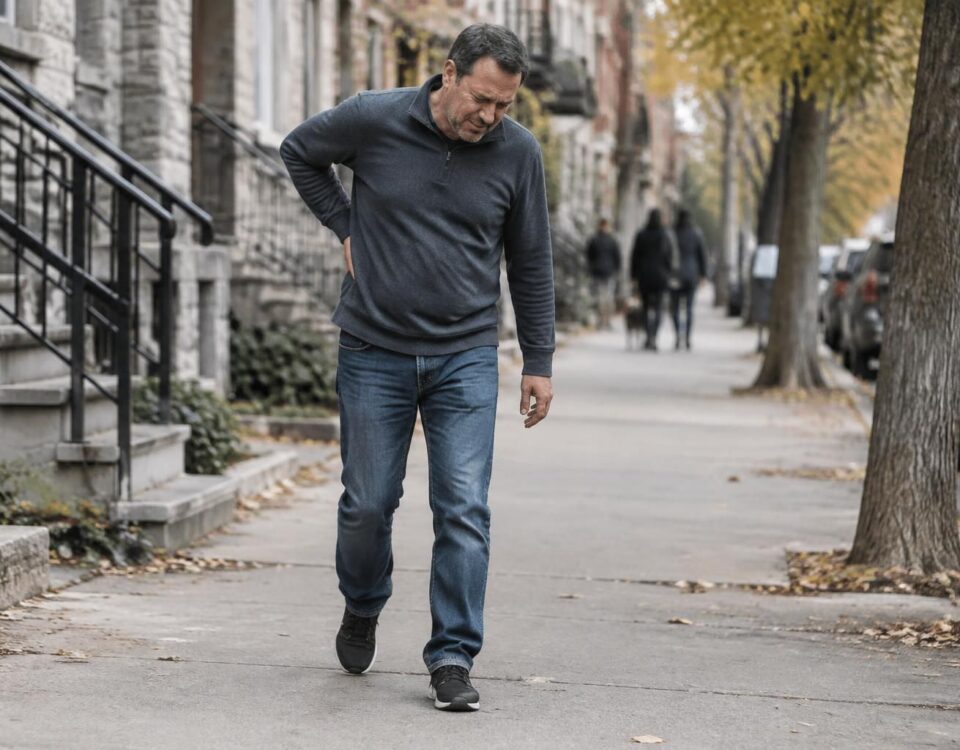



Sciatica and prolonged braking: tension in the leg
25/08/2026
Sciatica in Terrebonne: lower back pain with a shooting pain in the leg
26/08/2026
IN BRIEF Sciatica is a lower back pain with a sharp pain that follows the path of the sciatic nerve down the leg. In Montreal, this condition is managed through non-invasive approaches aimed at reducing pain, restoring mobility, and strengthening the lumbopelvic region. How does this work? By addressing nerve sensitization and posture, and then providing targeted exercises and manual techniques to support movement. The main benefits include rapid relief, improved posture, and prevention of recurrences, all while remaining active without resorting to surgery. |
In Montreal, sciatica typically manifests as lower back pain accompanied by a sharp pain radiating into the leg, which can reach the foot. The phenomenon most often results from irritation or sensitization of a nerve root, frequently associated with a herniated disc or foraminal stenosis, and may be accompanied by paresthesias and muscle weakness along the nerve’s path. The treatment prioritizes non-surgical and personalized approaches, such as physiotherapy, postural improvement, and strengthening of the lumbopelvic muscles. To obtain an accurate diagnosis and a tailored plan in Montreal, contact a specialist for a program of exercises and advice that allows you to stay active while reducing pain.
This article, written by a health professional, explains sciatica in Montreal as lower back pain with sharp pain in the leg. It describes possible causes, typical signs, diagnosis, and non-surgical treatment options available in Montreal. It also provides practical tips for better daily living.
What is sciatica?
Sciatica refers to pain that follows the path of the sciatic nerve. This nerve is the longest in the body and connects the lower back to the leg. The pain may start in the lower back and radiate into the buttock, thigh, calf, and sometimes down to the toes. The sciatic nerve transmits sensations and allows certain movements.
Main Causes and Mechanisms
Pain from the sciatic nerve often arises from irritation or sensitization of a nerve root. Common causes include a herniated disc or degenerative changes at the lumbar level. Lumbar osteoarthritis can also reduce the space around the nerve root and cause nerve sensitization.
In some cases, deep tension in the gluteal muscles may press on the nerve and contribute to symptoms. It is important to distinguish the causes and assess each situation individually.
Typical Symptoms
The main symptom is pain that may remain localized in the back or spread along the path of the sciatic nerve. Paresthesias, meaning sensations of numbness or tingling, may occur in the leg or foot. Loss of strength may also occur in the leg. The pain may be more intense during walking or after prolonged sitting.
The symptoms can affect the entire path of the nerve: lumbar region, buttock, thigh, calf, and even the toes.
Diagnosis and Warning Signs
The diagnosis is based on medical history and clinical examination. Complications require prompt evaluation by a health professional. Consult if the pain is severe, if it is accompanied by loss of urinary or bowel control, or if it persists for several weeks despite appropriate rest and general measures.
Treatment Options and Management in Montreal
Management of sciatica is generally multimodal. The goal is to reduce pain, preserve mobility, and strengthen the back and pelvic muscles. In the Montreal area, you can consider approaches at TAGMED Clinic and non-surgical options tailored to your situation.
Depending on the evaluation, non-surgical approaches may be suggested, such as specific osteopathic care or methods of motorized neurovertebral decompression. These options aim to improve comfort and function without resorting to surgical intervention. To learn more about the available options, consult the following resources:
- sciatica and numbness in the foot during driving
- sciatica – leg pain
- Osteopathy and sciatica in Montreal
- Sciatica in Terrebonne – difficulty walking on heels or toes
If necessary, your health professional may propose a multidisciplinary approach where non-surgical options are prioritized while referring you to specialists if an intervention is considered. For those seeking general information and local resources, content and services are available on the referenced websites below:
For additional information on causes and non-surgical treatments, consult the following resources:
- Sciatica and foot pain in the car
- Difficulty walking on heels or toes
- Sciatica Leg Pain – TAGMED Clinic
For more general information on mechanisms and approaches, some public or professional resources can be consulted through the dedicated pages on lower back pain science and non-surgical management on the websites mentioned below:
Note: in case of doubt or persistent pain, make an appointment with a professional for a precise and personalized evaluation. For more targeted information on exclusively non-surgical options and criteria for referral, please refer to the dedicated pages on the recommended sites below.
Medical disclaimer: The information and advice provided on this site do not replace the opinion, diagnosis, or treatment of a healthcare professional. Please note that Dr Sylvain Desforges, osteopath, is neither a medical doctor nor a physician and is not specialized in a medical specialty as defined by the Collège des médecins du Québec. Manual medicine, functional medicine, and sports medicine as described on this site exclude any treatment or medical diagnosis made by a physician or medical specialist. Always consult your doctor for any medical questions. For more details, please read our full Legal Notice.
- Sciatica in Montreal manifests as low back pain with shooting pain down the leg.
- Pathway: sciatic nerve from the roots L4-L5-S1-S2, from the lower back to the toes.
- Typical symptoms: paresthesia, pain, and possible weakness along the pathway.
- Alert: urinary control loss, severe sharp pain or fever – consult urgently.
- Local evaluation: consultation with an osteopath/physiotherapist for diagnosis and personalized plan.
- Non-surgical treatments: manual therapy, targeted exercises, gentle decompression if indicated.
- Posture and activity: avoid prolonged sitting positions, favor lumbar support and appropriate activity.
- When to act: pain persists >4 weeks or worsens, advocate for a treatment plan and follow-up.

This article provides practical recommendations for understanding and managing sciatica associated with lower back pain with shooting pain in the leg, tailored to the context of Montreal. You will find possible causes, signs to watch for, daily tips, and management options to improve mobility and quality of life.
Understanding sciatica and its manifestations
Sciatica refers to sensitization of the sciatic nerve, the longest nerve in the body, which runs from the lower back to the foot. Typical symptoms may start at the lumbar level and radiate to the buttock, thigh, calf, and sometimes to the toes. Paresthesia and muscle weakness may accompany the pain. In the majority of cases, about 85%, the cause is a herniated disc compressing a nerve root. Other mechanisms exist, such as lumbar osteoarthritis causing a stenosis of the neuroforamina, or deep gluteal syndrome when certain muscles in the buttock irritate the pathway of the nerve.

Sciatica in Montreal: understanding L5-S1 foraminal compression
IN BRIEF L5-S1 foraminal compression is a narrowing of the opening where a nerve root exits, which can cause sciatica with pain, tingling, or weakness in the buttock and leg. In Montreal, an assessment allows for correlating symptoms, clinical examination,…

Sciatica in Montreal: why L5-S1 is often involved
IN BRIEF The sciatica L5-S1 often corresponds to irritation of the S1 root, sometimes related to a herniated disc. The pain may start in the buttock and descend behind the thigh to the calf or the foot. In Montreal, understanding…
Common causes in Montreal
The most common causes remain herniated discs and foraminal stenosis related to osteoarthritis; they cause irritation or sensitization of the nerve roots and explain the shooting pains that sometimes radiate up to the lumbar region or throughout the leg. The deep gluteal syndrome may also play a role when deep gluteal muscles tighten and compress the sciatic nerve. Myofascial factors may contribute, but they are generally less frequent than structural causes.
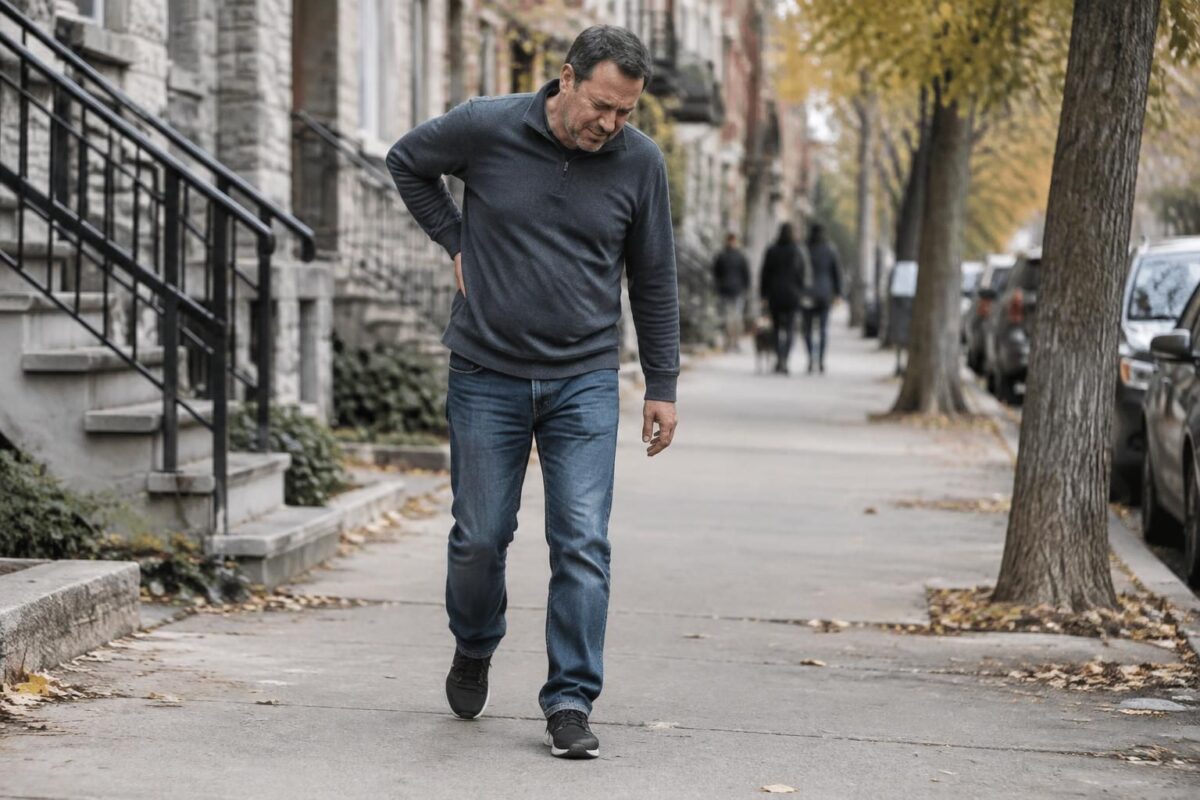
Sciatica in Montreal: L5 and difficulty lifting the foot
IN BRIEF The difficulty in lifting the foot with sciatica can indicate weakness related to the involvement of the L5 root, sometimes caused by a herniated disc. This foot drop increases the risk of falling and requires prompt medical evaluation;…

Sciatica in Montreal: S1 and difficulty rising up on the toes
IN BRIEF S1 sciatica can cause pain from the buttock to the calf and foot, as well as difficulty getting on tiptoe. This weakness may suggest irritation of the S1 nerve root, but is not sufficient to establish a diagnosis.…
When to seek immediate consultation
Seek immediate consultation if you experience loss of urinary or anal control, numbness in the saddle area, progressive or significant weakness of the leg or foot, fever, or severe and sudden pain after trauma. These signs may indicate a medical emergency requiring quick evaluation. In the absence of these signals, a specialized evaluation may still help clarify the cause and establish an appropriate treatment plan.
Warning signs
Pain that persists despite rest and usual activities, or pain that intensifies with effort or back bending, merits consultation to adjust treatment and prevent recurrences.

Sciatica in Montreal: L4-L5 and pain towards the top of the foot
IN BRIEF The sciatica related to L4-L5 can radiate from the lower back to the buttock and the leg; pain on the top of the foot may suggest involvement of the L5 root, but the pathways vary and symptoms overlap.…

Sciatica in Montreal: pain in the big toe, L5 root or another cause?
IN BRIEF Pain that radiates toward the big toe may indicate irritation of the L5 root, sometimes related to a herniated disc, but other causes are possible. In Montreal, evaluating the pain pathway, strength, sensitivity, and walking helps guide management…
What to do daily
Adopt a straight posture and favor workstations that alternate between sitting and standing positions. Use a lumbar support and avoid crossing your legs while sitting. Limit prolonged sitting periods and favor active micro-breaks that allow you to mobilize your back and hips.
Practical tips
Avoid positions that unnecessarily stretch the sciatic nerve, such as long legs and feet elevated without support. Incorporate walking breaks and gentle stretches tailored to your pain to maintain mobility without triggering a significant increase in symptoms.

Sciatica in Montreal: why the affected root changes the pain pathway
IN BRIEF Sciatica refers to pain or nerve symptoms that vary depending on the affected lumbar root. Pain, tingling, or numbness may manifest in the buttock, thigh, calf, or foot. Understanding this distribution helps guide the assessment, without diagnosing based…

Sciatica in Montreal: L4-L5 disc, L5-S1 disc, and leg pain
IN BRIEF Sciatica refers to pain that can radiate from the lower back or buttock down the leg, sometimes related to nerve irritation near the L4-L5 or L5-S1 discs. The level of the disc alone is not sufficient to identify…
Recommended exercises and therapies
An individualized program, ideally supervised by a professional, will help you reduce pain while strengthening the muscles of the back and pelvis. Moderate aerobic activities (walking, swimming, elliptical cycling) promote healing and mobility. Targeted strengthening exercises of the lumbar-pelvic and gluteal muscles, combined with gentle stretching of the hamstrings and deep gluteal muscles, can be beneficial when tolerated. The goal is to stay active while protecting the nerve and improving posture on a daily basis.
Typical plan
Your therapist may propose a progressive program: 20–30 minutes of light activity several times a week, followed by strengthening 2–3 times a week and conscious stretching. The objective is to improve tolerance to activity and reduce painful episodes.
Management options in Montreal
In the Montreal area, the approaches of physiotherapy and osteopathy offer specialized evaluations and personalized plans for sciatica. Manual therapies, myofascial release techniques, and postural advice are often integrated into a comprehensive plan aimed at reducing pain and restoring mobility. Options such as motorized neurovertebral decompression or foraminal blocks may be considered based on the evaluation to reduce nerve sensitization and promote a gradual return to usual activities.
| Aspect | Concise finding |
|---|---|
| Definition | Pain radiating along the path of the sciatic nerve, related to sensitization. |
| Anatomical path | Nerve arising from roots L4-L5-S1-S2, long lumbar journey to the toes. |
| Common causes | Disc herniation primary; foraminal stenosis and lumbar osteoarthritis possible. |
| Typical symptoms | Lumbar pain radiating into the leg; paresthesias and sometimes weakness; worsens with prolonged sitting. |
| Diagnosis | Clinical evaluation; imaging if suspected. |
| Initial treatment | Non-surgical approach: physiotherapy or osteopathy, exercises, posture improvement; medication as advised by the doctor. |
| Exercises and activity | Adapted activity: walking, swimming; personalized program to strengthen the lumbopelvic area. |
| Posture and habits | Straight back, lumbar support, alternating between standing and sitting; avoid crossed legs. |
| When to consult | Emergency if loss of urinary/intestinal control, unbearable pain, progressive weakness, fever, trauma. |
| Prevention and advice | Move regularly, active breaks, posture suited for work and daily life. |
Testimonials on sciatica in Montreal
Since I moved to Montreal, my lower back pain radiated down to my leg, with a tingling in the leg. After a few sessions, the symptoms have subsided and I’m gradually regaining my mobility.
As an athlete in Montreal, a lower back pain accompanied by a tingling in the leg held me back. The personalized treatment and advice allowed me to return to my activities and train again with confidence.
My lower back pain and the tingling in the leg forced me to consult in Montreal. The rehabilitation plan helped me improve my posture and reduce painful episodes.
The diagnosis was quick and clear, and the tingling in the leg was reduced thanks to a program tailored to Montreal. I can now walk and move without fear.
In Montreal, I found an effective approach for my lower back pain and my tingling in the leg. The exercise plan and daily advice helped me endure and avoid relapses.
Dr. Sylvain Desforges, expert in osteopathy, naturopathy, and manual medicine, is the founding president of the TAGMED clinics and the ACMA association. Living in Montreal, he focuses on improving the quality of life for people suffering from chronic spinal pain, with particular attention to sciatica and its tingling in the leg. His approach considers the patient holistically, integrating mobility, posture, breathing, and lifestyle habits to provide tailored care for each painful journey.
From a perspective of innovation in care, his career is distinguished by the integration of advanced technologies in the non-pharmacological and non-surgical field. He coordinates the use of motorized spinal decompression, laser, and shockwave therapies to reduce inflammation, improve nerve function, and promote progressive recovery. This approach is supported by evidence and a patient-centered approach, offering realistic options when traditional treatments are insufficient.
For Montreal patients suffering from sciatica, Dr. Desforges prioritizes a precise assessment of possible causes: disc herniation, degenerative changes, and sensitization of nerve roots, as well as deep muscular factors. He reminds that pain can radiate along the nerve path, but the origin is often multifactorial and requires a personalized approach, favoring non-surgical alternatives when possible. His work also focuses on the relationships between the deep structures of the buttock and the sciatic nerve to identify tension points that aggravate irritation.
The therapeutic framework combines precise osteopathic techniques, postural advice, and targeted exercises. The patient is guided to strengthen the pelvic floor and back muscles, improve lumbar mobility, and optimize the posterior muscle chains that support the leg. Depending on the case, it may be proposed to integrate complementary tools such as decompression sessions or physical therapies to accelerate recovery and reduce recurrent episodes of pain.
In parallel, Dr. Desforges places a strong emphasis on patient education and self-management. He explains the mechanisms of sciatica, helps distinguish signs requiring urgent care, and offers practical strategies to adapt daily activities: sitting posture, lifting, and gentle mobility. His approach emphasizes safety, the adapted progression of exercises, and the prevention of long-term relapses, in order to maintain the ability to engage in physical and professional activities.
For the residents of Montreal and surrounding areas, this integrated approach—osteopathy, naturopathy, and manual medicine—comes with personalized and accessible support. Dr. Desforges and his team offer in-depth evaluations, individualized treatment plans, and non-invasive options based on the latest advancements in the field. To learn more about his approach and the available services, contact the TAGMED Clinic.
This summary addresses sciatica in Montreal, when lower back pain is accompanied by a sharp pain in the leg. It recalls that most pain related to the sciatic nerve results from nerve sensitization and not a simple “pinched nerve,” and proposes non-surgical approaches focused on assessment, posture, and strengthening to reduce pain and regain mobility.
Key Points and Recommendations
In the context of lower back pain radiating to the leg, it is essential to understand that the origin may be a herniated disc, foraminal stenosis, lumbar osteoarthritis, or a deep myofascial factor. A precise diagnosis, made during a specialized consultation in Montreal, allows for targeted treatment without necessarily resorting to surgery and avoids erroneous assumptions about a simple “pinched nerve.”
Treatment emphasizes non-surgical approaches aimed at reducing pain, improving mobility, and strengthening the back and lumbopelvic muscles. Physical therapy plays a central role: personalized exercise programs, postural advice, and gradual progression of activities, with adaptation to your goals and lifestyle. Complementary options may include targeted techniques or injections, but the goal remains autonomy and the gradual return to daily activities.
In daily life, prioritize a straight posture, avoid prolonged sitting positions, and arrange your workspace to favor regular posture transitions. Adapted physical activities, such as walking or swimming, help maintain mobility and prevent recurrences, in coordination with your therapist. Exercises can be adjusted to respect your limits and progress safely.
For Montreal, seeking an evaluation from a sciatica specialist allows for the establishment of a personalized and realistic plan, facilitating the return to activities and sports. Online resources help better understand the mechanisms and painful pathways, including content on the distinction between lower back pain and nerve pain and on the pathway of pain before taking action: distinguish between lower back pain and nerve pain, understand the pathway of pain.
To deepen and guide your journey in Montreal, you can consult specialized resources and practical guides on sciatica and its treatment options: Sciatica or referred lumbar pain, symptoms and modern treatments, and useful summaries on Sciatica — Chronicle.
Complementary resources cover various aspects of sciatica and its nerve pathway: progressive numbness towards the foot, tingling and nerve pathway, and the descriptive page on Sciatica or referred lumbar pain.

Dr Sylvain Desforges, B.Sc., D.O., N.D., osteopath, is the founding president of TAGMED and of the ACMA association. He dedicates his practice to chronic spinal pain, low back pain and symptoms compatible with sciatica, particularly when pain radiates toward the buttock, leg, calf, foot or toes.
Through SOS Sciatique, he publishes educational content on sciatica symptoms, possible causes such as disc herniation, disc narrowing, foraminal stenosis or irritation of a lumbar nerve root, as well as non-surgical approaches that may be considered according to the evaluation. At Clinique TAGMED, care may include, depending on the case, motorized neurovertebral decompression, specific osteopathic care or precision percussion.
For an evaluation related to sciatica treatment in Montreal / Mount Royal or sciatica treatment in Terrebonne, please consult the services available at Clinique TAGMED.
Medical disclaimer
The information published on SOS Sciatique is provided for educational purposes only and does not replace a consultation, diagnosis, opinion or treatment provided by a physician or another authorized healthcare professional. The author of this article is neither a medical doctor nor a specialist in a medical specialty recognized by the Collège des médecins du Québec. The osteopathic, manual medicine or functional support approaches described on this site do not constitute medical acts and are not intended to replace medical follow-up.
Consult a physician or emergency service in cases of loss of bladder or bowel control, anesthesia in the saddle area, significant or progressive weakness in the leg or foot, fever, recent trauma, severe pain or rapid worsening of symptoms. For more details, please read our Legal Notice.