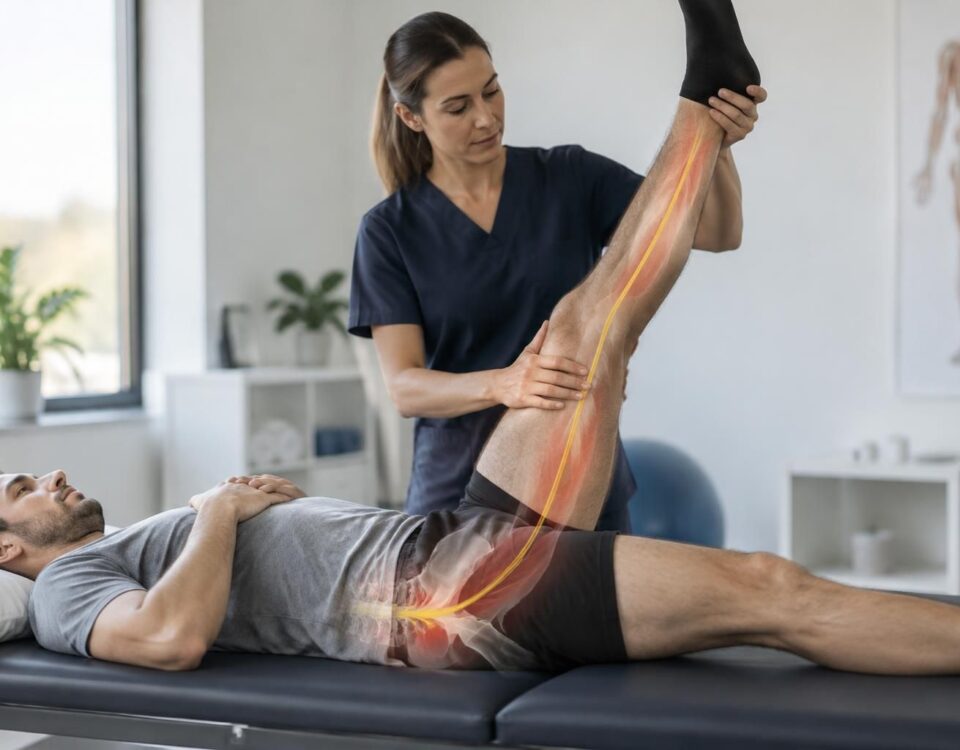
Herniated disc and recurrent sciatica: possible factors
25/08/2026
Sciatica in Montreal: lower back pain with shooting pain in the leg
26/08/2026
IN BRIEF
| In brief, sciatica is a symptom caused by irritation or compression of the sciatic nerve, resulting in pain that starts from the lower back and radiates into the leg. Prolonged braking and extended sitting positions can amplify this pain, but most episodes heal within 4 to 8 weeks without surgery, with help available via teleconsultation through MEDADOM. The mechanism is a root conflict or narrowing of the lumbar canal: treatment combines anti-inflammatories, analgesics, relative rest, and exercises (stretching and neurodynamics) to relieve and promote healing; in case of severe signs (paralysis, incontinence), consult emergency services. |
The sciatica is a symptom due to compression or irritation of the sciatic nerve, causing pain that starts from the lower back and radiates into the leg along the nerve pathway. The most frequent cause is a herniated disc, but other factors such as lumbar osteoarthritis or piriformis syndrome may also be responsible. The pain is typically unilateral, sharp, and may be accompanied by paresthesias or a burning sensation. On average, healing occurs in 4 to 8 weeks; beyond 3 months despite treatment, it is referred to as chronic sciatica. In case of prolonged braking, prioritize relative rest and appropriate exercises (stretching, walking), alternating cold and hot according to how you feel. Treatment involving paracetamol, short-term anti-inflammatories (NSAIDs), and physical therapy allows for healing; injections or surgery are only considered in specific cases. Teleconsultation available for quick advice.
This article, written by a healthcare professional, addresses the link between sciatica and prolonged braking and explains why tension in the leg may occur during long trips. It provides clear guidelines to understand the pain, know when to consult, and understand the main lines of management, without delving into specific exercises. The goal is to help act quickly and limit discomfort during prolonged braking.
Understanding the Mechanism
Sciatica results from irritation or compression of the sciatic nerve. This nerve is the longest in the body and it supplies the back of the leg. During prolonged braking, the sitting position and maintaining a flexed posture can increase pressure on the intervertebral disc and on the nerve roots. This pressure can trigger pain that radiates down the leg, sometimes all the way to the foot.
The path of the sciatic nerve explains why the pain spreads along the leg. It originates from the lumbar and sacral roots, crosses the buttock, and then descends to the foot. Irritation or root conflict is often the source of symptoms, and this mechanism can be triggered or worsened during periods of prolonged braking or driving.
Signs and Location
Pain is most often unilateral, meaning it affects one leg. It can be sharp, burning, or associated with paresthesias (tingling) and numbness. The pain may worsen when coughing, sneezing, or during exertion while driving.
Depending on the affected root, painful areas differ. Pain following the L5 pathway impacts the outer side of the leg and foot. Pain following the S1 pathway may target the heel and the outer edge of the foot.
Causes and Risk Factors Specific to Prolonged Braking
The most frequent cause remains the herniated disc that can compress a nerve root and trigger sciatica. Other factors may come into play, such as lumbar osteoarthritis or piriformis syndrome. Prolonged braking heightens the risk when sitting for long periods without movement, with a posture that increases pressure on the lower back and on the nerve structures.
For some individuals, repetitive driving situations or long trips without breaks promote the appearance or exacerbation of pain.
When to Consult and How to Establish the Diagnosis
The diagnosis is essentially clinical. The doctor evaluates the signs and may perform simple tests to confirm irritation of the sciatic nerve. There are warning signs: marked weakness, sensory disturbances, incontinence, or pain that persists despite rest. In these cases, quick consultation is necessary.
If the pain is typical and without serious signs, imaging is not systematic and does not always influence the initial treatment. However, the doctor may suggest exams if symptoms evolve or persist.
Management and Treatment Options
The goal is to relieve pain and reduce inflammation. The doctor may prescribe analgesics such as paracetamol and, in cases of intense pain, short-term non-steroidal anti-inflammatory drugs. Muscle relaxants may be considered if muscle tension accompanies the pain.
In some cases, injections or other interventions may be discussed depending on severity and response to medical treatment. Physical therapy may be considered, but approaches vary according to the context. For personalized choices, you can consult the TAGMED clinic in Montreal or Terrebonne.
Preventing Through Long Trips and Prolonged Braking
To prevent tension related to prolonged braking, prioritize regular breaks during long trips. Adopt a position that supports the lumbar area and avoid positions that increase pressure on the disc and nerve root. Using an ergonomic seat and adjusting the backrest can help. If possible, change your driving rhythm and vary positions to limit continuous pressure.
Resources and Support
For more information and management options, please consult the following resources:
sossciatique.com,
cliniquetagmed.com,
decompressionneurovertebrale.com,
sosherniediscale.com,
sosherniateddisc.com,
sostunnelcarpien.com,
sossciatique.com.
Medical disclaimer:
The information and advice provided on this site do not replace the opinion, diagnosis, or treatment of a healthcare professional. Please note that Dr. Sylvain Desforges, osteopath, is neither a doctor of medicine nor a physician, and is not a specialist in a medical specialty as defined by the College of Physicians of Quebec. Manual medicine, functional medicine, and sports medicine as described on this site exclude any medical treatment or diagnosis made by a physician or specialist. Always consult your doctor for any medical questions. For more details, please read our full Legal Notice.
- Sciatica: pain due to irritation of the sciatic nerve, pathway low back → buttock → leg.
- Frequent origin: Herniated disc, lumbar osteoarthritis, spinal canal stenosis, piriformis syndrome.
- Key symptoms: unilateral pain, irradiation, burning, paresthesias; worsened by effort, coughing, or sneezing.
- Location according to the L5 or S1 root: differentiated path and pain.
- Prolonged sitting: sitting for long periods and twisting increases tension in the leg.
- Consequences: pain in the buttock and back of the leg; sensation of muscle tension.
- Helpful gestures: relative rest, light walking, targeted stretches (knee-to-chest, piriformis, flossing) and heat after 48 hours.
- Posture and sleep: avoid prolonged sitting; cushion under knees (back) or between knees (side), neutral position.
- Exercises (frequency): 1–3 sets, 5–10 repetitions, 2–3 times/day; adapt according to acute pain.
- When to consult: pain persists > 48 hours or signs of alert (weakness, urinary/sphincter issues, intense pain).

This guide describes how a sciatica can manifest as a tension in the leg and what quick measures to take to alleviate pain and discomfort. You will discover the main causes, helpful gestures, decompression exercises, and when to consult, in order to limit the duration of pain and prevent recurrences.
Understanding prolonged tension in the leg and sciatica
The pain originates from irritation or compression of the sciatic nerve, the longest and largest nerve in the body. It typically manifests as pain starting from the lower back and radiating to the buttock, thigh, and sometimes down to the foot. The most common cause is a herniated disc, but lumbar osteoarthritis, spinal canal narrowing, or piriformis syndrome can also trigger this type of pain. The duration varies: improvement is often observed within 4 to 8 weeks, but chronic sciatica can be considered if symptoms persist after 3 months despite treatment.
Quickly alleviate tension: gestures and habits
To alleviate tension in the leg, prioritize relative rest and avoid positions that worsen pain, such as prolonged sitting or trunk twisting. Alternate heat and cold as the situation develops: cold can reduce inflammation initially, then heat helps relax the muscles and relieve pressure on the nerve.
Posture and daily activity
Adopt an appropriate posture and avoid gestures that put significant strain on the back. Sleep with adequate support: a cushion under the knees if you sleep on your back or a cushion between the knees if you sleep on your side to maintain pelvic alignment. Limit movements that require twisting and prioritize flat, short routes when pain is acute.
Exercises and decompression techniques
Simple and regular gestures can help relieve pressure on the sciatic nerve and speed up recovery. Start slowly and never push through the pain.
Knee-to-chest
Lying on your back, slowly bring one knee towards your chest while keeping the other leg extended or slightly bent. Hold for 20 seconds, then release. Repeat 2 to 3 times on each side to free up lumbar space.
Piriformis stretch
Lying on your back, cross one ankle over the opposite knee and gently pull the thigh towards you to stretch the nerve passing near the piriformis. Hold for 20 to 30 seconds and release. Repeat 2 to 3 times.
Nerve flossing (nerve mobilization)
Sitting on a chair, extend the painful leg while pointing the toes towards you, then slightly lean your head forward to tilt your back. Release and gently repeat 5 to 10 times, progressing slowly according to tolerance.
Medications and medical care
In case of pain, acetaminophen is often used as a first-line treatment. If the pain is stronger, a combination with a non-steroidal anti-inflammatory drug (NSAID) may be considered for a short period under medical supervision. Avoid prolonged self-medication and prioritize treatments suited to your medical history. Injections may be proposed in case of persistent pain despite treatment, under medical guidance.
When to consult urgently
Consult urgently in case of paralysis (inability to lift the foot or walk), cauda equina syndrome (sensitivity or sphincter control issues), fever, sudden pain accompanied by malaise or rapidly worsening pain, or if symptoms persist beyond 48 to 72 hours despite rest and self-care measures.
Prevent recurrences and strengthen
To prevent recurrences, focus on strengthening the supporting muscles and improving hip mobility. Maintain a regular adapted activity (walking, swimming, stability exercises) and continue stretching in the morning and evening to preserve the space around the nerve. A proactive and gradual approach is key to limiting tension and promoting sustainable recovery.
| Aspect | Concise Text |
|---|---|
| Sciatica | Pain radiating from the lower back to the leg due to irritation or compression of the sciatic nerve. |
| Prolonged braking – Pain | Prolonged sitting and lack of movement increasing muscle tension and pressure on the discs, worsening the pain. |
| Sciatica – Origin | Frequent origin: herniated disc or arthritis; root conflict irritating the nerve. |
| Prolonged braking – Pain | Typically unilateral pain exacerbated by effort; tension in the posterior muscles. |
| Sciatica – Pathway | Nerve pathway: lower back → buttock → thigh → leg to foot, explaining the radiation. |
| Prolonged braking – Quick measures | Active breaks, gentle stretching, and heat according to the pain; prioritize mobility and adapted exercises. |
| Sciatica – Duration | Typical duration: 4 to 8 weeks for spontaneous healing; persistence >3 months requires specialized advice. |
| Prolonged braking – When to consult | Consult if pain persists despite measures or if there are signs of neurological issues (weakness, numbness); teleconsultation possible. |
Testimonials on Sciatica and prolonged braking: tension in the leg
My name is Julie and I experienced a sciatica that appeared after a wrong movement. The pain started from my lower back and went up my leg, and the tension became particularly distressing during prolonged braking in the car: my foot seemed to be in pain and braking became a real challenge. It was indeed an irritation of the sciatic nerve, not an isolated condition.
My life was turned upside down for weeks. The pain was almost constant and unilateral, radiating behind my thigh to my calf. I had burning sensations and tingling, which worsened when I had to stop and brake for a long time. I was told that spontaneous healing typically takes 4 to 8 weeks, and that without improvement, it can become chronic after several months.
The doctor proposed a simple plan: stay active with relative rest, alternate heat and cold depending on the episode, and start stretching and mobility exercises. At first, moving was scary, but gentle walking and these exercises gradually relieved the nerve and reduced tension during braking.
For my travels, I adjusted my posture and took regular breaks to walk. Rehabilitation and neurodynamic exercises helped to free the nerve pathway, reducing episodes of pain during prolonged braking. I also felt that the pain was stronger when coughing or laughing, a classic sign of root involvement.
Today, after several weeks, the pain has decreased and the leg is less tense. I continue stretching exercises and walking, as adapted physical activity is essential for the healing of the sciatic nerve. I am convinced that sciatica is a symptom, not a fatality, and that recovery requires patience and regular mobilization.
Another testimony: during my first consultation, the doctor reminded me that imaging is not necessary at the beginning in the absence of serious signs, and that appropriate treatment is sufficient in most cases for rapid healing. This reassuring perspective encouraged me to follow the recommended plan and stay active despite the pain.
Detailed Biography – Sciatica and prolonged braking: tension in the leg
Dr. Sylvain Desforges, expert in osteopathy, naturopathy, and manual medicine, is the founding president of the TAGMED clinics and the ACMA association. His career is guided by innovation in health care, with a particular sensitivity to managing chronic pain and integrating advanced technologies such as spinal decompression, laser, and shockwave therapy. His mission is to provide evidence-based care to optimize health and well-being for everyone.
In his journey, Dr. Desforges has developed a multidisciplinary approach to tackle the challenges posed by Sciatica and prolonged braking — tension in the leg. By prioritizing close coordination with specialized teams, he develops protocols that first emphasize a clear understanding of the nerve and muscle origins, in order to offer effective and rapid non-surgical treatments. His approach that combines osteopathy, naturopathy, and manual medicine helps patients regain mobility and quality of life when pain radiates into the leg disrupts daily life.
His approach is based on rigorous clinical supervision and access to appropriate technologies. The tools available in his clinics cover detailed assessment, gentle rehabilitation techniques, and, when necessary, a reasoned use of advanced technologies. Spinal decompression, laser, and shockwave therapy are part of a range of tools aimed at reducing inflammation, relieving tension, and restoring nerve glide along the sciatic pathway. This approach is designed for cases of chronic pain and lumboradicular pain to avoid surgical options whenever possible.
As founding president, he works to democratize access to effective care and promote evidence-based clinical practices. His TAGMED clinics and the ACMA aim to offer a patient-centered experience: active listening, accurate diagnosis, and personalized support throughout the therapeutic journey. His work combines innovation, safety, and efficiency for those suffering from tension in the leg and Sciatica.
For patients seeking to understand and act in response to sciatica and prolonged braking, Dr. Desforges offers a combination of practical advice, tailored exercises, and targeted therapies that respect the body’s rhythm and promote sustainable recovery. His vision is to make care accessible, clarify options, and support each patient towards a tangible improvement in their condition and daily comfort.
His philosophy of support emphasizes patient education, pain control, and activity progression. He favors individualized plans that integrate body awareness advice, stretching, and strengthening exercises, while monitoring warning signals that could indicate a nerve complication. This approach aims to accelerate nerve recovery and limit long-term impacts on mobility and daily life.
This sheet addresses the link between sciatica and prolonged braking, describing how tension in the leg can occur and persist, the mechanisms involved, warning signs, treatment options, and helpful exercises for relief. It also offers practical advice for staying active without worsening the pain.
Sciatica most often arises from compression or irritation of the sciatic nerve, often related to a herniated disc or other mechanical causes. The pain is generally unilateral and radiates from the lower back to the buttock and leg, with sensations of burning, paresthesia, or muscle weakness in more severe cases. In the context of prolonged braking or lengthy sitting, pressure on the discs and along the nerve path can increase, making the pain more persistent and complicating the return to normal walking.
Warning signs require prompt consultation: pain associated with motor deficits (foot drop), inability to walk on heels or toes, sensory disturbances, or incontinence. In the absence of these signs, the diagnosis remains clinical, and the initial treatment focuses on relieving inflammation and maintaining appropriate activity. Imaging is not systematic and does not necessarily alter the therapeutic plan in cases of typical and acute symptoms less than 7 weeks.
For treatment, the goal is to break the inflammatory cycle and help with the gradual return of movement. Nonsteroidal anti-inflammatory drugs (NSAIDs) and paracetamol form the base, with potentially additional layers (muscle relaxants, corticosteroid injections if necessary, and sometimes surgery after failure of a well-conducted medical treatment over 6 to 8 weeks). Pain lasts on average between 4 and 8 weeks in the vast majority of cases; persistence beyond three months may indicate chronic sciatica requiring specialized reevaluation.
Exercises and posture adjustments play a key role in comfort and recovery. Decompression movements and targeted stretching (e.g., exercises for the sciatic nerve and piriformis) combined with regular walking and judicious use of heat and cold provide significant benefits. It is crucial to avoid sudden twists and prolonged sitting that exacerbate pressure on the nerve pathway.
To explore practical aspects and associated resources further, you can consult additional guides and expertise via these links: Sciatica and getting out of the car: movement to watch, Foot weakness and sciatica: when to consult quickly, Pain resembling sciatica: 10 common causes, Numbness progressing to the foot, Leg pain and sciatica, Leg and sciatica: signs and advice, Sciatica: avoid twisting in the car, Medadom – Symptoms and management, Permanent numbness: sign to watch.
If in doubt about the location or origin of pain in the leg, or if prolonged braking causes pain that persists despite initial measures, it is advisable to contact a healthcare professional for an appropriate evaluation and a personalized rehabilitation plan.
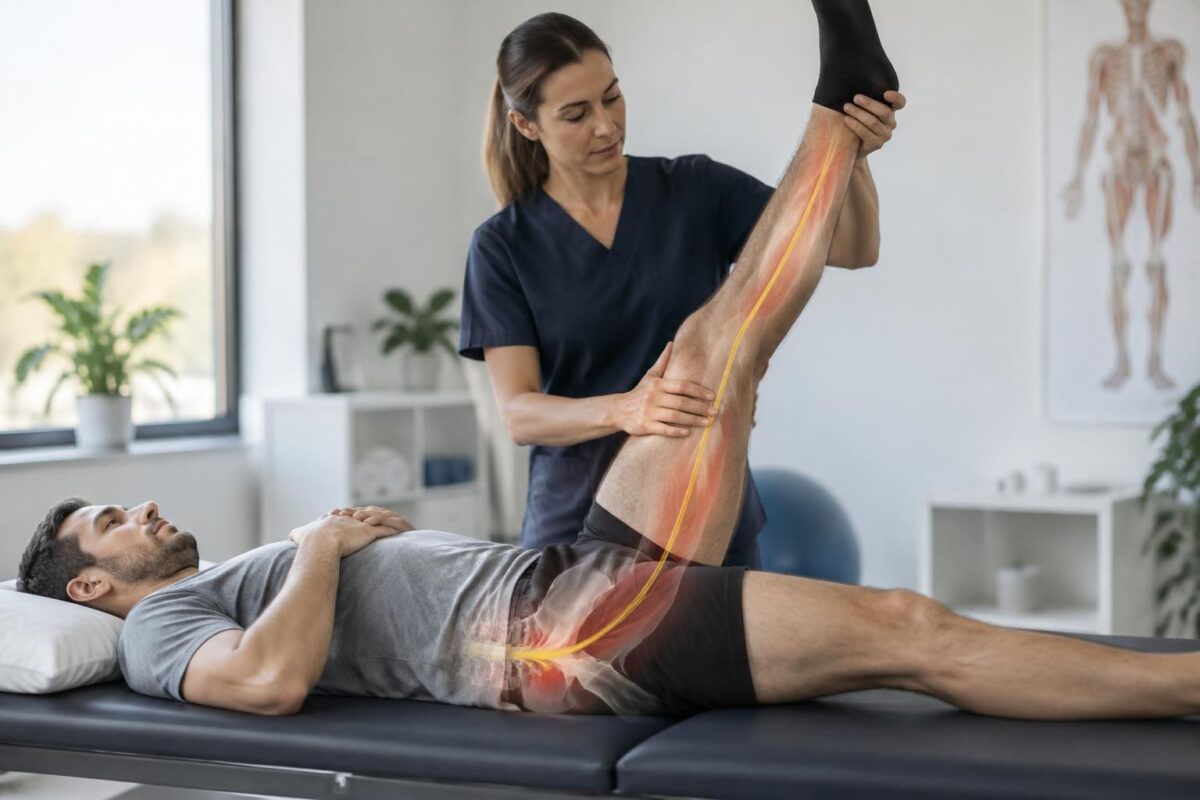
Sciatica and hamstring stretching: possible nerve tension
IN BRIEF Sciatica can make stretching the hamstrings uncomfortable, as the tension felt may come from the nerve rather than the muscle. A gentle stretch, with a straight back and without seeking maximum range, can help loosen the back of…
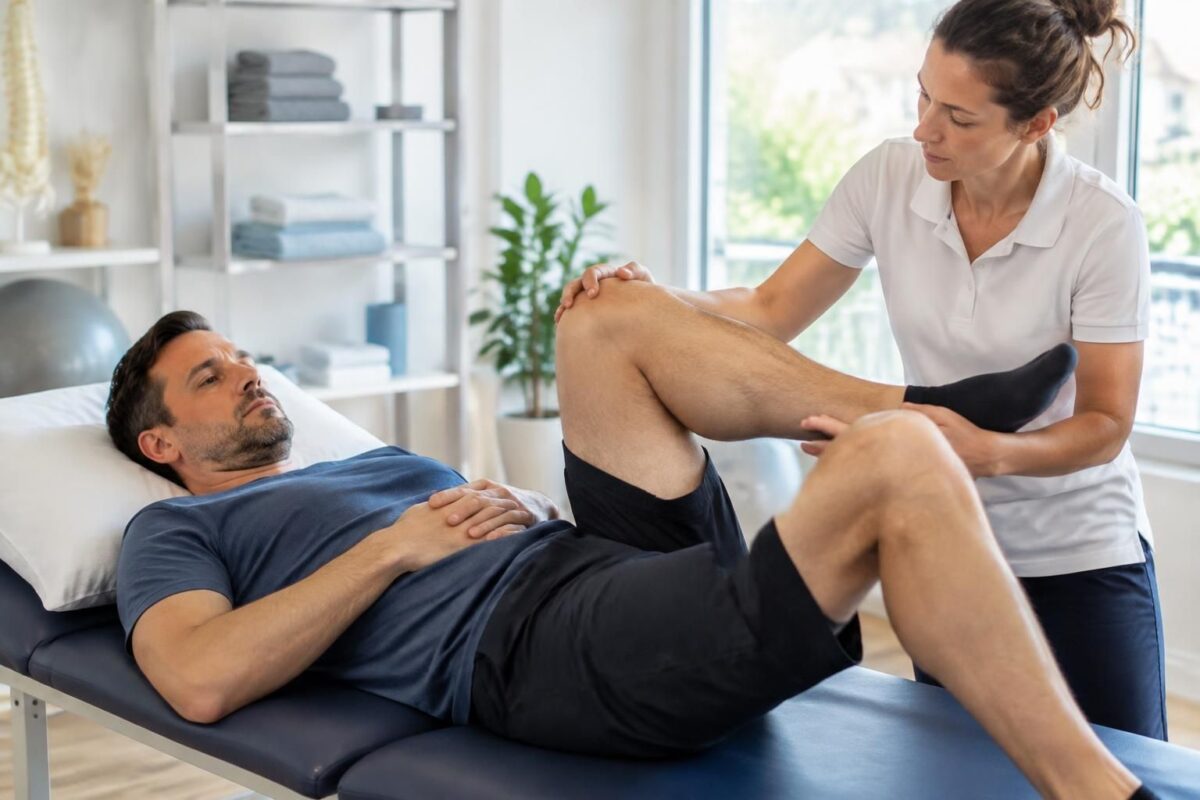
Sciatica and piriformis stretching: useful or worsening depending on the case
IN BRIEF Piriformis-related sciatica can cause deep pain in the buttock, sometimes radiating down the back of the thigh. A gentle stretch can loosen the hip and relieve discomfort if the muscle is involved, but it can worsen symptoms if…

Sciatica and popular stretches: why to stay cautious
IN BRIEF Sciatica causes pain that radiates from the lower back down the leg. Popular stretches, such as the pigeon pose or hamstring stretches, are not always suitable: pulling on an irritated nerve can worsen the symptoms. Favor gentle movements,…

Sciatica and Pilates: movements to adapt
IN SHORT Sciatica causes pain that can radiate from the lower back down to the leg. The Pilates Reformer can promote a gradual return to movement and strengthen core control, provided that the movements, range, and resistance are adapted. Favor…

Sciatica and core stability: variable tolerance depending on symptoms
IN BRIEF Core strengthening in case of sciatica consists of progressively strengthening the trunk muscles. Its tolerance varies depending on pain and symptoms: suitable without worsening the pain, it can support mobility and the resumption of activities, but does not,…

Sciatica and lunges: leg pain to watch out for
IN BRIEF Sciatica is pain that starts from the lower back or buttock and radiates down the leg. If a lunge triggers or worsens this pain, stop the movement and adjust your activity: this exercise does not address sciatica. Consult…

Sciatica and deadlifts: risk depending on the cause
IN BRIEF Sciatica and deadlifts are not always incompatible: the risk depends on the cause of the pain and its intensity. During acute episodes, it’s best to avoid heavy loads and seek medical or physiotherapy advice before resuming. A gradual…

Sciatica and squats: why caution is needed
IN BRIEF Sciatica does not always prohibit squats, but a deep or loaded squat can aggravate symptoms, especially during a flare-up. Gradually resume with a neutral back and a comfortable range of motion, and stop if the pain travels down…

Dr Sylvain Desforges, B.Sc., D.O., N.D., osteopath, is the founding president of TAGMED and of the ACMA association. He dedicates his practice to chronic spinal pain, low back pain and symptoms compatible with sciatica, particularly when pain radiates toward the buttock, leg, calf, foot or toes.
Through SOS Sciatique, he publishes educational content on sciatica symptoms, possible causes such as disc herniation, disc narrowing, foraminal stenosis or irritation of a lumbar nerve root, as well as non-surgical approaches that may be considered according to the evaluation. At Clinique TAGMED, care may include, depending on the case, motorized neurovertebral decompression, specific osteopathic care or precision percussion.
For an evaluation related to sciatica treatment in Montreal / Mount Royal or sciatica treatment in Terrebonne, please consult the services available at Clinique TAGMED.
Medical disclaimer
The information published on SOS Sciatique is provided for educational purposes only and does not replace a consultation, diagnosis, opinion or treatment provided by a physician or another authorized healthcare professional. The author of this article is neither a medical doctor nor a specialist in a medical specialty recognized by the Collège des médecins du Québec. The osteopathic, manual medicine or functional support approaches described on this site do not constitute medical acts and are not intended to replace medical follow-up.
Consult a physician or emergency service in cases of loss of bladder or bowel control, anesthesia in the saddle area, significant or progressive weakness in the leg or foot, fever, recent trauma, severe pain or rapid worsening of symptoms. For more details, please read our Legal Notice.