


Disc herniation and calf pain: possible nerve pathway
19/08/2026
Sciatica in Montreal: deep buttock pain and radiation in the thigh
20/08/2026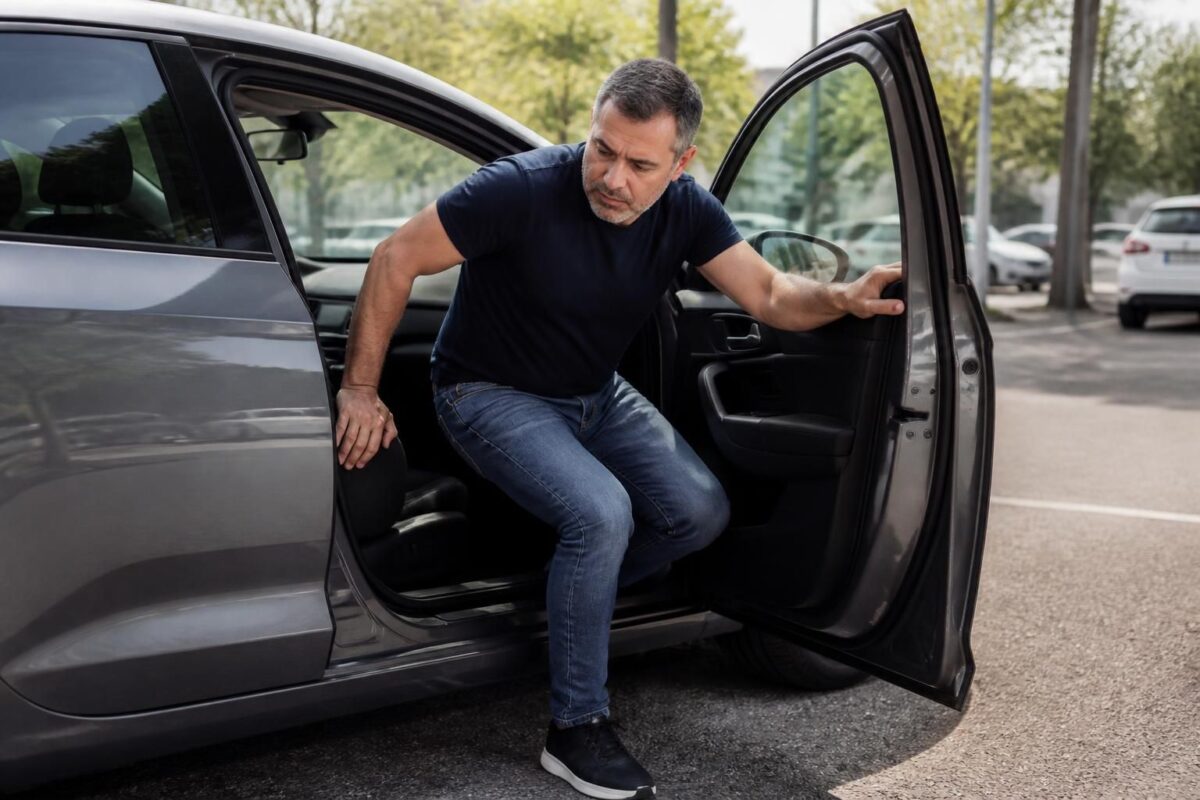
IN BRIEF
| In brief, managing sciatica when getting out of the car and the movements to monitor is a practical approach to limit pain. What is it? It is a set of gestures and postures that prevent pressure on the sciatic nerve and the coccyx when exiting the vehicle. What are the benefits? It reduces pain, improves stability, and increases comfort during trips. How does it work? Adopt an appropriate posture, relieve the coccyx, take regular breaks, and prioritize simple movements while stationary. Accessible in France, especially in Paris and Lyon, this guide easily integrates into daily commutes and long journeys. |
Quick summary on sciatica and the movements to monitor when getting out of the car to limit pain:
- Back straight and no twisting of the torso when tilting the pelvis.
- Get out of the seat by shifting your feet to the ground, then by pushing with your thighs to bring the pelvis forward.
- Avoid sudden movements and significant bending of the back.
- Prefer aids such as handles and, if possible, use an ergonomic cushion to relieve the coccyx and support the lower back.
- Take a break if pain occurs and exit gradually to check balance.
- Monitor warning signs: pain radiating down the leg, numbness or weakness; consult if persistent.
This article, written by a healthcare professional and expert, explains how to monitor movements when getting out of the car in the presence of sciatica. It specifies why certain gestures may worsen pain and provides simple, effective tips for exiting safely, minimizing pressure on the nerve, and preserving mobility. Reliable resources and clear guidelines help you adopt the right behaviors.
Sciatica can cause pain that follows the path of the sciatic nerve. The moment you go from sitting to standing after a trip can trigger or amplify this pain if the movements are not controlled. Three aspects must be monitored: posture, weight transfer, and torso rotation.
Preparing the transition: posture and safety
Before getting out, ensure that the position is stable. Keep your back straight, shoulders relaxed, and feet flat. Move the seat slightly forward to bring the hips close to the edge. Use your arms to push yourself out of the seat and engage the hips without twisting the back. A slight tilt of the hips and firm foot placement facilitate a smooth transition to an upright position.
Movements to monitor when transitioning to an upright position
Avoid sudden twists of the torso and rapid pivots of the body. Prefer rotating the feet and shifting the hips, followed by a gradual upright position. Keep the torso aligned with the spine and avoid projecting the head forward. If pain increases during exit, slow down and rest. A controlled transfer significantly reduces the activation of the lower back muscles and protects the nerve.
When signals require consultation
If the pain is intense, if the leg becomes heavy or numb, or if you lose strength, consult quickly. A professional can assess the origin and adapt advice to your situation. For reliable resources, see for example sossciatique.com and cliniquetagmed.com.
Role of aids and adaptations
A well-adjusted seat and appropriate lumbar support facilitate the transition. An ergonomic cushion can relieve the coccyx and improve pelvic stability during transfer. Reducing vibrations and limiting long journeys also help to minimize discomfort. To explore options, consult resources such as sossciatique.com, decompressionneurovertebrale.com, and sosherniediscale.com.
Additional resources
For further details, check these sites:
– sossciatique.com
– decompressionneurovertebrale.com
– sosherniediscale.com
– sosherniatedisc.com
– sostunnelcarpien.com
– cliniquetagmed.com
“Medical disclaimer: The information and advice provided on this site do not replace the advice, diagnosis, or treatment of a healthcare professional. Please note that Dr. Sylvain Desforges osteopath is neither a doctor of medicine nor a physician, and is not a specialist in any medical specialty as defined by the Collège des médecins du Québec. Manual medicine, functional medicine, and sports medicine as described on this site exclude any treatment or medical diagnosis made by a doctor or medical specialist. Always consult your physician for any medical questions. For more details, please read our full Legal Notice.”
Getting out of the car: movements to monitor
- Getting out with torso twisting: keep the torso and pelvis aligned.
- Raising the back: avoid bending or arching and favor a neutral position.
- Pivoting the body without turning the feet: rotate the entire body on the same axis.
- Pelvis moving forward too quickly: place the pelvis down gently and stabilize.
- First contact on the coccyx: limit pressure, prefer a slight cushion if necessary.
- Using arms to pull up: favor controlled movements rather than sudden gestures.
First steps after exit: movements to monitor
- First contact with the foot on the ground: no abrupt steps.
- Push from the hips during weight transfer: avoid a sudden lumbar push.
- Maintain knee-foot alignment: stable knee and aligned ankle.
- Breathing and relaxation of the shoulders: avoid tensions that pull on the nerve.
- Rotation of the pelvis while walking: limit repeated twists.
- Walk with a measured stride: reduce impact and stay balanced.

Clear summary: getting out of the car can trigger or worsen sciatica due to sitting position and vibrations. To get out without pain, favor a stable posture, controlled movements, pauses, and pelvic support. Simple exercises and a suitable ergonomic cushion can help relieve the coccyx and absorb shocks.
Preparing to Descend and Positioning
Before opening the door, adjust your seat to achieve an aligned torso and slightly bent knees. The backrest should be slightly reclined and provide sufficient lumbar support. Avoid overly soft seats that cause sinking of the pelvis. If necessary, add a back cushion or seat cushion to stabilize the lower back and limit tension in the lumbar region. Ensure you are at a comfortable distance from the steering wheel and can place your feet flat on the ground.

Sciatica and popular stretches: why to stay cautious
IN BRIEF Sciatica causes pain that radiates from the lower back down the leg. Popular stretches, such as the pigeon pose or hamstring stretches, are not always suitable: pulling on an irritated nerve can worsen the symptoms. Favor gentle movements,…

Sciatica and Pilates: movements to adapt
IN SHORT Sciatica causes pain that can radiate from the lower back down to the leg. The Pilates Reformer can promote a gradual return to movement and strengthen core control, provided that the movements, range, and resistance are adapted. Favor…
Movements to Favor When Exiting
Gradual and Controlled Descent
Place your hands on the seat, slightly tilt the torso forward, bend your knees and bring your feet near the edge of the seat. Then push with your thighs to stand up, keeping your back straight and your gaze directed forward. Avoid abrupt movements or sudden pain triggers; the goal is a controlled and smooth exit.
Avoid Risky Gestures
Avoid leaning sharply forward, suddenly twisting the torso, or lifting heavy loads when descending. Don’t try to get up by locking the spine; favor slow and conscious movements. If pain occurs, stabilize yourself and reevaluate your position before proceeding.

Sciatica and core stability: variable tolerance depending on symptoms
IN BRIEF Core strengthening in case of sciatica consists of progressively strengthening the trunk muscles. Its tolerance varies depending on pain and symptoms: suitable without worsening the pain, it can support mobility and the resumption of activities, but does not,…

Sciatica and lunges: leg pain to watch out for
IN BRIEF Sciatica is pain that starts from the lower back or buttock and radiates down the leg. If a lunge triggers or worsens this pain, stop the movement and adjust your activity: this exercise does not address sciatica. Consult…
After Exiting: Movements and Pain Management
Once standing, walk a few steps to reactivate circulation and allow your body to adjust. Then perform gentle stretches of the back and hips and make small movements of the ankles and knees to promote mobility. Plan for regular breaks during long trips, and when repositioning yourself, favor support that maintains a good lumbar curve and relieves the coccyx.

Sciatica and deadlifts: risk depending on the cause
IN BRIEF Sciatica and deadlifts are not always incompatible: the risk depends on the cause of the pain and its intensity. During acute episodes, it’s best to avoid heavy loads and seek medical or physiotherapy advice before resuming. A gradual…

Sciatica and squats: why caution is needed
IN BRIEF Sciatica does not always prohibit squats, but a deep or loaded squat can aggravate symptoms, especially during a flare-up. Gradually resume with a neutral back and a comfortable range of motion, and stop if the pain travels down…
Equipment and Practical Tips
To facilitate exits and breaks, favor an ergonomic cushion, firm and designed to relieve the coccyx while absorbing road vibrations. The Ergoccyx Vehicles model illustrates this approach: combining high-resilience foam with high-viscosity fluid technology, it distributes pressure and limits pain peaks during movements following the exit from the vehicle. Use it in any type of vehicle to optimize comfort and reduce tension on the sciatic nerve during daily commutes.
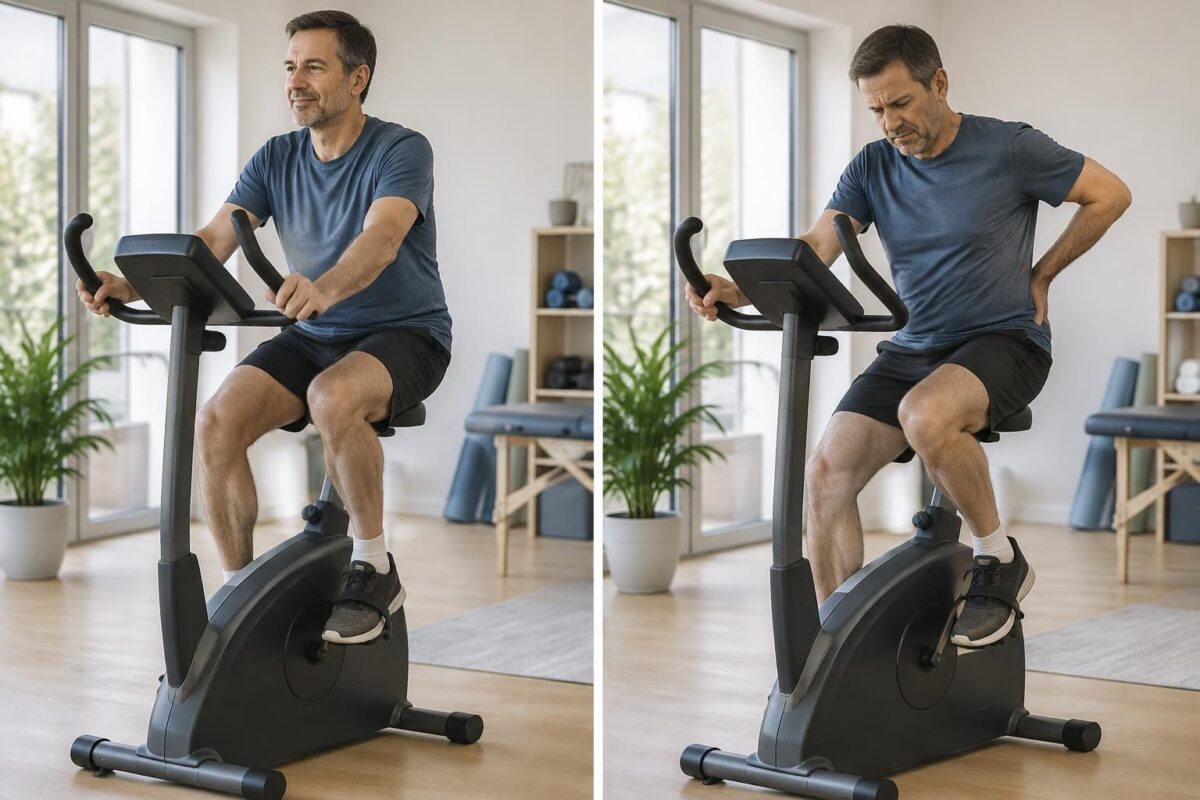
Sciatica and stationary bike: useful or aggravating depending on the case
IN BRIEF The stationary bike with sciatica can help you stay active if the pain is mild and stable. Start with a short session, at low resistance and in a comfortable position. If the pain goes further down the leg,…

Sciatica and cycling: sitting, bending, and symptoms
IN BRIEF Sciatica is pain related to irritation of the sciatic nerve, which can extend from the buttock down to the leg. Cycling may sometimes be possible if symptoms are mild and stable: a comfortable seat, a less bent posture,…
Sciatica and Getting Out of the Car: Movements to Watch
| Movement to Watch | Quick Tip |
|---|---|
| Torso rotation when getting out | Twisting: turn the torso and feet simultaneously and keep the shoulders aligned with the pelvis. |
| Bending the torso when exiting | Excessive bending: stay upright against the backrest and use the hips to exit. |
| Bending knees when getting out | Bend your knees to ~90° and push with your feet to exit without straining the lower back. |
| Arm support on the edge | Use your arms and the edge of the seat to stabilize without twisting the back. |
| Harsh pivot or turn | Prefer a turn and gradual repositioning of the feet rather than an abrupt pivot. |
| Torso twists | Avoid torso twists: keep the torso and hips in line during movement. |
| Lumbar support | A lumbar support or cushion can help maintain alignment during exit. |
| Uneven terrain | On uneven terrain, look for a stable support and avoid complex side steps. |
| Breathing and pauses | Breathe deeply and take pauses; exhale during movement to relax the muscles. |
Testimonials: Sciatica and Getting Out of the Car — Movements to Watch
Marie, 41 years old: After several trips, my Sciatica especially flares up when I’m getting out of the car. The movement to watch is torso rotation when I get up. I stay well-supported against the backrest and use my thighs to push, which helps avoid straining my back. The ergonomic cushion relieves the coccyx and makes the exit smoother.
Julien, 34 years old: On longer trips, the movement to watch is bending my back when exiting. I gently straighten up, keeping my shoulders aligned with my pelvis, then I move my feet forward and get out without abruptly twisting my torso. The cushion and slow breathing help minimize pain.
Fatima, 52 years old: Getting out of the car after a long trip can trigger lower back pain. The movement to watch is a too-impulsive pelvic rotation. I favor a controlled exit, keeping my back straight, and I use a coccyx relief cushion to limit pressure on the coccyx and sacrum.
Omar, 61 years old: I take breaks and do small mobility exercises during stops. The movement to watch is pelvic twisting during exit; I make sure to align myself correctly and avoid abrupt gestures. These simple habits have made getting out of the car much easier when pain flares up.
Dr. Sylvain Desforges embodies the alliance between osteopathy, naturopathy, and manual medicine, and he is one of the driving forces behind innovation in healthcare. Founding president of TAGMED clinics and the ACMA network, he has dedicated his career to understanding and treating chronic pain with an approach that combines scientific rigor and practical know-how. His perspective on sciatica goes well beyond the symptoms: he is interested in mobility and the safety of everyday movements, particularly when getting in and out of a car.
In his work, he emphasizes how the body reacts when one gets out of the car and the body transitions from a static position to an upright, mobile activity. For him, the key lies in reducing mechanical stress on the lumbar spine and the sciatic nerve while promoting a smooth and controlled transition. This perspective is supported by a comprehensive pain management approach and the integration of advanced technologies aimed at restoring more regular nerve and musculoskeletal function.
His approach relies on a precise assessment of the factors that trigger or exacerbate pain during movement: prolonged sitting posture, seat adjustments, and road shocks. He advocates for simple yet effective adjustments even before starting: ensuring an appropriate distance between the torso and thighs, favoring stable lumbar support, and, if necessary, using ergonomic accessories to relieve pressure on the coccyx. This preparation helps avoid muscle compensations that can trigger or amplify symptoms when standing up after the journey.
When getting out of the car, his approach prioritizes gradual transitions: standing up slowly, maintaining back support, and taking short walks or performing gentle stretches to get the joints and muscles moving without jolting the back. He also emphasizes controlled movements of the legs and feet when driving allows, to promote circulation and reduce stiffness that often accompanies parking and exiting. The goal is to transform this moment into a controlled step to prevent irritation of the sciatic nerve.
Desforges emphasizes that treating sciatica involves a multidisciplinary approach and evidence-based techniques. He integrates protocols that combine manual methods with technologies such as spinal decompression, laser, and shockwave therapies when indicated, to reduce tension, promote healing, and improve posture during transitions between sitting and standing. His commitment is to provide personalized care that optimizes the health and well-being of each individual while offering practical advice for daily life, such as movements to watch out for when getting out of a vehicle after a trip.
With a sustainable focus on evidence and tailoring treatments to individual needs, Dr. Desforges strives to make every journey less painful and every movement safer. His work aims to free patients from the limitations imposed by pain and to provide them with the tools to regain control over their car exits and daily movements.
This text focuses on how to get out of the car when sciatica and lower back pain may occur, emphasizing the movements to watch for and the simple gestures that preserve posture and relieve the coccyx. The goal is to exit smoothly, avoid twisting, and use appropriate supports to limit tension while considering ergonomic solutions tailored to each vehicle.
Movements to Watch When Exiting the Car
Before standing up, ensure that your sciatica remains aligned with the spine and that your back is well supported by the seatback. Breathe slowly and avoid sudden movements that trigger pain when transitioning from sitting to standing.
Place your feet flat on the ground and use your arms to gently push on your thighs to get into a standing position. This movement supports the pelvis and reduces pressure on the coccyx and lower back, promoting a more stable transition.
Avoid excessive twisting of the trunk: perform a gentle rotation of the torso and hips in the same direction, and then move one foot out of the vehicle at a time. Exiting in three stages, rather than turning abruptly, protects the discs and muscles.
Use temporary support points when necessary (armrests, seat edges, or a hand on the car door frame). A lumbar support and a seat cushion can help maintain a natural lumbar curve and relieve the coccyx during the transition.
If the journey has been long, plan a micro-pause outside the vehicle to do some gentle stretches of the legs and back. This prepares for the transition to walking and avoids a sudden onset of pain with the first steps.
When exiting, prioritize controlled movements of the legs and feet once outside while keeping your back straight and shoulders relaxed. Simple exercises done while stationary can promote circulation and limit post-traumatic stiffness.
To facilitate these transitions, an appropriate ergonomic cushion can be useful. The Ergoccyx Vehicles is designed to relieve the coccyx, absorb shocks, and support the pelvis during exits and stops, greatly improving comfort during the first steps after the journey.
To exit smoothly and preserve posture, favor slow gestures, stable support, and regular pauses, integrating these elements each time you take the vehicle.
To delve deeper into these gestures and understand the mechanisms between sciatica and driving, you can consult the following resources that discuss the link between pain and movements when getting out of the car: Santé Magazine, Vertebre, Soulager le Dos, Lombafit, and other practical resources like Sos Sciatique.
Other useful references to explore based on your situation include articles on interpreting calf pain associated with sciatica and tips for avoiding irritation during trips, available on websites dedicated to low back pain and sciatica: Calf and sciatica in Montreal, Calf and sciatica in Terrebonne, Sciatica in one leg in Montreal, and InPhysio – Relief from sciatica pain while driving.

Dr Sylvain Desforges, B.Sc., D.O., N.D., osteopath, is the founding president of TAGMED and of the ACMA association. He dedicates his practice to chronic spinal pain, low back pain and symptoms compatible with sciatica, particularly when pain radiates toward the buttock, leg, calf, foot or toes.
Through SOS Sciatique, he publishes educational content on sciatica symptoms, possible causes such as disc herniation, disc narrowing, foraminal stenosis or irritation of a lumbar nerve root, as well as non-surgical approaches that may be considered according to the evaluation. At Clinique TAGMED, care may include, depending on the case, motorized neurovertebral decompression, specific osteopathic care or precision percussion.
For an evaluation related to sciatica treatment in Montreal / Mount Royal or sciatica treatment in Terrebonne, please consult the services available at Clinique TAGMED.
Medical disclaimer
The information published on SOS Sciatique is provided for educational purposes only and does not replace a consultation, diagnosis, opinion or treatment provided by a physician or another authorized healthcare professional. The author of this article is neither a medical doctor nor a specialist in a medical specialty recognized by the Collège des médecins du Québec. The osteopathic, manual medicine or functional support approaches described on this site do not constitute medical acts and are not intended to replace medical follow-up.
Consult a physician or emergency service in cases of loss of bladder or bowel control, anesthesia in the saddle area, significant or progressive weakness in the leg or foot, fever, recent trauma, severe pain or rapid worsening of symptoms. For more details, please read our Legal Notice.


