Sciatica and permanent numbness: sign to watch for
19/08/2026
Sciatica and getting out of the car: movement to watch out for
19/08/2026
IN BRIEF
| In short, a herniated disc can cause calf pain when the nerve root is irritated, with a typical nerve pathway of the sciatic nerve running from the back down to the calf and foot. This pain reflects the neurogenic irritation rather than local pain and can vary based on the location of the hernia. The main advantages of understanding this pathway are: better recognition of signs, guiding the choice between conservative approaches (osteopathy, physiotherapy) and preventing recurrences, and promoting appropriate rehabilitation to reduce pain and regain mobility. Accessible and useful for those experiencing pain radiating to the calf, this content explains the link between herniated disc, nerve pathway, and symptoms to establish effective management without necessarily resorting to surgery. |
A herniated disc can cause radiating pain in the calf when the disc compresses a nerve root of the sciatic nerve.
The typical pathway starts from the lower back (L5-S1 or L4-L5) and follows the sciatic nerve: buttock, back of the leg, and may then descend to the calf, foot, and toes.
Associated signs may include tingling or weakness in the leg; for an accurate diagnosis and an appropriate treatment plan, do not hesitate to consult a specialist.
This document presents, from a clinical and practical perspective, how a herniated disc can cause pain radiating up to the calf. It describes the possible pathways of the involved nerves, the signs to monitor, evaluation methods, and preferred management options in our practice to clarify the care pathway without systematically resorting to stretches or inappropriate prescriptions.
Nerve Pathway Involved
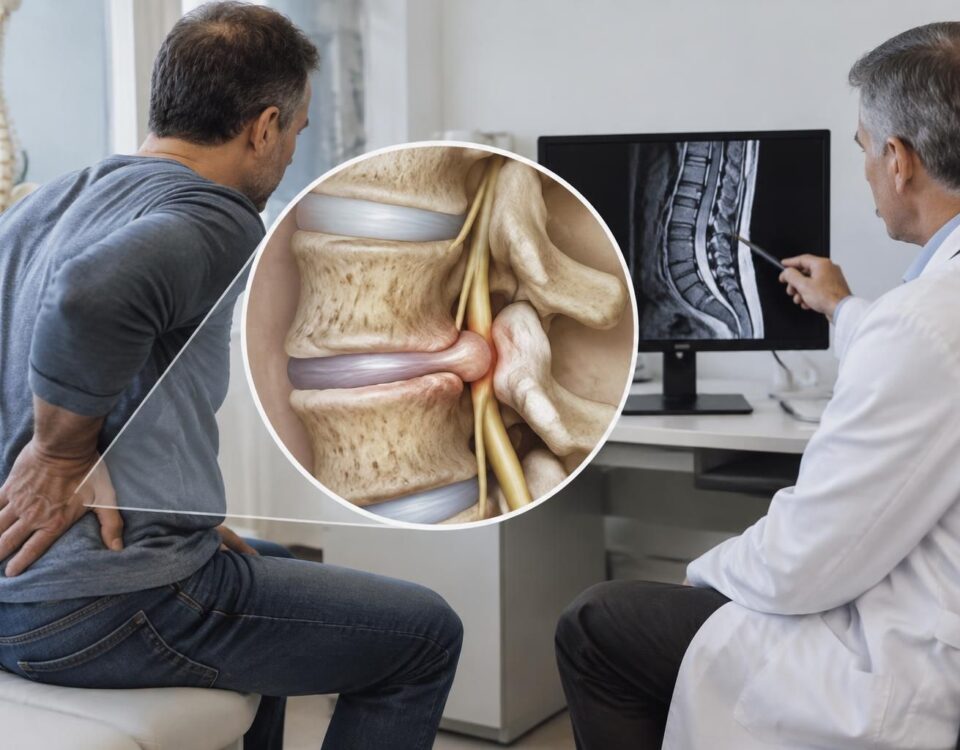
Pain that descends to the calf may follow the pathway of the sciatic nerve, which originates from the lumbar roots. A root compression or inflammation may affect the L4-L5 or L5-S1 roots, producing pain that migrates along the posterior or lateral aspect of the leg and may reach the calf and foot. The precise pathway depends on the affected root. For example, L5-S1 involvement may cause pain that radiates to the buttock and then along the outer edge of the leg to the big toe, while L4-L5 involvement may affect the posterolateral area and the back of the foot. In some cases, pain may be present on both sides or target exclusively one limb when the hernia is foraminal or extra-foraminal.
Typical Symptoms and Signs to Monitor
The symptoms reflect the location of the affected nerve. One may observe pain radiating down the leg, sensations of tingling or prickling, and sometimes weakness in walking or foot dorsiflexion. The pain may be more pronounced during movement, coughing, or prolonged sitting, and it may persist even at rest. A loss of strength or difficulty in raising the foot are indicators that require prompt medical evaluation.
Evaluation and Imaging
In the face of pain that descends to the calf, MRI is the key examination to confirm a herniated disc and specify the root involvement. Clinical evaluation aims to locate the involved root and exclude other causes. In certain cases, additional tests may be considered to guide multidisciplinary treatment. For more in-depth information on this topic, you can consult specialized resources on radicular pain and sciatica.
Causes and Risk Factors
The causes of herniated discs often fall within a mechanical and degenerative framework. Age, repetitive loads, rotational movements, and weight gain increase the risk of weakening the intervertebral disc. Joint blockages or muscle tensions can also promote localized stress areas on the disc.
Management and Therapeutic Options
Management relies on a multimodal approach, tailored to each patient. The preferred options in our network and at the TAGMED Clinic include neurovertebral decompression when indicated, alongside specific osteopathic techniques aimed at relieving tensions and optimizing spinal mobility. Medications and injections may be considered based on the inflammatory scope and clinical response. In some cases, a specialized consultation may be proposed to coordinate interventions between osteopathy, decompression, and other non-surgical approaches. For additional information about these approaches, consult the following resources: Neurovertebral decompression and its applications, and the pages dedicated to osteopathy and sciatica.
To learn more about options and care pathways, you can consult the following resources:
neurovertebral decompression,
TAGMED Clinic,
and specialized resources on sciatica and pain radiating down the leg. For specific insights on pain and the nerve pathway, you can also refer to targeted articles on the fields of herniated disc and sciatica and herniated disc L5-S1 and radicular pain.
Management does not necessarily involve exercises or stretches proposed outside a suitable framework. In relevant cases, a specialized evaluation helps determine the best approach, including the possibility of options such as decompression and appropriate osteopathic care. For management in Montreal or Terrebonne, you can turn to TAGMED services.
When to Consult and Emergency
Consult quickly if you notice a clear loss of strength, rapidly progressing pain, extremely intense pain, or signs of significant neurological deficit such as an inability to walk on tiptoes or persistent tingling in the calf or foot. Signs of sudden worsening or motor deficit warrant urgent medical evaluation.
For more information and similar cases, see the resources dedicated to sciatica and neurovertebral decompression on the referenced sites above.
Medical Disclaimer: The information and advice provided on this site do not replace the opinion, diagnosis, or treatment of a healthcare professional. Please note that Dr. Sylvain Desforges, osteopath, is neither a doctor of medicine nor a physician, and is not a specialist in a medical specialty as defined by the Collège des médecins du Québec. Manual medicine, functional medicine, and sports medicine as described on this site exclude any medical treatment or diagnosis made by a physician or specialist. Always consult your physician regarding any medical questions. For more details, please read our full Legal Notice.
About the Author
Dr. Sylvain Desforges, B.Sc., D.O., N.D., osteopath, is the founding president of
TAGMED
and the ACMA association. He dedicates his practice to chronic pain of the spine, lower back pain, and pain consistent with sciatica, particularly when the pain radiates down to the buttock, leg, calf, foot, or toes.
Through SOS Sciatique, he publishes educational content on the symptoms of sciatica, possible causes such as herniated disc, disc compression, foraminal stenosis, or irritation of a lumbar nerve root, as well as non-surgical approaches that may be considered based on the assessment. At the TAGMED Clinic, care may include, depending on the case, motorized neurovertebral decompression, specific osteopathy, or a precision impactor.
For an evaluation related to sciatica treatment in Montreal / Mont-Royal or sciatica treatment in Terrebonne, consult the available services at the TAGMED Clinic.
Medical Warning
The information published on SOS Sciatique is provided for educational purposes and does not replace a consultation, diagnosis, opinion, or treatment performed by a physician or another authorized healthcare professional. The author of this article is neither a doctor nor a specialist in a medical specialty recognized by the Collège des médecins du Québec. The osteopathy, manual medicine, or functional support approaches described on this site do not constitute medical acts and are not intended to replace medical follow-up.
Consult a doctor or emergency service in case of loss of bowel or bladder control, numbness in the saddle area, significant or progressive weakness of the leg or foot, fever, recent trauma, severe pain, or rapid worsening. For more details, please read our Legal Notice.
- Typical lumbar disc herniation at L5‑S1 or L4‑L5.
- Involved roots: S1 and/or L5.
- Pathway: from the spine via the sciatic nerve to the calf (and sometimes the foot).
- Radiating pain: buttock → back of the leg → calf.
- Signs: paresthesia, weakness in walking or foot extension.
- Location by segment: L5‑S1 → outer edge of the foot; L4‑L5 → back/outside of the foot and big toe.
- Evaluation: MRI imaging to confirm the path and inflammation.
- Management: osteopathy and physiotherapy with targeted exercises.
- Complementary options: injections if acute inflammation; prevention and strengthening.
- Emergencies: marked loss of strength, gait alteration, resting pain that progresses.

A hernia disc can cause pain radiating to the calf, due to the complex pathway of the sciatic nerve and its lumbar roots. This article presents the possible nerve path, signs to watch for, the role of imaging, and management options to relieve pain and preserve function.
Nerve Pathway and Implications for the Calf
The sciatic nerve originates at the lumbar roots, primarily L5 and S1, and descends along the back of the thigh. It can be irritated or compressed by a herniated disc in the lumbar discs, particularly between L4-L5 or L5-S1. This irritation can spread along the nerve pathway and manifest as pain that travels up to the buttock, then progresses along the posterior or lateral part of the leg and reaches the calf, heel, or toes. Depending on the involved root (L5 or S1), the painful areas and motor difficulties may vary. Irritation of L5 may affect the forefoot and big toe, while S1 is more associated with the heel and sole of the foot.
Symptoms and Variations by Location
The symptoms of a calf pain related to a herniated disc depend on the nerve compression and associated inflammation. They may include:
– Pain radiating from the lower back or buttock to the calf, sometimes persistent and more pronounced at the end of the day.
– Tingling or electric shocks in the calf, heel, or toes when the nerve is stimulated by movements or exertion.
– Muscular weakness related to nerve root involvement, which may manifest as difficulty lifting the foot or walking on the heels, or feeling a loss of strength in the toes.
– Pain worsened by coughing, sneezing, or during exertion, and sometimes nocturnal pain that does not subside at rest.
Diagnosis and Vigilance
In the presence of a combination of back pain, pain radiating to the calf, and signs of weakness, it is essential to seek an appropriate medical evaluation. Magnetic resonance imaging (MRI) is the examination of choice to confirm the presence of a herniated disc and specify the affected nerve roots. A precise diagnosis then guides the management and avoids inappropriate manipulations that could worsen symptoms.
Management Options and Care Pathway
Non-surgical Approaches and Osteopathy
The initial management favors conservative approaches aimed at reducing inflammation and restoring mobility. Manual treatments, including osteopathy, can help locally decompress the structures and improve the mobility of the affected vertebral segments. Targeted exercises and a physiotherapy program are recommended to strengthen deep muscles and stabilize the spine, while avoiding movements that exacerbate pain.
Gentle stretches may be offered during the acute phase to reduce pressure on the nerve and promote return to function. An adapted rehabilitation focused on core stability, elongation of muscle chains, and motor control helps limit recurrences and improve walking and endurance.
Exercises and MDT Approach
Structured exercises, derived from mechanical diagnostic and therapy methods, allow for precise targeting of problematic areas. The goals include reducing tension on the roots, improving range of motion, and daily postural correction to lessen strain on the discs.
When to Consider Surgery and Prevention
Surgery is considered after the failure of conservative treatments or in the presence of significant neurological deficits. Current options aim to quickly detect situations requiring decompression and to optimize recovery through appropriate rehabilitation. Meanwhile, preventive measures—maintaining a healthy weight, regular adapted physical activity, and correct posture—reduce the risk of recurrence and the appearance of new hernias.
| Aspect | Concise Description |
|---|---|
| Affected Nerve Pathway | L4-L5/L5-S1 compressed by a herniated disc, the pathway follows the sciatic nerve to the calf and foot. |
| Pain Transmission | Pain radiating from the spine to the calf and sometimes the heel depending on the level. |
| Motor Signs | Possible weakness in dorsiflexion or plantar flexion and altered gait depending on the level. |
| Associated Areas | Pain may radiate to the lower back or down to the calf and foot depending on L5-S1 or S1. |
| Diagnosis | The MRI confirms the level and nerve compression. |
| Non-surgical Approaches | Osteopathy and physiotherapy emphasize stretching and strengthening; avoid rotational manipulations if the disc is fragile. |
| Foraminal Differentiation | Foraminal or extra-foraminal hernia may impact a single limb; central or para-central may be bilateral. |
| Emergency Signs | Loss of urinary control, rapid weakness, severe pain, or significant neurological issues require immediate medical evaluation. |
Testimonials on Herniated Disc and Calf Pain: Possible Nerve Pathway
My name is Julie, and I experienced a herniated disc that triggered unbearable pain in my calf. The pathway of the sciatic nerve started from my lower back, went down through my buttock, and then along the back of my leg to my calf and sometimes to my foot. This radiating pain prevented me from walking and disrupted my sleep. After a thorough evaluation, the osteopath targeted the nerve pathway and offered gentle techniques to decompress the nerve, accompanied by exercises to do at home. Gradually, the symptoms diminished, and I regained my daily activities.
My name is Marc, and I had pain that started from my lower back and radiated into my calf, the nerve pathway preventing me from walking normally. The diagnosis became clear after the evaluation: lumbar herniated disc with involvement of the sciatic nerve. The osteopathic approach was adapted to decompress the nerve pathway and relieve the tensions around the nerve. Within a few weeks, the calf pain decreased and walking became natural again.
Karine, 41 years old, describes pain starting from the back and moving up the thigh to the calf and foot, following the pathway of the sciatic nerve. The context seemed to indicate a lumbar herniated disc affecting a nerve root. Thanks to osteopathic care focused on the nerve pathway and targeted exercises, the calf pain gradually eased and mobility was restored.
Émile, 63 years old, shares an experience of pain extending from the lower back to the calf and heel, reflecting a typical nerve pathway of the sciatic nerve. The diagnosis was confirmed by the evaluation, and the management favored local decompression techniques and joint mobilization, avoiding rotational manipulations. After a few weeks, night pain and walking limitations significantly decreased, and the calf regained tone.
Camille, 33 years old, explains that the pain first appeared at the lumbar level and then followed the nerve pathway to the calf and the arch of the foot, with shocks that depended on movements and efforts. The narrative of herniated disc and the pathway of the sciatic nerve explained the radiations. The osteopathic approach, combined with adapted exercises, helped decrease the intensity of the pain in the calf and gradually resume daily activities without resorting to heavy treatments.
Herniated Disc and Calf Pain: Possible Nerve Pathway — Biography of a Specialist
Dr Sylvain Desforges, osteopath, expert in osteopathy, naturopathy, and manual medicine, is the founding president of TAGMED clinics and the ACMA association. At 59 years old, he dedicates his practice to the evaluation and treatment of chronic spinal pain, emphasizing approaches that are adapted and based on the best available evidence. His commitment lies in comprehensive care that combines manual skills, advanced technologies, and prevention to optimize his patients’ quality of life.
In his journey, he pays particular attention to the herniated disc and the pain that can radiate down to the calf. This condition results from a displacement or degeneration of the intervertebral disc and can cause nerve compression that leads to pain radiating along the nerve pathway. Dr. Desforges’s clinical narrative relies on a precise understanding of the nerve pathway involved, especially when the disc is located in the lower lumbar segments. He explains that the pain can follow the sciatic nerve, starting from the lumbar segment and descending through the buttock, thigh, calf, and down to the foot, with variations depending on the affected roots.
In practice, he distinguishes the different potential routes of the nerve affected by the hernia. An injury at the L5-S1 level can radiate to the buttock and the posterior side of the leg down to the heel and toes, while an L4-L5 injury can affect the back of the thigh and the top of the foot. Dr. Desforges emphasizes that symptoms can be permanent or episodic and are often associated with signs such as nighttime pain, muscle weakness, or difficulty lifting the foot. This approach allows for a personalized treatment plan that targets inflammation control and gradual movement recovery.
To diagnose accurately and avoid inappropriate manipulations, he favors a pathway that incorporates rigorous clinical evaluations and imaging tools when necessary. As part of his approach, he promotes manual therapies and structured exercise programs as the first line, aiming to strengthen stabilizing muscles, improve mobility, and reduce pressure on the disc. He explains that, depending on the location and severity, complementary options such as injections or tailored rehabilitation strategies may be considered, while remaining vigilant about surgical indications and the timing of intervention.
Dr. Desforges’s expertise goes far beyond acute relief. He integrates advanced technologies, such as motorized spinal decompression, laser, and shock wave therapies, into a multidisciplinary approach. These tools aim to enhance disc dysfunction, promote functional recovery, and prevent recurrences. The goal is clear: to provide care based on evidence and tailored to each profile, particularly when pain affects the calf and limits walking or daily activities. By combining manual techniques, rehabilitation, and technologies, Dr. Desforges offers a personalized path to regain mobility and well-being.
Through his network and integrated approach, he emphasizes the importance of understanding the nerve pathway and the inflammatory mechanisms underlying the herniated disc. For patients facing pain radiating to the calf, he proposes a gradual, secure, and tailored approach to provide lasting relief and restore function. His goal remains to guide everyone toward a return to activities with confidence, thanks to close collaboration between manual therapies, targeted exercises, and innovative technologies.
This summary highlights the link between a herniated disc and calf pain, describing how the pathway of the sciatic nerve can be disrupted and lead to radiation down to the calf, even to the foot. It specifies the lumbar locations most concerned (L4-L5 and L5-S1), the mechanisms of nerve irritation, clinical signs, the role of imaging, and treatment options, with a focus on appropriate and progressive care.
The nerve pathway of the sciatic nerve is key to understanding why calf pain can accompany a herniated disc. When a protusion or degeneration affects a lumbar root, inflammation and compression can spread along the nerve pathway down to the calf and foot, with typical manifestations such as electric shocks, tingling, and potential muscle weakness. The locations most frequently associated with this symptomatology pertain to the L5-S1 and L4-L5 levels, but the pathway can vary depending on the root specifically affected (for example, S1 for the calf and heel, or L5 for the top of the foot and toes).
To confirm the discal origin and rule out other causes, MRI remains the reference examination before any manipulation. An accurate diagnosis allows for the differentiation of central, foraminal, or extraforaminal forms and anticipates the optimal therapeutic pathway. In case of doubt or curtain symptoms (intense pain, loss of strength, urinary disorders), rapid medical intervention is essential.
The comprehensive management often combines non-surgical approaches and targeted measures for decompression and rehabilitation. Manual therapies, especially osteopathy, can serve as an effective first line to relieve symptoms and restore mobility while avoiding rotatory manipulations when the disc is fragile. Specialized exercises and trunk strengthening work help stabilize the spine and prevent recurrences, prioritizing appropriate stretching and progressive physiotherapy sessions.
Additionally, options such as anti-inflammatory injections can provide rapid relief but do not address the cause and should be combined with a rehabilitation program to limit recurrences. The goal remains a sustainable reduction of pain and functional improvement, allowing for the resumption of daily activities without pain and limitations.
To deepen your understanding of the pathways and treatment options, you can consult the following resources, which particularly address the nerve pathway and associated manifestations:
Sciatica: nerve pathway and tingling
Lumbar herniated disc – Institut Du Rachis
Symptoms and complications of herniated discs – Vidal
Calf pain of possible nerve origin
Nerve pathway and healing of sciatica
Sciatica without herniated disc
Neuro-vertebral decompression and chronic disc herniations
Sciatica in Terrebonne: pain that goes down below the knee
Sciatica: hernia, stenosis or nerve irritation
Disc protrusion and disc pinching: combined mechanisms
IN BRIEF A disc protrusion is a bulging of the disc, while a disc narrowing refers to a decrease in its height. These changes can coexist and sometimes irritate a nerve root, leading to pain or radiation, but they can…

Disc herniation and associated foraminal stenosis
IN BRIEF A disc protrusion associated with foraminal stenosis occurs when a bulging disc coexists with a narrowing of the opening through which a nerve root passes. This association can lead to lower back pain radiating into the leg, tingling,…

Spinal disc protrusion and nerve inflammation
IN BRIEF A disc protrusion is a bulging of the disc that can irritate or compress a nerve, without necessarily causing symptoms. When it leads to nerve inflammation, it can cause pain in the back or neck, sometimes accompanied by…

Disc protrusion and irritation of L5
IN SHORT A disc protrusion is a bulging of the disc that can irritate the L5 root and cause lower back pain radiating to the buttock, leg, or foot, sometimes with tingling or weakness. MRI alone is not sufficient to…

Disc protrusion and pain after twisting the back
IN BRIEF A disc protrusion is a bulging of the disc that can contribute to pain after a back twist, but it alone does not confirm the cause. The pain can remain in the lower back or radiate to the…

Disc herniation and pain after lifting
IN BRIEF A disc protrusion is a bulging of a disc between the vertebrae. Pain that appears after lifting a load does not prove that it is the cause: the MRI must be interpreted alongside the symptoms and the clinical…

Disc herniation and lumbar flexion: why caution is necessary
IN BRIEF A disc protrusion is a bulge of the intervertebral disc, which can be silent or irritate a nerve. Lumbar flexion is not necessarily dangerous but can worsen symptoms in some individuals. Adapting movements, avoiding those that aggravate pain,…

Disc herniation and pain that worsens in the car
IN BRIEF A disc protrusion is a bulging of a disc that can irritate a nerve. In a car, prolonged sitting and vibrations can exacerbate back, buttock, leg, or arm pain. Regular breaks, an adapted posture, and personalized management can…

Dr Sylvain Desforges, B.Sc., D.O., N.D., osteopath, is the founding president of TAGMED and of the ACMA association. He dedicates his practice to chronic spinal pain, low back pain and symptoms compatible with sciatica, particularly when pain radiates toward the buttock, leg, calf, foot or toes.
Through SOS Sciatique, he publishes educational content on sciatica symptoms, possible causes such as disc herniation, disc narrowing, foraminal stenosis or irritation of a lumbar nerve root, as well as non-surgical approaches that may be considered according to the evaluation. At Clinique TAGMED, care may include, depending on the case, motorized neurovertebral decompression, specific osteopathic care or precision percussion.
For an evaluation related to sciatica treatment in Montreal / Mount Royal or sciatica treatment in Terrebonne, please consult the services available at Clinique TAGMED.
Medical disclaimer
The information published on SOS Sciatique is provided for educational purposes only and does not replace a consultation, diagnosis, opinion or treatment provided by a physician or another authorized healthcare professional. The author of this article is neither a medical doctor nor a specialist in a medical specialty recognized by the Collège des médecins du Québec. The osteopathic, manual medicine or functional support approaches described on this site do not constitute medical acts and are not intended to replace medical follow-up.
Consult a physician or emergency service in cases of loss of bladder or bowel control, anesthesia in the saddle area, significant or progressive weakness in the leg or foot, fever, recent trauma, severe pain or rapid worsening of symptoms. For more details, please read our Legal Notice.