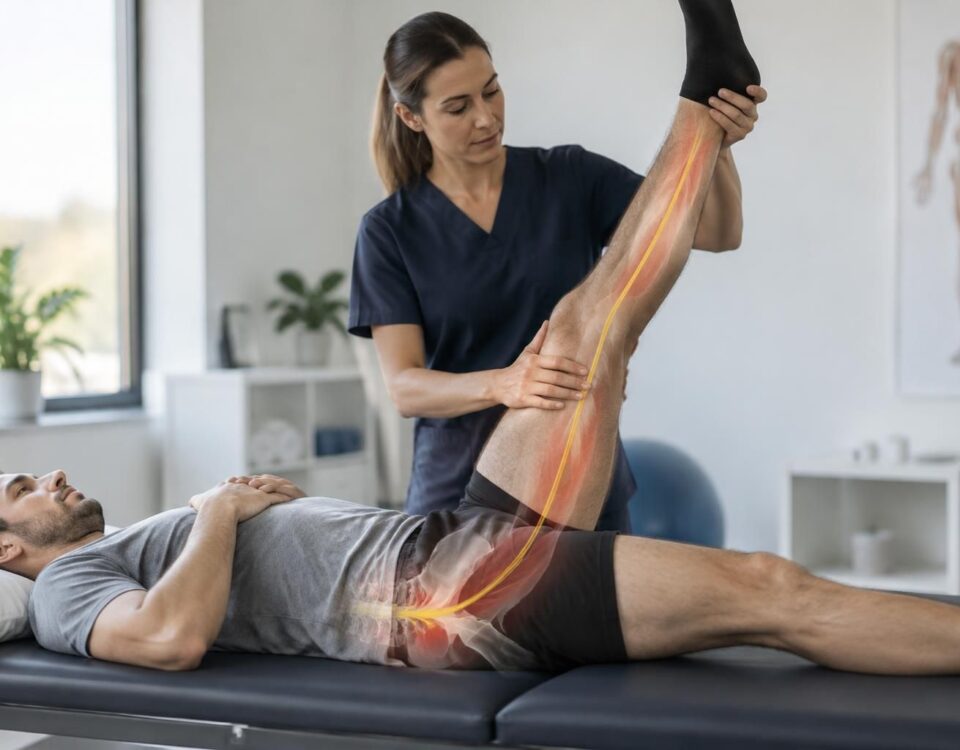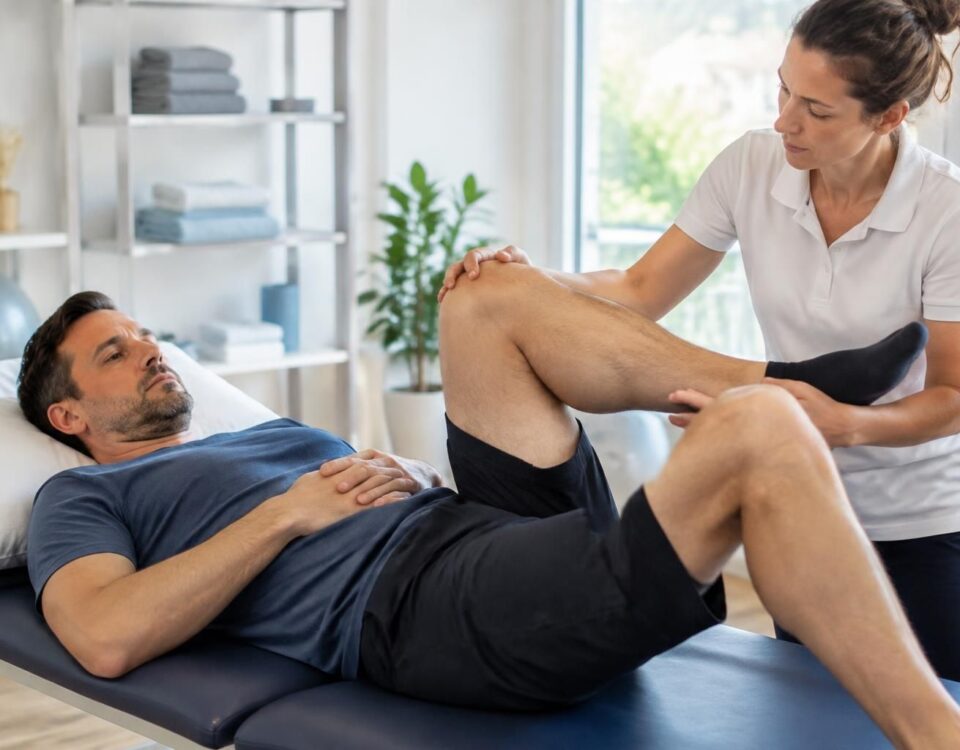
Herniated disc and pain under the knee: why it’s important
20/08/2026
Sciatica in Montreal: calf pain without significant lower back pain
21/08/2026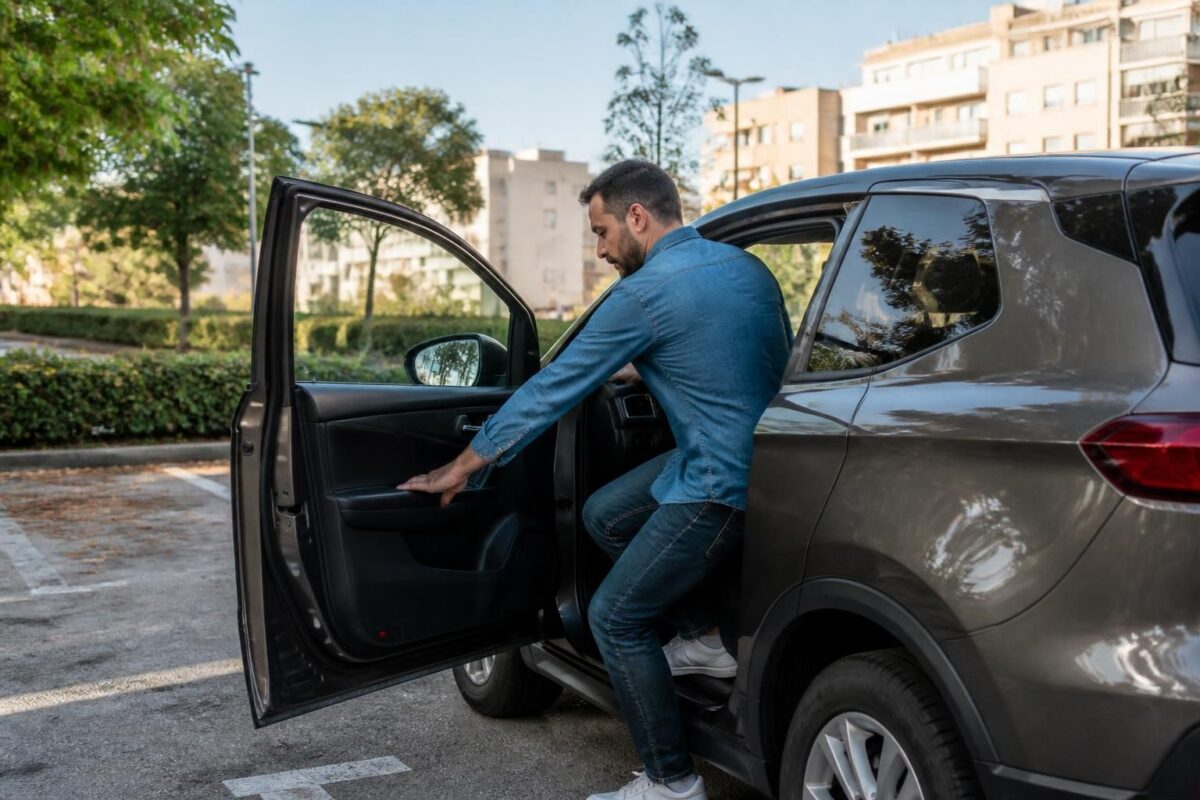
IN BRIEF
| In brief, sciatica associated with driving is pain that follows the path of the sciatic nerve and can be triggered or amplified by seated position and sudden twists when entering or exiting the car. The main benefits of applying the right reflexes are quick relief, better comfort during trips, and a reduction of lower back tension in the long term. This approach relies on simple adjustments: adjusting the seat and backrest, maintaining a good distance from the steering wheel, avoiding twists, and planning for regular breaks, reinforced by using a coccyx relief cushion and light exercises while stationary. Accessible in France, especially for daily commutes and long journeys, this principle allows for pain-free driving while protecting the sciatic nerve. |
For Sciatica, entering the car requires avoiding sudden twists in order to reduce pressure on the nerve. Here are the essentials in a few simple gestures.
- Entry and exit: prioritize a global rotation of the body rather than just turning the torso. Align the feet, pelvis, and shoulders.
- Starting position: adjust the seat to reach the pedals without leaning, and keep your back well supported.
- Avoid twists: avoid turning the torso with the legs stationary; rotate your pelvis and hips at the same time as your shoulders.
- Lumbar support: if necessary, use a cushion or lumbar support to maintain the natural curve of the spine.
- Gentle entry: slightly retract your pelvis, sit down gently, and adjust your shoulder and head position once seated.
This article, written by a healthcare professional, explains why sudden twists when entering the car can worsen sciatica and suggests simple and effective gestures to avoid them. Emphasis is placed on posture, proper seat adjustment, the use of an ergonomic cushion, and the importance of breaks.
Understanding the risk when entering the car
Sciatic pain follows the path of the sciatic nerve. In a car, the seated posture and rotational movements can increase pressure on the lower back and the nerve. Twists of the trunk and lumbar flexions often trigger or intensify pain. A good understanding of the mechanism helps in choosing simple and safe gestures.
Preparing the vehicle and seat
Avoid overly soft seats that encourage pelvic sagging. The backrest should slightly support the back and remain close to the torso without compressing it. If the seat does not properly support the lower back, add a lumbar or seating cushion to stabilize the spine and limit tension.
Enter the cabin without twisting
Before getting in, align yourself with the vehicle. Keep your back straight against the backrest and rotate your feet and pelvis together, without only turning the upper body. Use your hands for support, then sit down by sliding your buttocks back without twisting the trunk. If possible, prepare an entry position that avoids bending forward.
Using ergonomic aids
An ergonomic cushion can help relieve the coccyx and improve the opening between the torso and legs. It is better that it be firm and designed to absorb road vibrations. Choosing a suitable postural cushion can limit pressures and micro-movements that irritate the sciatic nerve. For more information on available options, check out this article on the car sciatic cushion.
Plan breaks and micro-movements
Avoid staying immobile for long periods in the same position. On long trips, plan breaks every 60 to 120 minutes to walk and adjust your posture. After each stop, restart with a slightly different position to limit strain on the lower back. Gentle movements allowed while stationary can promote circulation without excessively stressing the nerve.
Useful links and resources
For more in-depth information, you can consult resources on the following links that address symptoms related to sciatica and driving: foot pain in the car, tingling after walking, intermittent numbness, pain that goes down lower. For additional information on orthopedic solutions and cushions, see also how to avoid sciatica while driving and related resources.
Additional support options exist through specialized clinical resources, including approaches managed by TAGMED clinics in Montreal and Terrebonne. For more information, see supplementary options and other relevant guides on sossciatique.com.
If the pain persists or worsens, or if it is accompanied by other signs (muscle weakness, loss of sensitivity, urinary issues), contact a healthcare professional for appropriate evaluation. For general information and advice, you can also refer to specialized resources in the field.
Medical disclaimer: The information and advice provided on this site do not replace the opinion, diagnosis, or treatment of a healthcare professional. Please note that Dr. Sylvain Desforges, osteopath, is neither a medical doctor nor a physician, and is not a specialist in any medical specialty as defined by the Collège des médecins du Québec. Manual medicine, functional medicine, and sports medicine as described on this site exclude any medical treatment or diagnosis performed by a physician or medical specialist. Always consult your physician for any medical questions. For more details, please read our full Legal Notice.
- Approach and alignment: Stand facing the door, feet shoulder-width apart.
- Hip pivot: Turn hips and feet together; avoid turning only the torso.
- Descend without twisting: Sit down without leaning forward, back straight.
- Lumbar support: Add lumbar support if necessary.
- Breathing and relaxation: shoulders relaxed, slow breathing.
- Controlled entry: In motion, rotate hips, then shoulders, keeping the feet aligned; avoid torso twists.
- Backrest and posture: Keep your back supported and torso aligned while entering.
- Exit: To exit, pivot your whole body and place both feet together.
- Pause and breathe: On trips, take breaks and breathe calmly.
- Sustainable comfort: On long trips, prioritize support for the tailbone and shock absorption.

When you get into a car and suffer from sciatica, sudden twists can trigger pain and stiffness. To preserve your spine and limit irritation of the sciatic nerve, here are practical tips for entering without twisting your torso and adopting a stable posture throughout the trip.
Preparing the vehicle and your posture
Start by adjusting the seat so that your knees remain slightly bent and your feet reach the pedals without straining. The backrest should be slightly tilted to create a comfortable opening between the torso and legs, without forcing the lower back. Avoid overly soft seats that encourage pelvic sagging and an unstable posture. If lumbar support is lacking, add a dedicated cushion or a small bolster in the lower back to ensure good verticality and limit tension.
To prevent the onset of tension when crossing the doorframe, make sure your back remains supported during each movement. A stable base and correct starting position reduce the muscular compensations that often accompany twists during entry and maneuvering.
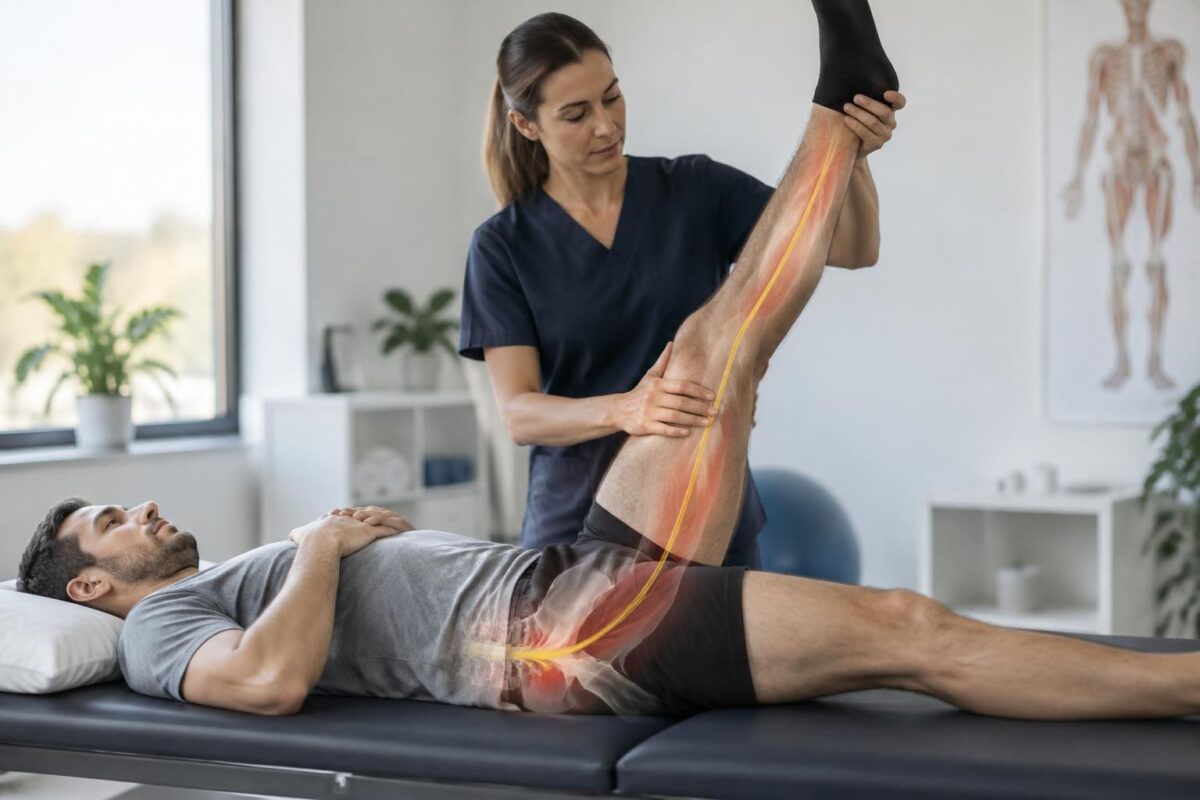
Sciatica and hamstring stretching: possible nerve tension
IN BRIEF Sciatica can make stretching the hamstrings uncomfortable, as the tension felt may come from the nerve rather than the muscle. A gentle stretch, with a straight back and without seeking maximum range, can help loosen the back of…
Sciatica and piriformis stretching: useful or worsening depending on the case
IN BRIEF Piriformis-related sciatica can cause deep pain in the buttock, sometimes radiating down the back of the thigh. A gentle stretch can loosen the hip and relieve discomfort if the muscle is involved, but it can worsen symptoms if…
The pivot without twisting
At the moment of entry, prioritize the complete pivot of the body rather than just twisting the trunk. Place one foot near the threshold, then rotate the hips, shoulders, and torso together, aligning the hips and shoulders before sitting down. This technique avoids abruptly twisting the back and preserves space for the lumbar spine.
To exit the vehicle, repeat the same principle: leave the seat by pivoting the feet and hips, then the shoulders, so that the torso does not abruptly cross the trajectory. If possible, extend both legs at the same time, without excessive separation of the torso. During this movement, keep your hands supported on the door frame or on the steering wheel to guide the movement without triggering trunk twisting.

Sciatica and popular stretches: why to stay cautious
IN BRIEF Sciatica causes pain that radiates from the lower back down the leg. Popular stretches, such as the pigeon pose or hamstring stretches, are not always suitable: pulling on an irritated nerve can worsen the symptoms. Favor gentle movements,…

Sciatica and Pilates: movements to adapt
IN SHORT Sciatica causes pain that can radiate from the lower back down to the leg. The Pilates Reformer can promote a gradual return to movement and strengthen core control, provided that the movements, range, and resistance are adapted. Favor…
Accessories and practical tips
An appropriate ergonomic cushion can make a difference. For example, the Ergoccyx Vehicles system combines high-performance foam and High Viscosity Fluid technology to distribute pressure and absorb road shocks. Its design, thicker at the back, relieves the tailbone and sacrum and facilitates a seated posture without forcing the lower back. Using this type of cushion allows for better opening between the torso and legs and limits pressure points when you sit down or get up.
Additionally, use support points during movements: hands on the door frame or on the dash can guide the movement without sudden trunk rotation. Favor slow and controlled gestures and avoid crossing your legs when sitting or standing to prevent destabilizing the pelvis.

Sciatica and core stability: variable tolerance depending on symptoms
IN BRIEF Core strengthening in case of sciatica consists of progressively strengthening the trunk muscles. Its tolerance varies depending on pain and symptoms: suitable without worsening the pain, it can support mobility and the resumption of activities, but does not,…

Sciatica and lunges: leg pain to watch out for
IN BRIEF Sciatica is pain that starts from the lower back or buttock and radiates down the leg. If a lunge triggers or worsens this pain, stop the movement and adjust your activity: this exercise does not address sciatica. Consult…
Habits to adopt during trips
During trips, alternate positions when possible and plan for short breaks to stretch your legs. In the car, move the seat forward enough to reach the pedals without stretching your legs and keep your back supported against the backrest to avoid excessive bending of the trunk.
To exit the vehicle after a trip, reiterate the dynamic and coordinated pivot movement: feet, hips, and shoulders turn together before the body leaves the seat, which limits twisting and protects the sciatic nerve. If pain appears or worsens with effort, consult a health professional to adjust the advice to your situation.
| Risk Element | Concise Recommendation |
|---|---|
| Sudden twists of the torso during entry | Pivot your whole body (feet, hips, shoulders) then sit without twisting |
| Poorly adjusted seat or too low | Adjust the seat so that the knees are level with the hips and support the back |
| Out of reach objects (seatbelt, controls) | Bring useful items closer, bend your knees, and keep your back long |
| Torso rotation when sitting | Turn your feet and hips together, then sit upright |
| Lack of lumbar support | Add lumbar support and a seat cushion |
| Entry without plan on a trip | Adjust the seat and plan for breaks to stand up |
| Heavy or utility vehicles | Apply the same principles: body alignment and controlled rotation |
| Long entry without movement | Change support, pivot the hips and shoulders together |

Sciatica and deadlifts: risk depending on the cause
IN BRIEF Sciatica and deadlifts are not always incompatible: the risk depends on the cause of the pain and its intensity. During acute episodes, it’s best to avoid heavy loads and seek medical or physiotherapy advice before resuming. A gradual…

Sciatica and squats: why caution is needed
IN BRIEF Sciatica does not always prohibit squats, but a deep or loaded squat can aggravate symptoms, especially during a flare-up. Gradually resume with a neutral back and a comfortable range of motion, and stop if the pain travels down…
Testimonials: entering the car without sudden twists to relieve sciatica
“Before my sciatica, getting into the car caused sudden twists that radiated down my leg. Since I started using the Ergoccyx Vehicles, I pivot my entire body (feet, hips, shoulders) and approach the seat without twisting. The ride is much less painful and smoother.”
“I am Julie, a daily driver. Thanks to the ergonomic cushion, I relieve my tailbone and absorb vibrations, which prevents sudden twists when getting into the car. I pivot my whole body in one motion and sit down gently, without tension.”
“As a long-distance driver, trips were exhausting due to sciatica. Now, I adjust my seat and enter by pivoting my body as a whole. No more pain at startup and less back twisting at each entry.”
“I am a mom, and my school commutes were complex when my sciatica flared up. With the Ergoccyx Vehicle Cushion, I relieve the coccyx and enter into a full body rotation, avoiding sudden twists. The ride becomes safer and more comfortable.”
“In my work with a company vehicle, I learned to avoid sudden twists when getting in: I position the seat to reach the pedals without stretching my leg, and I turn my feet, pelvis, and shoulders together. The motion is simple, and the pain is much less noticeable when starting.”
Dr Sylvain Desforges, an expert in osteopathy, naturopathy, and manual medicine, is the founding president of the TAGMED clinics and the ACMA association. His career is guided by a quest for innovation in care and a specialization in chronic pain management, integrating advanced technologies such as spinal decompression, laser, and shockwave therapies. His mission is to offer evidence-based care to optimize the health and well-being of his patients, including those suffering from sciatica who need to continue driving safely. His approach relies on the alliance between manual skills, a holistic approach, and cutting-edge technologies.
In the context of driving, sciatica can become particularly problematic during car rides. Prolonged sitting, vibrations, and micro-twists in the road can increase pressure on the pelvis and coccyx, exacerbating irritation of the sciatic nerve. Dr. Desforges reminds us that the sciatic nerve runs from the lower back down to the leg, and that pain is exacerbated by repeated strains. His message is clear: work on posture, the tools used, and shock absorption mechanisms so that each journey becomes safer and less painful.
His practical method for the car begins with vehicle preparation and optimizing position. He advises avoiding overly soft seats and adjusting the backrest to keep the torso aligned with the legs, with a slight forward tilt. A suitable lumbar support and, if necessary, a cushion that relieves the coccyx help maintain a stable position without straining the lower back. The principle is to reduce muscle compensations and limit pressure that travels up the sciatic nerve during the ride.
To manage discomfort while moving, Dr. Desforges recommends simple relaxation techniques, controlled breathing, and listening to the body before and during the ride. Applying heat or cold may be helpful before hitting the road: heat helps to relax muscles and prepare the back, while cold can limit local inflammation around the nerve. Regular breaks and light exercises performed while stationary, such as leg bends and extensions, promote circulation and prevent stiffness that worsens pain.
In terms of equipment, he highlights ergonomic solutions that support the pelvis, relieve the coccyx, and absorb vibrations from uneven roads. These principles fit within a holistic approach where technologies and simple gestures complement each other: decompression, targeted stimulation, and shock absorption mechanisms can be integrated into a safe driving program, specially designed for those affected by sciatica. Dr. Desforges emphasizes a gradual progression, so as not to compromise mobility or road safety.
To learn more about his approach and the services offered, it is recommended to consult the resources of the TAGMED clinics, which emphasize a multidisciplinary management based on the latest advances in chronic pain and mobility. The goal is to empower everyone to take control of their health daily, including on the road, without sudden twists and with better quality of life.
This text provides clear tips to prevent sciatica when getting into the car by avoiding sudden twists. The aim is to prepare the seat, adopt a stable posture, and coordinate movements to reduce strain on the sciatic nerve, while using simple aids like a cushion for the back or seat.
Key Tips for Getting into the Car Without Twists
Before opening the door, ensure your positioning by placing your feet flat and your back in contact with the backrest. Choose a seat that supports the lower back and adjust the distance to the steering wheel to avoid stretching your legs. A lumbar cushion or a small pillow in the small of the back can make a difference by stabilizing the spine and limiting pressure on the sacrum and coccyx.
Avoid twisting your torso only at the upper chest to sit down or stand up. Favor a coordinated rotation of the body: feet, pelvis, and shoulders move together to avoid creating an isolated twist of the trunk. This method reduces strain on the lower back and the sciatic nerve.
Use simple aids that relieve pressure on sensitive spots. A seat cushion and lumbar support allow for slightly raising the pelvis and avoiding sagging. For long trips, consider supports that absorb vibrations and reduce micro-movements that could irritate the nerve.
Incorporate relaxing and controlled gestures during the entry action. Deep breathing and relaxing the shoulders reduce muscle tension and facilitate the transition from one posture to another without excessive pain.
For longer trips, plan short breaks to readjust and walk for a few minutes. Each body realignment and each change of posture limits the accumulation of pressure on the sciatic nerve and promotes a more comfortable drive.
If pain occurs despite these precautions, do not hesitate to consult a healthcare professional who can tailor advice to your situation, especially if there is pain radiating down the leg or neurological symptoms. To delve deeper into tips regarding driving and sciatica, you can consult these resources:
tips on driving and sciatica,
protecting your back in the car,
positions to avoid and postures to favor,
to understand trips and pain.

Dr Sylvain Desforges, B.Sc., D.O., N.D., osteopath, is the founding president of TAGMED and of the ACMA association. He dedicates his practice to chronic spinal pain, low back pain and symptoms compatible with sciatica, particularly when pain radiates toward the buttock, leg, calf, foot or toes.
Through SOS Sciatique, he publishes educational content on sciatica symptoms, possible causes such as disc herniation, disc narrowing, foraminal stenosis or irritation of a lumbar nerve root, as well as non-surgical approaches that may be considered according to the evaluation. At Clinique TAGMED, care may include, depending on the case, motorized neurovertebral decompression, specific osteopathic care or precision percussion.
For an evaluation related to sciatica treatment in Montreal / Mount Royal or sciatica treatment in Terrebonne, please consult the services available at Clinique TAGMED.
Medical disclaimer
The information published on SOS Sciatique is provided for educational purposes only and does not replace a consultation, diagnosis, opinion or treatment provided by a physician or another authorized healthcare professional. The author of this article is neither a medical doctor nor a specialist in a medical specialty recognized by the Collège des médecins du Québec. The osteopathic, manual medicine or functional support approaches described on this site do not constitute medical acts and are not intended to replace medical follow-up.
Consult a physician or emergency service in cases of loss of bladder or bowel control, anesthesia in the saddle area, significant or progressive weakness in the leg or foot, fever, recent trauma, severe pain or rapid worsening of symptoms. For more details, please read our Legal Notice.