
Disc herniation and lumbar degeneration
24/10/2026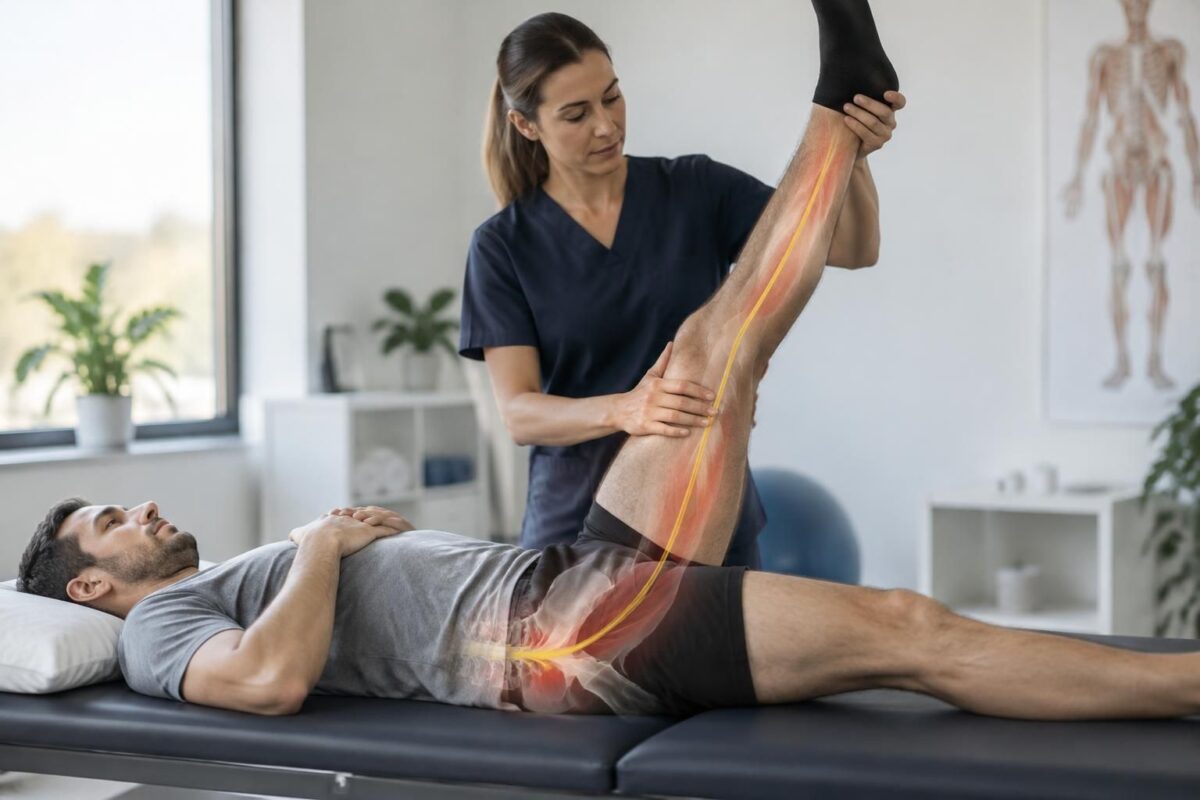
IN BRIEF
| Sciatica can make stretching the hamstrings uncomfortable, as the tension felt may come from the nerve rather than the muscle. A gentle stretch, with a straight back and without seeking maximum range, can help loosen the back of the thigh. If electric pain travels further down the leg, stop the movement: this is not a stretch to force. |
In the case of sciatica, pain felt at the back of the thigh is not always due to shortened hamstrings: it can also indicate nerve tension. Favor gentle stretching, without forcing or rounding the back, and stop if the pain travels further down the leg or becomes electric or intensifies.
A hamstring stretch can pull on the thigh but also increase tension along the sciatic nerve. If the pain travels down the leg, an intense stretching sensation does not always mean the muscle is tight. This article explains how to distinguish possible muscle tension from nerve irritation, why to avoid forcing, and when to seek professional advice.
The hamstrings are the muscles located at the back of the thigh. Their stretching can produce localized tension. However, pain that starts from the lower back or buttock and travels down to the calf or foot may also be related to sciatic nerve irritation or one of its roots.
These sensations can be similar. Muscle pain often remains localized at the back of the thigh. Nerve pain may be accompanied by burning, electric shocks, tingling, or numbness. These signs alone do not establish a diagnosis.
Why stretching can pull on the nerve
The sciatic nerve descends from the lower back to the buttock and leg. Certain movements that lengthen the hamstrings also shift the tissues around the nerve. If the nerve is sensitive, the movement can provoke or intensify symptoms, even if the muscle is not particularly short.
Therefore, pain that increases in the leg during stretching should lead to stopping the movement. Do not seek to gain range, and do not try to “unblock” the nerve by pulling harder. To learn more about different ways to stretch the back of the thigh, check the advice on hamstring stretches and hamstring stretching techniques. In the case of sciatic pain, however, adapt any movement to your symptoms.
Recognizing muscle tension or nerve pain
Muscle stiffness generally presents as diffuse tension at the back of the thigh. Pain occurs during muscle elongation and often decreases when the position is released. Sciatica may follow a more precise path and extend below the knee. It may also cause unusual sensations, such as tingling or weakness.
The pathway varies according to the affected nerve roots. Insights on possible radiations related to the L4, L5, and S1 roots can help understand why symptoms are not identical for everyone. Pain toward the top of the foot can be associated with certain pathways of the L5 root, but only a healthcare professional can evaluate your situation.
Signs to observe during movement
Before continuing a stretch, observe where the sensation is located and how it evolves. A mild tension limited to the back of the thigh that disappears upon releasing the position does not have the same meaning as a sharp pain that spreads to the calf or foot.
If the pain travels further down the leg, if tingling appears, or if numbness increases, stop. Information on an irritation of the L5 root and on the pain toward the top of the foot can provide guidance, but should not replace a clinical examination.

Sciatica and piriformis stretching: useful or worsening depending on the case
IN BRIEF Piriformis-related sciatica can cause deep pain in the buttock, sometimes radiating down the back of the thigh. A gentle stretch can loosen the hip and relieve discomfort if the muscle is involved, but it can worsen symptoms if…

Sciatica and popular stretches: why to stay cautious
IN BRIEF Sciatica causes pain that radiates from the lower back down the leg. Popular stretches, such as the pigeon pose or hamstring stretches, are not always suitable: pulling on an irritated nerve can worsen the symptoms. Favor gentle movements,…

Sciatica and Pilates: movements to adapt
IN SHORT Sciatica causes pain that can radiate from the lower back down to the leg. The Pilates Reformer can promote a gradual return to movement and strengthen core control, provided that the movements, range, and resistance are adapted. Favor…
Why to avoid forcing hamstring stretches
An intense stretch does not necessarily address the cause of the pain. It can, on the contrary, increase nerve sensitivity or lead to protective tension. Bouncing, holding positions despite sharp pain, and deep bends should be avoided if they trigger your symptoms.
In the presence of a known or suspected disc herniation, pain that worsens when bending, or symptoms that travel down the leg, do not choose a stretch or exercise program on your own. A healthcare professional can determine if the movement is appropriate. You can also read these tips on hamstring stretches in case of sciatica, keeping this rule in mind: stop any movement that increases the irradiation.
Strength training and flexion movements
Deadlifts engage the muscles at the back of the legs and the lower back. During periods of pain, a poorly tolerated load or technique can exacerbate symptoms. The risks depend on the cause and context; consult the insights on sciatica and deadlifts before resuming this movement.
Pilates also includes movements that may require adjustments. In the presence of irradiation in the leg, do not continue a posture that increases pain. This article on sciatica and Pilates movements presents points to consider, but personalized advice remains preferable if symptoms persist.

Sciatica and core stability: variable tolerance depending on symptoms
IN BRIEF Core strengthening in case of sciatica consists of progressively strengthening the trunk muscles. Its tolerance varies depending on pain and symptoms: suitable without worsening the pain, it can support mobility and the resumption of activities, but does not,…

Sciatica and lunges: leg pain to watch out for
IN BRIEF Sciatica is pain that starts from the lower back or buttock and radiates down the leg. If a lunge triggers or worsens this pain, stop the movement and adjust your activity: this exercise does not address sciatica. Consult…

Sciatica and deadlifts: risk depending on the cause
IN BRIEF Sciatica and deadlifts are not always incompatible: the risk depends on the cause of the pain and its intensity. During acute episodes, it’s best to avoid heavy loads and seek medical or physiotherapy advice before resuming. A gradual…
What to do if stretching triggers pain
Release the position and return to a comfortable posture. Avoid immediately repeating the movement to check if the pain is still present. Change position regularly and limit long sitting periods if they worsen your symptoms. The goal is not to provoke a lasting increase in pain, rather than seeking marked stretching.
General advice on how to choose stretches for sciatica can be helpful, but no movement is suitable for all causes. A professional can also inform you about ways to reduce the symptoms of an irritated sciatic nerve and guide you towards an appropriate assessment.
When to seek medical advice
Seek advice if the pain persists, recurs regularly, limits your activities, or is accompanied by tingling and numbness. An assessment is also important if you are unsure whether the pain originates from a muscle, the back, or a nerve. An examination allows for determining the course of action and ruling out certain causes that require specific management.
Consult urgently if you experience new or significant weakness in a leg, difficulty walking, loss of sensitivity in the perineal area, or urinary or intestinal disturbances. These symptoms should not be treated with stretches.
Medical disclaimer: The information and advice provided on this site do not replace the opinion, diagnosis, or treatment of a healthcare professional. Please note that Dr. Sylvain Desforges, osteopath, is neither a medical doctor nor a physician and is not a specialist in a medical specialty as defined by the Collège des médecins du Québec. Manual medicine, functional medicine, and sports medicine as described on this site exclude any treatment or medical diagnosis made by a physician or a specialist physician. Always consult your doctor for any medical questions. For more details, please read our complete Legal Notice.
Hamstring Stretch: Distinguishing Muscle Tension from Nerve Irritation
To Favor
To Monitor

A hamstring stretch can relieve tightness at the back of the thigh, but in the case of sciatica, the tension felt may also come from a sensitive nerve. To avoid worsening symptoms, favor a gentle range, keep your back comfortable, and stop if the electric pain radiates further down the leg.
Why Stretching Can Trigger Sciatica
The hamstrings are the muscles located at the back of the thigh. When they are tight, stretching them can produce localized muscle tension. However, the sciatic nerve runs nearby and descends into the leg: if it is irritated, certain positions that strongly lengthen the back of the thigh may also put strain on the nervous system.
A sensation of tension alone does not determine its origin. Muscle tightness is often felt in the thigh. Nerve pain, on the other hand, may manifest as burning, shocks, tingling, or numbness, sometimes all the way to the calf or foot. These signs do not replace a professional examination.
Spot the Reaction Rather Than Seeking Maximum Range
A suitable exercise should remain comfortable or cause a light, well-tolerated tension. If symptoms spread further down the leg, become electric, or increase after the exercise, stop the movement. Do not try to “pull” on the nerve or reach a maximum range.
Try a Gentle Version of the Stretch
To test tolerance, place a heel on a low and stable chair, keeping the knee slightly bent. Stand upright, then gently lean your torso from the hips, without rounding the back. Stop as soon as you feel a light stretch at the back of the thigh. You do not need to touch your toes.
Hold the position for about 10 to 20 seconds, then slowly release. Repeat only once or twice at first, and observe how you feel in the following hours. If the movement increases irradiation, replace it with gentle walking or a comfortable resting position. Stretching is not essential for recovery.
Avoid During a Painful Episode
Avoid bouncing, deep bends with straight legs, and forced holds despite pain. Long sitting positions can also exacerbate symptoms in some people: regularly change posture and take a few steps if it remains well tolerated.
Adapt Movements to Your Situation
Sciatica can be associated with several factors, including irritation of a nerve root, sensitivity in the lower back, or muscle tension. Therefore, the same exercise is not suitable for everyone. If you have a diagnosed or suspected herniated disc, especially avoid movements that replicate your symptoms and seek advice before resuming intense stretches.
A doctor or physical therapist can assess your strength, sensitivity, and the most suitable movements. Consult if the pain persists, recurs regularly, or limits your activities. Personalized support helps to choose between mobility, gradual strengthening, and daily adaptations, without focusing excessively on a painful area.
When to Seek Help Quickly
Stop the exercises and seek medical advice quickly if you notice new or increasing weakness in the leg, numbness that spreads, or difficulty walking. Urinary or bowel issues, loss of sensation in the perineum, fever, or pain after an injury require urgent evaluation. In these situations, do not delay care by trying to stretch.
| What you feel during the stretch | Practical marker |
|---|---|
| Diffuse tension behind the thigh | More likely indicates a muscle stretch. |
| Electric shock, burning, or tingling that goes down the leg | May signal nerve irritation: release. |
| Pain that travels to the calf or foot | Stop the movement, without forcing the range. |
| Mild, stable, and localized discomfort | Reduce the stretch and observe the reaction. |
Testimonials on Sciatica and Hamstring Stretching
Illustrative testimonials: these situations are examples and do not describe real patients. Pain that travels down the leg can have different causes; only a healthcare professional can assess your situation.
“When I stretched the back of my thigh, I felt a tension that started from the buttock and went down to the calf. I thought the muscle was just tight, but the more I forced it, the more the sensation became electric. I stopped the stretch and asked for advice.”
“My hamstring stretch pulled behind the thigh, without causing tingling or lower pain in the leg. Keeping my knee slightly bent and back straight made the movement more comfortable.”
“Sitting with my leg straight, I felt a sort of electric shock down to my foot. I was told that a nerve tension could sometimes be mistaken for a short muscle. So I avoided trying to touch my toes and gradually resumed the movements.”
“The pain increased after stretching and remained more present in the leg. I understood that it wasn’t the time to push. A more comfortable position and short walks were better tolerated while waiting for professional advice.”
A moderate stretching sensation at the back of the thigh may be muscular. However, an electric pain, tingling, or pain that travels further down to the calf or foot may signal nerve irritation: then release the position and do not force the range.
To test the stretch cautiously, place your heel on a low support, keep your knee slightly bent, and gently lean the torso from the hips, keeping the back long. Stop if symptoms intensify or spread in the leg. If the pain persists, recurs often, or is accompanied by weakness, seek the opinion of a healthcare professional.
Sciatica and Hamstring Stretching: Understanding Possible Nerve Tension
Dr Sylvain Desforges is a professional specialized in osteopathy, naturopathy, and manual medicine. Founder and president of TAGMED clinics and the ACMA association, he has devoted his career to innovation in health and managing chronic pain. His approach relies on evidence-based care and studying the needs unique to each patient.
Among the situations requiring special attention is sciatica, a pain that may start from the lower back or buttock and travel down the thigh, calf, sometimes to the foot. It may be accompanied by burning, electric shocks, tingling, or numbness. In this context, tension felt at the back of the thigh is not necessarily due to shortened hamstrings: it may also be related to the sensitivity of the sciatic nerve or its roots.
This distinction is important because a classic hamstring stretch may exacerbate symptoms in some people. When the nerve is irritated, stretching the leg and bending the torso may increase the pulling sensation or even cause more pain to travel down. Therefore, the movement should not be viewed as a way to “pull” on the nerve to release it. The goal is rather to find a comfortable range and maintain gradual mobility.
In a care approach, Dr Desforges emphasizes evaluating the context: the path of the pain, positions that worsen or relieve it, mobility of the back and hips, and any presence of neurological signs. These elements help distinguish muscle tension from pain that may involve the nerve. An exercise suitable for one person may be poorly tolerated by another; hence the choice of movements benefits from considering individual reactions.
To cautiously attempt a hamstring stretch, you can place your heel on a low and stable support, keep your knee slightly bent, and then gently lean the torso from the hips while maintaining a long back. A moderate tension at the back of the thigh may be acceptable. However, stop the movement if sharp pain appears, if irradiation intensifies, or if tingling spreads further down the leg. Bouncing and maximum ranges should be avoided.
Chronic pain management is one of Dr Desforges’ areas of expertise. Depending on the clinical situation, his work integrates manual approaches and advanced technologies, including spinal decompression, laser, and shock waves. These options are not suitable for everyone and do not replace a medical evaluation when necessary. Their relevance depends on the observed picture and the care goals defined with the patient.
A persistent, recurrent pain or one that limits daily activities deserves professional advice. New weakness in the leg, difficulty walking, significant loss of sensation, or urinary or bowel issues require urgent medical evaluation. As part of his commitment to individualized and evidence-based care, Dr Desforges aims to guide management toward careful, progressive choices tailored to each patient’s functioning.
A hamstring stretch can alleviate tightness at the back of the thigh, but pain that travels down the leg may also indicate sciatic nerve irritation. The difference matters: seek a light muscle tension, without pulling on electric pain or exacerbating symptoms. Your body’s response during and after the movement helps you know if it’s suitable for you.
Sciatica and Hamstring Stretching: Distinguishing Muscle Tension and Nerve Tension
A tight hamstring muscle typically causes a localized stretching sensation at the back of the thigh. Nerve pain may instead feel burning, tingling, or take the form of a shock, sometimes extending to the calf or foot. These sensations alone do not allow for a diagnosis, but they suggest caution. To discover movements suitable for flexibility in the back of the legs, consult these hamstring stretches.
When stretching, keep your back long and slightly bend your knee if it makes the movement more comfortable. Gently tilt your torso from the hips, without trying to touch your toes or achieve maximum range. A moderate tension in the thigh may be acceptable; increasing pain or pain that travels further down the leg indicates that you should release. Additional advice on mobilization is available in this guide to stretching the sciatic nerve — keeping in mind that a sensitive nerve should not be treated like a muscle to be forcibly stretched.
The affected nerve root can modify the pathway of symptoms. Irritation of the L5 root may particularly accompany sensations in the leg and foot; involvement of the S1 root may produce a different pathway. To better understand these variations, you can read these explanations on L5 root irritation, on the influence of the affected root on the painful pathway, and on the S1 root.
Difficulty in lifting the foot or pain in the big toe deserves special attention, as these symptoms can have several causes and require appropriate evaluation. The information regarding difficulty lifting the foot and pain in the big toe can help understand the issues to discuss with a healthcare professional, without replacing their advice.
If gentle movements are well tolerated, you can try one exercise at a time and observe the effects in the following hours. Suggestions for gentle stretches for sciatica or these relief exercises can serve as leads, to be adapted to your feelings. Stop any practice that increases radiation or causes sharp pain, increased numbness, or weakness.
In the case of persistent symptoms, recurrences, or significant discomfort in daily activities, seek advice from a doctor or physiotherapist to choose appropriate movements. Consult promptly if new weakness appears, if walking becomes difficult, or in the presence of urinary or intestinal issues, loss of sensitivity in the perineum, fever, or pain after trauma. In these situations, do not delay medical evaluation to try stretching.

Sciatica and squats: why caution is needed
IN BRIEF Sciatica does not always prohibit squats, but a deep or loaded squat can aggravate symptoms, especially during a flare-up. Gradually resume with a neutral back and a comfortable range of motion, and stop if the pain travels down…
Sciatica and stationary bike: useful or aggravating depending on the case
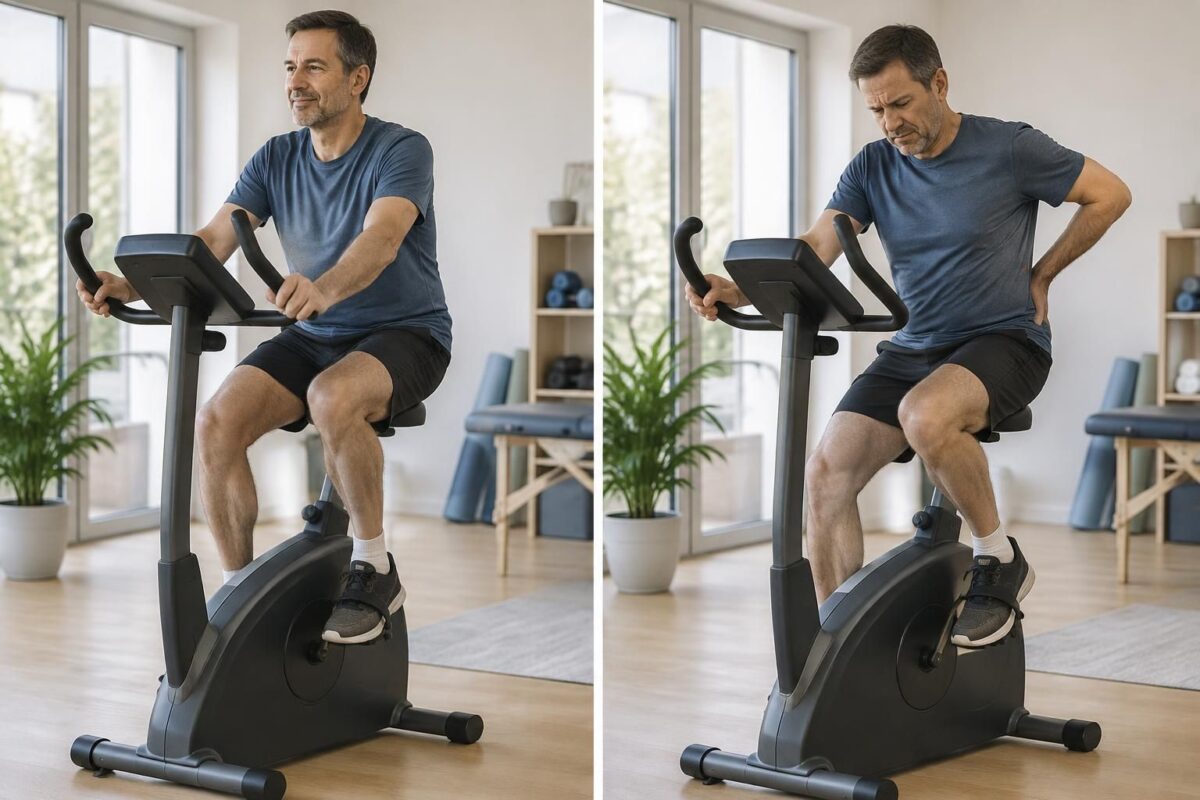
IN BRIEF The stationary bike with sciatica can help you stay active if the pain is mild and stable. Start with a short session, at low resistance and in a comfortable position. If the pain goes further down the leg,…

Dr Sylvain Desforges, B.Sc., D.O., N.D., osteopath, is the founding president of TAGMED and of the ACMA association. He dedicates his practice to chronic spinal pain, low back pain and symptoms compatible with sciatica, particularly when pain radiates toward the buttock, leg, calf, foot or toes.
Through SOS Sciatique, he publishes educational content on sciatica symptoms, possible causes such as disc herniation, disc narrowing, foraminal stenosis or irritation of a lumbar nerve root, as well as non-surgical approaches that may be considered according to the evaluation. At Clinique TAGMED, care may include, depending on the case, motorized neurovertebral decompression, specific osteopathic care or precision percussion.
For an evaluation related to sciatica treatment in Montreal / Mount Royal or sciatica treatment in Terrebonne, please consult the services available at Clinique TAGMED.
Medical disclaimer
The information published on SOS Sciatique is provided for educational purposes only and does not replace a consultation, diagnosis, opinion or treatment provided by a physician or another authorized healthcare professional. The author of this article is neither a medical doctor nor a specialist in a medical specialty recognized by the Collège des médecins du Québec. The osteopathic, manual medicine or functional support approaches described on this site do not constitute medical acts and are not intended to replace medical follow-up.
Consult a physician or emergency service in cases of loss of bladder or bowel control, anesthesia in the saddle area, significant or progressive weakness in the leg or foot, fever, recent trauma, severe pain or rapid worsening of symptoms. For more details, please read our Legal Notice.