


Sciatica in Montreal: why the affected root changes the pain pathway
17/10/2026
Sciatica and pain when getting out of bed
17/10/2026
IN BRIEF
| Sciatica is a pain related to the irritation of a lumbar nerve root, the path of which varies depending on the affected root. Damage to L5 can radiate to the top of the foot, while damage to S1 more often goes down the back of the leg to the heel or the outer edge of the foot. In Terrebonne, accurately identifying the pain pathway helps to better describe the symptoms and guide the evaluation; this does not replace a medical diagnosis. |
In Terrebonne, pain that starts from the lower back and descends into the leg can follow different paths depending on the irritated nerve root. Damage to L5 often manifests on the side of the leg up to the top of the foot; damage to S1 more often follows the back of the thigh and calf, sometimes reaching the heel or the outer edge of the foot. These landmarks help describe the symptoms but are not enough to make a diagnosis. In case of progressive weakness, significant loss of sensation, or urinary or intestinal issues, quickly consult a healthcare professional.
Pain that starts from the lower back or buttock and descends into the leg can follow different paths. The affected area often depends on the irritated nerve root, such as L5 or S1. Identifying where the pain propagates helps to describe the symptoms and guide the evaluation but is not sufficient to establish a diagnosis. In Terrebonne, a healthcare professional can assess the situation and determine if medical advice or further management is necessary.
Why does back pain radiate into the leg?
The sciatic nerve is formed from nerve roots located in the lower back. It crosses the pelvis and buttock area and then descends behind the thigh. Lower down, it divides into branches that control part of the movement and sensitivity of the leg and foot.
An irritated nerve root can cause pain at a distance from its origin. The person may feel a shock, a burning sensation, tingling, or numbness in the buttock, leg, or foot. To better understand this phenomenon, consult this information on the evolution of sciatica pain and the role of the sciatic nerve.
Pain that follows a pathway consistent with sciatica alone does not identify which structure is involved. A herniated disc, narrowing of the nerve spaces, or other factors may be considered depending on the signs and the clinical examination. The observed pathway must therefore be interpreted along with all the symptoms.

Sciatica in Terrebonne: L5 and difficulty lifting the foot
IN SHORT The L5 sciatica can cause pain or numbness on the side of the leg, the top of the foot, and the big toe, sometimes with difficulty lifting the foot. In Terrebonne, an evaluation compares strength, sensitivity, reflexes, and…
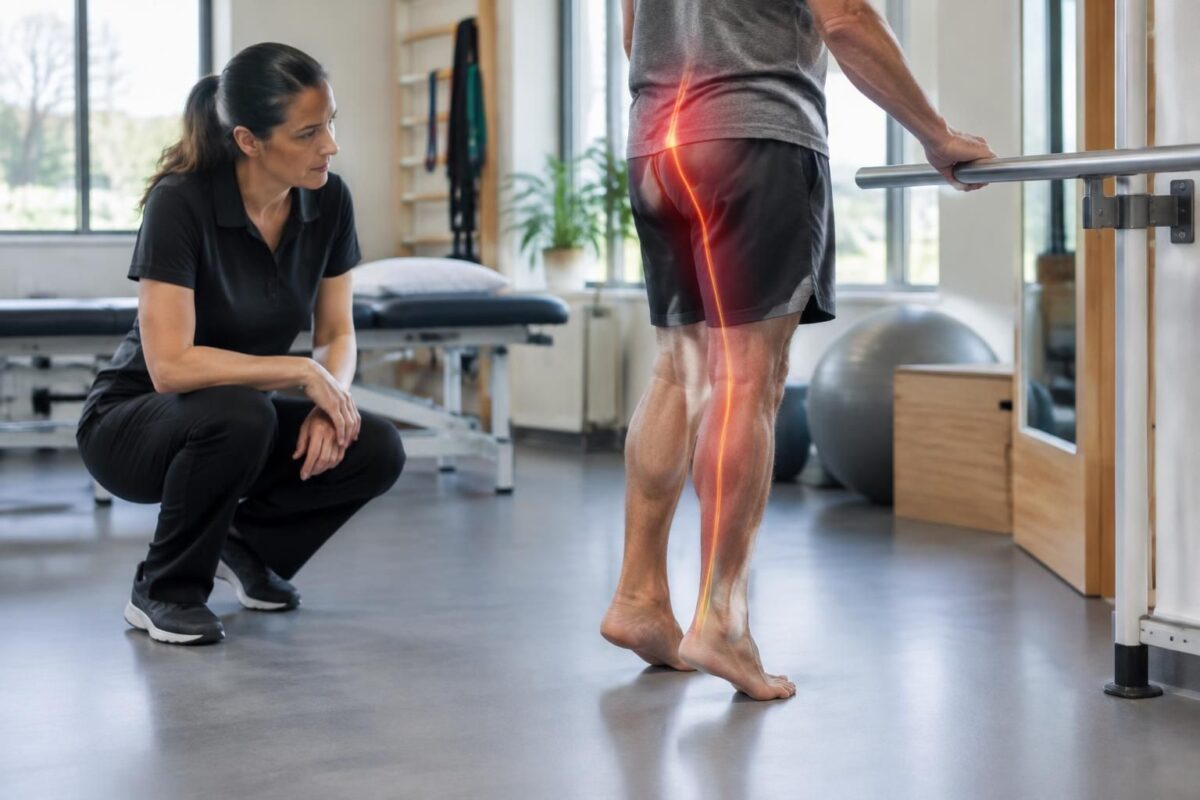
Sciatica in Terrebonne: S1 and difficulty standing on tiptoe
IN SHORT An S1 sciatica can irritate the nerve root associated with the calf and make it difficult to rise onto the balls of the feet. This sign should be evaluated with strength, sensitivity, reflexes, and walking: the pathway of…
The path of the pain according to the nerve root
Possible involvement of the L5 root
When the L5 root is irritated, the pain can pass through the buttock and the outer front of the thigh. It may continue down the leg and reach the top of the foot, sometimes extending to the big toe. Some people also report tingling or reduced sensitivity in this area.
Possible involvement of the S1 root
When the S1 root is affected, the pain may descend behind the thigh and calf. It can extend towards the heel, the outer edge of the foot, or the small toes. Sensations of numbness or burning may accompany the pain.
A pathway that does not reach the foot
The pain may remain in the buttock, thigh, or near the knee. The absence of pain in the foot does not exclude nerve irritation. Symptoms vary from person to person and may change over time. To learn more, read this article on sciatica pain in the calf, heel, or along the outer edge of the foot.
The pathway can also evolve depending on activities or positions. Note where the pain starts, how far it descends, and whether it is accompanied by tingling or loss of strength. This information can help the professional guide their evaluation. Also consult information on radiation in the leg after physical effort and on pain or numbness after walking.

Sciatica in Terrebonne: L4-L5 and pain towards the top of the foot
IN BRIEF A L4-L5 sciatica can radiate to the outer side of the leg and the top of the foot, sometimes reaching the big toe. This pathway can guide the assessment, though it does not suffice to confirm the cause:…

Sciatica in Terrebonne: L5-S1 and symptoms in the calf
IN BRIEF A L5-S1 sciatica can cause pain that radiates down the calf, sometimes accompanied by tingling, numbness, or weakness. At Terrebonne, an assessment at the TAGMED Clinic helps to examine the symptom pathways, strength, and sensitivity, and then discuss…
Signs that may accompany sciatica pain
Pain may be accompanied by tingling, numbness, a burning sensation or a feeling of electric shock. Some people feel a heavy leg or a different sensitivity to touch. Symptoms may be more pronounced after prolonged sitting, during walking, or at the end of the day, but these variations alone do not help identify the cause.
Weakness in the leg or foot deserves special attention. If the foot catches on the ground, if walking becomes unstable, or if weakness progresses, seek medical advice quickly. An evaluation is also indicated if pain persists, worsens, or limits normal activities.
Sciatica often affects only one side, but symptoms in both legs should be taken seriously. Seek medical help promptly in cases of loss of control over the bladder or bowels, numbness in the saddle area, or significant and progressive weakness.

Sciatica in Terrebonne: pain in the big toe, L5 root or another cause?
IN BRIEF Pain in the big toe accompanied by pain in the buttock or leg may be compatible with irritation of the L5 root, but other causes are possible. In Terrebonne, the evaluation notably compares strength, sensitivity, and gait to…

Sciatica in Terrebonne: L4-L5 disc, L5-S1 disc, and leg pain
IN BRIEF Sciatica is pain that travels down the leg when a nerve root is irritated. An injury to the L4-L5 disc often affects the L5 root; an L5-S1 injury affects the S1 root. The path of the pain and…
How evaluation helps to understand the pathway
The professional starts by listening to the history of the symptoms: their onset, evolution, pathway, and effects on walking, sleep, or daily activities. They can then assess mobility, sensitivity, and strength. Depending on the results, a doctor may request imaging tests or other evaluations. The choice depends on the clinical situation and is not solely based on the location of the pain.
It is helpful to accurately describe the symptoms: “the pain starts from the buttock, goes behind the calf, and reaches the edge of the foot,” for example. This description is more informative than the term “sciatica” alone. To delve deeper into the issue of changing symptoms at the end of the day, consult the resources dedicated to this topic.

Sciatica in Terrebonne: understanding lumbar levels on an MRI
IN BRIEF Sciatica may be related to irritation of a lumbar nerve root. A lumbar MRI shows the disks and nerves at different levels, such as L4-L5 or L5-S1, to help identify an abnormality and compare it with symptoms. In…

Sciatica L4-L5 in Terrebonne: possible pain, numbness, and weakness
IN BRIEF L4-L5 sciatica refers to pain related to irritation of a nerve root in the lower back. It can radiate to the buttock and leg, with numbness or weakness. Identifying these symptoms helps guide evaluation and care. In Terrebonne,…
What options to consider in Terrebonne?
The management depends on the suspected cause, the intensity of the pain, and the observed signs. A doctor or licensed healthcare professional can clarify the appropriate options and determine if medical follow-up is necessary. Manual approaches do not replace a medical diagnosis or the care indicated by a doctor.
At the Clinique TAGMED, an assessment can guide you towards the services available in Terrebonne, notably specific osteopathy or, when the situation warrants, motorized neurovertebral decompression. The relevance of these approaches depends on the assessment and they are not suitable for everyone. You can consult the page on sciatica management in Terrebonne for information on the services offered.
To better understand why symptoms can vary from person to person, also check this page on sciatic pain whose path changes over the days. These resources are informative and do not allow for remote diagnosis.
About the author
Sylvain Desforges, B.Sc., D.O., N.D., osteopath and naturopath, is the founding president of TAGMED and the ACMA association. He dedicates his practice to chronic spinal pain, lower back pain, and pain associated with sciatica, particularly when the pain radiates to the buttock, leg, calf, foot, or toes.
Through SOS Sciatica, he publishes educational content on sciatic symptoms, possible causes such as herniated discs, disc pinching, foraminal stenosis, or irritation of a lumbar nerve root, as well as non-surgical approaches that may be considered based on the evaluation. At Clinique TAGMED, care may include, depending on the case, motorized neurovertebral decompression, specific osteopathy, or a precision impactor.
For an assessment related to sciatica treatment in Montreal / Mont-Royal or sciatica treatment in Terrebonne, check the services available at the Clinique TAGMED.
Medical Disclaimer
Medical disclaimer: The information and advice provided on this site do not substitute for the opinion, diagnosis, or treatment of a health professional. Please note that Dr. Sylvain Desforges, osteopath, is neither a medical doctor nor a physician, and is not a specialist in a medical specialty as defined by the Collège des médecins du Québec. Manual medicine, functional medicine, and sports medicine as described on this site exclude any treatment or medical diagnosis made by a physician or a medical specialist. Always consult your doctor with any medical questions. For more details, please read our full legal notice.
The information published on SOS Sciatique is provided for educational purposes and does not replace a consultation, diagnosis, opinion, or treatment carried out by a physician or another authorized health professional. The author of this article is neither a doctor nor a specialist in a medical specialty recognized by the Collège des médecins du Québec. The approaches of osteopathy, manual medicine, or functional support described on this site do not constitute medical acts and are not intended to replace medical follow-up.
Consult a doctor or emergency service in case of loss of bladder or bowel control, numbness in the saddle area, significant or progressive weakness of the leg or foot, fever, recent trauma, severe pain, or rapid deterioration. For more details, please read our legal notice.
Root L5
- Pain from the buttock to the side of the thigh.
- May extend along the shin to above the foot and the big toe.
- A weakness in lifting the foot warrants medical evaluation.
Root S1
- Pain from the buttock to the back of the thigh and calf.
- May extend to the heel or the outer edge of the foot.
- Progressive weakness or significant symptoms should be evaluated promptly.
In Terrebonne, the path of the pain can help guide the assessment, but alone it cannot identify the affected root.

Sciatica in Terrebonne: why the affected root changes the path of pain
A sciatica does not always follow the same path: the pain may descend along the side of the leg, behind the calf, or to the foot. Its path notably depends on the irritated lumbar nerve root, often L5 or S1. Identifying where the discomfort is located, noting the associated sensations, and seeking an appropriate evaluation in Terrebonne can help better understand the situation and choose the next steps, without relying solely on the location of the pain.
The pain path provides clues
The nerve roots that emerge from the lower back help form the sciatic nerve. They transmit motor and sensory information to different regions of the leg. When a root is irritated or compressed, the pain may manifest farther away from its origin, for example in the buttock, thigh, calf, or foot.
The painful area may provide useful clues, but it cannot, by itself, confirm which root is affected or identify its cause. A herniated disc, narrowing of the space around a root, or other problems can cause similar symptoms. A health professional also takes into account strength, sensitivity, reflexes, and the evolution of symptoms.
When the L5 root is irritated
An impairment of the L5 root can cause pain starting from the lower back or buttock, then traveling along the outer side of the thigh and leg. Some individuals also experience tingling or numbness on the top of the foot, sometimes towards the big toe. Difficulty in lifting the foot or the big toe warrants prompt evaluation, especially if it appears or worsens.
When the S1 root is irritated
Root S1 irritation may manifest at the back of the thigh and calf, with discomfort sometimes reaching the heel or the outer edge of the foot. Tingling or a burning sensation may accompany the pain. Again, these pathways are general markers: symptoms vary from person to person and may overlap.
Recommendations for better describing your symptoms
Before a consultation in Terrebonne, note the starting point of the pain, its pathway, and the areas where numbness or tingling appears. Specify how long the symptoms have been present, what worsens them — for example, prolonged sitting, walking, or certain movements — and what seems to soothe them. Also mention any changes in strength or difficulty walking.
As long as it remains tolerable, favor gentle and regular movements rather than prolonged strict rest. Alternate positions and take short walks if they do not significantly increase the pain. Avoid forcing a stretch or exercise that causes sharp pain, marked numbness, or weakness. Seek advice from a professional before resuming targeted exercises or manual treatment.
When to seek medical advice
Consult a doctor or an emergency service in case of significant or progressive weakness in the leg or foot, loss of bladder or bowel control, or numbness in the saddle area. Pain that worsens rapidly, occurs after trauma, or is accompanied by fever also requires medical attention. These recommendations are educational and do not replace personalized assessment.
| Nerve root | Possible pain pathway |
|---|---|
| L5 | Buttock, outer side of the thigh, shin, top of the foot, and big toe. |
| S1 | Buttock, back of the thigh, calf, heel, or outer edge of the foot. |
| To remember in Terrebonne | The pathway varies according to the irritated root; it is not sufficient to confirm a diagnosis. |
Illustrative testimonies in Terrebonne: why the affected root changes the pain pathway
The testimonies below are fictional and composite examples, designed to illustrate different ways in which sciatic-type pain can manifest. The perceived pathway can guide evaluation, but it is not enough to deterministically find out which nerve root is irritated.
“My pain started from the lower back, crossed the buttock, and ran along the outside of the thigh. Then it descended towards the shin and the top of the foot, especially near the big toe. During my consultation in Terrebonne, I learned that this pathway could be consistent with irritation of the L5 root.” — Fictional testimony
The L5 root can be associated with pain that goes through the buttock, the outer leg, and the top of the foot. Tingling or a sensation of numbness may also appear in this area. However, symptoms vary from person to person and must be interpreted with the entire examination.
“For me, the pain descended rather behind the thigh, crossed the calf, and ended on the outer edge of the foot. It was sometimes accompanied by tingling. Understanding that this pathway could correspond to a different root helped me describe my symptoms more accurately during my evaluation in Terrebonne.” — Fictional testimony
An irritation of the S1 root can cause pain felt at the back of the leg, sometimes reaching the heel or the outer edge of the foot. However, the localization is not always so clear: several areas may be involved, and the pathway may change over time.
“My pain stopped at the knee. So I thought it wasn’t sciatica since nothing went down to the foot. I was explained that radiated pain could remain limited to the buttock or thigh. It was especially important to consider my entire range of symptoms, not just the distance traveled by the pain.” — Fictional testimony
Pain that does not go beyond the thigh or knee does not rule out nerve irritation. Conversely, pain that extends to the foot does not alone confirm sciatica or precisely identify its cause. A herniated disc, narrowing of the spaces through which nerves pass, or other phenomena may require appropriate evaluation.
“I had symptoms in both legs and weakness that was worsening. I realized I shouldn’t wait for a routine appointment and quickly sought medical advice.” — Fictional testimony
Sciatic pain often affects one side only, but bilateral involvement, significant or progressive weakness, or loss of bladder or bowel control demands urgent medical evaluation. Also consult promptly in case of numbness in the saddle area or rapidly worsening symptoms.
In Terrebonne, a professional assessment can help describe the pain pathway, check strength and sensitivity, and determine whether medical advice or a supportive approach is indicated. The perceived pathway helps guide questions but does not replace a diagnosis established by an authorized health professional.
Warning: this content is provided for educational purposes and does not replace a consultation, diagnosis, or treatment by an authorized health professional. The presented testimonies are fictional and do not guarantee results.
Sciatica in Terrebonne: why the affected nerve root modifies the pain pathway
In Terrebonne, pain that starts from the lower back or buttock and descends into the leg may suggest sciatica. However, the perceived pathway varies from person to person. It notably depends on the irritated nerve root, its level in the lumbar spine, and how the nervous system responds. Understanding these differences allows for better description of symptoms and guides evaluation, without claiming to diagnose based solely on the painful pathway.
The sciatic nerve consists of several nerve roots from the lower spine, generally from L4 to S3. They merge in the pelvis, then the nerve passes through the gluteal region and descends behind the thigh. Near the knee, it divides into branches serving the leg and foot. Thus, irritation can be felt far from its source: for example, foot pain may be associated with a root located in the lower back.
When the root L5 is involved, the pain or tingling may move from the buttock to the outer side of the thigh and leg, then reach the top of the foot or the big toe. An involvement of S1 is more often associated with discomfort that follows the back of the thigh and calf, up to the heel or the outer edge of the foot. Other roots, like L4, can produce symptoms more felt at the front of the thigh or towards the inner side of the leg. These pathways are markers, not precise maps: sensations often overlap.
Pain does not always limit itself to a burning sensation. It can take the form of electric shocks, tingling, numbness, or a feeling of a heavy leg. Some people also notice difficulty in lifting the foot or pushing on the toes. The location, intensity, and evolution of symptoms vary according to the cause, which may include a herniated disc, changes related to arthritis, or sometimes irritation of structures located in the buttock.
A consultation is not just about comparing symptoms to an anatomical diagram. A licensed health professional can examine mobility, strength, sensitivity, and reflexes, then determine whether further examinations are relevant. Imaging is not necessary in all situations. For a person in Terrebonne, clearly describing the path of the pain, positions that accentuate it, and observed changes helps guide this assessment.
Depending on the situation, a non-surgical management may include advice for staying appropriately active, progressive exercises, and manual approaches. In osteopathy, the assessment aims to understand the mechanical and functional factors that may contribute to discomfort; it does not replace a medical diagnosis. Care should be chosen according to the symptoms and history, without promising the same result for everyone. Significant or progressive weakness, loss of bladder or bowel control, or loss of sensation in the saddle area requires urgent medical evaluation.
Sylvain Desforges, B.Sc., D.O., N.D., is an osteopath and naturopath, founding president of TAGMED and the ACMA association. His practice focuses particularly on chronic spine pain and symptoms consistent with sciatica. Depending on the assessment and the needs of the person, the proposed care may include specific osteopathy or motorized neurovertebral decompression. The information presented here is educational and does not replace a consultation with a licensed health professional.
In Terrebonne, pain that starts from the lower back or buttock and descends into the leg can follow different pathways depending on the irritated nerve root. The affected area — notably L5 or S1 — helps to understand where symptoms may manifest, although it is not sufficient in itself to establish a diagnosis.
Sciatica in Terrebonne: why the affected root changes the pathway of pain
The lumbar nerve roots come together to form the sciatic nerve, which passes through the buttock and descends into the leg to the foot. Irritation near its origin can therefore be felt far from the lower back. To visualize this pathway, consult this guide on the pathway of the sciatic nerve and the possible causes of pain, as well as the illustrated explanations from Posturea and Journal des Femmes Santé. A complementary overview of the anatomy and role of the nerve is available on Le Traumato.
When the root L5 is involved, the pain may travel through the buttock and the outer side of the thigh, then run down the shin to the top of the foot or the big toe. Irritation of S1 tends to produce pain at the back of the thigh and calf, potentially reaching the heel or the outer edge of the foot. These pathways are useful markers, but they vary from person to person. To delve deeper into this distinction, consult the guide on the differences between L4-L5 and L5-S1, as well as the page on sciatica assessment in Terrebonne.
The pain does not always reach the foot: it may stop in the buttock, thigh, or near the knee. An incomplete pathway does not alone exclude a nerve irritation. Other sensations may accompany the pain, such as a heavy or painful leg, a decrease in sensitivity in the toes, or pain that radiates to the outer edge of the foot.
The pathway of symptoms directs the evaluation but does not solely confirm the affected root or the cause of the pain. A health professional can take into account the examination, strength, sensitivity, and evolution of symptoms to determine the appropriate course of action. Local information on sciatica in Terrebonne can complement this general reading, without replacing a personalized assessment.
Consult a doctor or emergency service promptly in case of loss of bladder or bowel control, numbness in the saddle area, significant or progressive weakness of the leg or foot, or rapid worsening of symptoms.

Dr Sylvain Desforges, B.Sc., D.O., N.D., osteopath, is the founding president of TAGMED and of the ACMA association. He dedicates his practice to chronic spinal pain, low back pain and symptoms compatible with sciatica, particularly when pain radiates toward the buttock, leg, calf, foot or toes.
Through SOS Sciatique, he publishes educational content on sciatica symptoms, possible causes such as disc herniation, disc narrowing, foraminal stenosis or irritation of a lumbar nerve root, as well as non-surgical approaches that may be considered according to the evaluation. At Clinique TAGMED, care may include, depending on the case, motorized neurovertebral decompression, specific osteopathic care or precision percussion.
For an evaluation related to sciatica treatment in Montreal / Mount Royal or sciatica treatment in Terrebonne, please consult the services available at Clinique TAGMED.
Medical disclaimer
The information published on SOS Sciatique is provided for educational purposes only and does not replace a consultation, diagnosis, opinion or treatment provided by a physician or another authorized healthcare professional. The author of this article is neither a medical doctor nor a specialist in a medical specialty recognized by the Collège des médecins du Québec. The osteopathic, manual medicine or functional support approaches described on this site do not constitute medical acts and are not intended to replace medical follow-up.
Consult a physician or emergency service in cases of loss of bladder or bowel control, anesthesia in the saddle area, significant or progressive weakness in the leg or foot, fever, recent trauma, severe pain or rapid worsening of symptoms. For more details, please read our Legal Notice.


