


Sciatica and core stability: variable tolerance depending on symptoms
20/10/2026
Sciatica and pain that worsens in the evening
20/10/2026
IN BRIEF A L5-S1 sciatica can cause pain that radiates down the calf, sometimes accompanied by tingling, numbness, or weakness. At Terrebonne, an assessment at the TAGMED Clinic helps to examine the symptom pathways, strength, and sensitivity, and then discuss appropriate options. However, calf pain does not confirm an L5-S1 involvement on its own. |
Pain radiating from the lower back or buttock to the calf may be compatible with irritation of a lumbar nerve root, particularly at the L5-S1 level. The pathway of the pain, tingling, numbness, strength, and limitations in walking or sitting must be evaluated together: no isolated symptom confirms the cause.
At the TAGMED Clinic in Terrebonne, located at 1150 Lévis Street, Suite 200, the assessment takes into account your symptoms and available imaging studies to discuss appropriate options. In cases of significant or progressive weakness, loss of urinary or bowel control, or numbness in the saddle region, seek medical attention promptly.
Pain in the calf may accompany irritation of a lumbar nerve root, particularly the S1 root associated with the L5-S1 region. Its pathway, changes in sensitivity, leg strength, and effects on walking help guide the assessment, but no single symptom is sufficient to confirm a diagnosis. At the TAGMED Clinic in Terrebonne, the first consultation serves to examine these elements and discuss options tailored to your situation.
How can L5-S1 irritation affect the calf?
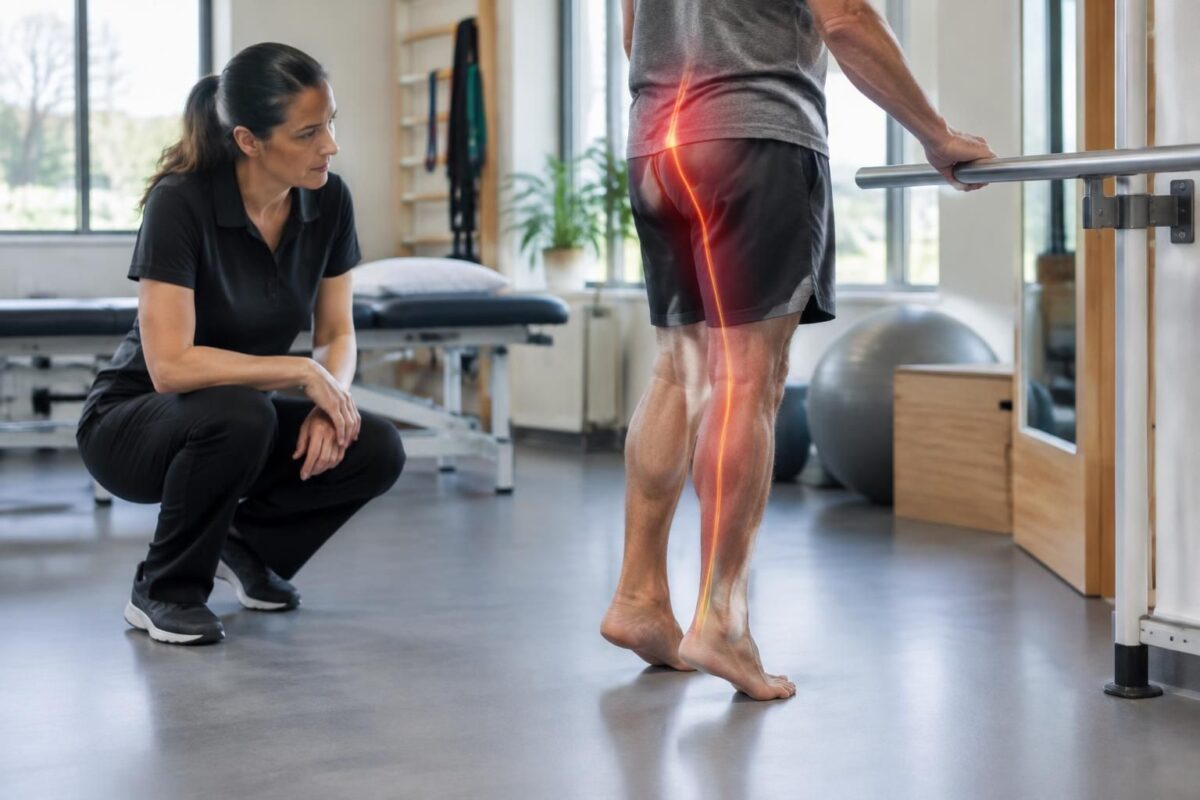
Between the L5 and S1 vertebrae lies a lumbar disc. A herniation or protrusion at this location may, in some cases, irritate the S1 root. Pain may start in the lower back or buttock, then radiate down behind the thigh and into the calf. It may sometimes reach the heel or the outer edge of the foot.
This pathway is a clinical guide, not proof. A visible anomaly on an MRI may be unrelated to the symptoms. The professional compares the imaging to the painful side, the neurological exam, and activity limitations. To learn more, visit our page on L5-S1 disc herniation and sciatic pain.
Signs sometimes associated with the S1 root
Pain or tingling at the back of the calf may be compatible with S1 irritation. Some individuals describe a burning sensation, electric shock, or numbness near the heel or the outer edge of the foot. A decrease in strength may also make it harder to push off with the foot or to walk on tiptoes.
Nerve territories vary from person to person and overlap. An examination of strength, sensitivity, and reflexes contributes to the assessment, but no reflex or isolated test confirms the cause on its own. Pain in the outer edge of the foot or pain primarily on the top of the foot may require a different analysis.
Sciatica in Terrebonne: L5 and difficulty lifting the foot
IN SHORT The L5 sciatica can cause pain or numbness on the side of the leg, the top of the foot, and the big toe, sometimes with difficulty lifting the foot. In Terrebonne, an evaluation compares strength, sensitivity, reflexes, and…
Sciatica in Terrebonne: S1 and difficulty standing on tiptoe
IN SHORT An S1 sciatica can irritate the nerve root associated with the calf and make it difficult to rise onto the balls of the feet. This sign should be evaluated with strength, sensitivity, reflexes, and walking: the pathway of…
Differentiating L5 and S1 profiles
An L5 injury can cause symptoms on the side of the leg, the top of the foot, or the big toe. Weakness in lifting the foot may also be observed. An S1 injury may more often affect the back of the calf, the heel, or the outer edge of the foot, sometimes with difficulty standing on tiptoes.
These markers do not reliably locate a lesion. The level of a disc visible on an MRI does not always correspond directly to the irritated root. To better understand the levels mentioned in a report, consult the guide on lumbar levels on an MRI or information on pain in the top of the foot and the L5 root.

Sciatica in Terrebonne: L4-L5 and pain towards the top of the foot
IN BRIEF A L4-L5 sciatica can radiate to the outer side of the leg and the top of the foot, sometimes reaching the big toe. This pathway can guide the assessment, though it does not suffice to confirm the cause:…

Sciatica in Terrebonne: pain in the big toe, L5 root or another cause?
IN BRIEF Pain in the big toe accompanied by pain in the buttock or leg may be compatible with irritation of the L5 root, but other causes are possible. In Terrebonne, the evaluation notably compares strength, sensitivity, and gait to…
A calf pain is not always sciatica
Pain in the calf can also arise from a muscle, joint, hip problem, or another nerve irritation. Some vascular causes may also produce leg pain. The context, the onset of symptoms, and associated signs are therefore as important as the painful location.
Pain that appears after exertion may be compatible with several causes. Note when it occurs, its pathway, and the activities that modify it. You can consult the article on pain radiating in the leg after physical exertion.

Sciatica in Terrebonne: why the affected root changes the pain path
IN BRIEF Sciatica is a pain related to the irritation of a lumbar nerve root, the path of which varies depending on the affected root. Damage to L5 can radiate to the top of the foot, while damage to S1…

Sciatica in Terrebonne: L4-L5 disc, L5-S1 disc, and leg pain
IN BRIEF Sciatica is pain that travels down the leg when a nerve root is irritated. An injury to the L4-L5 disc often affects the L5 root; an L5-S1 injury affects the S1 root. The path of the pain and…
What is evaluated during a consultation in Terrebonne
The consultation focuses on the history of symptoms and their concrete effect on daily life. The professional may ask when the pain started, whether it radiates down one or both legs, and if walking, sitting, sleeping, or working modifies it.
Symptom pathway and functional examination
The assessment may include walking, mobility, strength, sensitivity, and clinical tests chosen according to the symptoms. New or progressive weakness requires particular attention. The goal is to determine if the entire picture warrants conservative management or referral to a medical professional.
Imaging and other examinations
If you have already undergone an MRI, X-ray, or other examination, bring the report and, if possible, the images. The professional can relate them to the side and level of the symptoms. An image alone cannot determine the cause of the pain or the appropriate treatment.

Sciatica in Terrebonne: understanding lumbar levels on an MRI
IN BRIEF Sciatica may be related to irritation of a lumbar nerve root. A lumbar MRI shows the disks and nerves at different levels, such as L4-L5 or L5-S1, to help identify an abnormality and compare it with symptoms. In…

Sciatica L4-L5 in Terrebonne: possible pain, numbness, and weakness
IN BRIEF L4-L5 sciatica refers to pain related to irritation of a nerve root in the lower back. It can radiate to the buttock and leg, with numbness or weakness. Identifying these symptoms helps guide evaluation and care. In Terrebonne,…
Care options and limitations
The options depend on the evaluation, the stability of the symptoms, neurological signs, and functional goals. A conservative strategy may be discussed when the picture is stable and no warning signs require urgent medical evaluation.
The motorized neurovertebral decompression may be considered for certain individuals after evaluation. It is not suitable for everyone and does not reposition a disc. It does not guarantee the disappearance of symptoms or avoidance of surgery. If a trial is proposed, its effectiveness must be reassessed based on observable goals, such as walking, sleeping, or tolerance for sitting. If the expected improvement does not occur, the plan should be reexamined.
The TAGMED Clinic is located at 1150 Lévis Street, Suite 200, Terrebonne, QC J6W 5S6. To learn about the services and request an evaluation, visit the page on sciatica treatment in Terrebonne.
When does sciatic pain require urgent help?
Quickly consult a medical service in case of new loss of bowel or bladder control, numbness in the saddle area or perineum, or significant or progressive weakness. Recent foot drop, increasingly giving way of a leg, pain after a major trauma, fever, or unusual overall deterioration also justify prompt medical evaluation.
These signs should not wait for a routine consultation or treatment session. Persistent nighttime pain also deserves evaluation, especially if it worsens or is accompanied by other symptoms. Consult the information on night pain in the leg.
Frequently Asked Questions About L5-S1 and Calf Pain
Does an L5-S1 herniation always cause calf pain?
No. A visible herniation at L5-S1 may not cause any symptoms. When an S1 root is irritated, pain may affect the buttock, back of the leg, and calf, but the path varies from person to person.
Is calf pain enough to confirm sciatica?
No. Calf pain can have several causes. The path of pain, sensitivity, strength, reflexes, function, and available tests must all be considered together.
Do I need an MRI?
Not necessarily. The need for imaging depends particularly on evolution, warning signs, and clinical questions. A medical professional can determine if a test is indicated and when.
Can pain after exertion be related to L5-S1?
It’s possible, but exertion may also trigger muscle pain or other irritation. An examination helps better distinguish potential causes.
About the author
Sylvain Desforges, B.Sc., D.O., N.D., osteopath and naturopath, is the founding president of TAGMED and the ACMA association. He focuses his practice on chronic pain in the spine, back pain, and pain compatible with sciatica.
Through SOS Sciatique, he publishes educational content on symptoms, possible causes, and non-surgical approaches that can be discussed based on the evaluation. The care available at the TAGMED Clinic depends on the case and the professional involved.
Medical Disclaimer
The information published on SOS Sciatique is provided for educational purposes. It does not replace a consultation, diagnosis, opinion, or treatment performed by a doctor or another authorized healthcare professional. The author of this article is neither a doctor nor a specialist in a medical specialty recognized by the Collège des médecins du Québec. The osteopathy, manual medicine, or functional support approaches described on this site do not constitute medical acts and are not intended to replace medical follow-up. In case of loss of urinary or intestinal control, anesthesia in the saddle area, significant or progressive weakness, fever, recent trauma, severe pain, or rapid worsening, consult a physician or emergency service. Also read our Legal Notice.
Medical Disclaimer: The information and advice provided on this site do not replace the advice, diagnosis, or treatment by a healthcare professional. Please note that Dr. Sylvain Desforges, osteopath, is neither a doctor of medicine nor a physician, and is not a specialist in a medical specialty as defined by the Collège des médecins du Québec. Manual medicine, functional medicine, and sports medicine as described on this site exclude any treatment or medical diagnosis by a doctor or medical specialist. Always consult your physician for any medical questions. For more details, please read our full Legal Notice.
Consult urgently in case of new urinary or intestinal troubles, numbness in the saddle area, or significant or progressive weakness.Sciatica in Terrebonne: L5-S1 Markers and Calf Symptoms
Possible Markers
Evaluation in Terrebonne

Calf pain associated with lower back pain or discomfort in the buttock may be consistent with nerve irritation related to the L5-S1 region, but does not confirm it by itself. At the TAGMED Clinic in Terrebonne, the evaluation aims to specify the symptom path, check strength and sensitivity, consider previously conducted tests, and discuss a plan tailored to your situation.
Calf Pain: What Can the L5-S1 Region Indicate?
The L5-S1 region corresponds to the junction between the last lumbar vertebra and the sacrum. Irritation of a nerve root at this level can contribute to pain that starts from the lower back or buttock and radiates down the thigh, calf, ankle, or foot. The pain may be described as burning, electric shock, or stabbing; tingling or numbness may also be present.
The trajectory provides clues but does not, on its own, allow for a certain identification of the affected root. A profile associated with S1 can notably affect the back of the calf or the outer edge of the foot. A profile associated with L5 might project onto the side of the leg and the top of the foot. Furthermore, an injury located near the L5-S1 disk does not automatically mean that symptoms come from the same root in every person.
Why individualized assessment is important
Pain in the calf is not always sciatica. It may also be related to the hip, pelvis, muscles, a peripheral nerve, or a circulatory problem. Therefore, the assessment takes into account the affected side, the trajectory of the pain, sensitivity, strength, walking, and activities that worsen or relieve symptoms.
Exams and imaging
If you have already had an MRI, X-ray, or other examination, bring the results to the consultation. A herniated or protruding disc visible in imaging may be present without explaining all the symptoms. The images must be correlated with the affected side, the clinical examination, and your function; they are not sufficient, on their own, to establish the cause of the pain.
Management options in Terrebonne
After the assessment, conservative options may be discussed based on the profile and functional goals. They may include information, maintaining tolerated activities, adapted exercises, or certain clinical approaches. A motorized neurovertebral decompression may be considered for some individuals after verifying its relevance and contraindications. Traction is not systematically recommended for all low back pain or sciatica and does not guarantee a result.
A reasonable plan specifies the goals—such as walking better or tolerating a seated position for a longer time—along with the re-evaluation criteria. If leg pain, strength, or function do not improve sufficiently, the strategy should be reviewed. Depending on the situation, a medical or specialist opinion may also be indicated.
When to seek urgent help
Do not delay consulting a medical service in case of new loss of bladder or bowel control, numbness in the saddle area, significant or progressive weakness, or recent onset of foot drop. Pain that worsens rapidly, fever, or significant trauma also warrants appropriate medical assessment.
Consult at the TAGMED Clinic in Terrebonne
The TAGMED Clinic welcomes individuals who wish to have their pain radiating to the calf evaluated at the following address: 1150 Lévis Street, Suite 200, Terrebonne, QC J6W 5S6. A consultation allows for an overview of symptoms and discussion of tailored options, without presuming a diagnosis or particular outcome.
Medical warning: this content is educational and does not replace a consultation or diagnosis made by a physician or another authorized healthcare professional. The author is neither a physician nor a specialist in a medical field recognized by the Collège des médecins du Québec. The approaches described do not replace medical follow-up.
| Marker | To remember |
|---|---|
| Calf pain | May accompany lumbar nerve irritation, but does not confirm sciatica on its own. |
| S1 Profile | Pain often at the back of the calf, sometimes toward the heel or the outer edge of the foot. |
| L5 Profile | Symptoms sometimes on the side of the leg and the top of the foot. |
| L5-S1 Level | An injury at this level may involve a nerve root; the examination must specify which one. |
| Assessment | The trajectory, sensitivity, strength, and function are considered together. |
| Imaging | An MRI is interpreted based on its side and level, related to the symptoms. |
| Consultation in Terrebonne | Evaluation at the TAGMED Clinic, at 1150 Lévis Street, Suite 200. |
| Urgency | Progressive weakness, saddle anesthesia or new urinary or bowel issues require urgent medical evaluation. |
Illustrative testimonials on L5-S1 pain and symptoms in the calf in Terrebonne
Important: the testimonials below are fictional and composite examples, written for informational purposes. They do not come from identifiable patients and do not predict the outcomes of a consultation or treatment.
Illustrative example — pain extending to the calf: “My pain would start in the lower back and the hip, then travel down the back of my thigh to the calf. During the assessment, the trajectory of the symptoms, sensitivity, strength, and activities that aggravated the pain were examined. I was also able to present my MRI report to put it in context with my symptoms.”
Illustrative example — numbness and tingling: “In addition to the pain in my calf, I felt tingling in my foot. I was explained that signs associated with L5 or S1 can serve as markers, but they are not sufficient on their own to confirm the cause. The proposed plan had to take into account the examination and my function.”
Illustrative example — effects on walking and work: “Sitting for long periods and walking a certain distance became difficult. The assessment focused on how long I could walk or sit, as well as on movements that modified the symptoms. Conservative options and their limits were discussed before any decision.”
Pain in the calf may be consistent with irritation of a lumbar nerve root, but it may also have other causes. An MRI abnormality, such as a protrusion or herniation at L5-S1, is not enough to establish the source of the symptoms: the side, level, neurological examination, and functional limitations must be considered together.
At the TAGMED Clinic in Terrebonne, at 1150 Lévis Street, Suite 200, the assessment may include the history of symptoms, their trajectory in the leg, sensitivity, strength, walking, and examinations already available. Management options are discussed based on the situation, with objectives and re-evaluation criteria.
In case of loss of bladder or bowel control, numbness in the saddle area, significant or progressive weakness, or recent onset of foot drop, quickly request urgent medical evaluation rather than waiting for a routine consultation.
This information is educational and does not replace a consultation, diagnosis, or advice from an authorized healthcare professional.
Sciatica in Terrebonne: calf pain and possible involvement of L5-S1
A pain that radiates from the lower back or buttock down to the calf may indicate lumbar radicular pain, often referred to as sciatica. In Terrebonne, the TAGMED Clinic offers an evaluation aimed at better understanding the path of the symptoms, their impact on activities, and possible lumbar causes. The consultation takes place at 1150 Lévis Street, Suite 200, Terrebonne. The goal is to establish an individualized profile, rather than concluding a diagnosis solely based on the pain experienced.
The level L5-S1 corresponds to the region between the last lumbar vertebra and the sacrum. A herniated or protruded disc in this area can sometimes irritate a nerve root. Depending on its position and the affected structures, the S1 root may be involved; some problems in this region can also affect L5. However, the level indicated on an image alone is not sufficient to explain the symptoms: it is necessary to check whether the side and distribution observed align with the clinical examination.
When the S1 root is irritated, the pain may follow the back of the thigh and calf, then reach the heel or the outer edge of the foot. Burning sensations, electric discharge, tingling, or numbness may also occur. Weakness when pushing on the foot or walking on tiptoes may also be assessed. These indicators are useful, but no pattern of pain, reflex, or isolated test alone confirms an S1 involvement.
Pain in the calf is not always sciatica. It may also stem from the hip, knee, muscles, a peripheral nerve, or a circulatory issue. This is why the evaluation focuses on the onset of symptoms, their evolution, the positions that exacerbate or relieve them, as well as walking, sleeping, working, and daily activities. Strength, sensitivity, mobility, and certain reflexes may be examined as needed.
If an MRI, X-ray, or other examination is already available, the report can be considered alongside the clinical observations. An image may show a protrusion or narrowing without necessarily being the cause of the pain. The significance of an anomaly depends on its correlation with the affected side, neurological signs, and functional limitations. Additional imaging is not automatically necessary; its relevance depends on the context and may require medical advice.
After the evaluation, conservative options are discussed based on the results, objectives, and the individual’s tolerance. These may include information, gradual maintenance of tolerated activities, tailored exercises, or manual or instrumental clinical approaches when deemed relevant. Motorized neurovertebral decompression may be considered for certain profiles, but it is not suitable for everyone, does not “realign” a disc, and does not guarantee a result. Effects should be monitored using concrete goals, such as walking or duration in a sitting position; the plan is reassessed if the progress is unsatisfactory.
An urgent medical evaluation is necessary in cases of recent loss of bladder or bowel control, numbness in the saddle area, significant or rapidly progressive weakness, or the onset of foot drop. Pain following major trauma, accompanied by fever or unusual general deterioration, also requires prompt attention. These signs should not wait for a routine consultation.
About the author
Sylvain Desforges, B.Sc., D.O., N.D., osteopath and naturopath, is the founding president of TAGMED and the ACMA association. His practice focuses on chronic spinal pain, low back pain, and symptoms consistent with sciatica. The services and interventions available depend on the professional, their qualifications, and the evaluation of each situation.
Medical disclaimer: this information is provided for educational purposes and does not replace a consultation, diagnosis, or treatment by a doctor or other licensed healthcare professional. The author is neither a physician nor a specialist in a medical specialty recognized by the Collège des médecins du Québec. The approaches described do not constitute medical acts and do not replace medical follow-up.
A pain that radiates from the lower back or buttock down to the calf may be compatible with irritation of a lumbar nerve root, particularly in an L5-S1 context. In Terrebonne, the evaluation aims to examine the path of symptoms, sensitivity, strength, and effects on walking or activities, without concluding based solely on imaging.
L5-S1 and calf pain
The L5-S1 region corresponds to the junction between the fifth lumbar vertebra and the sacrum. A disc injury at this level can sometimes irritate a nerve root and cause pain radiating to the buttock, back of the calf, heel, or outer edge of the foot. However, the path varies from person to person: calf pain does not confirm, on its own, an S1 root involvement. To better understand the possible link with an L5-S1 discopathy, symptoms must be related to the clinical examination and the affected side.
Nerve irritation may also be accompanied by burning sensations, electric shocks, tingling, or numbness. Weakness, difficulty walking on tiptoes, or changes in gait are also elements to report. To explore possible manifestations further, refer to information on sciatica with tingling, burning, or numbness in Terrebonne, leg weakness and loss of confidence while walking, as well as pain towards the little toe and the S1 root.
Symptoms can be influenced by sitting position, walking, or certain efforts. Some people notice worsening when driving for long periods, sneezing, or straining, but these reactions are not sufficient to identify the cause. Additional resources address pain that hinders prolonged driving, pain intensified by sneezing or effort, and sciatica felt in the calf.
At the TAGMED Clinic in Terrebonne, located at 1150 Lévis Street, Suite 200, the evaluation may take into account the history of symptoms, function, strength, and sensitivity, as well as any prior examinations when relevant. A herniation, protrusion, or narrowing visible on an MRI does not necessarily explain all symptoms: the image must correspond to the side, level, and clinical signs. To learn more about lumbar radiculopathy, sciatica associated with a lumbar disc herniation, or the causes and symptoms of sciatica, these resources can provide general guidance.
A conservative management approach can be discussed based on the profile, safety, and functional goals; it should be tailored and re-evaluated according to progress. In the presence of significant or progressive weakness, recent foot drop, loss of bladder or bowel control, or numbness in the saddle area, a medical evaluation should be sought quickly rather than waiting for a routine appointment.

Dr Sylvain Desforges, B.Sc., D.O., N.D., osteopath, is the founding president of TAGMED and of the ACMA association. He dedicates his practice to chronic spinal pain, low back pain and symptoms compatible with sciatica, particularly when pain radiates toward the buttock, leg, calf, foot or toes.
Through SOS Sciatique, he publishes educational content on sciatica symptoms, possible causes such as disc herniation, disc narrowing, foraminal stenosis or irritation of a lumbar nerve root, as well as non-surgical approaches that may be considered according to the evaluation. At Clinique TAGMED, care may include, depending on the case, motorized neurovertebral decompression, specific osteopathic care or precision percussion.
For an evaluation related to sciatica treatment in Montreal / Mount Royal or sciatica treatment in Terrebonne, please consult the services available at Clinique TAGMED.
Medical disclaimer
The information published on SOS Sciatique is provided for educational purposes only and does not replace a consultation, diagnosis, opinion or treatment provided by a physician or another authorized healthcare professional. The author of this article is neither a medical doctor nor a specialist in a medical specialty recognized by the Collège des médecins du Québec. The osteopathic, manual medicine or functional support approaches described on this site do not constitute medical acts and are not intended to replace medical follow-up.
Consult a physician or emergency service in cases of loss of bladder or bowel control, anesthesia in the saddle area, significant or progressive weakness in the leg or foot, fever, recent trauma, severe pain or rapid worsening of symptoms. For more details, please read our Legal Notice.


