Disc herniation and lumbar flexion: why caution is necessary
15/10/2026
Sciatica in Montreal: L4-L5 disc, L5-S1 disc, and leg pain
16/10/2026
IN BRIEF
| Sciatica does not always prohibit squats, but a deep or loaded squat can aggravate symptoms, especially during a flare-up. Gradually resume with a neutral back and a comfortable range of motion, and stop if the pain travels down the leg. When in doubt, consult a healthcare professional. |
With sciatica, deep and loaded squats require caution: at the bottom of the movement, the lower back can round under strain, increasing pressure on the lumbar discs. It’s better to avoid them during a painful phase and, when symptoms stabilize, gradually resume with partial bodyweight squats while keeping the back neutral. Stop if the pain travels further down the leg.
Squats are not automatically forbidden in cases of sciatica, but they can provoke or worsen pain if the movement increases pressure on the lower back. The depth, load, technique, and intensity of the symptoms matter. During a flare-up or if pain travels down the leg, it’s best to suspend squats and seek medical advice before resuming. Sciatica refers to pain following the path of the sciatic nerve. It often starts from the lower back or buttock and can radiate down the thigh, leg, or foot. Nerve irritation can have various causes. Thus, the reaction to a squat depends on the origin of the pain and its stage. During a squat, the lower back bears part of the effort. Significant lumbar flexion, especially with a load, can increase stress on the structures of the back. A deep descent can also cause rounding of the lower back in some individuals. It is not the squat alone that determines the risk; the combination of load, depth, fatigue, and posture also counts. Caution is particularly important if the pain increases during the movement, travels further down the leg, or is accompanied by tingling. To better understand the connection between trunk flexion and pain related to the disc, refer to this article on caution to take with trunk flexion. A deep descent can tilt the pelvis and round the lower back, especially if mobility or movement control is limited. A significant load further increases the effort required from the trunk. If the pain is active, this type of squat may be poorly tolerated. Continuing a set while pain radiates down the leg is not a good guideline. Pain that progresses towards the calf or foot, or is accompanied by numbness, justifies stopping the movement and an appropriate assessment. After a period of rest, jumping back in with the same loads and depth as before can exceed the back’s tolerance. Resuming depends on the evolution of symptoms and the advice of a professional, and not on the same timeline for everyone. During a flare-up, when pain is intense or disrupts daily activities, it is prudent to pause squats. The goal is to avoid movements that significantly worsen symptoms without imposing strict prolonged rest. General recommendations favor maintaining tolerated activities, but the choice of movements should consider each individual’s situation. When the pain stabilizes, a healthcare professional can help decide if squats are suitable and under what conditions. Load, range, and technique should be evaluated according to symptoms. For additional guidelines, read these tips on weight training with sciatica and the precautions to take, as well as recommendations for resuming weight training. You can also consult these resources dedicated to weight training and sciatica, the practice of weight training despite sciatica, and precautions for adapting training. Observe the pain during and after activity. Mild and stable discomfort does not always mean the movement causes injury. Conversely, worsening pain that travels further down the leg or persists more after exertion indicates that the movement is not well tolerated at that moment. Stairs can also reveal a decrease in tolerance to effort. If pain occurs while descending, see information on sciatica and descending stairs. If it occurs while ascending, this article addresses pain related to climbing stairs. Do not attempt to “unblock” the back by forcing a manipulation or a painful movement. To learn more about manipulations, you can read this resource on osteopathic manipulations and joint mobility. Seek medical advice if pain persists, worsens, or returns with each attempt to resume. A professional can investigate the cause of sciatica and determine if squats are appropriate in your situation. Consult promptly in the event of new weakness in a leg or foot. Loss of sensation around the genitals or anus, difficulty urinating, or loss of control over urination or stool calls for urgent medical evaluation. In these circumstances, do not perform squats and contact emergency services. Medical Disclaimer: The information and advice provided on this site do not replace the opinion, diagnosis, or treatment of a healthcare professional. Please note that Sylvain Desforges, B.Sc., D.O., N.D., Doctor of Osteopathy, is neither a medical doctor nor a physician and is not a specialist in any medical specialty as defined by the Collège des médecins du Québec. Manual medicine, functional medicine, and sports medicine as described on this site exclude any treatment or medical diagnosis made by a physician or medical specialist. Always consult your doctor for any medical questions. For more details, please read our full Legal Notice.How can a squat aggravate sciatica?
Which squats require the most vigilance?
Deep squat with load
Squatting despite pain
Squats after too quick a return
Should squats be stopped during sciatica?
How to assess tolerance to movement?
When to seek medical advice?

With sciatica, squats are not systematically prohibited, but their depth, load, and technique can influence symptoms. During periods of acute pain, it is better to set aside deep and loaded squats. When the pain is more stable, a gradual return, first without weight and with controlled back positioning, may be considered if the movement does not provoke pain in the leg.
Why squats require caution
Sciatica corresponds to pain related to the irritation or compression of the sciatic nerve. Depending on its cause and phase of progression, certain movements may exacerbate symptoms. During a squat, the lower back should remain as stable as possible. If the pelvis rolls at the bottom of the movement and the back rounds, especially under load, the effort may be less tolerated.
The risk does not solely depend on the weight lifted. Technique, range, and fatigue are also important: a poorly controlled light load may be more problematic than a well-adapted and mastered movement. Therefore, deep loaded squats should be avoided until the pain is stabilized, especially if the descent rounds the lower back or triggers pain that radiates down the leg.
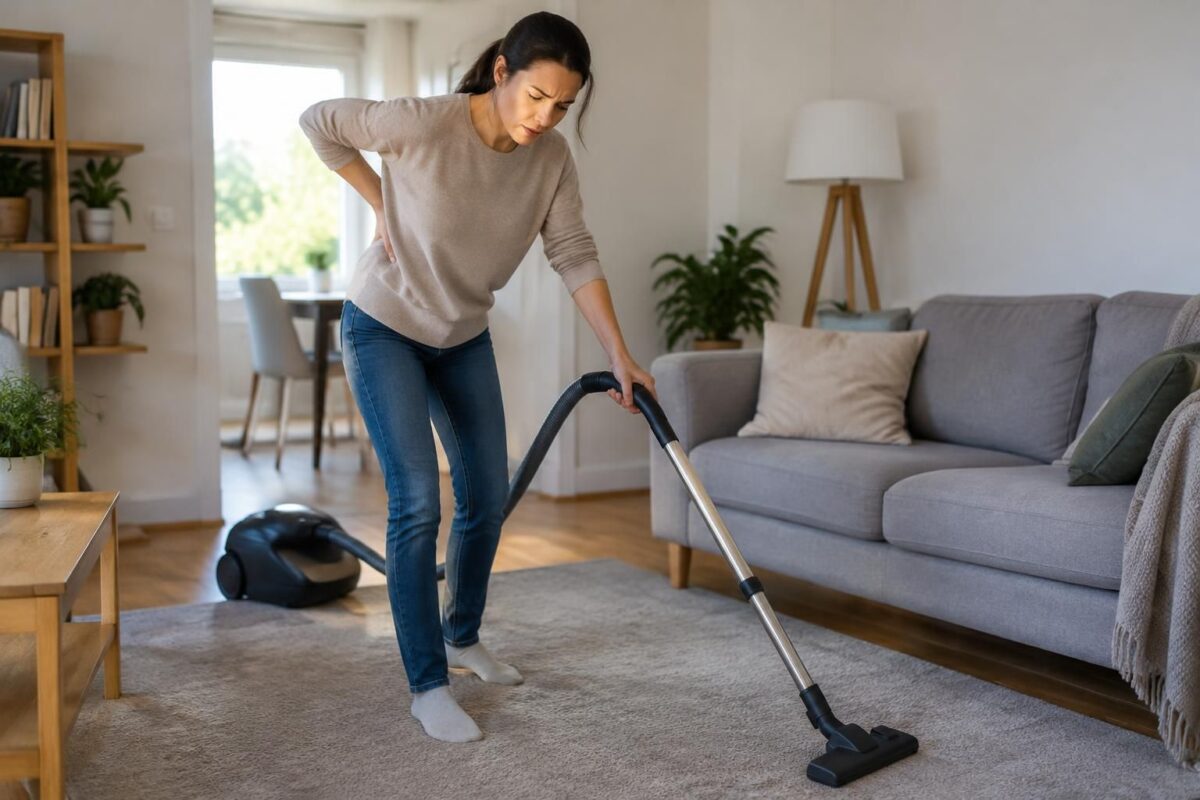
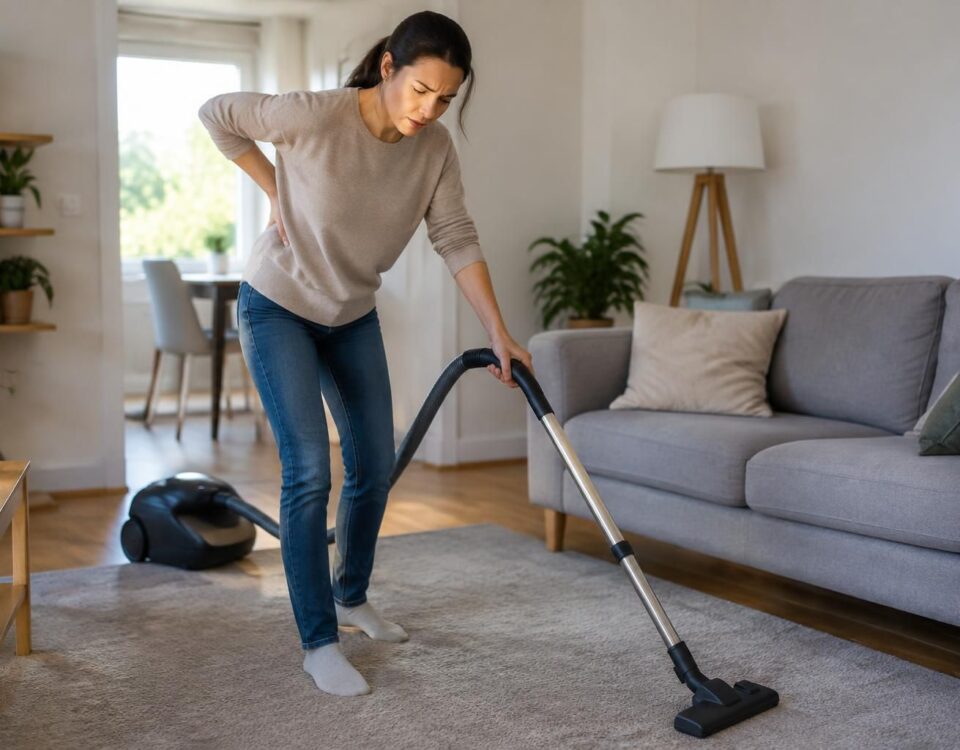
Sciatica and vacuuming: repetitive movement to watch out for
IN BRIEF Vacuuming with a sciatica can trigger pain because repeated bending and twisting strain the back. Break up the cleaning, keep the device close to you, and turn with your feet rather than twisting. Take a break if the…

Sciatica and household chores: twists, bends, and loads
IN BRIEF Sciatica can be aggravated by bending, twisting, and carrying loads while doing housework. Breaking tasks into smaller parts, taking breaks, and adjusting movements help manage effort without necessarily stopping everything. In Montreal, an assessment can help tailor activity…
Adapting squats to the evolution of symptoms
During an acute episode
If the pain is sharp, you have difficulty standing, or daily movements are hard, do not try to test your strength with squats. First, allow the most painful phase to ease and follow the management advice agreed upon with a healthcare professional. Prolonged strict rest is generally not desirable, but that does not mean you should continue an exercise that worsens the pain.
When the pain becomes more manageable
Start again with easy-to-control movements, such as sitting down and then standing up from a chair, without load and within a comfortable range. Keep your feet well anchored, your torso stable, and your back in a natural position. Avoid lowering yourself further if your pelvis tilts or your back rounds.
If this step is well tolerated, you can gradually increase the range or the number of repetitions, but not all at once. Wait to assess how you feel during the exercise and after the session before adding weight. A physical therapist can help you correct your movement and choose a progression suitable for your situation.
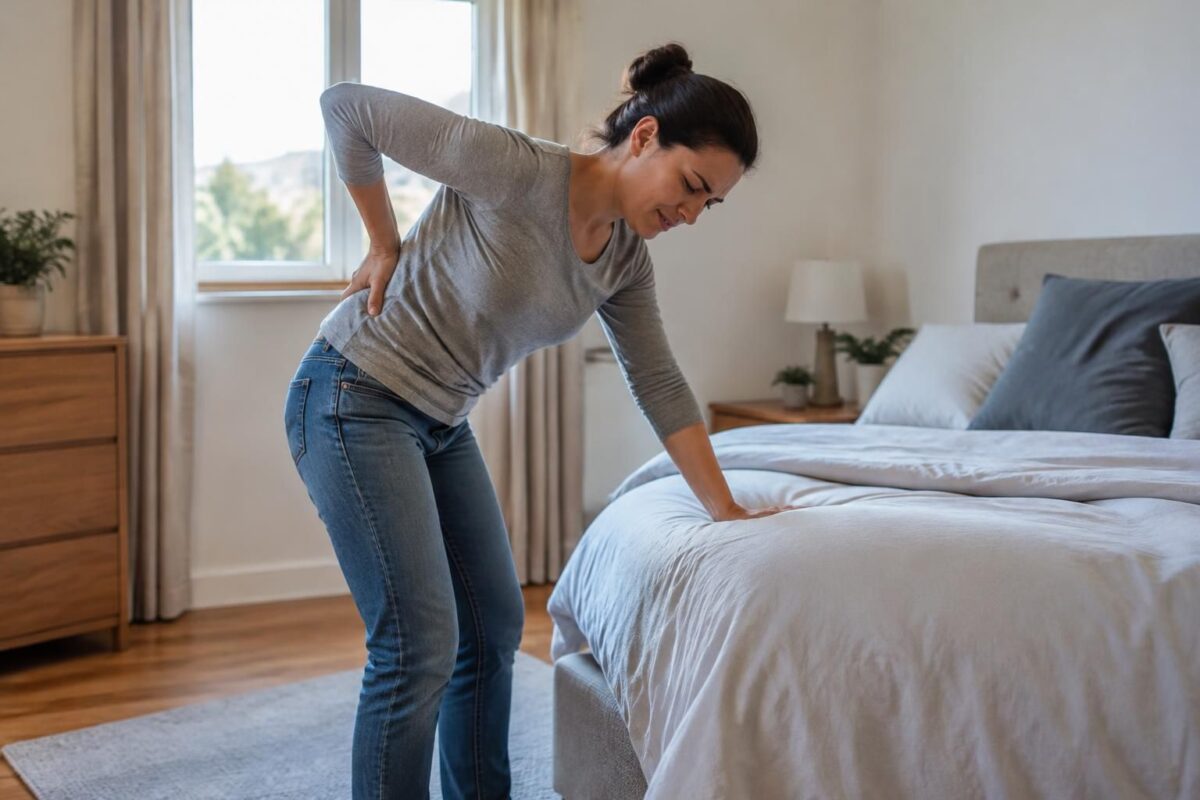
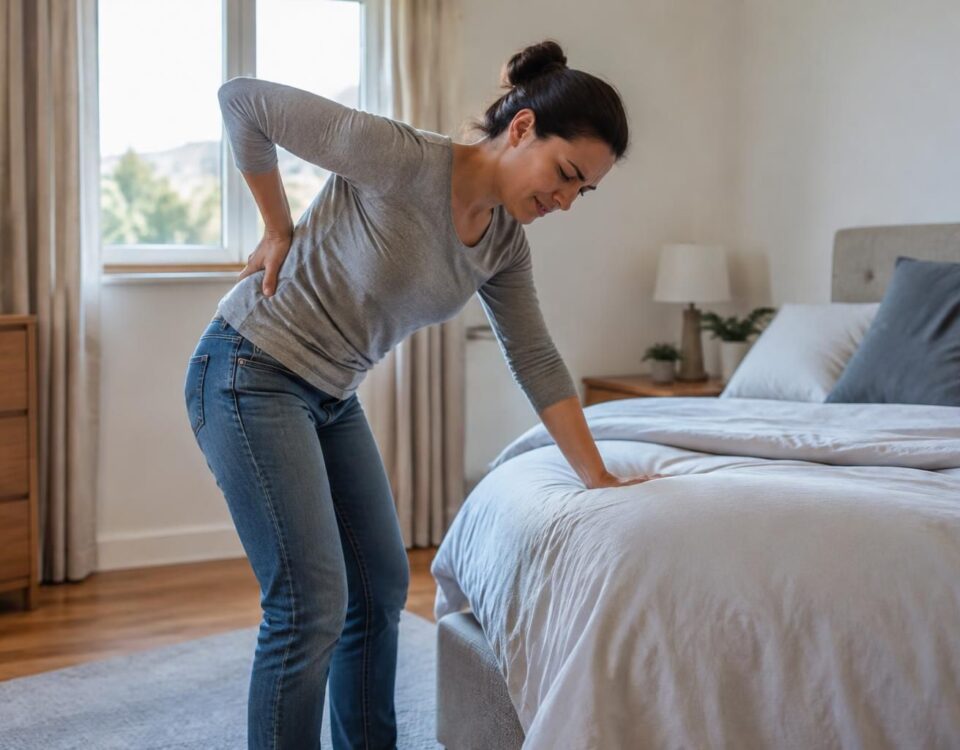
Sciatica and Making the Bed: Repeated Flexion and Lumbar Irritation
IN SHORT Sciatica is pain related to irritation or compression of the sciatic nerve. Making your bed can strain the lower back if bending is repeated, especially when rounding the back or twisting the torso. To limit lumbar irritation, bend…
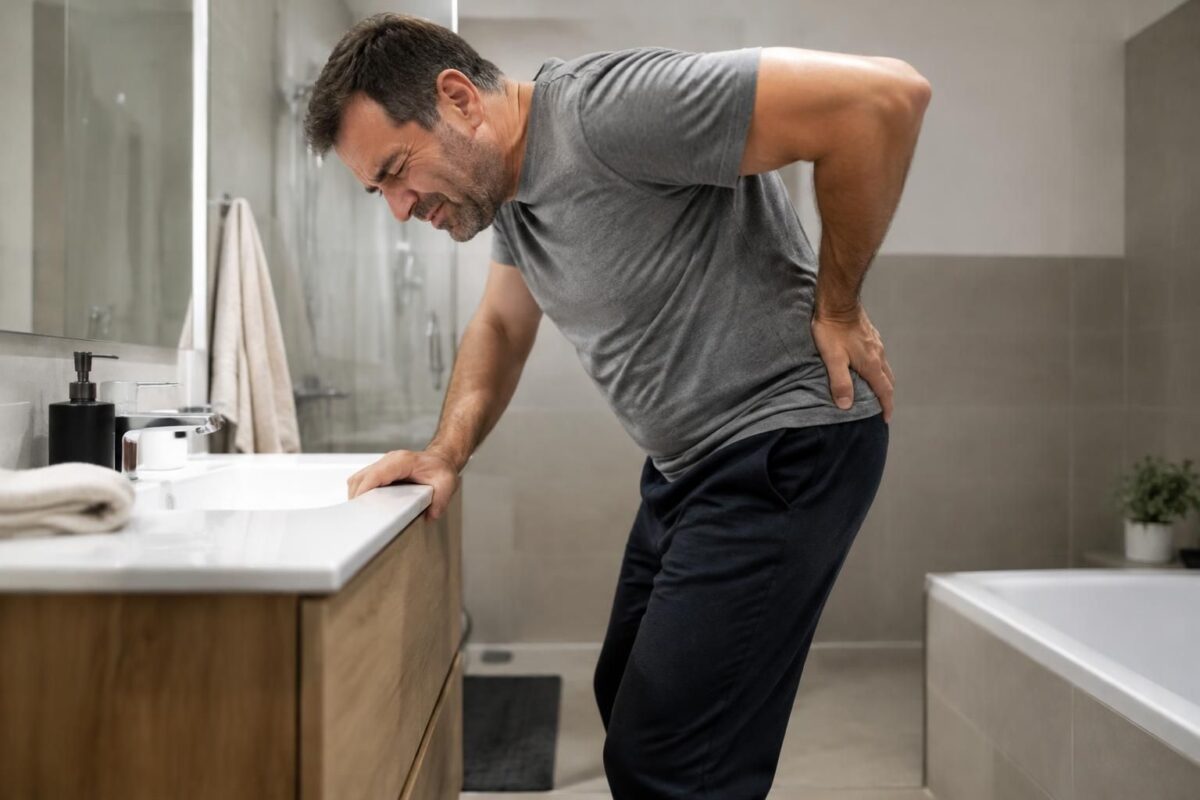
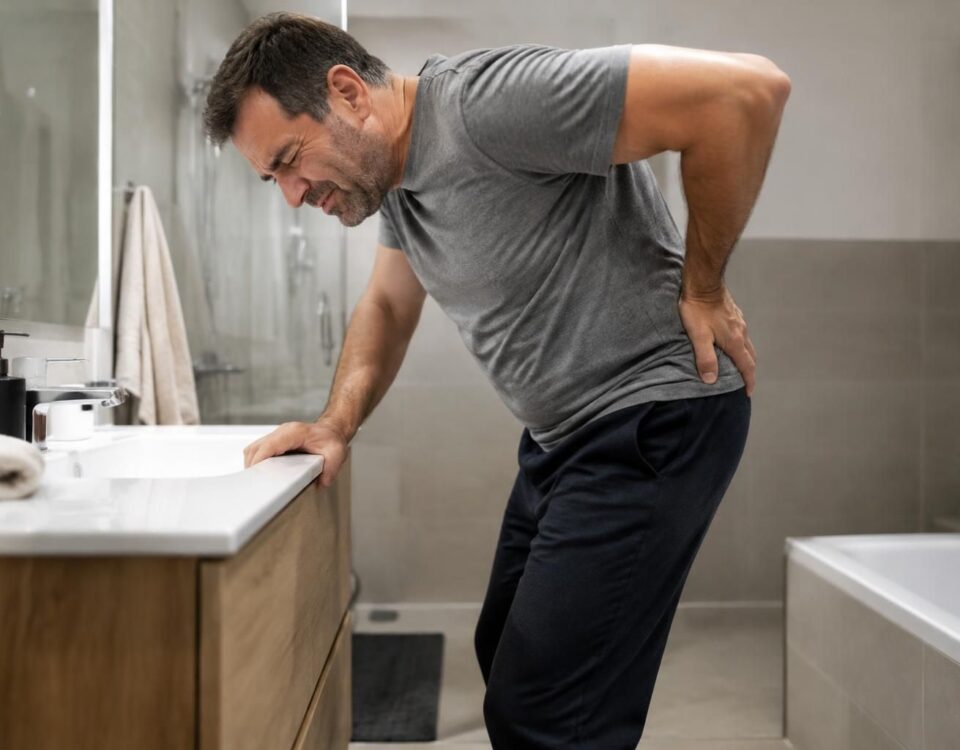
Sciatica and bending over the sink: pain in the leg
IN BRIEF Sciatica is pain related to irritation or compression of the sciatic nerve, which can extend from the lower back down to the leg. Bending over the sink can exacerbate the pain, especially if this position increases pressure on…
When to stop the movement
Stop the squat if the pain noticeably increases or radiates further into the buttock, thigh, or foot. Mild muscle discomfort is not necessarily a sign of worsening, but nerve pain that spreads warrants caution. Do not take medication solely to mask symptoms to continue training.
If squats remain uncomfortable, temporarily prioritize easier exercises to adjust, such as walking according to your tolerance or gentle core work that does not provoke pain. Strengthening should resume gradually: aim to regain stable movement rather than lift heavy quickly.
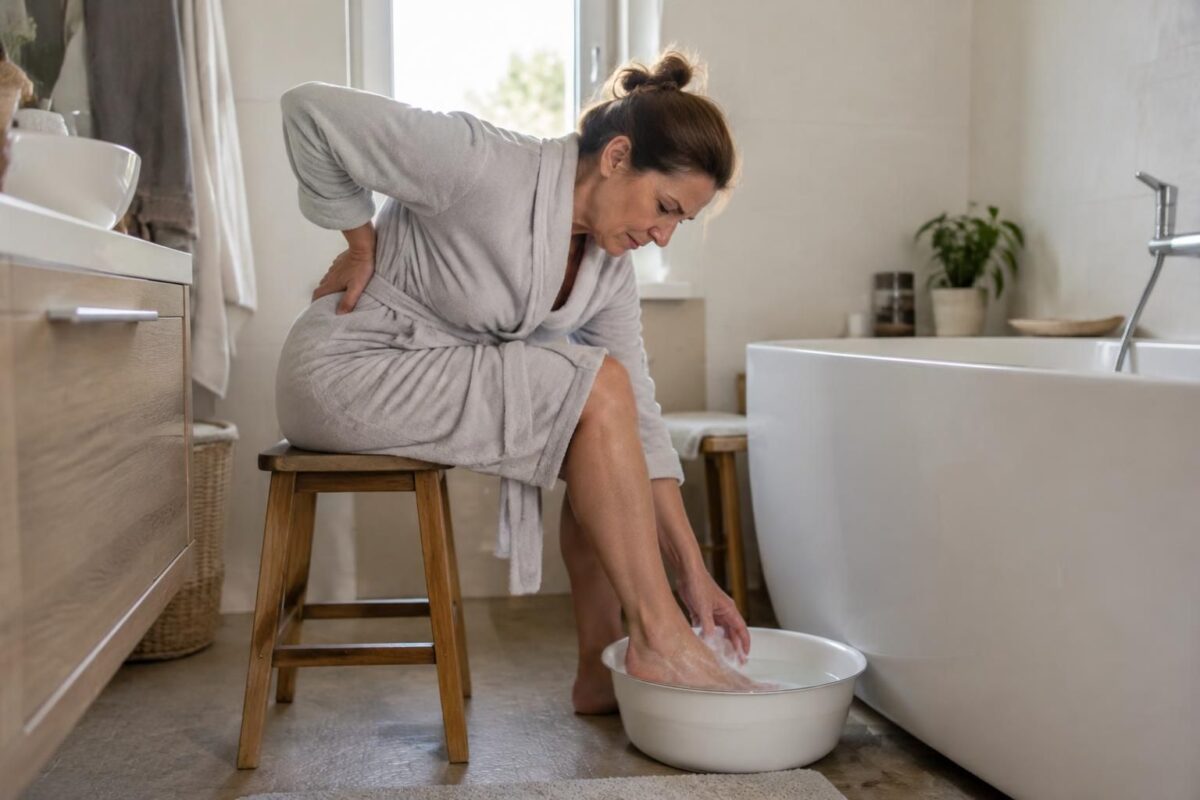
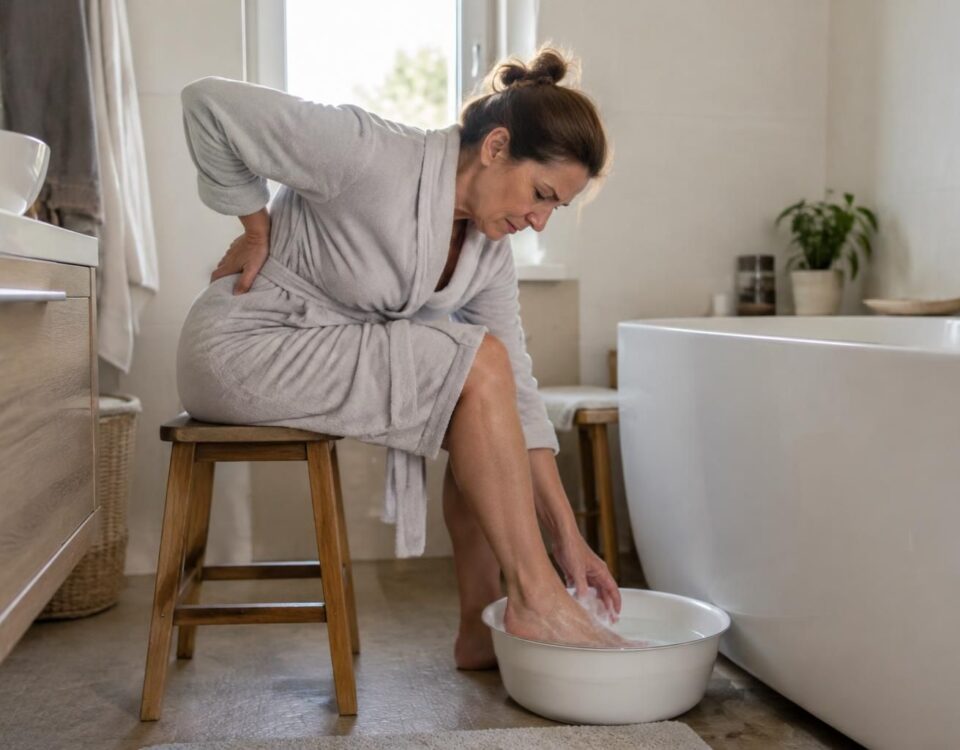
Sciatica and washing feet: lumbar flexion to monitor
IN BRIEF Sciatica can make washing your feet uncomfortable, as bending forward accentuates lumbar flexion and may trigger pain. To limit strain, sit down, bring your foot closer to you, or use a long-handled aid. These adjustments make personal hygiene…

Sciatica and dressing: daily gestures to adapt
IN BRIEF Sciatica can make dressing uncomfortable, but a few simple gestures help limit tension. Sit down to put on pants, socks, and shoes, choose easy-to-wear clothing, and avoid bending or twisting suddenly. These adjustments make daily dressing easier without…
Signs that require medical advice
Consult quickly in case of new weakness in one leg, loss of sensitivity around the genital area or anus, or urinary or intestinal issues. These symptoms require prompt medical evaluation. If pain persists, worsens, or systematically returns when you resume squats, seek advice from your doctor or a physical therapist before continuing.
These recommendations are informative and do not replace an individual evaluation by a healthcare professional.
| Reference | Advice |
|---|---|
| Acute episode | Avoid loaded squats. |
| Unstable pain | Postpone deep squats. |
| Resumption | Start without load, in reduced range. |
| Back position | Keep the lower back neutral. |
| Progression | Increase effort gradually. |
| Pain in the leg | Stop the movement if it triggers it. |
| Doubt about technique | Consult a professional. |
The testimonials below are fictional and illustrate possible situations. Each sciatica is different: a movement tolerated by one person may awaken pain in another. In case of doubt, consult a healthcare professional.
“I wanted to resume squats as before, while my pain was still radiating down my leg. As soon as I went deep with a bar, the symptoms intensified. I set aside the weights and resumed more gradually with adapted exercises.” — Marc, 42 years old
“I thought a light squat wouldn’t cause problems. But my technique deteriorated as soon as I got tired: my lower back rounded and the pain returned. My physical therapist helped me reassess the range and work first without load.” — Élodie, 36 years old
“During the episode, I preferred to avoid deep squats and weights. When the pain became more stable, I resumed with partial bodyweight movements. The most important thing was to gradually increase the effort without trying to regain my performance right away.” — Thomas, 51 years old
These experiences remind us that with sciatica, squatting is not necessarily prohibited, but it may be inappropriate during a painful phase. A deep bend, a heavy load, or a rounded back can increase discomfort. The priority is to maintain controlled movement and not to push through.
“I stopped my set as soon as the pain began to radiate further down my leg. I realized this was not a discomfort to ignore to finish the workout. After consulting a professional, I resumed with exercises that were better tolerated.” — Sarah, 45 years old
If a squat triggers or increases a pain radiating down the leg, stop the exercise. During an acute episode, avoid resuming deep or loaded squats without appropriate advice. Resumption can be done gradually, based on your symptoms, technique, and the guidance of your doctor or physical therapist.
“I initially worked on core stability and movements without load, rather than testing my limits with the barbell. This allowed me to regain confidence before reintroducing certain exercises, step by step.” — Nicolas, 39 years old
Sciatica refers to pain that follows the path of the sciatic nerve, from the lower back or buttock down the back of the thigh, sometimes all the way to the foot. It may be accompanied by tingling, numbness, or a feeling of weakness. When it is present, squats are not automatically prohibited, but their execution and the timing chosen for performing them require special attention.
The squat engages the legs and hips while requiring the trunk to stabilize the body. If the lower back rounds during the movement, particularly when descending very low or carrying a significant load, the lumbar spine may be more stressed. This position does not necessarily provoke sciatica in everyone, but it may worsen symptoms in some individuals, especially if the nerve is already irritated.
Caution is therefore required during an acute episode, when the pain is sharp, travels down the leg, or makes daily activities difficult. During this phase, it is better to avoid deep and loaded squats, as well as any exercise that intensifies the symptoms. Prolonged strict rest is generally not desirable, but it does not mean that one must maintain their usual training at all costs. A gradual return is prepared based on the progression of the pain.
When symptoms are more stable, an adapted version may sometimes be considered: partial squat, without load or with very light resistance, while keeping the back in a comfortable and controlled position. It is helpful to descend only to the range that does not trigger pain radiating down the leg. The quality of the movement, stability, and consistency matter more than the depth or the weight lifted. If the pain increases during the exercise or persists after the session, the movement should be interrupted and progression reassessed.
Before reintroducing loads, it may be relevant to return to gentle activities and trunk stabilization exercises, as long as they are well tolerated. A healthcare professional, such as a doctor or a physiotherapist, can help determine if the squat is appropriate for the situation and adjust the technique accordingly. The cause of the symptoms, their intensity, and any previous history influence the recommendations: general advice does not replace an individual evaluation.
A new weakness in the leg, a loss of sensation in the perineal area, or urinary or bowel issues require prompt medical attention. These signs should not be managed simply by changing one’s training. Outside of these urgent situations, pain that worsens or does not improve should also be discussed with a professional.
Dr Sylvain Desforges specializes in osteopathy, naturopathy, and manual medicine. Founder and president of TAGMED clinics and the ACMA association, he dedicates his career to health innovation and the management of chronic pain. His approach incorporates advanced technologies, such as spinal decompression, laser, and shockwave therapy, aiming to provide care based on scientific data tailored to patients’ needs.
In the case of sciatica, squats are not automatically prohibited, but their depth, load, and technique may influence symptoms. As long as the pain is not stabilized, it is better to avoid deep loaded squats, favor a gradual return, and interrupt any movement that increases pain in the leg.
Sciatica and Squats: Essential Guidelines
The squat engages the lower back, especially when the load is significant or when the pelvis rolls at the bottom of the movement. This position can increase lumbar flexion under load and further irritate an already sensitive area. Caution is therefore particularly important during an acute episode or when each repetition exacerbates symptoms. To better understand possible adaptations, check out these tips on squats and sciatica pain.
The return depends on your situation and the cause of the sciatica. When the pain becomes manageable and daily activities are better tolerated, you may consider partial squats, initially without load, keeping the back in a comfortable and controlled position. If the movement causes pain to radiate down the leg, stop the set rather than trying to push through. Additional guidelines are available in this guide on resuming physical activity with sciatica.
Before reintroducing loads, establish a base of tolerated movement, particularly with walking and gentle core exercises if these do not trigger symptoms. Then gradually increase the range and load without trying to immediately regain your usual performance. For movement comparisons and training adaptations, you can refer to these tips on weight training with sciatica or a herniated disc.
Seek advice from a doctor or physiotherapist if the pain worsens with each attempt, persists, or is accompanied by leg weakness. Urinary issues or loss of sensation in the genital area require urgent medical evaluation. This information remains general: a professional can help determine if the squat is suitable for your case and choose a safe progression.
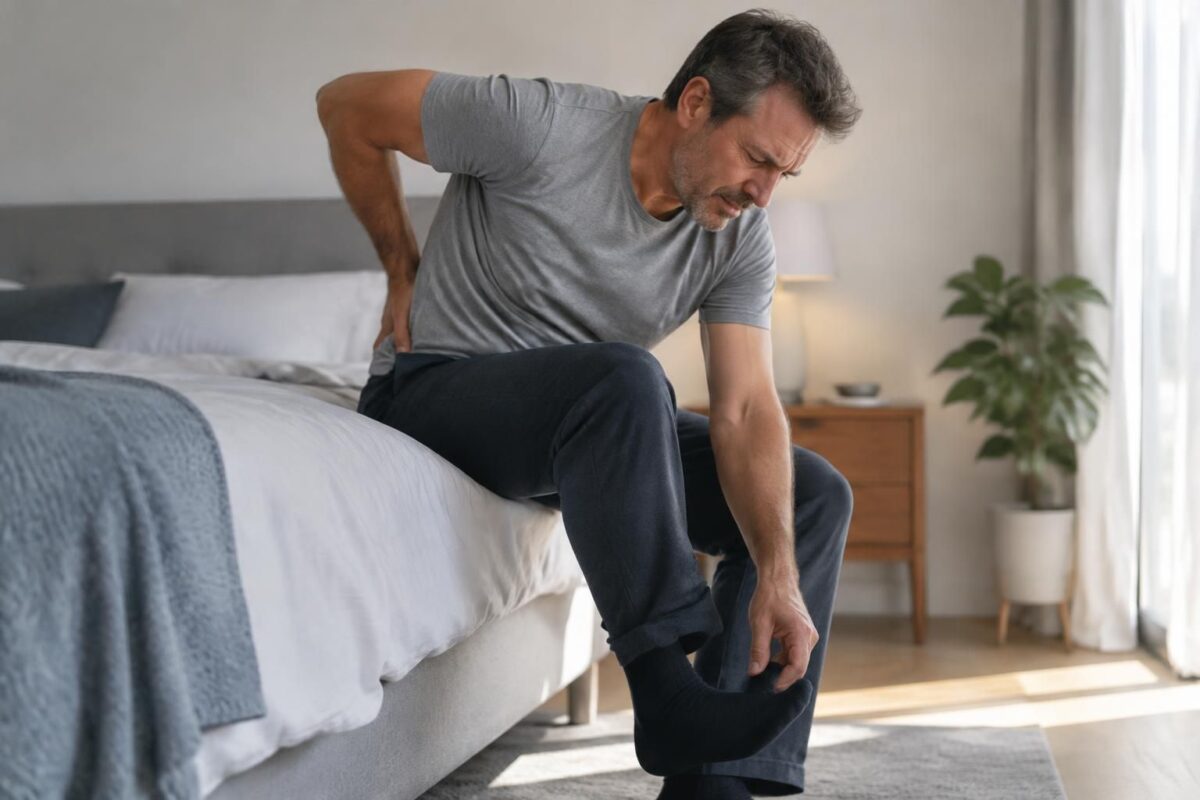
Sciatica and putting on socks: bending and pain in the leg
IN BRIEF Sciatica can make it difficult to put on your socks: bending over can increase the pain that radiates down the leg. Sitting down, using a sock aid, or avoiding painful bends can make this daily task easier. If…

Sciatica and tying your shoes: why the pain can radiate down
IN BRIEF Sciatica is pain related to the irritation of a nerve in the lower back, which can radiate into the buttock and leg. Leaning down to tie your shoes may accentuate the pain or cause it to descend further.…

Sylvain Desforges, B.Sc., D.O., N.D., docteur en ostéopathie
Dr Sylvain Desforges, B.Sc., D.O., N.D., osteopath, is the founding president of TAGMED and of the ACMA association. He dedicates his practice to chronic spinal pain, low back pain and symptoms compatible with sciatica, particularly when pain radiates toward the buttock, leg, calf, foot or toes.
Through SOS Sciatique, he publishes educational content on sciatica symptoms, possible causes such as disc herniation, disc narrowing, foraminal stenosis or irritation of a lumbar nerve root, as well as non-surgical approaches that may be considered according to the evaluation. At Clinique TAGMED, care may include, depending on the case, motorized neurovertebral decompression, specific osteopathic care or precision percussion.
For an evaluation related to sciatica treatment in Montreal / Mount Royal or sciatica treatment in Terrebonne, please consult the services available at Clinique TAGMED.
Medical disclaimer
The information published on SOS Sciatique is provided for educational purposes only and does not replace a consultation, diagnosis, opinion or treatment provided by a physician or another authorized healthcare professional. The author of this article is neither a medical doctor nor a specialist in a medical specialty recognized by the Collège des médecins du Québec. The osteopathic, manual medicine or functional support approaches described on this site do not constitute medical acts and are not intended to replace medical follow-up.
Consult a physician or emergency service in cases of loss of bladder or bowel control, anesthesia in the saddle area, significant or progressive weakness in the leg or foot, fever, recent trauma, severe pain or rapid worsening of symptoms. For more details, please read our Legal Notice.