Sciatica and pain that appeared after an accident
17/11/2026
Sciatica and putting on socks: bending and pain in the leg
17/11/2026
IN BRIEF A disc bulge is a disc that protrudes without necessarily being ruptured; it does not always cause pain. When pain returns, it may be related to nerve irritation, but a professional must verify the link with the symptoms. A gradual return to activities, appropriate medications based on professional advice, and, if necessary, physiotherapy can help. Most cases improve without surgery. |
A disc bulge may be associated with recurring pain, but an MRI alone is not sufficient to prove that it is the cause. Discomfort particularly depends on potential nerve irritation and must be interpreted alongside the symptoms and clinical examination.
In case of recurrence, evaluation by a healthcare professional can help to adapt activities and consider treatment, such as progressive exercises or physiotherapy. Consult quickly if new or progressive weakness, significant loss of sensitivity, or rapid worsening occurs.
A disc bulge may be visible on imaging without causing pain. When symptoms return, the MRI report alone is not enough to explain their origin: a professional must compare the images with the pain, its trajectory, and neurological signs. Relative rest, temporary adaptation of activities, and professional advice can help determine the next steps. Surgery is not necessary in the majority of cases.
Recurring pain may be linked to a disc bulge, but this link is not automatic. Symptoms may vary depending on activities, positions, local inflammation, and potential irritation of a nerve root. An anomaly observed on the MRI may also be present without causing symptoms.
The term disc bulge describes a disc that extends beyond its usual outline. It indicates a shape observed on imaging, but does not by itself explain the cause of the pain. To better understand this difference, consult our article on disc bulge and its possible signs.
Recurrent pains deserve evaluation if they limit activities, radiate down a limb, or are accompanied by tingling or numbness. A consultation allows for verification if the symptoms correspond to the described disc level and to rule out other causes.
Disc bulge, protrusion, and herniation: what are the differences?
A bulge generally corresponds to a more extensive overflow of the disc. A disc protrusion refers to a more localized bulge, while a disc herniation occurs when part of the internal material of the disc bulges through the outer layers. The terms may vary from one report to another. The clinical significance mainly depends on the position of the anomaly and its potential contact with a nerve root or the spinal cord.
Pain is therefore not determined by the name used in the report. A moderate anomaly may correspond to marked symptoms, while a more visible bulge may cause no discomfort. To learn more, check the information on choosing a non-surgical approach for disc protrusion.
Disc bulge and diagnosis not to be simplified
IN BRIEF A disc bulge is a protrusion of a disc visible on imaging; it is not sufficient on its own to explain pain or to make a diagnosis. Its interpretation must take into account symptoms, clinical examination, and context.…
Disc bulge and lumbar osteoarthritis
IN BRIEF A disc bulge is a protrusion of the lumbar disc; wear can also contribute to lumbar osteoarthritis and lower back pain. Symptoms vary by individual and may sometimes radiate into the leg. Motion imaging may be considered by…
Why can pain return?
Everyday Strain
The disc may be subjected to repeated strain during work tasks, heavy lifting, or certain activities. A period of pain may subside, then reappear as strains increase. Posture, repetitive movements, and a history of injury can also contribute to symptoms.
Changes Related to the Disc
Over time, discs may lose some hydration and flexibility. These changes, sometimes referred to as degenerative disc disease, do not always cause pain. However, they may coexist with a bulge, osteoarthritis, or narrowing of the space around a nerve.
Irritation of a Nerve Root
A bulge can irritate a nerve root if its position reduces the available space. Pain may then extend from the lower back to the buttock and leg. Some symptoms depend on the nerve involved. For example, pain in the calf or heel can have several causes and does not alone confirm disc involvement. Consult the articles on disc protrusion and calf pain and on disc protrusion and heel pain.

Disc bulge and narrowed foramen
IN BRIEF A disc bulge is a protrusion of the disc that can contribute to narrowing the foramen, the opening where a nerve root passes through. If this is irritated or compressed, pain, tingling, or weakness may occur, sometimes extending…

Disc bulge and loss of disc height
IN BRIEF A disc bulge is a protrusion of the disc between the vertebrae; a loss of disc height means that the disc has thinned. These changes may be related to wear and sometimes contribute to pain, stiffness, or nerve…
How to interpret an MRI in case of recurring pain?
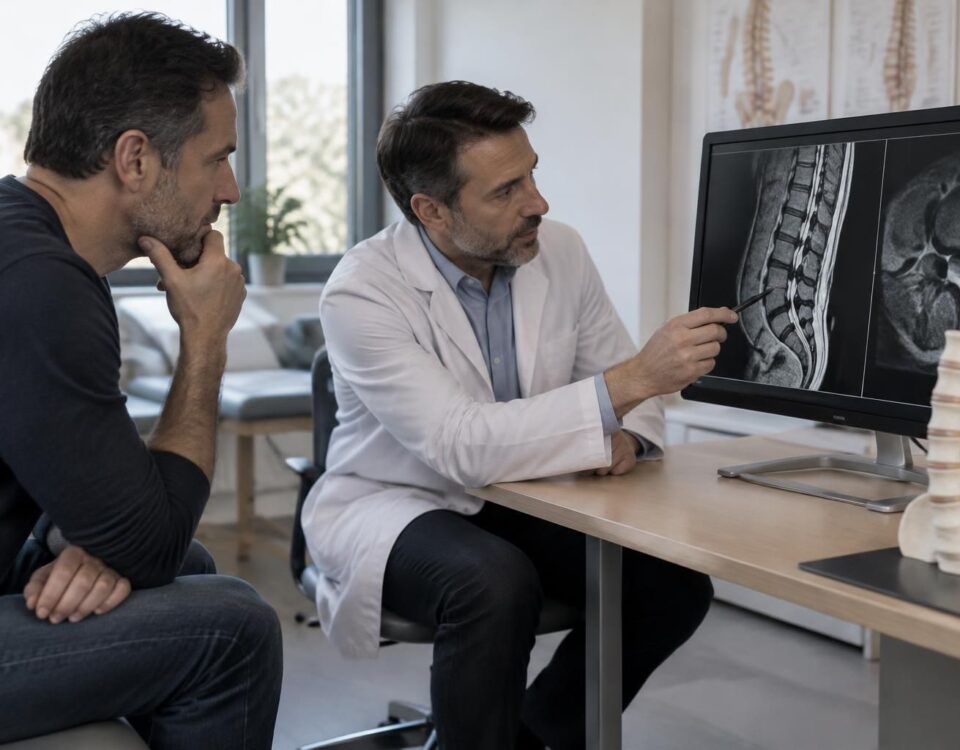
The MRI shows the discs, vertebrae, nerve roots, and spinal canal. It describes the structures but does not directly measure pain. Therefore, the healthcare professional compares the report with the painful side, the trajectory of symptoms, sensitivity, strength, and reflexes.
Terms like “protrusion,” “contact with a root,” or “foraminal narrowing” describe different observations. A visible “contact” does not always mean that a nerve is symptomatically compressed. Likewise, an old MRI may not represent the current situation. New imaging depends on clinical evaluation and symptom progression.
Pain radiating down the leg is not always caused by a disc. Joint problems, muscle issues, or other nerve compressions can produce similar symptoms. An evaluation serves to distinguish these possibilities. If pain radiates toward the foot and is accompanied by weakness, also read the information on disc herniation with foot weakness.

Disc bulging and disc degeneration
IN SHORT A disc bulge is a protrusion of the disc, sometimes associated with disc degeneration related to aging. These visible changes on imaging do not always cause symptoms. Their significance is determined by comparing the MRI to pain, strength,…

Disc bulge and pain after exertion
IN BRIEF A disc bulge is a disc that slightly protrudes between two vertebrae; after exertion, it may be associated with low back pain, sometimes radiating into the leg. An imaging result alone is not enough to explain the pain…
What to do when the pain returns?
Temporarily adjust activities
When pain begins, temporarily reduce movements that significantly worsen it. Relative rest may be helpful, but prolonged bed rest is generally not a strategy to pursue without professional advice. Gradually resume tolerated activities and avoid forcing through increasing pain or pain radiating further down the leg.
Some movements may exacerbate symptoms depending on the person and the cause. Lumbar flexion, for instance, does not have the same effect on everyone. Avoid movements that trigger significant irradiation and seek advice before following a program found online. For more details, refer to the article on caution related to lumbar flexion in case of protrusion.
Discussing medications with a professional
Some over-the-counter medications may reduce pain or inflammation in certain individuals. Anti-inflammatories, such as ibuprofen or naproxen, are not suitable for everyone and may cause side effects or interact with other treatments. Ask a doctor or pharmacist if a medication is appropriate for you, and adhere to the prescribed dosage and duration.
Getting persistent pain evaluated
Consult a professional if pain persists, frequently recurs, or limits your sleep, work, or mobility. They can assess the symptoms and discuss options tailored to your situation. Depending on the examination, management may include medical follow-up, activity modification, or other non-surgical care.
At the TAGMED Clinic, the options evaluated based on the case may include motorized neurovertebral decompression, specific osteopathy, or precision impactor. These approaches do not replace a medical diagnosis and may not be suitable for everyone. A preliminary assessment allows for discussion of potential benefits, limitations, and contraindications. Consult the services of the TAGMED Clinic or the information about disc bulging and management options.
Surgical intervention may be discussed in certain situations, particularly in cases of persistent or progressive weakness, significant compression, or debilitating pain that does not respond to appropriate treatments. The decision depends on examination, progression, and imaging, not solely on the mention of “disc bulging”.
When to consult quickly?
Consult a professional quickly in cases of new or increasing weakness in a leg or foot, progressive loss of sensation, or rapid worsening of symptoms. Loss of control of the bladder or bowels, numbness in the saddle area, or significant weakness require urgent evaluation.
Pain after trauma, fever associated with back pain, or severe pain that worsens also justify prompt medical advice. These signs do not allow for remote diagnosis, but they should not be ignored.
About the author
Sylvain Desforges, B.Sc., D.O., N.D., Doctor of Osteopathy and Naturopath, is the founding president of TAGMED and the ACMA association. His practice focuses on chronic pain of the spine, lower back pain, and pain compatible with sciatica, particularly when pain radiates down to the buttock, leg, calf, foot, or toes.
Through SOS Sciatique, he publishes educational content on sciatica symptoms, possible causes like herniated discs, disc pinching, foraminal stenosis, or irritation of a lumbar nerve root, as well as on non-surgical approaches that may be considered based on assessment. At the TAGMED Clinic, care may include, as needed, motorized neurovertebral decompression, specific osteopathy, or precision impactor.
For an evaluation related to the sciatica treatment in Montreal / Mont-Royal or the sciatica treatment in Terrebonne, consult the services available at the TAGMED Clinic.
Medical Disclaimer
Medical disclaimer: The information and advice provided on this site do not replace the advice, diagnosis, or treatment of a healthcare professional. Please note that Sylvain Desforges, B.Sc., D.O., N.D., Doctor of osteopathy, is neither a medical doctor nor a physician, and is not a specialist in a medical specialty as defined by the Collège des médecins du Québec. Manual medicine, functional medicine, and sports medicine as described on this site exclude any treatment or medical diagnosis made by a physician or specialist. Always consult your doctor for any medical questions. For more details, please read our complete legal notice.
Disc bulging and recurrent pain: the right guidelines
To better manage episodes
- Temporarily reduce movements that trigger pain.
- Gradually resume tolerated activities, such as walking.
- Avoid prolonged immobilization and efforts that worsen symptoms.
- Seek advice before taking medications, especially in case of contraindications.
When to seek an evaluation
- Pain recurs frequently or limits daily activities.
- Symptoms persist despite activity modification.
- Pain radiates down an arm or leg, or is accompanied by tingling.
- New or progressive weakness requires prompt consultation.
- A visible bulge on imaging alone is not sufficient to identify the cause of pain.

A disc bulge may be associated with recurring pain, but the image observed on the MRI is not sufficient to determine the cause. To better manage episodes, prioritize a gradual return to activities, avoid prolonged immobilization, and seek professional evaluation if pain persists, worsens, or is accompanied by neurological symptoms.
Understanding disc bulging and recurrent pain
A bulge occurs when an intervertebral disc protrudes beyond its usual contour while remaining intact. A disc herniation, on the other hand, involves a tear in its outer layer and protrusion of its contents. These terms describe different aspects, but neither alone proves that the disc is responsible for the pain.
Discs naturally change with age. Posture, repetitive motions, lifting heavy loads, or a previous injury can also contribute to symptoms. Some people have a bulge without pain; others experience recurring episodes, sometimes with radiation to the buttock or leg when nerve structures are irritated.
What to do when the pain returns?
Maintain relative rest
Temporarily reduce activities that clearly trigger pain, without staying in bed for extended periods. After a short recovery period, resume tolerated movements, such as walking, gradually increasing their duration. Prolonged immobility can promote stiffness and loss of physical condition.
Use medications with caution
Some over-the-counter pain relievers or anti-inflammatories can help control pain in the short term. However, they may not be suitable for everyone and can interact with other treatments. Consult a doctor or pharmacist to check for contraindications, dosage, and duration of use. Avoid prolonging or combining medications without professional advice.
Gradually resume activities
When a movement significantly increases pain or causes more radiation, adapt it rather than forcing through. Take breaks if you remain seated or standing for long periods and keep loads close to your body when lifting them. A gradual return to daily activities is generally preferable to alternating between intense efforts and complete immobility.
When to seek professional evaluation?
If pain returns frequently, limits sleep, or interferes with daily tasks, a healthcare professional can assess its evolution and propose an appropriate plan. Physiotherapy can particularly help restore tolerated movements and gradually strengthen the trunk and back. The goal is to improve function, not to “put the disc back in place.”
Consult a doctor if pain persists for several weeks, worsens, or radiates down the leg with numbness or weakness. An MRI decision is based on examination and context; its results must be correlated with symptoms and neurological examination. Surgery is only considered in certain situations, and most people do not need it.
Recognizing emergency signs
Consult quickly in case of significant or progressive weakness in the leg or foot. A loss of bladder or bowel control, anesthesia in the saddle region, fever, recent trauma, or rapid worsening requires urgent medical evaluation. This information is educational and does not replace a diagnosis or follow-up by a healthcare professional.
| When pain returns | Useful reference |
|---|---|
| After a period of improvement | A flare-up does not necessarily mean the disc has worsened. |
| After effort or prolonged posture | Temporarily reduce the triggering action and gradually resume. |
| With pain radiating down the arm | Note its path, tingling, and movements that affect it. |
| With a visible bulge on the MRI | The image alone does not confirm the cause of the symptoms. |
| If episodes repeat | A professional can reassess symptoms and adjust management. |
| To maintain activities | Favor tolerated movements rather than prolonged immobility. |
| In case of new or progressive weakness | Consult a healthcare professional promptly. |
Testimonies on disc bulges and recurring pain
Note: The testimonies below are fictional examples, written for informational purposes. They do not describe real patients and cannot predict the evolution of your situation.
“The pain would return as soon as I resumed my activities”
After a period of discomfort in my lower back, I learned that my MRI showed a disc bulge. Rest had eased the pain, but it returned when I resumed my usual tasks. I consulted a healthcare professional to ensure that the symptoms aligned with the imaging and to adjust my return. Gradually advancing helped me better identify the movements that exacerbated the pain, without remaining immobile for too long.
“The report worried me more than my symptoms”
The term “disc bulge” made me fear a serious herniation and surgery. I was told that an MRI image alone is not enough to determine the cause of the pain: it must also consider its path, sensitivity, and strength. This discussion helped me understand the report and follow a management plan tailored to my clinical examination.
“I had episodes of pain after busy days”
My lower back pain would mostly return after long periods of sitting or days with a lot of repetitive movements. Rather than immediately resuming all my efforts, I adjusted my activities and introduced light movements that I could tolerate. A professional then guided me to progressive exercises. The symptoms evolved over periods, requiring patience and adjustments.
“The pain radiated down my leg”
During certain flare-ups, the pain would start from my lower back and radiate to my buttock and leg. The presence of a disc bulge on imaging did not, by itself, confirm the source of this radiation. The evaluation considered the path of the pain and neurological signs to determine the next steps and monitor progress.
“I learned not to downplay a worsening”
My pain would return, but a consultation also helped me identify which changes needed to be reported promptly. New or progressive weakness, significant loss of sensation, or urinary or bowel disorders require urgent medical evaluation. For persistent or recurring symptoms, it is better to seek professional advice rather than relying solely on the imaging report.
Disc bulge and recurring pain: understanding and acting
A disc bulge corresponds to an intervertebral disc that protrudes from its usual contour, without necessarily rupturing. It can affect different regions of the spine, particularly the lower back. When pain returns in episodes, it is natural to wonder if the disc is responsible. However, an anomaly observed in imaging is not enough to explain the symptoms: it must be correlated with their location, progression, and the results of the clinical examination.
Discs gradually change with age and accumulated stress. A sustained posture, repetitive movements, lifting loads, or an old injury can also contribute to making the back sensitive. Some individuals exhibit a visible bulge on MRI without pain, while others experience significant discomfort. Therefore, the size of the bulge does not, on its own, indicate the intensity of the pain or the necessary treatment.
Recurrent lower back pain may remain localized to the back or radiate down to the buttock and leg. Tingling, numbness, or a feeling of weakness may sometimes accompany nerve irritation, but these signs can also have other possible causes. It is also important to distinguish a bulge from a herniated disc, where a part of the disc protrudes through a weakened area of its casing. Symptoms primarily depend on the affected structure and the correlation between imaging and examination findings.
When an episode begins, a short adjustment of activities that aggravate the pain can be helpful. However, staying immobile for too long may decrease the back’s ability to resume its functions. Gentle and tolerated movements, such as walking, can help maintain activity. Pain medications or anti-inflammatories should be used under the guidance of a professional, as they are not suitable for everyone and can present risks or interactions.
If episodes recur, last several weeks, or limit work, sleep, or daily activities, a professional evaluation may help clarify the situation. It can assess mobility, strength, sensitivity, and reflexes, and determine if imaging is relevant. A personalized management plan may include a gradual progression of exercises, core strengthening, adjustments to movements, and strategies to resume activities without consistently triggering a painful flare-up.
Sylvain Desforges, B.Sc., D.O., N.D., Doctor of Osteopathy and Naturopath, is the founding president of TAGMED clinics and the ACMA association. His practice focuses on chronic spinal pain and lower back pain. In the context of an evaluation, options may include specific osteopathy, motorized neurovertebral decompression, or other approaches proposed based on the case. These treatments do not replace a medical diagnosis; their relevance must be determined on a case-by-case basis, considering the symptoms and contraindications.
An urgent consultation is necessary in case of loss of control over the bladder or intestines, numbness in the saddle area, significant or progressive weakness, fever, recent trauma, or rapid deterioration. These signs demand immediate evaluation.
Medical warning: This information is provided for educational purposes and does not replace a consultation, diagnosis, advice, or treatment by a physician or another authorized health professional. The author is neither a doctor nor a specialist in a medical specialty recognized by the Collège des médecins du Québec. Osteopathy, manual medicine, and functional support approaches do not constitute medical acts and do not replace medical follow-up.
A disc bulge may be associated with recurring pain, but the image observed on MRI is not sufficient to determine the cause. The evolution of symptoms, their path, and the clinical examination are as important as the report: relative rest, gradual resumption of activities, and appropriate support can be considered based on the situation.
Understanding Recurring Pain
Symptoms can fluctuate with movements, prolonged postures, exertion, or the resumption of demanding activities. A disc bulge may sometimes irritate a nerve structure, but it can also be found without being responsible for the pain. The distinction between a disc bulge and sciatica requires relating the imaging findings to the felt signs and the professional examination.
When pain radiates down a leg, its pathway, any potential numbness, and changes in strength are important to clarify. A L4-L5 disc bulge accompanied by leg pain may warrant evaluation, without the imaging level alone establishing a diagnosis. Recurring lumbar discomfort may also be accompanied by stiffness in the lower back or intermittent numbness.
When to Request Reevaluation
If episodes recur, intensify, persist, or limit daily activities, consult a health professional to review the symptoms and management plan. Persistent leg pain can have several explanations, as noted in this article about disc protrusion and prolonged pain. Options depend notably on the examination, progression, and history; they may include a temporary adjustment of activities and individualized rehabilitation. Complementary resources on disc bulge, its symptoms, and treatments can help prepare questions to ask during a consultation.
A significant or progressive weakness, loss of urinary or bowel control, numbness in the saddle area, fever, recent trauma, or rapid deterioration require urgent medical evaluation. These signs should not be automatically attributed to a disc bulge.

Disc bulge and tingling in the foot
IN SHORT A disc bulge refers to a disc that bulges beyond its boundary; if it irritates a nerve root, it can contribute to tingling in the foot, numbness, or pain in the leg. However, MRI alone is not sufficient…

Disc bulge and intermittent numbness
IN SHORT A bulging disc associated with intermittent numbness may sometimes indicate nerve irritation, but an MRI alone does not allow determining the cause. Connecting the symptoms’ path, sensitivity, and strength helps guide the evaluation and next steps. New or…

Sylvain Desforges, B.Sc., D.O., N.D., docteur en ostéopathie
Dr Sylvain Desforges, B.Sc., D.O., N.D., osteopath, is the founding president of TAGMED and of the ACMA association. He dedicates his practice to chronic spinal pain, low back pain and symptoms compatible with sciatica, particularly when pain radiates toward the buttock, leg, calf, foot or toes.
Through SOS Sciatique, he publishes educational content on sciatica symptoms, possible causes such as disc herniation, disc narrowing, foraminal stenosis or irritation of a lumbar nerve root, as well as non-surgical approaches that may be considered according to the evaluation. At Clinique TAGMED, care may include, depending on the case, motorized neurovertebral decompression, specific osteopathic care or precision percussion.
For an evaluation related to sciatica treatment in Montreal / Mount Royal or sciatica treatment in Terrebonne, please consult the services available at Clinique TAGMED.
Medical disclaimer
The information published on SOS Sciatique is provided for educational purposes only and does not replace a consultation, diagnosis, opinion or treatment provided by a physician or another authorized healthcare professional. The author of this article is neither a medical doctor nor a specialist in a medical specialty recognized by the Collège des médecins du Québec. The osteopathic, manual medicine or functional support approaches described on this site do not constitute medical acts and are not intended to replace medical follow-up.
Consult a physician or emergency service in cases of loss of bladder or bowel control, anesthesia in the saddle area, significant or progressive weakness in the leg or foot, fever, recent trauma, severe pain or rapid worsening of symptoms. For more details, please read our Legal Notice.