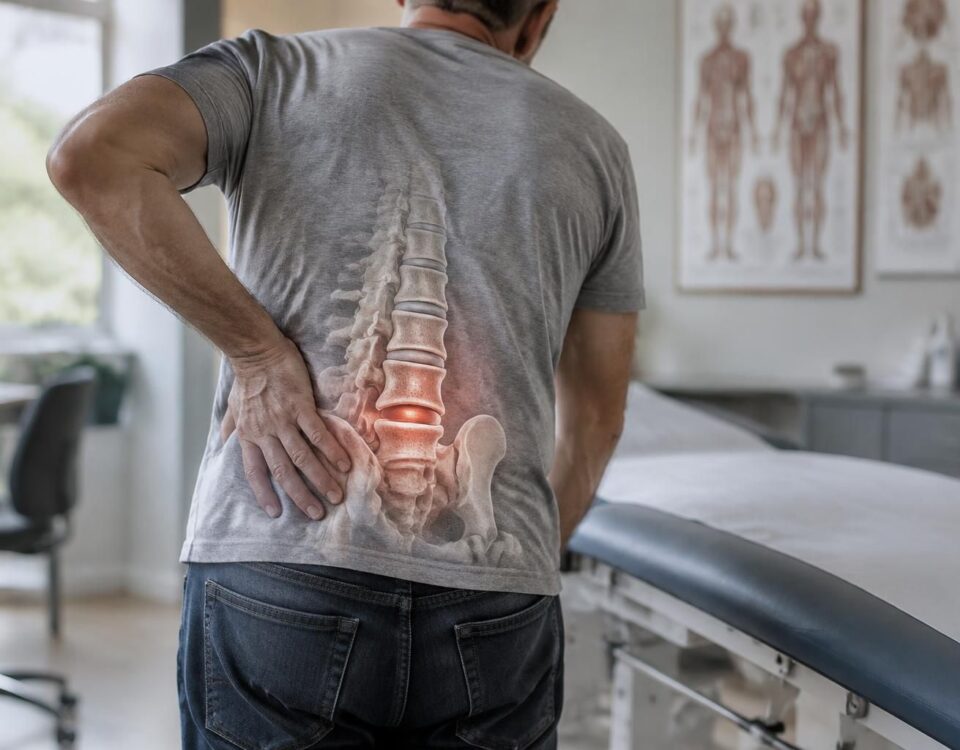
Sciatica and extreme leg pain: when to consult?
28/11/2026
Sciatica and lifting a load: why technique isn’t always enough
28/11/2026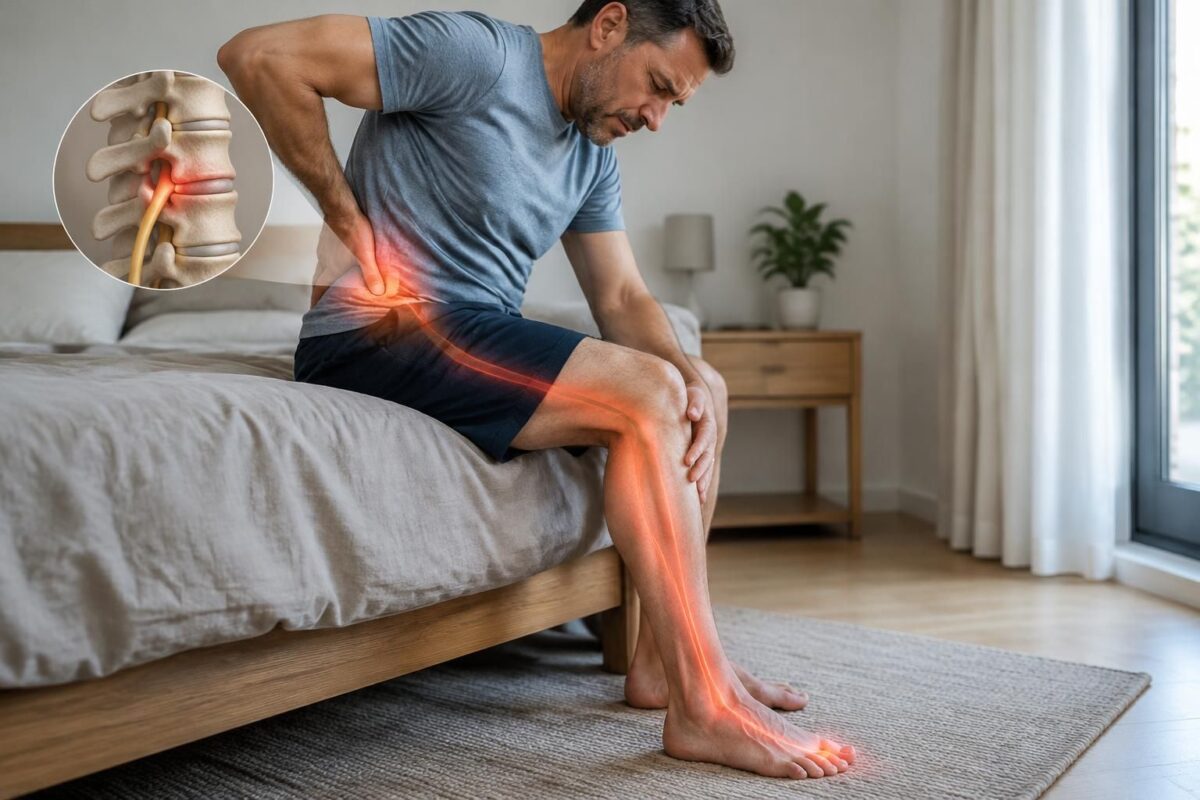
IN BRIEF
| A disc bulge corresponds to a reduction of space between two vertebrae. If it irritates a lumbar nerve root, the pain may radiate down the leg towards the big toe, sometimes accompanied by tingling or weakness. This pathway can guide the evaluation, but is not sufficient to confirm the cause: a healthcare professional can examine the symptoms and determine the appropriate management. |
A disc bulge in the lower back can sometimes irritate a nerve root and cause pain that radiates into the buttock and leg down to the big toe. Tingling, numbness, or weakness in the foot may also occur. However, these symptoms alone do not confirm the cause: a professional evaluation can help guide the management.
Consult a doctor quickly if weakness worsens, if you lose control of your bladder or bowels, or if you experience numbness in the saddle region.
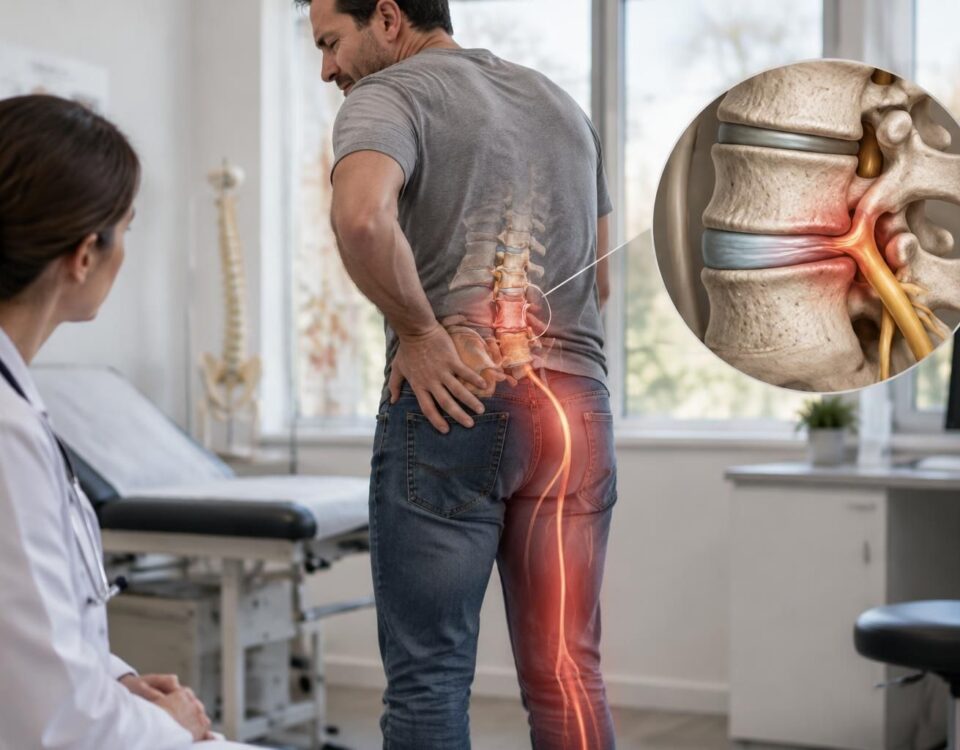
A disc bulge may be associated with pain that radiates down the leg to the big toe, but this sign alone is not enough to establish the cause. Irritation of a lumbar nerve root, often the L5 root, can produce this pathway. An evaluation helps contextualize the symptoms and determine if medical advice is needed.
The disc is located between two vertebrae. Over time, its height may decrease. An imaging examination can then describe a disc bulge. This result does not prove on its own that the disc is causing the pain. Some individuals have a visible bulge without pain, while others experience significant symptoms.
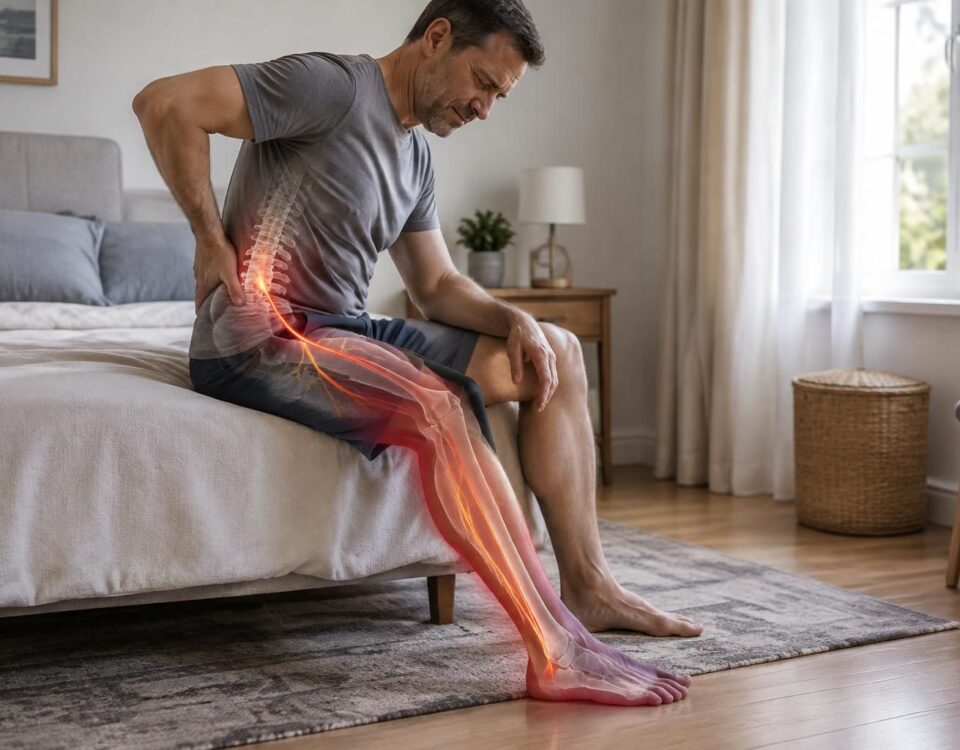
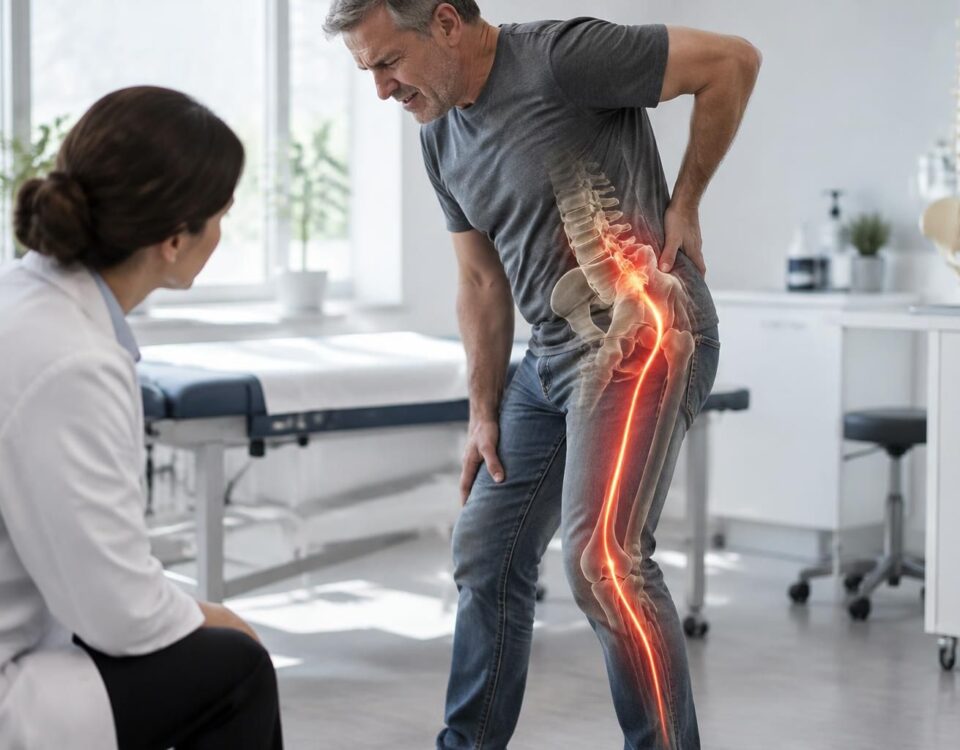
Pain towards the big toe can follow the pathway of an irritated lumbar nerve. It may start in the lower back or buttock, then radiate down the thigh, leg, and foot. It may be accompanied by tingling, numbness, or a sensation of weakness. Symptoms vary from person to person.
What is the link between the lumbar disc and the big toe?
The L5 nerve root contributes to the sensation of certain areas of the foot and the movement of the big toe. Irritation of this root can thus lead to pain or abnormal sensations towards the big toe. A disc bulge may be among the factors examined, but a herniation, disc protrusion, or another cause may also explain the symptoms.
A disc bulge can coexist with disc dehydration and radiating pain. A disc protrusion associated with buttock pain or a herniated disc with leg weakness are also situations that require appropriate evaluation.
Symptoms to Watch For
Pain can be sharp, burning, or like an electric shock. It may worsen in certain positions or during common movements. Difficulty washing your feet, for example, may prompt you to monitor the flexion of the lower back and the evolution of symptoms. See information on lumbar flexion when washing feet.
Note where the pain starts, how far it radiates, and whether it is accompanied by numbness or weakness. This information helps the professional evaluating you. It does not replace an examination and cannot confirm a disc bulge as the sole cause of the symptoms.
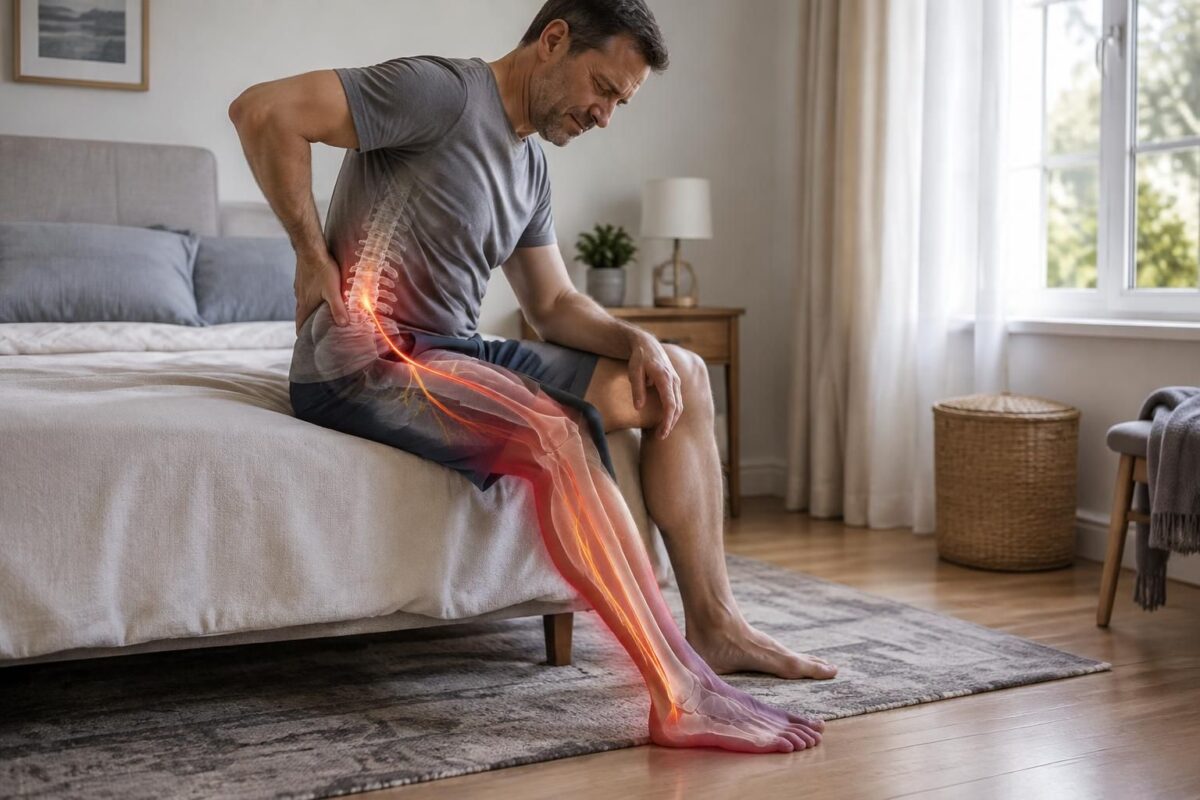
Disc bulge and pain towards the heel
IN BRIEF A disc herniation corresponds to a decrease in the height of a disc between the vertebrae. If it irritates a lumbar nerve root, pain can radiate down the leg to the heel, sometimes accompanied by tingling or weakness.…
Disc herniation L4-L5 and irritation of the L5 root
IN BRIEF A disc protrusion L4-L5 corresponds to a reduction in the space between two lumbar vertebrae and can contribute to the irritation of the L5 nerve root. This can cause pain or tingling in the buttock, leg or top…
How to Evaluate a Disc Bulge
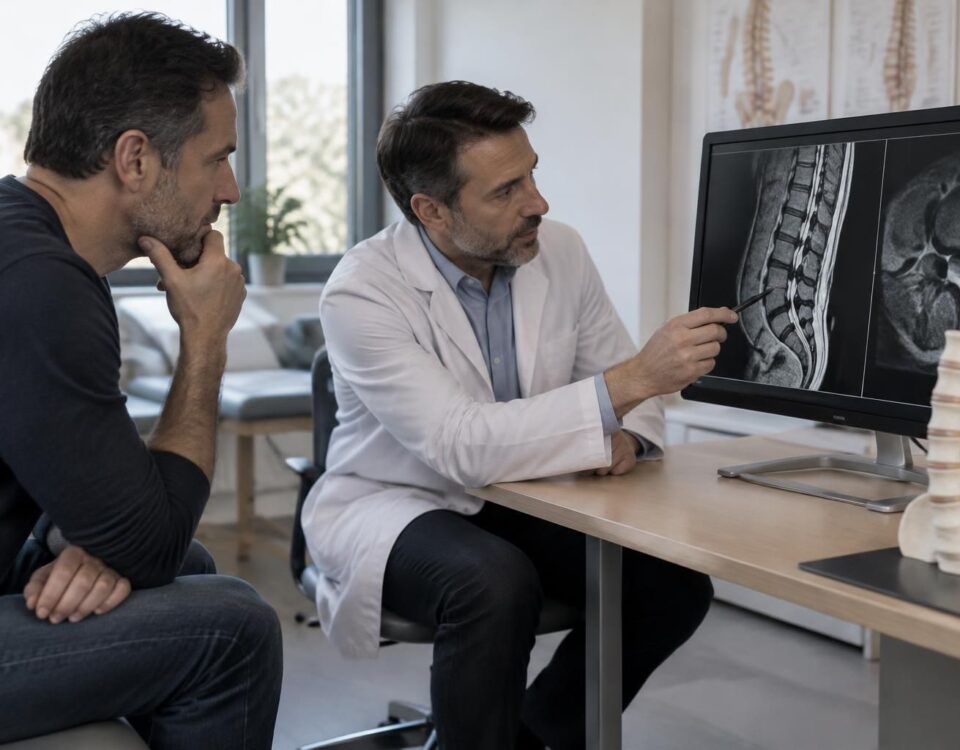
A licensed healthcare professional can examine your symptoms, sensitivity, and strength. They can also check movements that reproduce or modify the pain. Depending on the results, they may recommend a medical consultation or further examinations. Imaging should be interpreted in light of your symptoms and examination.
Pain towards the big toe can have multiple causes. A nerve issue is not the only possible explanation. The evaluation aims to distinguish possible causes and to identify signs that require prompt medical attention.
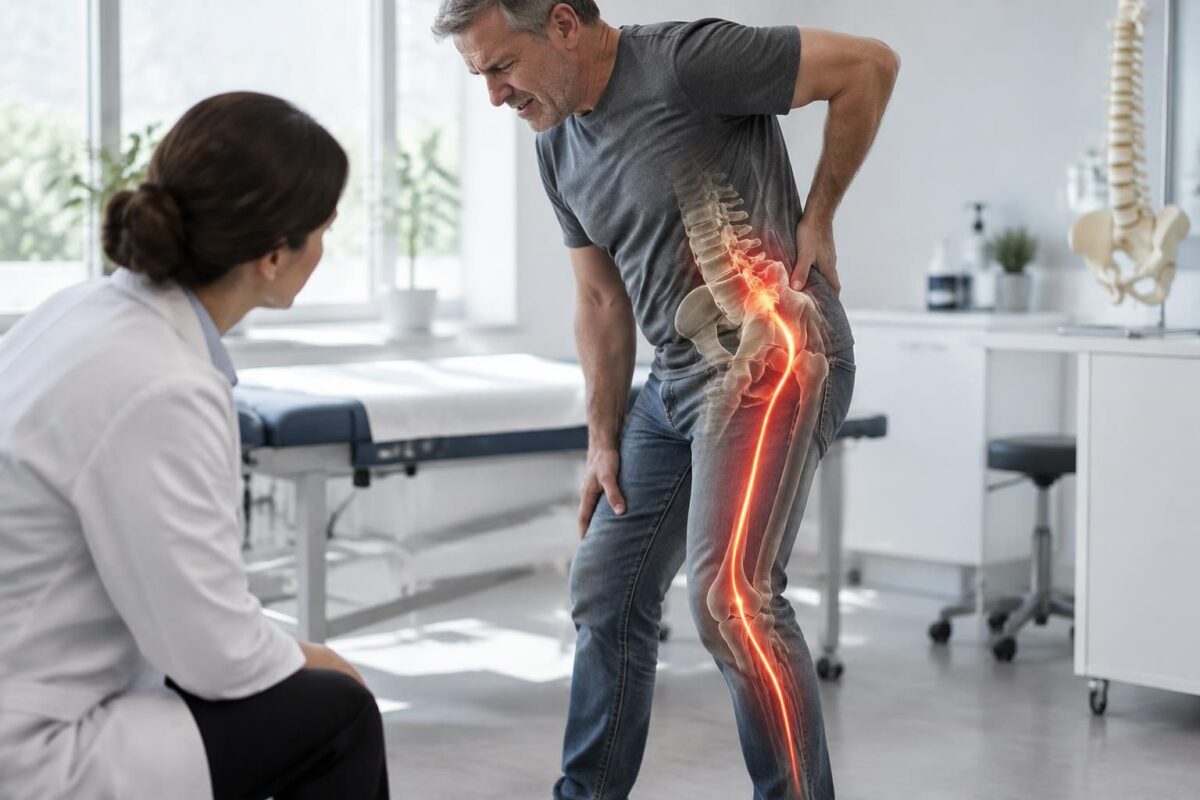
Lumbar disc herniation L5-S1 and sciatic pain
IN BRIEF The L5-S1 disc bulge corresponds to a reduction of space between the last two lumbar vertebrae and the sacrum. It can cause lower back pain and, if a nerve root is irritated, sciatica radiating to the buttock and…
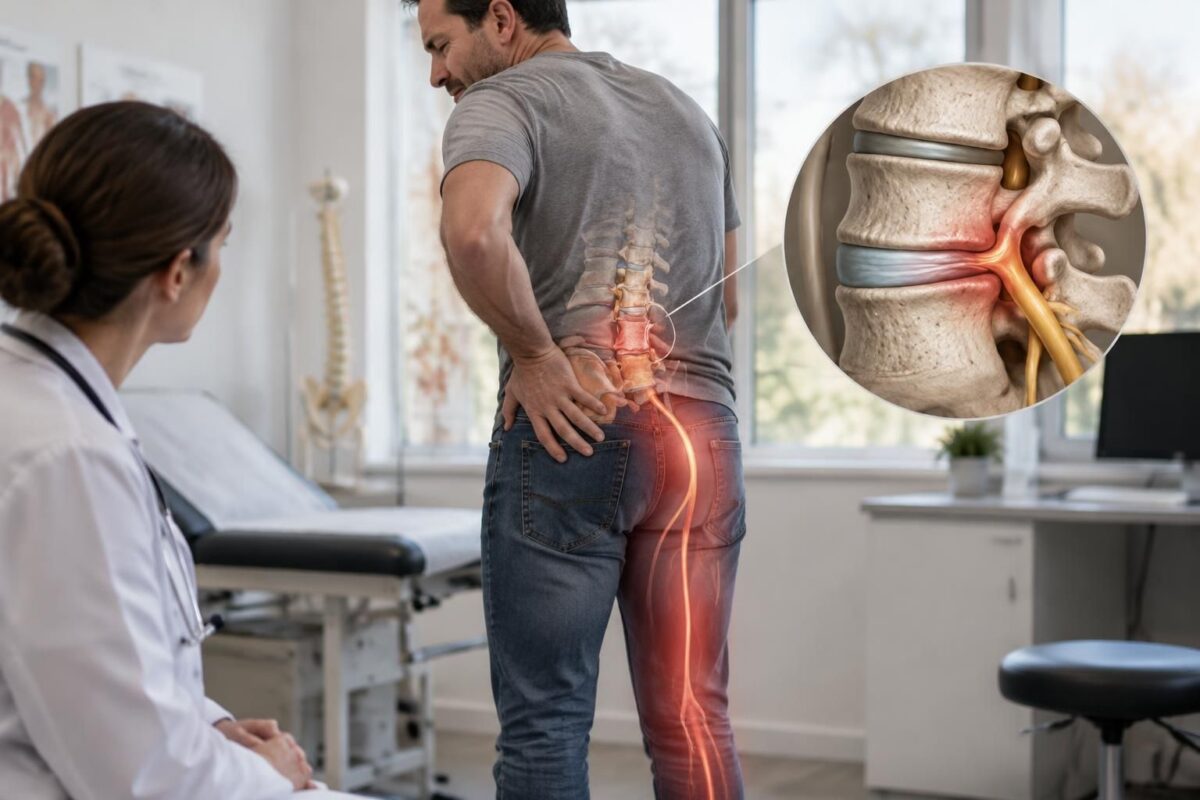
Disc herniation and sciatica: understanding the loss of disc height
IN BRIEF The disc herniation is a loss of height of the disc between two vertebrae. It can contribute to sciatica when nerve structures are irritated, with pain that may radiate down the leg. Imaging and assessment by a professional…
Support Options at TAGMED Clinic
After an evaluation, some individuals may consider non-surgical support. At the TAGMED Clinic, options may include, depending on the case, motorized neurovertebral decompression, specific osteopathy, or precision impactor. The choice depends on the symptoms, examination, and history. No results can be guaranteed, and these approaches do not replace a diagnosis or medical follow-up.
To learn about available services, see the pages on sciatica treatment in Montreal and Mont-Royal or sciatica treatment in Terrebonne.
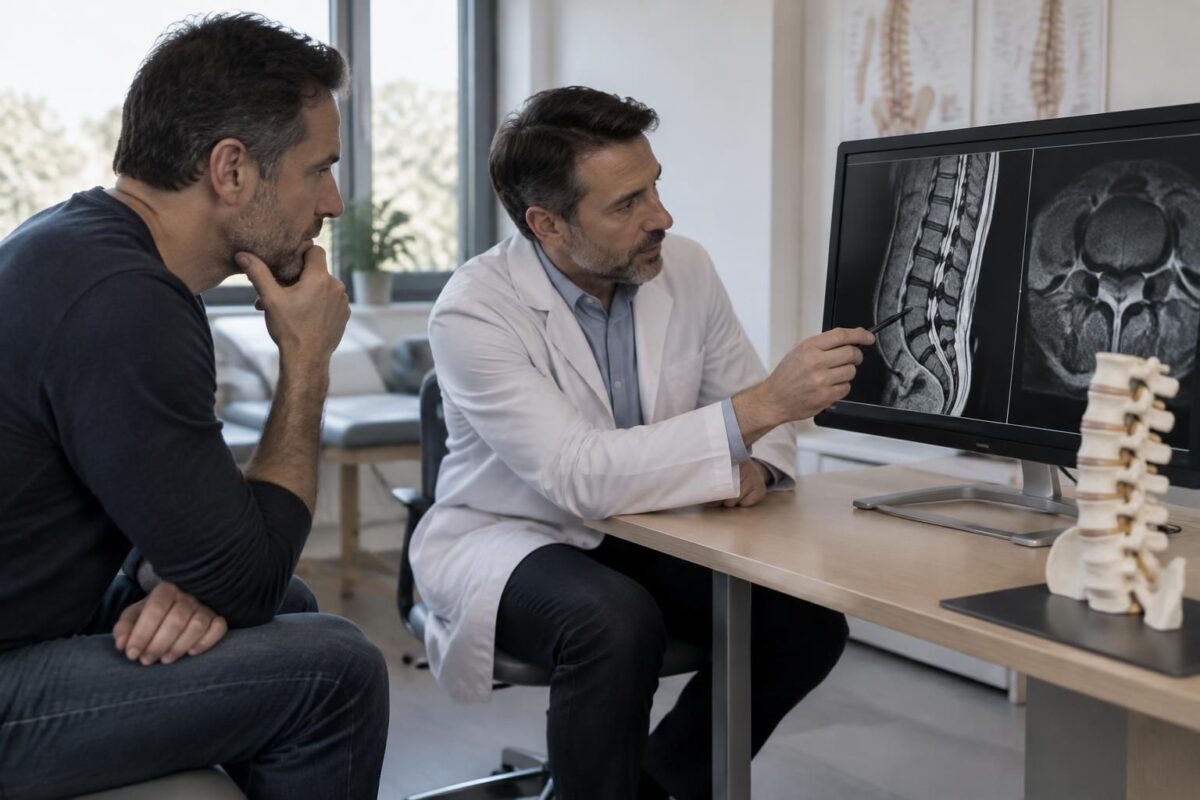
Disc bulge and diagnosis not to be simplified
IN BRIEF A disc bulge is a protrusion of a disc visible on imaging; it is not sufficient on its own to explain pain or to make a diagnosis. Its interpretation must take into account symptoms, clinical examination, and context.…
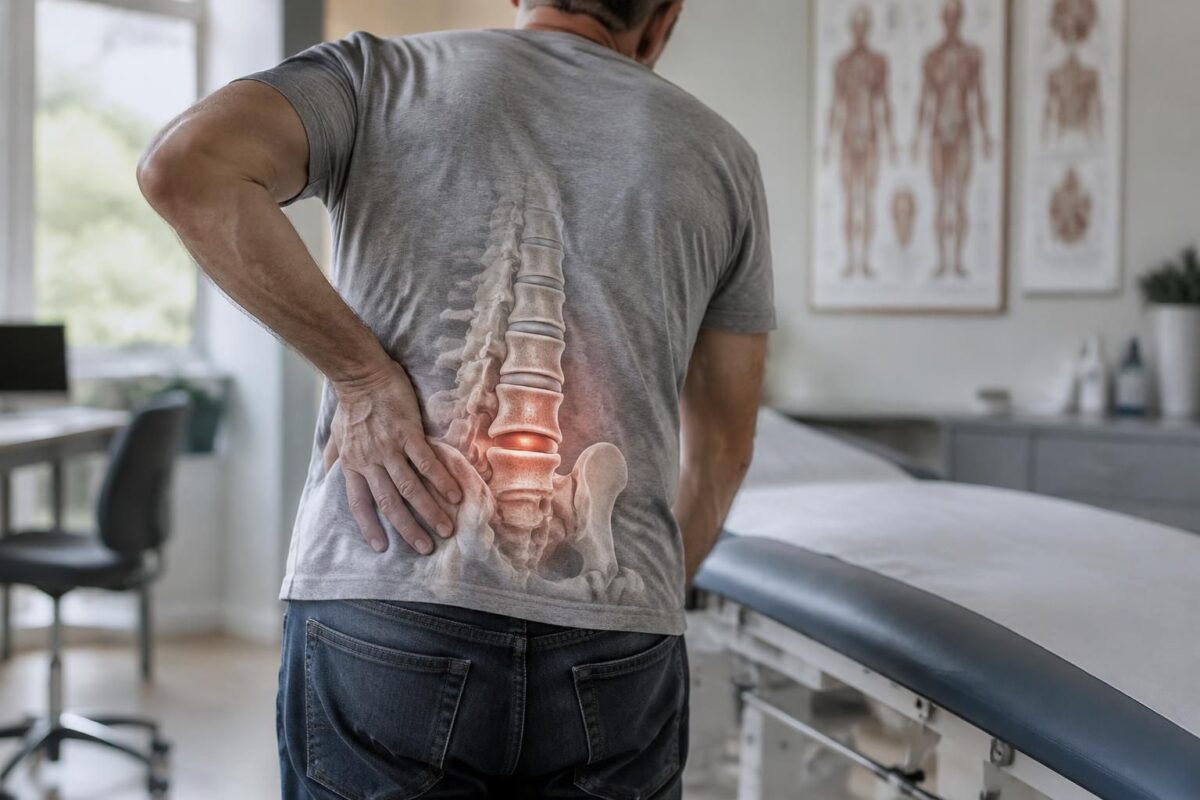
Disc bulge and lumbar osteoarthritis
IN BRIEF A disc bulge is a protrusion of the lumbar disc; wear can also contribute to lumbar osteoarthritis and lower back pain. Symptoms vary by individual and may sometimes radiate into the leg. Motion imaging may be considered by…
When to Consult Quickly
Consult a doctor or an emergency service if you lose control of your bladder or bowels, if you have numbness in the saddle area, or if significant or progressive weakness affects the leg or foot. A fever, recent trauma, severe pain, or rapid worsening also warrants immediate medical evaluation.
The loss of bowel control associated with sciatica constitutes a medical emergency. Do not wait for a routine appointment if this sign appears.

Disc bulge and narrowed foramen
IN BRIEF A disc bulge is a protrusion of the disc that can contribute to narrowing the foramen, the opening where a nerve root passes through. If this is irritated or compressed, pain, tingling, or weakness may occur, sometimes extending…

Disc bulge and loss of disc height
IN BRIEF A disc bulge is a protrusion of the disc between the vertebrae; a loss of disc height means that the disc has thinned. These changes may be related to wear and sometimes contribute to pain, stiffness, or nerve…
About the Author
Sylvain Desforges, B.Sc., D.O., N.D., Doctor of Osteopathy and naturopath, is the founding president of TAGMED and the ACMA association. He dedicates his practice to chronic pain of the spine, lumbar pain, and pain compatible with sciatica, especially when the pain radiates to the buttock, leg, calf, foot, or toes.
Through SOS Sciatique, he publishes educational content on the symptoms of sciatica, possible causes such as herniated discs, disc compression, foraminal stenosis, or irritation of a lumbar nerve root, as well as non-surgical approaches that may be considered based on the assessment. At the TAGMED Clinic, treatments may include, depending on the case, motorized neurovertebral decompression, specific osteopathy, or precision percussion.
For an assessment related to sciatica treatment in Montreal / Mont-Royal or sciatica treatment in Terrebonne, consult the services available at the TAGMED Clinic.
Medical Disclaimer
The information published on SOS Sciatique is provided for educational purposes and does not replace a consultation, diagnosis, opinion, or treatment performed by a physician or other licensed healthcare professional. The author of this article is neither a doctor nor a specialist in a medical specialty recognized by the Collège des médecins du Québec. The osteopathy, manual medicine, or functional support approaches described on this site do not constitute medical acts and are not intended to replace medical follow-up. Consult a physician or an emergency service in case of loss of urinary or bowel control, anesthesia in the saddle area, significant or progressive weakness of the leg or foot, fever, recent trauma, severe pain, or rapid worsening. For more details, please read our Legal Notice.
Medical Disclaimer: The information and advice provided on this site do not replace the opinion, diagnosis, or treatment of a healthcare professional. Please note that Sylvain Desforges, B.Sc., D.O., N.D., Doctor in osteopathy, is neither a medical doctor nor a physician, and is not specialized in a medical specialty as defined by the Collège des médecins du Québec. Manual medicine, functional medicine, and sports medicine as described on this site exclude any medical treatment or diagnosis made by a physician or medical specialist. Always consult your doctor for any medical questions. For more details, please read our complete Legal Notice.
What this may indicate
- Irritation of a lumbar nerve root, sometimes associated with pain towards the big toe.
- Pain that radiates down the leg may be compatible with sciatica.
- A visible compression on imaging is not sufficient alone to identify the cause of the symptoms.
Points to monitor
- Note if the pain is accompanied by tingling or numbness.
- Weakness of the foot or big toe warrants a medical evaluation.
- Consult urgently in case of progressive weakness or loss of urinary or bowel control.

A disc compression can sometimes irritate a nerve root and cause pain that radiates down the leg to the big toe. This radiation may suggest lumbar nerve irritation but does not, by itself, identify the cause. A professional assessment helps clarify the situation and choose appropriate measures, without delaying a medical opinion if warning signs appear.
Understanding Pain in the Big Toe
The term “disc compression” generally describes a reduction in the space between two vertebrae or a change in a disc. This finding, sometimes observed on imaging, does not necessarily mean it is responsible for the symptoms. The pain may also be related to irritation of a nerve root, a herniated disc, or another lumbar cause.
When a nerve root in the lower back is irritated, the pain may follow a path through the buttock, thigh, and leg, then reach the foot or the big toe. Tingling, numbness, or a feeling of weakness may accompany it. The affected area and the intensity of the symptoms vary from person to person.
What to Do When Pain Appears?
Stay Active Without Straining
If the pain allows, favor gentle movements and tolerable activities instead of prolonged bed rest. Alternate positions, get up regularly, and temporarily reduce movements that significantly amplify the radiation, such as certain lifts or repeated movements. Gradually resume your activities without attempting to “push through” an intensifying pain.
Observe the Evolution of Symptoms
Note where the pain is located, what aggravates it or relieves it, as well as the presence of numbness or weakness. This information can help the healthcare professional guide their assessment. Avoid concluding that a disc is necessarily involved solely based on the path of the pain or an imaging result.
When to Seek an Evaluation?
A consultation is indicated if the pain persists, recurs frequently, limits walking, or disrupts sleep and daily activities. A physician or other licensed healthcare professional can examine your situation and determine if further tests or treatments are necessary. Non-surgical approaches, such as functional support or certain manual interventions, should be chosen based on the assessment, symptoms, and your medical history.
At the TAGMED Clinic, an evaluation can facilitate discussion of relevant options depending on the case, including specific osteopathy or motorized neurovertebral decompression. These approaches are not suitable for everyone and do not replace a medical diagnosis or prescribed follow-up. Ask for a clear explanation of the expected benefits, limitations, and alternative solutions before undertaking any care.
Signs Requiring Urgent Attention
Quickly consult a physician or an emergency service in case of loss of urinary or bowel control, anesthesia in the saddle area, significant or progressive weakness of the leg or foot, fever, recent trauma, severe pain, or rapid deterioration. These signs require immediate evaluation.
Medical warning: this content is provided for educational purposes and does not replace a consultation, diagnosis, opinion, or treatment by a licensed healthcare professional. The author is neither a doctor nor a specialist in a medical specialty recognized by the Collège des médecins du Québec. The approaches of osteopathy, manual therapy, and functional support do not replace medical follow-up.
| Marker | What it may indicate |
|---|---|
| Disc pinch | A thinned disc can sometimes irritate a nerve root. |
| Pain towards the big toe | May be compatible with irritation of a lumbar root, often L5. |
| Pain radiating down the leg | Irradiation from the buttock may suggest sciatica. |
| Numbness or tingling | Can accompany nerve irritation, without confirming its cause. |
| Weakness in lifting the big toe | Justifies a prompt medical evaluation. |
| Image of the spine | A visible pinch does not prove that it explains the pain. |
| Loss of urinary or bowel control | Consult an emergency service immediately. |
Testimonials on disc pinch and pain towards the big toe
Note: the testimonials below are fictional and presented for illustrative purposes. Pain radiating towards the big toe can have different causes; it does not allow, by itself, to confirm a disc pinch or nerve damage.
“The pain radiated down to the big toe”
For several weeks, I had pain in my lower back and in my buttock. At times, a pain followed the back of the leg down to the foot and the big toe. I consulted to have my symptoms evaluated rather than drawing my own conclusions from an image or a term like “disc pinch.”
“The numbness worried me”
In addition to my lower back pain, I felt tingling in my foot and an unusual sensation in the big toe. The evaluation helped me to precisely describe when the symptoms appeared and what aggravated them. I also understood that a professional examination was necessary to determine the cause.
“Sitting for long periods worsened my symptoms”
After long periods of sitting, a pain started from my lower back and sometimes extended down to the big toe. I was looking for a solution tailored to my situation; I was told that care should be considered based on the evaluation and that it could not guarantee the same result for everyone.
“I learned to monitor the progression”
I had pain in my leg accompanied by tingling near the big toe. Noting the intensity, duration, and changes in my symptoms allowed me to communicate more clearly during my consultation. I also realized that worsening weakness requires prompt medical attention.
Lumbar pain that radiates to the foot may be compatible with irritation of a nerve root, but only a healthcare professional can evaluate the symptoms and determine the appropriate tests or treatments. Consult a doctor quickly if you notice significant or progressive weakness, loss of urinary or bowel control, or numbness in the saddle area.
Disc pinch and pain towards the big toe: understanding the link
A disc pinch refers to a decrease in space between two vertebrae, often related to wear of the intervertebral disc, a loss of height, or other changes in the spine. This term describes a finding observed in imaging but does not, by itself, explain pain. Some individuals may have a pinch without symptoms, while others experience lumbar pain or radiation down the leg. Evaluation must consider the symptoms, their progression, and clinical examination.
When pain radiates down to the big toe, irritation of a lumbar nerve root may be considered. Depending on the affected root, discomfort may follow a path from the lower back to the buttock, thigh, calf, and then the foot. Tingling, numbness, or a sensation of weakness may also accompany the pain. A disc pinch can sometimes contribute to reducing the available space around a nerve root, but other causes are possible, including a herniated disc or stenosis. Only a healthcare professional can determine the appropriate tests or treatments for the situation.
Pain towards the big toe does not automatically mean that a nerve is compressed. It may also originate locally in the foot, ankle, or joints, or be associated with another health issue. It is helpful to specify to the professional when the pain started, where it radiates, what aggravates or relieves it, and whether there have been changes in sensitivity or strength. Imaging, when indicated, should be interpreted in relation to these elements rather than considered in isolation.
Management depends on the probable cause, the intensity of the symptoms, and their duration. After an appropriate evaluation, non-surgical options may be discussed. At TAGMED Clinic, care may include, depending on the case, specific osteopathy, motorized neurovertebral decompression, or technologies such as laser and shockwaves. These approaches are not necessarily suitable for everyone and do not replace a medical diagnosis or follow-up when required. The goal is to adapt support to the individual’s needs and to support their daily functioning.
Sylvain Desforges, B.Sc., D.O., N.D., Doctor of Osteopathy and naturopath, is the founding president of TAGMED clinics and the ACMA association. His career is dedicated to innovation in health and supporting individuals living with chronic pain, particularly in the spine. His practice focuses on integrating manual approaches and technologies, including spinal decompression, laser, and shockwave therapy. His goal is to provide care based on available data and tailored to the assessment of each individual.
Medical warning: This information is provided for educational purposes and does not replace a consultation, diagnosis, opinion or treatment by a physician or other licensed healthcare professional. The author is neither a doctor nor a specialist in a medical specialty recognized by the Collège des médecins du Québec. In case of loss of urinary or bowel control, numbness in the saddle area, significant or progressive weakness in the leg or foot, fever, recent trauma, severe pain, or rapid worsening, consult a doctor or emergency service promptly.
A disc herniation can sometimes be associated with pain that radiates down the leg to the big toe, but this pathway alone is not enough to confirm the cause. The evaluation takes into account how the pain started, its progression, sensations and strength in the leg, as well as movements that aggravate or relieve it. Understanding these elements helps to choose the appropriate next steps and avoid drawing conclusions from a single symptom.
Pain towards the big toe: elements to consider
Irritation of a lumbar nerve root can cause pain, tingling, or numbness that extends into the leg and foot. A disc with decreased height may be part of the changes observed in imaging, but its presence does not prove that it solely explains the symptoms. To better understand what a loss of disc height means, see the article on disc herniation and sciatica.
Pain can vary depending on activities and positions. In some people, bending or sitting for long periods exacerbates symptoms; in others, the situation is different. The article on pain aggravated by bending and possible disc causes provides useful guidelines, but does not replace an individual evaluation. Changes related to disc degeneration may also be present: see the information on disc degeneration and symptoms in the leg.
If pain towards the big toe appeared after an accident or trauma, specify to the healthcare professional the mechanism, date, and progression of the symptoms. You can consult the resources on pain that appeared after an accident and on warning signs after trauma. New or persistent pain deserves attention appropriate to its context.
An evaluation allows for linking symptoms, clinical examination, and, when indicated, imaging results. Depending on the situation, non-surgical approaches may be discussed with the relevant professionals. At the TAGMED Clinic, options may include, based on evaluation, specific osteopathy or motorized vertebral decompression. These treatments do not replace a medical diagnosis or prescribed follow-up.
Seek immediate medical attention or go to an emergency service in case of loss of urinary or bowel control, numbness in the saddle area, significant or progressive weakness in the foot or leg, fever, recent trauma, or rapid deterioration. The information presented here is educational and does not replace the advice of a licensed healthcare professional. For more details, see the Legal notice of SOS Sciatique.

Sylvain Desforges, B.Sc., D.O., N.D., docteur en ostéopathie
Dr Sylvain Desforges, B.Sc., D.O., N.D., osteopath, is the founding president of TAGMED and of the ACMA association. He dedicates his practice to chronic spinal pain, low back pain and symptoms compatible with sciatica, particularly when pain radiates toward the buttock, leg, calf, foot or toes.
Through SOS Sciatique, he publishes educational content on sciatica symptoms, possible causes such as disc herniation, disc narrowing, foraminal stenosis or irritation of a lumbar nerve root, as well as non-surgical approaches that may be considered according to the evaluation. At Clinique TAGMED, care may include, depending on the case, motorized neurovertebral decompression, specific osteopathic care or precision percussion.
For an evaluation related to sciatica treatment in Montreal / Mount Royal or sciatica treatment in Terrebonne, please consult the services available at Clinique TAGMED.
Medical disclaimer
The information published on SOS Sciatique is provided for educational purposes only and does not replace a consultation, diagnosis, opinion or treatment provided by a physician or another authorized healthcare professional. The author of this article is neither a medical doctor nor a specialist in a medical specialty recognized by the Collège des médecins du Québec. The osteopathic, manual medicine or functional support approaches described on this site do not constitute medical acts and are not intended to replace medical follow-up.
Consult a physician or emergency service in cases of loss of bladder or bowel control, anesthesia in the saddle area, significant or progressive weakness in the leg or foot, fever, recent trauma, severe pain or rapid worsening of symptoms. For more details, please read our Legal Notice.