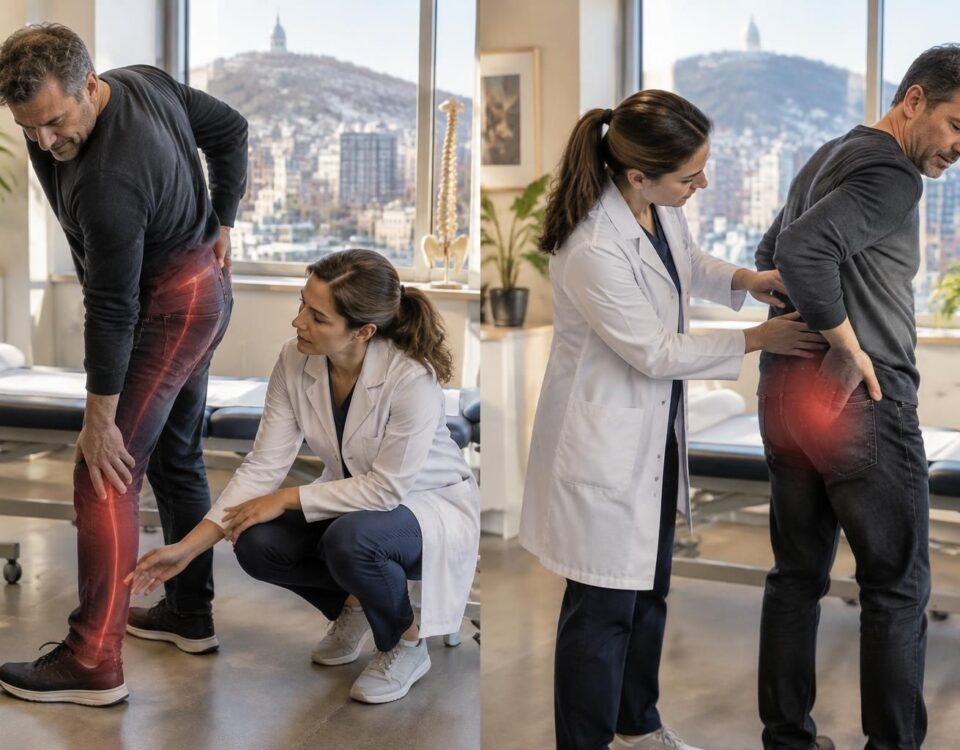
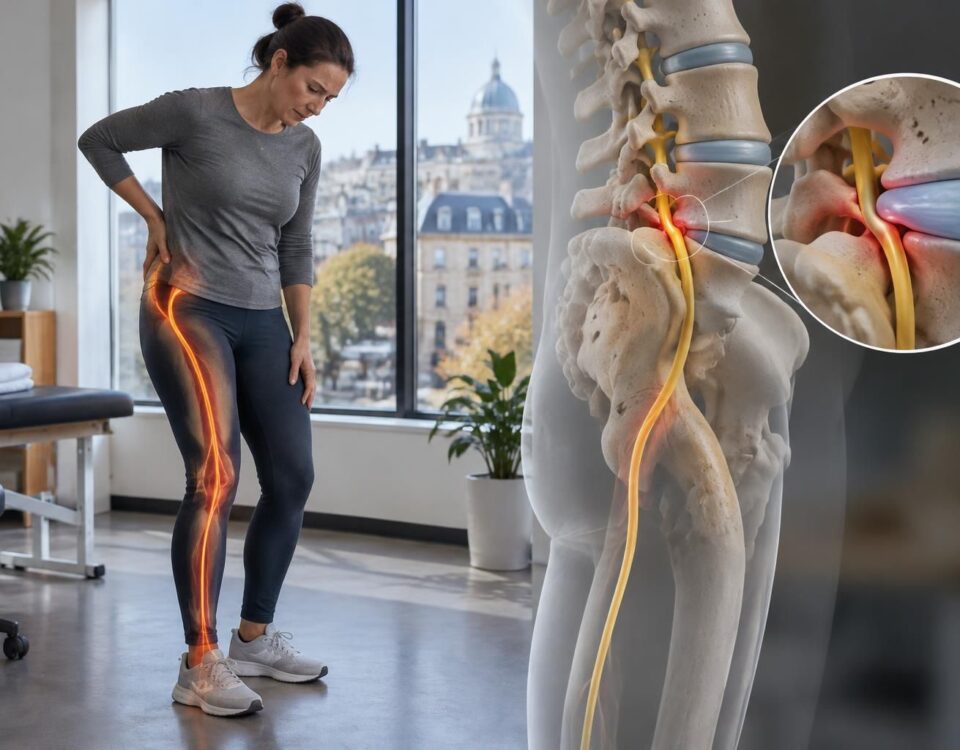
Sciatica and pain that travels lower after a stretch
27/10/2026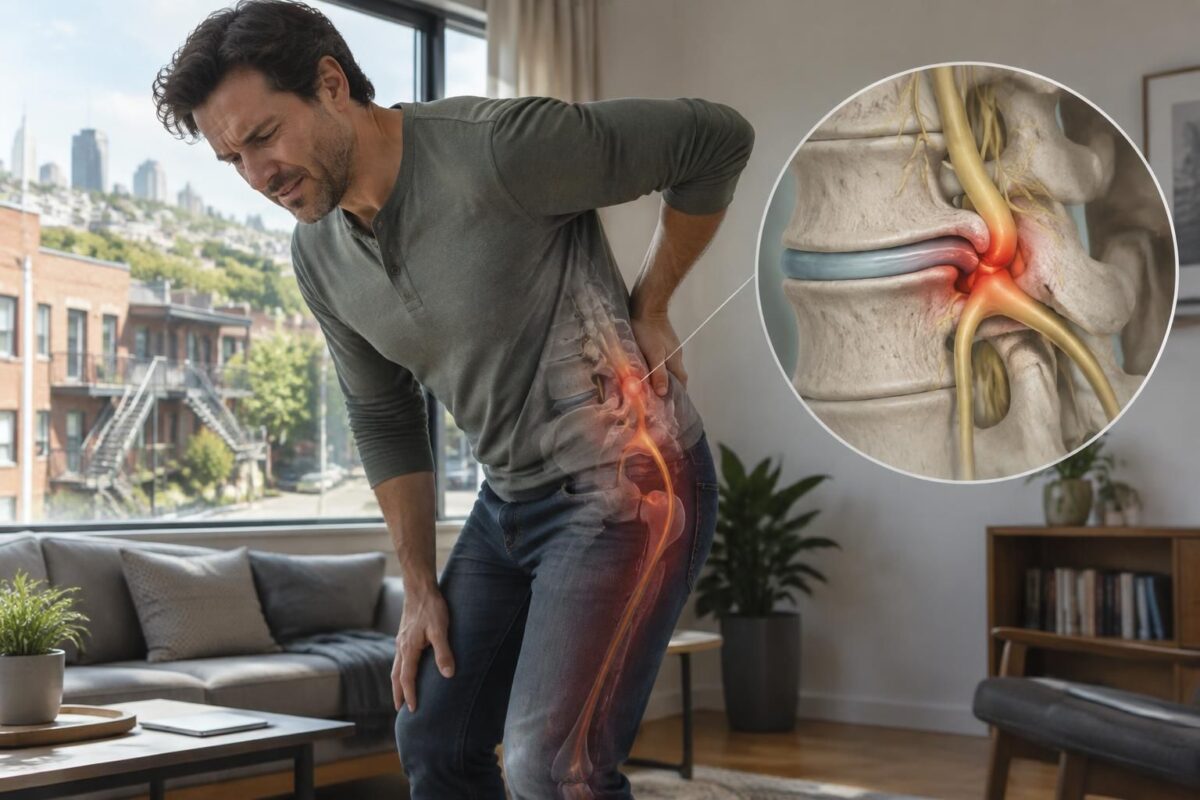
IN BRIEF A disc-root conflict refers to possible contact or pressure between an intervertebral disc and a nerve root. In Montreal, this mention in the MRI can help understand a sciatica, but does not by itself prove that the disc is causing the pain. Symptoms, strength, and sensitivity must be evaluated to guide management. |
Sciatica in Montreal: what does “disc-root conflict” mean?
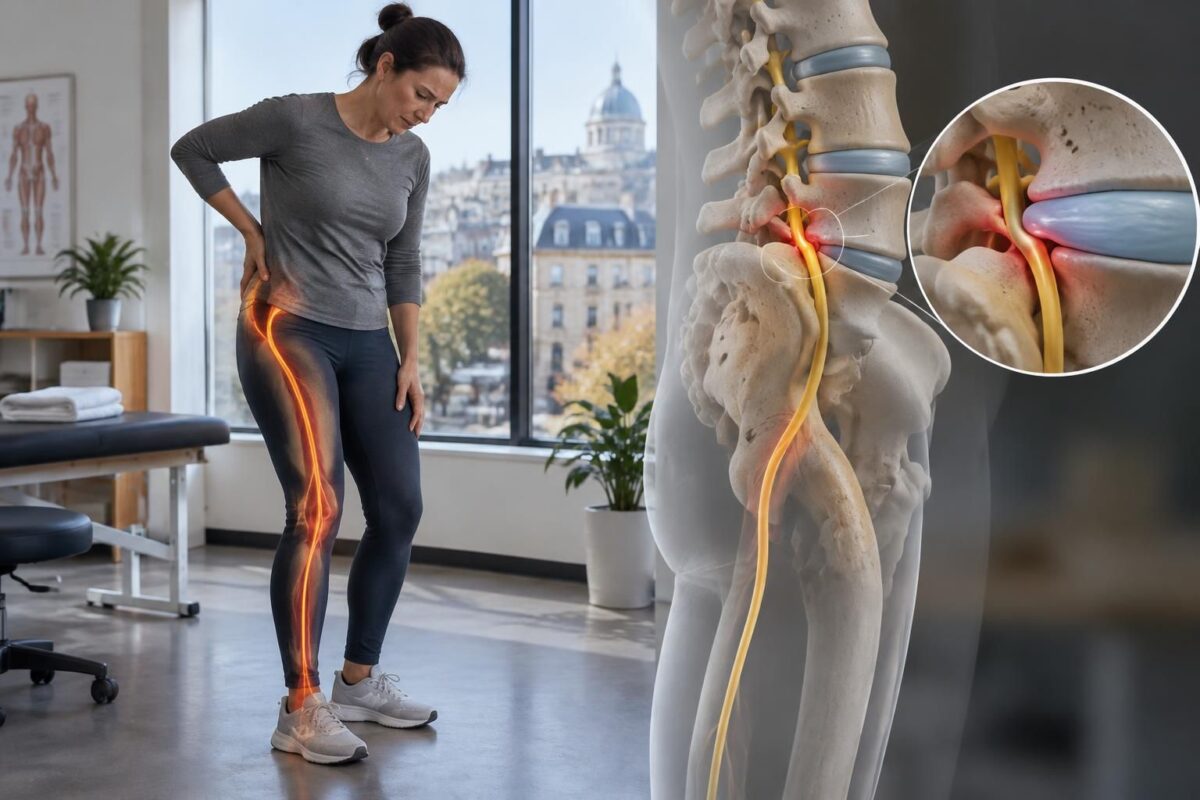
A disc-root conflict refers to contact or proximity between a spine disc and a nerve root. In the MRI, this mention may be associated with pain that radiates down the buttock and leg, but it does not alone prove that the disc is causing the symptoms or that an intervention is necessary.
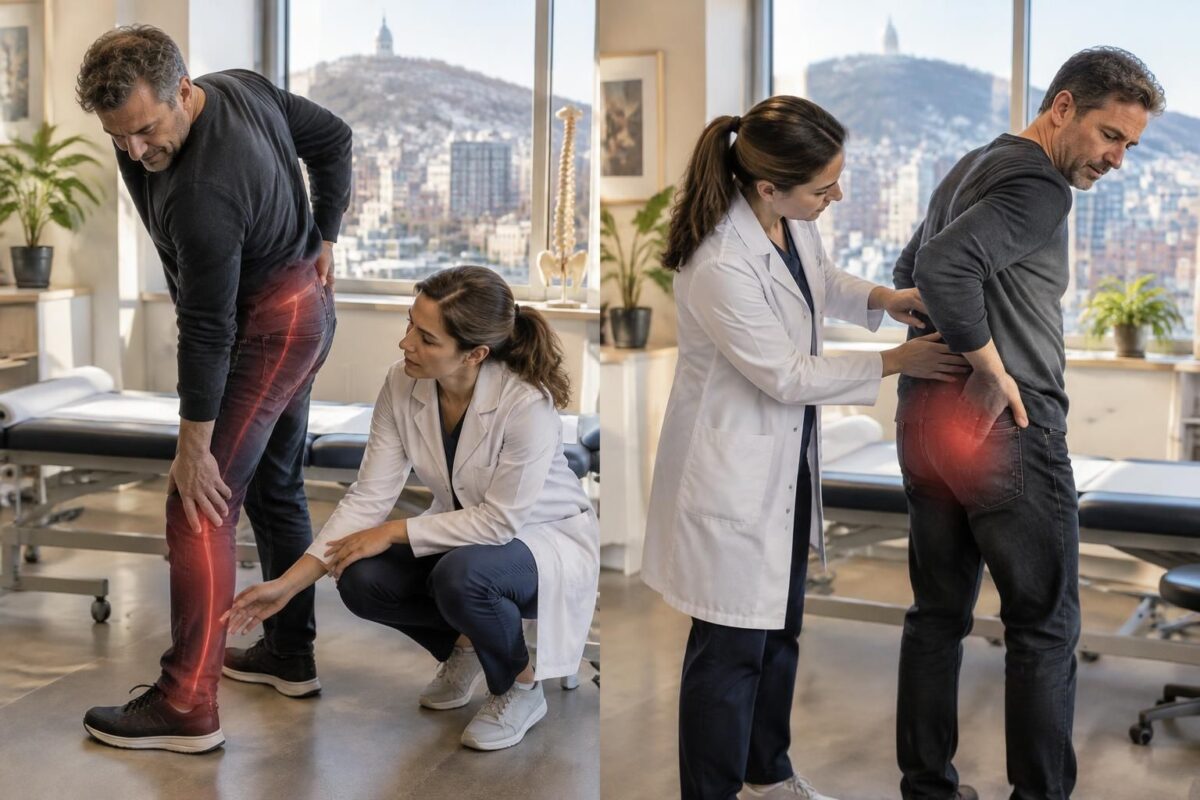
To assess a sciatica in Montreal, it is necessary to compare the imaging with the pain pathway, sensitivity, and muscle strength. An evaluation by a healthcare professional helps determine the next steps. See a doctor promptly in cases of significant or progressive weakness, loss of bladder or bowel control, or numbness in the saddle region.
In Montreal, the mention “disc-root conflict” in an MRI report describes a relationship between an intervertebral disc and a nerve root. It does not, by itself, prove that the nerve is compressed or that this image explains a sciatica. The evaluation also takes into account the pathway of pain, sensitivity, muscle strength, and the evolution of symptoms.
Sciatica in Montreal: radicular pain versus referred pain
IN BRIEF Radicular sciatica corresponds to irritation of a nerve root, while referred pain can spread to the buttock or leg without direct nerve involvement. In Montreal, distinguishing these pains helps guide the evaluation by linking the symptom route to…
Sciatica in Montreal: what does “disc-root conflict” mean?
The discs are located between the vertebrae. They help distribute loads and allow for spine movements. The nerve roots pass near the discs and exit the spine through small passages called foramina.
A disc may bulge or protrude toward a nerve root. The radiologist may then describe a disc-root conflict. This term indicates proximity, contact, or a modification in the position of the root. It does not specify, by itself, the intensity of the irritation or the certain cause of the pain.
Contact, impression, and compression: three different descriptions
A contact means that the disc touches the root. An impression or a deflection indicates that the root or its sheath appears slightly displaced or modified. The word compression describes a more pronounced mechanical effect, but a clinical examination remains necessary to understand if this effect corresponds to the symptoms.
A visible anomaly on the MRI may cause no pain. Conversely, a minor lesion on the image may be associated with significant symptoms. For this reason, the interpretation does not rest solely on the report. The healthcare professional compares the side and level described in the MRI with the pain pathway, sensitivity, and strength.
To better understand why the image alone is not sufficient to establish the cause of pain, see our article on herniated discs and sciatica on MRI.
Sciatica in Montreal: nerve root, disc, and foramen explained simply
IN BRIEF Sciatica corresponds to pain linked to the irritation of a nerve root, sometimes near a lumbar disc or a narrowed foramen. In Montreal, distinguishing an L4-L5 issue that may affect the L5 root from an L5-S1 problem that…
Herniation, protrusion, or bulge: what do these words mean on an MRI?
Reports may use several terms to describe the shape of the disc. They do not all refer to the same modification. Location also matters: a protrusion toward the center of the canal has a different relationship with the roots than a protrusion located on the side or in a foramen.
The main descriptions of the disc
- Disc bulge: the contour of the disc extends quite widely. This finding is common and does not automatically mean that a root is irritated.
- Protrusion: a part of the disc forms a localized bulge that remains largely attached to the disc.
- Extrusion: a part of the disc protrudes more, with a narrower base than the displaced portion.
- Free fragment or sequestration: a fragment has separated from the disc. Its effect depends on its location and its relationship with the nerve structures.
A herniated disc may sometimes partially resolve over time. The presence of a hernia or a free fragment does not therefore automatically mean that surgery is necessary. The decision depends on the symptoms, the examination, and their evolution. To learn more, see our page on sciatica associated with a lumbar herniated disc.

Sciatica in Montreal: understanding L5-S1 foraminal compression
IN BRIEF L5-S1 foraminal compression is a narrowing of the opening where a nerve root exits, which can cause sciatica with pain, tingling, or weakness in the buttock and leg. In Montreal, an assessment allows for correlating symptoms, clinical examination,…
What symptoms can accompany a lumbar disc-root conflict?
When a nerve root is irritated or not functioning properly, symptoms may include pain radiating down the leg, tingling, numbness, or weakness. The pain may feel like burning, stabbing, shooting, or pulling.
Lumbar radicular pain may follow the pathway of the sciatic nerve or the femoral nerve. Sciatica often manifests in the buttock and the back or side of the leg. Femoralgia, on the other hand, affects the front of the thigh and may reach the knee. The path varies according to the affected root, and symptoms do not always follow a perfect pattern.
- A lesion near the L3-L4 level may cause pain toward the front of the thigh or knee.
- A lesion near the L4-L5 level may manifest on the side of the leg or the top of the foot.
- A lesion near the L5-S1 level may lead to pain toward the back of the leg or the outer edge of the foot.
These markers do not allow for a diagnosis without an examination. Pain in the leg may exist even if the lower back hurts little or not at all. To explore this point, read our article on sciatica without lower back pain. Mild lumbar pain may also coexist with significant pain in the leg: our page on mild lumbar pain and severe leg pain explains this situation.

Sciatica in Montreal: why L5-S1 is often involved
IN BRIEF The sciatica L5-S1 often corresponds to irritation of the S1 root, sometimes related to a herniated disc. The pain may start in the buttock and descend behind the thigh to the calf or the foot. In Montreal, understanding…
Disc-root conflict, radiculopathy, and sciatica: what is the difference?
The disc-root conflict describes an anatomical relationship between a disc and a root, often observed in imaging. Radiculopathy refers to a disorder related to the function of a nerve root. It can produce pain, alterations in sensitivity, or a decrease in strength. The term sciatica typically describes pain that follows the path of the sciatic nerve down the leg.
These terms are therefore not interchangeable. A person may have a visible conflict on an MRI without radicular symptoms. Sciatica can occur without muscular weakness. Pain that follows the path of a nerve may also have a different cause than a herniated disc.
Pain may sometimes increase when lying down, but this symptom alone is not sufficient to identify the cause. Consult our article on sciatica and pain when lying down to better understand the factors that can influence symptoms.

Sciatica in Montreal: L5 and difficulty lifting the foot
IN BRIEF The difficulty in lifting the foot with sciatica can indicate weakness related to the involvement of the L5 root, sometimes caused by a herniated disc. This foot drop increases the risk of falling and requires prompt medical evaluation;…
How is the MRI interpreted in Montreal?
The MRI shows the discs, nerve roots, and other tissues of the spine. It helps locate the area and type of alteration, but it does not measure pain or its effects on daily activities on its own. The healthcare professional correlates the images with the history of symptoms and the physical examination.
Depending on the case, a medical examination may check strength, reflexes, sensitivity, and movements that reproduce pain. Other exams, such as a CT scan or an electromyogram, may be considered if the professional deems them helpful. The choice depends on the situation and the questions that need to be answered.

Sciatica in Montreal: S1 and difficulty rising up on the toes
IN BRIEF S1 sciatica can cause pain from the buttock to the calf and foot, as well as difficulty getting on tiptoe. This weakness may suggest irritation of the S1 nerve root, but is not sufficient to establish a diagnosis.…
What management options can be discussed?
Management depends on pain, neurological signs, imaging, and progression. In the absence of red flags, a professional may suggest a temporary adaptation of activities, medications when appropriate, and follow-up. Prolonged complete rest is generally not the only goal; however, returning to activities should take into account symptoms and received guidance.
Surgery is not systematic in cases of herniated discs. It may be discussed by a doctor when pain remains very disabling despite appropriate management, or when a neurological deficit justifies it. Progressive weakness requires rapid medical evaluation.
In Montreal or Terrebonne, TAGMED Clinic can evaluate certain spinal pains and discuss non-surgical approaches depending on the situation. Services may include, based on the evaluation, specific osteopathy, precision impactor, or motorized neurovertebral decompression. These approaches do not replace a medical diagnosis or follow-up by a doctor. For local information, consult the pages on sciatica treatment in Montreal and Mont-Royal and sciatica treatment in Terrebonne.

Sciatica in Montreal: L4-L5 and pain towards the top of the foot
IN BRIEF The sciatica related to L4-L5 can radiate from the lower back to the buttock and the leg; pain on the top of the foot may suggest involvement of the L5 root, but the pathways vary and symptoms overlap.…
When should you seek immediate consultation?
A rapid medical evaluation is necessary if new weakness appears or worsens, if the foot drags on the ground, if an area becomes very numb, or if the pain becomes uncontrollable. Also, consult quickly in case of fever, recent trauma, or marked worsening.
New urinary or intestinal issues, numbness in the genital or perineal region, or significant weakness in both legs require urgent care. These signs may indicate serious neurological impairment.
About the author
Sylvain Desforges, B.Sc., D.O., N.D., Doctor of Osteopathy and Naturopath, is the founding president of TAGMED and the ACMA association. He dedicates his practice to chronic pain of the spine, back pain, and pain compatible with sciatica, notably when pain radiates down to the buttock, leg, calf, foot, or toes.
Through SOS Sciatica, he publishes educational content on the symptoms of sciatica, possible causes such as herniated discs, disc pinching, foraminal stenosis, or irritation of a lumbar nerve root, as well as non-surgical approaches that may be considered based on the evaluation. At TAGMED Clinic, care may include, depending on the situation, motorized neurovertebral decompression, specific osteopathy, or precision impactor.
Medical Disclaimer: The information and advice provided on this site do not replace the opinion, diagnosis, or treatment of a healthcare professional. Please note that Dr. Sylvain Desforges, osteopath, is neither a medical doctor nor a physician, and is not a specialist in a medical specialty as defined by the Collège des médecins du Québec. Manual medicine, functional medicine, and sports medicine as described on this site exclude any medical treatment or diagnosis made by a physician or medical specialist. Always consult your doctor for any medical questions. For more details, please read our complete Legal Disclaimer.

Sciatica in Montreal: pain in the big toe, L5 root or another cause?
IN BRIEF Pain that radiates toward the big toe may indicate irritation of the L5 root, sometimes related to a herniated disc, but other causes are possible. In Montreal, evaluating the pain pathway, strength, sensitivity, and walking helps guide management…
Sciatica in Montreal: what does “disc-root conflict” mean?
- Definition: a disc touches or may irritate a nerve root.
- On MRI: the term describes an image, not necessarily a certain cause of pain.
- Possible sciatica: pain that radiates down the buttock and leg, sometimes to the foot.
- Other signs: tingling, numbness, or weakness may accompany the pain.
- Interpretation: the image must correspond to the side, the trajectory of the symptoms, and the clinical examination.
- Management: it depends on the symptoms and may include a gradual resumption of movement and rehabilitation.
- Quick assessment: new or progressive weakness, uncontrollable pain, or significant loss of sensitivity.
- Urgency: urinary or intestinal issues, numbness in the genital area, or marked weakness in both legs.

In Montreal, the mention of “disco-radicular conflict” on an MRI means that a disc could be touching or displacing a nerve root. It does not prove by itself that this abnormality causes your symptoms or that intervention is necessary. To understand the result, it must be correlated with the trajectory of the pain, sensitivity, muscle strength, and the progression of your condition.
What does a disco-radicular conflict mean?
Intervertebral discs are located between the vertebrae and help cushion movements. The nerve roots pass nearby, in exit spaces called foramina. If a disc bulges or protrudes, it may come into contact with a root, displace it, or reduce the space around it. The radiologist can then describe a disco-radicular conflict.
The terms in the report sometimes specify the type of modification: a disc bulge corresponds to a rather wide overflow, while a protrusion is a more localized bulge. An extrusion refers to a more marked bulge; a free fragment may have separated from the disc. These descriptions indicate the appearance of the image but do not automatically determine the intensity of the pain.
Contact, irritation, or compression: important differences
A simple contact between the disc and the root does not necessarily mean there is painful damage. An imprint may slightly alter the position of the root; the word “compression” describes a more marked relationship, the extent of which must be assessed. Some people present visible anomalies without significant symptoms. Others feel sharp pain despite a less impressive image.
What symptoms may appear?
When a nerve root is irritated, the pain may travel down a limb and feel like burning, an electric shock, or sharpness. In the lower back, a sciatic type of pain may start from the buttock and extend along the back or side of the leg, down to the foot. A cruralgia radiates more toward the front of the thigh. Tingling, a numb area, or decreased strength may also occur.
The affected level provides clues but cannot alone diagnose the condition. For example, an issue at L4-L5 may be accompanied by symptoms on the side of the leg or the top of the foot. At L5-S1, the pain may follow the back of the leg to the outer edge of the foot. The side, trajectory, and observed signs must be compared to the examination results.
Recommendations for assessment and management in Montreal
If you have received an MRI report, bring it to a healthcare professional and describe your symptoms precisely: their onset, trajectory, what aggravates or alleviates them, as well as any changes in sensitivity or strength. Clinical evaluation helps verify if the image corresponds to your situation. An MRI should not be interpreted in isolation nor should it be the sole basis for selecting treatment.
In the absence of alarming signs, non-surgical management may be considered based on the assessment: temporary adjustment of activities, gradual resumption of movement, and tailored rehabilitation. Medications should be discussed with a professional, especially in the presence of other health issues. Surgery is not routine; it may be considered if the pain remains disabling despite appropriate management or if neurological impairment justifies it.
When to seek help quickly
Consult promptly if new weakness appears or worsens, if the foot drags, or if the pain becomes uncontrollable. New urinary or intestinal issues, loss of sensation in the genital or perineal region, or significant weakness in both legs require urgent evaluation. This information is educational and does not replace medical advice.
| Element | What it means |
|---|---|
| Disco-radicular conflict | The disc touches or irritates a nerve root; the image alone does not confirm the cause of the pain. |
| Contact | The disc touches the root, without proving significant compression. |
| Compression | The nerve seems more compressed; symptoms and examination must confirm it. |
| Sciatica | Pain that can travel from the lower back to the buttock and leg. |
| Associated signs | Tingling, numbness, or weakness may appear. |
| MRI interpretation | To be correlated with the painful side, symptom trajectory, and muscle strength. |
| Assessment in Montreal | A healthcare professional can determine if the image corresponds to the symptoms and guide management. |
Sciatica in Montreal: illustrative testimonials on “disco-radicular conflict”
The testimonials below are fictional and serve only to illustrate possible situations. They do not describe real patients and do not allow for a diagnosis. The mention of “disco-radicular conflict” on an MRI describes a relationship between a disc and a nerve root; it does not prove by itself that this observation explains the pain.
“I thought my MRI necessarily confirmed the cause of my sciatica.” — Fictional example: a person in Montreal reads “contact with a nerve root” in their report and becomes worried. This wording indicates that the disc touches the root. To determine if this contact is associated with their symptoms, a professional must also consider the affected side, the trajectory of the pain, sensitivity, and muscle strength.
“My report talks about a protrusion, but my pain doesn’t travel down my leg.” — Fictional example: a disc anomaly may be visible without causing radicular symptoms. Lower back pain may be present without significant compression of a root. The image must therefore be interpreted in light of the examination and evolution, rather than taken in isolation.
“The pain starts from the buttock and goes down to the foot; is it necessarily sciatica?” — Fictional example: pain that radiates down the leg may correspond to radicular pain, especially when a nerve root is irritated. Burning sensations, electric shocks, or tingling may also occur. However, different problems can produce similar symptoms, and an evaluation is necessary to investigate the cause.
“The report mentions compression, but what should be checked?” — Fictional example: beyond the radiologic term, the evaluation particularly focuses on the location of the conflict, the affected side, strength, reflexes, and sensitivity. A bulging, protrusion, or extrusion do not mean exactly the same thing, and their size is not sufficient to determine the severity of the symptoms.
In the lower back, certain conditions may irritate the roots associated with the sciatic nerve or the femoral nerve. Depending on the affected root, pain may extend to the back or side of the leg, the top of the foot, or rather the front of the thigh. Weakness, numbness, or tingling may also be present, but their presence and importance vary from person to person.
The term disc-root conflict describes an anatomical observation; radiculopathy refers to a functional impairment of a nerve root. Sciatica generally describes pain that follows the path of the nerve down the leg. These terms are related but not interchangeable: an image may show a conflict without sciatica, and sciatic-type pain does not automatically mean a disc herniation is the cause.
In Montreal, as elsewhere, management depends on symptoms, examination, and their progression. In the absence of serious signs, a professional may discuss a temporary adaptation of activities, a gradual return to movement, rehabilitation, or other options tailored to the situation. Surgical intervention is not systematic; it is considered based on the clinical picture and response to treatment.
A rapid medical evaluation is necessary if new or progressive weakness appears, if the foot drags on the ground, if the pain becomes uncontrollable, or if there is significant loss of sensitivity. New urinary or bowel issues, numbness in the genital or perineal area, or marked weakness in both legs require urgent attention.
About the author
Sylvain Desforges, B.Sc., D.O., N.D., doctor in osteopathy and naturopath, is the founding president of TAGMED and the ACMA association. His practice particularly focuses on chronic spinal pain, low back pain, and pain consistent with sciatica.
Through SOS Sciatique, he publishes educational content on symptoms, possible causes, and non-surgical approaches that may be considered after evaluation. Care provided at the TAGMED Clinic may include, depending on the case, motorized neurovertebral decompression, specific osteopathy, or precision impactor.
Medical warning
The information presented is provided for educational purposes and does not replace a consultation, diagnosis, opinion, or treatment by a physician or another authorized health professional. The author is neither a physician nor a specialist in a medical specialty recognized by the Collège des médecins du Québec. Osteopathy, manual medicine, or functional support approaches do not constitute medical acts and do not replace medical follow-up.
Sciatica in Montreal: what does “disc-root conflict” mean?
When an MRI report mentions a disc-root conflict, it means that an intervertebral disc is in contact with a nerve root, or it could reduce the available space. This observation can help understand pain that radiates down the buttock or leg, but it does not alone determine the exact cause of the symptoms or the appropriate treatment. For those consulting in Montreal for sciatica, the essence is to connect the images, symptoms, and clinical examination results.
Intervertebral discs are located between the vertebrae and help absorb stresses related to movements. A nerve root exits the spine through an opening called a foramen. If the disc bulges backward or sideways, it may touch this root, displace it, or apply pressure. The radiologist then describes the relationship between these structures. However, the terms “contact,” “imprint,” and “compression” do not necessarily indicate the same intensity of impairment, and none automatically prove that the root is responsible for the pain.
The words associated with the description of the disc provide clarifications. A disc bulge corresponds to a fairly broad overflow of its contour, while a protrusion describes a more localized bulge. An extrusion is a more pronounced bulge; a sequestrated fragment has detached from the disc. Location also matters: a central, posterolateral, or foraminal anomaly may approach different roots. Even a marked image may produce few symptoms, while moderate irritation can be very painful.
A sciatica generally refers to pain that follows the path of the sciatic nerve, from the buttock down the back or side of the thigh, sometimes to the calf or foot. It may be accompanied by burning sensations, shocks, tingling, or numbness. Weakness may also appear, depending on the affected root. Pain in the front of the thigh may rather suggest cruralgia. These pathways guide the evaluation, but are not sufficient to establish a diagnosis.
The disc-root conflict is an anatomical description; radiculopathy refers to a disruption in the functioning of a nerve root. To verify if they coincide, a health professional considers the affected side, the path of the pain, sensitivity, strength, and reflexes. MRI is useful for visualizing discs and nerve tissues, but it must be interpreted alongside the history of symptoms and clinical examination. A visible anomaly may be incidental, and sciatica can have other causes than a disc herniation.
In the absence of serious signs, management is often non-surgical and tailored to each person. It may include a gradual return to activities, rehabilitation, and advice on managing daily movements. Medications should be discussed with a health professional, depending on history and situation. Surgery is not systematic: it may be considered when the pain remains very disabling despite appropriate care or if neurological impairment justifies it. Some hernias evolve favorably over time.
A quick medical evaluation is necessary in case of new or progressive weakness, foot dragging, significant loss of sensitivity, or uncontrollable pain. Recent urinary or bowel disturbances, numbness in the genital or perineal region, or marked weakness in both legs require urgent care.
About the author
Sylvain Desforges, B.Sc., D.O., N.D., Doctor of Osteopathy and Naturopath, is the founding president of TAGMED and the ACMA association. His practice particularly focuses on chronic spinal pain, lower back pain, and pain compatible with sciatica. He is interested in the integration of approaches and technologies such as motorized neurovertebral decompression, laser, and shock wave therapy. The care provided is determined based on the assessment of each situation.
Medical disclaimer
This content is provided for educational purposes and does not substitute for a consultation, diagnosis, or treatment by a physician or another licensed healthcare professional. The author is neither a physician nor a specialist in a medical specialty recognized by the Collège des médecins du Québec. Osteopathy, manual medicine, or functional support approaches do not replace medical follow-up.
In Montreal, the term “disc-root conflict” refers to a relationship observed in imaging between an intervertebral disc and a nerve root. This finding can be associated with sciatica when the pain radiates down the buttock and leg, but it alone does not confirm that the disc is responsible for the symptoms or determine the appropriate treatment. Clinical examination, the pathway of pain, sensitivity, muscle strength, and symptom progression are equally important.
Understanding what a disc-root conflict means
A disc can protrude and touch, displace, or compress a nerve root. The terms used in a report—contact, impression, displacement, or compression—describe degrees of anatomical relationship, but do not always reveal the intensity of symptoms. Some individuals may present a visible abnormality on an MRI without corresponding pain; others may experience significant pain despite an image that appears moderate.
A sciatica corresponds to pain that follows a pathway down the leg and may be accompanied by burning, shocks, tingling, or numbness. Depending on the affected root, the pain may radiate down to the calf, heel, or outer edge of the foot. To better understand these irradiations, check our page on sciatic pain in the calf, heel, or outer edge of the foot, as well as this article on disc herniation and pain radiating down the leg.
To interpret an MRI result, it is essential to verify if the described side and level correspond with the symptoms and observations from the examination. Therefore, mentioning a conflict alone does not allow one to conclude a painful compression or the need for intervention. You can also consult our article dedicated to what a disc-root conflict means, as well as the resources from Centre Valmy and NotreFamille.
Evaluation and management options in Montreal
When pain in the buttock radiates down the leg, an evaluation allows for correlating symptoms, available imaging results, and functional capacities. Management depends on this evaluation and may, depending on the situation, include a temporary adaptation of activities, a gradual return to movement, and appropriate exercises or care. To learn more about pain radiating down the leg, visit the page Sciatica in Montreal: pain in the buttock radiating down the leg.
Nocturnal pain or worsening should be assessed in context with other present symptoms. You will find guidelines in the article Sciatica and night pain: what to watch for. A quick medical evaluation is necessary in case of new or progressive weakness, foot dragging, significant loss of sensitivity, or uncontrollable pain. New urinary or bowel disturbances, numbness in the genital or perineal region, or marked weakness in both legs require urgent care.
Medical disclaimer: this information is educational and does not replace a consultation, diagnosis, or treatment by a physician or another licensed healthcare professional. The author is neither a physician nor a specialist in a medical specialty recognized by the Collège des médecins du Québec. If you have doubts about your symptoms, seek professional advice. For more details, please refer to the legal notice from SOS Sciatique.

Sylvain Desforges, B.Sc., D.O., N.D., docteur en ostéopathie
Dr Sylvain Desforges, B.Sc., D.O., N.D., osteopath, is the founding president of TAGMED and of the ACMA association. He dedicates his practice to chronic spinal pain, low back pain and symptoms compatible with sciatica, particularly when pain radiates toward the buttock, leg, calf, foot or toes.
Through SOS Sciatique, he publishes educational content on sciatica symptoms, possible causes such as disc herniation, disc narrowing, foraminal stenosis or irritation of a lumbar nerve root, as well as non-surgical approaches that may be considered according to the evaluation. At Clinique TAGMED, care may include, depending on the case, motorized neurovertebral decompression, specific osteopathic care or precision percussion.
For an evaluation related to sciatica treatment in Montreal / Mount Royal or sciatica treatment in Terrebonne, please consult the services available at Clinique TAGMED.
Medical disclaimer
The information published on SOS Sciatique is provided for educational purposes only and does not replace a consultation, diagnosis, opinion or treatment provided by a physician or another authorized healthcare professional. The author of this article is neither a medical doctor nor a specialist in a medical specialty recognized by the Collège des médecins du Québec. The osteopathic, manual medicine or functional support approaches described on this site do not constitute medical acts and are not intended to replace medical follow-up.
Consult a physician or emergency service in cases of loss of bladder or bowel control, anesthesia in the saddle area, significant or progressive weakness in the leg or foot, fever, recent trauma, severe pain or rapid worsening of symptoms. For more details, please read our Legal Notice.