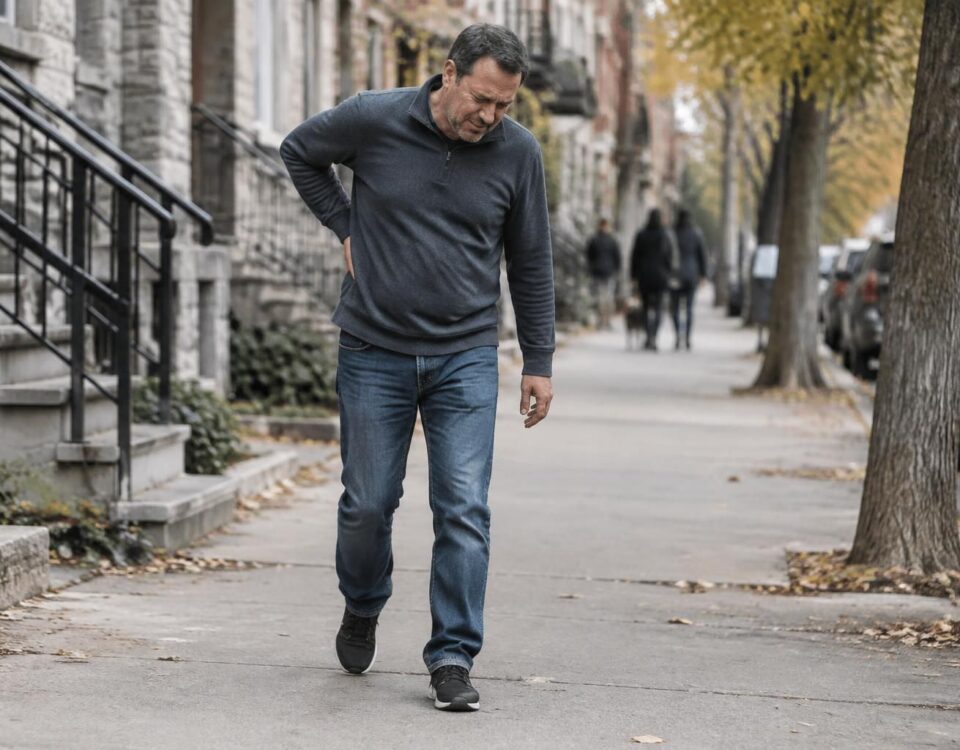
Sciatica and pain after a sitting day
03/07/2026
Treatment of sciatica in Terrebonne: hernia, stenosis or nervous irritation?
04/07/2026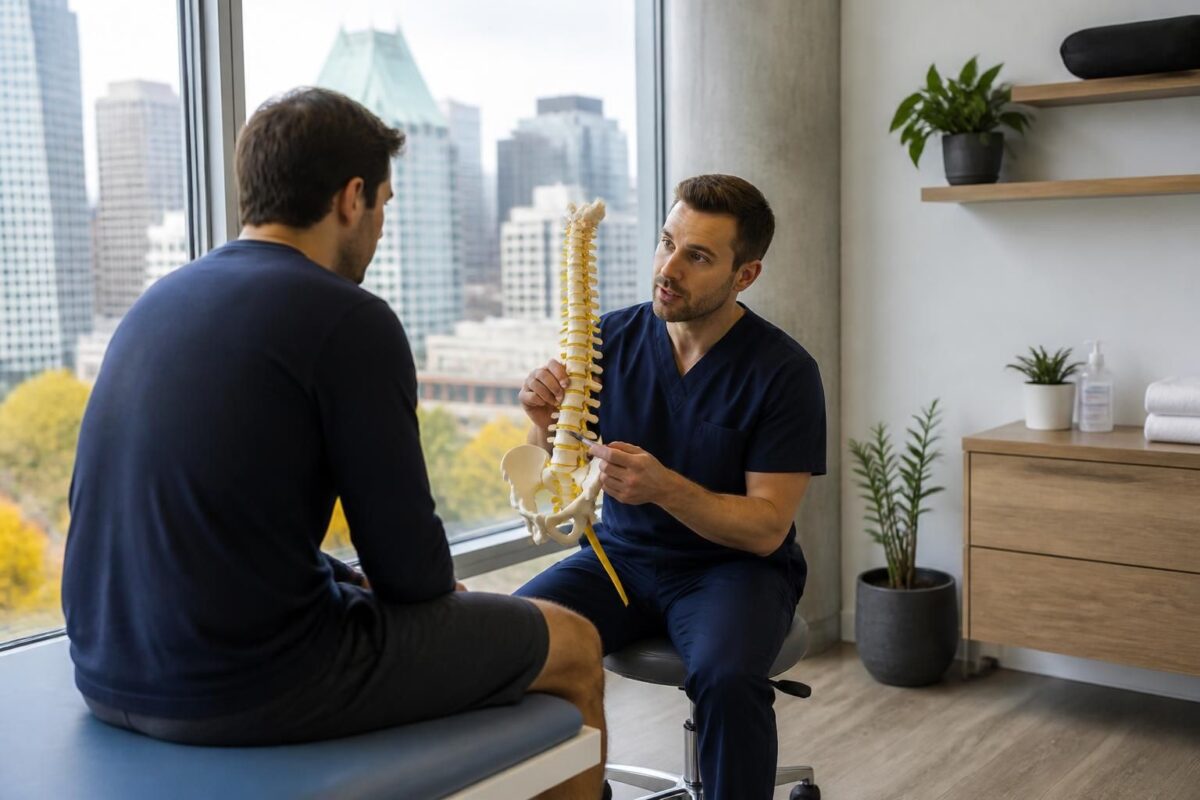
In short
| In short, the sciatica treatment is one Non-surgical approach to relieve the pain and to Restore mobility When the pain results from a slipped disc, dune Spinal stenosis or dune Sciatic nerve irritation. At Montreal, this service is particularly suitable for people looking for local and personalized care without surgery. Advantages: Sustainable relief, Improving mobility and Custom Plan including neurovertebral decompression, physiotherapy and re-education, with a monitoring and adjustments according to cause and severity. Operation is based on a Clinical evaluation, the identification of the cause (hernia, stenosis or nerve irritation) and the implementation of a suitable protocol and Exercise program, in order to release the sciatic nerve and reduce inflammation, with results that can be quick or progressive depending on the case. |
Treatment of sciatica in Montreal: hernia, stenosis or nervous irritation?
In Montreal, the treatment aims to determine whether the pain comes from a slipped disc, of a Foraminal stenosis or a Sciatic nerve irritation and to propose a suitable approach. The diagnosis is based on a thorough clinical examination and medical history, supplemented, if necessary, by imaging (MRI or CT scan) to identify the precise cause.
- optionally, favor non-surgical solutions such as anti-inflammatory, the physiotherapy And some Rehabilitation exercises, possibly with infiltrations.
- Depending on the severity and cause, surgery may be considered, but after a complete and personalized assessment.
- Objectives: pain reduction, restoration of mobility and prevention of recurrences thanks to a Custom Plan and one monitoring adapted.
Sciatica can come from a slipped disc, of a Foraminal or spinal stenosis, or a nervous irritation localized to the sciatic nerve. This article describes common causes, diagnostic steps and options non-surgical Available in Montreal, with a look at the treatments offered at the TagMed Clinic. It offers clear information to help patients discuss with their healthcare professional and choose a suitable approach.
Understanding sciatica and its main causes
The sciatic nerve is the longest in the body. Its trajectory starts from the lower back, crosses the buttocks and descends along the leg. When the nerve is compressed or irritated, pain that follows this path appears. This table can also include burning sensations, tingling, numbness or, sometimes, muscle weakness.
Slipped disc
A disc herniation occurs when part of the intervertebral disc pushes and compresses the sciatic nerve. This compression causes red-red pain that descends along the leg and can be associated with increased sensitivity of the back. The diagnosis is based on a clinical examination and, depending on the case, imaging such as MRI or CT to confirm the location and severity of the compression. Treatment may include anti-inflammatory measures, injectable options, and sometimes surgery if the pain persists or worsens. To learn more about non-surgical approaches and their limitations, see the Guide on Neurovertebral Decompression and its Alternatives on sossciatica.com.
Foraminal stenosis and spinal stenosis
The Foraminal stenosis Refers to a narrowing of the passages through which the nerve roots leave the spine. The Spinal stenosis is a narrowing of the spinal canal. These narrowings increase the pressure on the sciatic nerve and cause radiant pain, sometimes accompanied by weakness or numbness in the leg. Diagnosis is often based on imaging (MRI or CT scan) and clinical evaluation. Treatment may include non-surgical techniques and, depending on the severity, procedures for intervention. For information on non-surgical treatments and specialized options in Montreal, see the following resources: Non-surgical treatment of sciatica in Montreal and neurovertebral decompression.
Nerve irritation and referred pain
Sciatic nerve irritation can also result from muscle imbalance, overwork or inadequate sustained posture. This irritation triggers pain that can be felt in the lower back, buttock and leg. The diagnosis is based on clinical history and physical examination. The treatment aims to reduce irritation and restore mobility, without systematically using specific exercises. To understand the mechanisms and choices of management, you can consult the general sciatica resources proposed by sossciatica.com.

Sciatica in Montreal: understanding L5-S1 foraminal compression
IN BRIEF L5-S1 foraminal compression is a narrowing of the opening where a nerve root exits, which can cause sciatica with pain, tingling, or weakness in the buttock and leg. In Montreal, an assessment allows for correlating symptoms, clinical examination,…

Sciatica in Montreal: why L5-S1 is often involved
IN BRIEF The sciatica L5-S1 often corresponds to irritation of the S1 root, sometimes related to a herniated disc. The pain may start in the buttock and descend behind the thigh to the calf or the foot. In Montreal, understanding…
Treatment and management in Montreal
In Montreal, the use of neurovertebral decompression and specialized osteopathy is one of the non-surgical options offered by some clinics. This approach aims to reduce the pressure on the nerve structures and to promote resumption of function without surgery. To understand the principles and possible results of neurovertebral decompression, see this informative guide: Neurovertebral decompression and sciatic pain.
The options offered in TagMed
In tagmed, the team favors non-surgical treatments adapted to each patient. Commonly proposed terms include theSpecific osteopathy, non-invasive treatments and infiltrations where relevant. The goal is to improve pain and function while avoiding surgery when possible. To find out about the services offered in Montreal and the surrounding area, visit Tagmed Clinic.
Sciatica in Montreal: L5 and difficulty lifting the foot
IN BRIEF The difficulty in lifting the foot with sciatica can indicate weakness related to the involvement of the L5 root, sometimes caused by a herniated disc. This foot drop increases the risk of falling and requires prompt medical evaluation;…

Sciatica in Montreal: S1 and difficulty rising up on the toes
IN BRIEF S1 sciatica can cause pain from the buttock to the calf and foot, as well as difficulty getting on tiptoe. This weakness may suggest irritation of the S1 nerve root, but is not sufficient to establish a diagnosis.…
When to consult and follow
The typical duration of a sciatic crisis is variable. An improvement can occur in a few weeks with an appropriate treatment. Signs that require rapid assessment include rapidly worsening pain, progressive weakness, loss of urinary or intestinal control, or sudden and intense pain that greatly limits daily activities. In these cases, consult a doctor immediately.
An effective treatment plan is based on an accurate diagnosis and an appropriate approach to the underlying cause. Muscle tension or nervous irritation can be managed differently from stenosis or disc herniation. For general information and resources on non-surgical treatments, you can consult: Non-surgical treatment of sciatica in Montreal and Pain in the buttocks and sciatica.
To learn more about decompression possibilities and specific advice in Montreal or Terrebonne, you can also explore the following resources: SOS SCIATIC, Carpal tunnel and sciatica, and the pages dedicated to decompression and herniated disc on SoshernieDiscale.com.
For technical information on treatments and non-surgical approaches, consult the dedicated resources in Montreal and Terrebonne via the links above and the pages of TagMed.
Medical Disclaimer: The information and advice provided on this site does not replace the health professional’s diagnosis or treatment. Please note that Dr. Sylvain Desforges osteopath is neither a doctor of medicine nor a doctor, and is not a specialist in a medical specialty as defined by the Collège des Médecins du Québec. Manual medicine, functional medicine and sports medicine as described on this site exclude any medical treatment or diagnosis made by a doctor or specialist doctor. Always consult your doctor for any medical questions. For more details, please read our full legal notice.
- Slipped disc — Sciatica by protrusion: neurovertebral decompression, re-education, stealth; surgery considered if failure.
- Lumbar stenosis — Root compression: Target decompression, Stability exercises, stealth; surgery according to severity.
- nervous irritation (Piriforme syndrome or inflammatory radiculopathy) — Treatments: Manual therapies, osteopathy, re-education, stealth; Postural adaptation.
- Diagnosis and orientation — Clinical evaluation + imagery (MRI/scanner) If necessary to confirm the cause and plan the treatment.
- priority non-surgical approaches — Custom plan, neurovertebral decompression, exercises and follow-up.
- When to intervene surgically — Persistence after treatment, progressive weakness or severe pain; decision after evaluation.

This article guides you on the treatment of sciatica in Montreal depending on the main cause: slipped disc, stenosis or nervous irritation. It offers non-surgical approaches adapted to the local context, benchmarks for diagnosis and practical advice to quickly regain normal activity, while insisting on the importance of a personalized plan developed by your health professional in the region.

Sciatica in Montreal: L4-L5 and pain towards the top of the foot
IN BRIEF The sciatica related to L4-L5 can radiate from the lower back to the buttock and the leg; pain on the top of the foot may suggest involvement of the L5 root, but the pathways vary and symptoms overlap.…

Sciatica in Montreal: pain in the big toe, L5 root or another cause?
IN BRIEF Pain that radiates toward the big toe may indicate irritation of the L5 root, sometimes related to a herniated disc, but other causes are possible. In Montreal, evaluating the pain pathway, strength, sensitivity, and walking helps guide management…
Understand the cause of sciatica
Slipped disc
A slipped disc May compress the sciatic nerve, causing pain that radiates from the lumbar region to the leg, sometimes with numbness or tingling. The diagnosis is based on a clinical examination and, as the case may be, appropriate imaging. In Montreal, teams focus on a progressive assessment to determine whether targeted exercises and manual therapies can release pressure and improve mobility.
Spinal or foraminal stenosis
The stenosis Can reduce space around the nerve or nerve roots, causing lower back pain and symptoms in the leg, especially when walking. Precise diagnosis guides appropriate care: some patients benefit from a strengthening and stretching program, others a non-surgical decompression intake or targeted interventions depending on the severity and location of the compression.
Nervous irritation without major hernia
Sciatic nerve irritation may occur from piriformis syndrome, spondylosis or other mechanical factors. These irritations produce pain and burning sensations or electric shocks. The treatment then aims to relax the tissues, improve mobility and correct bad postural habits, in order to prevent recurrences and promote functional recovery.

Sciatica in Montreal: why the affected root changes the pain pathway
IN BRIEF Sciatica refers to pain or nerve symptoms that vary depending on the affected lumbar root. Pain, tingling, or numbness may manifest in the buttock, thigh, calf, or foot. Understanding this distribution helps guide the assessment, without diagnosing based…

Sciatica in Montreal: L4-L5 disc, L5-S1 disc, and leg pain
IN BRIEF Sciatica refers to pain that can radiate from the lower back or buttock down the leg, sometimes related to nerve irritation near the L4-L5 or L5-S1 discs. The level of the disc alone is not sufficient to identify…
Treatment plan adapted to Montreal
Preferred non-surgical approaches
For the majority of patients, treatments non-surgical combine osteopathy, physiotherapy and personalized exercises. These approaches aim to decompress the nerve structures, strengthen the back and stabilizing muscles, and promote better posture. The infiltration Or equivalent techniques can be considered when the pain is particularly strong and other measures do not provide lasting relief. The objective is a gradual reduction in pain and a resumption of daily activities without major limitation.
When to consider surgery
Surgery is considered when conservative treatments do not provide sufficient relief or when signs of progressive neurological involvement appear, or in the presence of a diagnosis of severe stenosis or a Compressive hernia Persistent. In the Montreal region, the decision is taken after a thorough assessment and a discussion of risks and benefits, in order to favor a solution adapted to each patient.
Examples of care pathways
A typical course can begin with a detailed consultation, followed by a personalized rehabilitation program, regular evaluations and an adjustment of the exercises according to the evolution. Some people will join sessions of neurovertebral decompression or other non-invasive manual techniques, in order to optimize the results and limit anti-inflammatory drugs.
Practical advice and prevention
Adopt a Adapted posture, avoid sudden movements and favor gentle exercises of Back strengthening and ofstretches targeted. Maintain regular physical activity appropriate to your condition and check quickly if the symptoms get worse, if you develop a loss of urinary or intestinal control, or if the pain persists beyond a few weeks. A personalized treatment plan, supervised by specialists in Montreal, can help you reduce pain and regain an active life without limitation.
| main cause | Treatment approach in Montreal (concise text) |
|---|---|
| Slipped disc | key diagnosis by MRI; neurovertebral decompression and rehabilitation; affiliation ains and exercises; Surgery considered only if failure or progression. |
| Foraminal spinal stenosis | Evaluation by MRI/CT; approach multimodal including targeted decompression, physical therapy and stealth so useful; surgery if severe compression persists. |
| Nerve irritation (piriform or non-compressive radiculopathy) | Approach Smooth and targeted with osteopathy, stretching, reinforcement; advice postural; Possible injection if pain persists. |
Testimonials on the treatment of sciatica in Montreal: hernia, stenosis or nervous irritation?
Marie, 46, residing in Montreal, suffered from a slipped disc lumbar that caused radiant pain along the leg. After a full assessment, the personalized plan began with a neurovertebral decompression associated with a targeted rehabilitation program. Within a few weeks, the pain decreased and mobility returned, making it possible to gradually resume daily activities without limiting your movements.
Jean, 58, Montreal, presented a Foraminal stenosis which compresses the nerve roots and stimulates intense pain along the leg. Through multidisciplinary care, including physiotherapy sessions, strengthening exercises and, if necessary, infiltration options, he experienced a gradual improvement in pain and a better ability to walk long distances without acute pain.
Sophie, 34, Montreal, suffered from a Sciatic nerve irritation, often linked to muscle tension and postural imbalance. The treatment combined postural advice, gentle exercises and targeted manual techniques. After the program, she regained ease during her daily activities and was able to resume her favorite sport without marked pain.
Dr. Sylvain Desforges, osteopath, naturopath and doctor Manuel, is the founding president of the Tagmed clinics and the ACMA association. With a career dedicated to innovation in health care, he specializes in the management of Chronic pain of the spine and in the integration of advanced technologies such as the neurovertebral decompression, the laser and the Shockwave therapy. His approach is based on clear principles: providing care evidence-based to optimize the health and well-being of its patients, by favoring a global and personalized approach adapted to the Montreal context.
In Montreal, his work around the sciatica For patients withHerniated/Discals or of Foraminal stenosis, as well asnervous irritation Can radiate the lower back, buttocks and legs. He understands that sciatic pain can result from various mechanisms, ranging from disc movement to foramial compression or neural irritation, and that each case requires a specific assessment to target the underlying cause and choose the most relevant options.
His approach first favors solutions non-invasive and non-surgical when possible, in order to quickly reduce pain and improve function. Neurovertebral decompression is one of the key approaches that it integrates with other manual and osteopathic techniques in order to release the pressure exerted on the lumbar nerves and to promote the rehydration of the discs. In addition, treatment protocols include modalities such as laser and the Shockwave therapy, which can accelerate the reduction of inflammation and support muscle and neural recovery.
The diagnosis is made after a thorough clinical examination and careful review of the patient’s medical history. Elements such as symptoms, location, intensity and progress guide the diagnostic orientation. As appropriate, appropriate imaging examinations, such as MRI or CT scan, can be considered to accurately identify the cause of sciatic nerve compression or irritation. This diagnostic-therapeutic approach makes it possible to build a Personalized treatment plan and evolutionary.
Dr. Desforges’ vision is to put the patient back at the center of his own recovery, with careful follow-up and continuous adjustments to the therapeutic plan. In practice, this means close coordination between the different disciplines present in TAGMED and the prudent use of advanced techniques when justified by the evaluation. The objective is clear: to restore mobility, to sustainably reduce pain and reduce the risk of recurrence, while preserving patient safety and comfort in a professional and welcoming environment in Montreal.
This article details the treatment of sciatica in Montreal by distinguishing the most frequent causes — slipped disc, Foraminal stenosis or nervous irritation — and presenting the appropriate support options for the region. He recalls that the diagnosis is based on a thorough clinical examination and medical history, sometimes with imaging examinations (MRI or CT scan) to identify the precise cause of sciatic nerve compression. The treatments favor personalized non-surgical approaches, including neurovertebral decompression, theosteopathy and the physiotherapy, in order to reduce pain, improve mobility and promote recovery in compliance with local specificities.
In Montreal practice, sciatica can result from a slipped disc, of a stenosis channel or a nervous irritation linked to structures close to the sciatic nerve. The diagnosis is based on a careful clinical evaluation and analysis of the symptomatic table, supplemented by imaging when necessary. To understand why the neurovertebral decompression may be a solution non-invasive For sciatica, you can consult specialized resources, including this article. Why neurovertebral decompression is a non-invasive solution for sciatica
In Montreal, the treatment options are multiple and adapt to each case: neurovertebral decompression (often associated with exercises and osteopathic care), physiotherapy, and, when necessary, stealth or surgical intervention adapted to the cause and severity. For a general presentation of the care available in Montreal, visit the page dedicated to the treatment of sciatica: Sciatica treatment in Montreal. Other local resources, including specialized clinics, offer patient-centric approaches and personalized plans. TagMed Clinic – Treatment of Sciatica in Montreal
theosteopathy And the associated techniques play an important role in managing symptoms and reducing inflammation. To better understand the benefits of these approaches, refer to resources that explain how osteopathy can help reduce sciatic pain. The benefits of osteopathy to reduce sciatic pain
In practice, it is essential to plan a suitable care pathway and monitor the progress with your health professional. If the pain descends into the leg and you are looking for practical advice for Montreal, dedicated resources provide guidance on the steps to follow and the options available. What to do when the pain goes down in the leg
To enrich your knowledge and consider the most relevant modalities, other local resources offer clear explanations on sciatica and its treatment, such as explanatory guides and clinical presentations. sciatica explained and Sciatica Clinic
Finally, in case of suspicion of Montreal Sciatica Disc Herniation, it may be useful to consult specialized clinics that treat this type of pathology and offer specific treatment plans. Disc and Sciatica Herniated – Montreal
For additional information and additional support options, several online resources offer explanations and recommendations on the sciatica, the vertebral decompression and long-term management strategies. In particular, you can consult the following articles and resources: Sciatica and driving, Calf and sciatica pain: how to interpret it, and Treatment of sciatica – what to do when the pain descends into the leg

Dr Sylvain Desforges, B.Sc., D.O., N.D., osteopath, is the founding president of TAGMED and of the ACMA association. He dedicates his practice to chronic spinal pain, low back pain and symptoms compatible with sciatica, particularly when pain radiates toward the buttock, leg, calf, foot or toes.
Through SOS Sciatique, he publishes educational content on sciatica symptoms, possible causes such as disc herniation, disc narrowing, foraminal stenosis or irritation of a lumbar nerve root, as well as non-surgical approaches that may be considered according to the evaluation. At Clinique TAGMED, care may include, depending on the case, motorized neurovertebral decompression, specific osteopathic care or precision percussion.
For an evaluation related to sciatica treatment in Montreal / Mount Royal or sciatica treatment in Terrebonne, please consult the services available at Clinique TAGMED.
Medical disclaimer
The information published on SOS Sciatique is provided for educational purposes only and does not replace a consultation, diagnosis, opinion or treatment provided by a physician or another authorized healthcare professional. The author of this article is neither a medical doctor nor a specialist in a medical specialty recognized by the Collège des médecins du Québec. The osteopathic, manual medicine or functional support approaches described on this site do not constitute medical acts and are not intended to replace medical follow-up.
Consult a physician or emergency service in cases of loss of bladder or bowel control, anesthesia in the saddle area, significant or progressive weakness in the leg or foot, fever, recent trauma, severe pain or rapid worsening of symptoms. For more details, please read our Legal Notice.