Sciatica: when the lumbar disc irritates the nerve
03/07/2026
Treatment of sciatica in Montreal: hernia, stenosis or nervous irritation?
04/07/2026
In short
In short, the sciatica Associated with a Pain after a sitting day is a pain that starts from the lower back and can radiate into the buttocks and leg. It is often aggravated by the Extended sitting position. This management approach offers benefits clear: reduce the Lumbar pressure, limit inflammation of the sciatic nerve and improve comfort at work and at home. Operation is based onalternation of postures And some Active breaks regular (approximately every 30 minutes), as well as theErgonomic fit single seat and use of lumbar support. In practice, these measures make it possible to Quick Relief After a sitting day and preserve the productivity and well-being in the medium and long term. |
After a day course, the sciatica May intensify: Pressure on the lumbar discs and inflammation of the sciatic nerve can cause pain that starts from the lower back and can radiate to the buttocks or leg.
There is no Universal posture, but the goal is to Vary positions And to alternate support throughout the day. Adopt an ergonomic base: flat feet, Sustained back, well-adjusted chair, and favor regular active breaks every 30 minutes.
To relieve, favor simple measures such as hot or cold and soft stretches. If the pain persists or is accompanied by unusual signs (weakness, urinary disorders), consult a professional quickly.
Quick summary: After a day spent in a sitting position, nerve pain sciatica may appear or increase. This pain starts from the lower back and can descend into the buttocks or leg. This article explains simple mechanisms, practical gestures and warning signals. The goal is to quickly reduce pain and improve comfort over time.
Understand the mechanism after a sitting day
The sciatica May become painful when sitting maintains pressure on the lumbar discs and maintains nerve inflammation. Staying for a long time can decrease the natural curvature of the back and increase stress on the spine. These factors promote pain that can radiate to the buttock and leg.
Adapt your posture and work environment
Objective: to find a comfortable position and make it evolve regularly. Start with simple basics:
• Feet hovered on the ground, Knees slightly bent, Back supported by the file, Basin in neutral position On the ischines.
• Use lumbar support or rolled towel if lower back lacks support.
• Alternate postures during the day. No position should be maintained for too long.
To promote comfort, favor ergonomic devices and active breaks. Common options include a suitable chair, a dynamic seat or a height-adjustable desk. The objective is to distribute the stresses over different areas of the body and to avoid overloading a single zone.
habits to change to limit pain
Avoid prolonged immobility. Staying in the same position for hours increases lumbar tension and can awaken pain. Varying the supports and working angles helps to release the spine.
Avoid slumping or throwing your head forward in front of the screen. Keep your shoulders relaxed and your gaze straight ahead.
Set the screen at eye level and use screen supports if necessary to limit cervical and lumbar tension.
Avoid continually crossing your legs. Lay the feet flat and favor a stable base of the pelvis.
If you experience increased pain, quickly adjust your posture and take a short active break.
What you can do after a prolonged sitting day
Heat or cold: Apply warm to relax the muscles, or cold to reduce local inflammation. Use short and moderate compresses to avoid skin lesions.
Soft stretches: After the day, simple gestures can help. For example:
• Knee towards the chest: lie on your back, bring one leg towards the chest, hold for a few seconds then release.
• Stretching of the piriform: On the back, plant an ankle on the opposite knee and bring the thigh towards you.
• Hamstrings: Place the heel on a support and lean forward slightly, back straight.
Stay tuned to your body. If a stretch triggers pain, stop and ask a professional for advice.
Lying down for a few moments can provide quick relief when the pain is strong. Place a cushion under the knees to relax the lower back and reduce pressure on the nerve root. This posture remains temporary and then resumes a light activity.
When to consult: A consultation is indicated in the presence of elements such as a decrease in strength in the leg, urinary disorders, loss of perineal sensitivity, or extreme pain that does not respond to analgesics.
Resources and useful links
To deepen, these resources provide additional information on sciatica and non-surgical approaches:
- Sciatica:#ATFP_CLOSE_TRANSLATE_SPAN# When the lumbar disk irritates the nerve
- Causes#atfp_close_translate_span# of sciatica and pain descent
- Evaluation#ATFP_CLOSE_TRANSLATE_SPAN# Clinic and treatment
- Suffer#ATFP_CLOSE_TRANSLATE_SPAN# Less: Simple gestures in sitting position
- position#atfp_close_translate_span# prolonged and sciatica seat
- Treatment#ATFP_CLOSE_TRANSLATE_SPAN# Non-surgical in Montreal
- Causes#atfp_close_translate_span# and sciatica mechanisms
- Sciatica#ATFP_CLOSE_TRANSLATE_SPAN# and sitting position
- Sensation#ATFP_CLOSE_TRANSLATE_SPAN# Electric and Nervous Irritation
- Sciatica#ATFP_CLOSE_TRANSLATE_SPAN# and position to avoid
Medical Disclaimer: The information and advice provided on this site does not replace the health professional’s diagnosis or treatment. Please note that Dr. Sylvain Desforges osteopath is neither a doctor of medicine nor a doctor, and is not a specialist in a medical specialty as defined by the Collège des Médecins du Québec. Manual medicine, functional medicine and sports medicine as described on this site exclude any medical treatment or diagnosis made by a doctor or specialist doctor. Always consult your doctor for any medical questions. For more details, please read our full legal notice.
Axis : Prevent and relieve the sciatica After a sitting day alternating postures and simple gestures.
- Sciatica After sitting day: pain that starts in the lower back and can radiate to the buttocks or leg.
- Axis prevention : vary the postures to limit the pressure on discs and inflammation.
- Basic posture: flat feet, knees slightly bent, Back against the backrest, neutral basin.
- Seat options: Ergonomic chair, dynamic seat (balloon), seat-knees.
- Avoid theimmobility prolonged and legs crosses Too long.
- Active pause: get up and walk or stretch all 30 minutes.
- Soft stretches: knee to the chest, piriform, hamstring, without forcing.
- Temporary relief: heat or cold depending on the pain; Lie briefly on your back with a cushion under your knees.
- Analgesics: paracetamol in first intention; ains Maximum 5 days without medical advice.
- Monitoring: If pain persists or neurological signs appear, consult.

After a day course, the sciatica May wake up with pain that stretches in the leg. The idea is simple: vary the postures, adopt a working position ergonomic and program active pauses to release the spine and nerve. This guide offers practical advice to limit pain in the short term and improve comfort over the medium and long term, without looking for a universal posture.
Understand the link between sitting and pain
The sciatica comes from an irritated or compressed nerve that starts from the lower back and descends along the leg. maintain a sitting Prolonged increases the pressure on the lumbar discs, decreases natural lordosis and maintains the inflammatory reaction around the nerve. The goal is not to find a perfect posture, but to find a Comfortable position and to make it evolve regularly during the day.

Sciatica and calf stretching: when the pain increases
IN SHORT A calf stretch can exacerbate sciatica if it further irritates the nerve. It should not cause pain that increases or radiates down the leg: stop the movement and do not push through. Stretches may help with some tensions,…
Posture and workstation: basics to adapt
Starting posture
To get started, adopt a stable base: flat feet On the ground, Knees slightly bent, back in support against the file and neutral basin On the ischines. This configuration preserves a slight natural curvature of the lower back. If the seat does not support enough, add a small lumbar cushion or a rolled towel.
Variants and equipment
It is not necessary to aim for the “perfect posture” at all times: it is rather necessary to alternate the positions to distribute the constraints. Consider solutions that allow you to vary the supports: Dynamic seat (exercise ball), Active seat (ergonomic stool), or Height adjustable desk to switch to standing position. Each option acts differently on breathing, trunk musculature and disc pressure.
Simple rules to follow on a daily basis
Program active breaks every 30 minutes, get up, take a few steps and stretch gently. Avoid crossing your legs permanently and make sure that the screen and keyboard are aligned with the eyes and at a comfortable distance to avoid painful compensations.
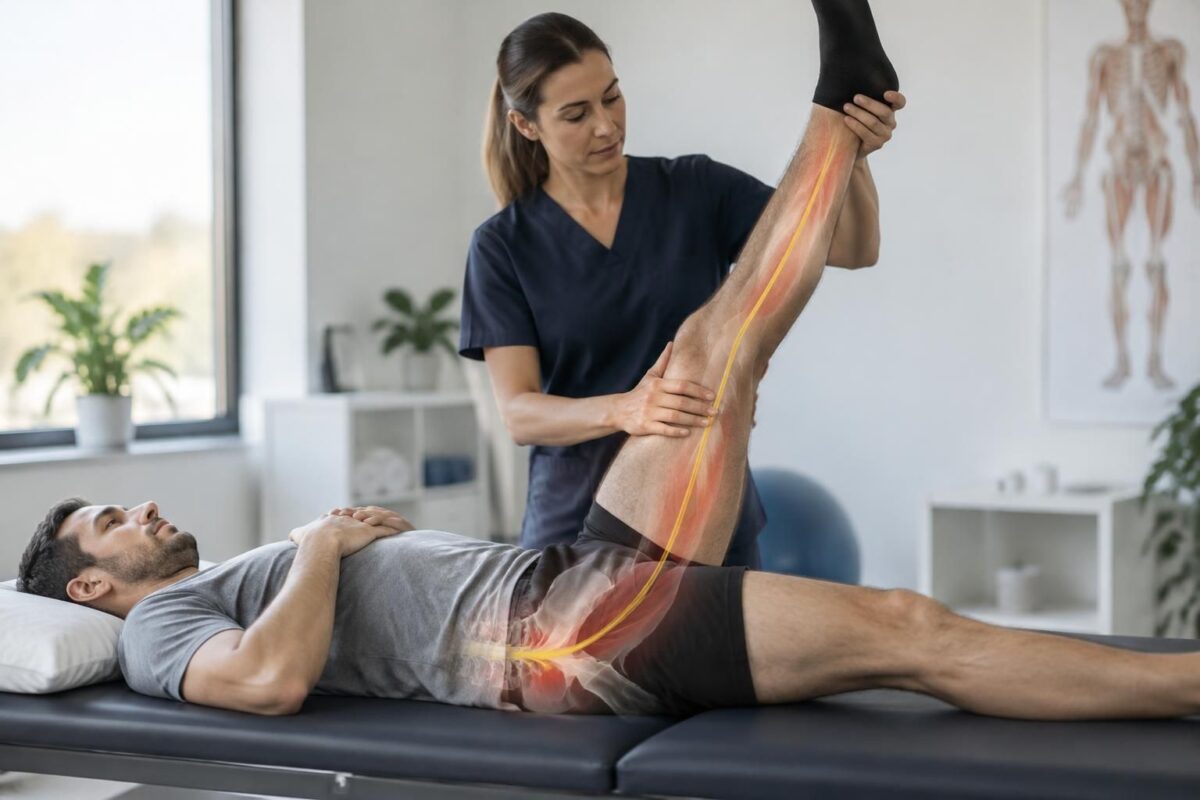
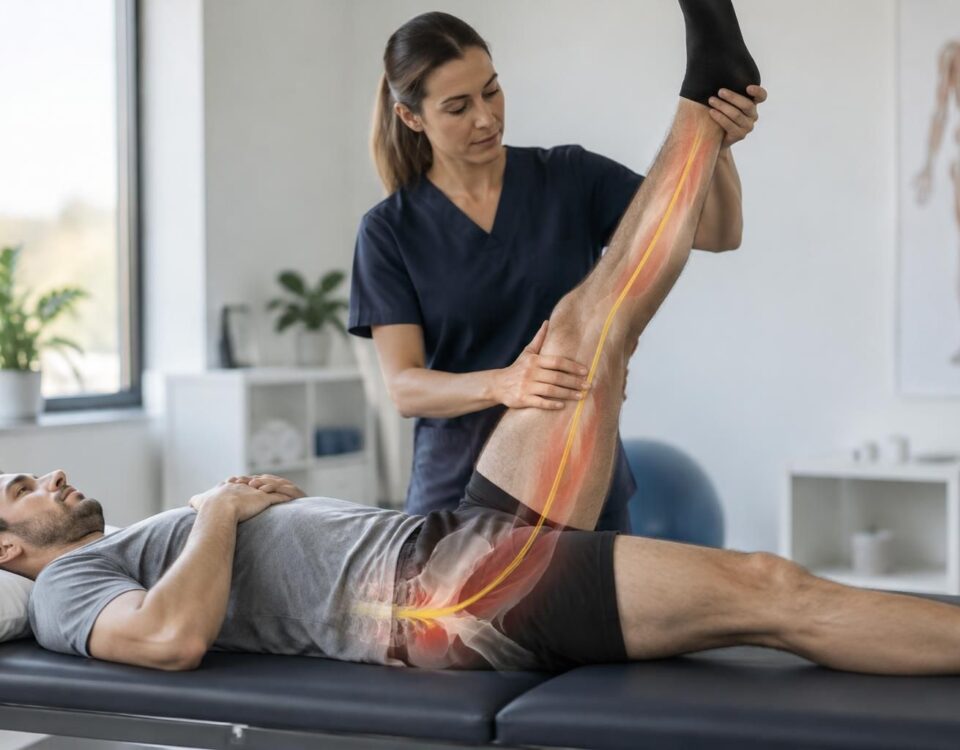
Sciatica and hamstring stretching: possible nerve tension
IN BRIEF Sciatica can make stretching the hamstrings uncomfortable, as the tension felt may come from the nerve rather than the muscle. A gentle stretch, with a straight back and without seeking maximum range, can help loosen the back of…
How to relieve after a long day in a sitting position
Quick and efficient solutions
To calm the pain at the end of the day, apply alternately heat or cold Depending on the type of pain: cold in case of acute inflammation, heat to relax tense muscles. Gentle stretches targeting the sciatic nerve path can also help: knee to the chest, piriforme, hamstrings. If the pain is intense, lie on your back for a few minutes with a small cushion under your knees to relax your lower back.
About treatments and gestures
The paracetamol Is generally recommended as first-line for quick relief. Anti-inflammatories should be used with caution and not beyond five days without medical advice. These measures do not replace a medical assessment if the symptoms persist or worsen.
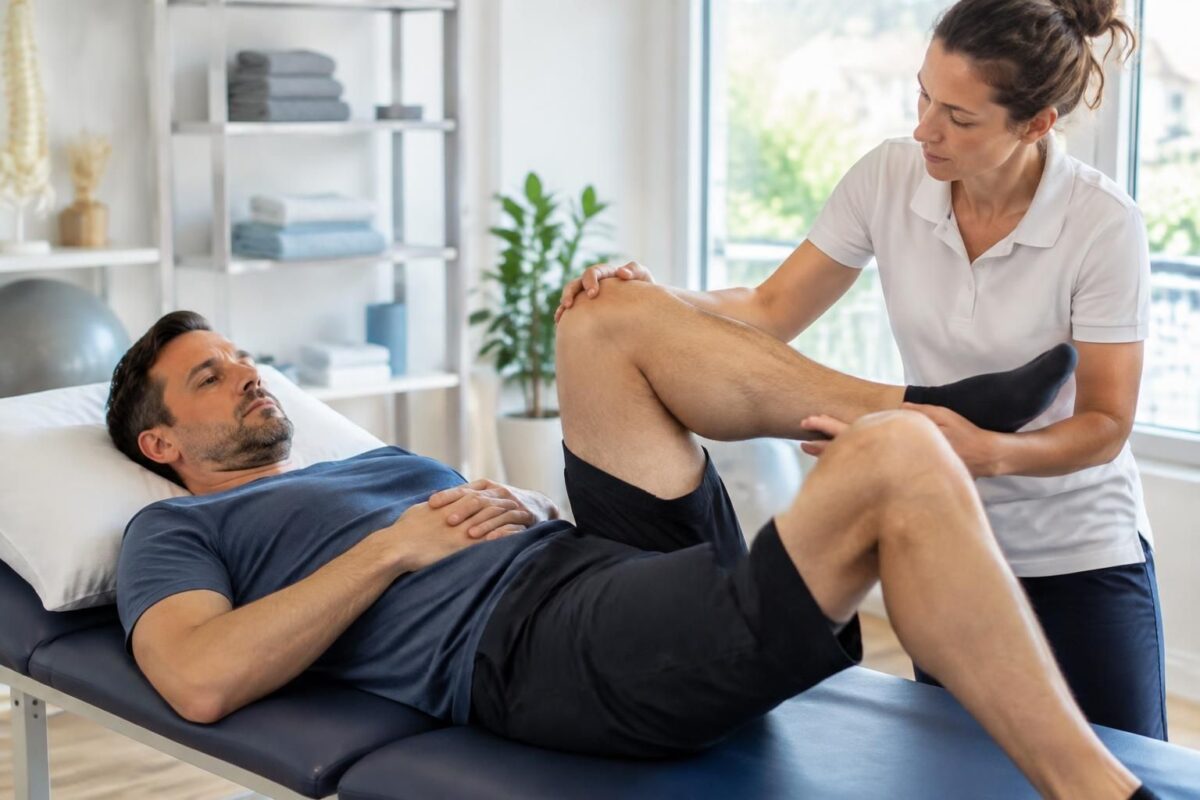
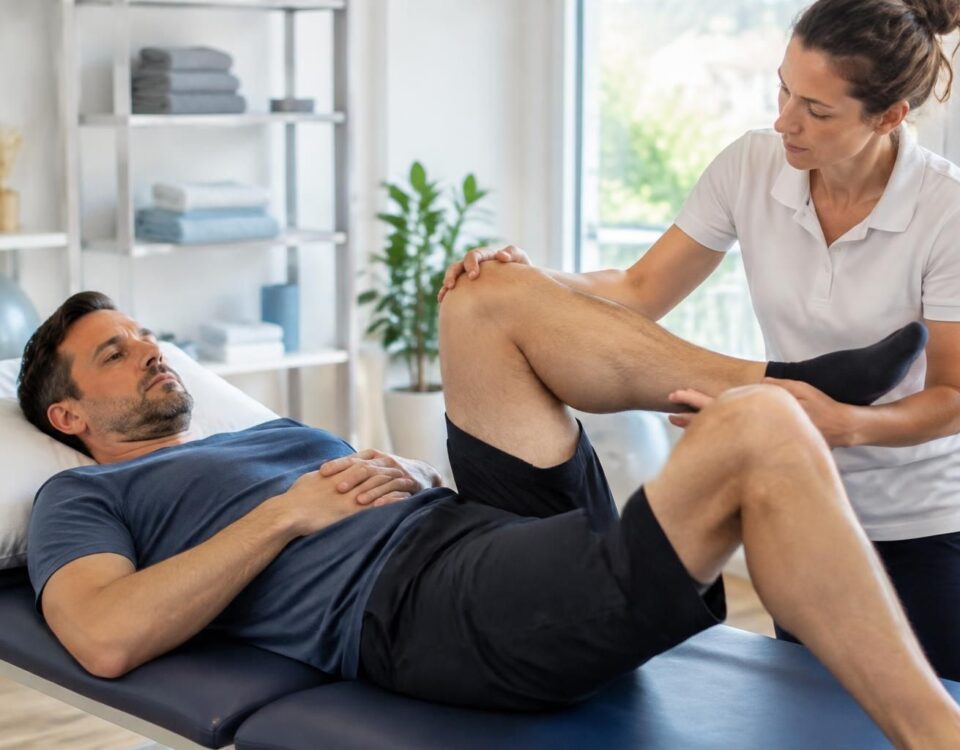
Sciatica and piriformis stretching: useful or worsening depending on the case
IN BRIEF Piriformis-related sciatica can cause deep pain in the buttock, sometimes radiating down the back of the thigh. A gentle stretch can loosen the hip and relieve discomfort if the muscle is involved, but it can worsen symptoms if…
When to consult and warning signs
Consult if you notice a dip in the leg, a loss of sensitivity At the level of the perineum, difficulties in urinating, urinary leakage or Extreme pain that does not respond to analgesics. Proper support may be required.
| Element | concise detail |
|---|---|
| Origin | The pain comes from a lumbosciatica related to irritation of the sciatic nerve; The prolonged sitting position increases the pressure on the lumbar discs and inflammation. |
| Typical symptoms | Pain that starts from the lower back towards the buttocks and the leg, aggravated in a sitting position and during movement. |
| Office factors | motionless posture, poorly adapted chair, lack of variations; Alternate positions and lift regularly. |
| Useful postures | No universal posture; Favor a slight camber and vary the positions throughout the day. |
| Quick Solutions | Active pause every 30 minutes, change of position, heat or cold depending on the pain, gentle stretching. |
| Equipment and gestures | Height-adjustable desk, dynamic seat, lumbar cushion, treadmill, accessories to vary the supports. |
| When to consult | Pain persists >6 weeks or neurological signs appear (weakness, urinary disorders, loss of sensitivity). |
| Additional activities | Light walking, soft stretches, lengthen briefly to relieve, avoid heavy loads. |
| To avoid | Lean forward, swipe for a long time, legs crossed for a long time, badly placed screen. |

Sciatica and popular stretches: why to stay cautious
IN BRIEF Sciatica causes pain that radiates from the lower back down the leg. Popular stretches, such as the pigeon pose or hamstring stretches, are not always suitable: pulling on an irritated nerve can worsen the symptoms. Favor gentle movements,…
Testimonials on sciatica and pain after a sitting day
After eight hours in front of the computer, my sciatica Wakes up in the buttock and goes down to the leg. I reorganized my post: best-adjusted chair, flat feet, and Active breaks every 30 minutes. Small improvement? Yes, as the days go by, the pain decreases and mobility returns.
I test theDynamic seat with a Balance cushion And it’s a revelation: my deep muscles are strengthening and the lower back pain softens after long sessions. I especially avoid the Static pressure on discs And I feel that my posture holds up better throughout the day.
By opting for a Height adjustable desk and one Lumbar cushion, my posture aligns naturally: slight arch, straight back, and less tightness. The pain is less present at the end of the day and I can end my day without being blocked by the seat.
of Soft stretches and a few minutes fromelongation As soon as you leave the office help me release the tissues around the painful journey, and I find mobility without overloading my back. Success comes above all from the regularity and smoothness of the movements.
For me, the secret is to keep a good posture And to avoid crossing your legs in the long term. I leave itScreen at eye level And I make sure to maintain the straight back In order to avoid pelvic tilt and lumbar tensions. A simple practice that changes all the feelings at the end of the day.
One Lumbar belt can help during pain spikes, and Active breaks regular remain essential. But lasting improvements come mainly from the variety of positions and daily movements around the workstation.

Sciatica and Pilates: movements to adapt
IN SHORT Sciatica causes pain that can radiate from the lower back down to the leg. The Pilates Reformer can promote a gradual return to movement and strengthen core control, provided that the movements, range, and resistance are adapted. Favor…
Journey and approach of Dr. Sylvain Desforges in the face of sciatica and pain after a sitting day
DR. Sylvain Desforges is a reference in the field ofosteopathy, from the naturopathy and from the manual medicine. As founding president of TagMed clinics and the ACMA association, he leads a career dedicated to innovation in care and sustainable improvement of the quality of life of patients. specialist in chronic pain, it integrates advanced technologies to optimize recovery and well-being, with a gait guided approach and a patient-centric approach.
in the context of issues related to sciatica, and particularly after a day spent in position course, his gaze is based on a biomechanical understanding associated with practical solutions for everyday life. It shows how the pressure on the lumbar discs And inflammation of the sciatic nerve can get worse after long periods without movement. Its message is clear: you should not aim for a universal posture, but establish a comfortable position and vary it regularly to reduce pain and improve work tolerance.
To sustainably support his patients, Dr. Desforges favors an educational and personalized approach. He offers advice fromergonomy And targeted exercises to gradually change work habits, relieve tension and limit painful episodes after a sitting day. Its objective is to make the management of pragmatic and accessible pain, while restoring mobility and the ability to carry out daily activities without restrictions.
On the therapeutic level, it mobilizes proven and complementary tools: the spinal decompression To reduce the pressure on the nerve roots, the laser To promote tissue regeneration and Shockwave therapy To reduce inflammation and accelerate recovery. These technologies, used with discernment and as part of a personalized program, aim to obtain concrete results while avoiding invasive treatments when possible.
Its practice is based on Evidence and a multidisciplinary approach. He collaborates with health professionals and strives to inform his patients about the mechanisms of sciatica and the habits likely to influence their pain, in particular the importance of active pauses and the variability of positions. This philosophy makes it possible not only to reduce pain after a sitting day, but also to prevent recurrences and to sustainably improve tolerance to work and daily life.
As a leader in healthcare innovation, Dr. Desforges pursues a clear mission: to provide evidence-centric, personalized, personalized care focused on the real improvement of the quality of life. Thanks to his expertise and his network, he helps patients suffering from sciatica and lower back pain linked to a prolonged sitting position to regain mobility, autonomy and serenity in their professional and personal activities, based on an integrated vision of care and well-being.
This summary explains why a whole day spent sitting can trigger or aggravate a sciatica, and details how to adjust its sitting, vary the postures and adopt simple gestures to relieve pain after a day’s work, while providing benchmarks to act in the short and medium term.

Sciatica and core stability: variable tolerance depending on symptoms
IN BRIEF Core strengthening in case of sciatica consists of progressively strengthening the trunk muscles. Its tolerance varies depending on pain and symptoms: suitable without worsening the pain, it can support mobility and the resumption of activities, but does not,…
Impact of the day sitting on pain
The sciatica is manifested by pain that originates in the lower back and can descend along the leg. The sitting Prolonged increases the pressure on the lumbar discs and can maintain inflammation of the sciatic nerve. There is no universal posture: the objective is to find a comfortable position and to make it evolve regularly to distribute the constraints and limit the aggravation.
Staying seated all day accentuates lumbar tension and may awaken pain that spreads through the buttocks or leg. To limit these effects, favoring dynamic alternatives and active pauses allows you to release tension and avoid muscle stiffening.

Sciatica and lunges: leg pain to watch out for
IN BRIEF Sciatica is pain that starts from the lower back or buttock and radiates down the leg. If a lunge triggers or worsens this pain, stop the movement and adjust your activity: this exercise does not address sciatica. Consult…
Posture and handling of his workstation
The bases for a comfortable seat begin with flat feet on the ground, the knees slightly bent, the back resting against the backrest and the pelvis in a neutral position on the ischions. This configuration helps to preserve natural lordosis and limit lumbar fatigue. If the lumbar support is missing, a small cushion or a rolled towel can make a difference.
It is not a question of remaining frozen, but of avoiding lasting sag. As many people tolerate a slight camber better than the completely rounded back, you can adjust the leg position slightly according to the pain, without twisting or excessive tension. The alternation of postures remains more effective than the quest for a perfect posture.
In practice, favoring an alternation between different types of seats can greatly help: well-adjusted ergonomic chair, dynamic seat (balloon or balance cushion), active seat (ergonomic stool or seat-knees), standing with an adjustable desk, or even walking Light on coworking mat. This rotation of the supports makes it possible to distribute the loads and to preserve the spine.
To facilitate these transitions and reduce pain related to sitting position, solutions such as adjustable desks and ergonomic chairs are offered by kqueo. Note: The products mentioned are not an official recommendation on my part, they illustrate possibilities for varying postures. To deepen, you can consult resources like Sciatica#ATFP_CLOSE_TRANSLATE_SPAN# Sitting position How to do.
To complete, other useful resources address mechanisms and good practices around posture and pain, for example Sciatica#ATFP_CLOSE_TRANSLATE_SPAN# and back twist and Approach#ATFP_CLOSE_TRANSLATE_SPAN# Cautious in case of pain.

Sciatica and deadlifts: risk depending on the cause
IN BRIEF Sciatica and deadlifts are not always incompatible: the risk depends on the cause of the pain and its intensity. During acute episodes, it’s best to avoid heavy loads and seek medical or physiotherapy advice before resuming. A gradual…
Techniques to relieve after a prolonged sitting position
After a long sitting period, the use of hot or cold can relieve depending on the type of pain: the cold is useful in the event of an inflammatory flare, while the heat helps to relax the contracted muscles. Apply these gestures for short periods and moderate temperatures.
Soft stretches can loosen the tissues around the painful journey without forcing. For example, you can try:
Knee towards the chest: lying on the back, bend one leg and bring the knee towards the chest with the hands, then release;
Stretching the piriform: On the back, cross an ankle on the opposite knee and bring the thigh towards you;
Hamstrings: Heel placed on a low support, leg outstretched, lean forward slightly with your back straight.
These movements must remain comfortable; Stop them if acute pain occurs and consult a healthcare professional if necessary. Lying for a few minutes on your back can also provide quick relief, placing a cushion under your knees to relax your lower back. This remains a temporary solution; Resume a gentle activity as soon as possible.
For additional practical advice, you can consult resources like Relieve#atfp_close_translate_span# Sciatica in sitting position and Osteopathy#ATFP_CLOSE_TRANSLATE_SPAN# and full support.
When to consult and precautions
A medical consultation is recommended if the sciatica is accompanied by a loss of strength in the leg, an altered sensitivity in the perineum, difficulty in urinating, incontinence or extreme pain that does not yield despite analgesics. In some cases, complementary treatments may be considered under medical supervision, such as targeted approaches or specialized therapies.
In telework, domestic furniture is rarely adapted and can maintain tension: make sure to best reproduce an ergonomic position and plan active breaks every 30 minutes to preserve tolerance and recovery.
To go further and explore other approaches, you can consult additional resources such as Approach#ATFP_CLOSE_TRANSLATE_SPAN# Cautious in case of pain, Decompression#ATFP_CLOSE_TRANSLATE_SPAN# Neuro-vertebral and relief without surgery, and Treatment#ATFP_CLOSE_TRANSLATE_SPAN# Sciatica Montreal – What to do when pain goes down in the leg.

Dr Sylvain Desforges, B.Sc., D.O., N.D., osteopath, is the founding president of TAGMED and of the ACMA association. He dedicates his practice to chronic spinal pain, low back pain and symptoms compatible with sciatica, particularly when pain radiates toward the buttock, leg, calf, foot or toes.
Through SOS Sciatique, he publishes educational content on sciatica symptoms, possible causes such as disc herniation, disc narrowing, foraminal stenosis or irritation of a lumbar nerve root, as well as non-surgical approaches that may be considered according to the evaluation. At Clinique TAGMED, care may include, depending on the case, motorized neurovertebral decompression, specific osteopathic care or precision percussion.
For an evaluation related to sciatica treatment in Montreal / Mount Royal or sciatica treatment in Terrebonne, please consult the services available at Clinique TAGMED.
Medical disclaimer
The information published on SOS Sciatique is provided for educational purposes only and does not replace a consultation, diagnosis, opinion or treatment provided by a physician or another authorized healthcare professional. The author of this article is neither a medical doctor nor a specialist in a medical specialty recognized by the Collège des médecins du Québec. The osteopathic, manual medicine or functional support approaches described on this site do not constitute medical acts and are not intended to replace medical follow-up.
Consult a physician or emergency service in cases of loss of bladder or bowel control, anesthesia in the saddle area, significant or progressive weakness in the leg or foot, fever, recent trauma, severe pain or rapid worsening of symptoms. For more details, please read our Legal Notice.