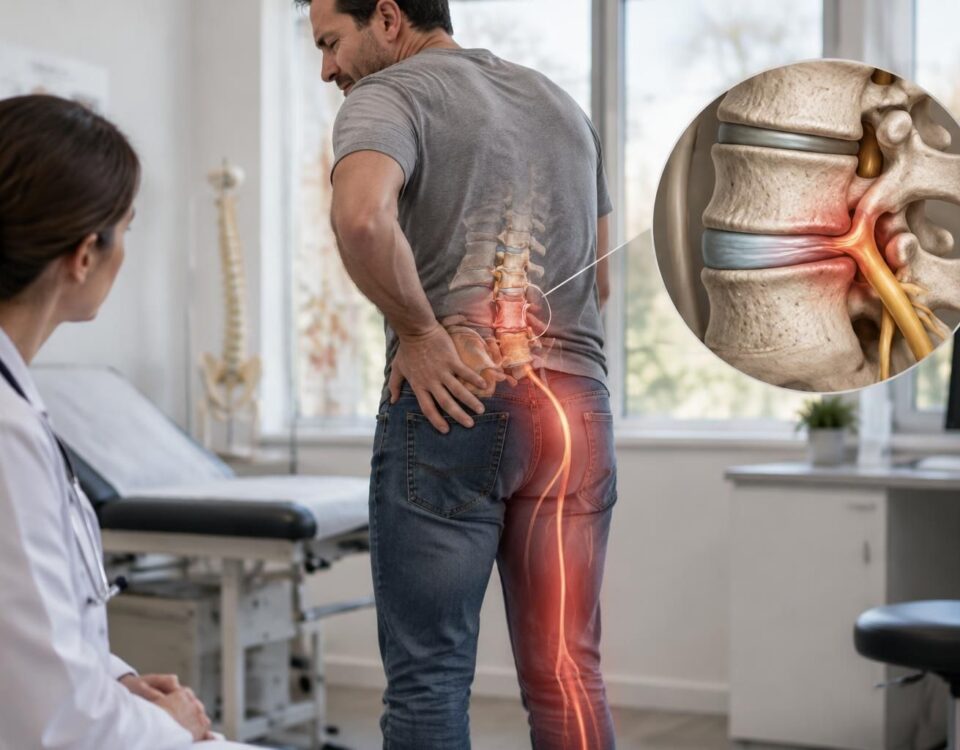
Sciatica and pain when turning in bed
18/10/2026
Sciatica and core stability: variable tolerance depending on symptoms
20/10/2026
IN SHORT
| A disc protrusion is a bulging of the disc that can irritate the L5 root and cause lower back pain radiating to the buttock, leg, or foot, sometimes with tingling or weakness. MRI alone is not sufficient to confirm the link: symptoms and examination must also be taken into account. An evaluation helps guide treatment and activity resumption; progressive weakness or urinary issues require urgent medical advice. |
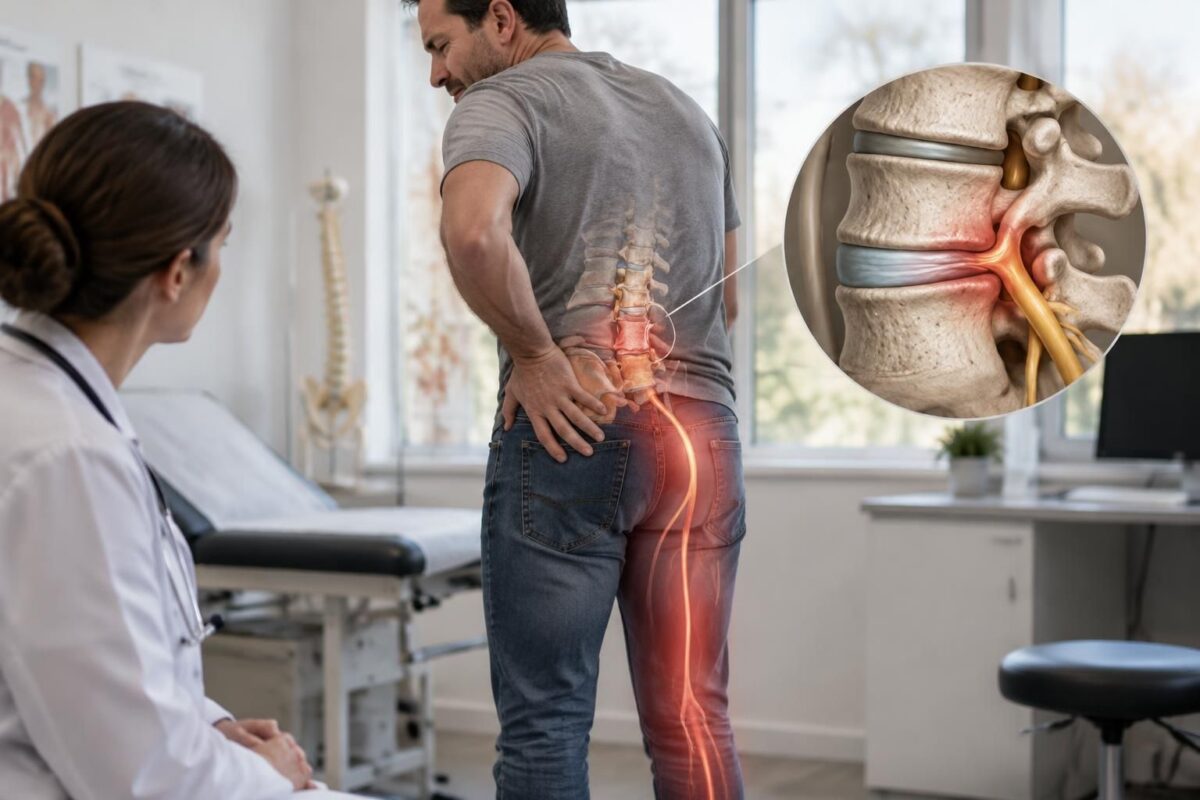
A disc protrusion can irritate the nerve root L5 if its location corresponds to its pathway, particularly at the lumbar level. It can then cause lower back pain radiating to the buttock, the side of the leg, or the top of the foot, sometimes accompanied by tingling or weakness. However, the MRI must be interpreted alongside symptoms and clinical examination: a visible protrusion does not always mean it is the cause of the pain. Consult promptly in cases of significant or progressive weakness, or urinary or intestinal issues.
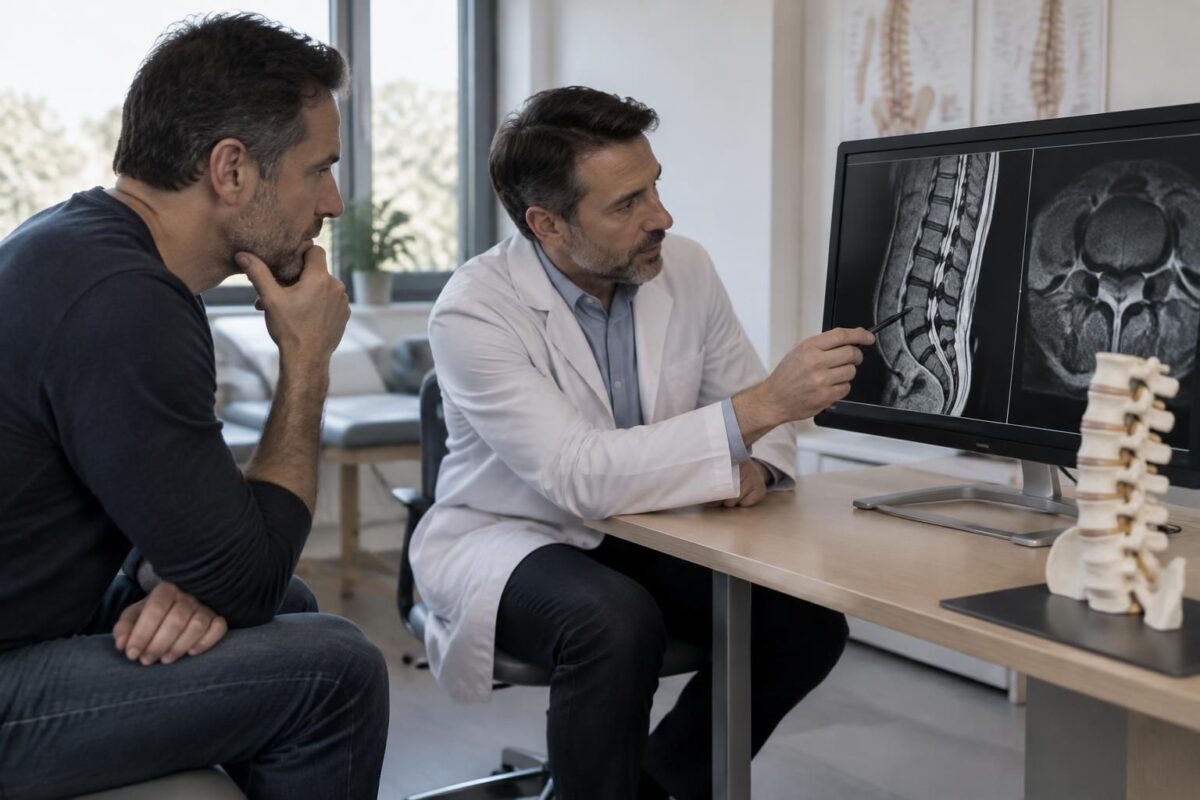
A disc protrusion can irritate the L5 nerve root, but the image alone does not confirm the cause of the symptoms. The location of the pain, changes in sensitivity or strength, and clinical examination help assess the link. This article explains possible signs, the role of MRI, situations requiring prompt advice, and management options to discuss with a healthcare professional. An intervertebral disc is located between two vertebrae. It consists of a soft central part surrounded by a fibrous shell. A disc protrusion refers to a bulging of the disc beyond its usual shape. This term describes a shape visible on imaging. It does not confirm, by itself, nerve compression or the cause of pain. A protrusion is distinguished from a disc herniation by the shape and extent of the disc displacement. The terms used in reports may vary. It is therefore preferable to have the full report explained by a professional rather than drawing a conclusion from a single word. To review these differences, see our page on disc protrusion and contact with a nerve root, as well as this resource on sciatica associated with a lumbar disc herniation. The L5 nerve root exits the lumbar region and participates in the sensitivity and movements of the leg and foot. Irritation of this root can cause pain that starts from the lower back or buttock and radiates down into the leg. Some people experience tingling or numbness, particularly towards the top of the foot or the big toe. The pathway varies from person to person and is not sufficient to establish a diagnosis. Pain in the big toe can have multiple causes. It does not confirm, by itself, irritation of L5. To understand why this symptom can guide the evaluation without proving the source of the pain, see this page on big toe pain and the L5 root. Symptoms depend on the position of the protrusion, local inflammation, and the sensitivity of the nerve root. One person may have lower back pain without radiating symptoms. Another may feel pain in the buttock and leg, sometimes down to the foot. Some protrusions visible on MRI cause no symptoms. Possible signs include: New or progressive weakness requires medical evaluation. Pain that radiates into the leg does not automatically indicate that a root is severely compressed. The professional checks whether the symptoms, examination, and imaging correspond with each other. The MRI can describe the level of the disc, the direction of the bulging, and its relationship to surrounding structures. A protrusion located at L4-L5 or L5-S1 can be discussed when a person has symptoms consistent with L5 irritation. However, these levels do not automatically indicate the source of the pain. Other factors, such as foraminal narrowing or osteoarthritic changes, may also appear in the report. The professional compares the image with the history of symptoms and examination results. They specifically check strength, sensitivity, and the affected movements. A radiological anomaly may be present without pain, while significant pain can have multiple factors. To learn more about reading an MRI, see this guide on disc protrusion, its symptoms, and MRI interpretation. A protrusion at L4-L5 may also raise questions about symptoms and management options. A summary is available on L4-L5 disc protrusion. For the L5-S1 region, consult this resource on discussed treatments for an L5-S1 protrusion. Certain signs require urgent assessment, regardless of the MRI findings: In the presence of urinary or intestinal issues, numbness in the saddle area, or significant weakness, contact emergency services immediately. Do not wait to determine for yourself if the protrusion is responsible. Management depends on the symptoms, their duration, neurological signs, and daily needs. The professional may discuss monitoring, relief measures, temporary adjustments to activities, or specialized advice. Pain medications should be chosen based on medical history, other treatments, and contraindications. A pharmacist or doctor can assist in verifying their use. A protrusion does not automatically justify surgery. A specialist opinion may become relevant if pain remains very limiting despite appropriate management, if neurological deficit appears, or if the evolution concerns the professional. An extruded herniation describes a particular form on imaging, but the decision always depends on examination and symptoms. For further information, see the pages on clinical significance of an extruded herniation and the possible factors for recurrence of sciatica related to a disc herniation. At the TAGMED Clinic, the assessment may allow for a discussion, depending on the situation, of specific osteopathy care or motorized neurovertebral decompression. These approaches do not replace either a medical diagnosis or an urgent consultation in the presence of warning signs. The relevance of care depends on the individual evaluation and the person’s goals. You can also consult this general resource on disc protrusion and this file dedicated to L5-S1 disc protrusion. A precise description helps the professional connect the image with the experienced situation. Note how long the pain has been present, its trajectory, sensations in the foot, activities it limits, and recent changes. Bring the complete MRI report and the list of treatments already attempted. To address the issue of possible sciatica, you can also consult information on sciatica and lumbar disc herniation. Sylvain Desforges, B.Sc., D.O., N.D., osteopath and naturopath, is the founding president of TAGMED and the ACMA association. He dedicates his practice to chronic pain of the spine, lumbar pain, and pain compatible with sciatica, particularly when the pain radiates down to the buttock, leg, calf, foot, or toes. Through SOS Sciatique, he publishes educational content on the symptoms of sciatica, possible causes such as disc herniation, disc pinching, foraminal stenosis, or irritation of a lumbar nerve root, as well as on non-surgical approaches that may be considered depending on the evaluation. At the TAGMED Clinic, care may include, depending on the case, motorized neurovertebral decompression, specific osteopathy, or precision percussion. For an evaluation related to sciatica treatment in Montreal / Mont-Royal or sciatica treatment in Terrebonne, check the available services at the TAGMED Clinic. The information published on SOS Sciatique is provided for educational purposes and does not replace a consultation, diagnosis, advice, or treatment by a physician or another licensed health professional. The author of this article is neither a doctor nor a specialist in a medical specialty recognized by the Collège des médecins du Québec. The approaches of osteopathy, manual medicine, or functional support described on this site do not constitute medical acts and are not intended to replace medical follow-up. Consult a physician or an emergency service in case of loss of bladder or bowel control, anesthesia in the saddle area, significant or progressive weakness of the leg or foot, fever, recent trauma, severe pain, or rapid worsening. For more details, please read our Legal Notice. Medical disclaimer: The information and advice provided on this site do not replace the opinion, diagnosis, or treatment of a health professional. Please note that Sylvain Desforges, B.Sc., D.O., N.D., Doctor of Osteopathy, is neither a medical doctor nor a physician, and is not a specialist in a medical specialty as defined by the Collège des médecins du Québec. Manual medicine, functional medicine, and sports medicine as described on this site exclude any treatment or medical diagnosis performed by a physician or specialist. Always consult your doctor for any medical questions. For more details, please read our complete Legal Notice.What does a disc protrusion mean?
What is the role of the L5 root?
Possible symptoms of L5 irritation
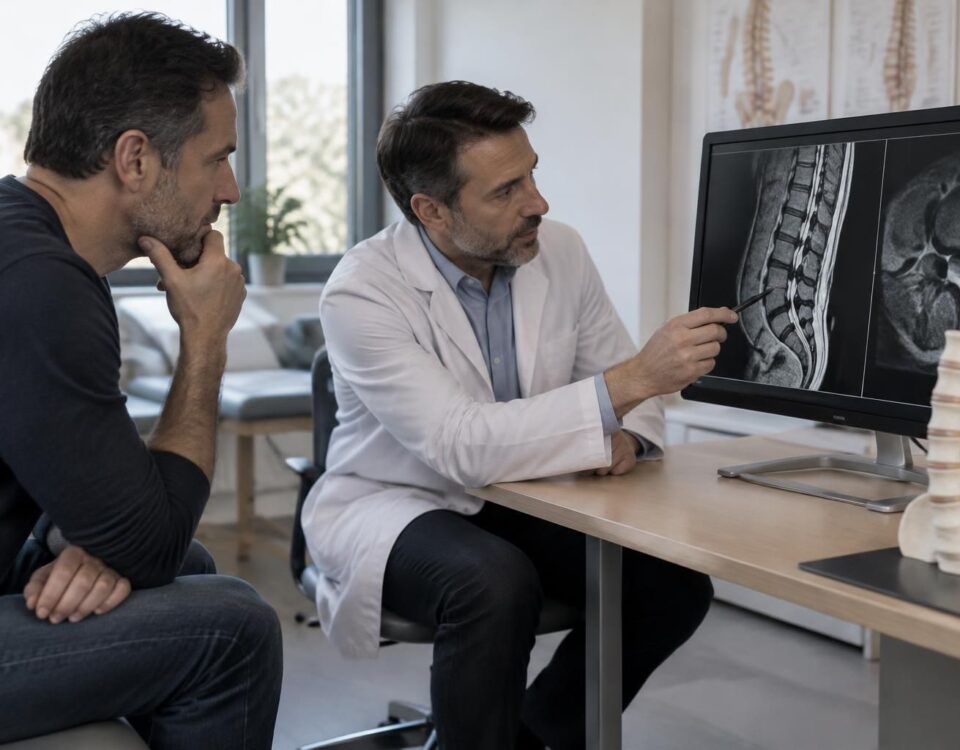
What MRI can show
When to seek urgent medical advice
Management and options to discuss
Preparing for a Consultation
About the Author
Medical Disclaimer
Disc Protrusion
- Definition: bulging of the disc, without automatic evidence of severity.
- MRI: the image alone does not confirm the cause of the symptoms.
- Reference: verify that the level described corresponds to the clinical examination.
Irritation of L5
- Possible signs: pain towards the buttock, leg, or top of the foot.
- To monitor: tingling, loss of sensitivity, or weakness of the foot.
- Emergency: progressive weakness, anesthesia of the perineum, or urinary/intestine issues.

A disc protrusion can irritate the L5 nerve root, but an MRI image is not sufficient to confirm that the disc explains the symptoms. The preferred approach is to have the report reviewed with a professional, monitor the evolution of pain and strength, and gradually adapt activities. Certain signs, particularly progressive weakness or urinary issues, require urgent evaluation.
Understanding the Link Between Disc Protrusion and L5
Protrusion refers to a bulging of the intervertebral disc. It is not automatically a hernia and does not necessarily mean that a nerve is compressed. Irritation of L5 becomes more plausible when the symptoms align with the clinical examination and the level described in the imaging.
What Symptoms May Be Associated?
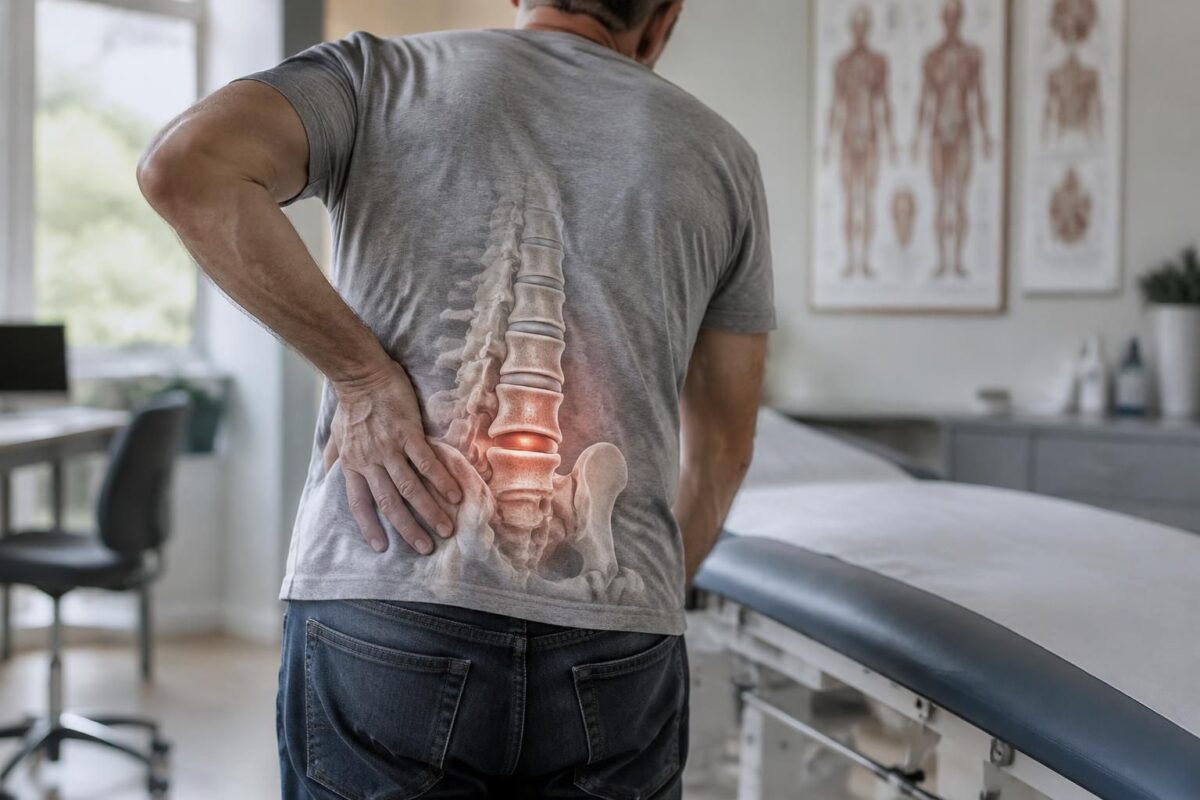
Lumbar pain may be accompanied by radiation towards the buttock, outer part of the leg, or top of the foot. Tingling, a less sensitive area, or difficulty lifting the foot or big toe may also be reported. These manifestations alone do not allow for a diagnosis: other causes are possible, and the distribution of pain varies from person to person.
Disc herniation and sciatica: understanding the loss of disc height
IN BRIEF The disc herniation is a loss of height of the disc between two vertebrae. It can contribute to sciatica when nerve structures are irritated, with pain that may radiate down the leg. Imaging and assessment by a professional…
Disc bulge and diagnosis not to be simplified
IN BRIEF A disc bulge is a protrusion of a disc visible on imaging; it is not sufficient on its own to explain pain or to make a diagnosis. Its interpretation must take into account symptoms, clinical examination, and context.…
Disc bulge and lumbar osteoarthritis
IN BRIEF A disc bulge is a protrusion of the lumbar disc; wear can also contribute to lumbar osteoarthritis and lower back pain. Symptoms vary by individual and may sometimes radiate into the leg. Motion imaging may be considered by…

Disc bulge and narrowed foramen
IN BRIEF A disc bulge is a protrusion of the disc that can contribute to narrowing the foramen, the opening where a nerve root passes through. If this is irritated or compressed, pain, tingling, or weakness may occur, sometimes extending…
Have the MRI Interpreted in Context
Bring the complete report and, if possible, the images to your doctor or the professional who is following your case. Indicate how long the pain has been present, where it radiates, what aggravates or relieves it, and whether your walking, sleep, or work are affected. The decision depends on all these elements, not just the term “protrusion.”
Avoid concluding on your own that there is serious compression, or that there is no problem, by reading an isolated sentence. A protrusion may be seen in a person without pain; conversely, significant pain warrants evaluation even if the description of the MRI seems moderate. Reevaluation is indicated if symptoms persist, extend, or change.
Adjusting Activities and Relief
Stay Active Without Straining
According to your tolerance and the advice received, prioritize gentle movements and regular position changes rather than prolonged bed rest. Walking or daily activities can be gradually resumed. Temporarily reduce any movement that significantly increases radiating pain, without trying to “test” your pain or follow generic exercises found online.
Seek Advice Before Treatment
A doctor, pharmacist, or physiotherapist can help you choose an appropriate management plan, particularly for medications and resuming exercises. Painkillers or anti-inflammatories may not be suitable for everyone: consider your other treatments and medical history, and follow the advice given. Physiotherapy can accompany a gradual return when indicated.
Recognizing Signs That Require Immediate Help
Consult quickly if new or progressive weakness appears in the leg or foot. If you experience difficulty urinating, loss of control over urination or bowel movements, or numbness around the perineum, contact emergency services without delay. A fever, recent trauma, severe pain, or rapid deterioration also warrants medical advice.
| Indicator | Disc Protrusion and L5 Irritation |
|---|---|
| What it is | A protruding disk can irritate the L5 nerve root. |
| Possible Pain | Lower back, buttock, side of the leg, or top of the foot. |
| Other Symptoms | Tingling, numbness, or weakness in the foot may be possible. |
| To Remember | MRI alone does not confirm that the protrusion causes the symptoms. |
| Next Step | Relate the imaging results to the symptoms and clinical examination. |
| Emergency | Consult quickly if weakness progresses or if urinary or intestinal problems arise. |
Illustrative Testimonials on Disc Protrusion and L5 Irritation
Transparency Note: The testimonials below are fictional examples written for educational purposes. They do not correspond to identifiable patients and do not predict the evolution of an individual situation. A visible protrusion on an MRI does not prove, on its own, that it irritates the L5 root.
“The Pain No Longer Stayed in the Lower Back”
“My pain started in the lower back, then it went down into the buttock and along the side of the leg. I also had tingling towards the top of the foot. The report mentioned a disc protrusion, but I didn’t know if it really explained what I was feeling. During the consultation, we compared the pain’s path, sensations, and the examination with the MRI results. I better understood why it was important to look at the whole picture rather than just the word ‘protrusion’ on its own.”
“The MRI Result Worried Me”
“Reading my report, I immediately thought that my disk was severely damaged. However, the radiological mention did not, by itself, indicate the level of severity or the treatment to follow. I prepared my questions and explained what triggered the pain, what alleviated it, and the movements that had become difficult. This discussion helped me differentiate the image from my actual symptoms.”
“I Adapted My Days Without Stopping All Movement”
“Staying seated for too long made my discomfort more present, and walking was sometimes uncomfortable. With the advice received, I tried to change positions regularly and gradually resume activities, without forcing when the pain intensified. I also noted changes in the leg and foot so I could discuss them during follow-up.”
“I Wanted to Know If Surgery Was Inevitable”
“The word ‘protrusion’ made me fear an operation. I learned that an image does not automatically dictate surgery. The decision depends particularly on the pain, its evolution, the examination, and the possible presence of weakness. I could discuss options suited to my situation and the signs that would require quickly seeking a new opinion.”
“I Better Described Symptoms Related to L5”
“I felt a pain that radiated down my leg and an unusual sensation on the top of my foot. Before the appointment, I noted when it started, the areas involved, and the activities that had become more difficult. These indications made our exchange more concrete. I understood that we needed to check if the symptoms matched the location indicated on the imaging, without drawing conclusions based on the report alone.”
To Remember: L5 root irritation can be considered when pain or sensory disturbances follow a consistent pathway in the leg or foot, but only a healthcare professional can evaluate their origin. In cases of significant or progressive weakness, loss of urinary or bowel control, or numbness in the saddle area, consult medical services without delay.
About the Author
Sylvain Desforges, B.Sc., D.O., N.D., osteopath and naturopath, is the founding president of TAGMED and the ACMA association. His practice focuses particularly on chronic spinal pain, lower back pain, and pain compatible with sciatica.
The information published is for educational purposes and does not replace a consultation, diagnosis, or treatment by a licensed healthcare professional. The author is neither a doctor nor a specialist in a medical specialty recognized by the Collège des médecins du Québec. Osteopathy, manual medicine, or functional support approaches do not replace medical follow-up.
Disc Protrusion and L5 Irritation: Understanding Symptoms and Management Options
A disc protrusion corresponds to a disc bulging beyond its usual shape. In the lumbar region, a protrusion located near L4-L5 or L5-S1 can sometimes irritate a nerve root, particularly the L5 root. However, the imaging report alone is not sufficient to determine the cause of pain or its severity: it must be interpreted in conjunction with symptoms and clinical examination.
The L5 root is notably involved in the sensitivity of certain areas of the leg and the top of the foot, as well as several movements of the ankle and toes. When irritated, the pain may radiate from the lower back or the buttock and travel down the side of the leg to the foot. Tingling, numbness, or a feeling of weakness may also occur. The path can vary from person to person, and these symptoms alone do not confirm an L5 injury.
A protrusion may be visible on an MRI without causing symptoms. Conversely, an image described as modest may be relevant if its location corresponds to the pain and signs found during the examination. The concept of concordance between the image, symptoms, and examination is therefore essential. The healthcare professional considers the duration of the pain, its evolution, sensitivity, strength, and activities that have become difficult.
Management depends on this evaluation. When the situation allows, it may prioritize non-surgical measures: maintaining tolerated activity, gradual resumption of movements, appropriate physiotherapy, and relief strategies discussed with a professional. Medications are not suitable for everyone; their selection, contraindications, and duration must be verified with a doctor or pharmacist. It is also preferable to avoid prolonged immobility as well as exercises that significantly worsen symptoms.
A quick consultation is necessary in the case of significant or progressive weakness in the leg or foot, loss of urinary or bowel control, or numbness in the saddle area. Pain that worsens rapidly, occurs after trauma, or is accompanied by fever also warrants medical attention. Surgery is not determined solely by the presence of a protrusion: it may be considered by a specialized team depending on neurological signs, impact, and progression despite appropriate care.
Sylvain Desforges, B.Sc., D.O., N.D., osteopath and naturopath, is the founding president of TAGMED clinics and the ACMA association. His practice focuses particularly on the management of chronic spinal pain and manual or functional approaches. Depending on the situation and the assessment, the services offered at TAGMED may include specific osteopathy, motorized neurovertebral decompression, or precision strikes. These approaches do not replace a diagnosis or medical follow-up.
Medical warning: this content is provided for educational purposes and does not replace a consultation, diagnosis, or treatment by a doctor or another authorized healthcare professional. The author is neither a physician nor a specialist in a medical specialty recognized by the Collège des médecins du Québec. In the presence of warning signs, consult a doctor or an emergency service without delay.
A disc protrusion may irritate the L5 nerve root, but its presence on an MRI alone is not sufficient to explain pain or determine its severity. To understand the situation, one must correlate the level and direction of the disc bulge with the symptoms, their evolution, and the results of the clinical examination.
The L5 root is notably involved in the sensitivity and certain movements of the leg and foot. When irritated, the pain may start from the lower back or the buttock and descend into the leg, sometimes to the top of the foot or the big toe. Tingling, decreased sensitivity, or difficulty in lifting the foot or big toe may also be present. However, the path varies from person to person: these signs alone do not confirm an L5 injury. To better understand the possible radiation towards the foot, consult this article on L5-S1 protrusion and sciatic pain.
The level indicated in the report must be interpreted accurately. A protrusion at L4-L5 may, depending on its location, be compatible with L5 irritation. A protrusion at L5-S1 may also be involved depending on its direction and the structures affected, but it does not automatically mean that the L5 root is compressed. Therefore, the vertebral level, the location of the bulge, and the symptoms must be examined together. The pages dedicated to protrusions L4-L5 and L5-S1 present these locations in more detail.
A protrusion is a description of the shape of the disc; it is not synonymous with a herniated disc and does not, alone, prove symptomatic nerve compression. Some protrusions are found in people who do not have corresponding pain. Conversely, significant pain may require evaluation even if the MRI description seems unremarkable. Imaging should therefore be interpreted in conjunction with the history of symptoms and the examination, as emphasized in this resource on the terms of protrusion and herniated disc.
Management depends on pain, functional capabilities, neurological signs, and their evolution. When the situation allows, professionals may consider a non-surgical approach: maintaining tolerated activity, temporarily adapting efforts, and individualized rehabilitation. There is no universal exercise or guaranteed recovery timeframe; worsening or persistent symptoms justify reevaluation. Prolonged sitting may exacerbate discomfort in some people: posture changes and breaks may be discussed, without establishing the cause of irritation.
A new or progressive weakness, particularly difficulty in lifting the foot, warrants prompt medical attention. Urinary or bowel issues, loss of sensitivity around the perineum, or significant weakness require urgent evaluation; these signs should not be attributed to a protrusion without examination. To identify concerning situations, consult the pages on foot weakness and the cauda equina syndrome.

Disc bulge and loss of disc height
IN BRIEF A disc bulge is a protrusion of the disc between the vertebrae; a loss of disc height means that the disc has thinned. These changes may be related to wear and sometimes contribute to pain, stiffness, or nerve…

Disc bulging and disc degeneration
IN SHORT A disc bulge is a protrusion of the disc, sometimes associated with disc degeneration related to aging. These visible changes on imaging do not always cause symptoms. Their significance is determined by comparing the MRI to pain, strength,…

Herniated disc and recurring pain
IN BRIEF A disc bulge is a disc that protrudes without necessarily being ruptured; it does not always cause pain. When pain returns, it may be related to nerve irritation, but a professional must verify the link with the symptoms.…

Disc bulge and pain after exertion
IN BRIEF A disc bulge is a disc that slightly protrudes between two vertebrae; after exertion, it may be associated with low back pain, sometimes radiating into the leg. An imaging result alone is not enough to explain the pain…

Sylvain Desforges, B.Sc., D.O., N.D., docteur en ostéopathie
Dr Sylvain Desforges, B.Sc., D.O., N.D., osteopath, is the founding president of TAGMED and of the ACMA association. He dedicates his practice to chronic spinal pain, low back pain and symptoms compatible with sciatica, particularly when pain radiates toward the buttock, leg, calf, foot or toes.
Through SOS Sciatique, he publishes educational content on sciatica symptoms, possible causes such as disc herniation, disc narrowing, foraminal stenosis or irritation of a lumbar nerve root, as well as non-surgical approaches that may be considered according to the evaluation. At Clinique TAGMED, care may include, depending on the case, motorized neurovertebral decompression, specific osteopathic care or precision percussion.
For an evaluation related to sciatica treatment in Montreal / Mount Royal or sciatica treatment in Terrebonne, please consult the services available at Clinique TAGMED.
Medical disclaimer
The information published on SOS Sciatique is provided for educational purposes only and does not replace a consultation, diagnosis, opinion or treatment provided by a physician or another authorized healthcare professional. The author of this article is neither a medical doctor nor a specialist in a medical specialty recognized by the Collège des médecins du Québec. The osteopathic, manual medicine or functional support approaches described on this site do not constitute medical acts and are not intended to replace medical follow-up.
Consult a physician or emergency service in cases of loss of bladder or bowel control, anesthesia in the saddle area, significant or progressive weakness in the leg or foot, fever, recent trauma, severe pain or rapid worsening of symptoms. For more details, please read our Legal Notice.