Sciatica and Pilates: movements to adapt
21/10/2026
Sciatica in Terrebonne: S1 and difficulty standing on tiptoe
22/10/2026
IN BRIEF
| S1 sciatica can cause pain from the buttock to the calf and foot, as well as difficulty getting on tiptoe. This weakness may suggest irritation of the S1 nerve root, but is not sufficient to establish a diagnosis. In Montreal, a professional assessment helps to clarify the cause and management options; many cases improve with conservative care and a gradual resumption of activities. Significant or progressive weakness requires prompt consultation. |
An S1 sciatica can cause pain that radiates from the buttock down the back of the thigh and calf, to the heel or little toe. Difficulty getting on tiptoe may indicate muscular weakness and deserves rapid evaluation by a health professional in Montreal. If this weakness appears suddenly or worsens, or is accompanied by urinary or bowel issues or perineal numbness, seek emergency care immediately.
Pain radiating from the buttock to the heel, accompanied by difficulty getting on tiptoe, may correspond to irritation of the S1 nerve root. This sign alone is not sufficient to establish a diagnosis. An evaluation allows checking strength, sensitivity, and reflexes, and then determining if a medical examination or imaging is needed.
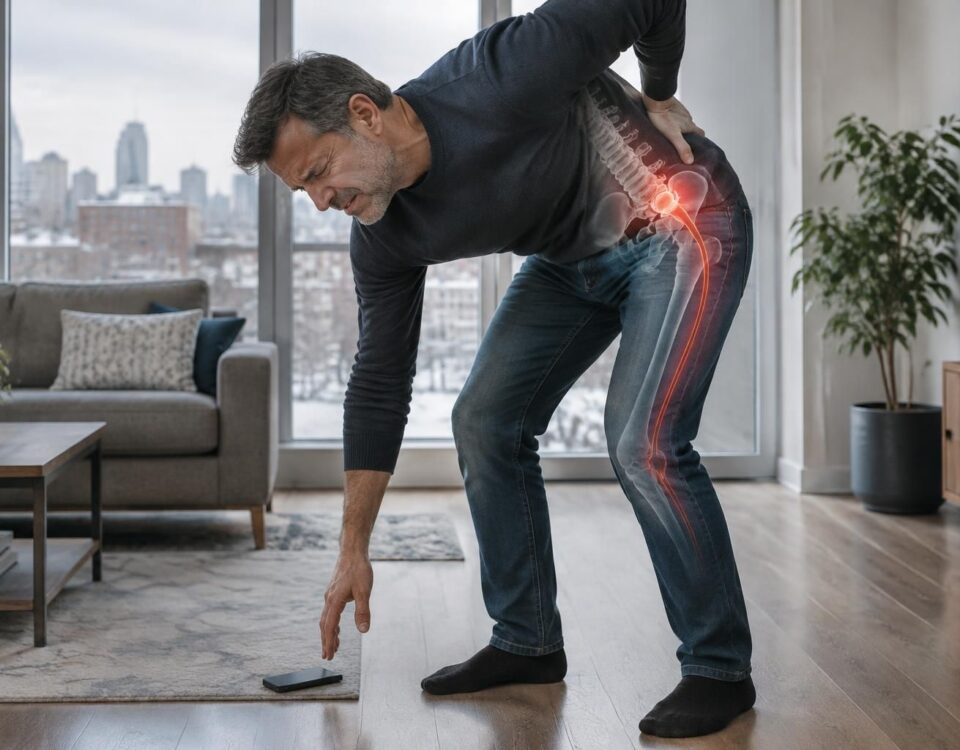
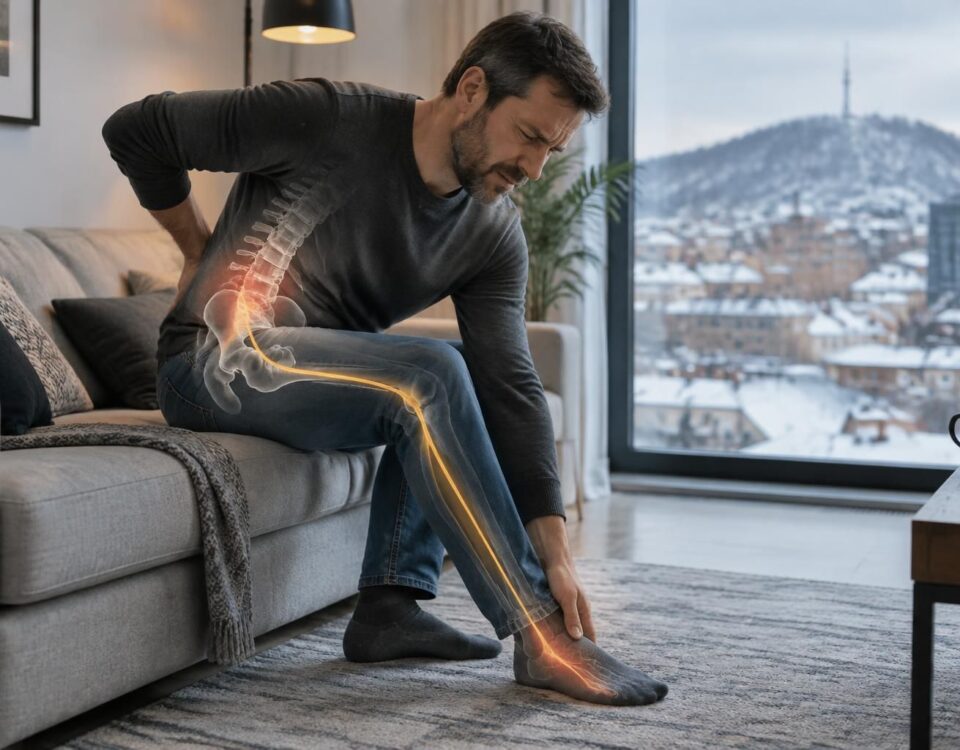
S1 sciatica can cause pain in the buttock, back of the thigh and calf, then down to the heel, sole of the foot, or little toe. Some people also experience tingling, numbness, or a burning sensation.
Difficulty getting on tiptoe may signal weakness in the calf muscles. The S1 root particularly contributes to the movement that allows the foot to push down. New or worsening weakness requires prompt attention, especially if it hinders walking.
Why getting on tiptoe can become difficult
Irritation of the S1 root may disrupt the nerve signals that control certain calf muscles. The person may then struggle to get on tiptoe on the painful side or to repeat this movement.
The pain may also limit effort without a true loss of strength. A health professional must thus distinguish between muscular weakness and a movement restricted by pain. They can compare the two legs and check other functions, such as foot sensitivity and the Achilles reflex.
To learn more about the link between heel pain and the S1 root, check out this article on heel pain associated with possible S1 irritation.
Differences between S1 pain and L5 pain
The pathway of the pain can help guide the evaluation, without confirming the affected root alone. Pain consistent with S1 often radiates down the back of the thigh and calf to the heel or sole of the foot. Pain consistent with L5 may instead affect the top of the foot and the big toe.
Affecting S1 may be accompanied by difficulty pushing on the foot or decreased Achilles reflex. Affecting L5 may sometimes make it harder to raise the foot or walk on the heels. These signs must be interpreted alongside a complete examination.
You can check explanations about the pain pathway according to roots L4, L5 and S1, as well as the page on pain towards the big toe related to possible L5 sciatica.
Possible causes of S1 sciatica
A lumbar disc herniation is a common cause of root pain. A disc bulge can irritate or compress a nerve root. At the L5-S1 level, the issue may affect the S1 root. Other causes include changes related to osteoarthritis or narrowing of the space where the root passes.
The location of the pain does not determine the exact cause. The professional evaluates the symptoms, their progression, history, and neurological signs. Imaging, such as an MRI, may be considered depending on evaluation results, duration of symptoms, and presence of warning signs.

Sciatica in Montreal: pain worsened when sitting and lumbar disc
IN BRIEF Worsening sciatica in a sitting position may be related to lower back irritation, sometimes associated with a disc, without this sign being sufficient to establish the cause. In Montreal, an evaluation that considers symptoms, strength, sensitivity, and function…
When to seek prompt attention
Seek prompt attention if difficulty getting on tiptoe appears suddenly, worsens, or is accompanied by weakness that hinders walking. A progressive loss of strength warrants immediate medical evaluation.
Go to the emergency room in case of loss of bladder or bowel control, perineal numbness, or significant weakness affecting one or both legs. Fever, recent trauma, severe pain that worsens rapidly, or unusual pain in the context of known cancer also justify urgent evaluation.

Sciatica in Montreal: pain worsened by flexion and disc-related cause
IN BRIEF Flexion-Aggravated Sciatica is pain that starts in the lower back and may radiate into the buttock or leg; irritation related to a lumbar disc can be a possible cause. In Montreal, an assessment helps clarify the origin of…
Sciatica evaluation in Montreal
An evaluation starts with questions about the pain pathway, onset, and movements that modify it. The examination may include checking strength, sensitivity, reflexes, and walking. These observations help determine if the symptoms suggest irritation of S1 or another cause.
At TAGMED Clinic, a non-surgical approach may be discussed after assessment and according to each person’s situation. Care may include specific osteopathy, precision percussion, or, when indicated, motorized neurovertebral decompression. These approaches do not replace a medical diagnosis and may not be suitable for all situations.
To learn about assessment and management options, check the services for sciatica treatment in Montreal and Mont-Royal or sciatica treatment in Terrebonne. The TAGMED Clinic can provide information about available services.

Discogenic sciatica in Montreal: why some stretches worsen
IN BRIEF Disc-related sciatica refers to pain related to the irritation of a nerve root, often near a herniated disc. Certain stretches, especially those that emphasize bending or pull on the leg, can worsen symptoms rather than relieve them. In…
Frequently asked questions about S1 sciatica and tiptoeing
Does difficulty getting on tiptoe confirm S1 sciatica?
No. This sign may direct the evaluation towards S1, but it does not alone confirm sciatica. Pain, muscle strength, sensitivity, and reflexes must be examined together.
Can a calf weakness go away?
The outcome depends on the cause and the severity of the condition. Some sciatic conditions improve with appropriate management, but new or progressive weakness should be evaluated quickly. Do not delay a consultation in the presence of strength loss.
Is an MRI always necessary?
No. An MRI is not routine for every episode of sciatica. A physician may request it in the presence of warning signs, neurological deficit, persistent symptoms, or if the results can guide treatment decisions.
To further explore anatomical landmarks and possible causes, refer to the file on the L5 lumbar root and the article dedicated to sciatica and back pain.
About the author
Sylvain Desforges, B.Sc., D.O., N.D., osteopath and naturopath, is the founding president of TAGMED and the ACMA association. He dedicates his practice to chronic pain of the spine, lower back pain, and pain compatible with sciatica, particularly when pain radiates down to the buttock, leg, calf, foot, or toes.
Through SOS Sciatique, he publishes educational content on sciatica symptoms, possible causes, and non-surgical approaches that may be considered after an evaluation. At TAGMED Clinic, care may include, depending on the case, motorized neurovertebral decompression, specific osteopathy, or precision percussion.
Medical Disclaimer
The information and advice provided on this site do not replace the opinion, diagnosis, or treatment of a healthcare professional. Please note that Sylvain Desforges, B.Sc., D.O., N.D., Doctor of Osteopathy, is neither a medical doctor nor a physician, and is not specialized in a medical specialty as defined by the Collège des médecins du Québec. Manual therapy, functional medicine, and sports medicine as described on this site exclude any treatment or medical diagnosis made by a physician or medical specialist. Always consult your doctor for any medical questions. For more details, please read our Complete Legal Notice.
What this may indicate
- A pain from the buttock to the back of the calf and the outer edge of the foot may suggest an involvement of the S1 root.
- The difficulty in standing on tiptoe may indicate weakness in the calf muscles.
- These signs must be evaluated: they are not sufficient, by themselves, to confirm S1 sciatica.
When to consult in Montreal
- Quickly request an evaluation if the weakness is new or affects walking.
- Consult urgently if it worsens, if the foot becomes difficult to move, or if urinary, intestinal issues, or perineal numbness develop.
- A clinical evaluation helps determine the course of action and if tests are necessary.

An S1 sciatica can cause pain that radiates from the buttock to the back of the thigh and calf, down to the heel, the foot’s sole, or the little toe. Difficulty in standing on tiptoe may indicate muscle weakness and warrants a rapid evaluation, especially if it appears suddenly or worsens. In Montreal, the priority is to check leg strength, identify emergency signs, and choose appropriate management rather than attempting manipulations or painful exercises without professional advice.

Sciatica disc in Montreal: movements to avoid at the start
IN BRIEF Disc-related sciatica refers to pain related to the irritation of a nerve, sometimes associated with a lumbar disk. Initially, avoid movements that worsen your symptoms, such as lifting a load by bending over or performing repeated twists. Adjusting…
Recognizing possible signs of S1 involvement
Radicular pain related to S1 often follows the back of the leg and may be accompanied by tingling, numbness, or altered sensitivity in the heel, sole of the foot, or outer edge of the foot. The Achilles tendon reflex may also be diminished. These signs are not sufficient, by themselves, to confirm the cause: the examination must notably distinguish irritation of a nerve root from other back, hip, or lower limb issues.
Why standing on tiptoes is important
The triceps surae helps push the foot down, a movement necessary for standing on tiptoes. If one side is significantly weaker, if you can no longer perform this movement, or if weakness progresses, quickly seek medical evaluation. Avoid multiplying tests or forcing the leg to check your strength.

Sciatica in Montreal: disc herniation with leg weakness
IN BRIEF Sciatica related to a herniated disc can irritate a nerve root and cause pain that travels down the leg, sometimes accompanied by weakness. In Montreal, an evaluation helps clarify the cause and guide appropriate care; nonsurgical approaches can…
When to consult without delay
Go to the emergency room if you have loss of bladder or bowel control, new difficulty urinating, loss of sensation around the perineum or genitals, or significant and rapidly progressive weakness. Sudden foot weakness, intense pain after trauma, or pain accompanied by fever also warrants urgent evaluation. These symptoms may require rapid assessments; do not delay care while awaiting a clinic appointment.

Sciatica in Montreal: herniated disc with foot numbness
IN BRIEF Sciatica related to a herniated disc can cause pain that radiates down the leg and numbness in the foot. In Montreal, an assessment helps to investigate the cause of the symptoms and consider appropriate management without assuming the…
Recommendations for the first few days
In the absence of emergency signs, avoid prolonged strict bed rest. Temporarily modify movements that strongly trigger pain, but try to maintain gentle and regular movement as tolerated. Stop an activity if it significantly increases weakness, numbness, or pain in the leg. Also, avoid forced stretching, intense exercises, and aggressive spinal manipulations during the acute phase.
Pain medications should be chosen with a healthcare professional, considering your medical history, other medications, and contraindications. Do not prolong self-medication, especially with anti-inflammatories. A clinical evaluation can determine if imaging is relevant; an MRI is not necessary in all cases but may be indicated depending on symptoms and their evolution.

Sciatica in Montreal: lumbar disc and inflammation of the nerve root
IN BRIEF Disc-related sciatica occurs when irritation of the nerve root causes pain that may radiate down into the buttock and leg. In Montreal, an assessment helps identify the cause of the symptoms and consider appropriate non-surgical care based on…
Organizing care in Montreal
After the initial assessment, a progressive rehabilitation program can help regain mobility and strength. Physiotherapy can be tailored to current capabilities, with monitored progression. Osteopathy or other manual therapies may sometimes be considered as support, once it’s confirmed they are appropriate; they do not replace medical diagnosis or urgent care. In Montreal or Mont-Royal, request an individualized assessment from a licensed professional and clearly specify any difficulty standing on tiptoe.

Sciatica and disc pinching in Montreal: when space decreases
IN BRIEF The disc herniation refers to a decrease in space between two vertebrae; it can irritate a nerve root and contribute to sciatica, with pain that radiates into the buttock or leg. In Montreal, an assessment helps specify the…
About the Author
Sylvain Desforges, B.Sc., D.O., N.D., osteopath and naturopath, is the founding president of TAGMED and the ACMA association. His practice mainly focuses on chronic spinal pain and pain compatible with sciatica. The treatments offered at the TAGMED Clinic, such as specific osteopathy or motorized neurovertebral decompression, depend on the assessment and may not be suitable for every situation.
Medical Warning: this information is educational and does not replace a consultation, diagnosis, or treatment by a licensed health professional. The author is neither a doctor nor a specialist of a medical specialty recognized by the Collège des médecins du Québec. In the presence of warning signs, consult a doctor or emergency service without delay.
| Marker | S1 Sciatica: Key Points |
|---|---|
| Common Path | Buttock, back of thigh and calf, heel, sole of foot or little toe. |
| Difficulty on Tiptoe | A weakness in rising onto the toes may suggest a motor impairment of the S1 root. |
| Other Possible Signs | Tingling or decreased sensitivity in the calf or the outer edge of the foot. |
| Reflex | The Achilles reflex may be diminished; its evaluation is up to a professional. |
| In Montreal | A clinical evaluation helps clarify the cause and determine the appropriate course of action. |
| Evolution | Difficulty standing on tiptoe alone does not confirm S1 sciatica. |
| Consult Quickly | If weakness appears, worsens, or affects walking, seek medical advice without delay. |
| Emergency | Loss of bladder or bowel control, numbness in the perineum, or significant weakness: go to the emergency room. |
Illustrative Testimonials: S1 Sciatica and Difficulty on Tiptoe in Montreal
Note: the narratives below are fictional examples, written for informational purposes. They do not represent specific patients and do not guarantee a treatment outcome.
“The pain radiated down to my heel” — For several days, a pain starting from my left buttock traveled down the back of my thigh and calf to my heel. I also felt tingling under my foot. I noticed that standing on my left toes had become difficult. This weakness prompted me to request an evaluation rather than assume it was just a muscle cramp.
“I could no longer push normally with my foot” — My pain sometimes felt like an electric shock, intensifying when I coughed. While walking, I felt my right leg lacked the strength to propel me. A professional explained that pain behind the calf and under the foot, accompanied by difficulty standing on tiptoes, could be compatible with irritation of the S1 root. An examination is necessary to determine the cause.
“I consulted because my strength was decreasing” — Initially, I thought I could wait, but the weakness in my foot intensified and walking became less stable. In Montreal, I sought an assessment to understand my symptoms and find out what options were appropriate. The assessment allowed us to discuss the situation and the potential need for additional examinations.
Difficulty standing on tiptoe may signal a motor impairment associated with the S1 root, but it alone is insufficient to confirm a diagnosis. Pain radiating from the buttock down the back of the leg and the outer edge or sole of the foot may also be compatible with S1 sciatica. A clinical examination allows for the evaluation of strength, sensitivity, and reflexes.
If weakness is significant, new, or progressive, seek medical advice promptly. In case of loss of bladder or bowel control, numbness in the perineal region, or sudden worsening of strength in one or both legs, consult emergency services without delay.
In Montreal, evaluation by a health professional can help clarify symptoms and guide subsequent steps. Manual or functional approaches, when considered, must be tailored to the situation and do not replace a diagnosis or medical follow-up.
Sciatica in Montreal: S1 Impairment and Difficulty on Tiptoe
A difficulty standing on tiptoe may accompany sciatica related to irritation of the S1 nerve root. This root is particularly involved in controlling the calf muscles, which allow the foot to push down. When it is irritated or compressed, the pain can start from the lower back or buttock, travel down the back of the thigh and calf, and then reach the heel, sole of the foot, or little toe. These signs may guide the evaluation but are not sufficient on their own to establish a diagnosis.
Sciatica, also known as lumbosciatica, refers to pain associated with irritation of a lumbar or sacral nerve root. A lumbar disc herniation may be the cause, but other issues like narrowing of the canal or arthritic changes are also possible. Pain may take the form of burning, electric shocks, or stabbing sensations. Tingling, decreased sensitivity, or muscle weakness may also manifest.
Difficulty standing on tiptoe on the painful side deserves particular attention. It may indicate weakness of the calf muscles, sometimes referred to as plantar flexion deficit. A professional will assess its presence, intensity, and evolution, as well as sensitivity and reflexes, including the Achilles reflex. Pain alone can also make movement difficult: thus, it is essential to distinguish between a limitation due to pain and a true loss of strength. Avoid excessive testing if movement causes significant pain.
In Montreal, an adapted evaluation typically begins with the history of symptoms and a physical examination. The professional focuses on the path of the pain, its onset, the movements that modify it, and the ability to walk. Imaging, such as MRI, is not necessary for all sciatica cases: its relevance depends on the observed signs, their evolution, and the effect of treatments. In cases of persistent or worsening weakness, a medical consultation is important to determine the appropriate course of action.
When the situation allows, management may include advice on maintaining appropriate activity, a gradual resumption of movements, and supervised exercises. It is generally better to avoid prolonged strict bed rest. Manual or functional approaches may sometimes be considered as a complement, after evaluation and according to the person’s tolerance. At the TAGMED Clinic, services may include specific osteopathy or motorized neurovertebral decompression, depending on the case. These approaches do not replace a medical examination when indicated.
Consult a doctor or emergency service promptly if weakness increases rapidly, if the foot becomes difficult to control, or if there is a loss of bladder or bowel control, numbness in the perineum, fever, or severe pain following a trauma. These manifestations require urgent evaluation.
About the author
Sylvain Desforges, B.Sc., D.O., N.D., osteopath and naturopath, is the founding president of TAGMED and the ACMA association. He dedicates his practice to chronic spinal pain, notably low back pain and symptoms compatible with sciatica. His approach focuses on functional evaluation and, when appropriate, the integration of technologies such as motorized neurovertebral decompression, laser, or shock waves.
Medical warning
This content is provided for educational purposes and does not replace a consultation, diagnosis, or treatment by a licensed healthcare professional. The author is neither a doctor nor a specialist in a medical field recognized by the Collège des médecins du Québec. Osteopathic and functional support approaches do not constitute medical acts and do not replace medical follow-up.
In Montreal, pain that radiates from the buttock to the calf, heel, or little toe, accompanied by difficulty standing on tiptoe, may be compatible with irritation of the nerve root S1. This sign warrants evaluation to clarify its origin and determine the appropriate course of action: many sciatica cases improve with conservative management, but new or progressive weakness requires swift attention.
Sciatica in Montreal: recognizing S1 involvement
Pain associated with S1 involvement often follows the back of the thigh and calf, then may reach the heel, the sole of the foot, or the little toe. Tingling, reduced sensitivity, or a burning sensation may also manifest. To better understand this path, refer to the explanations on pain towards the little toe and root S1, as well as on L5-S1 sciatica that can radiate down to the foot.
Difficulty standing on tiptoe may indicate weakness of the calf muscles, particularly the gastrocnemius, activated during this movement. However, it is impossible to confirm S1 involvement based on this sign alone: the examination must also take into account strength, sensitivity, reflexes, and the evolution of symptoms. For a deeper understanding of this sign, you can read information on walking on tiptoes and root S1 and about sciatica S1.
Pain present upon waking or more pronounced at the end of the day may influence movement and daily activities, but these moments of occurrence alone do not allow for identifying the cause. Resources on sciatica and pain upon getting out of bed and on evening pain can help better describe these variations to a professional. An L5 involvement may rather lead to pain towards the top of the foot: also see information on L4-L5 sciatica in Montreal and pain on the top of the foot.
The first step is to obtain an appropriate evaluation, especially if the weakness is recent, significant, or worsening. The professional will be able to examine strength and sensitivity, then determine if further tests are justified. Imaging is not systematic for every sciatica pain; its relevance depends particularly on the examination, the duration of symptoms, and the presence of warning signs. General recommendations regarding consultation and treatment are described by l’Assurance Maladie.
In the absence of urgent signs, management often prioritizes the maintenance of tolerable activity and a gradual resumption of movements rather than prolonged bed rest. Exercises and care should be tailored to the situation and should not worsen symptoms. To explore support and rehabilitation options, consult the resources from Rehabital on sciatica management. However, significant or progressive weakness in the leg or foot calls for rapid medical evaluation before continuing with exercises.
In case of loss of control over the bladder or bowels, numbness in the perineal region, significant or rapidly progressive weakness, fever, or severe pain after trauma, consult a medical service or emergency department without delay. These symptoms should not be treated solely with manual therapy. The information presented here is educational and does not replace a consultation, diagnosis, or advice from a licensed healthcare professional.

Sylvain Desforges, B.Sc., D.O., N.D., docteur en ostéopathie
Dr Sylvain Desforges, B.Sc., D.O., N.D., osteopath, is the founding president of TAGMED and of the ACMA association. He dedicates his practice to chronic spinal pain, low back pain and symptoms compatible with sciatica, particularly when pain radiates toward the buttock, leg, calf, foot or toes.
Through SOS Sciatique, he publishes educational content on sciatica symptoms, possible causes such as disc herniation, disc narrowing, foraminal stenosis or irritation of a lumbar nerve root, as well as non-surgical approaches that may be considered according to the evaluation. At Clinique TAGMED, care may include, depending on the case, motorized neurovertebral decompression, specific osteopathic care or precision percussion.
For an evaluation related to sciatica treatment in Montreal / Mount Royal or sciatica treatment in Terrebonne, please consult the services available at Clinique TAGMED.
Medical disclaimer
The information published on SOS Sciatique is provided for educational purposes only and does not replace a consultation, diagnosis, opinion or treatment provided by a physician or another authorized healthcare professional. The author of this article is neither a medical doctor nor a specialist in a medical specialty recognized by the Collège des médecins du Québec. The osteopathic, manual medicine or functional support approaches described on this site do not constitute medical acts and are not intended to replace medical follow-up.
Consult a physician or emergency service in cases of loss of bladder or bowel control, anesthesia in the saddle area, significant or progressive weakness in the leg or foot, fever, recent trauma, severe pain or rapid worsening of symptoms. For more details, please read our Legal Notice.