


Sciatica in Terrebonne: L4-L5 and pain towards the top of the foot
21/10/2026
Spinal disc protrusion and nerve inflammation
21/10/2026
IN BRIEF
| Sciatica is pain that often starts from the lower back or buttock and travels down the leg. Pain that worsens at the end of the day may be related to activities or prolonged positions, but it is not sufficient to determine the cause. Alternating positions and gradually resuming movement can help manage symptoms better; a healthcare professional can assess the situation. Consult promptly in case of significant or progressive weakness, numbness in the perineum, or urinary or intestinal issues. |
Sciatica and Pain at the End of the Day
A sciatica pain that increases at the end of the day may be favored by prolonged postures, fatigue, or certain activities. Alternating positions and maintaining gentle movements, depending on your tolerance, can help manage discomfort: strict prolonged rest is generally to be avoided. Persistent or worsening pain deserves evaluation by a healthcare professional. In case of significant or progressive weakness, loss of bladder or bowel control, or numbness in the perineum, consult urgently.
A sciatica pain that increases at the end of the day may be related to accumulated stress, prolonged positions, or fatigue. This worsening does not always mean that the nerve is more compressed. The location of the pain, its evolution, and associated signs help guide the evaluation. In case of significant weakness, urinary issues, or numbness in the perineum, consult without delay.
Sciatica and pain that worsens when walking
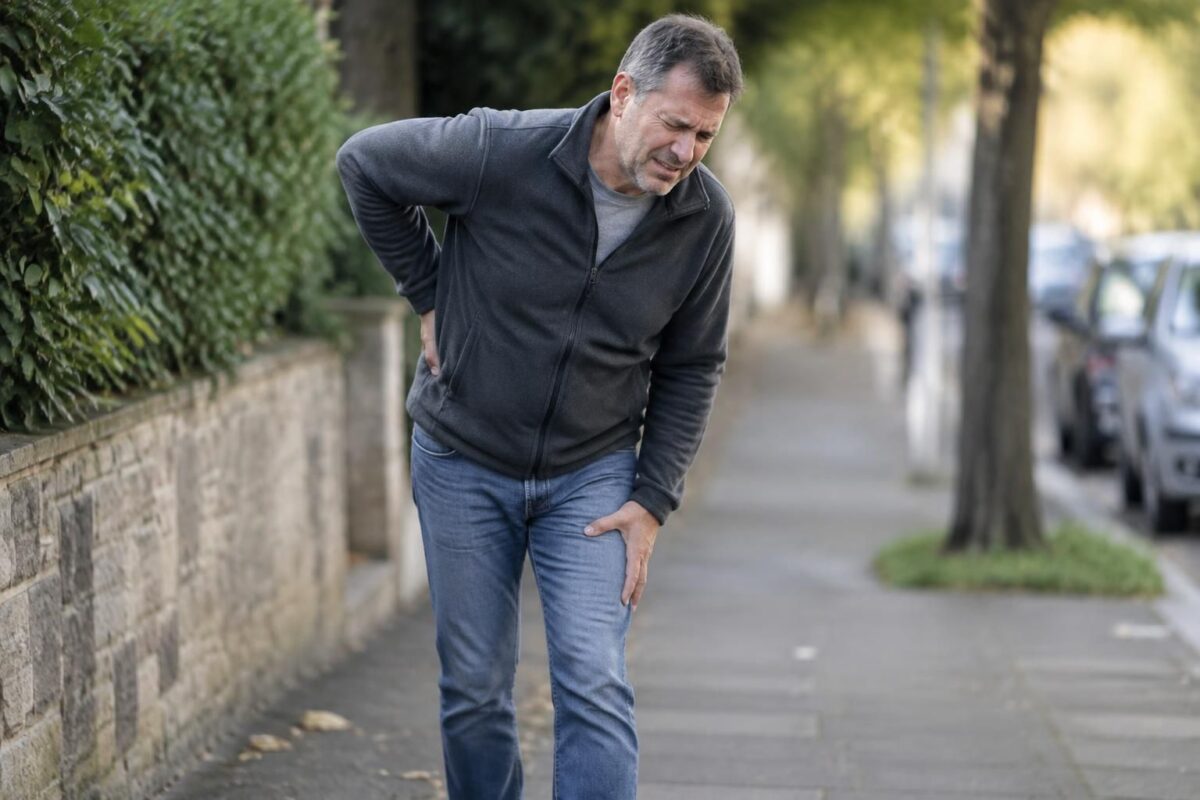
IN BRIEF A sciatica that worsens with walking is pain radiating from the buttock down the leg, exacerbated by walking. Several causes are possible: this symptom alone does not suffice for a diagnosis. Temporarily reduce walking duration, change positions, and…

Sciatica and pain that improves when walking
IN SUMMARY Sciatica is pain that radiates from the lower back or buttock down to the leg, sometimes all the way to the foot. If it decreases with walking, a gentle and regular walk can help limit stiffness and maintain…
Why Pain May Increase in the Evening
Sciatica corresponds to pain that follows the path of an irritated lumbar nerve root. It can start from the lower back or buttock, then travel down the thigh, calf, or foot. Possible causes include a herniated disc, arthritis-related changes, or narrowing around a nerve root. Only a healthcare professional can evaluate the cause of the symptoms.
Throughout the day, sitting or standing positions, movements, and certain tasks can strain the back. Pre-existing pain may then become more pronounced. Fatigue can also make pain harder to tolerate. To better understand this link, refer to this article on sciatica, fatigue, and pain intensity.
Prolonged Positions and Changes in Activity
Maintaining a seated position for a long time may accentuate symptoms in some people. Transitioning from sitting to walking can also cause initial pain. This phenomenon alone does not allow for identifying the cause. The article on pain that increases at the beginning of walking after sitting describes this situation.
More demanding physical activities can also provoke pain in some individuals. If pain occurs in the leg after jogging or intensifies during exercise, avoid overexertion and seek advice tailored to your situation. You can read our article on pain in the leg after jogging.

Sciatica and pain that worsens in the evening
IN BRIEF more painful sciatic pain in the evening is often related to inactivity, fatigue, and increased attention to sensations. This does not necessarily mean that the nerve is worsening. Gently changing positions, walking for a few minutes, and finding…

Sciatica and pain when turning in bed
IN BRIEF Sciatica can cause pain when turning in bed, as certain movements irritate the lower back or leg. Turn slowly, moving your shoulders and hips together; a cushion between the knees or under the knees can improve comfort. If…
What Symptoms to Watch For
Sciatica can cause burning pain, electric shock sensations, or stabbing pains. Tingling, reduced sensitivity, or weakness may also occur. Symptoms vary depending on the affected nerve root and are not the same from person to person.
A burning sensation in the foot should be taken seriously, especially if it persists, worsens, or is accompanied by loss of sensitivity or strength. It does not automatically confirm nerve compression, but warrants evaluation if it is new or concerning. For more information, consult the details on burning in the foot and possible nerve irritation as well as nerve symptoms that should not be dismissed.
Evening Pain Does Not Always Indicate Worsening
The intensity of pain can vary throughout the day. More pronounced pain in the evening does not suffice to conclude that the injury is worsening. It is also necessary to consider its evolution over several days, its path, the presence of numbness, and any changes in strength in the leg or foot.
If the pain persists or returns regularly, an evaluation may help determine the next steps. The article dedicated to persistent sciatica presents elements to discuss with a professional. A recurring pain may also be associated with a herniated disc, without being confirmed without examination. Consult our page on herniated disc and recurrent sciatica pain.

Sciatica and pain when getting out of bed
IN BRIEF Sciatica upon getting out of bed is pain that radiates from the lower back to the buttock or leg and can be more pronounced after the night. Gradually rising, moving gently, and finding a comfortable sleeping position can…

Sciatica and difficulty finding a comfortable position
IN BRIEF Sciatica is a pain that often starts in the lower back or buttock and radiates down the leg, sometimes making it difficult to find a comfortable position. Alternating positions, avoiding postures that aggravate the pain, and trying a…
What to Do When Pain Increases in the Evening
Avoid staying in bed for a long time without a professional’s indication. If your symptoms allow, maintain your daily activities at a tolerable level and temporarily adapt tasks that trigger severe pain. Change positions regularly and avoid continuing an activity that causes significant aggravation.
Do not start a medication or continue a treatment without verifying that it is suitable for you. Some pain medications come with risks or contraindications. A doctor or pharmacist can advise you based on your history and other treatments you are on.
If the pain does not improve, if it limits your activities, or if it returns frequently, seek an evaluation. The duration of a flare-up varies among individuals and its cause. For general guidelines, consult this article on the possible duration of a sciatica flare-up.

IN BRIEF Sciatica typically causes pain from the lower back to the buttock and leg; abdominal pain is not a typical sign and may have another cause. An evaluation helps to distinguish symptoms and guide management. Consult quickly if the…

IN BRIEF Sciatica corresponds to pain related to the irritation of a nerve, often felt in the lower back and may radiate to the buttock or leg. It can be accompanied by back pain, tingling, or numbness. An assessment helps…
When to Consult Promptly
Consult without delay if you experience significant or progressive weakness in the leg or foot, new difficulty in walking, loss of bladder or bowel control, or numbness in the perineum. These signs may indicate a medical emergency.
A fever, recent trauma, rapidly worsening intense pain, or a deteriorating general condition also require prompt medical advice. In case of doubt or severe symptoms, contact the emergency services in your area.
Evaluation and Support Options
A healthcare professional can assess your symptoms, mobility, and the strength and sensitivity of your legs. Imaging is not necessary in all situations; its utility depends on the observed signs and progression. For general information on the causes and treatments, you can visit our page on sciatica, its causes and treatments.
At the TAGMED Clinic, an evaluation can lead to discussions about non-surgical approaches suitable for your situation. For consultation information at TAGMED, see Treatment for sciatica in Montreal or Treatment for sciatica in Terrebonne. Depending on the results and contraindications, treatments may include a motorized neurovertebral decompression, specific osteopathy, or the precision impactor. These approaches do not replace a medical diagnosis or urgent care when necessary. You can consult the services of the TAGMED Clinic in Montreal and Terrebonne.
For an assessment related to sciatica treatment in Montreal and Mont-Royal or sciatica treatment in Terrebonne, consult the services available at the TAGMED Clinic.
About the Author
Sylvain Desforges, B.Sc., D.O., N.D., osteopath and naturopath, is the founding president of TAGMED and the ACMA association. His practice focuses on chronic pain of the spine, lower back pain, and pain associated with sciatica, particularly when pain radiates towards the hip, leg, calf, foot, or toes.
Through SOS Sciatica, he publishes educational content on the symptoms of sciatica, its possible causes, and non-surgical approaches that can be considered after evaluation. At the TAGMED Clinic, care may include, depending on the case, motorized neurovertebral decompression, specific osteopathy, or the precision impactor.
Medical Disclaimer
Medical disclaimer: The information and advice provided on this site do not replace the opinion, diagnosis, or treatment of a healthcare professional. Please note that Dr. Sylvain Desforges, osteopath, is neither a medical doctor nor a physician, and is not a specialist in a medical field as defined by the Collège des médecins du Québec. Manual therapy, functional medicine, and sports medicine as described on this site exclude any treatment or diagnosis performed by a doctor or medical specialist. Always consult your doctor for any medical questions. For more details, please read our full legal notice.
Why Pain Increases
- Walking, prolonged standing, or sitting can irritate the sensitive area.
- Fatigue and the accumulation of activities can exacerbate symptoms.
- Stronger pain in the evening does not, by itself, identify the cause.
What Reflexes to Adopt
- Alternate positions and favor a gentle activity, according to your tolerance.
- Avoid prolonged strict rest and movements that clearly trigger pain.
- Consult quickly if pain worsens or is accompanied by progressive weakness.
- In case of urinary or intestinal issues, or numbness in the perineum, consult urgently.

Increased sciatica pain at the end of the day may be related to the accumulation of efforts, prolonged positions, or excessive activity. To better manage it, alternate positions, break tasks into smaller parts, and maintain gentle activity rather than staying in bed. However, pain that rapidly worsens or is accompanied by significant weakness requires medical evaluation.
Why Can Pain Increase in the Evening?
Sciatica typically corresponds to irritation of a lumbar nerve root. Pain may start from the lower back or hip, then travel down the leg, sometimes to the foot. It may be accompanied by tingling, numbness, or a burning sensation.
Throughout the day, activities, walking, household tasks, or prolonged sitting can increase the sensitivity of the painful area. Fatigue may also make symptoms harder to tolerate. However, stronger pain in the evening does not, by itself, identify the cause or severity of the problem.
Adapting Activities During the Day
Avoid Prolonged Immobilization
If you work sitting down, regularly change positions and get up at regular intervals to walk for a few minutes. If you are standing for a long time, take short breaks and alternate tasks. The goal is to limit positions that clearly trigger pain without abandoning all activity.
Distributing Efforts
Avoid concentrating demanding tasks at the end of the day. Break cleaning, shopping, or physical work into shorter periods, with breaks as needed. When lifting a load, bring it close to your body, bend your knees, and avoid sudden twisting movements. Temporarily reduce gestures that cause a strong radiation in the leg.
A gentle walk or an appropriate activity may help preserve mobility. However, adjust the duration and intensity according to your tolerance: if an exercise significantly increases pain or introduces new symptoms, stop it and seek advice from a healthcare professional.
Alleviating Symptoms at the End of the Day
Choose a comfortable position that does not cause increased pain down the leg. Some people feel better lying on their side with a cushion between their knees or on their back with their legs supported. There is no universal position: prefer the one that relieves you without maintaining an uncomfortable posture.
Heat or cold can provide temporary relief. Protect the skin and avoid applications that are too long or at extreme temperatures. Before taking medication, especially an anti-inflammatory, consult with a pharmacist or doctor if you have contraindications, are taking other treatments, or have a health issue.
When to seek medical help?
Consult a professional if the pain persists, limits your activities, or worsens despite adjusting your efforts. An evaluation can check strength, sensitivity, and reflexes, then determine the appropriate care. Gradual return to movement and, if needed, supervised rehabilitation may be part of the management.
Seek emergency care in case of loss of control over the bladder or bowels, numbness in the perineum, significant or progressive weakness in the leg or foot, fever, or severe pain after trauma. These signs require rapid evaluation.
Things to remember for better end-of-day management
Observe the activities and positions that worsen your symptoms, then adjust them without imposing strict rest on yourself. Regular breaks, distributed efforts, and gentle activity can help you get through the day better. If the pain changes in nature, becomes unusual, or is accompanied by warning signs, seek medical advice.
Medical warning: this information is educational and does not replace a consultation, diagnosis, or treatment by a licensed healthcare professional.
| Sciatica | End-of-day pain |
|---|---|
| Pain that often starts in the buttock and descends into the leg. | Discomfort that can remain localized to the back or legs. |
| May follow a specific path down to the foot or toes. | Often related to efforts or prolonged positions during the day. |
| May be accompanied by tingling or numbness. | These signs are not characteristic of temporary fatigue. |
| Coughing or certain movements may worsen the pain. | Resting or changing position may provide relief. |
| Weakness in the leg or foot requires evaluation. | Persistent or worsening pain also warrants professional advice. |
| Pain radiating down the leg is not enough to confirm sciatica. | End-of-day pain alone does not allow one to determine its cause. |
| Seek emergency care if there is progressive weakness or urinary or bowel issues. | Fever, recent trauma, or rapid worsening require urgent evaluation. |
Sciatica and end-of-day pain: illustrative testimonies
Note: The stories below are fictional examples written to illustrate possible experiences. They do not represent identifiable patient testimonies and do not allow for a diagnosis.
“The pain returns after a day standing” — Claire, 46
In the morning, I feel quite well. But after several hours of working on my feet, a pain starts in my buttock and goes down the back of my thigh. By the end of the day, it becomes sharper, and I struggle to find a comfortable position. I now try to vary my postures and take short breaks rather than remaining still for too long.
“Sitting all day worsens my symptoms” — Marc, 52
I spend a lot of time in front of a screen. By late afternoon, a burning sensation appears in my buttock and can extend down into my calf. Getting up regularly and walking for a few minutes sometimes helps me better tolerate the pain. I pay attention not to strain when symptoms increase.
“Fatigue makes the pain harder to manage” — Nadia, 39
My sciatica isn’t always this intense, but after a busy day, I feel it more. The pain mostly goes down the side of my leg and the top of my foot. In the evening, I am also more tense and less patient. I’ve learned to spread some tasks out and gradually resume my activities without trying to do everything at once.
“The car ride triggers discomfort in the evening” — Jean, 58
After a long drive or several hours of sitting, I have pain in my buttock that sometimes radiates down the back of my leg. It is often more pronounced when I get home. I stop to move around during long trips and avoid sitting in the same position for too long. These adjustments do not replace an evaluation, but they help me better observe what influences my symptoms.
“I thought I needed to stay in bed” — Sophie, 43
When the pain intensified in the evening, I tended to lie down and avoid any movement. Over time, I realized that prolonged strict rest was not necessarily the best option. I now prefer gentle movements and a gradual return to activities, staying mindful of how the pain evolves.
A pain that increases at the end of the day may be influenced by the amount of time spent sitting or standing, fatigue, and the activities performed. Its timing alone does not allow for determining its cause. If the pain persists, worsens, or is accompanied by weakness, seek advice from a healthcare professional.
Seek emergency care in case of loss of control over the bladder or bowels, numbness in the perineum, significant or progressive weakness in a leg or foot, fever, recent trauma, or rapid worsening of symptoms.
Sciatica and end-of-day pain: understanding the causes and good reflexes
Sciatica, also called lumbar sciatica, refers to pain related to irritation of a nerve root in the lower back. It may start from the lumbar region or buttock and descend into the thigh, calf, sometimes down to the foot or toes. Pain that appears or intensifies at the end of the day may be consistent with sciatica, but this timing alone does not determine the cause.
Throughout the hours, daily activities, movements, maintaining a prolonged posture, or repeated efforts can stress the back and make symptoms more noticeable. Prolonged sitting, standing work without breaks, or carrying loads can also contribute to discomfort for some individuals. The pain may be described as a burning sensation, electrical discharge, stabbing, or pulling feeling. It may be accompanied by tingling or numbness in the leg.
The common cause of sciatica is a herniated disc, which can irritate or compress a nerve root. Other factors—such as changes related to arthritis or narrowing of certain nerve passages—can also be involved. However, more pronounced pain in the evening alone does not distinguish these mechanisms. A healthcare professional will evaluate, in particular, the pattern of symptoms, their duration, factors that worsen or relieve them, as well as the strength and sensitivity of the leg.
It is useful to observe the circumstances in which the pain increases: after prolonged sitting, walking, physical activity, or certain movements. Noting these elements can help describe the progression during a consultation. In many cases, it is preferable to maintain a gentle and suitable activity rather than remain in bed for long periods. Regular position changes and a gradual return to activities may be considered according to tolerance and received advice. However, avoid movements that trigger intense pain and vigorous manipulations without prior assessment.
The management depends on the situation and the clinical examination. It may include advice to maintain movement, supervised exercises, or other approaches chosen according to needs. Manual therapy and technologies such as neurovertebral decompression, laser, or shock waves may not be suitable for everyone and do not replace a diagnosis or medical follow-up. Medications, especially anti-inflammatories, should be used according to a professional’s advice, as they have contraindications and risks.
Consult a professional if the pain persists, worsens, recurs frequently, or limits your activities. An assessment is also important in the presence of new or increasing weakness in the leg or foot, marked loss of sensation, or unusual symptoms. Persistent nighttime pain, fever, recent trauma, or altered general condition also require medical advice.
Seek urgent medical help in cases of loss of bladder or bowel control, numbness in the perineal area, or significant and progressive weakness. These signs may indicate nerve damage requiring rapid assessment.
Sylvain Desforges, B.Sc., D.O., N.D., is an osteopath and naturopath, founding president of TAGMED and the ACMA association. His practice focuses on chronic spinal pain, low back pain, and symptoms consistent with sciatica. The information presented here is educational and does not replace a consultation, diagnosis, or treatment by a licensed healthcare professional.
A more pronounced sciatica in the late day may be linked to the accumulation of demands, positions held for long periods, or general fatigue, but this progression alone does not identify the cause. Observing the circumstances that worsen or relieve the pain, maintaining an appropriate activity, and having persistent symptoms evaluated helps in determining the course of action. Certain signs, particularly progressive weakness or urinary or bowel issues, require urgent evaluation.
Sciatic pain often follows a path from the lower back or buttock to the thigh, calf, or foot. It may manifest as a burning sensation, electric shock, numbness, or tingling. In some individuals, it increases throughout the day; in others, it is mainly present upon waking or at night. These variations do not necessarily mean that the injury is worsening: they can also reflect tissue sensitivity, activities performed, and time spent in the same posture.
A day spent sitting can contribute to worsening discomfort in some people, especially when breaks are rare or the position remains unchanged for long. Insights into this phenomenon are presented in this article on sciatica and pain after a day of sitting work. Sitting alone is not, however, proof of nerve compression or a specific cause.
Walking, physical tasks, and movement can also bring out symptoms when tolerance to effort is decreased. Fatigue felt at the end of the day can make the pain more difficult to bear, without necessarily signaling anatomical worsening. To better distinguish fatigue from the progression of symptoms, you can consult the explanations on sciatica and fatigue at the end of the day.
Identify the path and triggering factors
The path of the pain can help the healthcare professional guide their assessment. Pain that radiates down to the top of the foot or the big toe may suggest an L5 root involvement; pain towards the heel, sole of the foot, or little toe may correspond more to the S1 territory. These indicators are not sufficient to establish a diagnosis, but they are useful to describe during a consultation. An article dedicated to the pain paths according to the L4, L5, and S1 roots presents these differences.
It may be helpful to note for a few days when the pain occurs, the activities performed, the time spent sitting or standing, as well as the positions that bring relief. Morning pain, for example, is not necessarily interpreted the same way as pain that appears after several hours of activity. Additional information is available on the pain radiating down the leg upon awakening.
Nighttime also deserves attention when pain regularly disrupts sleep, becomes unusual, or does not improve with position changes. To better understand this context, consult the resources on sciatica and pain during sleep and on nocturnal sciatica and situations where rapid evaluation is indicated.
Adjust activity without immobilizing
In the absence of alarm signs, a relative rest is generally preferable to prolonged bed rest. It consists of temporarily reducing activities that trigger significant pain while maintaining tolerated movements and gradually resuming daily actions. Short breaks, regular position changes, and adapted walking can be more beneficial than remaining still for long periods.
Strengthening, particularly core stability, should be adjusted to the symptoms and capacity of the individual. An exercise may be well tolerated at one moment and become too demanding if the pain is sharp or if the symptoms extend further down the leg. Recommendations regarding variable tolerance to core stability in case of sciatica emphasize the importance of individualized progression. Avoid continuing a movement that causes a significant worsening or a new deficit without consulting a professional.
When to seek an evaluation
Persistent, recurrent pain, or pain that limits activities deserves evaluation by a healthcare professional. The examination takes into account the history of the symptoms, their progression, and any potential neurological signs. Imaging is not automatically necessary in all situations; the decision depends particularly on the duration of evolution, the results of the examination, and the presence of concerning signs. For a general overview of mechanisms, symptoms, and possible management, refer to this summary on sciatica, its anatomy, causes, and management.
Pain that lasts or recurs frequently may require re-evaluation to clarify the factors that maintain it and the appropriate options. Resources also address chronic sciatica and steps to consider as well as general information on sciatica. However, these do not replace an examination adapted to your situation.
Consult urgently in case of loss of control of the bladder or bowels, numbness of the perineum or saddle area, or significant or progressive weakness of the leg or foot. Fever, recent trauma, severe pain, or rapid worsening also justify prompt medical advice. This information is educational and does not replace a diagnosis or consultation with an authorized healthcare professional.

Dr Sylvain Desforges, B.Sc., D.O., N.D., osteopath, is the founding president of TAGMED and of the ACMA association. He dedicates his practice to chronic spinal pain, low back pain and symptoms compatible with sciatica, particularly when pain radiates toward the buttock, leg, calf, foot or toes.
Through SOS Sciatique, he publishes educational content on sciatica symptoms, possible causes such as disc herniation, disc narrowing, foraminal stenosis or irritation of a lumbar nerve root, as well as non-surgical approaches that may be considered according to the evaluation. At Clinique TAGMED, care may include, depending on the case, motorized neurovertebral decompression, specific osteopathic care or precision percussion.
For an evaluation related to sciatica treatment in Montreal / Mount Royal or sciatica treatment in Terrebonne, please consult the services available at Clinique TAGMED.
Medical disclaimer
The information published on SOS Sciatique is provided for educational purposes only and does not replace a consultation, diagnosis, opinion or treatment provided by a physician or another authorized healthcare professional. The author of this article is neither a medical doctor nor a specialist in a medical specialty recognized by the Collège des médecins du Québec. The osteopathic, manual medicine or functional support approaches described on this site do not constitute medical acts and are not intended to replace medical follow-up.
Consult a physician or emergency service in cases of loss of bladder or bowel control, anesthesia in the saddle area, significant or progressive weakness in the leg or foot, fever, recent trauma, severe pain or rapid worsening of symptoms. For more details, please read our Legal Notice.


