



Sciatica in Terrebonne: L5 and difficulty lifting the foot
23/10/2026
Disc protrusion and disc pinching: combined mechanisms
23/10/2026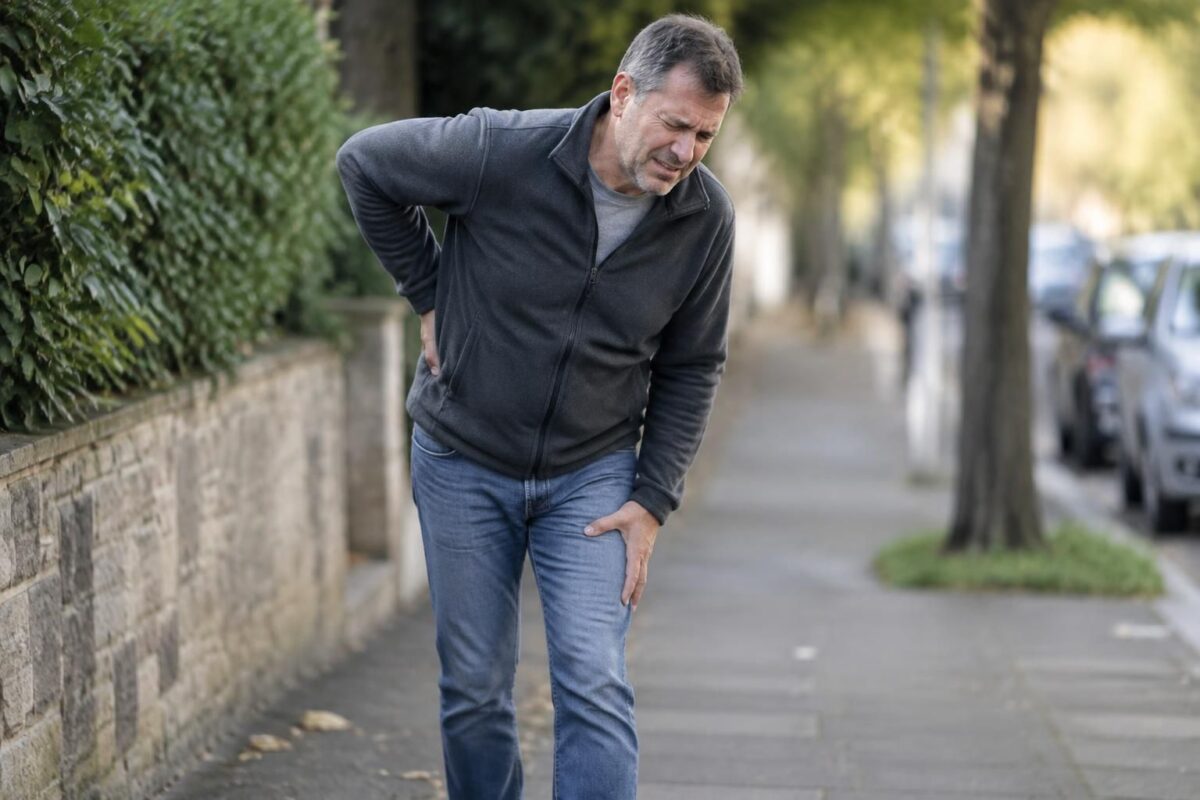
IN BRIEF
| A sciatica that worsens with walking is pain radiating from the buttock down the leg, exacerbated by walking. Several causes are possible: this symptom alone does not suffice for a diagnosis. Temporarily reduce walking duration, change positions, and gradually resume activity according to your tolerance. Consult if the pain persists or intensifies; progressive weakness, urinary or bowel issues, or numbness in the genital area require urgent evaluation. |
A sciatica that worsens with walking may be linked to nerve irritation or another lumbar cause; this symptom alone does not allow for a diagnosis to be established. Temporarily reduce walking duration, take breaks, and gradually resume according to your tolerance. If the pain persists or intensifies, seek the advice of a healthcare professional. Significant or progressive weakness, loss of sensation in the perineum, or urinary or bowel issues require a urgent medical evaluation.
A sciatic pain that increases during walking may be related to nerve irritation, narrowing of the spaces around the nerves, or another issue affecting the back, hip, or legs. The path of the pain, its response to rest, and associated symptoms help guide evaluation, but are not enough for a diagnosis. Here are useful guidelines to know when to consult and how to avoid worsening the situation.
How can sciatica cause pain while walking?
The sciatic nerve originates from nerve roots located in the lower back. It runs through the buttock and down the back of the thigh, with its branches extending into the leg and foot. Irritation of a nerve root can therefore cause pain in the buttock or along the leg, sometimes with tingling or numbness.
The pain may increase during walking because this activity stresses the back, pelvis, and legs. The duration of walking, trunk position, and the cause of symptoms can also play a role. However, pain that follows the leg does not, on its own, prove that the sciatic nerve is compressed.
The affected nerve root can alter the path of the symptoms. Painful areas are not the same for everyone. To learn more, consult the articles on the path of pain depending on the affected root in Montreal and in Terrebonne.

Sciatica and pain that improves when walking
IN SUMMARY Sciatica is pain that radiates from the lower back or buttock down to the leg, sometimes all the way to the foot. If it decreases with walking, a gentle and regular walk can help limit stiffness and maintain…
Why might the pain worsen when walking?
Narrowing around the nerves
A narrowing of the lumbar canal or the openings through which the nerves pass can contribute to pain that increases when standing or walking. Some people also experience heaviness, tingling, or weakness in the legs. Symptoms may diminish when they stop or sit down, but this profile alone does not confirm stenosis.
Medical imaging, such as an MRI, must be interpreted along with symptoms and clinical examination. A visible abnormality does not necessarily explain the pain. To better understand what lumbar levels can show on an MRI, consult this article on lumbar levels in Terrebonne.
Nerve irritation or a herniated disc
A herniated disc can irritate a nerve root and provoke pain that radiates down the leg. Walking may then exacerbate symptoms in some individuals, while others may feel more pain when sitting or bending. The reaction varies from person to person and does not allow for the cause to be identified alone.
A herniation or another disc modification may also appear on an image without being the source of the symptoms. The healthcare professional must therefore compare imaging results with examination and pain history.
Other possible causes
Pain that increases with walking does not always originate from the sciatic nerve. Hip pain, muscle impairment, joint issues, or circulation problems can produce similar or associated symptoms. Pain in the calf that appears regularly with exertion and diminishes at rest particularly warrants medical evaluation.
For a general overview of causes and symptoms, you can read the content from SOS Sciatique. An examination is necessary to distinguish between the different possibilities.

IN BRIEF Sciatica is pain that often starts from the lower back or buttock and travels down the leg. Pain that worsens at the end of the day may be related to activities or prolonged positions, but it is not…
What signs may accompany sciatica?
The pain may start in the lower back or buttock and then radiate down the back of the thigh. It may reach the calf, foot, or toes. Some people describe burning, electric shock-like sensations, or sharp pain. Others feel tingling, numbness, or decreased sensitivity.
A muscle weakness, such as a new difficulty in lifting the foot or walking normally, should be taken seriously. The presence, intensity, and path of symptoms vary from one person to another. No isolated sign can confirm sciatica.

Sciatica and pain that worsens in the evening
IN BRIEF more painful sciatic pain in the evening is often related to inactivity, fatigue, and increased attention to sensations. This does not necessarily mean that the nerve is worsening. Gently changing positions, walking for a few minutes, and finding…
What to do if walking increases the pain?
Do not push through a significant worsening
If the pain becomes much stronger, radiates further down the leg, or is accompanied by new numbness, stop walking and take a break in a comfortable position. Avoid repeating an activity that causes significant worsening. This does not mean you should stay in bed: prolonged immobility can reduce mobility and make returning to activities more difficult.
Adjust duration and pace
If you can walk without significant worsening, reduce the duration and pace rather than aiming to reach a fixed distance. Take breaks as needed. Gradually resume your movements according to the response of symptoms during and after walking. There is no universal duration that fits all cases of sciatica.
Walking is not always the best activity during a painful phase. Cautionary advice is available in this guide on walking with sciatica. If you are considering stationary biking, its tolerance also depends on the person and the position adopted. Read the guidelines on stationary biking and sciatica.
Choose a position that reduces symptoms
Sit or lie down briefly if it reduces pain. Some people feel better on their back, with legs supported, or on their side with a pillow between their knees. Others need a different position. The right indicator is a decrease in discomfort, without symptoms spreading to the foot.
Avoid staying in a position that significantly increases pain for long periods. General guidelines do not replace an evaluation, especially if the pain is new, intense, or accompanied by neurological signs.

Sciatica and pain when turning in bed
IN BRIEF Sciatica can cause pain when turning in bed, as certain movements irritate the lower back or leg. Turn slowly, moving your shoulders and hips together; a cushion between the knees or under the knees can improve comfort. If…
Should I do stretches or exercises?
There is no exercise or sciatic stretch that suits everyone. A movement that soothes one person can exacerbate symptoms in another. Avoid forcing a stretch or mobilization if the pain travels further down the leg, if numbness occurs, or if you feel new weakness.
If you have persistent pain or a possible disc or nerve cause, consult a healthcare professional before adding exercises. You may also read the guidelines on caution with popular stretches for sciatica.

Sciatica and pain when getting out of bed
IN BRIEF Sciatica upon getting out of bed is pain that radiates from the lower back to the buttock or leg and can be more pronounced after the night. Gradually rising, moving gently, and finding a comfortable sleeping position can…
When to consult for pain that worsens while walking?
Consult a doctor or healthcare professional if the pain persists, worsens, returns frequently, or limits your movement. An evaluation is also indicated if you have persistent tingling, a loss of sensation, or difficulty walking that does not improve.
The professional may ask you about the onset of the pain, its course, the activities that modify it, and other symptoms. They can also assess sensitivity, strength, and reflexes. An MRI is not necessary in every case. The doctor decides if imaging is relevant based on the signs present and the progression.

Sciatica and difficulty finding a comfortable position
IN BRIEF Sciatica is a pain that often starts in the lower back or buttock and radiates down the leg, sometimes making it difficult to find a comfortable position. Alternating positions, avoiding postures that aggravate the pain, and trying a…
What signs require urgent evaluation?
Consult an emergency service immediately if you have a loss of bladder or bowel control, a new difficulty urinating, numbness in the genital area or around the anus, or significant or progressive weakness in a leg or foot.
Severe pain accompanied by fever, recent trauma, or rapid deterioration also requires urgent medical evaluation. These signs do not allow for a remote diagnosis, but they may reveal a situation that requires prompt care.

IN BRIEF Sciatica typically causes pain from the lower back to the buttock and leg; abdominal pain is not a typical sign and may have another cause. An evaluation helps to distinguish symptoms and guide management. Consult quickly if the…
An evaluation suited to your symptoms
Management depends on the cause, the intensity of the pain, and your health status. At the Clinique TAGMED in Montreal and Terrebonne, an evaluation may allow for a discussion of non-surgical options suited to your situation. Motorized neurovertebral decompression, specific osteopathy, or precision percussion may be considered depending on the evaluation; these approaches do not replace a medical diagnosis or follow-up with a doctor.
If you want to better understand the factors associated with pain and the management options, also check out this article on the causes, symptoms, and possible treatments for sciatica.

IN BRIEF Sciatica corresponds to pain related to the irritation of a nerve, often felt in the lower back and may radiate to the buttock or leg. It can be accompanied by back pain, tingling, or numbness. An assessment helps…
About the author
Sylvain Desforges, B.Sc., D.O., N.D., osteopath and naturopath, is the founding president of TAGMED and the ACMA association. His practice focuses on chronic pain of the spine, lower back pain, and pain compatible with sciatica, especially when the pain travels down to the buttock, leg, calf, foot, or toes.
Through SOS Sciatique, he publishes educational content on the symptoms of sciatica, its possible causes, and non-surgical approaches that may be considered after evaluation. Services at Clinique TAGMED may include, depending on the case, motorized neurovertebral decompression, specific osteopathy, or precision percussion.
For an evaluation related to sciatica treatment in Montreal / Mont-Royal or to sciatica treatment in Terrebonne, check the services available at the Clinique TAGMED.
Medical disclaimer
The information and advice provided on this site do not replace the opinion, diagnosis, or treatment of a healthcare professional. Please note that Dr. Sylvain Desforges, osteopath, is neither a medical doctor nor a physician, and is not a specialist in a medical specialty as defined by the Collège des médecins du Québec. Manual therapy, functional medicine, and sports medicine as described on this site exclude any medical treatment or diagnosis made by a doctor or medical specialist. Always consult your doctor for any medical questions. For more details, please read our Full Legal Notice.
What this may evoke
- Walking may intensify sciatic pain, without revealing the cause on its own.
- Increasing pain when standing or walking may sometimes be linked to lumbar stenosis.
- The distance walked, posture, and pace can influence symptoms.
How to respond
- Reduce the duration or pace, then gradually resume if symptoms settle down.
- Stop if the pain travels further down the leg or if numbness occurs.
- Consult if the pain persists or worsens. Progressive weakness, a loss of urinary or bowel control, or numbness in the saddle area requires urgent evaluation.

When sciatic-type pain increases while walking, don’t push to reach a predefined distance: slow down, take a break, and observe how symptoms evolve. Prolonged walking or standing can aggravate certain lower back pains radiating down the leg, but this sign alone is not enough to identify the cause. Here are some guidelines to adjust your movements, stay active without exacerbating pain, and know when to seek medical advice.
Why can pain increase while walking?
Walking puts a strain on the back, pelvis, and legs. Depending on the situation, the pain may be linked to nerve irritation, increased sensitivity to movement, or other issues related to muscles and joints. For some people, standing or walking for a long time increases symptoms, while sitting or leaning slightly forward provides relief. This phenomenon can particularly be observed in lumbar canal stenosis, but it cannot, on its own, lead to a diagnosis.
Take note of the distance or duration that usually triggers the pain, its path, and the time it takes for it to decrease after a break. This information can help a healthcare professional assess your situation.
How to adapt walking without stopping all activity?
Reduce the duration and break up your walks
Start with a short duration, such as a few minutes on flat terrain, then take a break before the pain becomes strong. Several short walks throughout the day may be easier to tolerate than a long outing. Gradually increase the duration only if symptoms remain stable during and after the activity.
Choose a comfortable pace and environment
Walk at a gentle pace, with suitable shoes and on a route where you can stop easily. If a slight forward lean improves your comfort, you might try briefly leaning on a counter or stable support during a break. However, don’t maintain a posture that causes more pain, and don’t assume a particular position works for everyone.
If the pain travels further down the leg, if tingling increases, or if weakness develops, stop the exercise. Rest in a comfortable position and avoid repeating the movement that significantly increases symptoms.
When to consult about pain that worsens while walking?
Make an appointment with a doctor or healthcare professional if the pain regularly returns while walking, limits your activities, persists, or worsens. An assessment may examine strength, sensitivity, reflexes, and the circumstances that trigger or relieve the pain. Imaging is not routine: its usefulness depends on the symptoms and clinical examination.
Consult urgently in case of significant or progressive weakness of the leg or foot, new difficulty urinating, loss of control over urine or stool, or numbness in the saddle area. Severe pain accompanied by fever, occurring after trauma, or worsening rapidly also requires prompt medical assessment.
What actions should be avoided?
Avoid forcing yourself to walk long distances despite obvious worsening, but don’t stay bedridden for several days without medical advice. Do not perform forced stretches or exercises that increase irradiation. If in doubt about the activity or what to do, seek advice from a healthcare professional. These recommendations are educational and do not replace a consultation, diagnosis, or personalized treatment.
| Situation | Useful guideline |
|---|---|
| Pain increases with the first steps | Reduce the duration and walk at your own pace. |
| Pain intensifies after a long walk | Take a break, then gradually resume if symptoms calm down. |
| Pain travels further towards the calf or foot | Stop walking if irradiation significantly increases. |
| Walking remains tolerable despite moderate discomfort | Short outings can help maintain mobility. |
| Pain worsens with every attempt | Consult a healthcare professional to assess the situation. |
| Significant or progressive weakness appears | Request a medical evaluation promptly. |
| Urinary or intestinal issues arise | Consult emergency services without delay. |
Testimonials about sciatica and pain worsening while walking
“After a few minutes, the pain traveled down my leg”
“I had pain in my buttock and behind my thigh. While walking, the pain became sharper and eventually radiated down to my calf. I took a break, then resumed over a shorter distance. I also consulted to reassess and find a way to stay active without greatly increasing my symptoms.” — Illustrative testimonial
“I thought I had to keep going no matter what”
“I wanted to maintain my usual walks, so I persisted even when the pain intensified. I realized it was better to adjust the duration: a few short walks at a comfortable pace rather than a long outing that greatly aggravated the pain.” — Illustrative testimonial
“Standing bothered me more than sitting”
“My pain mostly occurred after a time standing or walking. It decreased when I sat down or leaned slightly forward. Since this reaction recurred regularly, I talked to a healthcare professional to assess the situation and choose a better-tolerated activity.” — Illustrative testimonial
“The pain didn’t behave the same every day”
“Some days, I could walk a bit without difficulty. Other times, the pain in my buttock and leg came on quickly. I started with short distances and observed my symptoms during and after walking. This helped me manage my activities without considering every movement as dangerous.” — Illustrative testimonial
“I stopped the exercises that caused the pain to travel downward”
“A stretch I had tried increased the tingling down to my foot. I stopped it instead of forcing it. An exercise is not suitable if it significantly increases irradiation, numbness, or weakness.” — Illustrative testimonial
These testimonials are fictional examples, written for informational purposes; they do not correspond to identifiable patients and do not predict the evolution of your situation. Pain that increases while walking can have several causes: its behavior alone does not allow for a diagnosis.
If the pain persists, worsens, or significantly limits your movements, seek advice from a healthcare professional. Significant or progressive weakness, loss of bladder or bowel control, or numbness in the saddle area require urgent medical evaluation.
Sciatica refers to pain that follows, in whole or in part, the path of a lumbar nerve root and the sciatic nerve. It can start from the lower back or the buttock, then descend behind the thigh and sometimes extend down to the calf or foot. When it intensifies while walking, the discomfort can quickly limit movement and daily activities. This reaction warrants observation, but it is not sufficient on its own to identify the cause of the pain.
Walking engages the muscles, joints, and nerve structures of the back and legs. Depending on the situation, standing or moving may increase irritation, while sitting or leaning slightly forward can sometimes provide relief. This profile can especially occur in the presence of lumbar canal stenosis, but other factors can contribute to the symptoms. A herniated disc, nerve irritation, or muscular pain can also produce similar manifestations. Clinical examination remains essential to interpret these clues.
It is also important not to draw conclusions from a single medical image. An anomaly observed on an MRI is not necessarily responsible for the pain, and real pain can persist without a clearly visible specific cause. The healthcare professional takes into account the history of symptoms, their evolution, muscle strength, sensitivity, reflexes, and tolerance to movement. Imaging is considered based on the context, particularly if concerning signs appear or if symptoms persist.
When walking worsens the pain, it may be useful to temporarily reduce the duration of outings, without imposing prolonged rest. Short walking periods, interspersed with breaks, can sometimes help maintain suitable activity. Some people find a more comfortable position by sitting or supporting their legs; others tolerate a different posture better. The goal is to identify movements that reduce symptoms, without forcing a movement that significantly increases pain or causes it to radiate further down the leg.
Exercises are not universal. Gentle mobilization or gradual strengthening may suit some people but should be adjusted according to the reaction of the symptoms. If a movement causes marked worsening, new numbness, or weakness, it should be stopped, and advice should be sought. Individualized support helps to gradually resume walking and activities, taking into account the suspected cause, the person’s capabilities, and their functional goals.
Sylvain Desforges, B.Sc., D.O., N.D., is an osteopath and naturopath, as well as the founding president of TAGMED clinics and the ACMA association. His practice primarily focuses on managing chronic pain and care approaches integrating technologies such as neurovertebral decompression, laser, and shock waves, when these are appropriate to the situation. His aim is to offer support based on assessment and available data, in order to promote the health and well-being of patients. Management options must be determined individually and do not replace medical follow-up when necessary.
A significant or progressive weakness in the leg or foot, loss of bladder or bowel control, numbness in the saddle area, fever, recent trauma, or rapid worsening necessitate urgent medical evaluation. In case of doubt, consult a doctor or an emergency service rather than continuing exercises or movements that worsen the symptoms.
A sciatica that worsens when walking may relate to nerve irritation or another lumbar cause, but this symptom alone does not permit a diagnosis. The reaction to walking, the distance traveled before the pain appears, its path in the leg, and any possible tingling or weakness are useful indicators. The goal is to stay active as much as possible, without forcing or ignoring persistent worsening.
Walking can sometimes relieve stiffness, but it can also exacerbate symptoms. Pain that progressively increases while standing or after walking for a certain time deserves particular attention, especially if it radiates from the buttock down to the calf or foot. The pathway of symptoms can sometimes guide the evaluation: calf pain is addressed in this article on sciatica L5-S1 and symptoms in the calf, while pain in the big toe may have different explanations, as detailed on this page about big toe pain and the L5 root.
However, localization alone is not sufficient to identify the affected nerve root. The differences between possible L4-L5 and L5-S1 impairments are presented in resources about the difference between L4-L5 and L5-S1 in Montreal and the difference between L4-L5 and L5-S1 in Terrebonne. Difficulty standing on tiptoe, especially if it is new or worsening, should also be reported to a healthcare professional; see information on the S1 root and difficulty standing on tiptoe.
Adapting Walking and Movements
If the pain remains tolerable and does not extend further down the leg, try short walking periods at a comfortable pace, then take a break. You can gradually increase the duration if the symptoms remain stable during and after the activity. If the pain becomes significantly stronger, radiates further down to the foot, or is accompanied by numbness, reduce the duration or stop walking for the time being. Advice on the benefits and precautions of walking with sciatica and on precautions to take while walking can complement these guidelines.
There is no position or exercise that suits everyone. Favor gentle movements that do not increase irradiation and avoid forced stretches or exercises that clearly worsen symptoms. To explore options cautiously, consult these resources on exercises and relief for sciatic pain, as well as this general presentation of sciatica.
When to request a medical evaluation
Seek advice from a healthcare professional if the pain persists, worsens, increasingly limits walking, or recurs regularly. An evaluation takes into account your symptoms, clinical examination, and general condition, without automatically deducing the cause from an imaging result. The guidelines from Assurance Maladie specify what to do in case of sciatica and when to consult.
Significant or progressive weakness in the leg or foot, loss of control of the bladder or bowels, or numbness in the genital or perineal region require urgent medical evaluation. Also consult quickly in case of fever, recent trauma, severe pain, or rapid deterioration. These signs should not be managed solely by exercises or continued walking.

Dr Sylvain Desforges, B.Sc., D.O., N.D., osteopath, is the founding president of TAGMED and of the ACMA association. He dedicates his practice to chronic spinal pain, low back pain and symptoms compatible with sciatica, particularly when pain radiates toward the buttock, leg, calf, foot or toes.
Through SOS Sciatique, he publishes educational content on sciatica symptoms, possible causes such as disc herniation, disc narrowing, foraminal stenosis or irritation of a lumbar nerve root, as well as non-surgical approaches that may be considered according to the evaluation. At Clinique TAGMED, care may include, depending on the case, motorized neurovertebral decompression, specific osteopathic care or precision percussion.
For an evaluation related to sciatica treatment in Montreal / Mount Royal or sciatica treatment in Terrebonne, please consult the services available at Clinique TAGMED.
Medical disclaimer
The information published on SOS Sciatique is provided for educational purposes only and does not replace a consultation, diagnosis, opinion or treatment provided by a physician or another authorized healthcare professional. The author of this article is neither a medical doctor nor a specialist in a medical specialty recognized by the Collège des médecins du Québec. The osteopathic, manual medicine or functional support approaches described on this site do not constitute medical acts and are not intended to replace medical follow-up.
Consult a physician or emergency service in cases of loss of bladder or bowel control, anesthesia in the saddle area, significant or progressive weakness in the leg or foot, fever, recent trauma, severe pain or rapid worsening of symptoms. For more details, please read our Legal Notice.


