


Sciatica and movement that provides temporary relief: is it enough?
30/10/2026
Sciatica in Terrebonne: L5 or S1 irritation, why the clinical examination matters
31/10/2026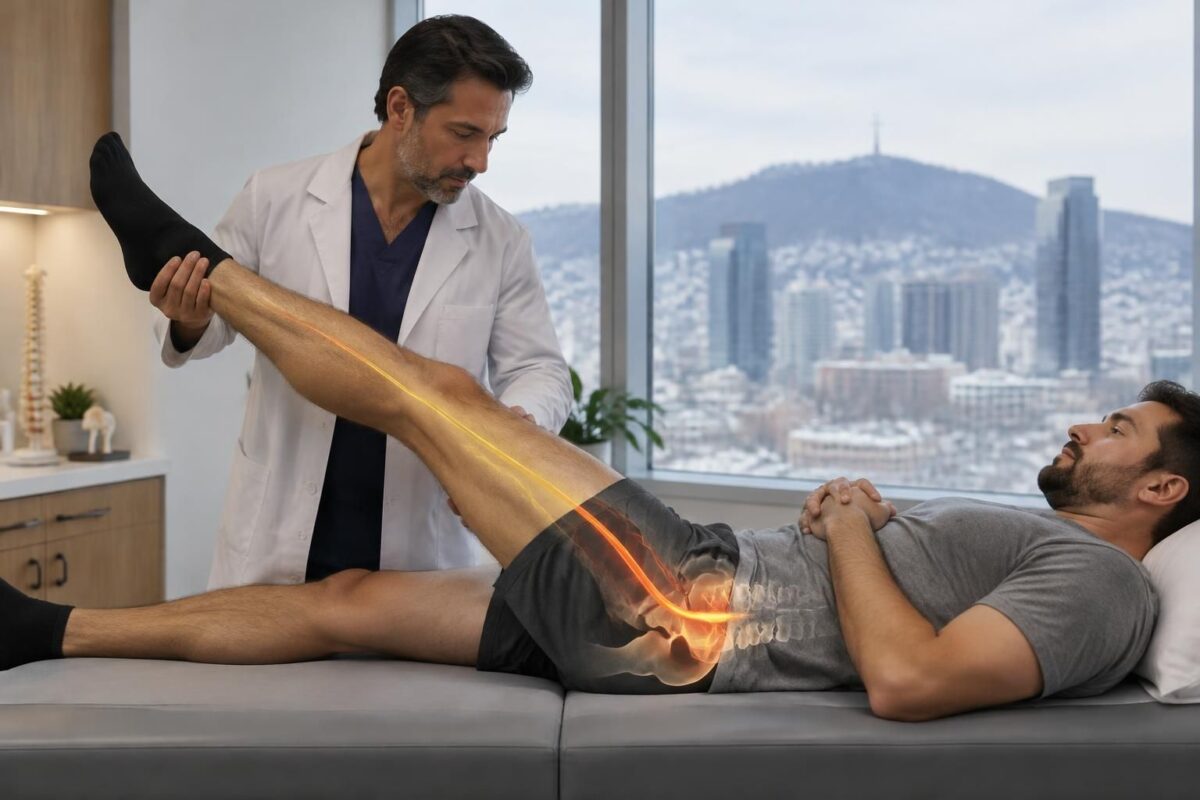
IN BRIEF The sciatica related to irritation of the L5 or S1 root can cause pain, numbness, or weakness in the leg and foot. In Montreal, the clinical examination compares the course of symptoms, sensitivity, strength, and reflexes to guide the evaluation and verify if the imaging corresponds to the reported issue. The L5 and S1 landmarks vary from person to person: no isolated sign is sufficient to precisely locate the irritation. |
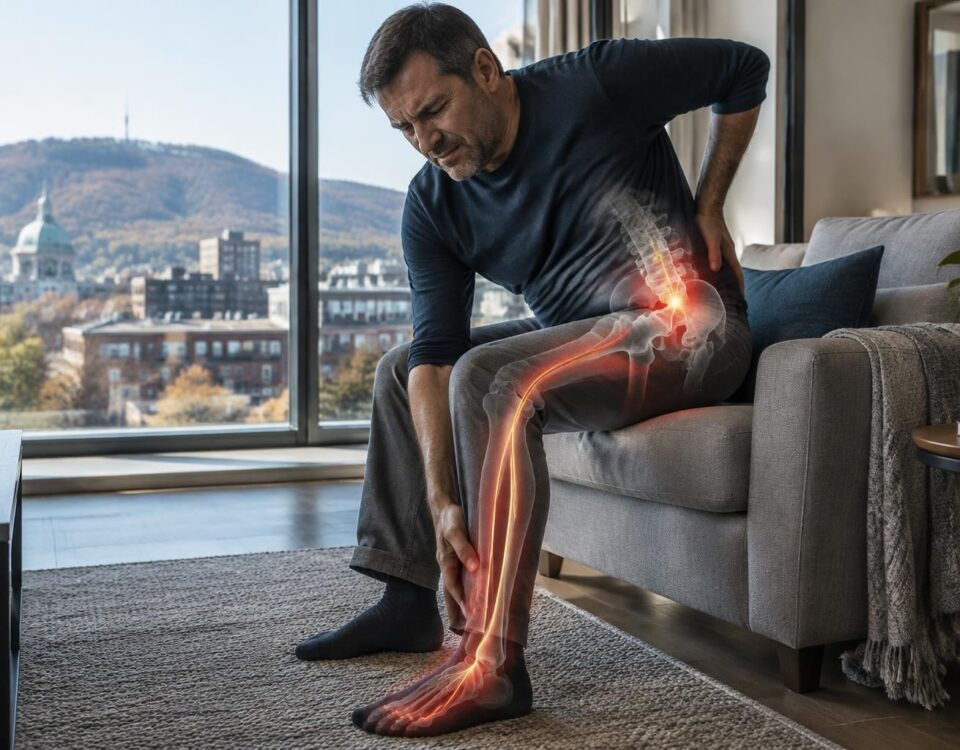
Pain that travels down to the top of the foot or the big toe may suggest irritation of the L5 root; pain towards the calf or the outer edge of the foot may lean towards S1. These areas overlap and vary: they do not, by themselves, allow for precise localization of the cause.
In Montreal, the clinical examination helps relate the clues: the course of symptoms, sensitivity, strength, reflexes, gait, and targeted tests. Imaging results, when relevant, must be compared to this examination and the functions actually affected. An evaluation at TAGMED Clinic can help determine the appropriate next steps.
Consult quickly in case of new or progressive weakness; urinary or bowel issues and numbness in the saddle region require urgent attention.
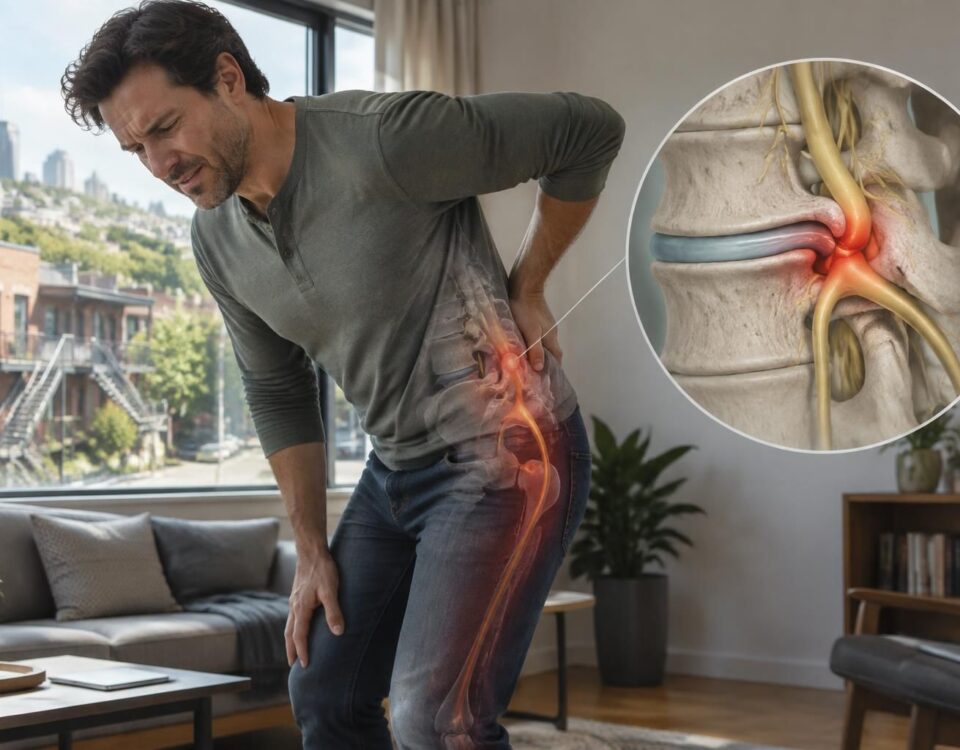
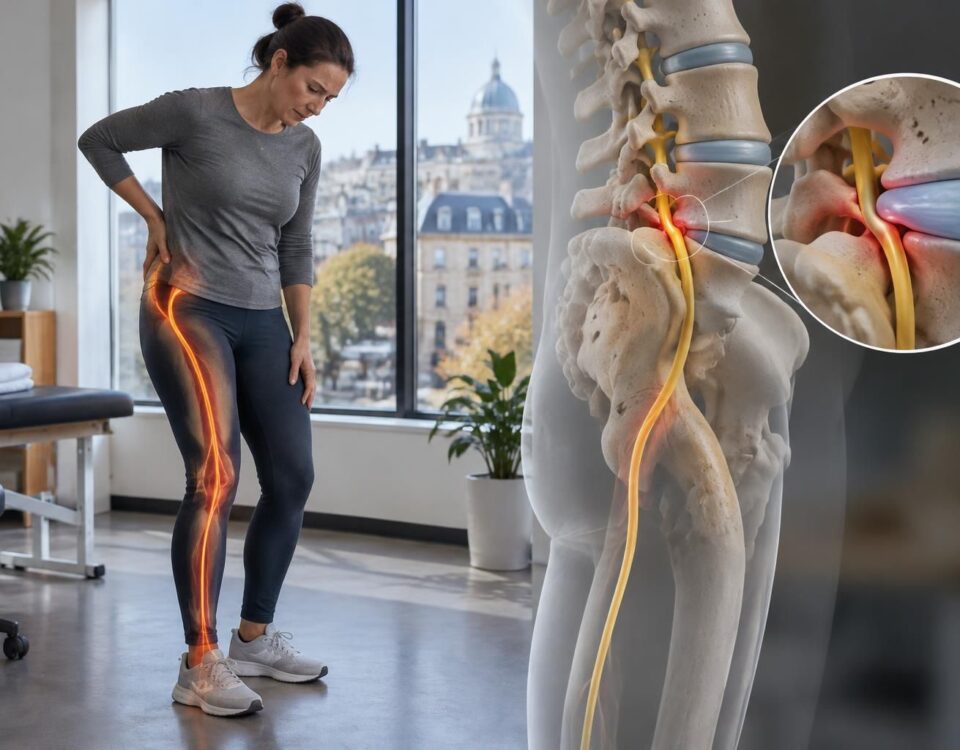
Pain that travels from the buttock down to the foot may suggest irritation of a lumbar nerve root, often L5 or S1. The course of pain and the areas of numbness provide clues, but alone do not determine the root involved. In Montreal, the evaluation must also compare strength, sensitivity, reflexes, and function with the imaging results, if imaging is relevant. The L5 and S1 roots are involved in the sensitivity and movements of the leg and foot. Irritation can cause pain, tingling, numbness, or weakness. These signs do not always follow anatomical maps exactly: the territories overlap and vary from person to person. Irritation of L5 may be accompanied by pain on the side of the leg and the top of the foot. The big toe often serves as a sensory landmark, but this landmark does not, by itself, confirm an involvement of L5. The examination may also check the ability to lift the foot or the big toe and to walk on the heels. Irritation of S1 may cause pain in the back of the thigh and calf, then towards the outer edge of the foot. The clinician may check the sensitivity of this area, strength during foot flexion downward, and the Achilles reflex. A new difficulty in rising onto the toes deserves evaluation, especially if it worsens. To learn more about this sign, consult this page on S1 and difficulty rising onto the toes. The landmarks L4, L5, and S1 are useful for describing symptoms, without perfectly localizing a lesion. This resource on sciatica L4, L5, and L5-S1 in Montreal presents the possible territories. The course of the sciatic nerve can also help understand why the pain radiates down the leg. Sciatica is primarily a clinical problem. The evaluation does not rely on a single symptom, an isolated test, or an image. The professional collects the history of the pain, checks neurological functions, and compares sides. They seek to determine if multiple findings indicate the same hypothesis. The course of the pain, its duration, and intensity matter. It is also important to specify the presence of tingling, numbness, or weakness, as well as the activities or positions that influence the symptoms. Pain in the hip region is not always a nerve irradiation. This page explains the difference between a hip pain and a nerve irradiation. Symptoms may vary throughout the day. Their worsening at the end of the day or at night should be reported to the professional, without allowing this alone to identify a root. You can read information regarding sciatica that worsens at the end of the day and night pain in the leg. The examination may include comparison of the muscle strength of both legs, checking different sensitivity areas, and observing gait. The professional may also check the patellar and Achilles reflexes and perform targeted tests, depending on the symptoms. These actions help identify a deficit and see if it corresponds to a plausible nerve distribution. A nerve tension test may reproduce pain in the leg. Its result must be interpreted cautiously: pain limited to the lower back does not, by itself, mean that the test reveals sciatica. An evaluation of sciatica in Montreal examines symptoms and function as a whole. An MRI or a CT scan describes the visible structures, such as the discs and the spaces through which nerve roots pass. An anomaly may be present without explaining the symptoms. The image must therefore correspond to the affected side, the suspected level, and the signs observed in the examination. A disc-root conflict takes on meaning when it aligns with the clinical picture. An MRI is not necessary in every situation. A doctor may request it when symptoms persist, when concerning neurological signs appear, or if the result can guide a care decision. An electromyogram may be considered in certain cases, for example, if the diagnosis remains uncertain. To better understand the relationship between a disc herniation and symptoms, consult this resource on lumbar sciatica associated with a lumbar disc herniation. Certain signs require quick attention. Consult without delay for a routine appointment in case of new or progressive weakness, recent foot drop, or if the leg is increasingly giving way. Loss of control of the bladder or bowel, new difficulty urinating, or numbness in the perineum and the so-called “saddle” area justify urgent evaluation. Significant symptoms in both legs, major trauma, fever, or general deterioration also require quick medical evaluation. In case of a new urinary or bowel problem, saddle anesthesia, or significant and sudden weakness, go to the emergency room or call emergency services. General recommendations on sciatica are available in this resource on sciatica recommendations. A follow-up compares concrete changes over time rather than a single observation. It can focus on strength, the extent of numbness, walking, sleep, sitting position, and important activities. Report any worsening or new neurological signs to the professional accompanying you. At TAGMED Clinic, a consultation can help connect symptoms, functional examination, and existing tests to discuss the next steps. Available services and care depend on the evaluation and the professionals present. To learn about the options in Montreal and Mont-Royal, visit the TAGMED Clinic. Sylvain Desforges, B.Sc., D.O., N.D., Doctor of Osteopathy and naturopath, is the founding president of TAGMED and the ACMA association. His practice focuses on chronic pain of the spine, lower back pain, and pain associated with sciatica, particularly when pain radiates to the buttock, leg, calf, foot, or toes. Through SOS Sciatique, he publishes educational content on sciatica symptoms, its possible causes, and non-surgical approaches that may be considered based on the evaluation. At TAGMED Clinic, care may include, depending on the case, motorized neurovertebral decompression, specific osteopathy or precision impactor. For an evaluation related to sciatica treatment in Montreal and Mont-Royal or sciatica treatment in Terrebonne, check the services available at TAGMED Clinic. The information and advice provided on this site do not replace the opinion, diagnosis, or treatment of a health professional. Please note that Sylvain Desforges, B.Sc., D.O., N.D., doctor of osteopathy, is neither a doctor of medicine nor a physician and is not a specialist in a medical specialty as defined by the Collège des médecins du Québec. Manual medicine, functional medicine, and sports medicine as described on this site exclude any treatment or medical diagnosis made by a doctor or a medical specialist. Always consult your doctor for any medical questions. For more details, please read our full legal notice. The information published on SOS Sciatique is provided for educational purposes. It does not replace a consultation, diagnosis, advice, or treatment provided by a doctor or another licensed health professional. The author of this article is neither a doctor nor a specialist in a medical specialty recognized by the Collège des médecins du Québec. The osteopathy, manual medicine, or functional support approaches described on this site do not constitute medical acts and are not intended to replace medical follow-up. Consult a doctor or emergency service in case of loss of bladder or bowel control, numbness in the saddle area, significant or progressive weakness of the leg or foot, fever, recent trauma, severe pain, or rapid worsening. The information on this page is general and does not allow for a diagnosis. The description of a treatment or condition does not mean that every professional, author, founder, or leader of TAGMED Clinic personally performs the presented interventions. Each care is subject to a professional according to their qualifications, skills, and area of practice. Available services depend on the professionals present and the establishment.Understanding the difference between L5 and S1
Signs compatible with L5 irritation
Signs compatible with S1 irritation
Why the clinical examination matters
Describing symptoms and their evolution
Comparing strength, sensitivity, and reflexes
Linking examination to imaging tests
When to seek medical evaluation promptly
Tracking evolution usefully
About the Author
Medical Disclaimer
Sciatica L5 or S1: the markers
- L5: pain or numbness often toward the top of the foot and the big toe.
- S1: symptoms sometimes felt in the back of the calf and on the outer edge of the foot.
- These pathways are markers: they vary and overlap.
Why the clinical examination matters
- It compares strength, sensitivity, reflexes, and gait on both sides.
- It connects the distribution of symptoms to the function actually affected.
- An isolated image or numbness is not sufficient to identify a nerve root.
Consult quickly in case of new or progressive weakness. Urinary or bowel issues, or numbness in the saddle region, require urgent evaluation.
Educational information: it does not replace an evaluation by a health professional.

A pain radiating down the leg may suggest irritation of the L5 or S1 root, but its pathway alone is not enough to identify the cause. In Montreal, the clinical evaluation allows for the correlation of symptoms, strength, sensitivity, reflexes, and function before interpreting an image or choosing the next steps.
Why distinguish L5 irritation from S1 irritation?
The lumbar nerve roots contribute to sensitivity and movement of different regions of the leg and foot. Identifying these areas can guide the examination, but does not provide a diagnosis alone: the skin territories overlap and vary from person to person.
Markers often associated with L5
An irritation of L5 may be accompanied by pain or abnormal sensations on the side of the leg, the top of the foot, or near the big toe. The examination may also check the ability to lift the foot and the big toe. New or progressing weakness deserves prompt medical evaluation.
Markers often associated with S1
An irritation of S1 may be associated with symptoms behind the thigh and calf, toward the heel, or the outer edge of the foot. The professional may examine sensitivity, the downward push of the foot, and the ability to stand on tiptoes, as well as the Achilles reflex.
Sciatica in Montreal: L5-S1 Herniation and Pain Towards the Foot
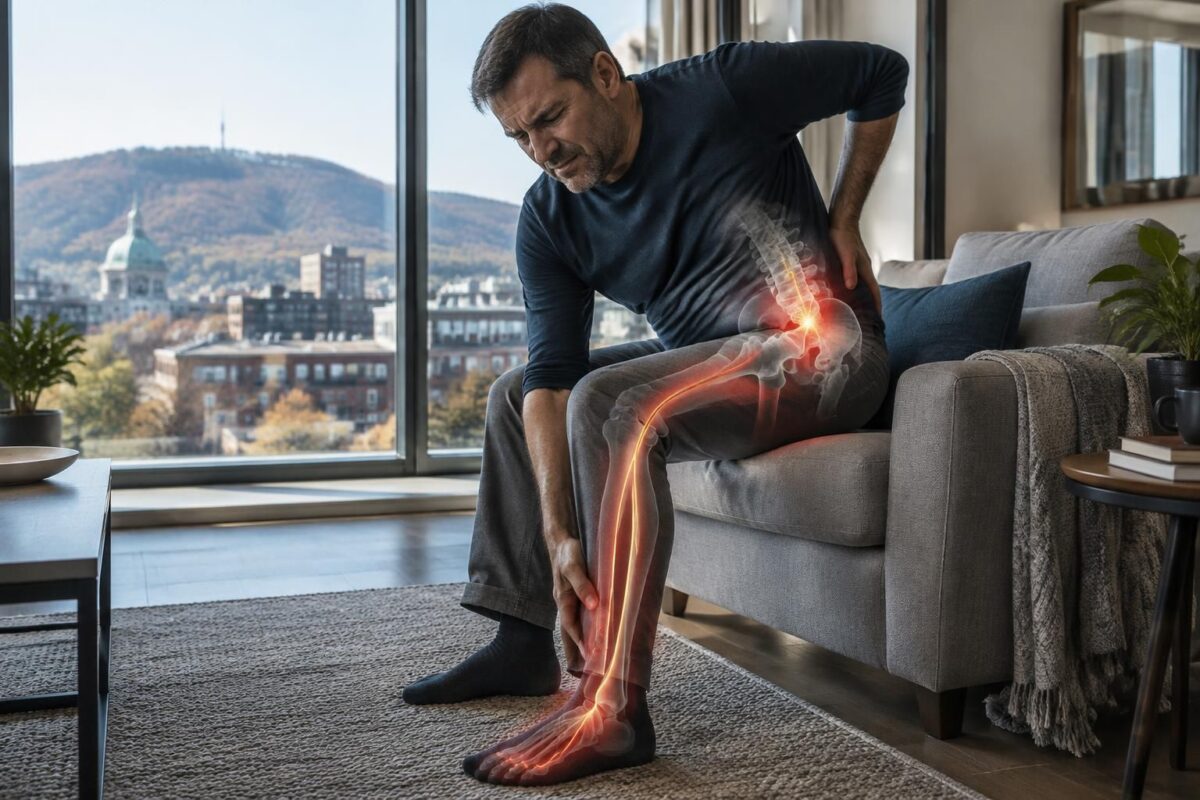
IN BRIEF A L5-S1 disc herniation can irritate the S1 nerve root and cause sciatica in Montreal, with pain or numbness radiating down to the calf, heel, or foot. The assessment correlates symptoms, strength, and sensitivity with imaging, if relevant;…
The clinical examination: connecting the dots
A useful evaluation begins with a precise description: where does the pain start, how far does it go down, how long has it been present, and what aggravates or relieves it? It is also important to report numbness, tingling, weakness, and changes in walking or daily activities.
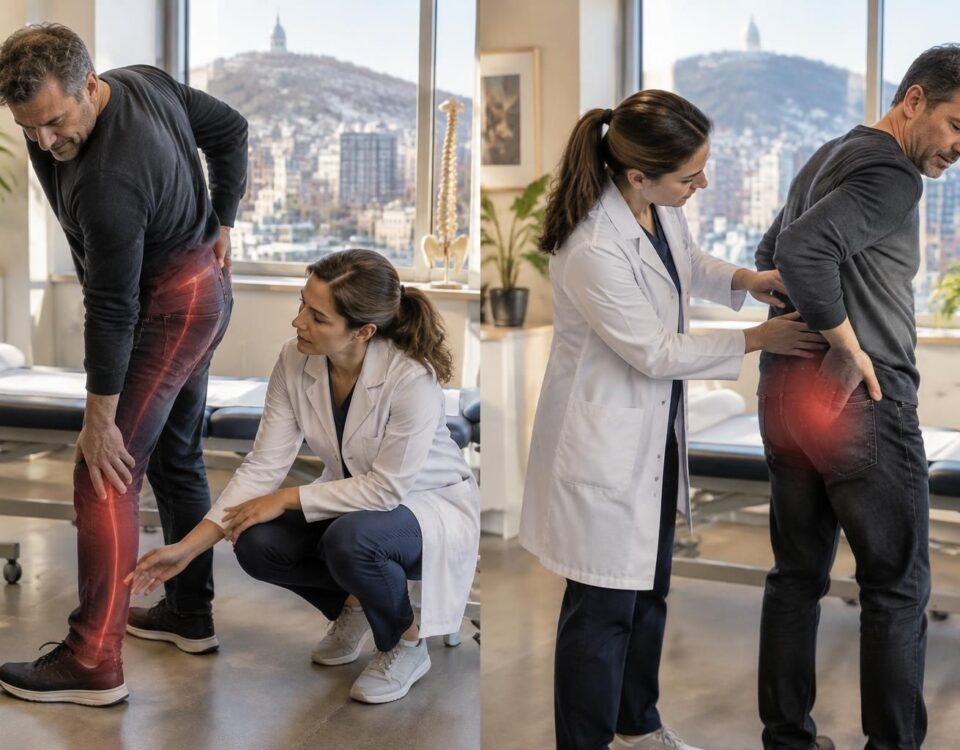
The examination then compares both sides. It may include tests of strength, sensitivity, and reflexes, observation of gait, as well as targeted maneuvers, such as raising the straight leg. No single test necessarily confirms a cause. The hypothesis becomes more relevant when multiple findings correspond to the same side and a plausible anatomical distribution.
An MRI or CT scan shows structures, while an EMG can sometimes help assess nerve function. These tests are not required in every situation: their indication depends on symptoms, examination, and the question to be clarified. An abnormality on imaging does not automatically prove that it explains the pain.

Sciatica in Montreal: L4-L5 protrusion and leg pain
IN BRIEF An L4-L5 disc protrusion is a bulging of the disc that can irritate a nerve root and cause sciatica, with pain in the buttock and leg. However, it does not always cause symptoms. In Montreal, an assessment can…
What next steps to consider in Montreal?
Depending on the progression and results of the evaluation, next steps may include follow-up, a tailored conservative approach, or a referral to a medical professional for further investigations. At TAGMED Clinic, a consultation can help relate symptoms, clinical tests, and already completed examinations. Possible care depends on the evaluation and the skills of the concerned professional.
Follow-up should focus on observable changes: strength, extent of numbness, walking, sleep, and ability to sit or perform important activities. These benchmarks provide more useful information than a single “snapshot” of the symptoms.
Sciatica in Montreal: what “disc-root conflict” means
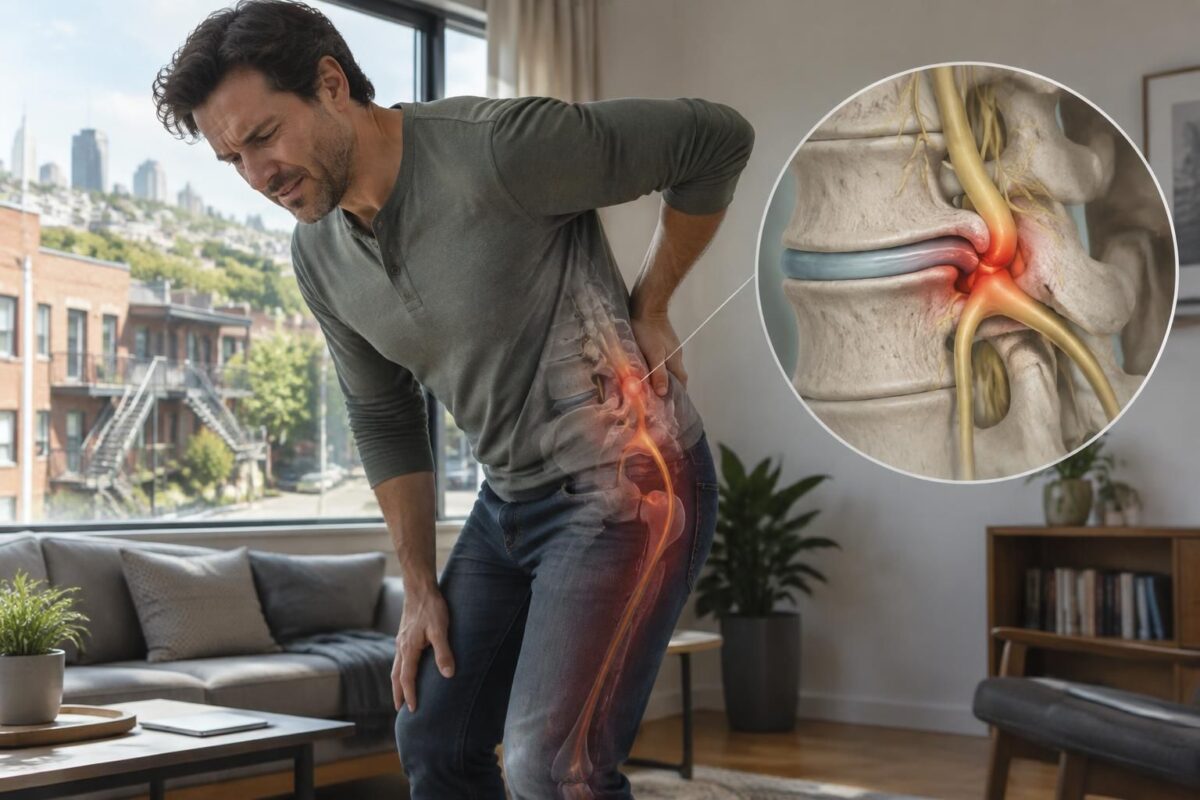
IN BRIEF A disc-root conflict refers to possible contact or pressure between an intervertebral disc and a nerve root. In Montreal, this mention in the MRI can help understand a sciatica, but does not by itself prove that the disc…
When to seek urgent help?
Consult immediately in cases of significant or rapidly progressive weakness, recent foot drop, increasingly giving way of the leg, loss of bowel or bladder control, or numbness in the saddle area or perineum. Rapid deterioration, fever, or recent trauma also warrant quick medical evaluation. These signs should not wait for a routine appointment.
About the Author
Sylvain Desforges, B.Sc., D.O., N.D., Doctor of Osteopathy and Naturopath, is the founding president of TAGMED and the ACMA association. His practice focuses in particular on chronic spinal pain, lower back pain, and symptoms consistent with sciatica.
Medical Disclaimer: This content is provided for educational purposes and does not replace a consultation, diagnosis, or treatment by a licensed healthcare professional. The author is neither a physician nor a specialist in a medical specialty recognized by the Collège des médecins du Québec. In the presence of emergency signs, consult a physician or go to the emergency room.
| Clinical Marker | L5 or S1: what the examination checks |
|---|---|
| Symptom Pathway | Compares pain and tingling to areas often associated with L5 or S1. |
| Sensitivity | Tests multiple areas; dermatomes overlap and vary from person to person. |
| Strength | Evaluates targeted movements and compares both legs to identify weakness. |
| Reflexes | The Achilles reflex can shed light on the evaluation of S1; L5 does not have a similarly reliable simple reflex. |
| Gait | Observes notably heel walking and toe walking. |
| Interpretation | Links symptoms, examination, and relevant imaging; a single sign does not reliably localize the root. |
| Evolution | Tracks changes in strength, sensitivity, and function over time. |
| Urgency | A new or progressive weakness, numbness of the saddle or urinary or bowel issues necessitate urgent evaluation. |
Sciatica in Montreal: radicular pain versus referred pain
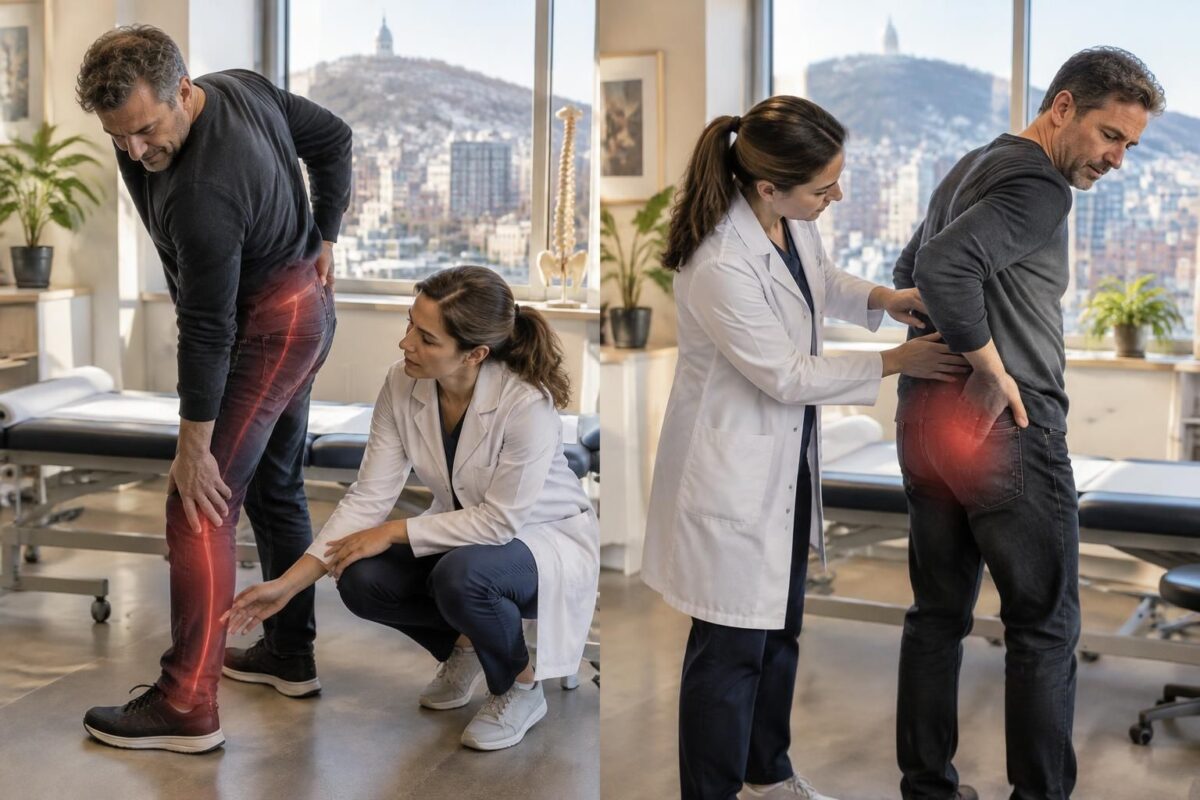
IN BRIEF Radicular sciatica corresponds to irritation of a nerve root, while referred pain can spread to the buttock or leg without direct nerve involvement. In Montreal, distinguishing these pains helps guide the evaluation by linking the symptom route to…
Similar Symptoms that Must Be Evaluated Holistically
The following testimonials are fictional composite examples, created for educational purposes. They do not describe identifiable patients and do not allow for a diagnosis. Pain or numbness in the foot may guide the evaluation, but it is not enough to determine which nerve root is involved.
A L5 root irritation may particularly be accompanied by symptoms on the side of the leg or the top of the foot, sometimes extending to the big toe. An issue with S1 may rather indicate pain towards the back of the leg, the calf, or the outer edge of the foot. These markers vary and overlap: they do not constitute an infallible diagnostic map.
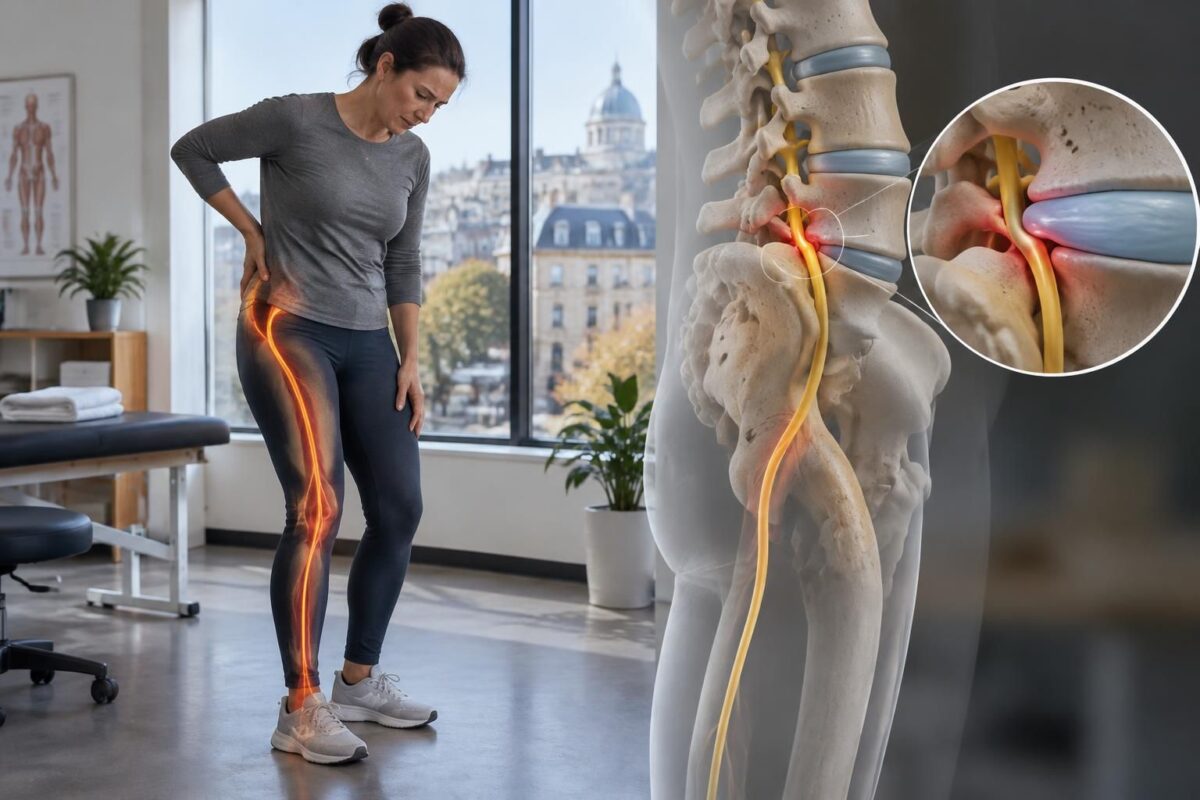
Sciatica in Montreal: nerve root, disc, and foramen explained simply
IN BRIEF Sciatica corresponds to pain linked to the irritation of a nerve root, sometimes near a lumbar disc or a narrowed foramen. In Montreal, distinguishing an L4-L5 issue that may affect the L5 root from an L5-S1 problem that…
Illustrative Testimonials: The Importance of Connecting the Dots
“The pain descended to the big toe. I thought this must confirm an L5 issue.”
In this composite example, the path of the pain served as a marker, without being considered proof on its own. The examination also took into account sensitivity, the strength of certain foot movements, gait, and the difference between the two sides.
“I felt pain in the calf and on the edge of the foot, but I didn’t know if it was S1.”
This presentation could be compatible with various scenarios. The evaluation must verify whether the symptoms, neurological findings, and, when indicated, imaging tell a coherent story. A single sensitive area does not precisely localize a root.
“My imaging exam showed an anomaly, but I wanted to know if it actually explained my symptoms.”
An image describes anatomy; it is not sufficient to establish the cause of every pain. The affected side, the observed level, the signs found during examination, and functional limitations must be related before drawing conclusions.

Sciatica in Montreal: understanding L5-S1 foraminal compression
IN BRIEF L5-S1 foraminal compression is a narrowing of the opening where a nerve root exits, which can cause sciatica with pain, tingling, or weakness in the buttock and leg. In Montreal, an assessment allows for correlating symptoms, clinical examination,…
What Clinical Examination Can Provide
A structured evaluation begins with the description of the pain pathway, its duration, progression, and factors that aggravate or relieve it. Numbness, tingling, and any sensation of weakness are also specified.
The examination can compare muscle strength, sensitivity, and certain reflexes between sides. Gait, functional movements, and targeted tests may be evaluated depending on the situation. It is not about relying on a single test, but about searching for consistency among multiple observations.
Follow-up also benefits from comparing tangible changes: strength, extent of numbness, gait, sleep, tolerance to sitting, and daily activities. An isolated snapshot of symptoms provides less information than functional evolution observed over time.

Sciatica in Montreal: why L5-S1 is often involved
IN BRIEF The sciatica L5-S1 often corresponds to irritation of the S1 root, sometimes related to a herniated disc. The pain may start in the buttock and descend behind the thigh to the calf or the foot. In Montreal, understanding…
When Imaging or EMG Can Be Considered
The MRI or CT scan can answer a specific anatomical question when the clinical context justifies it and the result is likely to influence the next steps. An EMG can sometimes contribute to the functional assessment of radiculopathy or an uncertain differential diagnosis. The relevance of these examinations must be determined by a licensed professional; they are not necessary in all situations.
In Montreal or Mont-Royal, a consultation at the TAGMED Clinic can help assess symptoms and function, and discuss the appropriate next steps based on the situation. This approach does not replace a medical evaluation when one is necessary.

Sciatica in Montreal: L5 and difficulty lifting the foot
IN BRIEF The difficulty in lifting the foot with sciatica can indicate weakness related to the involvement of the L5 root, sometimes caused by a herniated disc. This foot drop increases the risk of falling and requires prompt medical evaluation;…
Signs that require prompt attention
Consult without delay for a routine appointment in case of new, significant, or progressive weakness, recent foot drop, increasingly giving way of the leg, marked symptoms in both legs, fever, significant trauma, or rapid deterioration.
New urinary or bowel issues, difficulty urinating, or loss of sensitivity in the perineum and saddle region may signal an emergency. In these circumstances, go immediately to the emergency room or call emergency services.
About the Author
Sylvain Desforges, B.Sc., D.O., N.D., Doctor of Osteopathy and naturopath, is the founding president of TAGMED and the ACMA association. His practice focuses on chronic spinal pain, lower back pain, and pain compatible with sciatica, including pain radiating to the buttock, leg, calf, foot, or toes.
Through SOS Sciatique, he publishes educational content on the symptoms of sciatica, its possible causes, and non-surgical approaches that may be considered based on the assessment. At the TAGMED Clinic, the available care may include, depending on the case and the professionals involved, motorized neurovertebral decompression, specific osteopathy, or precision percussion.
Medical Disclaimer
This content is provided for educational purposes and does not replace a consultation, diagnosis, opinion, or treatment performed by a physician or another licensed health professional. The author is neither a physician nor a specialist in a medical specialty recognized by the Collège des médecins du Québec. The approaches described in osteopathy, manual medicine, or functional support do not constitute medical acts and do not replace medical follow-up.
A pain that starts from the lower back or buttock and radiates down the leg may indicate sciatica, also known as lumbar radicular pain. It may be accompanied by burning, electrical jolts, tingling, numbness, or sometimes weakness. The perceived pathway may suggest irritation of the L5 or S1 root, but it does not alone confirm which root is affected.
The L5 root is often associated with symptoms that travel along the side of the leg and the top of the foot, sometimes reaching the big toe. Difficulty lifting the foot or big toe may also be assessed during the evaluation. Irritation of S1 may instead be accompanied by pain behind the thigh and calf, toward the outer edge of the foot. Difficulty standing on tiptoe and a change in the Achilles reflex may also be part of the signs examined.
These markers are helpful, but sensory territories are not perfectly defined boundaries. Dermatome maps vary from person to person and overlap. An unusual sensation in the big toe, for instance, is not enough to establish an L5 diagnosis. The pain may also originate from other structures, and an abnormality observed in imaging may be present without explaining the symptoms. The clinical context remains essential.
In Montreal, an evaluation approach begins with a precise description of the symptoms: their location, duration, progression, activities that aggravate or relieve them, as well as the presence of weakness or tingling. The physical examination may compare both sides and assess the strength of targeted muscle groups, sensitivity, reflexes, and certain aspects of gait. Nerve tension tests may also be used when relevant. No single test answers all questions; it is the consistency between observations that matters.
This comparison helps determine whether the picture fits more with radicular irritation and to identify a significant functional change. It also serves to distinguish pain that is primarily felt from measurable neurological deficits. If an MRI, CT scan, or electromyogram is available, its results should be correlated with the affected side, observed signs, and disrupted function. These examinations are not necessary in every situation: their usefulness depends on the clinical question and their ability to guide the next steps.
Follow-up should focus on concrete elements: progression of strength, extent of numbness, gait, sleep, and tolerance to sitting or important activities. New weakness or rapid deterioration warrants immediate medical evaluation. New urinary or bowel problems, loss of sensitivity in the perineal or saddle area, significant leg weakness, fever, or recent trauma require urgent attention.
At the TAGMED Clinic, symptom evaluation can help relate the person’s narrative, examination findings, and already conducted tests to discuss appropriate options. Depending on the situation and the competencies of the concerned professional, a non-surgical approach may be considered; it does not replace a medical evaluation when one is necessary. A consultation also helps better define whether conservative follow-up, further investigation, or referral to another professional is indicated.
About the Author
Sylvain Desforges, B.Sc., D.O., N.D., Doctor of Osteopathy and naturopath, is the founding president of the TAGMED clinics and the ACMA association. His practice focuses on managing chronic pain and integrating approaches and technologies, including neurovertebral decompression, laser, and shockwave therapy. The care provided depends on the evaluation, the professional’s competencies, and the services available.
Medical Disclaimer: this content is educational and does not replace a consultation, diagnosis, or treatment by a physician or another licensed health professional. The author is neither a physician nor a specialist in a medical specialty recognized by the Collège des médecins du Québec. In the presence of urinary or bowel issues, saddle anesthesia, or significant or progressive weakness, consult an emergency service immediately.
In Montreal, pain radiating down the leg may suggest irritation of the L5 or S1 root, but the painful area alone does not determine the cause. The trajectory of symptoms, strength, sensitivity, reflexes, and function must all be evaluated together; imaging or EMG only make sense in relation to these observations. To locate the symptoms, also consult this guide on sciatic dermatomes.
L5 or S1 Irritation: Guidelines, Not a Diagnosis
An L5 lesion may particularly be accompanied by abnormal sensations on the side of the leg or the top of the foot, sometimes extending to the big toe. An irritation of S1 may rather affect the back of the calf and the outer edge of the foot. These areas overlap and vary from person to person: isolated numbness of the big toe, for example, does not confirm an L5 lesion by itself. To better understand these guidelines, see the pages on L5 and S1 in sciatica and big toe numbness with low back pain.
Pain can also be referred from other structures and resemble radicular pain. Therefore, the doctor or qualified professional seeks to distinguish nerve root-related pain from referred pain, taking into account the history and examination. To delve into this distinction, consult radicular pain or referred pain, as well as the guide on disc herniation and sciatica.
Why Clinical Examination Matters
The clinical examination allows for comparison between both sides and verification if multiple indicators agree. It may assess the strength of certain foot and toe movements, sensitivity of different areas, reflexes, walking on heels or toes, as well as targeted tests based on symptoms. A distribution compatible with a specific root strengthens a hypothesis, but no isolated sign is sufficient to make a diagnosis. To understand which symptoms to monitor, also consult the neurological signs of sciatica not to be trivialized.
The evaluation also takes into account the intensity and evolution of pain, activities that have become difficult, and factors that worsen or relieve the symptoms. MRI or CT scans describe anatomy, while EMG may provide functional information in certain situations. These tests are not systematic: their relevance depends on the clinical question and the possibility that their results will modify the next steps. An educational document on sciatic pain and roots L3 to S1 is available in this class dedicated to sciatica.
When to Seek an Evaluation
If pain, tingling, or numbness persists, spreads, or limits walking, sleep, or daily activities, an evaluation may help connect symptoms to clinical findings and previous tests. In Montreal, Clinique TAGMED presents its services and available professionals; potential care depends on the evaluation, the professional’s skills, and their scope of practice. You can also consult information on sciatica management in Montreal.
A new or rapidly worsening weakness, a foot drop, recent difficulty urinating or controlling bowel movements, or perineal numbness require urgent medical attention. A fever associated with pain, significant trauma, or general deterioration also justifies a quick evaluation. If you experience concerning symptoms, do not delay care while waiting for a routine consultation.
For a medical evaluation of sciatica, you can check the information from Clinique Omicron; information is also provided in English. The choice between follow-up, additional investigations, or referral to another professional depends on your situation.

Sylvain Desforges, B.Sc., D.O., N.D., docteur en ostéopathie
Dr Sylvain Desforges, B.Sc., D.O., N.D., osteopath, is the founding president of TAGMED and of the ACMA association. He dedicates his practice to chronic spinal pain, low back pain and symptoms compatible with sciatica, particularly when pain radiates toward the buttock, leg, calf, foot or toes.
Through SOS Sciatique, he publishes educational content on sciatica symptoms, possible causes such as disc herniation, disc narrowing, foraminal stenosis or irritation of a lumbar nerve root, as well as non-surgical approaches that may be considered according to the evaluation. At Clinique TAGMED, care may include, depending on the case, motorized neurovertebral decompression, specific osteopathic care or precision percussion.
For an evaluation related to sciatica treatment in Montreal / Mount Royal or sciatica treatment in Terrebonne, please consult the services available at Clinique TAGMED.
Medical disclaimer
The information published on SOS Sciatique is provided for educational purposes only and does not replace a consultation, diagnosis, opinion or treatment provided by a physician or another authorized healthcare professional. The author of this article is neither a medical doctor nor a specialist in a medical specialty recognized by the Collège des médecins du Québec. The osteopathic, manual medicine or functional support approaches described on this site do not constitute medical acts and are not intended to replace medical follow-up.
Consult a physician or emergency service in cases of loss of bladder or bowel control, anesthesia in the saddle area, significant or progressive weakness in the leg or foot, fever, recent trauma, severe pain or rapid worsening of symptoms. For more details, please read our Legal Notice.