Sciatica and vacuuming: repetitive movement to watch out for
23/11/2026
Sciatica in Terrebonne: disc protrusion and pain under the knee
24/11/2026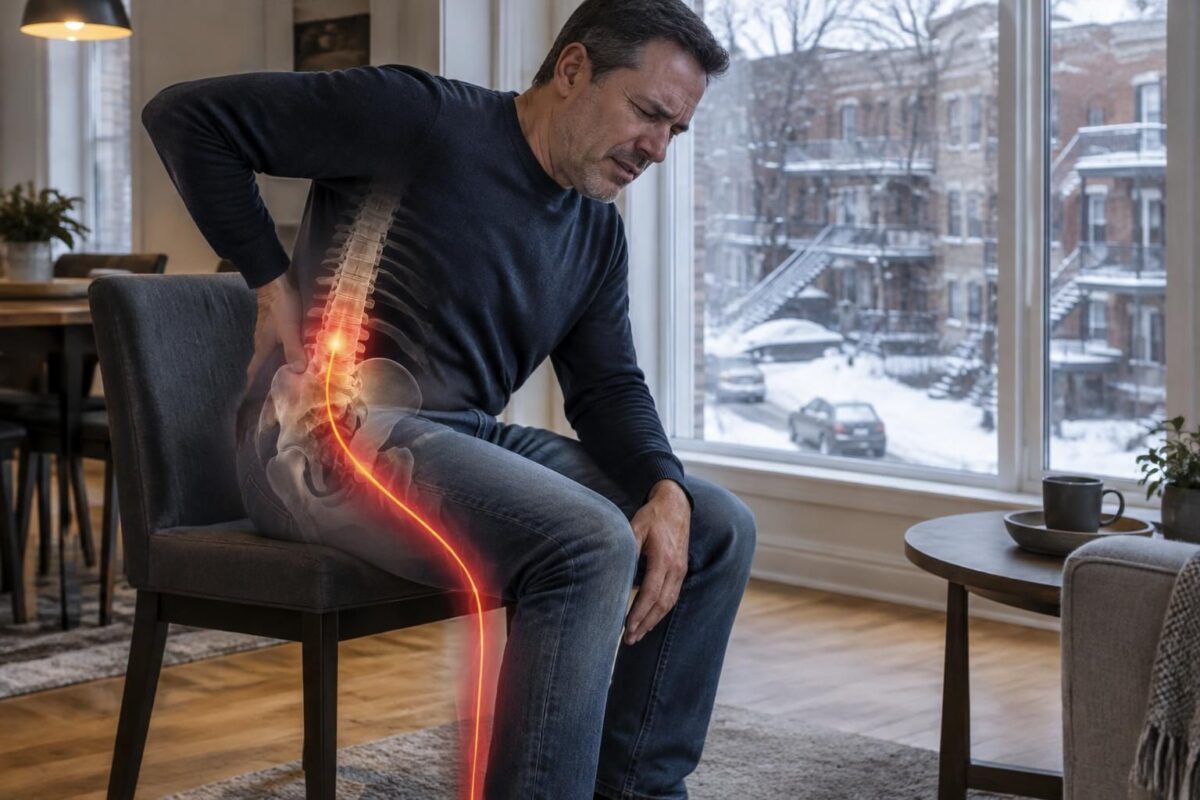
IN BRIEF A disc protrusion can irritate a nerve root and contribute to sciatica with pain below the knee, sometimes down to the calf or foot. In Montreal, an evaluation helps clarify the cause of symptoms and consider suitable non-surgical approaches, as appropriate. The protrusion alone does not confirm the source of the pain. |
A disc protrusion can irritate a nerve root and cause sciatica-like pain that radiates below the knee, sometimes down to the calf or foot. However, imaging alone cannot confirm the cause of the symptoms: an evaluation is necessary to guide treatment. In Montreal, tailored management can help better understand your situation and consider non-surgical options based on your needs.
Quickly consult a healthcare professional if you notice significant or progressive weakness, or urinary or bowel issues.
A disc protrusion can sometimes irritate a nerve root and cause pain that radiates below the knee. However, the presence of a protrusion on imaging does not, by itself, confirm the cause of the symptoms. The evaluation considers their trajectory, intensity, strength and sensitivity of the leg, as well as the results of any medical examinations already performed.
Understanding disc protrusion and pain below the knee
A disc is located between the vertebrae. It helps distribute loads and facilitate movements of the spine. A disc protrusion describes a disc that extends beyond its usual contour. It can be present without pain. In some cases, it may contribute to the irritation or compression of a nerve root.
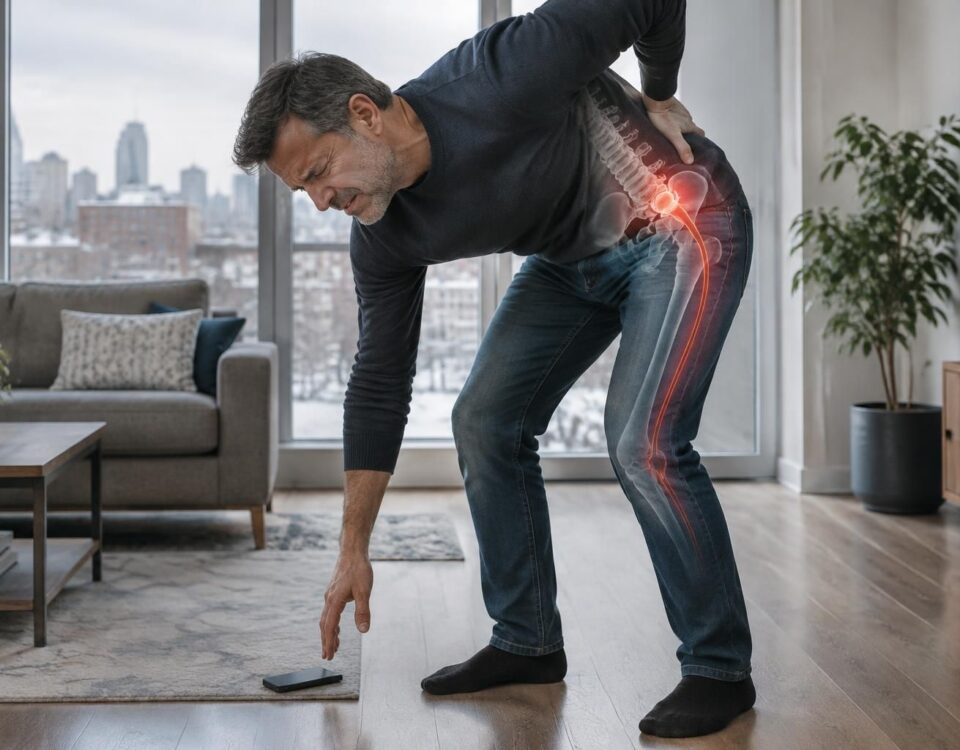
Sciatica refers to symptoms associated with irritation of a nerve or nerve root in the lower back. Pain can start in the lumbar region or buttock and radiate down the thigh, below the knee, toward the calf or foot. Some people also experience burning, tingling, numbness, or weakness.
Why does the pain radiate below the knee?
The lumbar and sacral nerve roots transmit sensations to different parts of the leg. Thus, irritation can produce symptoms distant from the lower back. The trajectory varies depending on the affected root, but it alone does not allow for a definitive determination of the cause.
Pain below the knee may be consistent with irritation of the L5 or S1 root. To better understand the possible role of L5, consult this article on irritation of the L5 root. The page on irritation of the S1 root also describes symptoms that may affect the back of the leg and foot.

Sciatica in Montreal: herniated disc and painful cough
IN BRIEF Sciatica is a pain that extends from the lower back to the buttock and leg; a herniated disc can irritate a nerve root. Coughing can exacerbate the pain by increasing pressure in the back. In Montreal, an evaluation…

Sciatica in Montreal: pain worsened when sitting and lumbar disc
IN BRIEF Worsening sciatica in a sitting position may be related to lower back irritation, sometimes associated with a disc, without this sign being sufficient to establish the cause. In Montreal, an evaluation that considers symptoms, strength, sensitivity, and function…
A visible protrusion on imaging does not confirm the cause
An X-ray, computed tomography, or magnetic resonance imaging may show a disc protrusion. The result must be interpreted alongside the symptoms and clinical examination. A visible abnormality does not automatically mean it is the cause of the pain. Conversely, the severity of symptoms cannot be inferred solely from the size of a protrusion.
An authorized healthcare professional can assess strength, sensitivity, reflexes, and movements. They can also determine if a medical opinion or additional examinations are necessary. The evaluation helps distinguish symptoms consistent with nerve irritation from other possible causes of leg pain.
Foraminal compression and symptoms in the leg
The nerve roots exit the spine through openings called foramina. A narrowing of these openings can sometimes contribute to nerve compression. To learn more about this area, refer to the page on foraminal compression L5-S1.
A burning sensation in the foot can have various causes. It may be consistent with nerve irritation, but it does not allow for the identification of the affected structure on its own. The page dedicated to burning in the foot and possible nerve compression highlights this distinction.

Sciatica in Montreal: pain worsened by flexion and disc-related cause
IN BRIEF Flexion-Aggravated Sciatica is pain that starts in the lower back and may radiate into the buttock or leg; irritation related to a lumbar disc can be a possible cause. In Montreal, an assessment helps clarify the origin of…

Discogenic sciatica in Montreal: why some stretches worsen
IN BRIEF Disc-related sciatica refers to pain related to the irritation of a nerve root, often near a herniated disc. Certain stretches, especially those that emphasize bending or pull on the leg, can worsen symptoms rather than relieve them. In…
Leg weakness: a sign to be evaluated
Pain may accompany a decrease in strength. For example, a person may have difficulty lifting their foot or walking on their heels. New, significant, or progressive weakness requires prompt medical evaluation. Also consult the article on herniated disc associated with leg weakness.
Loss of control over the bladder or bowels, numbness in the saddle area, or significant weakness in the leg or foot require urgent consultation. Fever, recent trauma, severe pain, or rapid deterioration also justify immediate medical evaluation.

Sciatica disc in Montreal: movements to avoid at the start
IN BRIEF Disc-related sciatica refers to pain related to the irritation of a nerve, sometimes associated with a lumbar disk. Initially, avoid movements that worsen your symptoms, such as lifting a load by bending over or performing repeated twists. Adjusting…

Sciatica in Montreal: disc herniation with leg weakness
IN BRIEF Sciatica related to a herniated disc can irritate a nerve root and cause pain that travels down the leg, sometimes accompanied by weakness. In Montreal, an evaluation helps clarify the cause and guide appropriate care; nonsurgical approaches can…
Evaluation and non-surgical options in Montreal
Management depends on assessment, symptoms, and available medical results. At Clinique TAGMED, the evaluation can guide non-surgical approaches, as appropriate. Care may include specific osteopathy, precision percussion, or motorized neurovertebral decompression, when deemed appropriate after evaluation.
These approaches do not replace a medical diagnosis and may not be suitable for all situations. They should be considered based on symptoms, history, and possible contraindications. Progressive weakness or a sign of emergency should be evaluated by a physician or emergency service before any non-urgent care steps are taken.
For an evaluation, consult information on treatment of sciatica in Montreal and Mont-Royal or on treatment of sciatica in Terrebonne. The available services are listed by Clinique TAGMED.
About the author
Sylvain Desforges, B.Sc., D.O., N.D., Doctor of Osteopathy and naturopath is the founding president of TAGMED and the ACMA association. He dedicates his practice to chronic pain of the spine, lumbar pain, and pain compatible with sciatica, especially when the pain radiates down to the buttock, leg, calf, foot, or toes.
Through SOS Sciatique, he publishes educational content on the symptoms of sciatica, possible causes such as disc herniation, disc pinching, foraminal stenosis, or irritation of a lumbar nerve root, as well as non-surgical approaches that may be considered based on the assessment. At TAGMED Clinic, treatments may include, depending on the case, motorized neurovertebral decompression, specific osteopathy, or precision impact therapy.
Medical disclaimer: The information and advice provided on this site do not replace the opinion, diagnosis, or treatment of a healthcare professional. Please note that Sylvain Desforges, B.Sc., D.O., N.D., doctor of osteopathy, is neither a medical doctor nor a physician and is not a specialist in a medical specialty as defined by the Collège des médecins du Québec. Manual medicine, functional medicine, and sports medicine as described on this site exclude any medical treatment or diagnosis made by a physician or medical specialist. Always consult your doctor for any medical questions. For more details, please read our full Legal Notice.
Medical warning
The information published on SOS Sciatique is provided for educational purposes and does not replace a consultation, diagnosis, opinion, or treatment performed by a physician or another licensed healthcare professional. The author of this article is neither a doctor nor a specialist in a medical specialty recognized by the Collège des médecins du Québec. The approaches of osteopathy, manual medicine, or functional support described on this site do not constitute medical acts and are not intended to replace medical follow-up.
Consult a doctor or emergency service in case of loss of bowel or bladder control, numbness in the saddle area, significant or progressive weakness of the leg or foot, fever, recent trauma, severe pain, or rapid deterioration. For more details, please read our Legal Notice.

In Montreal, a disc protrusion can sometimes be associated with pain that radiates below the knee, but imaging alone cannot confirm the cause of the symptoms. A professional assessment helps clarify the situation, identify signs that require medical advice, and choose appropriate measures. In the meantime, prioritize tolerated movement, avoid efforts that significantly worsen the pain, and seek advice if it persists or intensifies.
Disc protrusion and pain below the knee: what to understand?
A disc protrusion corresponds to a change in the shape of a disc between the vertebrae. It may be visible on imaging without causing pain. In some cases, however, irritation of a nerve root in the lower back can contribute to lumbar pain that radiates to the buttock and leg, sometimes down to the calf or foot.
Pain below the knee should therefore be assessed as a whole: its location, evolution, sensations of tingling or numbness, and any potential weakness. Other causes besides disc protrusion may explain similar symptoms. Avoid drawing conclusions based on an imaging report without relating it to your clinical examination.
Recommendations for the first days
Stay active according to tolerance
Prolonged rest can make resuming activities more difficult. Try to maintain gentle movements and regular tasks, adjusting their duration and intensity. A short walk may be preferable to a long sitting period if it does not significantly increase symptoms. Stop or modify an activity if the pain intensifies or spreads further in the leg.
Adapt positions and efforts
Change positions regularly rather than remaining seated or standing for long periods. To lift an object, bring it close to your body and avoid sudden rotational movements. There is no ideal posture for everyone: temporarily seek positions that allow you to move more comfortably without forcing through the pain.
Consult before multiplying exercises
Exercises are not universal. A useful movement for one person may exacerbate symptoms for another, especially when pain radiates below the knee. A healthcare professional can assess your mobility, strength, and sensations, then guide you towards progressive exercises or a medical evaluation if necessary.
When to seek an assessment in Montreal?
If the pain persists, returns frequently, or limits walking, sleeping, or working, make an appointment with a licensed healthcare professional. At TAGMED Clinic, approaches may include, depending on the assessment and the individual’s situation, targeted osteopathy or motorized neurovertebral decompression. These options are not suitable for everyone and do not replace a medical diagnosis or prescribed care.
Quickly consult a doctor or emergency service in case of loss of bowel or bladder control, numbness in the saddle area, significant or progressive weakness of the leg or foot, fever, recent trauma, or rapid deterioration. These signs require immediate medical attention.
About the author
Sylvain Desforges, B.Sc., D.O., N.D., Doctor of Osteopathy and naturopath, is the founding president of TAGMED and the ACMA association. His practice particularly focuses on chronic spinal pain, lower back pain, and pain associated with sciatica.
Through SOS Sciatique, he publishes educational content on sciatica symptoms, their possible causes, and non-surgical approaches that may be considered based on the evaluation. The care offered at TAGMED Clinic may include, depending on the case, motorized spinal decompression, specific osteopathy, or precision percussion.
Medical Warning
This information is provided for educational purposes and does not replace consultation, diagnosis, advice, or treatment performed by a physician or other licensed health professional. The author is neither a physician nor a specialist in a medical specialty recognized by the Collège des médecins du Québec. The approaches described do not constitute medical acts and are not intended to replace medical follow-up.
| Marker | What it may suggest |
|---|---|
| Pain below the knee | May correspond to nerve irritation, notably from a lumbar root. |
| Disc protrusion on imaging | Does not prove the cause of the symptoms on its own: the link must be evaluated clinically. |
| Pain towards the calf or foot | Note the path, sensations, and circumstances that worsen or relieve the pain. |
| Numbness or weakness | A professional examination helps to clarify the situation and next steps. |
| Evaluation in Montreal | A professional can assess the symptoms and discuss options tailored to your case. |
| Emergency signs | Consult quickly in case of progressive weakness, saddle anesthesia, or loss of urinary or bowel control. |
Illustrative Testimonials: Disc Protrusion and Pain Below the Knee in Montreal
Important: the testimonials below are fictional examples intended to illustrate possible situations. They do not correspond to verified patient opinions and do not guarantee any results. Pain that radiates below the knee can have different causes; the presence of a disc protrusion on imaging alone is not enough to establish the origin of the symptoms.
“The pain started in my lower back and radiated down to my calf.”
In this example, a person from Montreal describes pain below the knee, accompanied by occasional tingling. They wished to better understand the possible link between their symptoms and a disc protrusion. An appropriate evaluation allows for a discussion of the factors to consider and non-surgical options that may be feasible, without presuming a diagnosis.
“I was afraid that every movement would worsen the protrusion.”
This fictional situation illustrates the concerns that imaging results can evoke. Guidance can help clarify the symptoms, review the activities that influence them, and determine if a manual or functional approach is appropriate. The choice of care depends, however, on the evaluation and the individual’s health status.
“The pain below my knee was bothering me at work and while I was moving around.”
In this example, the person is seeking care in Montreal for pain radiating towards their leg. A consultation aims first to clarify the nature of the symptoms and identify signs that require medical attention. The proposed care cannot be determined solely from the term “disc protrusion.”
If you experience pain that radiates below the knee, weakness, or numbness, seek advice from a health professional. An individual evaluation is more relevant than comparing with a testimonial, as causes and progression vary from person to person.
About the Author
Sylvain Desforges, B.Sc., D.O., N.D., Doctor of Osteopathy and naturopath, is the founding president of TAGMED clinics and the ACMA association. His career is dedicated to managing chronic pain and advancing care approaches. In his practice, he is particularly interested in spinal pain and symptoms compatible with sciatica, including pain that radiates from the lower back or buttock and goes below the knee.
In Montreal, pain below the knee can be concerning, especially when accompanied by tingling, numbness, or a sensation of weakness. It can be compatible with irritation of a lumbar nerve root, but this symptom alone does not establish a diagnosis. A professional evaluation takes into account the history of the pain, its path, movements that modify it, and the other signs present.
A disc protrusion refers to an overflow of the intervertebral disc beyond its usual limits. It can sometimes contribute to irritating a nerve structure, but its presence on imaging does not automatically mean it is the cause of the symptoms. Some individuals have a protrusion without pain, while others experience pain radiating towards the leg for different reasons. The interpretation should therefore be based on the symptoms and examination, rather than on an isolated image.
Sciatic pain can follow a variable path: buttock, back or side of the thigh, calf, foot, or toes. When it radiates below the knee, the location, associated sensations, and their progression are useful information to communicate to the healthcare professional. It is also relevant to specify whether the pain increases when sitting, walking, bending, or during coughing. These details help guide the evaluation and determine if medical advice or further examinations are necessary.
Sylvain Desforges’ work focuses on supporting individuals living with persistent pain and on the thoughtful integration of technologies in healthcare contexts. Depending on the assessment and needs, the services offered at the TAGMED Clinic may include motorized neurovertebral decompression, specific osteopathy, laser, or shockwave therapy. These approaches are not suitable for everyone and do not replace a medical diagnosis or treatments recommended by an authorized professional. The choice of an intervention must take into account the person’s health status, symptoms, and goals.
A useful approach also relies on realistic expectations and a follow-up on progress. Pain reduction, improved mobility, and the gradual return to activities can be discussed with the relevant professionals. If the pain worsens, if weakness appears or progresses, or if symptoms change rapidly, a medical consultation is indicated. In case of loss of urinary or bowel control or numbness in the saddle region, urgent care should be sought.
The information presented is educational and does not replace a consultation, diagnosis, or treatment by a physician or other licensed healthcare professional. Sylvain Desforges is neither a doctor nor a specialist in a medical specialty recognized by the Collège des médecins du Québec. The manual and functional approaches described do not constitute medical acts.
A disc protrusion can sometimes irritate a nerve root and contribute to pain that radiates below the knee, down to the calf or foot. However, this symptom alone does not allow for identifying the cause: the assessment considers the painful area, strength, sensitivity, movements that worsen the pain, and, if necessary, medical examinations.
Understanding Pain Below the Knee
When lower back or buttock pain extends below the knee, it may correspond to a nerve root irritation. A protrusion at L4-L5 or L5-S1 could be among the possible causes, but imaging results must be interpreted alongside symptoms and clinical examination: a visible protrusion does not automatically explain the pain. To learn more about the symptoms associated with an L4-L5 protrusion, refer to this article on L4-L5 protrusion and leg pain.
The affected area can influence the trajectory of the pain and the signs felt. Possible involvement of L5-S1, the canal, or the foramen can be examined among the hypotheses, without being able to diagnose based solely on the painful trajectory. The article on L5-S1, the canal, the foramen, and nerve compression presents these elements in more detail.
The context of onset also provides useful information. Pain that starts or intensifies after physical exertion may have several explanations and deserves evaluation based on its evolution, intensity, and associated signs. You can also check the information on radiation in the leg after physical exertion.
Certain symptoms require special attention. A new difficulty standing on tiptoe, for example, should be reported to a healthcare professional, especially if accompanied by progressing weakness. The article dedicated to S1 and difficulty rising on tiptoes describes this sign and its possible context.
If the pain wakes you at night, mention it during the evaluation, specifying how long this has been occurring and whether other symptoms are present. Nighttime pain does not necessarily indicate a specific cause, but its evolution and associated signs are important. Refer to the information regarding pain that wakes at night.
An evaluation allows for discussing options suited to your situation and determining if medical follow-up or further examinations are necessary. Non-surgical approaches, including manual care, should be considered based on the assessment and do not replace a medical diagnosis. Consult a physician or emergency service promptly in case of loss of urinary or bowel control, numbness in the saddle region, significant or progressive weakness, fever, recent trauma, or rapid deterioration.

Sciatica in Montreal: herniated disc with foot numbness
IN BRIEF Sciatica related to a herniated disc can cause pain that radiates down the leg and numbness in the foot. In Montreal, an assessment helps to investigate the cause of the symptoms and consider appropriate management without assuming the…

Sciatica in Montreal: lumbar disc and inflammation of the nerve root
IN BRIEF Disc-related sciatica occurs when irritation of the nerve root causes pain that may radiate down into the buttock and leg. In Montreal, an assessment helps identify the cause of the symptoms and consider appropriate non-surgical care based on…

Sylvain Desforges, B.Sc., D.O., N.D., docteur en ostéopathie
Dr Sylvain Desforges, B.Sc., D.O., N.D., osteopath, is the founding president of TAGMED and of the ACMA association. He dedicates his practice to chronic spinal pain, low back pain and symptoms compatible with sciatica, particularly when pain radiates toward the buttock, leg, calf, foot or toes.
Through SOS Sciatique, he publishes educational content on sciatica symptoms, possible causes such as disc herniation, disc narrowing, foraminal stenosis or irritation of a lumbar nerve root, as well as non-surgical approaches that may be considered according to the evaluation. At Clinique TAGMED, care may include, depending on the case, motorized neurovertebral decompression, specific osteopathic care or precision percussion.
For an evaluation related to sciatica treatment in Montreal / Mount Royal or sciatica treatment in Terrebonne, please consult the services available at Clinique TAGMED.
Medical disclaimer
The information published on SOS Sciatique is provided for educational purposes only and does not replace a consultation, diagnosis, opinion or treatment provided by a physician or another authorized healthcare professional. The author of this article is neither a medical doctor nor a specialist in a medical specialty recognized by the Collège des médecins du Québec. The osteopathic, manual medicine or functional support approaches described on this site do not constitute medical acts and are not intended to replace medical follow-up.
Consult a physician or emergency service in cases of loss of bladder or bowel control, anesthesia in the saddle area, significant or progressive weakness in the leg or foot, fever, recent trauma, severe pain or rapid worsening of symptoms. For more details, please read our Legal Notice.