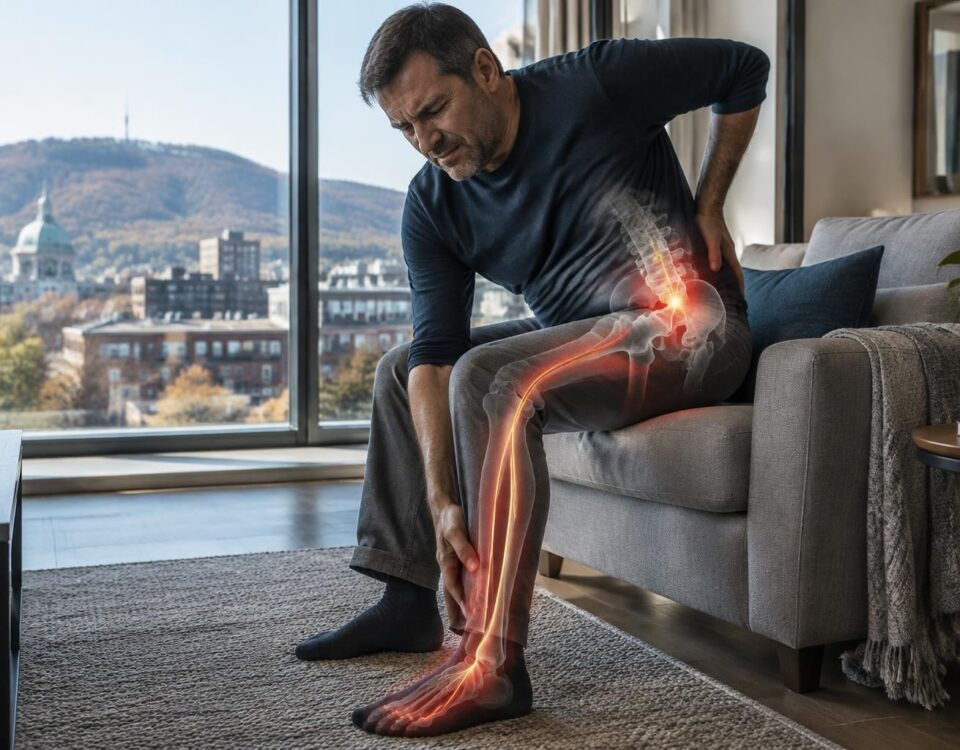



Disc herniation L4-L5 and leg pain
05/11/2026
Sciatica in Terrebonne: L5-S1, canal, foramen and nerve compression
06/11/2026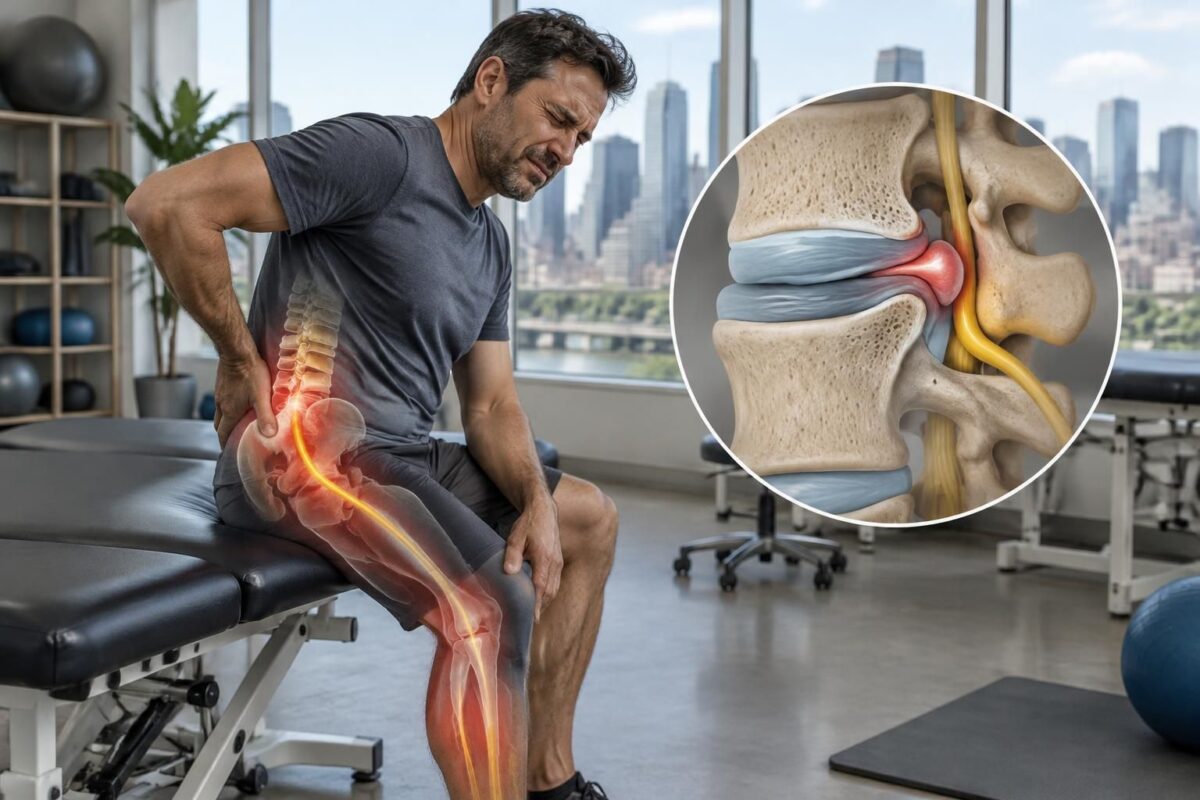
IN BRIEF
| Sciatica related to L5-S1 can occur when a nerve root is irritated or compressed, particularly due to narrowing of the spinal canal or the foramen, the opening through which the nerve exits the spine. It can cause pain, numbness, or weakness in the buttock and leg. Assessment of symptoms, gait, and, if necessary, imaging helps guide care. In Montreal, an evaluation can inform the choice of appropriate approaches, such as therapeutic activity or conservative care, based on the clinical picture. |
At L5-S1, a disc herniation or age-related changes can narrow the spinal canal or the foramen, the opening through which a nerve root exits. This compression can cause sciatica: pain, numbness, or weakness in the buttock, leg, or foot. In Montreal, an evaluation allows for comparison of symptoms, mobility, and imaging to guide the next steps. Progressive weakness or new urinary or bowel issues require urgent medical attention.
Sciatica associated with the L5-S1 level can cause pain in the buttock, leg, or foot. It may be related to irritation of a nerve root, a disc herniation, or narrowing of the canal or foramen. Imaging helps examine these structures, but diagnosis also relies on symptoms, clinical examination, and their effect on gait and daily activities. The L5-S1 level is located between the last lumbar vertebra and the sacrum. This area supports movement and a significant portion of the trunk’s load. The nerve roots that exit the spine contribute to the sensation and movement of the leg and foot. The terms “canal” and “foramen” refer to two different passages. The spinal canal is the central passage that contains the nerve structures. The intervertebral foramen, also called the neural foramen, is a lateral opening through which a nerve root exits the spine. Narrowing of the canal can reduce the space around the central nerve structures. Foramen narrowing may instead compress a nerve root near its exit. These conditions can lead to different symptoms, but they can also coexist. An abnormality on an X-ray or MRI does not, by itself, prove that it causes pain. The affected side, the pathway of symptoms, strength, sensitivity, and reflexes must correspond to the imaging results. To better understand the relationship between a disc and a nerve root, consult this article on the disc-radicular conflict. An irritated nerve root can transmit painful sensations along the leg. The pain can take the form of burning, shooting, or aching. Tingling, numbness, or weakness may also appear. The pathway depends on the affected nerve root and varies among individuals. Pain felt in the foot alone is not sufficient to determine the affected level. The presence of numbness of the big toe with low back pain, for example, must be interpreted alongside the clinical examination. The L4-L5 and L5-S1 levels can both be associated with sciatica-like pain. The pathway of the pain and changes in strength or sensitivity can provide clues, but they do not always conclusively identify the irritated root. To compare these levels, consult the page on the difference between L4-L5 and L5-S1. A disc protrusion at L4-L5 can also contribute to leg pain. Therefore, one should avoid automatically attributing symptoms to L5-S1 without assessment. You can learn more about the L4-L5 protrusion and leg pain. Several changes can reduce the available space for a nerve root. They can occur gradually, or symptoms may manifest after a movement or a period of overload. Possible causes include: Foraminal stenosis refers to narrowing of the opening through which the nerve root exits. To learn more about the symptoms and evaluation, consult the guide on sciatica and lumbar stenosis. Symptoms may affect one side or, more rarely, both legs. They can worsen when standing, walking, or in certain sitting positions. Some people mainly experience leg pain with little pain in the lower back. During the evaluation, the healthcare professional focuses on the pathway of the pain, its duration, muscle strength, sensitivity, and reflexes. They also check for activities that become difficult, such as walking, standing, or sitting. If the pain prevents you from sitting, this information can help clarify functional impact; also consult the advice on pain that prevents sitting. An MRI can show the discs, nerve roots, and spinal canal. It can help identify a herniation or foraminal narrowing. However, results must be compared with symptoms and examination. An image does not always explain the pain or solely dictate treatment. X-rays primarily show bone structures and alignment. The professional may request imaging or another examination when symptoms persist, evolve, or are accompanied by neurological signs. The choice depends on the clinical situation. Management depends on the likely cause, symptom intensity, duration, and changes in strength or sensitivity. A professional can discuss conservative options, additional medical evaluation, or specialized opinion. Care should be chosen after assessment, not solely based on an imaging report. At the TAGMED Clinic, options may include, depending on the assessment and available services, a specific osteopathic approach, a precision impactor, or a motorized neurovertebral decompression. These approaches are not suitable for everyone and do not replace a medical diagnosis or follow-up with a physician when necessary. The scientific data on traction and decompression do not guarantee a result for each person. A conservative approach can be discussed if appropriate, with monitoring of symptoms, walking, and function. To learn about the services and request an assessment, visit the TAGMED Clinic. Quickly consult a professional if new weakness appears, if the foot becomes difficult to lift, if the leg buckles, or if your ability to walk decreases significantly. A progressive worsening of neurological symptoms must be evaluated without delay. Go to the emergency room in case of loss of control of the bladder or bowels, numbness in the saddle area or perineum, or significant and rapidly progressive weakness. Fever, recent trauma, or a rapid deterioration in general condition also justify urgent medical evaluation. It can be associated with pain, tingling, or numbness in the leg and foot. The pathway depends on the affected root. An examination is necessary to determine if the symptoms correspond to imaging. Yes. Some people present visible narrowing on imaging without significant symptoms. The results must be interpreted in relation to pain, function, and clinical examination. No. Pain that radiates down the leg can have multiple causes. The evaluation helps distinguish nerve irritation from other issues that may produce similar symptoms. Sylvain Desforges, B.Sc., D.O., N.D., Doctor of Osteopathy and Naturopath, is the founding president of TAGMED and the ACMA association. His practice focuses on chronic spinal pain, low back pain, and pain associated with sciatica, particularly when the pain radiates to the buttock, leg, calf, foot, or toes. Through SOS Sciatique, he publishes educational content on the symptoms of sciatica, their possible causes, and non-surgical approaches that may be considered after evaluation. The care offered at the TAGMED Clinic varies depending on the case and available services. For information about an assessment related to sciatica treatment in Montreal and Mont-Royal or sciatica treatment in Terrebonne, consult the services of the TAGMED Clinic. Medical disclaimer: The information and advice provided on this site do not replace the advice, diagnosis, or treatment of a healthcare professional. Please note that Sylvain Desforges, B.Sc., D.O., N.D., Doctor of osteopathy, is neither a medical doctor nor a physician, and is not a specialist in a medical specialty as defined by the Collège des médecins du Québec. Manual therapy, functional medicine, and sports medicine as described on this site exclude any treatment or medical diagnosis made by a doctor or specialist. Always consult your doctor for any medical questions. For more details, please read our Complete Legal Disclaimer.Difference between the lumbar canal and the L5-S1 foramen
How nerve compression can cause sciatica
The difference between L4-L5 and L5-S1
Possible causes of narrowing at L5-S1
Symptoms and diagnosis of L5-S1 sciatica
The role of MRI and other examinations
Management options in Montreal
When to consult quickly or urgently
Frequently asked questions about sciatica and L5-S1
Can L5-S1 foraminal stenosis cause foot pain?
Can one have stenosis on MRI without pain?
Does sciatic pain always mean a nerve is compressed?
About the author
Anatomical landmarks
- L5-S1: junction between the last lumbar vertebra and the sacrum.
- Spinal canal: central passage where nerves travel.
- Foramen: lateral opening through which a nerve root exits.
- Compression: may be associated with osteoarthritis, a herniation, or loss of disc height.
To monitor in Montreal
- Symptoms: pain, tingling, or numbness in the buttock, leg, or foot.
- Evaluation: correlate clinical examination with imaging results.
- Function: note the effects on walking and standing.
- Urgency: progressing weakness, anesthetic saddle, or new urinary or bowel issues.

A sciatica associated with the L5-S1 level may be related to irritation or compression of a nerve root, but narrowing of the spinal canal and the foramen are two different phenomena. In Montreal, the recommended approach is to assess the pain pathway, strength, and sensitivity of the leg, then compare these observations to imaging studies before choosing care. Worsening weakness or urinary or bowel issues require urgent consultation.
L5-S1: understanding the canal and foramen
Two spaces, two types of narrowing
The spinal canal is the central passage where nerve structures travel. Stenosis of the canal can compress several roots, sometimes on both sides. The intervertebral foramen, also known as the conjugation hole, is a lateral opening through which a nerve root exits the spine. At L5-S1, a reduction of this space may irritate a root and cause symptoms in the buttock, leg, or foot.
A disc herniation, a loss of disc height, arthritic changes, or vertebral slippage can contribute to narrowing. However, a visible anomaly on imaging does not prove by itself that it is responsible for pain. The location, side, and behavior of symptoms must correspond to the results of the clinical examination.
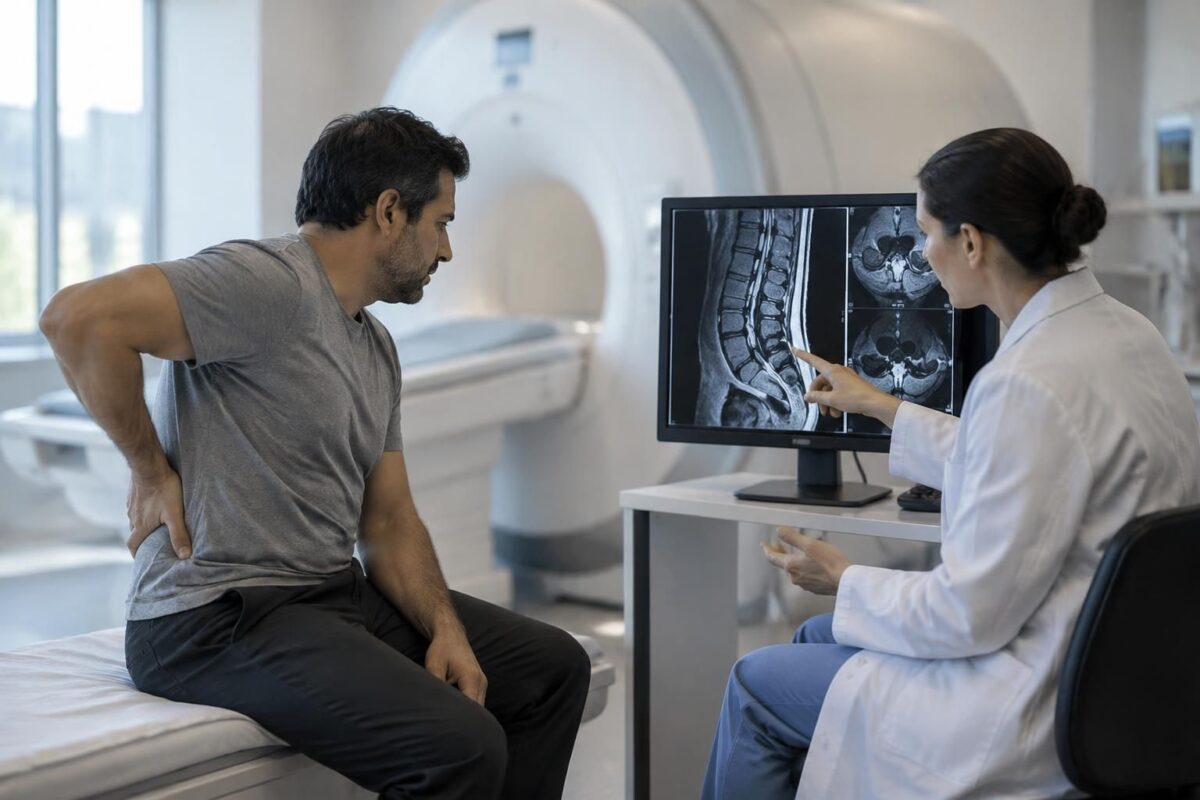
Sciatica in Montreal: why an MRI must be correlated with symptoms
IN BRIEF An MRI for sciatica shows structures in the lower back, but an anomaly alone does not prove the cause of the pain. It must be compared with the symptom pathway, the affected side, and the neurological examination. This…
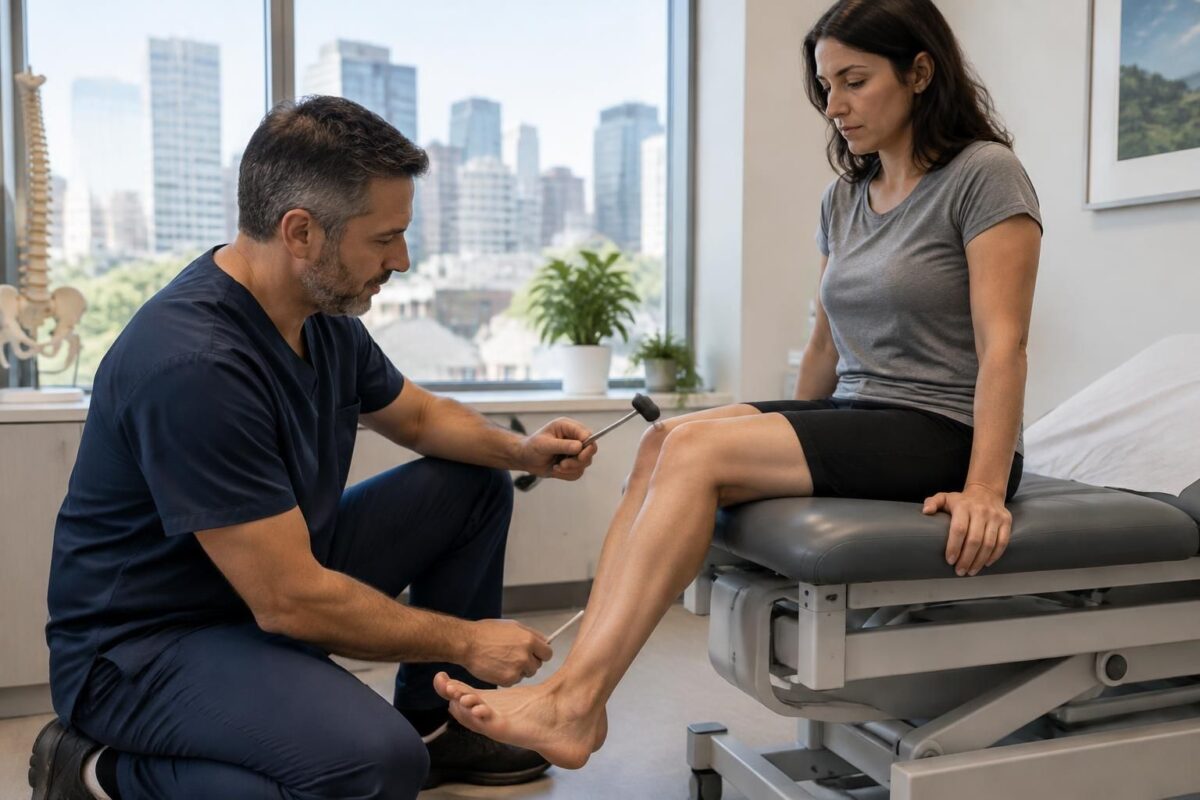
Sciatica in Montreal: reflexes, strength, and sensitivity in evaluation
IN BRIEF The evaluation of sciatica involves examining reflexes, muscle strength, and sensitivity, in addition to the pathway and evolution of pain. In Montreal, these observations help the healthcare professional identify potential neurological signs and guide the next steps. No…
Identifying symptoms and their evolution
Sciatica can manifest as a descending pain, burning, electric shocks, tingling, or a sensation of numbness. Some people describe a heavy leg or difficulty walking on the heel or tiptoe. Note the affected side, painful areas, duration of episodes, and positions that aggravate or relieve symptoms.
Also monitor your ability to walk and stand, as well as the time needed to recover after activity. These concrete benchmarks help the consulted professional assess progress and determine if further investigation is warranted.
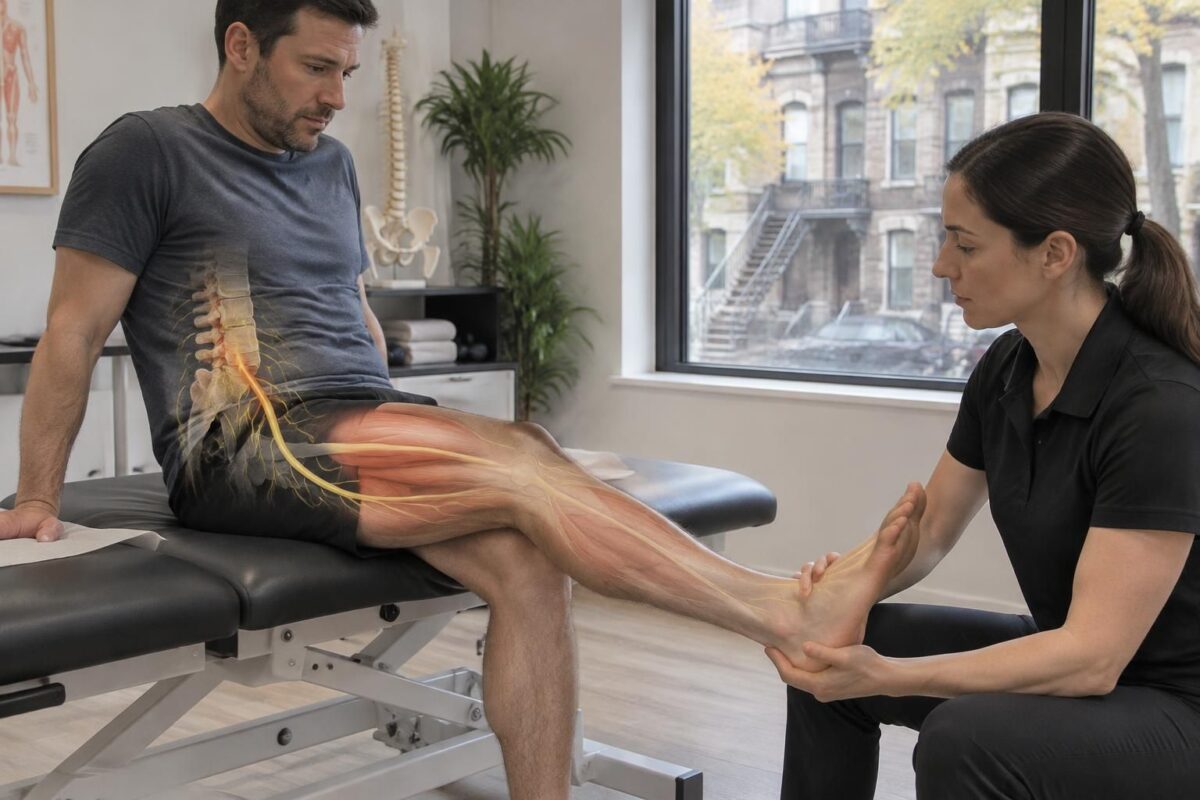
Sciatica in Montreal: Muscle Weakness Based on the Irritated Root
IN BRIEF Sciatica can cause muscle weakness when lumbar nerve roots are irritated. Depending on the affected root, it may become difficult to lift the foot or stand on tiptoes. In Montreal, an assessment of strength, sensation, and pain pathway…
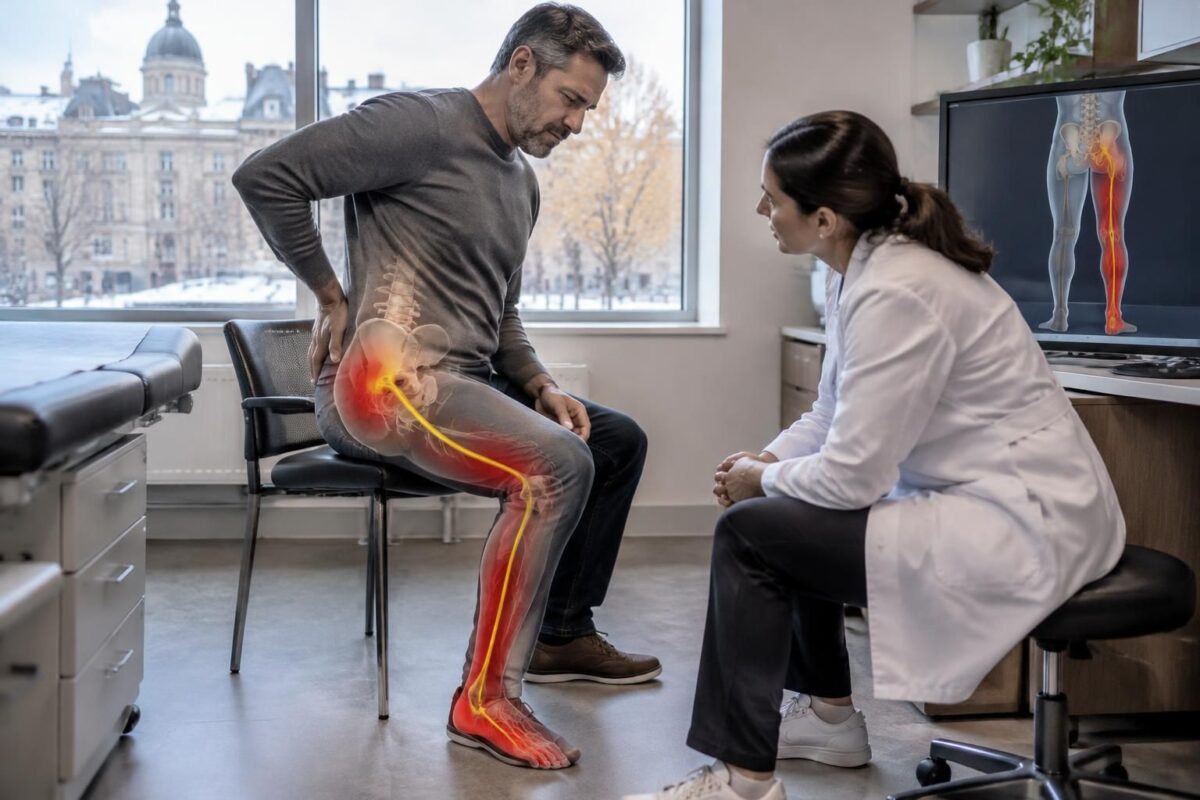
Sciatica in Montreal: nerve pain and sensory territory
IN BRIEF Sciatica is a nerve pain that radiates from the lower back or buttock down the leg. Its sensitive territory varies depending on the affected root and may include burning, tingling, or numbness down to the foot. In Montreal,…
What steps to prioritize in Montreal?
Start with an appropriate assessment
Make an appointment with a licensed healthcare professional if symptoms persist, recur frequently, or limit your activities. The assessment may include questions about your history, an examination of strength, sensation, reflexes, and gait. An MRI may be considered when symptoms last, if a neurological deficit is present, or if the results could alter the care plan. Imaging should be interpreted in relation to your symptoms, not in isolation.
Adjust activity and discuss options
While awaiting an assessment, avoid prolonged bed rest and prioritize tolerated movements, such as short walks if they don’t exacerbate symptoms. Modify prolonged sitting periods, vary positions, and avoid exercises that trigger pain radiating further down the leg. A supervised exercise program can be adjusted to your condition. Depending on the diagnosis, the duration of symptoms, and your goals, the doctor may also discuss medications, injections, or a specialist opinion. Manual techniques or decompression may not be suitable for everyone and should not delay necessary medical evaluation.
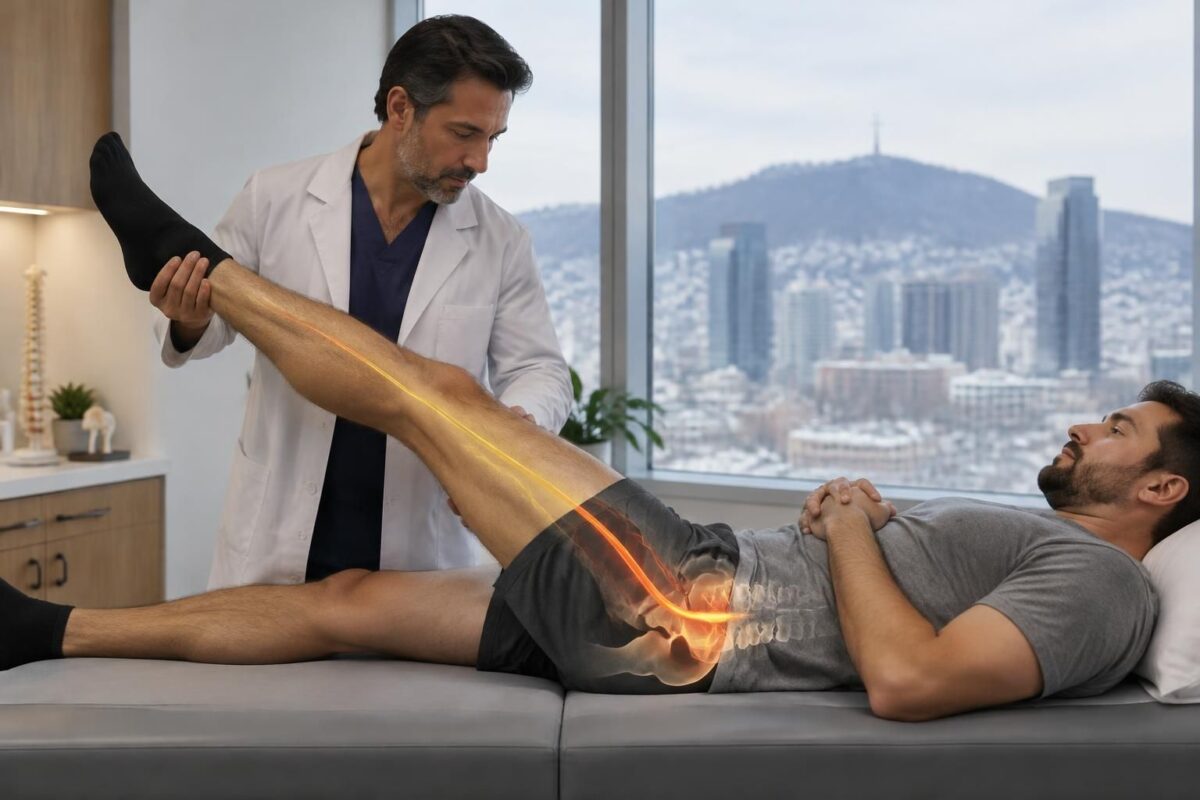
Sciatica in Montreal: irritation L5 or S1, why the clinical examination matters
IN BRIEF The sciatica related to irritation of the L5 or S1 root can cause pain, numbness, or weakness in the leg and foot. In Montreal, the clinical examination compares the course of symptoms, sensitivity, strength, and reflexes to guide…
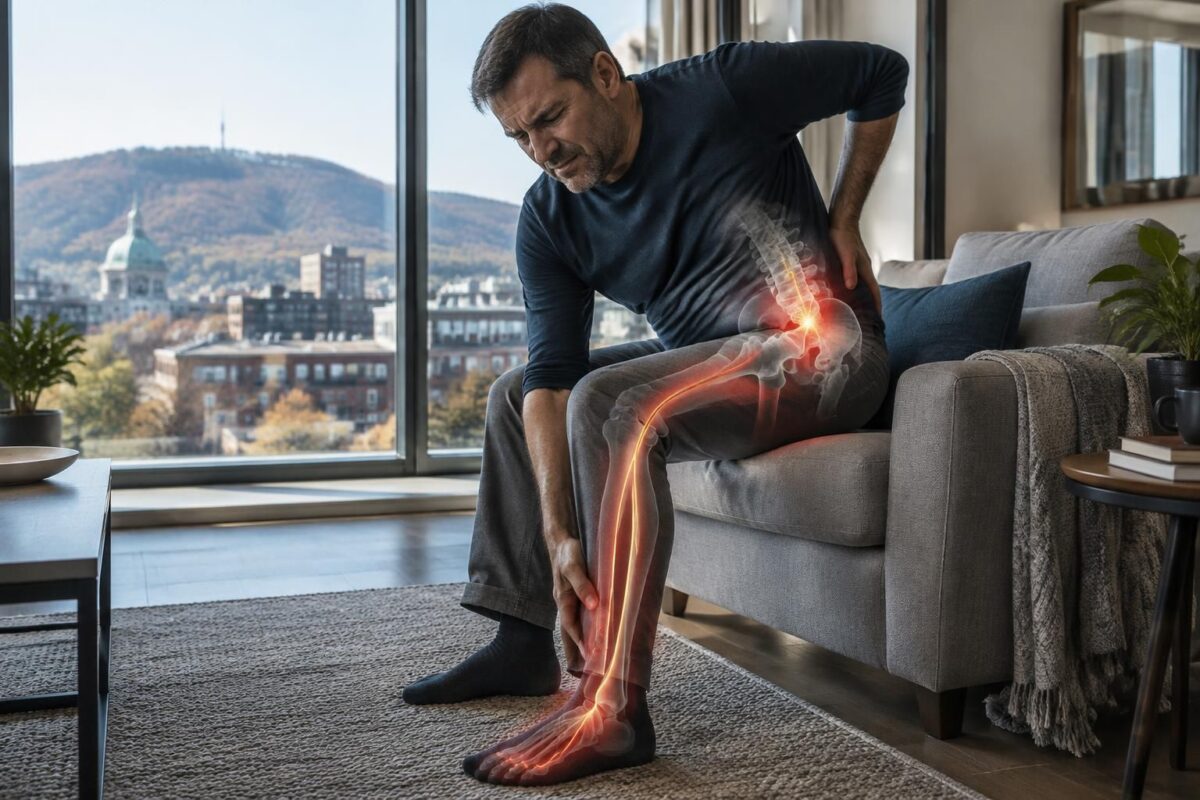
Sciatica in Montreal: L5-S1 Herniation and Pain Towards the Foot
IN BRIEF A L5-S1 disc herniation can irritate the S1 nerve root and cause sciatica in Montreal, with pain or numbness radiating down to the calf, heel, or foot. The assessment correlates symptoms, strength, and sensitivity with imaging, if relevant;…
When to consult without delay
Seek immediate care in case of loss of control of the bladder or bowels, numbness in the perineal area, significant or rapidly progressive weakness, or marked symptoms in both legs. Fever, recent trauma, or rapid deterioration also warrant prompt medical attention.
Medical warning: this content is informative and does not replace a consultation, diagnosis, or treatment by a licensed healthcare professional.
| Element | Clinical benchmark in Montreal |
|---|---|
| Level L5-S1 | Lumbar junction often affected by sciatic pain. |
| Spinal canal | Its narrowing can compress several nerve structures. |
| Foramen | This opening allows a nerve root to exit; its narrowing can irritate it. |
| Possible symptoms | Pain, tingling, or weakness in the buttock, leg, or foot. |
| Assessment | Clinical examination and imaging, if indicated, to be correlated. |
| Next step | Have persistent symptoms or walking limitations evaluated. |
| Emergency | Consult without delay in case of urinary issues, saddle anesthesia, or progressive weakness. |
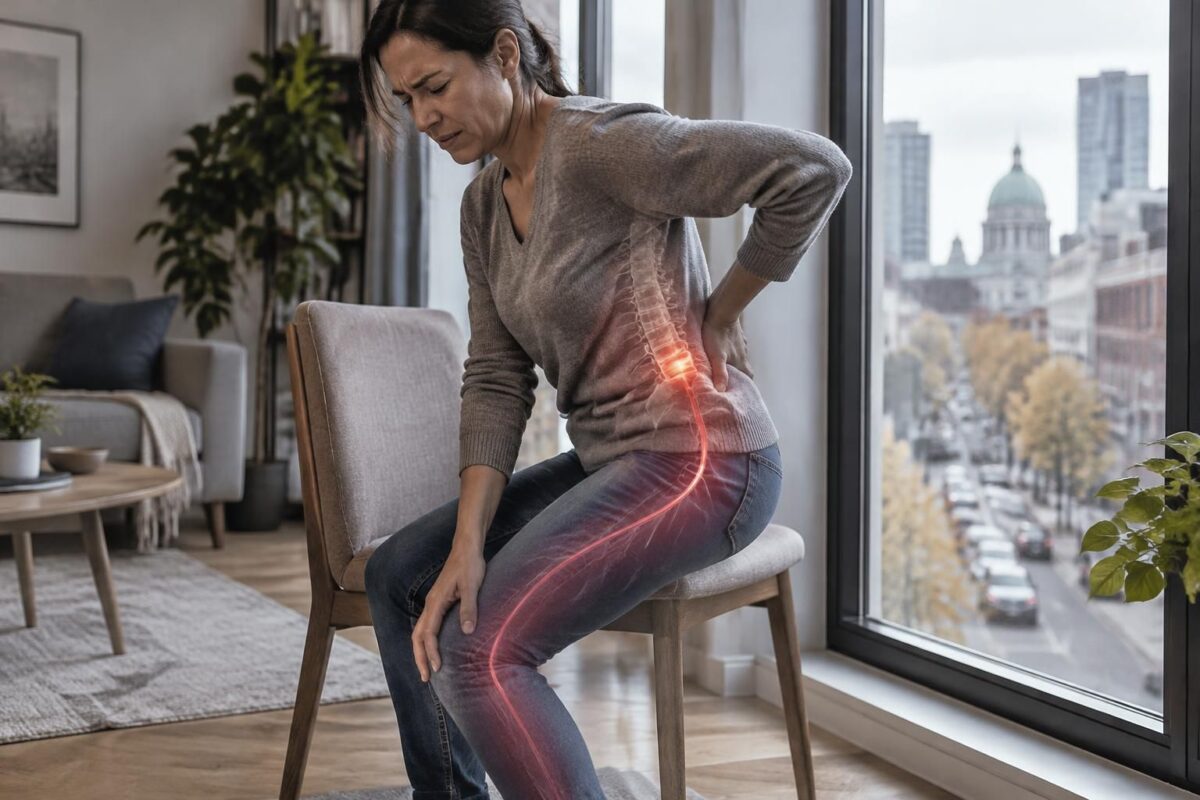
Sciatica in Montreal: L4-L5 protrusion and leg pain
IN BRIEF An L4-L5 disc protrusion is a bulging of the disc that can irritate a nerve root and cause sciatica, with pain in the buttock and leg. However, it does not always cause symptoms. In Montreal, an assessment can…
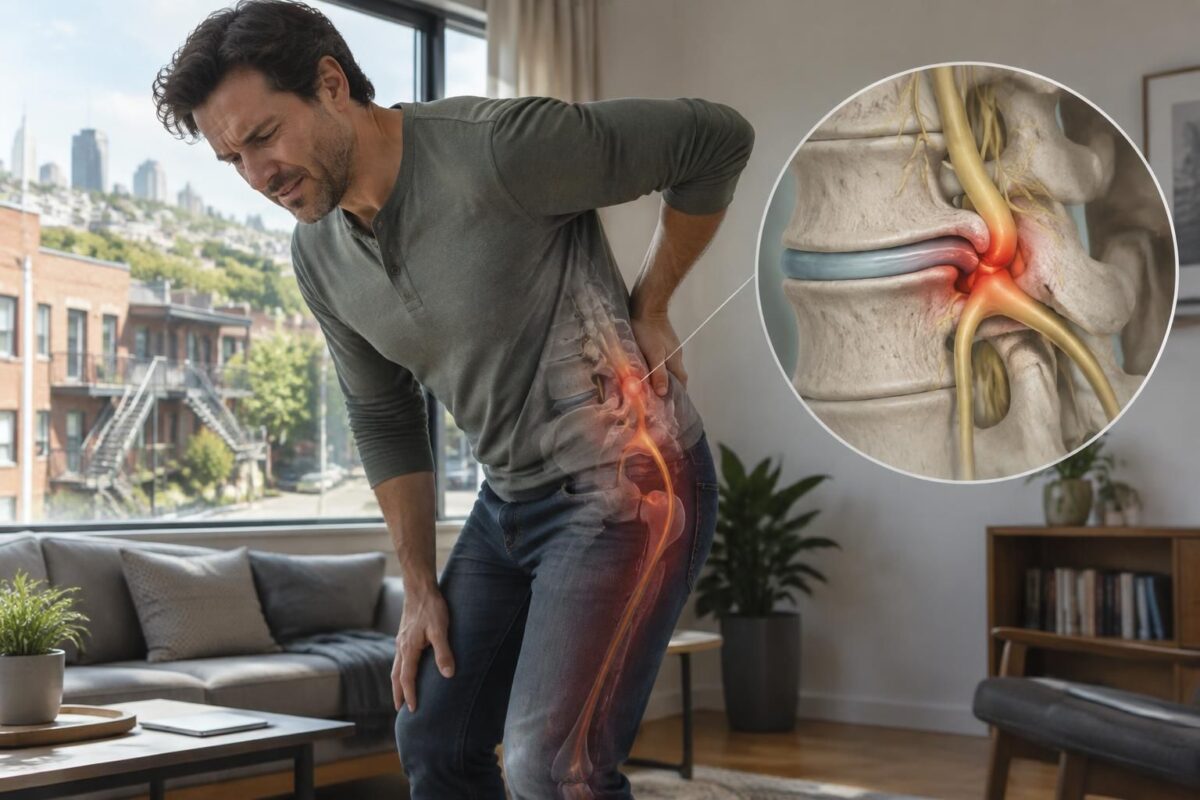
Sciatica in Montreal: what “disc-root conflict” means
IN BRIEF A disc-root conflict refers to possible contact or pressure between an intervertebral disc and a nerve root. In Montreal, this mention in the MRI can help understand a sciatica, but does not by itself prove that the disc…
Illustrative testimonials on sciatica in Montreal: L5-S1, canal, and foramen
Note: the accounts below are fictional examples written for educational purposes. They do not originate from real patients and do not guarantee any treatment outcomes.
“The pain was radiating from the buttock down to the foot.” In Montreal, this illustrative scenario describes a person whose MRI mentions a change at the L5-S1 level. The discomfort worsens after standing for a period and is sometimes accompanied by tingling. The evaluation should verify if the level and side observed on imaging correspond to the symptoms and examination.
“I had to stop after a few minutes of walking.” In this fictional example, a person learns that the lumbar canal is narrowed. The walking distance, the positions that exacerbate or relieve symptoms, and the evolution of strength in the legs are crucial elements to communicate to the healthcare professional. An image alone is insufficient to determine the cause of the pain.
“The report mentioned a narrowed foramen.” This illustrative account refers to possible foraminal stenosis at L5-S1, meaning a decreased nerve exit space. Pain radiating towards the leg or foot may be compatible with nerve irritation, but other causes must also be considered. Treatment depends on the diagnosis, symptoms, and function.
“What concerned me the most was the weakness.” In this fictional scenario, a person notices that their foot seems weaker and their gait is changing. New or progressive weakness merits rapid medical evaluation. Options may include tailored conservative care, additional tests, or a specialist opinion, depending on the situation.
If you consult for sciatica in Montreal, prepare concrete information: pain trajectory, affected side, numbness, strength changes, walking distance, and positions that alter symptoms. A professional will be able to confront these elements with the examination and available imaging.
Consult urgently in case of loss of urinary or bowel control, numbness in the saddle area, significant or rapidly progressive weakness, or marked worsening of symptoms.
Sciatica in Montreal: understanding the role of L5-S1, canal, and foramen
Sciatica describes pain related to irritation of a nerve root in the lower back. It can start from the lumbar region or buttock and radiate down the thigh, calf, foot, or toes. In Montreal, individuals seeking care for this pain benefit from understanding an essential distinction: the symptom trajectory alone does not accurately identify the cause. An assessment must consider the clinical examination, function, and, when indicated, imaging tests.
The L5-S1 level is located at the junction between the last lumbar vertebra and the sacrum. This area bears a significant share of mechanical stress related to posture and movements. At this level, a nerve root may be irritated by various changes, including a herniated disc, a decrease in disc height, arthritis, or vertebral slippage. These factors can contribute to reducing the available space around nerve structures, without necessarily causing symptoms in everyone.
Two spaces are often mentioned in reports: the spinal canal and the intervertebral foramen. The spinal canal is the central passage that contains nerve structures. The foramen, also known as the conjugation hole, is a lateral opening through which a nerve root exits the spine. A narrowing of the canal and a foraminal narrowing are therefore different anatomical situations. They can sometimes coexist, but their possible effects depend on the level involved, the affected side, and the correlation with the symptoms.
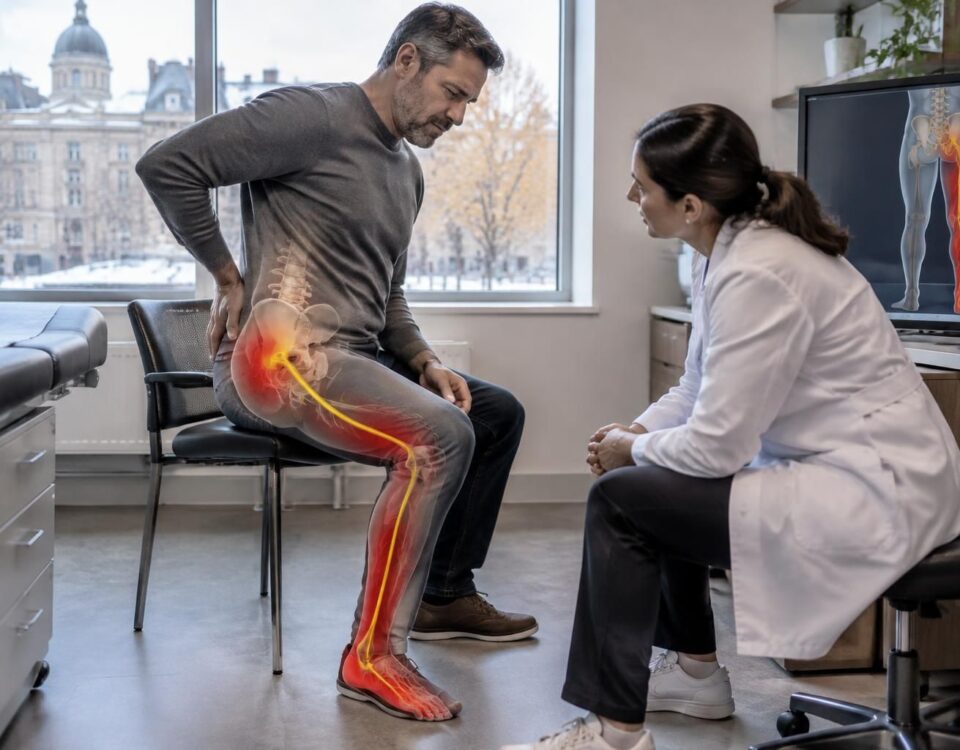
When a nerve root is irritated or compressed, manifestations can include sharp or burning pain, shocks, tingling, numbness, or weakness. Symptoms may increase when walking, standing, or in certain sitting positions; others may find relief in a specific position. It is useful to note the affected side, the path of the pain, the possible walking distance, and any changes in strength or sensitivity. This information helps the clinician assess the actual impact of the problem.
X-rays primarily show bone structures, while MRI can help visualize the discs and the tissues around the nerves. However, a single image is not sufficient to determine the cause of the symptoms: abnormalities can be present without pain, and their significance must be weighed against the physical examination. The decision to request imaging or a specialist opinion depends particularly on the progression, neurological signs, and the possibility that the result will change the care plan.
Management varies depending on the situation. It may include appropriate activity, progressive exercises, advice to limit aggravating movements, and medical evaluation when symptoms persist or intensify. At TAGMED Clinic, non-surgical options that may be considered based on the assessment include specific osteopathy or motorized neurovertebral decompression. These approaches do not suit everyone and do not guarantee a result; their relevance must be determined on a case-by-case basis. A surgical intervention or opinion may be discussed by a physician if the compression correlates with significant limitation or neurological deficit.
New or progressive weakness, a foot that becomes difficult to lift, a loss of bladder or bowel control, or numbness in the saddle area require urgent evaluation. These signs should not wait for a routine appointment. The information presented here is educational and does not replace a consultation, diagnosis, or treatment by a licensed healthcare professional. Sylvain Desforges, Doctor of Osteopathy and Naturopath, is the founding president of TAGMED and the ACMA association; his practice and content particularly focus on chronic spinal pain and non-surgical approaches, within the limits of his practice.
In Montreal, nerve irritation at the L5-S1 level can cause pain that starts from the lower back or buttock and radiates down the leg to the foot. A narrowing of the lumbar canal or foramen can contribute to this compression, but imaging must always be correlated with symptoms, clinical examination, and functional abilities before determining appropriate care.
Understanding the Role of the Canal and Foramen at L5-S1
The lumbar canal houses the nerve structures in the spine, while the intervertebral foramens are the lateral openings through which nerve roots exit. At the L5-S1 junction, a disc herniation, a decrease in disc height, or changes related to arthritis can reduce the available space and irritate a root. To better understand the differences between the affected levels, check this page on sciatica L4-L5 and L5-S1 in Montreal.
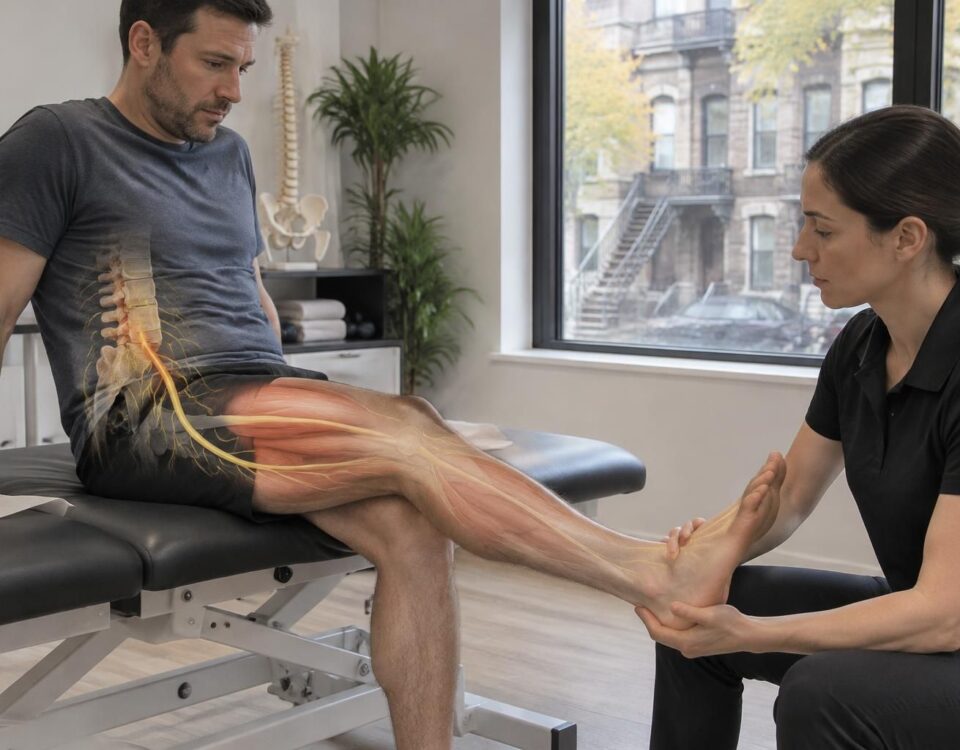
The path of pain varies depending on the affected root and the characteristics of the compression. L5 irritation may be associated with symptoms in the leg or foot, while S1 involvement may particularly affect the ability to stand on tiptoe. You can learn more about irritation of the L5 root, the difficulty in standing on tiptoe with possible S1 involvement, and the pain pathway associated with roots L4, L5, and S1.
Linking Symptoms to Examination and Imaging
A burning pain behind the thigh, tingling in the foot, numbness, or a sensation of weakness can guide the evaluation, but they are not sufficient to establish the cause. The pain may also be more pronounced in sitting, standing, or during walking. Note its side, path, activities that trigger it, and the time needed to recover. These details are helpful during a sciatica evaluation in Montreal. To compare certain types of sensations, refer to the pages on burning behind the thigh and tingling in the foot while sitting.
The MRI can show stenosis, herniation, or other anatomical changes, but an image alone cannot determine the origin of the symptoms or their severity. The correlation between the observed level, the affected side, the examination of strength, sensitivity, and reflexes, as well as walking limitations is essential. Supplementary resources on lumbar sciatica related to a disc herniation and recommendations regarding sciatica can help better place the different evaluation stages.
Assessing Management Options
When symptoms persist, an individualized assessment can help discuss the next steps: appropriate activity, gradual exercises, symptom management strategies, additional examinations, or specialized medical advice. Neurovertebral decompression and manual approaches do not suit everyone and do not guarantee the widening of the foramen or the disappearance of sciatica. Their relevance must be assessed based on diagnosis, neurological signs, and functional objectives. To learn more about the evaluation proposed regarding L5-S1 foraminal stenosis and sciatica, consult the information from TAGMED Clinic.
Quickly consult a healthcare professional if weakness sets in or worsens, if the foot becomes difficult to lift, if walking deteriorates significantly, or if symptoms affect both legs. A loss of control over the bladder or bowels, numbness in the saddle area, or significant and rapidly progressive weakness require urgent medical evaluation. These signs should not wait for a routine consultation.

Sylvain Desforges, B.Sc., D.O., N.D., docteur en ostéopathie
Dr Sylvain Desforges, B.Sc., D.O., N.D., osteopath, is the founding president of TAGMED and of the ACMA association. He dedicates his practice to chronic spinal pain, low back pain and symptoms compatible with sciatica, particularly when pain radiates toward the buttock, leg, calf, foot or toes.
Through SOS Sciatique, he publishes educational content on sciatica symptoms, possible causes such as disc herniation, disc narrowing, foraminal stenosis or irritation of a lumbar nerve root, as well as non-surgical approaches that may be considered according to the evaluation. At Clinique TAGMED, care may include, depending on the case, motorized neurovertebral decompression, specific osteopathic care or precision percussion.
For an evaluation related to sciatica treatment in Montreal / Mount Royal or sciatica treatment in Terrebonne, please consult the services available at Clinique TAGMED.
Medical disclaimer
The information published on SOS Sciatique is provided for educational purposes only and does not replace a consultation, diagnosis, opinion or treatment provided by a physician or another authorized healthcare professional. The author of this article is neither a medical doctor nor a specialist in a medical specialty recognized by the Collège des médecins du Québec. The osteopathic, manual medicine or functional support approaches described on this site do not constitute medical acts and are not intended to replace medical follow-up.
Consult a physician or emergency service in cases of loss of bladder or bowel control, anesthesia in the saddle area, significant or progressive weakness in the leg or foot, fever, recent trauma, severe pain or rapid worsening of symptoms. For more details, please read our Legal Notice.