Sciatica in Montreal: disc protrusion and pain under the knee
24/11/2026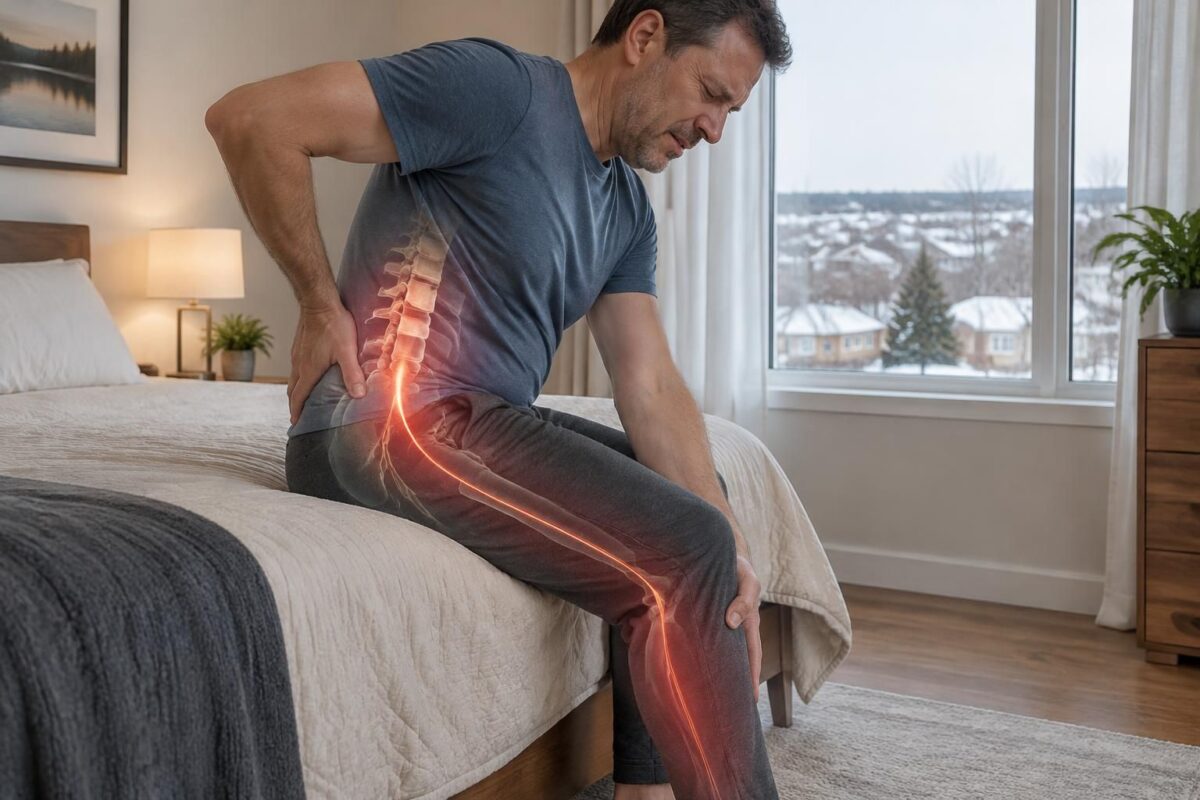
IN BRIEF A sciatic pain related to a disc protrusion can cause lower back or buttock pain that radiates below the knee, sometimes accompanied by tingling or numbness. In Terrebonne, an assessment helps distinguish nerve-related pain from a knee problem and to consider appropriate care to promote mobility and relieve symptoms. However, the disc protrusion is not always the cause of the pain: only a healthcare professional can evaluate it. |
In Terrebonne, a disc protrusion can irritate a lumbar nerve root and cause pain of a sciatica type below the knee, sometimes accompanied by tingling, burning, or a feeling of weakness in the leg or foot. However, pain that radiates down the leg does not confirm, by itself, the origin of the problem: a professional evaluation can help clarify its cause and the appropriate non-surgical management options.
Seek medical attention promptly in case of significant or progressive weakness, loss of urinary or bowel control, or numbness in the saddle area.
Pain that radiates below the knee may be linked to the irritation of a nerve root in the lower back. A disc protrusion can sometimes contribute to this irritation, but its presence on imaging does not prove it is causing the pain. In Terrebonne, a clinical assessment helps correlate symptoms, examination findings, and imaging results before considering management.
How can a disc protrusion cause pain below the knee?
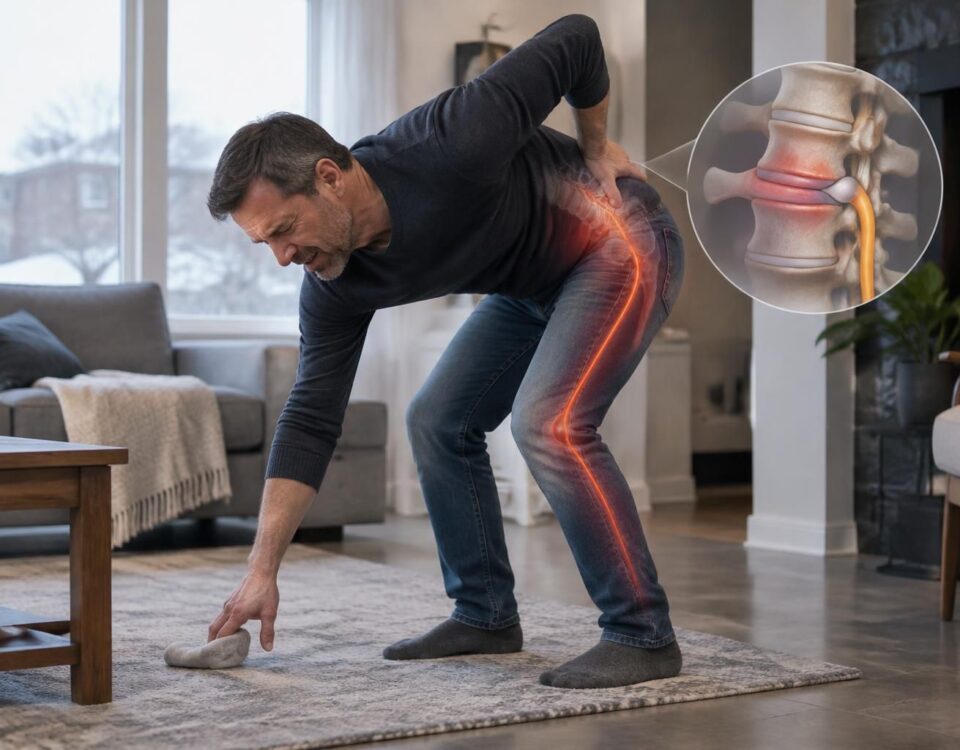
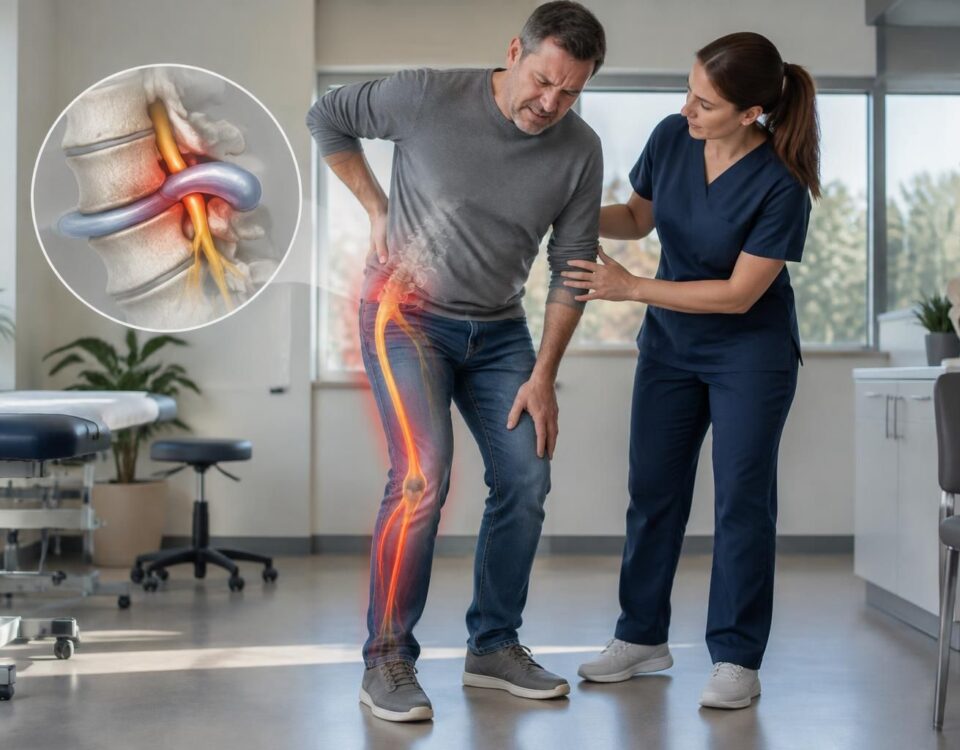
The discs located between the vertebrae serve as support and help distribute loads. A protrusion corresponds to a bulging of the disc. If this bulge irritates or compresses a nerve root, the pain can follow the path of the nerve in the buttock and leg, sometimes down to the foot.
Pain below the knee does not automatically mean that a nerve is compressed. Local knee pain, involvement of another nerve, or another condition can produce similar symptoms. The path of the sensitive territory associated with nerve pain can help guide the evaluation, but it is not sufficient to make a diagnosis.
The role of lumbar nerve roots
The lumbar and sacral nerve roots participate in leg sensitivity and movement. Depending on the affected root, the pain can affect different areas. Irritation of L5 can particularly cause symptoms on the side of the leg or on the top of the foot. Involvement of S1 may manifest behind the thigh and calf, or towards the heel and the outer edge of the foot.
However, the painful area varies from person to person. To better understand these differences, refer to this article on L4, L5, and S1 nerve roots in case of sciatica. A general presentation of the link between sciatica and pain in the leg can also help recognize possible symptoms.

Sciatica in Terrebonne: disc herniation and painful cough
IN BRIEF In Terrebonne, sciatica related to a herniated disc may be accompanied by pain that increases when coughing, as the pressure exerted can further irritate a nerve root. An evaluation helps to understand the origin of the symptoms and…
What symptoms may accompany sciatica below the knee?
Nerve-related pain can present as burning, electric shock-like sensations, tingling, or numbness. Some people experience pain that starts from the lower back or buttock and radiates behind the thigh, below the knee, or down to the foot. However, the presence of pain below the knee alone does not confirm sciatica.
Weakness in the leg or foot deserves special attention. It may accompany nerve irritation, but it should be evaluated by a healthcare professional. For more information about this sign, consult information on a disc herniation associated with leg weakness.
Sitting position and symptoms
The sitting position can exacerbate pain in some individuals. However, this does not confirm the presence of a protrusion or herniated disc by itself. Note the positions and activities that modify your symptoms, and then pass this information to the professional evaluating you.
Resources explain the sciatic pain that prevents sitting and the pain aggravated by sitting possibly related to a lumbar disc. This information does not replace an individual examination.

Sciatica in Terrebonne: pain worsened in sitting position and lumbar disc
IN SHORT Aggravated sciatica in a sitting position may be related to the irritation of a lumbar nerve root, sometimes associated with a lumbar disc. In Terrebonne, varying positions, taking short active breaks, and getting an evaluation can help better…
How to evaluate a disc protrusion in Terrebonne?
The evaluation begins with symptoms and medical history, followed by a clinical examination. The professional may check sensitivity, strength, reflexes, and movements that reproduce the pain. A doctor determines whether imaging, such as an MRI, is necessary based on the observed signs and context.
A protrusion visible on an MRI can exist without pain. Therefore, the image must be interpreted alongside the symptoms and examination findings. The diagnosis does not rely solely on a radiological report. For general information about the sciatic nerve and its path, consult the page dedicated to the sensitive territory of nerve pain.

Sciatica in Terrebonne: pain worsened by flexion and disc-related cause
IN BRIEF Aggravated sciatica by flexion is pain that starts in the lower back and radiates into the buttock or leg; a lumbar disc herniation can irritate a nerve root, although it may not be the only possible cause. In…
What management options should be considered?
Management depends on the likely cause, the intensity of symptoms, and the results of the evaluation. A healthcare professional can discuss options suitable for your situation. No treatment can guarantee pain relief, and a protrusion does not automatically require specific intervention.
At the TAGMED Clinic, an evaluation can determine whether care such as specific osteopathy or motorized neurovertebral decompression may be considered. The relevance of these approaches depends on each individual’s history. Refer to the sciatica treatment services in Terrebonne or the information of the TAGMED Clinic in Terrebonne.
For an overview of the approaches offered by SOS Sciatique, visit the page on the follow-up of sciatica associated with a herniated disc. Recommendations should always take into account the examination and the evolution of symptoms.

Disc herniation in Terrebonne: why some stretches worsen
IN BRIEF Discogenic sciatica is pain related to the irritation of a nerve, sometimes worsened by certain stretches that intensify the symptoms. In Terrebonne, avoiding movements that cause pain to radiate down the leg and focusing on an appropriate approach…
When to seek medical help quickly?
Consult a doctor or an emergency service quickly if you have significant or worsening weakness in your leg or foot, loss of control over your bladder or bowels, or loss of sensation in the anal region. A fever, recent trauma, severe pain, or rapid aggravation also requires medical evaluation.
About the author
Sylvain Desforges, B.Sc., D.O., N.D., Doctor of Osteopathy and Naturopath, is the founding president of TAGMED and the ACMA association. His practice particularly focuses on chronic pain of the spine, lower back pain, and symptoms compatible with sciatica, including pain radiating to the buttock, leg, calf, foot, or toes.
Through SOS Sciatique, he publishes educational content on the symptoms of sciatica, its possible causes, and non-surgical approaches that may be considered after an evaluation. At the TAGMED Clinic, treatment may include, depending on the case, motorized neurovertebral decompression, specific osteopathy, or precision percussion.
For an evaluation related to sciatica treatment in Montreal or Mont-Royal, sciatica treatment in Terrebonne, or services from the TAGMED Clinic.
Medical disclaimer
The information and advice provided on this site do not replace the opinion, diagnosis, or treatment of a healthcare professional. Please note that Sylvain Desforges, B.Sc., D.O., N.D., Doctor of osteopathy, is neither a medical doctor nor a physician and is not a specialist in any medical specialty as defined by the Collège des médecins du Québec. Manual medicine, functional medicine, and sports medicine as described on this site exclude any treatment or medical diagnosis made by a physician or medical specialist. Always consult your doctor for any medical questions. For more details, please read our complete Legal Notice.
Pain indicators
- A disc protrusion may irritate a lumbar nerve root.
- Pain may radiate to the buttock, thigh, and below the knee.
- Burning, jolting, or tingling sensations may indicate a nerve origin.
When to seek an evaluation
- An examination helps distinguish sciatica from a knee-specific problem.
- Consult if the pain persists, worsens, or limits your activities.
- Progressive weakness or loss of bladder or bowel control requires urgent medical help.

In Terrebonne, pain radiating below the knee may be compatible with irritation of a lumbar nerve root, sometimes associated with a disc protrusion. However, this finding alone is not sufficient to establish the cause: the examination must take into account your symptoms, their evolution, and your health condition. An appropriate evaluation helps determine the next steps and identify signs that require prompt medical attention.

Sciatica disc in Terrebonne: movements to avoid at the beginning
IN BRIEF Disc-related sciatica corresponds to a nerve irritation that can cause pain from the lower back to the buttock or leg. Initially, avoid movements that worsen the pain, such as deep bends, sudden twists, and carrying heavy loads. In…
Disc protrusion and pain below the knee
The discs located between the vertebrae help distribute loads and allow movements of the back. A disc protrusion refers to a disc that bulges out. It may sometimes irritate a nerve root, but it may also be visible on imaging without being the source of symptoms. Therefore, it is important to avoid concluding that an observed anomaly necessarily explains all pain.
When a nerve root is irritated, pain may begin in the lower back or buttock and extend into the thigh, calf, or foot. It is sometimes described as burning, electric shock, or tingling. Pain below the knee may follow the path of a nerve, but other issues can also cause discomfort in that area. The location alone does not allow for a diagnosis.

Sciatica in Terrebonne: disc herniation with leg weakness
IN SHORT Sciatica related to a disc herniation can cause pain that radiates down the leg, sometimes accompanied by weakness. In Terrebonne, an assessment helps guide management based on symptoms and their progression. A new, significant, or progressive weakness requires…
What elements to observe before an evaluation?
Distribution and evolution of symptoms
Note when the pain started, its precise path, and the situations that exacerbate or alleviate it. Indicate also the presence of numbness, tingling, or weakness, as well as the effects on walking, sleep, and daily activities. This information can help the professional guide the examination.
An examination before choosing treatment
In Terrebonne, a consultation allows for a review of your symptoms, history, and mobility. Depending on the results, the professional may recommend medical follow-up or request additional evaluation. An X-ray, MRI, or other examination is not automatically necessary: the decision depends on the clinical context and observed signs.

Sciatica in Terrebonne: herniated disc with foot numbness
IN BRIEF Sciatica related to a herniated disc can irritate a nerve root and cause pain that radiates down the leg, sometimes with a numbness in the foot. In Terrebonne, an evaluation helps to better understand the symptoms and consider…
Precautionary measures to preserve your mobility
When symptoms allow, prefer gentle and regular movements rather than prolonged bed rest. Short walks, adjusted to your tolerance, can help maintain mobility. Temporarily reduce movements that significantly exacerbate the pain, and then gradually resume your activities. Avoid forced stretching and exercises that trigger pain radiating further down the leg.
Support in osteopathy or another functional approach may be considered after an evaluation, depending on your situation and preferences. At the TAGMED Clinic, options may include specific osteopathy or motorized neurovertebral decompression when the professional deems these approaches appropriate. They do not replace a medical diagnosis and do not guarantee a result. Seek medical advice if the pain persists, intensifies, or limits your activities.

Sciatica in Terrebonne: lumbar disc and nerve root inflammation
IN BRIEF Lumbar disc-related sciatica occurs when irritation or inflammation of a nerve root causes pain that may radiate from the buttock down to the leg. In Terrebonne, an evaluation can help better understand the cause of symptoms and identify…
When to consult quickly?
Consult a doctor or emergency service promptly in case of loss of bladder or bowel control, numbness in the saddle area, significant or progressive weakness in the leg or foot, fever, recent trauma, or rapid deterioration. Intense or unusual pain also justifies quick professional advice.
Pain Below the Knee: Guidelines to Distinguish Sciatica from a Local Issue
| Indicator | What It May Indicate |
|---|---|
| Pain that starts from the lower back or buttock | Nerve irritation related, among other things, to a disc protrusion is possible. |
| Pain that radiates down the back of the thigh and under the knee | The trajectory may correspond to sciatica-type pain. |
| Electric shocks, burning sensations, or tingling | These sensations may accompany irritation of a nerve root. |
| Pain triggered mainly by a movement of the knee | A local cause at the knee may also be considered. |
| Variable symptoms depending on posture | The position may influence the sensitivity of an irritated nerve. |
| Weakness or numbness of the foot | An evaluation by a healthcare professional is recommended. |
| Persistent or worsening pain | A clinical examination helps clarify the cause and management options. |
| Loss of bladder or bowel control, or progressive weakness | Consult emergency services immediately. |
Sciatica in Terrebonne: Illustrative Testimonials on a Disc Protrusion and Pain Below the Knee
Important: the stories below are fictional examples created for educational purposes. They do not correspond to verified patient accounts and do not allow for determining the cause of an individual pain.
“The pain radiated down to my calf” — Marc, illustrative situation
After several days of lower back pain, Marc felt sharp pains in his buttock and behind his thigh, then pain below the knee. Medical evaluation and imaging suggested a disc protrusion, but the image alone was not enough to explain the symptoms. His management plan was adapted to his examination and the evolution of his pain. Walking and gradually resuming tolerated movements were considered according to his healthcare professionals’ recommendations.
“I thought the problem was with my knee” — Nadia, illustrative situation
Nadia experienced pain in the hollow behind her knee, especially after sitting for a long time. She had no direct injury to the knee but also described pulling sensations in her buttock and leg. Pain that radiates below the knee may sometimes be related to irritation of a nerve root in the lower back, but other causes are possible. A healthcare professional can help distinguish nerve-related pain from a joint or vascular issue.
“The tingling varied from day to day” — Éric, illustrative situation
Éric occasionally felt tingling in his calf and foot, as well as lower back pain. The term disc protrusion had been mentioned after an examination, but the intensity of his symptoms did not solely depend on that result. His follow-up focused on the evolution of the pain, mobility, and the potential presence of neurological signs. A personalized evaluation remains important, especially if weakness or numbness worsens.
A disc protrusion refers to a bulge of the disc between the vertebrae. It may sometimes contribute to the irritation of a nerve root, but it can also be observed without causing symptoms. Pain below the knee, electric shocks, or tingling may be consistent with sciatica, without solely confirming this diagnosis. Clinical examination and, when indicated, additional tests guide the evaluation.
In Terrebonne, management can be discussed with a professional based on the symptoms, their duration, and the evaluation performed. Manual or functional approaches do not replace a medical diagnosis; care must be tailored to each situation and coordinated with medical follow-up when necessary.
Consult a doctor or emergency service quickly in case of loss of bladder or bowel control, numbness in the saddle area, significant or progressive weakness in the leg or foot, fever, recent trauma, severe pain, or rapid deterioration.
About the Author
Sylvain Desforges, B.Sc., D.O., N.D., Doctor of Osteopathy and Naturopath, is the founding president of TAGMED and the ACMA association. His practice is dedicated mainly to chronic spinal pain, lumbar pain, and pain consistent with sciatica. At TAGMED Clinic, treatments may include, based on the evaluation, motorized neurovertebral decompression, specific osteopathy, or precision percussion.
Medical Disclaimer
This information is provided for educational purposes and does not replace a consultation, diagnosis, opinion, or treatment by a physician or another authorized healthcare professional. The author is neither a physician nor a specialist in a medical specialty recognized by the Collège des médecins du Québec. Osteopathy, manual medicine, or functional support approaches do not constitute medical acts and are not intended to replace medical follow-up.
Pain radiating below the knee can be particularly concerning, especially when accompanied by burning sensations, tingling, or electric shocks. In Terrebonne, individuals seeking consultation for this type of symptom often want to understand whether their back, hip, or knee is the cause. When the pain follows the path from the buttock to the back or side of the leg, it may be consistent with sciatica, indicating irritation of a nerve root contributing to the formation of the sciatic nerve.
The sciatic nerve originates in the lower back from several lumbar and sacral nerve roots. It traverses the buttock region, descends behind the thigh, and divides near the knee into branches that continue down the leg and foot. Therefore, pain felt below the knee does not necessarily mean that the joint itself is affected: the origin may be higher up, in the lumbar region. The distribution of symptoms varies depending on the affected nerve root.
A disc protrusion refers to a deformation of the contour of a disc located between the vertebrae. It may sometimes contribute to irritating a nerve root, but its presence on imaging does not prove alone that it explains the pain. Some protrusions cause no symptoms. The evaluation should consider the history of the pain, its trajectory, the strength and sensitivity of the leg, and the activities that worsen or relieve the symptoms. Other causes, such as lumbar osteoarthritis or nerve irritation from another source, may also be considered.
Pain related to nerve irritation can be described as burning, shooting, cold sensations, or tingling. It may extend to the calf, heel, above, or edge of the foot. Weakness or changes in sensitivity may also occur. These signs alone do not allow for determining the exact cause. A healthcare professional can perform a clinical examination and, when warranted, recommend imaging or other medical assessments.
In Terrebonne, the approach proposed at the TAGMED Clinic depends on the evaluation and needs of each individual. It may include specific osteopathy, functional support, or, when deemed appropriate, motorized neurovertebral decompression or the use of a precision impactor. These approaches are not suitable for all cases and do not replace a medical diagnosis. The goals, limitations, and possible options should be discussed with the consulted professional, without assuming that a disc protrusion requires particular treatment.
Sylvain Desforges, B.Sc., D.O., N.D., is a doctor of osteopathy and naturopath, founder and president of TAGMED and the ACMA association. His practice focuses on persistent spinal pain, lower back pain, and symptoms compatible with sciatica. His work is interested in the integration of manual approaches and technologies, including neurovertebral decompression, according to the clinical context and assessed needs.
A quick medical consultation is indicated in cases of significant or progressive weakness of the leg or foot, loss of bladder or bowel control, numbness in the saddle area, fever, recent trauma, or rapid deterioration. This information is educational and does not replace a consultation, diagnosis, or treatment by a physician or another authorized healthcare professional. Sylvain Desforges is neither a physician nor a specialist of a medical specialty recognized by the Collège des médecins du Québec.
A pain below the knee in Terrebonne may sometimes be related to irritation of the sciatic nerve rather than a problem with the knee itself. A lumbar disc protrusion can contribute to irritating a nerve root and project symptoms into the leg, but the location of the pain alone is not enough to establish a diagnosis: a clinical examination is necessary to look for its cause.
Pain below the knee: recognizing a possible nerve origin
The sciatic nerve originates in the lower back, traverses the buttock, and descends into the leg. Therefore, irritation at the root can be felt far from its origin, particularly behind the knee, in the calf, or down to the foot. Shoots, burning sensations, tingling, or a feeling of weakness may accompany the pain. To better understand why sciatic pain may manifest near the knee, consult this article on sciatica and knee pain.
The pathway of symptoms varies depending on the affected nerve root. Irritation of L5 may particularly be accompanied by manifestations on the side of the leg and towards the top of the foot or the big toe; however, other causes may produce comparable signs. To learn more about the possible role of this root, read this page on irritation of the L5 root, as well as this article dedicated to pain in the big toe and possible causes.
Disc protrusion: an imaging result to interpret with caution
A disc protrusion, sometimes referred to as a disc bulge, corresponds to a deformation of the contour of an intervertebral disc. It may be present without causing symptoms; therefore, imaging results must be correlated with the clinical examination and the signs experienced. These resources explain the difference between a protrusion or disc bulge associated with sciatica and a disc protrusion and sciatic symptoms.
Pain below the knee that appears after exertion can have several explanations, whether they are nerve-related, muscular, or joint-related. Note when it starts, the actions that worsen it, its pathway, and any associated tingling or weakness. You can consult the information on irradiation in the leg after physical exertion and on calf pain that resembles a cramp. To prepare for a consultation, this page offers useful guidelines to describe your symptoms to the healthcare professional.
Assessment and next steps
A healthcare professional can evaluate mobility, strength, sensitivity, and movements that reproduce the symptoms. Based on the results, imaging examinations may be considered; they are not necessary in all cases. A general presentation of symptoms, possible causes, and assessment can be found in the resources from Doctissimo on sciatica and from the MSD Manual.
While awaiting an evaluation, prioritize tolerated movements and avoid straining with an exercise that significantly increases pain or symptoms in the leg. Significant or progressive weakness, loss of bladder or bowel control, numbness in the saddle area, fever, recent trauma, or rapid deterioration warrant urgent medical consultation.

Sylvain Desforges, B.Sc., D.O., N.D., docteur en ostéopathie
Dr Sylvain Desforges, B.Sc., D.O., N.D., osteopath, is the founding president of TAGMED and of the ACMA association. He dedicates his practice to chronic spinal pain, low back pain and symptoms compatible with sciatica, particularly when pain radiates toward the buttock, leg, calf, foot or toes.
Through SOS Sciatique, he publishes educational content on sciatica symptoms, possible causes such as disc herniation, disc narrowing, foraminal stenosis or irritation of a lumbar nerve root, as well as non-surgical approaches that may be considered according to the evaluation. At Clinique TAGMED, care may include, depending on the case, motorized neurovertebral decompression, specific osteopathic care or precision percussion.
For an evaluation related to sciatica treatment in Montreal / Mount Royal or sciatica treatment in Terrebonne, please consult the services available at Clinique TAGMED.
Medical disclaimer
The information published on SOS Sciatique is provided for educational purposes only and does not replace a consultation, diagnosis, opinion or treatment provided by a physician or another authorized healthcare professional. The author of this article is neither a medical doctor nor a specialist in a medical specialty recognized by the Collège des médecins du Québec. The osteopathic, manual medicine or functional support approaches described on this site do not constitute medical acts and are not intended to replace medical follow-up.
Consult a physician or emergency service in cases of loss of bladder or bowel control, anesthesia in the saddle area, significant or progressive weakness in the leg or foot, fever, recent trauma, severe pain or rapid worsening of symptoms. For more details, please read our Legal Notice.