


Sciatica and Gradual Resumption of Walking After an Attack
03/10/2026
Sciatica and pain after cycling
04/10/2026
IN BRIEF Sciatica is pain or a tingling sensation that descends from the lower back or buttock down the leg. In Terrebonne, describing its path, duration, triggers, and effects on walking helps the professional assess the symptoms and guide the next steps. Also mention any new weakness; urinary or intestinal issues, numbness in the saddle area, or significant weakness require urgent evaluation. |
Sciatica in Terrebonne: Describe Your Symptoms in Consultation
To facilitate evaluation, specify where the pain starts and how far it descends: buttock, thigh, calf, or foot. Also indicate how long it has been present, whether it is continuous or episodic, and what worsens it, such as coughing, certain movements, or walking.
Mention the tingling, numbness, or any weakness, as well as their effects on your sleep, walking, and daily activities. Report your history, treatments, and exams already performed. An evaluation in Terrebonne can help determine the next steps based on your symptoms and their evolution.
Consult urgently in case of loss of bladder or bowel control, numbness in the saddle area, or significant or progressive weakness in the leg.
This information is educational and does not replace evaluation by a licensed healthcare professional.
During a consultation for sciatica in Terrebonne, describe where the pain starts, how far it descends, what worsens it, and any changes in sensitivity or strength you have noticed. Also specify when the symptoms began and how they affect your walking, sleep, and activities. This information helps the professional better assess your situation and determine the next steps. Show the path of the pain on your body, or describe it in simple words. Indicate whether it is located in the lower back, buttock, hip, thigh, calf, foot, or toes. Specify whether it affects one leg or both. Sciatica can radiate without being accompanied by significant pain in the back. The pain can be burning, electric, stabbing, or similar to a shock. Say if it descends behind the thigh or along the side of the leg. To better distinguish hip pain from nerve radiation, you can refer to this guide on hip pain or nerve pain in Terrebonne. Report tingling, prickling, numbness, or burning sensations. Indicate their exact location and say whether they stay in the same spot or move. A burning sensation behind the thigh or in the foot can be useful to describe, but this symptom alone does not confirm the cause. You may specify if the sole of the foot, the top of the foot, or a toe feels less sensitive. To prepare this part of your description, consult the pages on burning in the foot, burning behind the thigh, and numbness in the leg. Indicate the date or period when the symptoms started. Say if they occurred suddenly or gradually, and if they followed an effort, unusual movement, a fall, or another event. Also mention their progression: improvement, stability, worsening, or recurring episodes. Describe the actions or situations that change the pain. For example, specify if it increases when you cough, sneeze, sit for long periods, stand up, or walk. Pain worsened by sneezing or exertion should be reported to the professional evaluating you. To better understand the signs often associated with sciatica, also check these details on the signs of sciatica and when to consult, the symptoms of sciatica, and the sciatalgia. Pain is only one part of the evaluation. Say if your leg feels weak, if your foot drags on the ground, if your knee buckles, or if you have more difficulty climbing stairs. Mention any recent changes in your walking or balance. Also explain what the symptoms prevent you from doing. For example, specify if you need to interrupt your work, reduce your movements, change your position to sleep, or ask for help with certain tasks. These details help the professional understand the real impact of the symptoms. Before the appointment, note the elements that summarize your situation. You do not need to use medical terms. Precise and simple observations are generally more useful than a pre-applied label. If available, bring imaging reports and a list of your medications or other treatments received. An anomaly seen on an image does not always explain the symptoms. The professional compares the results to your account and the examination. To learn more about a sciatica evaluation in Terrebonne, check the information for patients. Some symptoms require urgent medical evaluation. Do not wait for a routine appointment. Consult quickly if you notice significant or progressive weakness, a leg that gives way increasingly, or recent foot drop. New urinary or intestinal issues, difficulty emptying the bladder, or loss of sensation around the genital area and anus also require urgent attention. A fever, recent trauma, or rapid deterioration of your condition also justifies immediate medical evaluation. You will find additional guidelines in this guide on when to consult for sciatica in Terrebonne. Sciatica is assessed based on symptoms, clinical examination, and health context. The examination may focus on strength, sensitivity, reflexes, and walking. Imaging is not necessary in all cases from the beginning; a healthcare professional determines if it is indicated based on observed signs and progression. Management depends on the situation and the presence or absence of warning signs. It may include advice to adjust activities, conservative care, or a referral to a physician for tests or specialized opinions. For a consultation in Terrebonne, you can inquire about the services of the TAGMED Clinic and about the evaluation of sciatica symptoms. Dr. Sylvain Desforges, B.Sc., D.O., N.D., Osteopath, is the founding president of TAGMED and the ACMA association. His practice focuses on chronic spinal pain, lumbar pain, and symptoms consistent with sciatica, especially when the pain radiates to the buttock, leg, calf, foot, or toes. Through SOS Sciatique, he publishes educational content on sciatica symptoms, possible causes, and non-surgical approaches that may be considered based on the assessment. At the TAGMED Clinic, care may include, depending on the case, motorized neuro-vertebral decompression, specific osteopathy, or precision percussion. For an evaluation related to sciatica treatment in Montreal / Mont-Royal or sciatica treatment in Terrebonne, check the services available at the TAGMED Clinic. The information published on SOS Sciatique is provided for educational purposes and does not replace a consultation, diagnosis, opinion, or treatment performed by a physician or another licensed healthcare professional. The author of this article is neither a doctor nor a specialist in a medical specialty recognized by the Collège des médecins du Québec. The osteopathy, manual medicine, or functional support approaches described on this site do not constitute medical acts and are not meant to replace medical follow-up. Medical disclaimer: The information and advice provided on this site do not replace the opinion, diagnosis, or treatment of a healthcare professional. Please note that Dr. Sylvain Desforges, Osteopath, is neither a doctor of medicine nor a physician, and is not a specialist in a medical specialty as defined by the Collège des médecins du Québec. Manual medicine, functional medicine, and sports medicine as described on this site exclude any medical treatment or diagnosis performed by a doctor or a specialist. Always consult your physician for any medical questions. For more details, please read our complete Legal Notice. Consult a doctor or emergency service in case of loss of urinary or bowel control, anesthesia in the saddle area, significant or progressive weakness of the leg or foot, fever, recent trauma, severe pain, or rapid deterioration. Timelines and outcomes vary based on the cause of symptoms, their duration, neurological signs, history, and individual response to care.Describe the Path of the Pain
Specify Sensations in the Leg and Foot
Explain When the Symptoms Appear
Describe the Strength and Effects on Your Activities
Prepare Useful Information for the Consultation
Recognize Signs That Require Prompt Attention
Discuss Evaluation and Management Options
About the Author
Medical Disclaimer
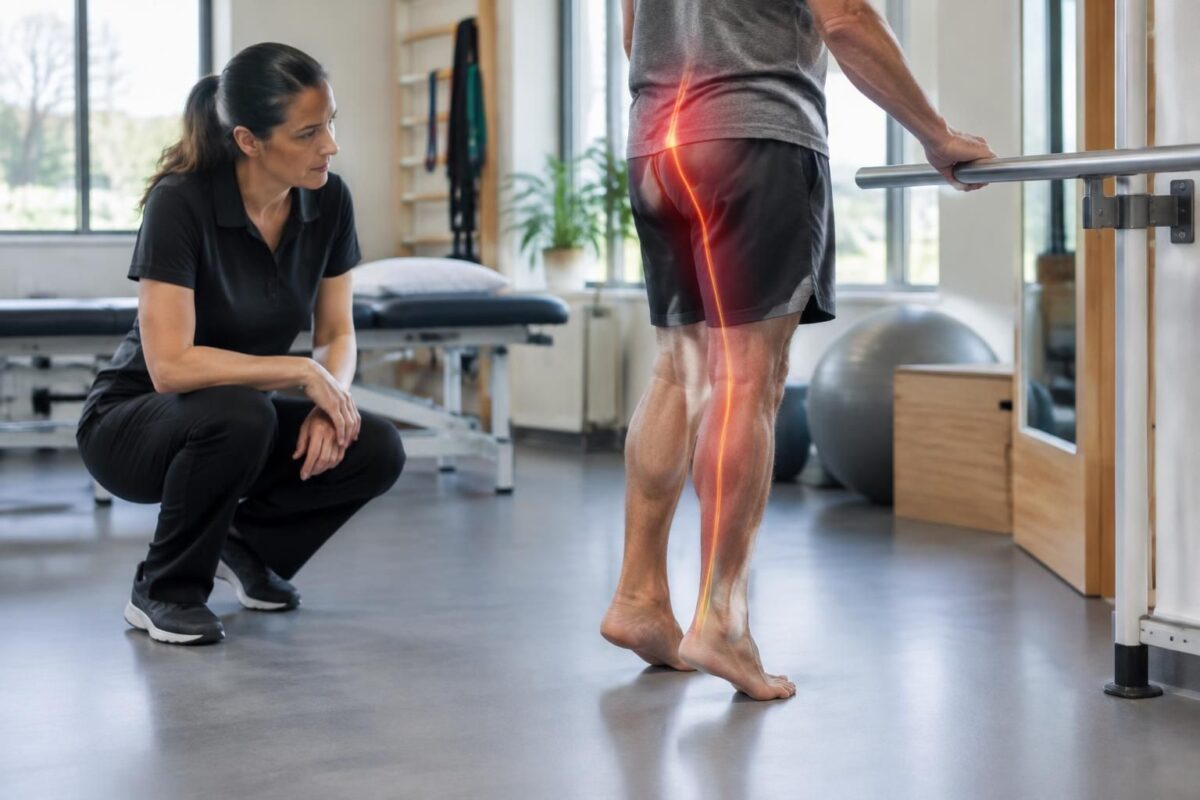
Sciatica in Terrebonne: S1 and difficulty standing on tiptoe
IN SHORT An S1 sciatica can irritate the nerve root associated with the calf and make it difficult to rise onto the balls of the feet. This sign should be evaluated with strength, sensitivity, reflexes, and walking: the pathway of…
Sciatica in Terrebonne: Describe Your Symptoms in Consultation
What You Feel
- Path: back or buttock, thigh, calf, foot or toes.
- Sensation: pain, burning, tingling or numbness.
- Side: right leg, left or both.
- Progression: onset, duration, and recent changes.
What Influences Your Daily Life
- Triggers: walking, sitting position, coughing or movements.
- Limits: sleep, movement, work, and activities.
- Strength: difficulty lifting foot or leg giving way.
- Urgent Signs: progressive weakness, loss of urinary or bowel control, numbness in the saddle: request an urgent medical evaluation.

During a consultation for sciatica in Terrebonne, a precise description of the pain, its path, its progression, and its effects on your activities helps the professional better understand your situation. Note when the symptoms started, what modifies them, and if you have noticed tingling, numbness, or weakness. This information directs the examination and the next steps, without replacing a medical diagnosis.

Sciatica in Terrebonne: L4-L5 and pain towards the top of the foot
IN BRIEF A L4-L5 sciatica can radiate to the outer side of the leg and the top of the foot, sometimes reaching the big toe. This pathway can guide the assessment, though it does not suffice to confirm the cause:…
Describe the Path and Nature of the Pain
Indicate the Affected Areas
Explain where the pain started and how far it descends: lower back, buttock, thigh, calf, foot, or toes. Specify if it affects one side or both, and whether its path remains similar or varies. You can show the concerned areas on your body or note them in advance. Pain that descends into the leg may indicate nerve irritation, but its path alone does not allow for determining the cause.
Choose Concrete Words
Describe the sensation in your own words: burning pain, stabbing, electric shock, pulling, tingling, or numbness. Indicate whether it is constant or intermittent. If you use a scale of 0 to 10, specify what your score corresponds to and whether it changes throughout the day. A numerical measure is useful, but it does not replace the description of your symptoms and their consequences.

Sciatica in Terrebonne: L5-S1 and symptoms in the calf
IN BRIEF A L5-S1 sciatica can cause pain that radiates down the calf, sometimes accompanied by tingling, numbness, or weakness. At Terrebonne, an assessment at the TAGMED Clinic helps to examine the symptom pathways, strength, and sensitivity, and then discuss…
Explain the Progression and Triggering Factors
Specify When Symptoms Occur
Note the date or period of onset, whether the appearance was sudden or gradual, and if an effort, a fall, or a long sitting period preceded the symptoms. State whether coughing, certain movements, sitting position, walking, or sleeping influence the pain. Also mention what seems to relieve it, such as changing position or temporarily reducing an activity.
Discuss Function in Daily Life
Provide concrete examples: difficulty driving, working, climbing stairs, walking, dressing, or sleeping. Indicate how long you can walk or sit before needing to take a break. Explain whether your ability varies from day to day and if you have had to modify your professional tasks or usual activities. This impact helps track progression beyond merely assessing the intensity of the pain.

Sciatica in Terrebonne: pain in the big toe, L5 root or another cause?
IN BRIEF Pain in the big toe accompanied by pain in the buttock or leg may be compatible with irritation of the L5 root, but other causes are possible. In Terrebonne, the evaluation notably compares strength, sensitivity, and gait to…
Report Neurological Symptoms and Relevant Elements
Describe any changes in sensitivity, any weakness, and any difficulty in lifting the foot or walking on heels or toes. Indicate when these signs started and if they are progressing. Also inform the professional about your previous episodes of low back pain, your health issues, your treatments, any recent trauma, and any significant history, including recent cancer or infection.
Recognize Signs That Require Urgent Evaluation
New urinary or bowel disturbances, numbness around the perineum or saddle area, significant or rapidly progressive weakness, or marked deterioration in walking require urgent medical evaluation. Do not wait for a routine consultation in these circumstances. In case of fever, significant trauma, or rapid deterioration, seek medical advice immediately.

Sciatica in Terrebonne: why the affected root changes the pain path
IN BRIEF Sciatica is a pain related to the irritation of a lumbar nerve root, the path of which varies depending on the affected root. Damage to L5 can radiate to the top of the foot, while damage to S1…
Prepare for Your Consultation in Terrebonne
If possible, bring a list of your medications and the results of any previous examinations. Prepare some questions about activities to adapt, signs to monitor, and options appropriate to your situation. Imaging is not automatically necessary: the decision depends on symptoms, examination, and their evolution. An evaluation allows for discussion of conservative options or determination of whether further medical advice is indicated.
For an evaluation related to sciatica in Terrebonne, TAGMED Clinic can inform you about available services and possible approaches based on your profile. The care provided does not replace a medical examination when it is necessary.

Sciatica in Terrebonne: L4-L5 disc, L5-S1 disc, and leg pain
IN BRIEF Sciatica is pain that travels down the leg when a nerve root is irritated. An injury to the L4-L5 disc often affects the L5 root; an L5-S1 injury affects the S1 root. The path of the pain and…
About the Author
Dr. Sylvain Desforges, B.Sc., D.O., N.D., osteopath, is the founding president of TAGMED and the ACMA association. His practice focuses on chronic spinal pain, low back pain, and symptoms consistent with sciatica. Through SOS Sciatique, he publishes educational content on symptoms, their possible causes, and non-surgical approaches that can be considered after evaluation.

Sciatica in Terrebonne: understanding lumbar levels on an MRI
IN BRIEF Sciatica may be related to irritation of a lumbar nerve root. A lumbar MRI shows the disks and nerves at different levels, such as L4-L5 or L5-S1, to help identify an abnormality and compare it with symptoms. In…
Medical Disclaimer
This content is provided for educational purposes and does not replace a consultation, diagnosis, advice, or treatment by a physician or other licensed health professional. The author is neither a physician nor a specialist in a medical specialty recognized by the Collège des médecins du Québec. Osteopathy, manual medicine, or functional support approaches do not constitute medical acts and do not replace medical follow-up. In case of urgent signs, consult a physician or an emergency service.
| To Describe | Useful Guidelines in Consultation |
|---|---|
| Pain Pathway | Indicate where it starts and how far it goes down: buttock, thigh, calf, foot, or toes. |
| Onset and Duration | Specify when symptoms started, their evolution, and if they are continuous or episodic. |
| Feelings | Describe the pain, tingling, pins and needles, or numbness. |
| Intensity and Frequency | Note the intensity, when symptoms are most present, and their evolution. |
| Triggers and Relief | Mention positions, movements, efforts, or coughing that change the symptoms. |
| Strength and Walking | Report any weakness, a leg giving way, difficulty walking, or recent changes in mobility. |
| Daily Impact | Explain which activities, sleep, or work have become difficult. |
| Context and Care Already Tried | Indicate your history, ongoing treatments, and measures already attempted. |
| Urgent Signs | Significant or progressive weakness, loss of sensitivity between the legs, or new urinary or bowel disturbances require urgent medical evaluation. |

Sciatica L4-L5 in Terrebonne: possible pain, numbness, and weakness
IN BRIEF L4-L5 sciatica refers to pain related to irritation of a nerve root in the lower back. It can radiate to the buttock and leg, with numbness or weakness. Identifying these symptoms helps guide evaluation and care. In Terrebonne,…
Sciatica in Terrebonne: Examples of Testimonials to Describe Your Symptoms in Consultation
During a consultation for possible sciatica, precisely describing what you feel helps the professional understand your situation. The pathway of pain, unusual sensations, their evolution, and their effect on your activities are often more informative than a simple note of intensity.
Note: The testimonials below are fictional examples of formulations. They do not represent real patients and do not, by themselves, allow for a diagnosis.
Example: Pain Descending from the Buttock to the Leg
“For the past few days, I have had pain in the lower back and right buttock. It descends behind the thigh to the calf. It gets worse when I sit for long periods or cough. Walking slowly sometimes seems more comfortable.”
This description specifies the affected side, the pathway of the pain, its duration, and certain factors that modify it. If the pain does not start in the back, mention that too: some people primarily feel discomfort in the buttock or leg.
Example: Tingling or Numbness
“In addition to the pain, I feel a tingling sensation on the side of my leg and on the top of my foot. It comes and goes. I mainly notice this sensation after standing or sitting for a while.”
Indicate where the tingling or numbness is located, whether it is constant or intermittent, and if it spreads. You can also mention if the sensitive area has changed since the onset of symptoms.
Example: Weakness or Difficulty Walking
“Since yesterday, my foot seems less easy to lift and I sometimes trip while walking. I don’t know if my leg is actually weaker, but walking feels different.”
A new or progressive weakness, a foot drop, or a leg giving way deserves particular attention. Describe what you can no longer do and since when, even if you are not sure of the cause.
Useful Information to Prepare
Before your consultation in Terrebonne, you can note when the symptoms started, their evolution, their location, and the activities that exacerbate or relieve them. Also specify if the pain appeared after an effort or trauma, if it wakes you up at night, and if it is accompanied by symptoms in the other leg.
Mention the effects on your daily life: difficulty walking, sleeping, driving, working, bending, or sitting. Also report your history of back problems, your health conditions, and any medications or other treatments already attempted.
During a consultation, the evaluation may particularly focus on walking, strength, sensitivity, and certain reflexes. Symptoms are interpreted as a whole: pain in a specific area or a imaging result is not always sufficient to explain what you are feeling on its own.
When to request urgent evaluation
Do not hesitate to consult a medical service if you have new urinary or bowel troubles, loss of sensitivity in the perineum or saddle area, significant or rapidly worsening weakness, or marked deterioration in walking. A fever, recent trauma, or rapid deterioration also warrants medical evaluation.
About the author
Dr. Sylvain Desforges, B.Sc., D.O., N.D., osteopath, is the founding president of TAGMED and the ACMA association. His practice primarily deals with chronic spinal pain, low back pain, and pain compatible with sciatica, including when it radiates to the buttock, leg, calf, foot, or toes.
Through SOS Sciatique, he publishes educational content on sciatica symptoms, their possible causes, and non-surgical approaches that may be considered depending on the evaluation. Treatments offered at the TAGMED Clinic may include, depending on the situation, motorized neurovertebral decompression, specific osteopathy, or precision percussion.
Medical warning
The information presented is provided for educational purposes and does not replace a consultation, diagnosis, advice, or treatment performed by a physician or other authorized health professional. The author is neither a doctor nor a specialist in a medical specialty recognized by the Collège des médecins du Québec. Osteopathy, manual medicine, or functional support approaches do not constitute medical acts and do not replace medical follow-up.
During a consultation for sciatica in Terrebonne, accurately describing what you are feeling helps the professional understand the evolution of your symptoms and their effect on your activities. Sciatica generally refers to pain or abnormal sensations following the path of a nerve root from the lower back to the buttock and leg. It does not manifest identically in everyone: pain may stop at the thigh, descend to the calf, or reach the foot.
Start by explaining where the pain begins and how far it spreads. Indicate if it starts from the lower back, the buttock, or another area, then specify the affected areas: back or side of the thigh, leg, heel, top of the foot, or toes. Mention the affected side and say if both legs are involved. You can show the path with your hand or draw it. Tingling, prickling, or a sense of numbness are also important elements to describe.
Next, specify when the symptoms began and how they have evolved. For example, did they appear after exertion, unusual movement, or gradually? Are they constant or intermittent? Note what exacerbates them—such as coughing, certain position changes, walking, or an activity—and what eases them. Also mention treatments already tried and their effect, even if it was limited.
Pain alone does not always provide a complete picture of the situation. Explain its intensity but also its impact on your function: sleep, work, driving, walking, stairs, or daily tasks. Report if you need to stop after a certain distance, if your leg seems less stable, or if you have difficulty lifting your foot or standing on your toes. Any new or worsening weakness should be reported without waiting for a routine appointment.
During the assessment, the professional may inquire about your history, examine back mobility, and check strength, sensitivity, reflexes, and walking. The examination helps put symptoms in context; one test or a painful area is not enough to establish a cause. Imaging is not routinely performed initially for a typical presentation without concerning signs. It may be considered depending on the evolution, examination results, or the presence of particular signs.
Quickly consult a medical service if you notice significant or progressive weakness, a leg that is giving way more, or marked deterioration in walking. New difficulties controlling the bladder or bowels, urinary retention, or numbness around the perineum require urgent evaluation. Also mention a fever, recent trauma, or deterioration in your general condition.
To prepare for your consultation in Terrebonne, you can note the start date, the path of symptoms, the activities that have become difficult, and the changes observed. This clear description facilitates an appropriate evaluation and discussion of the next steps. Depending on your situation, these may include advice, temporary adaptation of activities, a rehabilitation approach, or medical referral. Options should be chosen based on the examination and do not guarantee identical results for everyone.
About the author
Dr. Sylvain Desforges, B.Sc., D.O., N.D., osteopath, is the founding president of TAGMED clinics and the ACMA association. His practice focuses on chronic spinal pain, low back pain, and symptoms compatible with sciatica. He is interested in integrating manual approaches and technologies, including motorized neurovertebral decompression, depending on the evaluation and the needs of the person.
Medical warning
This content is provided for educational purposes and does not replace a consultation, diagnosis, or treatment by a physician or another authorized health professional. The author is neither a doctor nor a specialist in a medical specialty recognized by the Collège des médecins du Québec. Osteopathy and manual medicine approaches do not constitute medical acts and do not replace medical follow-up. In the presence of urgent signs or rapid deterioration, consult a physician or an emergency service.
During a consultation for sciatica in Terrebonne, accurately describing the path of the pain, unusual sensations, their evolution, and their effects on your activities helps the professional guide their evaluation. Also note any weakness or changes in walking: these elements, along with your history and clinical examination, help determine the appropriate next steps.
Describing your symptoms usefully
Indicate where the pain started — in the lower back, the buttock, or the leg — and how far it goes down. Specify if it reaches the thigh, goes under the knee, extends to the calf or the foot. It may sometimes be felt mainly in the buttock, as in this example of deep buttock pain radiating into the thigh in Terrebonne, or travel down to the little toe, a path that may be associated with irritation of the S1 root without being sufficient on its own to establish a diagnosis.
Also describe the nature of the sensations: sharp pain, burning, electric shock, tingling, prickling, or numbness. Mention whether the symptoms are present on one side or both, if they vary with positions, and if they are accentuated by coughing, certain movements, or prolonged sitting. The pages on pain that goes below the knee and pain towards the little toe illustrate possible pathways, but each situation should be assessed as a whole.
To facilitate communication, you may note when the symptoms began, whether they appeared gradually or after an effort, and if they improve, remain stable, or worsen. Describe their intensity, but also what you can still do: walk, sleep, work, drive, or bend over. Discomfort that makes long trips difficult, for example, deserves to be explained concretely; also refer to this page on sciatica that prevents long driving. General advice for better conveying your observations is offered in this guide to correctly describe a symptom.
Specify the evolution and repercussions
Report factors that seem to modify the pain: walking, resting, changes in position, professional activity, or sitting posture. Also explain if the pain appears more pronounced in the leg than in the lower back. This difference may be part of the picture, but the intensity or location of the pain, taken in isolation, does not allow for identifying the cause. To delve deeper, you can read why sciatic pain may be stronger in the leg.
Bring a list of your current medications and treatments, as well as pertinent information about your medical history: previous episodes of low back pain, trauma, known health issues, or treatments already tried. You can also note the questions you want to ask. The information from Health Insurance on the consultation and treatment of sciatica and the recommendations regarding sciatica provide general guidelines on evaluation and management.
During the assessment, the examination may focus on strength, sensitivity, reflexes, and walking. Imaging is not automatically necessary at the onset of a typical presentation without concerning signs: the decision depends on the evolution, clinical findings, and medical indications. An anomaly visible on imaging should also be interpreted in relation to the symptoms and examination, not separately.
Recognize signs that require prompt attention
Do not hesitate to seek medical evaluation if you notice new or progressive weakness, a foot dropping, a leg giving way, or deterioration in your walking. New urinary or intestinal issues, a loss of sensitivity around the perineum or in the area known as the “saddle,” very intense pain, or rapid deterioration require urgent attention. In the presence of these signs, do not limit yourself to a routine consultation.
If you wish to have your situation evaluated in Terrebonne, the page dedicated to the treatment of sciatica in Terrebonne presents the services available at the TAGMED Clinic. You can also consult the guide on symptoms of sciatica. An assessment can help clarify the options available based on your profile; it does not replace a medical diagnosis when necessary.
About the author
Dr. Sylvain Desforges, B.Sc., D.O., N.D., osteopath, is the founding president of TAGMED and the ACMA association. He dedicates his practice to chronic spinal pain, lower back pain, and pain compatible with sciatica, particularly when the pain travels to the buttock, leg, calf, foot, or toes.
Through SOS Sciatique, he publishes educational content on the symptoms of sciatica and its possible causes, as well as non-surgical approaches that may be considered based on the evaluation. At the TAGMED Clinic, care may include, as appropriate, motorized neurovertebral decompression, specific osteopathy, or precision percussion.
Medical disclaimer
The information published on SOS Sciatique is provided for educational purposes and does not replace a consultation, diagnosis, advice, or treatment provided by a doctor or another authorized healthcare professional. The author is neither a doctor nor a specialist in a medical specialty recognized by the Collège des médecins du Québec. The osteopathy, manual medicine, or functional support approaches described on this site do not constitute medical acts and are not intended to replace medical follow-up. In case of loss of bladder or bowel control, anesthesia in the saddle area, significant or progressive weakness, fever, recent trauma, severe pain, or rapid worsening, consult a doctor or an emergency service. For more details, please read our Legal Notice.

Dr Sylvain Desforges, B.Sc., D.O., N.D., osteopath, is the founding president of TAGMED and of the ACMA association. He dedicates his practice to chronic spinal pain, low back pain and symptoms compatible with sciatica, particularly when pain radiates toward the buttock, leg, calf, foot or toes.
Through SOS Sciatique, he publishes educational content on sciatica symptoms, possible causes such as disc herniation, disc narrowing, foraminal stenosis or irritation of a lumbar nerve root, as well as non-surgical approaches that may be considered according to the evaluation. At Clinique TAGMED, care may include, depending on the case, motorized neurovertebral decompression, specific osteopathic care or precision percussion.
For an evaluation related to sciatica treatment in Montreal / Mount Royal or sciatica treatment in Terrebonne, please consult the services available at Clinique TAGMED.
Medical disclaimer
The information published on SOS Sciatique is provided for educational purposes only and does not replace a consultation, diagnosis, opinion or treatment provided by a physician or another authorized healthcare professional. The author of this article is neither a medical doctor nor a specialist in a medical specialty recognized by the Collège des médecins du Québec. The osteopathic, manual medicine or functional support approaches described on this site do not constitute medical acts and are not intended to replace medical follow-up.
Consult a physician or emergency service in cases of loss of bladder or bowel control, anesthesia in the saddle area, significant or progressive weakness in the leg or foot, fever, recent trauma, severe pain or rapid worsening of symptoms. For more details, please read our Legal Notice.


