Sciatica in Montreal: disc herniation with leg weakness
18/11/2026
Sciatica and pain after trauma: warning sign
18/11/2026
IN SHORT Sciatica related to a disc herniation can cause pain that radiates down the leg, sometimes accompanied by weakness. In Terrebonne, an assessment helps guide management based on symptoms and their progression. A new, significant, or progressive weakness requires prompt medical consultation; non-surgical approaches are appropriate only after proper evaluation. |
A lumbar disc herniation can irritate a nerve root and cause sciatica with pain in the leg, numbness, or weakness. In Terrebonne, an assessment helps better understand the symptoms and examine non-surgical support options suitable for your situation. A new or worsening weakness requires prompt medical evaluation; in case of loss of bladder or bowel control, seek emergency services immediately.
A lumbar disc herniation can irritate a nerve root and cause pain that radiates into the buttock and leg. Weakness in the leg or foot may also appear. This sign warrants evaluation by a healthcare professional, especially if it progresses. In Terrebonne, an assessment helps clarify symptoms, determine if medical intervention is necessary, and discuss care options suitable for your situation.
How can a disc herniation cause leg weakness?
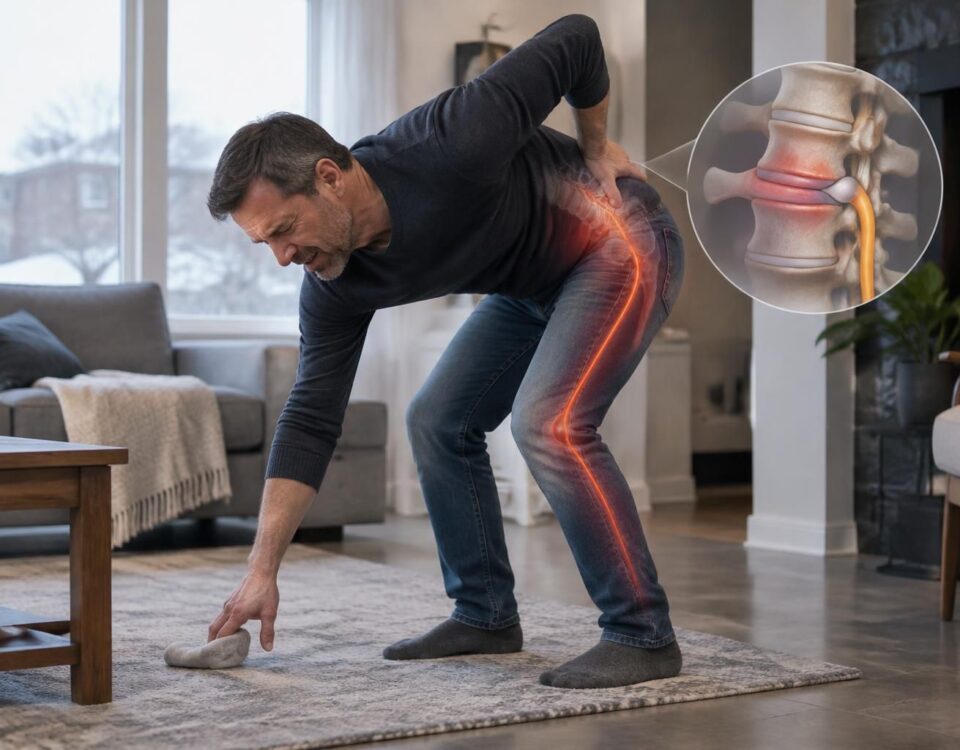
The discs located between the vertebrae cushion loads and facilitate movement of the spine. A part of a disc may bulge or move out of place. If this herniation irritates or compresses a nerve root, it can cause low back pain that follows the pathway of the nerve down the leg. Tingling, loss of sensation, or a decrease in muscle strength may also occur.
Weakness sometimes depends on the affected nerve root. The painful area and difficult movements may therefore vary from person to person. To learn more about the pathway of symptoms, refer to this article on the affected nerve root and the pain pathway.
Real weakness or movement limited by pain?
Severe pain can prevent a person from pushing or raising the leg with full strength. This limitation does not always mean a muscle has lost its strength. A healthcare professional can examine strength, sensitivity, and reflexes to better distinguish between pain-related weakness and neurological deficit.
Certain signs can guide the evaluation. Difficulty in lifting the foot or big toe may be associated with certain lumbar roots. Difficulty standing on tiptoe may warrant particular attention. However, these signs alone are not sufficient to confirm the cause of the symptoms.
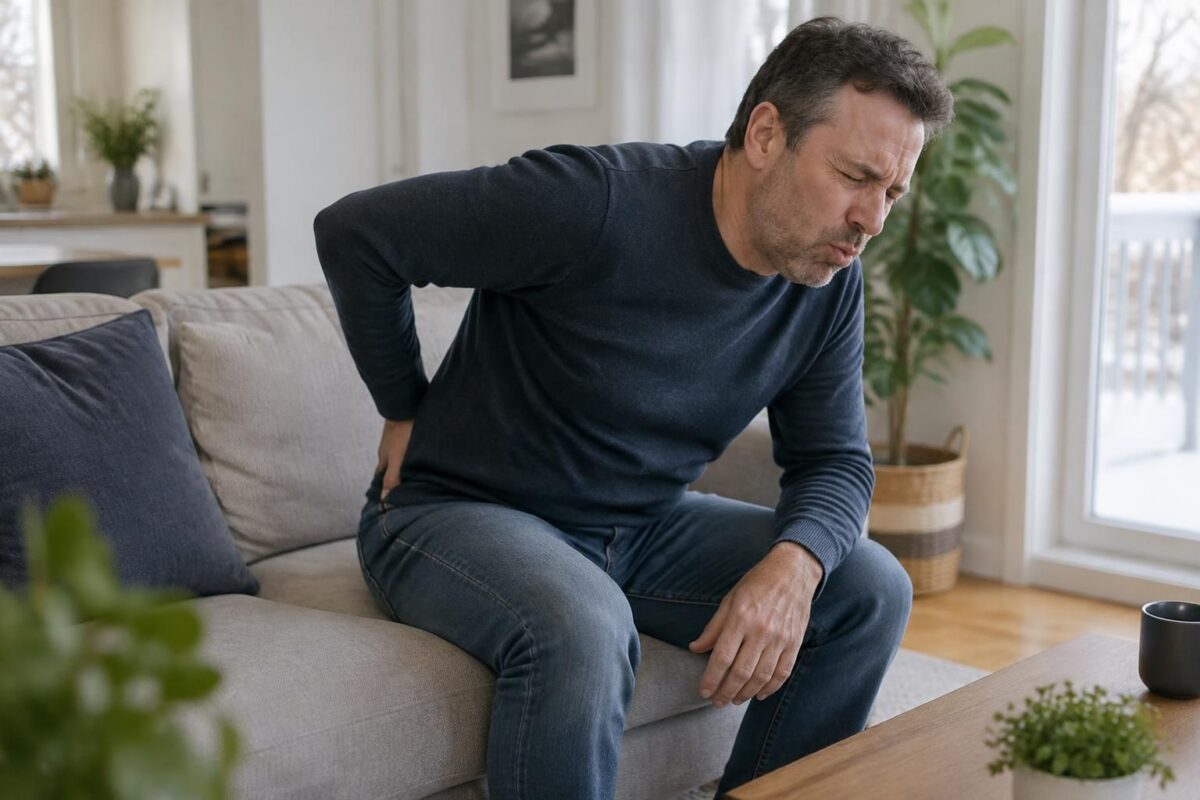
Sciatica in Terrebonne: disc herniation and painful cough
IN BRIEF In Terrebonne, sciatica related to a herniated disc may be accompanied by pain that increases when coughing, as the pressure exerted can further irritate a nerve root. An evaluation helps to understand the origin of the symptoms and…

Sciatica in Terrebonne: pain worsened in sitting position and lumbar disc
IN SHORT Aggravated sciatica in a sitting position may be related to the irritation of a lumbar nerve root, sometimes associated with a lumbar disc. In Terrebonne, varying positions, taking short active breaks, and getting an evaluation can help better…
What symptoms to watch for?
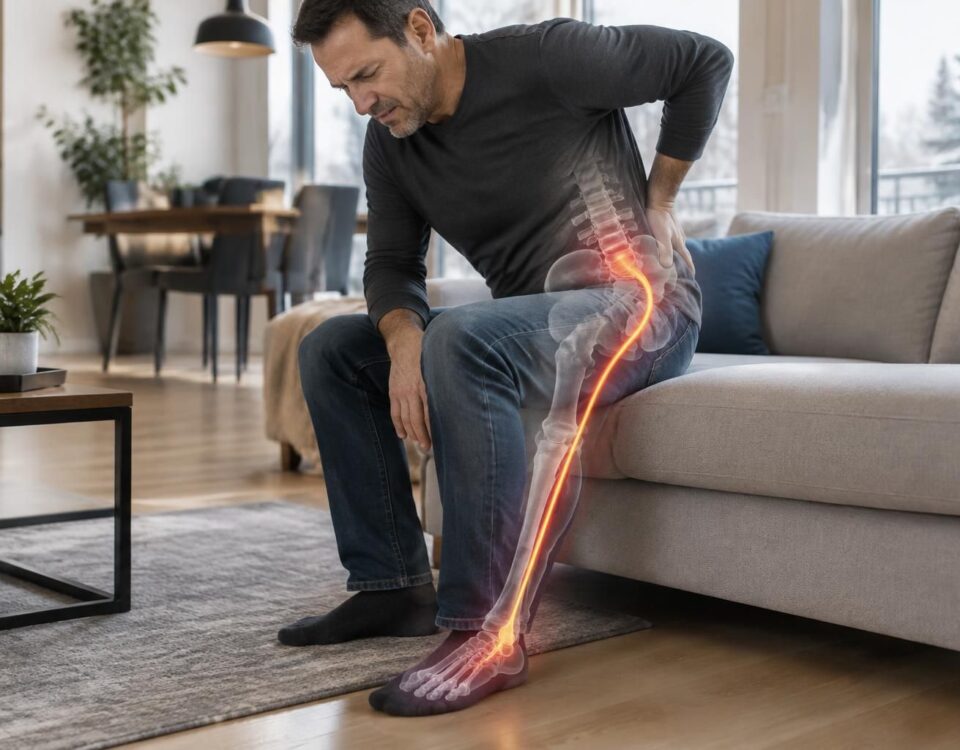
Sciatica can cause pain that starts in the lower back and radiates to the buttock, thigh, calf, or foot. Some people also feel numbness, tingling, or a burning sensation. The pain may affect only one side, but the symptoms vary according to the cause and the affected nerve root.
Numbness in the big toe accompanied by low back pain may be part of the symptoms to report during an assessment. Also, read our page on numbness in the big toe and low back pain.
A herniation between the L5 and S1 vertebrae may sometimes be associated with pain radiating down to the foot. To understand this link, refer to the article on the L5-S1 herniation and pain down to the foot.

Sciatica in Terrebonne: pain worsened by flexion and disc-related cause
IN BRIEF Aggravated sciatica by flexion is pain that starts in the lower back and radiates into the buttock or leg; a lumbar disc herniation can irritate a nerve root, although it may not be the only possible cause. In…

Disc herniation in Terrebonne: why some stretches worsen
IN BRIEF Discogenic sciatica is pain related to the irritation of a nerve, sometimes worsened by certain stretches that intensify the symptoms. In Terrebonne, avoiding movements that cause pain to radiate down the leg and focusing on an appropriate approach…
When should you seek prompt consultation?
Consult a doctor promptly if a new or growing weakness affects the leg or foot. Loss of strength may require immediate medical evaluation. Seek emergency services in case of loss of bladder or bowel control, numbness in the saddle region, or significant and progressive weakness.
Fever, recent trauma, severe pain, or rapid deterioration also require medical evaluation. Do not rely solely on the intensity of the pain: a strength deficit deserves special attention even if the pain seems moderate.

Sciatica disc in Terrebonne: movements to avoid at the beginning
IN BRIEF Disc-related sciatica corresponds to a nerve irritation that can cause pain from the lower back to the buttock or leg. Initially, avoid movements that worsen the pain, such as deep bends, sudden twists, and carrying heavy loads. In…

Sciatica in Terrebonne: herniated disc with foot numbness
IN BRIEF Sciatica related to a herniated disc can irritate a nerve root and cause pain that radiates down the leg, sometimes with a numbness in the foot. In Terrebonne, an evaluation helps to better understand the symptoms and consider…
How can evaluation help?
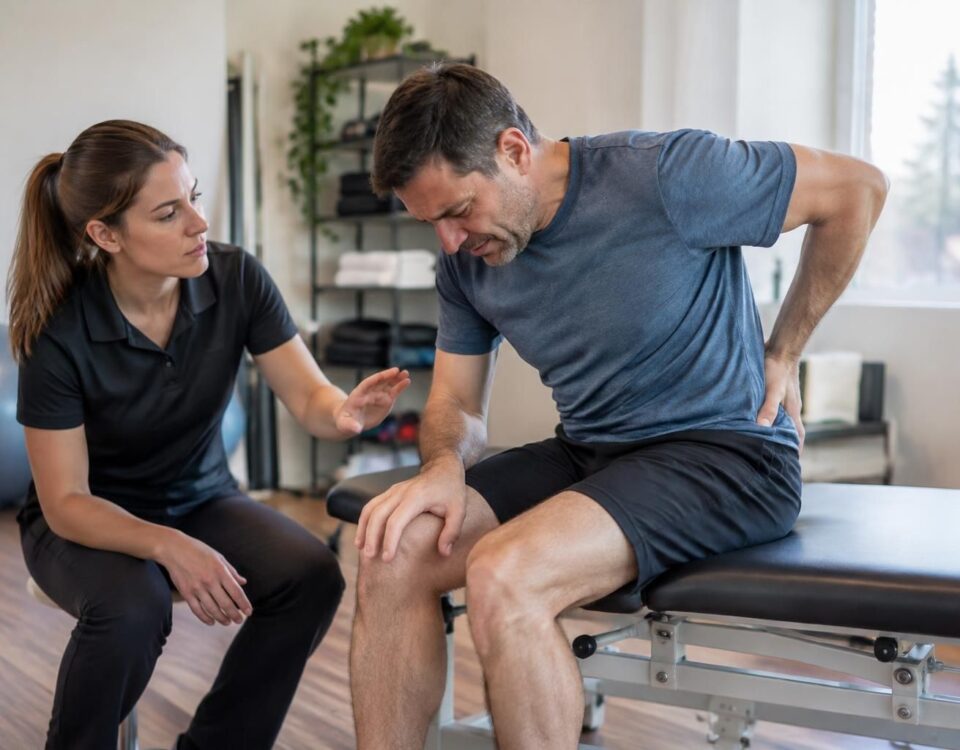
A healthcare professional examines the symptoms, their progression, and the movements that pose problems. They can check muscle strength, sensitivity, and reflexes. Depending on the results, they may recommend medical consultation or imaging studies. An image alone does not always explain the pain; it must be interpreted alongside symptoms and clinical examination.
Compression in the L5-S1 region may concern the canal or a passage where a nerve root travels. To better understand these concepts, refer to the article on the canal, foramen, and nerve compression at L5-S1.
A difficulty standing on tiptoe can be a sign to clearly describe to the professional evaluating you. Our article on S1 and difficulty standing on tiptoes presents this sign and its possible context.

Sciatica in Terrebonne: lumbar disc and nerve root inflammation
IN BRIEF Lumbar disc-related sciatica occurs when irritation or inflammation of a nerve root causes pain that may radiate from the buttock down to the leg. In Terrebonne, an evaluation can help better understand the cause of symptoms and identify…

Sciatica and disc pinching in Terrebonne: when space decreases
IN BRIEF The disc bulge corresponds to a reduction in the space between two vertebrae; it can sometimes contribute to nerve irritation and sciatica, with pain that radiates down the buttock or leg. In Terrebonne, an assessment allows for a…
What management options to discuss in Terrebonne?
Management depends on the examination, the likely cause, the intensity of symptoms, and their progression. Any significant or progressive weakness should first be evaluated by a doctor. Manual therapy or non-surgical approaches do not replace this evaluation and may not be suitable for all situations.
At the TAGMED Clinic, an evaluation can help determine if care such as specific osteopathy, precision percussion, or motorized neurovertebral decompression can be considered. These options are not suitable for all cases and do not guarantee results. The clinic can also refer the person for medical evaluation when symptoms warrant it.
To learn more about the available services, visit the page dedicated to the sciatica treatment in Terrebonne. In case of leg weakness, describe your loss of strength in detail and indicate if it is worsening.
About the author
Sylvain Desforges, B.Sc., D.O., N.D., Doctor of Osteopathy and Naturopath, is the founding president of TAGMED and the ACMA association. He dedicates his practice to chronic pain of the spine, lower back pain, and pain associated with sciatica, especially when the pain radiates down to the buttock, leg, calf, foot, or toes.
Through SOS Sciatique, he publishes educational content on sciatica symptoms, possible causes such as herniated disc, disc pinching, foraminal stenosis, or irritation of a lumbar nerve root, as well as non-surgical approaches that may be considered based on the assessment. At the TAGMED Clinic, treatments may include, depending on the case, motorized neurovertebral decompression, specific osteopathy, or precision percussion.
For an assessment related to sciatica treatment in Montreal / Mont-Royal or sciatica treatment in Terrebonne, check the available services at TAGMED Clinic.
Medical warning
The information published on SOS Sciatique is provided for educational purposes and does not replace a consultation, diagnosis, opinion, or treatment conducted by a physician or another licensed healthcare professional. The author of this article is neither a doctor nor a specialist in a medical specialty recognized by the Collège des médecins du Québec. The approaches to osteopathy, manual medicine, or functional support described on this site do not constitute medical acts and are not intended to replace medical follow-up.
Consult a physician or an emergency service in case of loss of bladder or bowel control, anesthesia in the saddle area, significant or progressive weakness of the leg or foot, fever, recent trauma, severe pain, or rapid deterioration. For more details, please read our Legal Notice.
Medical disclaimer: The information and advice provided on this site do not replace the opinion, diagnosis, or treatment of a healthcare professional. Please note that Sylvain Desforges, B.Sc., D.O., N.D., Doctor of osteopathy, is neither a medical doctor nor a physician, and is not a specialist in a medical specialty as defined by the Collège des médecins du Québec. Manual medicine, functional medicine, and sports medicine as described on this site exclude any treatment or medical diagnosis made by a physician or a specialist physician. Always consult your doctor with any medical questions. For more details, please read our Complete Legal Notice.
Signs to watch for
- Pain radiating from the buttock down the leg
- Weakness when walking, climbing stairs, or raising the foot
- Symptoms that may be associated with a herniated disc, but do not confirm it by themselves
When to act
- Quickly evaluate any new weakness of the leg
- Consult urgently if it worsens or is accompanied by loss of bladder or bowel control
- In Terrebonne, an assessment will help determine the next steps suited to your situation

A sciatica associated with a herniated disc and leg weakness deserves special attention: weakness may signal nerve damage and should be evaluated quickly by a healthcare professional. In Terrebonne, clarify the cause of the symptoms before starting treatment; in the meantime, avoid efforts that worsen the pain and monitor any progression.
Leg weakness: when to seek help
A herniated disc can irritate a nerve root and cause pain that radiates from the lower back to the buttock, thigh, calf, or foot. Numbness, tingling, or a feeling of reduced stability in the leg may also occur. However, these symptoms alone do not confirm a herniated disc: a clinical examination is necessary, and imaging tests are determined by a professional based on the situation.
If the leg becomes increasingly weak, if the foot drags on the ground, or if you have difficulty walking, quickly contact a doctor or a healthcare service. Significant or progressive weakness requires urgent evaluation. Go to the emergency room in case of loss of bladder or bowel control, numbness in the saddle area, or rapidly worsening symptoms.
Cautious measures while awaiting evaluation
Stay active without overexerting
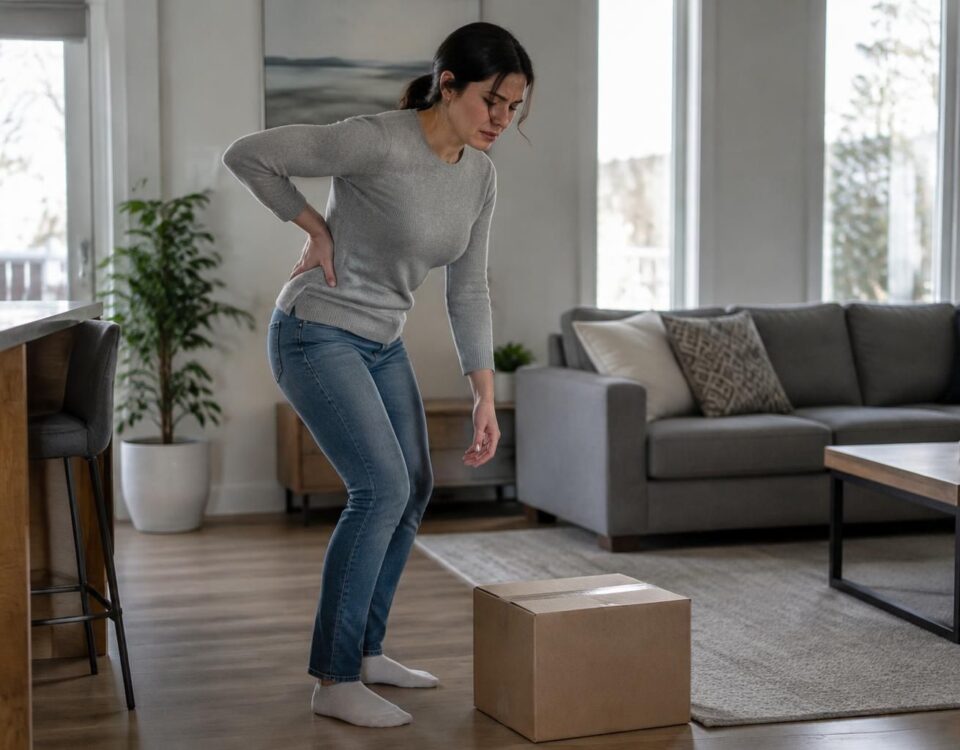
Avoid prolonged complete rest if you can move safely. Small tolerated movements can help maintain your activities, but do not try to “tough it out” through marked pain or weakness. Temporarily reduce heavy lifting, repeated twisting, and positions that trigger worsening. Change your posture regularly and choose a resting position that relieves your symptoms.
Avoid risky movements
Do not attempt sudden manipulations, forced stretching, or exercises found online without appropriate advice, especially if leg strength has changed. Note when weakness appears, the affected areas, and activities that influence the pain. This information will help the professional consulted. Also seek advice before taking medication, especially if you have other health issues or are already undergoing treatment.
Choosing Support in Terrebonne
The priority is to evaluate the weakness in order to rule out a condition requiring specific medical treatment. Depending on the results, the professional may recommend medical follow-up, rehabilitation, or other options. A manual or functional approach may sometimes be considered as support, but it does not replace medical diagnosis or urgent care, and must be tailored to your condition.
At the TAGMED Clinic, an evaluation can help discuss possible non-surgical options, including specific osteopathy or motorized neurovertebral decompression, when deemed appropriate. These treatments are not suitable for every situation and should not delay a medical consultation in the presence of weakness. For sciatica in Terrebonne, first request an evaluation tailored to your symptoms and their progression.
About the Author
Sylvain Desforges, B.Sc., D.O., N.D., Doctor of Osteopathy and naturopath, is the founding president of TAGMED and the ACMA association. His practice focuses particularly on chronic spinal pain and pain associated with sciatica.
Medical Disclaimer
This content is provided for educational purposes and does not substitute for a consultation, diagnosis, or treatment by a licensed healthcare professional. The author is neither a doctor nor a specialist in a medical specialty recognized by the Collège des médecins du Québec. Consult a doctor or an emergency service in case of loss of bladder or bowel control, anesthesia in the saddle region, significant or progressive weakness, fever, recent trauma, or rapid worsening.
| Check Point | Useful Reference |
|---|---|
| Leg Weakness | Note whether it is new, persistent, or worsening. |
| Movements Affected | Report any difficulty walking, climbing stairs, or lifting the foot. |
| Radiating Pain | Specify its path from the lower back to the buttock, leg, or foot. |
| Medical Evaluation | A weakness associated with sciatica merits prompt evaluation. |
| Emergency Signs | Loss of bladder or bowel control, numbness in the saddle area, or progressive weakness: medical emergency. |
| In Terrebonne | Request a tailored evaluation before considering non-surgical care. |
Illustrative Testimonials on Sciatica in Terrebonne
Important: The texts below are fictional examples, not testimonials from real patients. They should not be presented as authentic opinions or attributed to individuals without their consent.
Fictional Example — Weakness in the Leg
“My pain was descending from my lower back down to my leg, and I noticed unusual weakness. I realized it was important to have these symptoms evaluated by a healthcare professional before considering a complementary approach.”
Fictional Example — Suspected Herniated Disc
“I was told there might be a herniated disc after the onset of pain radiating into my buttock and leg. The evaluation helped me better understand the options suited to my situation and not to downplay the weakness I felt.”
Fictional Example — Cautious Approach
“I was seeking help in Terrebonne for pain like sciatica. As my leg seemed weaker, I first sought medical advice, then discussed support possibilities based on the recommendations I received.”
Important to Remember: A new or worsening weakness in the leg or foot requires rapid medical evaluation. In case of loss of bladder or bowel control, numbness in the saddle region, or significant or progressive weakness, consult an emergency service without delay.
Sciatica in Terrebonne: Herniated Disc and Leg Weakness
Sylvain Desforges, B.Sc., D.O., N.D., Doctor of Osteopathy and naturopath, dedicates his practice to supporting individuals living with persistent spinal pain. As the founding president of TAGMED clinics and the ACMA association, he has a particular interest in lower back pain and symptoms compatible with sciatica, especially when they radiate down to the buttock, leg, calf, or foot.
In Terrebonne, pain that starts from the lower back and radiates into a leg may be associated with irritation of a nerve root. A lumbar herniated disc is one possible cause, but it does not necessarily explain all symptoms and cannot be confirmed by a simple description of the pain. Evaluating symptoms, their progression, and functional capabilities helps determine the appropriate next steps.
Leg weakness deserves particular attention. It may manifest as difficulty climbing stairs, lifting the foot, walking on the heels, or getting up from a chair. It is important to distinguish a sensation of fatigue or limitation due to pain from a real loss of strength. A new, marked, or progressive weakness requires rapid medical evaluation; it should not be addressed solely through manual therapy.
In his educational content, Sylvain Desforges presents the possible causes of sciatica, such as a herniated disc, disc pinch, foraminal stenosis, or lumbar nerve irritation. He reminds us that similar symptoms can have different origins and that a licensed healthcare professional can determine if a medical examination or further investigations are warranted.
At the TAGMED Clinic, support options are considered based on the situation and evaluation of each person. They may include specific osteopathy, motorized neurovertebral decompression, or the use of a precision impactor. The clinic is also interested in integrating technologies such as spinal decompression, laser, or shockwave therapy, when deemed relevant. No approach suits everyone, and results cannot be guaranteed. The goal is to discuss possible non-surgical options and their limitations without replacing medical follow-up when necessary.
Sylvain Desforges’ mission is to provide clear information and support focused on functional well-being, taking into account available data and the specific needs of each individual. For sciatica in Terrebonne accompanied by leg weakness, it is essential not to delay a medical consultation to assess the cause and severity of the symptom before undertaking treatment.
Medical warning: this information is educational and does not replace a consultation, diagnosis, or treatment by a doctor or another licensed health professional. Sylvain Desforges is neither a doctor nor a specialist in a medical specialty recognized by the College of Physicians of Quebec. In the event of loss of bladder or bowel control, numbness in the saddle area, significant or progressive weakness, fever, recent trauma, or rapid deterioration, consult a doctor or emergency service without delay.
In Terrebonne, a herniated disc accompanied by leg weakness deserves special attention: pain may follow the path of a nerve, while weakness may indicate a functional impairment that needs evaluation. An examination by a health professional helps clarify the situation and determine the appropriate next steps.
Herniated disc and leg weakness: points to watch for
A lumbar herniated disc can irritate a nerve root and cause pain in the lower back, buttock, or leg. Numbness, tingling, or a decrease in strength may also occur. To better understand the link between the disc and nerve irritation, refer to this article on the lumbar disc and nerve root inflammation.
Weakness may manifest as difficulty walking on heels or toes, climbing stairs, or having a foot that drags on the ground. Note when it occurs, if it worsens, and which activities have become difficult. This information can help the consulted professional better understand the progression of symptoms, but it does not replace an examination.
Symptoms are not always constant. Some people experience intermittent pain, while others have persistent pain; weakness may also vary. To distinguish these experiences, you can read information on intermittent or constant pain and on nerve pain and sensitive territory.
Changes in position or exertion can sometimes modify symptoms. You may observe whether pain increases during transitions between sitting and standing, or if it appears after physical exertion with radiation into the leg. These observations are useful to communicate during an evaluation; they do not, by themselves, confirm a herniated disc.
In the presence of new, significant, or progressive weakness, seek medical advice quickly. Loss of bladder or bowel control, numbness in the saddle area, or rapid deterioration requires urgent evaluation. A non-surgical approach should only be considered after appropriate evaluation and does not replace indicated medical follow-up.

Sylvain Desforges, B.Sc., D.O., N.D., docteur en ostéopathie
Dr Sylvain Desforges, B.Sc., D.O., N.D., osteopath, is the founding president of TAGMED and of the ACMA association. He dedicates his practice to chronic spinal pain, low back pain and symptoms compatible with sciatica, particularly when pain radiates toward the buttock, leg, calf, foot or toes.
Through SOS Sciatique, he publishes educational content on sciatica symptoms, possible causes such as disc herniation, disc narrowing, foraminal stenosis or irritation of a lumbar nerve root, as well as non-surgical approaches that may be considered according to the evaluation. At Clinique TAGMED, care may include, depending on the case, motorized neurovertebral decompression, specific osteopathic care or precision percussion.
For an evaluation related to sciatica treatment in Montreal / Mount Royal or sciatica treatment in Terrebonne, please consult the services available at Clinique TAGMED.
Medical disclaimer
The information published on SOS Sciatique is provided for educational purposes only and does not replace a consultation, diagnosis, opinion or treatment provided by a physician or another authorized healthcare professional. The author of this article is neither a medical doctor nor a specialist in a medical specialty recognized by the Collège des médecins du Québec. The osteopathic, manual medicine or functional support approaches described on this site do not constitute medical acts and are not intended to replace medical follow-up.
Consult a physician or emergency service in cases of loss of bladder or bowel control, anesthesia in the saddle area, significant or progressive weakness in the leg or foot, fever, recent trauma, severe pain or rapid worsening of symptoms. For more details, please read our Legal Notice.