Sciatica in Montreal: L5-S1 Herniation and Pain Towards the Foot
30/10/2026
Sciatica and pain that varies with posture
30/10/2026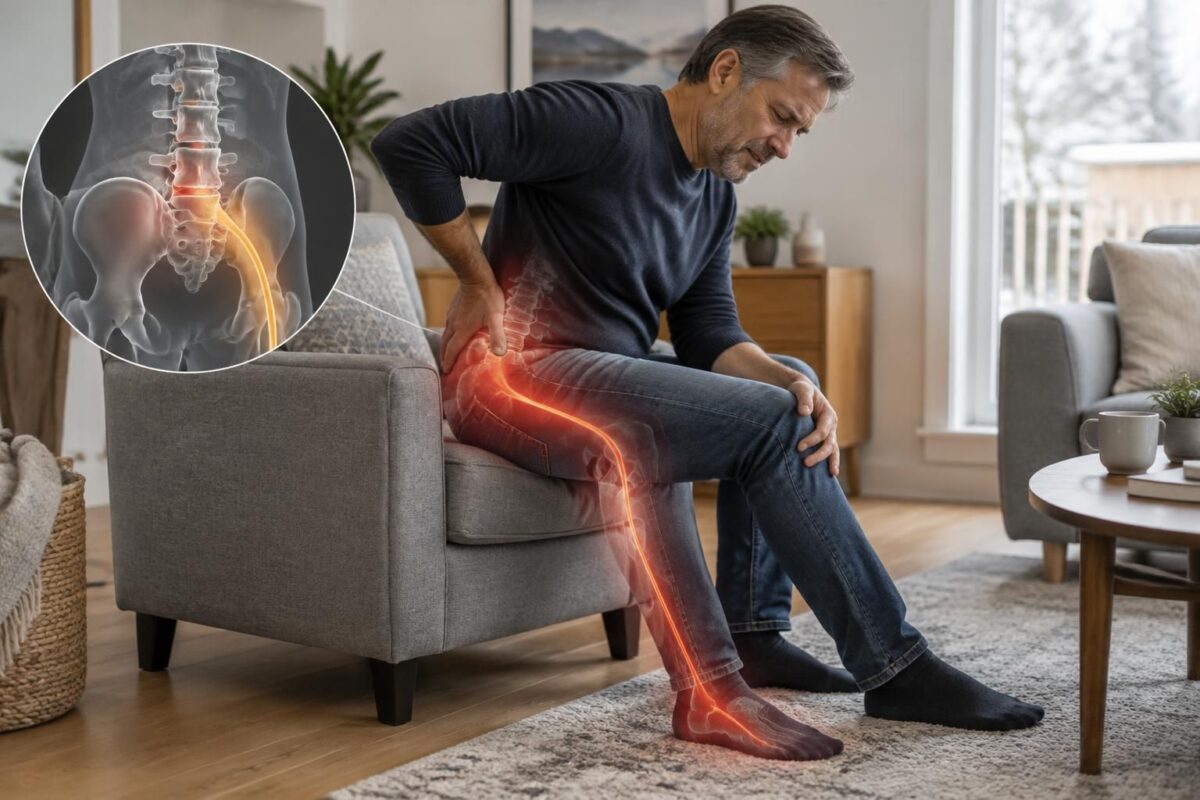
IN BRIEF
| A sciatica related to a possible L5-S1 herniation can cause pain from the lower back or buttock down to the calf, heel, or foot. The path of the symptoms alone is not enough to confirm the cause: the evaluation also considers sensitivity, strength, function, and available imaging. At the TAGMED Clinic in Terrebonne, located at 1150 Lévis Street, the examination helps specify possible causes and discuss tailored options; any potential treatments are separate from the examination. |
Pain that starts from the lower back or buttock and travels down to the foot may be consistent with irritation of the S1 nerve root, sometimes associated with an L5-S1 disc herniation. At the TAGMED Clinic in Terrebonne, an initial evaluation examines the pathway of the pain, sensitivity, strength, and function, then discusses tailored options. MRI results must be correlated with symptoms and clinical examination.
Free examination worth $85: ask for this offer when booking. It pertains to the examination; any potential treatment is separate. The clinic is located at 1150 Lévis Street, Suite 200, in Terrebonne. In cases of significant or progressive weakness, recent foot drop, numbness in the saddle area, or urinary or bowel issues, seek medical attention immediately.
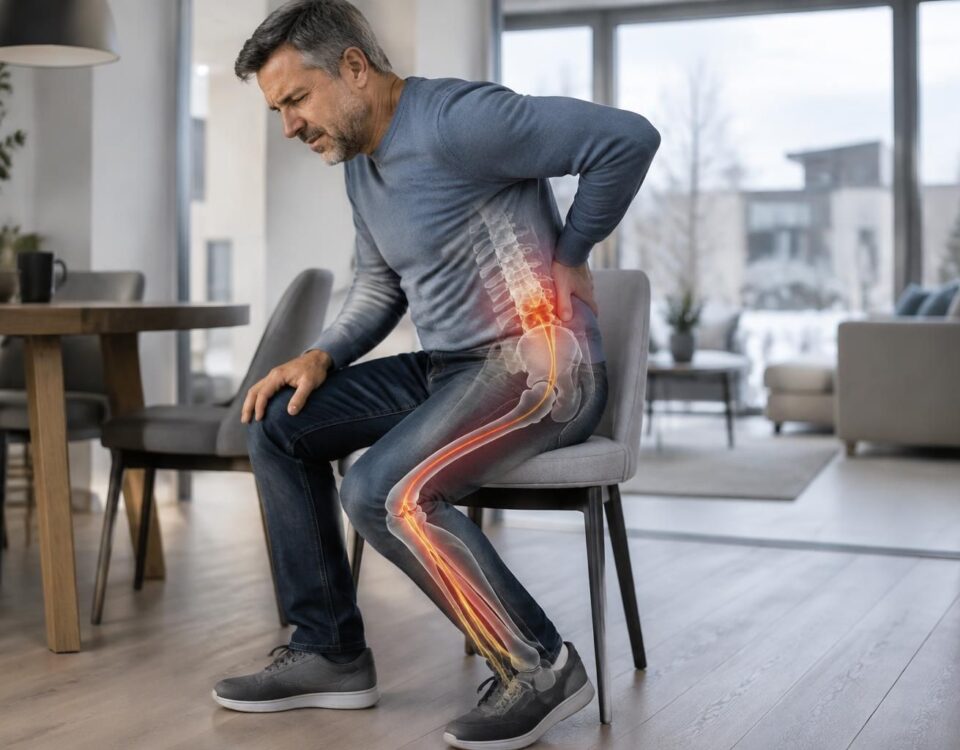
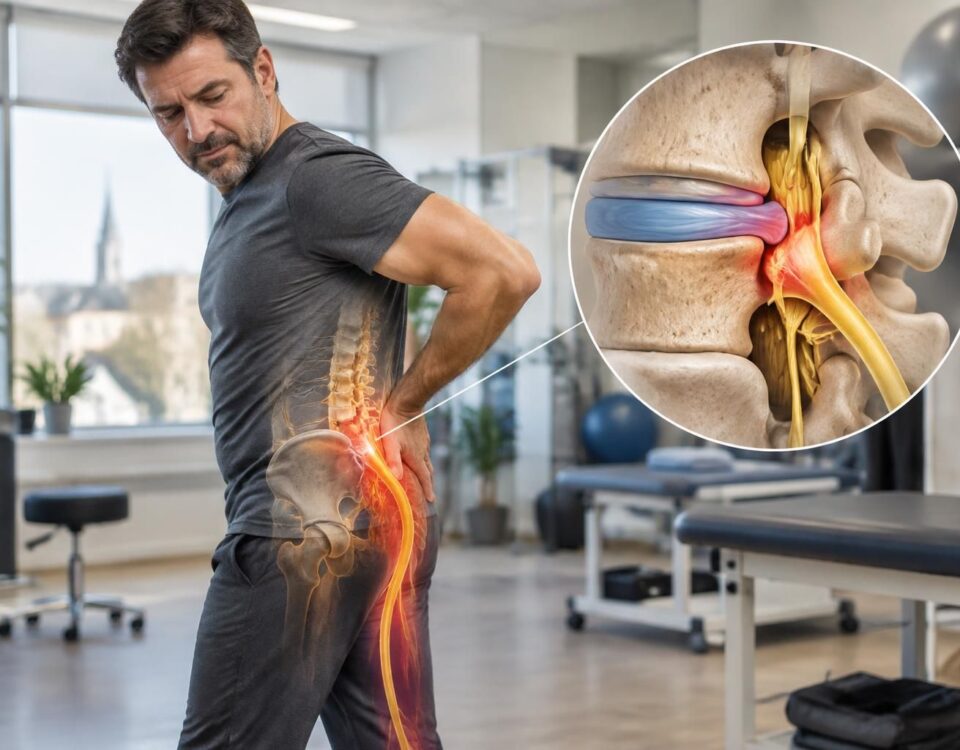
A L5-S1 disc herniation can irritate a nerve root and cause pain that radiates from the buttock to the calf, heel, or outer edge of the foot. At the TAGMED Clinic in Terrebonne, the first consultation serves to examine the pathway of the pain, sensitivity, strength, and function, then to discuss adapted options. A free examination offer worth $85 is available upon request when booking; any potential treatments are billed separately. Pain that starts from the lower back or buttock and travels down one leg may be consistent with radicular pain, often referred to as sciatica. A herniation located between the L5 and S1 vertebrae can irritate a nearby nerve root. However, the presence of a herniation on an MRI does not, by itself, prove that it causes the symptoms. The side, the level of the image, and the results of the examination must correspond to the clinical picture. The pain may present as a burning sensation, a sharp pain, or an electric shock feeling. It can also be accompanied by tingling or numbness. To better recognize possible sensations, visit our page on burning pain behind the thigh. An L5-S1 herniation can irritate the S1 root, particularly when it is located in the center or on the side of the disc. The pathway can then affect the buttock, back of the thigh, calf, heel, or outer edge of the foot. Some people primarily feel pain in the leg and have little back pain. Affecting the L5 root may instead cause pain on the side of the leg, the top of the foot, or the big toe. Pathways vary from person to person. They provide clues, but do not alone confirm the affected root. To learn more, read this guide on sciatica L4-L5 and L5-S1 in Terrebonne and this page on the possible pathway of pain associated with L5. Pain towards the outer edge of the foot may be consistent with irritation of S1, but it can also have another origin. To understand this symptom, consult our article on pain radiating towards the outer edge of the foot. A disc herniation corresponds to a change in the disc. It can become relevant if it reduces space around a nerve root and if its position correlates with the symptoms. The consulted doctors and professionals may also consider a protrusion, disc pinching, foraminal stenosis, or other causes. The term disc-root conflict describes a possible relationship between the disc and a root; it is not enough to establish the cause of every pain. To delve deeper into this subject, consult our guide on disc-root conflict. An MRI may show a protrusion or herniation that does not cause any symptoms. The evaluation thus considers the painful side, the observed level, the neurological examination, and the effects on activities. To understand symptoms sometimes associated with an L4-L5 protrusion, also visit our page on L4-L5 protrusion and pain in the leg. Pain or numbness that appears during walking also requires context analysis. The duration of walking, standing position, and factors that reduce symptoms help guide the evaluation, but do not allow for a conclusion of a single cause. Visit our page on pain and numbness after walking. The first consultation relates the history of symptoms, function, and neurological signs. Bring your MRI reports, X-rays, or other tests if you have them. They can help compare images with the painful side and the pathway of the pain but do not replace the clinical examination. The consultation focuses on the onset of the pain, its duration, and its location. It considers symptoms in the buttock, thigh, calf, ankle, and foot. Sitting or standing positions, walking, sleeping, and work are also discussed. The evaluation may include tests of mobility, walking, sensitivity, and strength, depending on the situation. Difficulty lifting the foot, walking on heels or toes, or climbing stairs deserves special attention. No single test is sufficient to confirm a diagnosis. After the evaluation, possible options, their limitations, and reevaluation criteria are explained. A conservative approach may be discussed if it suits the presented situation. Referral to a physician is indicated when symptoms or results justify further medical evaluation. For more general information on lumbosciatica, refer to this explanatory document on radiculalgia associated with lumbar disc herniation as well as information from Health Insurance on the consultation and management of sciatica. The options depend on the likely cause, the intensity of symptoms, function, and neurological signs. Management can aim for concrete objectives, such as improving tolerance to walking or sitting positions and reducing daily limitations. Effects vary from person to person; no results can be guaranteed. The motorized neurovertebral decompression may be discussed in certain cases after an evaluation and verification of relevant precautions. It is not suitable for everyone and should not be presented as a method that puts a disc back in place or eliminates a hernia. If considered, its relevance must be reevaluated based on the evolution of pain and function. NICE recommendations do not advise routine traction for all low back pain with or without sciatica. Other conservative approaches, including specific osteopathy or precision hammering, may be discussed depending on the profile and skills of the professional providing the care. The decision takes into account safety, symptoms, and defined goals. For an overview of possible symptoms, also refer to our guide on sciatica symptoms. Some symptoms should not wait for a routine consultation. Seek medical help promptly in cases of: These signs may require urgent medical evaluation. They should not be managed solely by a non-medical care session. The TAGMED Clinic is located at 1150 Lévis Street, Suite 200, Terrebonne, QC J6W 5S6. To book online on GOrendezvous, select “I am a new client,” then “Osteopathy treatment” and Sylvain Desforges in Terrebonne. When booking, ask for the offer “Free examination — value of $85”. This offer only applies to the examination. Any proposed treatment is separate and not included in the offer. You may bring your imaging tests and reports to the consultation. An evaluation can help clarify whether the pain towards the foot is compatible with radicular irritation, what lumbar causes deserve consideration, and what options can be discussed in your situation. Sylvain Desforges, B.Sc., D.O., N.D., Doctor of Osteopathy and Naturopath, is the founding president of TAGMED and the ACMA association. His practice focuses on chronic pain of the spine, lower back pain, and pain compatible with sciatica, especially when the pain radiates down to the buttock, leg, calf, foot, or toes. Through SOS Sciatique, he publishes educational content on sciatica symptoms, possible causes such as disc herniation, disc pinch, foraminal stenosis, or irritation of a lumbar nerve root, as well as non-surgical approaches that may be considered after evaluation. At TAGMED Clinic, available care may include, depending on the case and the relevant professional, motorized neurovertebral decompression, specific osteopathy, or precision hammering. For an evaluation related to sciatica treatment in Montreal or Mont-Royal, or sciatica treatment in Terrebonne, check out the services available at TAGMED Clinic. The information published on SOS Sciatique is provided for educational purposes. It does not replace a consultation, diagnosis, opinion, or treatment performed by a doctor or another authorized healthcare professional. The author of this article is neither a physician nor a specialist in a medical specialty recognized by the Collège des médecins du Québec. The approaches to osteopathy, manual medicine, or functional coaching described on this site do not constitute medical acts and are not intended to replace medical follow-up. Consult a doctor or an emergency service in cases of loss of urinary or bowel control, numbness in the saddle area, significant or progressive weakness of the leg or foot, fever, recent trauma, severe pain, or rapid worsening. For more details, please read our Legal Notice. Medical Disclaimer: The information and advice provided on this site do not replace the advice, diagnosis, or treatment of a healthcare professional. Please note that Sylvain Desforges, B.Sc., D.O., N.D., Doctor of Osteopathy, is neither a medical doctor nor a physician and is not a specialist in a medical specialty as defined by the Collège des médecins du Québec. Manual medicine, functional medicine, and sports medicine as described on this site exclude any medical treatment or diagnosis performed by a doctor or specialist. Always consult your doctor for any medical questions. For more details, please read our full Legal Notice.What pain pathway can correspond to an L5-S1 herniation?
Disc herniation, disc-root conflict, and imaging
How does the evaluation proceed in Terrebonne?
The pathway and evolution of symptoms
Sensitivity, strength, and function
The decision and objectives
What conservative options can be discussed?
When to seek urgent medical evaluation?
Make an appointment at TAGMED Clinic in Terrebonne
About the author
Medical disclaimer
- Pain towards the foot: consistent with nerve irritation, to be confirmed by evaluation.
- Hernia L5-S1: its relevance depends on the side, symptoms, and examination; imaging alone is not sufficient.
- Signs to evaluate: pain pathway, sensitivity, strength, and ability to walk.
- In Terrebonne: TAGMED Clinic, 1150 Lévis Street, Suite 200.
- Examination offered: ask for the free examination, valued at $85, when booking. Any potential treatments are separate.
- Booking: new client → “Osteopathy treatment” → Sylvain Desforges, Terrebonne.
- Urgency: urinary or bowel issues, numbness in the saddle area or progressive weakness require urgent medical evaluation.

Sciatica in Terrebonne: hernia L5-S1 and pain down to the foot
Pain starting from the lower back or buttock and radiating down to the foot may be compatible with nerve irritation related to a hernia L5-S1, but imaging alone is not sufficient to confirm the cause. At the TAGMED Clinic in Terrebonne, an initial evaluation serves to examine the pathway of symptoms, strength, sensitivity, and impacts on your activities, and then discuss options suitable for your situation.

Sciatica in Terrebonne: L5 or S1 irritation, why the clinical examination matters
IN BRIEF Sciatica is pain related to the irritation of a nerve root, often L5 or S1. The pathway of symptoms, strength, sensitivity, and walking provide clues, but the territories may overlap: the clinical examination therefore helps guide the assessment…

Sciatica in Terrebonne: L4-L5 protrusion and leg pain
IN BRIEF A L4-L5 disc protrusion is a bulging of a lumbar disc that may, depending on its relationship with the nerves, contribute to sciatica, with pain, tingling, or numbness in the leg. In Terrebonne, an assessment helps relate symptoms,…
Recognizing Symptoms Without Jumping to Conclusions
Pain associated with the S1 root may follow the back of the thigh and calf, then reach the heel or the outer edge of the foot. Others primarily feel burning, tingling, electric shocks, or numbness. Weakness may also complicate walking on tiptoes or climbing stairs.
The path of the pain provides clues, but no skin territory, reflex, or test alone confirms an affected root. Pain in the foot can also come from other structures, including the hip, pelvis, muscles, a peripheral nerve, or a circulatory problem. The examination must therefore consider the entire picture.
Sciatica in Terrebonne: what “disc-root conflict” means
IN BRIEF A disc-root conflict occurs when an intervertebral disc irritates or compresses a nerve root in the lower back. It can cause sciatica: lower back pain that radiates down into the buttock and leg, sometimes accompanied by sensory disturbances…
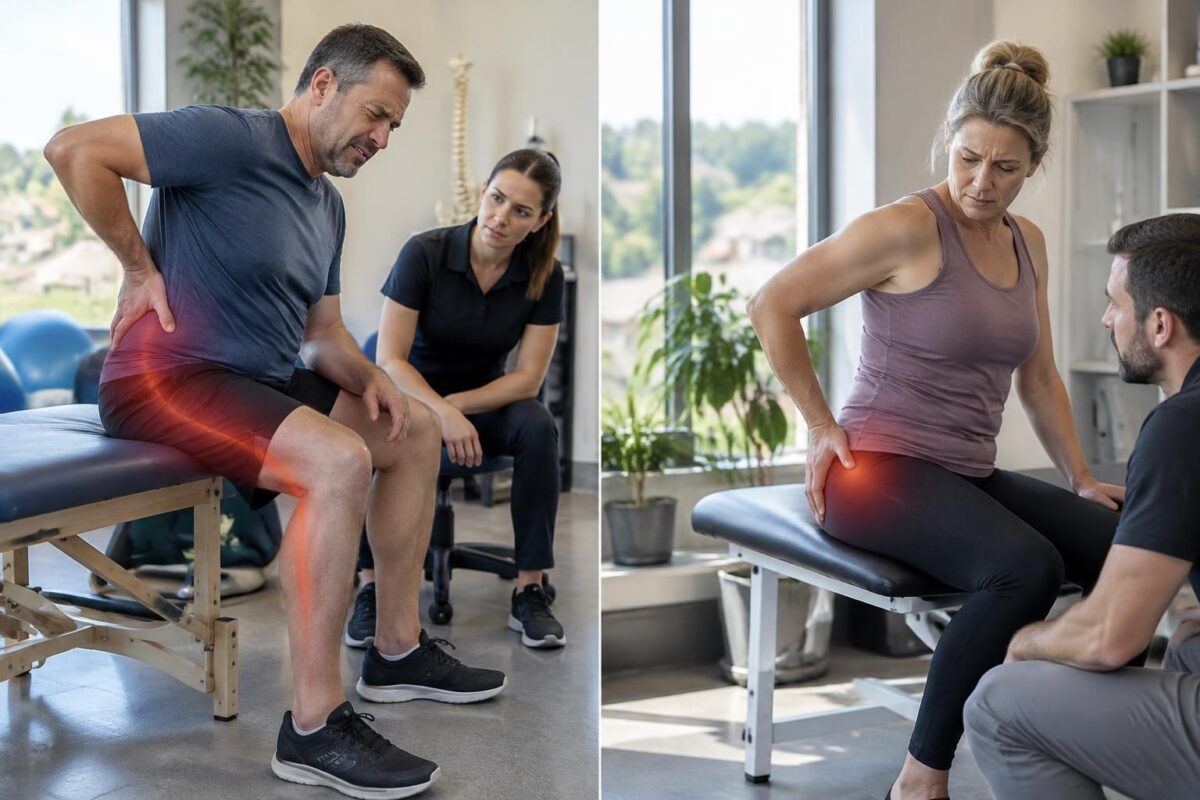
Sciatica in Terrebonne: radicular pain versus referred pain
IN BRIEF Sciatica refers to pain that radiates into the buttock and sometimes the leg. A radicular pain comes from the irritation of a nerve root and may be accompanied by tingling, numbness, or weakness; a referred pain spreads from…
Understanding the Role of MRI
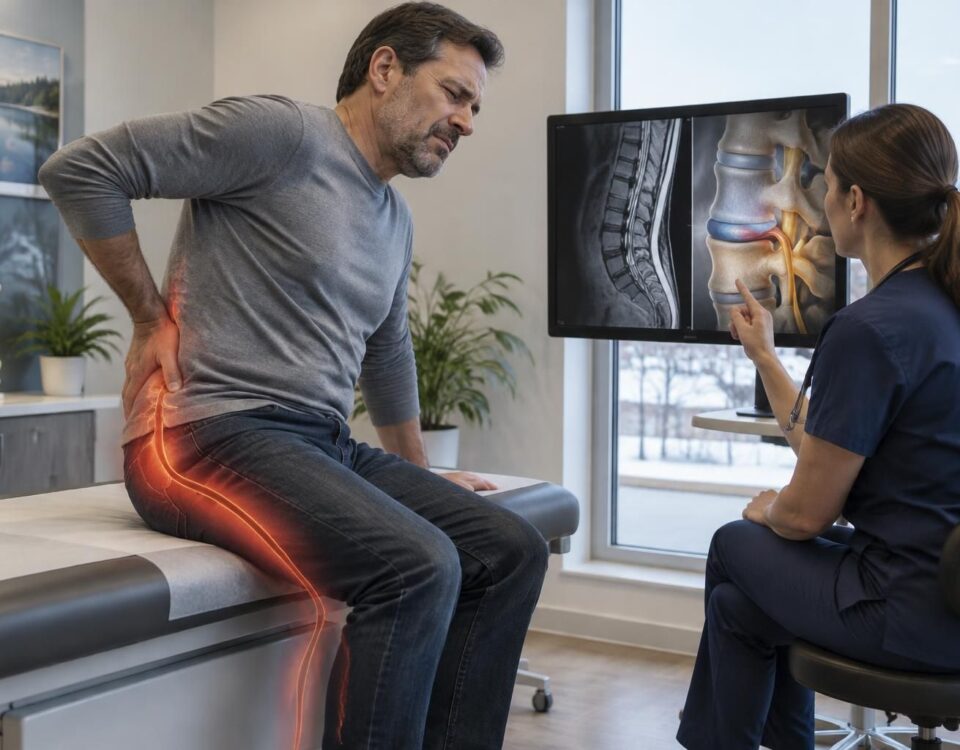
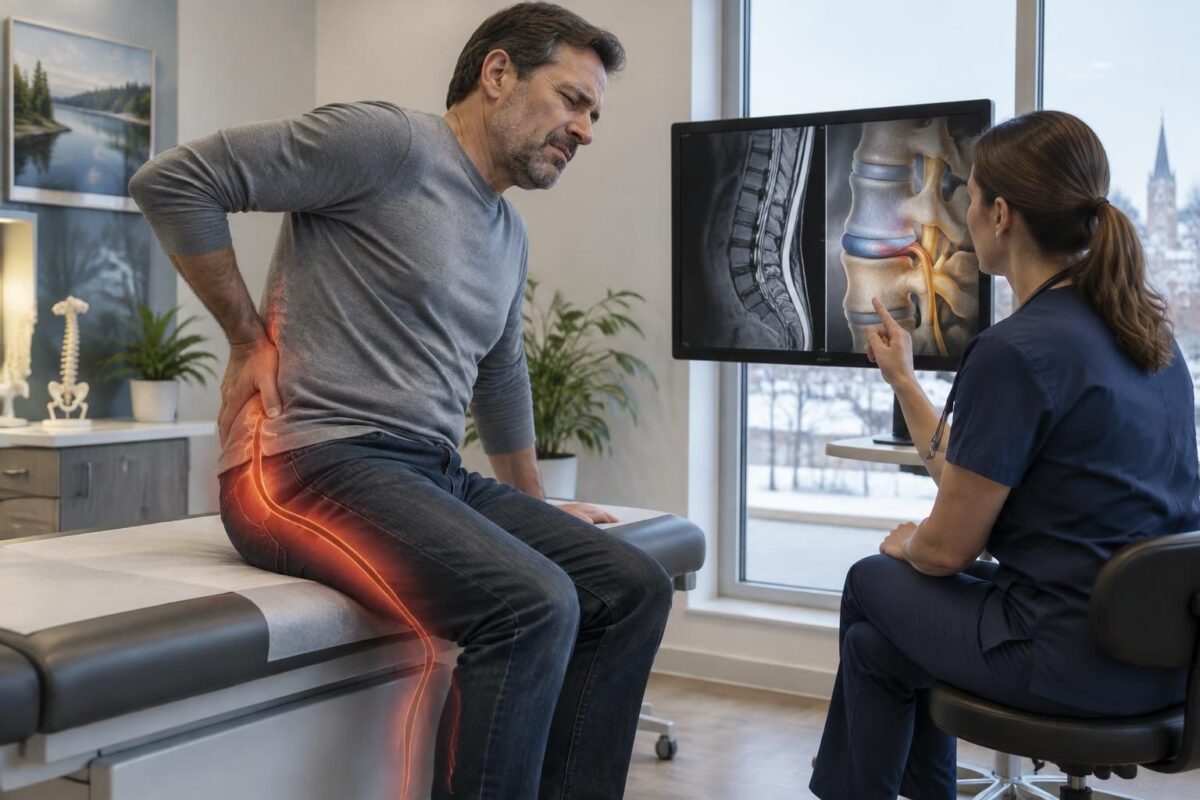
An MRI can show a herniation or protrusion at L5-S1, but these changes are not always the cause of symptoms. To interpret the image, one must check if the side and level observed match the pain, neurological signs, and functional limitations. Bring your reports and previous examinations if you have any.
The evaluation may focus on sensitivity, strength, walking, mobility, and positions that worsen or relieve your symptoms. It also helps determine if a medical referral or additional examination merits discussion. X-rays do not directly show a disc herniation; the choice of imaging depends on the context and the opinion of the qualified professional.
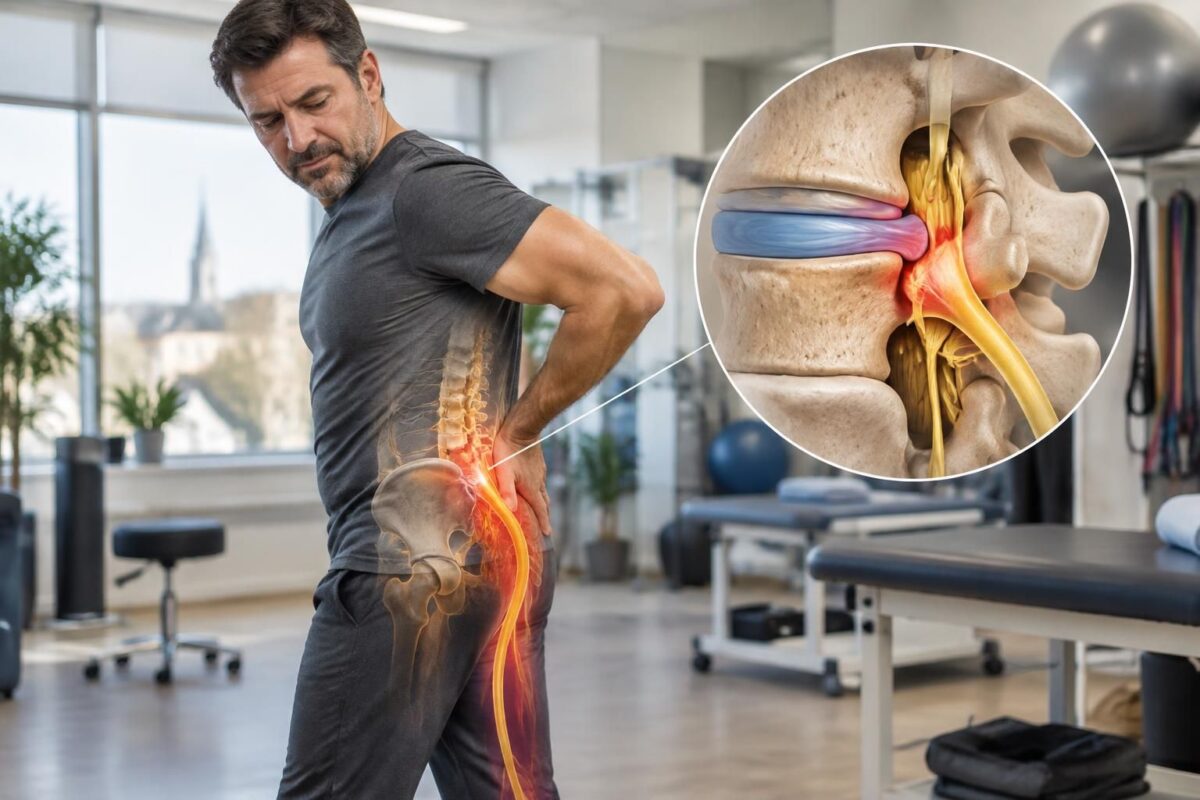
Sciatica in Terrebonne: nerve root, disc, and foramen explained simply
IN BRIEF Sciatica is pain that occurs when a nerve root in the lower back is irritated or compressed, sometimes by a disk or a narrowed foramen. Understanding these structures helps better locate the possible cause of symptoms and guide…
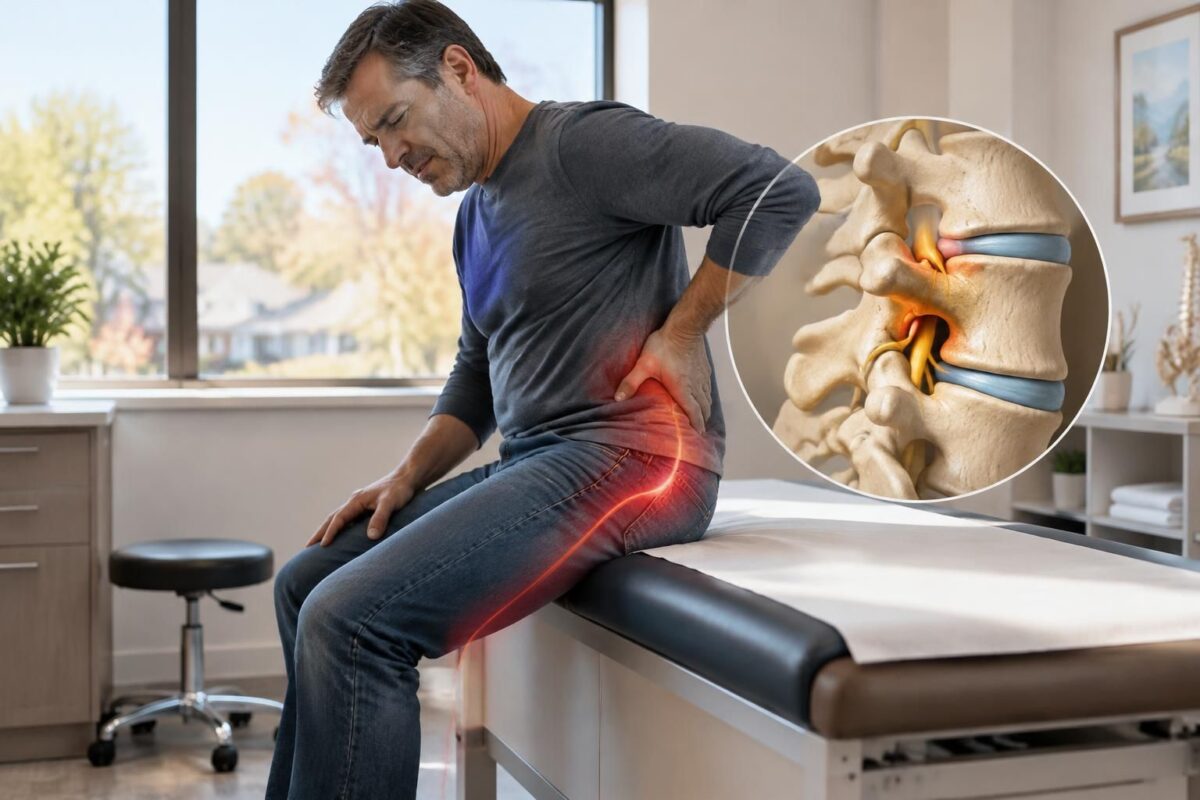
Sciatica in Terrebonne: understanding the L5-S1 foraminal compression
IN BRIEF The L5-S1 foraminal compression corresponds to a narrowing of the opening through which a nerve root passes, potentially contributing to sciatica. In Terrebonne, the assessment compares the side and course of the symptoms, neurological examination, imaging, and limited…
Management Options in Terrebonne
Setting Realistic Goals
Depending on the results, management may include information, maintaining tolerated activities, tailored exercises, and certain conservative approaches. Goals can be tangible: walking better, sitting longer, sleeping more comfortably, or gradually resuming certain tasks. The plan should be reassessed based on progress rather than automatically continued.
Discussing Decompression Cautiously
Motorized traction may be considered for certain profiles after evaluation, but it is not suitable for everyone and does not “put” a disc back in place. NICE recommendations do not endorse its routine use for low back pain with or without sciatica. Any approach must be integrated into an individualized plan, with criteria to judge whether it provides functional benefit.
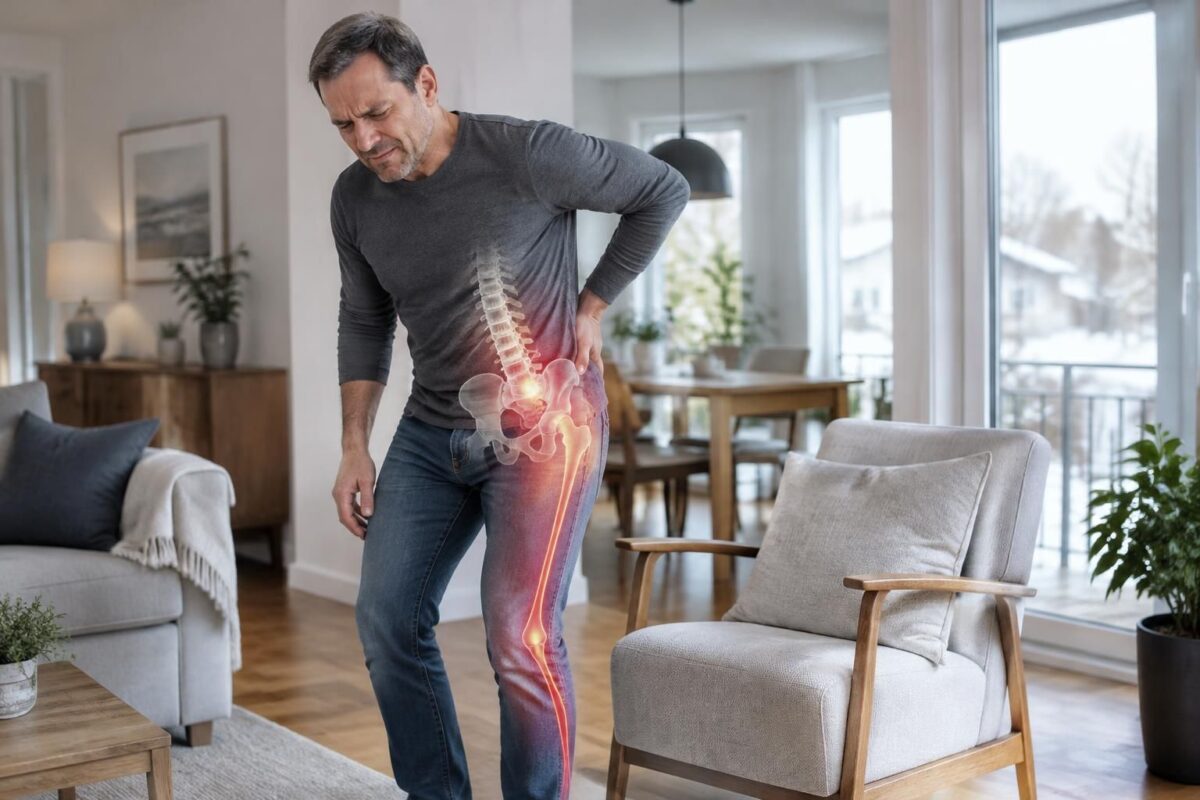
Sciatica in Terrebonne: why L5-S1 is often involved
IN BRIEF Sciatica corresponds to pain related to the irritation of a nerve root, which can extend from the buttock down to the leg. The L5-S1 level is often involved, as a disc herniation or irritation at this location can…
Sciatica in Terrebonne: L5 and difficulty lifting the foot
IN SHORT The L5 sciatica can cause pain or numbness on the side of the leg, the top of the foot, and the big toe, sometimes with difficulty lifting the foot. In Terrebonne, an evaluation compares strength, sensitivity, reflexes, and…
When to Seek Urgent Medical Help
Do not delay in obtaining a medical evaluation in cases of recent loss of urinary or bowel control, numbness in the saddle region, significant or progressive weakness, or the onset of foot drop. A fever, major trauma, general deterioration, or severe worsening pain also requires prompt attention. These signs should not wait for a routine appointment.
Book an Evaluation at TAGMED Clinic
The TAGMED Clinic is located at 1150 Lévis Street, Suite 200, Terrebonne, QC J6W 5S6. A free assessment worth CAD 85 is available: request it when making your reservation. It pertains only to the assessment; potential treatments are separate. On GOrendezvous, select “I am a new client,” then “Osteopathy treatment,” and Sylvain Desforges in Terrebonne.
About the Author
Sylvain Desforges, B.Sc., D.O., N.D., Doctor of Osteopathy and Naturopath, is the founding president of TAGMED and the ACMA association. His practice focuses in particular on chronic spinal pain and pain compatible with sciatica.
Medical Disclaimer
This content is provided for educational purposes and does not replace a consultation, diagnosis, or treatment by a licensed healthcare professional. The author is neither a physician nor a specialist in a medical specialty recognized by the Collège des médecins du Québec. The approaches described do not replace medical follow-up.
| Point to Evaluate | Concise Reference |
|---|---|
| Pain Toward the Foot | May correspond to lumbar nerve irritation; the path alone does not confirm the cause. |
| L5-S1 Herniation | Its relevance depends on its correlation with the side of symptoms and the clinical examination. |
| Possible S1 Profile | Pain or numbness sometimes at the back of the calf, at the heel, or at the outer edge of the foot. |
| Neurological Signs | Sensitivity, strength, and walking are evaluated; no isolated sign suffices for diagnosis. |
| Previous MRI | The report can be related to your symptoms and function. |
| First Consultation | Evaluation of the painful path, neurological signs, and tailored conservative options. |
| Offer in Terrebonne | Examination provided, worth CAD 85; request the offer when booking. Potential treatments are separate. |
| Reservation and Address | GOrendezvous: new client, osteopathy treatment, Sylvain Desforges. 1150 Lévis Street, Suite 200, Terrebonne. |
| Signs of Urgency | Loss of urinary or bowel control, saddle area numbness, or rapidly progressive weakness: seek emergency care. |
Illustrative Testimonials: Sciatica Related to L5-S1 Herniation and Pain to the Foot
Important: the examples below are fictional and do not represent actual patient opinions. They illustrate possible situations; symptoms and outcomes vary from person to person.
Example 1 — Pain from the Buttock to the Foot
“My pain started from the lower back, went through the buttock, and descended to the foot. I already had an MRI report indicating an L5-S1 herniation. During the evaluation, the path of the pain, my sensations, and the effects on walking were taken into account, rather than relying solely on the image.”
Example 2 — Tingling and Numbness
“In addition to the pain in my leg, I felt tingling toward the foot. The consultation allowed me to precisely describe where the symptoms occurred and what exacerbated them, such as prolonged sitting. Possible options and their limitations were then explained based on my case.”
Example 3 — An Evaluation Before Choosing an Approach
“I wanted to know if my pain was compatible with nerve irritation related to my L5-S1 herniation. The evaluation focused on strength, sensitivity, and function, as well as on the examinations I had already undergone. I was able to discuss an adapted plan and the criteria to monitor to reassess the situation.”
Pain that radiates from the buttock down to the calf or foot may be indicative of nerve root irritation, but it does not alone confirm sciatica or symptomatic herniation. The diagnosis relies on the history of symptoms, clinical examination, function, and, when relevant, correlation with imaging. A visible abnormality on MRI may also not be the sole cause of the symptoms.
Evaluation in Terrebonne: TAGMED Clinic is located at 1150 Lévis Street, Suite 200, Terrebonne. A free examination offer, valued at CAD 85, is available upon request at the time of booking. This offer concerns the examination; any potential treatment is separate. To book on GOrendezvous, select “I am a new client,” then “Osteopathy treatment” and Sylvain Desforges in Terrebonne.
Seek medical attention quickly in case of loss of urinary or bowel control, numbness in the saddle area, significant or progressive weakness, or recent onset of a foot drop. These signs should not wait for a routine appointment.
About the author
Sylvain Desforges, B.Sc., D.O., N.D., is an osteopath and naturopath, founding president of TAGMED and the ACMA association. His educational content focuses particularly on spinal pain, lower back pain, and symptoms compatible with sciatica.
Medical disclaimer
This information is provided for educational purposes and does not replace a consultation, diagnosis, or treatment by a physician or other licensed healthcare professional. The author is neither a physician nor a specialist in a medical specialty recognized by the Collège des médecins du Québec. Approaches involving osteopathy, manual medicine, or functional support do not replace medical follow-up.
Sciatica in Terrebonne: L5-S1 Herniation and Pain Down to the Foot
Sylvain Desforges, B.Sc., D.O., N.D., Doctor of Osteopathy and Naturopath, is the founding president of TAGMED clinics and the ACMA association. His work primarily addresses chronic spinal pain, lower back pain, and symptoms that may suggest sciatica. At TAGMED Clinic in Terrebonne, he contributes to a patient-centered approach focusing on pain assessment, function, and non-surgical management options tailored to each situation.
Pain related to lumbar nerve irritation may start from the lower back or buttock and then radiate down the thigh, calf, ankle, or foot. When a disc herniation occurs at L5-S1, it may sometimes irritate a nerve root, but the presence of an imaging abnormality is not sufficient to determine the cause of the symptoms. The affected side, pain trajectory, neurological signs, and impact on activities must also be taken into account.
Pain towards the foot may be accompanied by burning, electric shocks, tingling, or numbness. Some individuals also notice weakness, difficulty lifting the foot, or reduced tolerance for walking, sitting, or working. The evaluation aims to describe these manifestations and distinguish, as much as possible, pain compatible with root irritation from other possible causes, such as a hip problem, muscle involvement, or peripheral neuropathy.
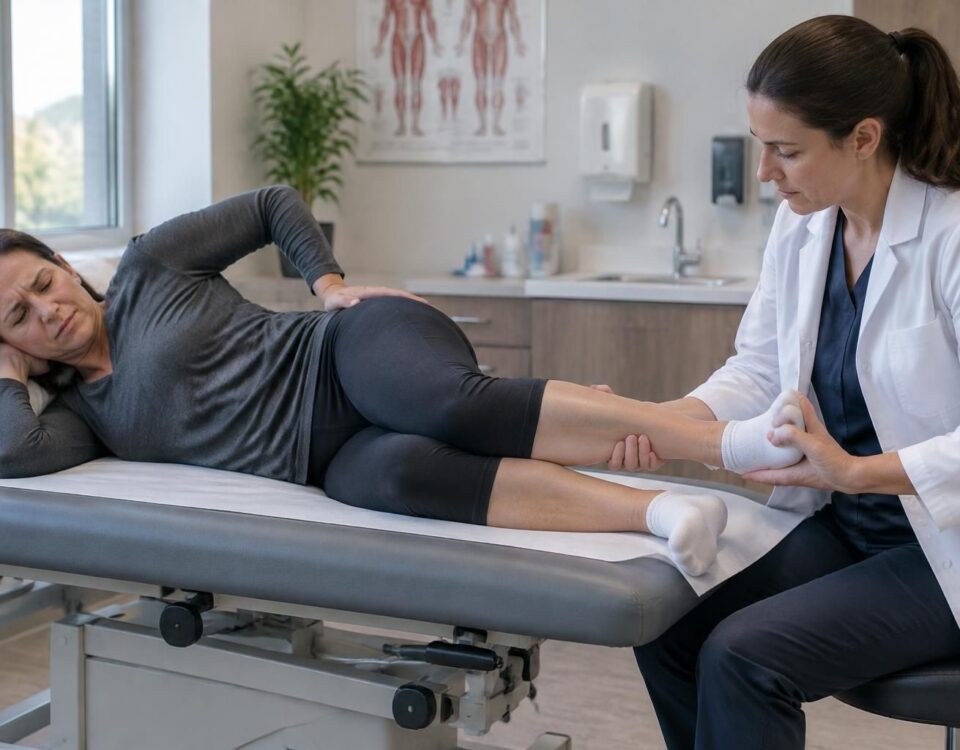
During a first consultation, the history of symptoms is correlated with function and clinical examination. The onset of pain, its location, movements that aggravate or relieve it, sleep, and daily activities are discussed. Observations regarding mobility, walking, sensitivity, and strength may be made depending on the presented condition. X-rays, MRIs, or already available reports may be reviewed when pertinent, without assuming that a single image explains all symptoms.
Based on the results, an individualized plan may be discussed. It may include advice to maintain tolerated activities, functional strategies, and, when appropriate, manual or instrumental approaches. Motorized spinal decompression may be considered for certain selected patients, but it is not suitable for everyone and does not guarantee a result. Goals and responses are reassessed; if progress is not satisfactory, guidance or next steps should be reviewed. Medical options, such as injections or surgical consultation, fall under the competence of the medical professional.
In Terrebonne, consultations take place at 1150 Lévis Street, Suite 200, Terrebonne, QC J6W 5S6. A promotional offer for a free initial examination, valued at CAD 85, is available upon request at the time of booking; it concerns the examination and any treatments are billed separately. To book on GOrendezvous, select “I am a new client,” then “Osteopathy treatment” and Sylvain Desforges in Terrebonne.
The information presented is educational and does not replace a diagnosis or medical follow-up. New loss of urinary or bowel control, numbness in the saddle area, significant or progressive weakness, or recent foot drop require urgent medical evaluation rather than a routine consultation.
Pain that starts from the lower back or buttock and radiates down to the foot may be compatible with nerve root irritation, particularly in the context of L5-S1 disc herniation. However, the trajectory of the pain, tingling, or numbness is not sufficient to confirm the cause: the evaluation also considers strength, sensitivity, walking, daily activities, and, if necessary, imaging tests.
When the S1 root is involved, symptoms may follow the back of the thigh and calf and then reach the heel or outer edge of the foot. However, the presentation varies from person to person. Pain towards the foot may also be related to another root, foraminal stenosis, or a non-lumbar cause. To better understand the differences between levels, consult this guide on L4, L5, and L5-S1, as well as resources on L5-S1 and Calf Pain and on how the affected root influences symptom trajectory.
An image showing a hernia or protrusion does not, by itself, prove that it explains the pain: it is necessary to verify whether the observed side and level correspond with the symptoms and examination. For more information, see details about the L5-S1 disc herniation and foraminal compression at this level. External resources also describe the diagnosis of sciatica related to a disc herniation, sciatica, and conditions of the lumbar spine.
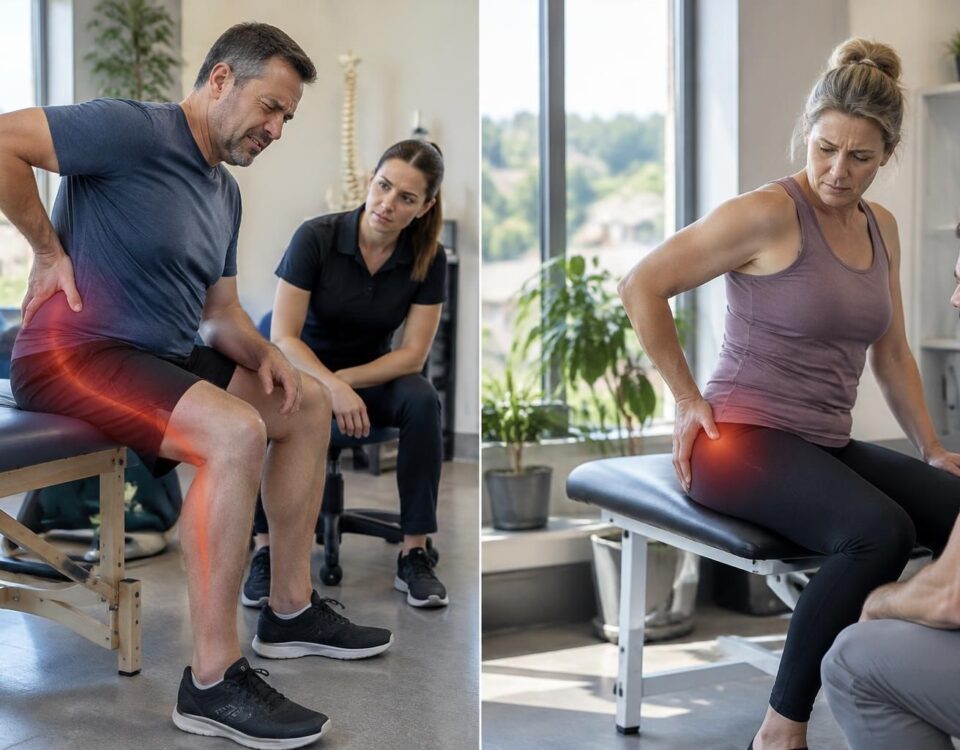
In Terrebonne, a consultation at the TAGMED Clinic can help clarify the pain pathway, examine sensitivity, strength, and function, and discuss options suitable for the situation. If you already have an MRI or a report, bring it along: it can be correlated with clinical signs. Conservative approaches are considered on a case-by-case basis, with specific goals and reevaluation; no treatment guarantees a particular outcome. To learn about the services on-site, visit the page of the TAGMED Clinic in Terrebonne.
A free examination worth CAD 85 is offered in Terrebonne for the examination only; any potential treatments are separate. To request this offer, mention it when you book. On GOrendezvous, select “I am a new client,” then “Osteopathy Treatment” and Sylvain Desforges in Terrebonne. The clinic is located at 1150 Lévis Street, Suite 200, Terrebonne, QC J6W 5S6.
In the presence of significant or progressive weakness, recent foot drop, loss of bladder or bowel control, or numbness in the saddle region, do not delay urgent medical evaluation to wait for a routine appointment. Severe pain that rapidly worsens, fever, or significant trauma also justify appropriate medical attention. Tingling in the foot, especially when the pain increases while sitting, deserves interpretation according to the overall symptoms; you can read about this on the page about seated pain accompanied by tingling in the foot.
About the author
Sylvain Desforges, B.Sc., D.O., N.D., Doctor of Osteopathy and Naturopath, is the founding president of TAGMED and the ACMA association. His practice is dedicated to chronic spinal pain, lower back pain, and pain associated with sciatica.
Medical disclaimer
This information is provided for educational purposes and does not replace a consultation, diagnosis, opinion, or treatment by a physician or other licensed healthcare professional. The author is neither a doctor nor a specialist in a medical specialty recognized by the Collège des médecins du Québec. The approaches presented do not constitute medical acts and do not replace medical follow-up. In case of emergency signs, consult a physician or an emergency service. For more details, please read our Legal Notice.

Sylvain Desforges, B.Sc., D.O., N.D., docteur en ostéopathie
Dr Sylvain Desforges, B.Sc., D.O., N.D., osteopath, is the founding president of TAGMED and of the ACMA association. He dedicates his practice to chronic spinal pain, low back pain and symptoms compatible with sciatica, particularly when pain radiates toward the buttock, leg, calf, foot or toes.
Through SOS Sciatique, he publishes educational content on sciatica symptoms, possible causes such as disc herniation, disc narrowing, foraminal stenosis or irritation of a lumbar nerve root, as well as non-surgical approaches that may be considered according to the evaluation. At Clinique TAGMED, care may include, depending on the case, motorized neurovertebral decompression, specific osteopathic care or precision percussion.
For an evaluation related to sciatica treatment in Montreal / Mount Royal or sciatica treatment in Terrebonne, please consult the services available at Clinique TAGMED.
Medical disclaimer
The information published on SOS Sciatique is provided for educational purposes only and does not replace a consultation, diagnosis, opinion or treatment provided by a physician or another authorized healthcare professional. The author of this article is neither a medical doctor nor a specialist in a medical specialty recognized by the Collège des médecins du Québec. The osteopathic, manual medicine or functional support approaches described on this site do not constitute medical acts and are not intended to replace medical follow-up.
Consult a physician or emergency service in cases of loss of bladder or bowel control, anesthesia in the saddle area, significant or progressive weakness in the leg or foot, fever, recent trauma, severe pain or rapid worsening of symptoms. For more details, please read our Legal Notice.