Sciatica in Montreal: L4-L5 protrusion and leg pain
29/10/2026
Sciatica and pain worsened in lumbar flexion
29/10/2026
IN BRIEF
| A L4-L5 disc protrusion is a bulging of a lumbar disc that may, depending on its relationship with the nerves, contribute to sciatica, with pain, tingling, or numbness in the leg. In Terrebonne, an assessment helps relate symptoms, neurological signs, and available examinations to discuss appropriate options and monitor functional evolution. Imaging alone does not confirm the cause of the pain. |
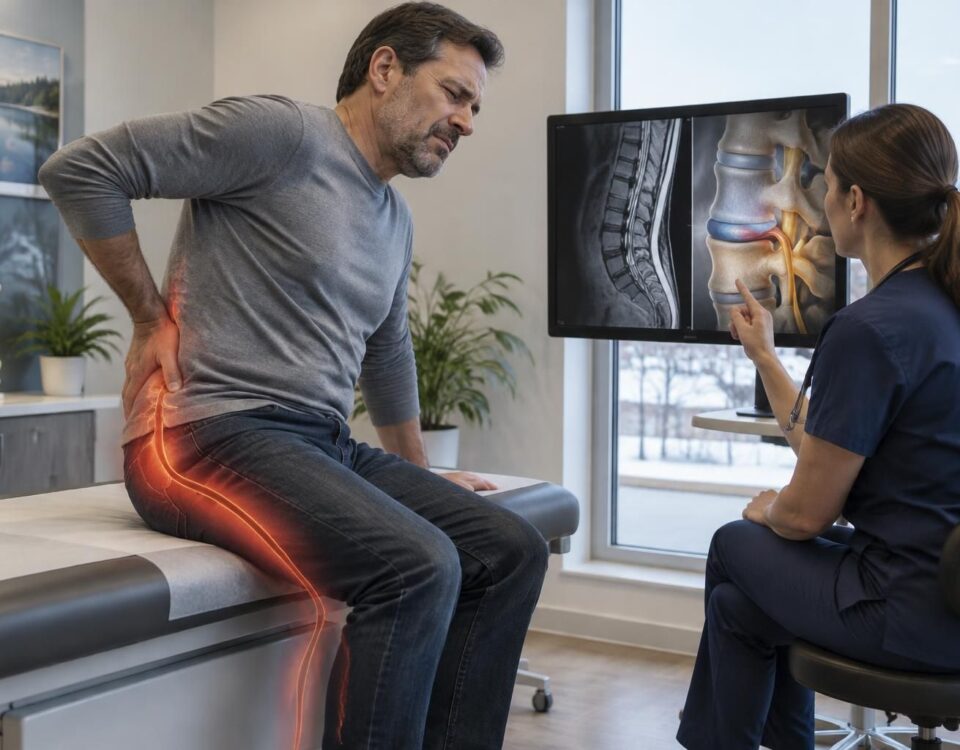
A L4-L5 disc protrusion can sometimes contribute to lower back pain that radiates into the buttock or leg, with tingling or numbness. However, a protrusion visible on imaging does not always explain the symptoms: its level and side must be related to the examination and function.
At the TAGMED Clinic in Terrebonne, an assessment can help clarify the pain’s path, sensitivity, strength, and conservative options to discuss. The clinic is located at 1150 Lévis Street, Suite 200. To book online, select “I am a new client,” then “Treatment in osteopathy ” and Sylvain Desforges in Terrebonne.
Important: significant or progressive weakness, numbness in the saddle region, or loss of urinary or bowel control requires urgent medical evaluation. This information is educational and does not replace a medical consultation.
A L4-L5 disc protrusion can contribute to lower back pain that extends to the buttock or leg, sometimes with tingling or weakness. However, an MRI image alone is not sufficient to explain the symptoms: the pain’s path, neurological examination, and function must also be considered. In Terrebonne, an assessment helps clarify possible causes and discuss appropriate options, with medical referral if concerning signs are present. Sciatica refers to pain related to the irritation of a lumbar nerve root or the sciatic nerve. It can originate from the lower back or buttock and extend into the thigh, calf, or foot. Some people mainly feel the pain in their leg, with little lower back pain. A protrusion is a bulge of the disc between two vertebrae. At the L4-L5 level, this bulge can reduce the space around a nerve root. The effect depends on its location, the affected side, and the proximity to the nerve. A protrusion can also be visible on imaging without causing pain. In a protrusion, the disc bulges beyond its usual contour, but its outer covering generally remains intact. A disc herniation involves a more localized deformation; depending on the case, disc material may breach a fissure in the covering. Both situations may be associated with pain, but their mere presence on an image does not confirm that they are the cause. To learn more about the characteristics of a disc injury at this level, refer to this guide on L4-L5 disc protrusion. Symptoms vary from person to person. They may appear gradually or after exertion and may fluctuate depending on positions and activities. A protrusion can also cause no symptoms. A L4-L5 protrusion can sometimes irritate the L5 root, but the path of the symptoms varies. The markers associated with nerve roots alone cannot confirm a diagnosis. To better understand the possible signs of an L5 injury, refer to the guide on difficulty lifting the foot. Radicular pain often follows a path down the leg and may be accompanied by unusual sensations or weakness. Referred pain can also spread from the back, hip, or neighboring tissues, without irritating a nerve root. The path alone does not always distinguish these mechanisms. Pain in the hip can resemble sciatica. The evaluation takes into account the location, movements that influence the symptoms, and neurological signs. Also consult this guide on radicular pain versus referred pain and this page on hip pain or nerve irradiation. An evaluation begins with the history of symptoms: their onset, duration, side, path, and effect on walking, sleep, work, and daily activities. The examination may include observation of walking, mobility, strength, and sensitivity, depending on the situation. If an MRI or another examination is already available, its results can be compared to the symptoms and the examination. An image must be interpreted cautiously: some disc changes are present in people without pain. The side and level observed must correspond to the clinical picture to be relevant. Pain that does not extend down to the foot does not alone rule out nerve irritation. Refer to this guide on the incomplete path of sciatica pain to better understand this variability. Management depends on the symptoms, their evolution, history, and neurological signs. For many stable cases, professionals can discuss conservative options and monitor their effects on concrete goals, such as leg pain, walking, or tolerance to sitting. At the TAGMED Clinic in Terrebonne, the evaluation aims to clarify the pain’s path, function, and neurological signs, then discuss suitable options. Depending on the case, a manual approach or a motorized neurovertebral decompression may be considered. Decompression is not indicated for everyone and does not guarantee the disappearance of symptoms or a change in the disc. Its relevance should be reassessed based on the observed response. The care plan must specify the objectives, the limits of the approach, and the reevaluation criteria. If symptoms do not improve, worsen, or do not correspond to imaging results, another evaluation or medical referral may be necessary. Surgery is subject to evaluation by a medical specialist and can be discussed based on the severity, progression, and correlation between symptoms and examinations. Quickly consult a medical service if you experience significant or progressive weakness, a new difficulty lifting your foot, or a rapid worsening of symptoms. A loss of bowel or bladder control, numbness in the saddle region, or severe weakness require urgent medical evaluation. In the case of fever, significant trauma, or unusual general deterioration, also seek medical advice without waiting for a routine consultation. At TAGMED Clinic, located at 1150 Lévis Street, Suite 200, in Terrebonne, the evaluation may focus on the path of the pain, sensitivity, strength, walking, and already available examinations. Options are discussed based on findings and functional objectives. If a referral to a healthcare professional is indicated, it becomes part of the decisions to consider. To consult services related to sciatica in Terrebonne, inquire about the clinic’s availability and appointment procedures. If you already have an MRI, an imaging report, or a medical summary, you can bring it to the consultation. Sylvain Desforges, B.Sc., D.O., N.D., Doctor of Osteopathy and Naturopath, is the founding president of TAGMED and the ACMA association. His practice focuses on chronic pain of the spine, lower back pain, and pain compatible with sciatica. Through SOS Sciatique, he publishes educational content on the symptoms of sciatica, their possible causes, and non-surgical approaches that can be discussed based on the evaluation. The care available at TAGMED Clinic depends on the case and the relevant professionals. Medical Disclaimer: The information and advice provided on this site do not replace the opinion, diagnosis, or treatment of a healthcare professional. Please note that Sylvain Desforges, B.Sc., D.O., N.D., Doctor of Osteopathy, is neither a medical doctor nor a physician, and is not a specialist in a medical specialty as defined by the Collège des médecins du Québec. Manual therapy, functional medicine, and sports medicine as described on this site exclude any treatment or medical diagnosis made by a physician or medical specialist. Always consult your doctor for any medical questions. For more details, please read our Complete Legal Disclaimer.Disc protrusion and disc herniation: what’s the difference?
What symptoms can accompany an L4-L5 protrusion?
Nerve pain or referred pain?
How to evaluate sciatica in Terrebonne?
What management options can be discussed?
When to request an urgent evaluation?
Evaluation of Sciatica in Terrebonne
About the author
Medical Disclaimer
Identify the profile
- L4-L5 protrusion: disc bulge that does not always cause symptoms.
- Pain in the leg: may radiate from the buttock to the thigh, calf, or foot.
- Associated signs: tingling, numbness, or weakness to be assessed.
- The MRI relates to the painful side, the examination, and the function.
Evaluate in Terrebonne
- The consultation examines the path of the pain, sensitivity, strength, and mobility.
- The plan may include adapted conservative options and a reevaluation of progress.
- A visible protrusion on imaging does not confirm the cause of symptoms by itself.
- Progressive weakness, urinary issues, or numbness in the saddle region: seek urgent medical evaluation.

A L4-L5 disc protrusion may sometimes irritate a nerve root and cause pain that radiates from the lower back or buttock down the thigh, calf, or foot. However, a protrusion observed on the MRI does not automatically explain the symptoms: the path of the pain, sensitivity, strength, and function must also be evaluated. In Terrebonne, a consultation can help clarify possible causes and discuss suitable options without presuming the diagnosis.
Recognize the symptoms and their evolution
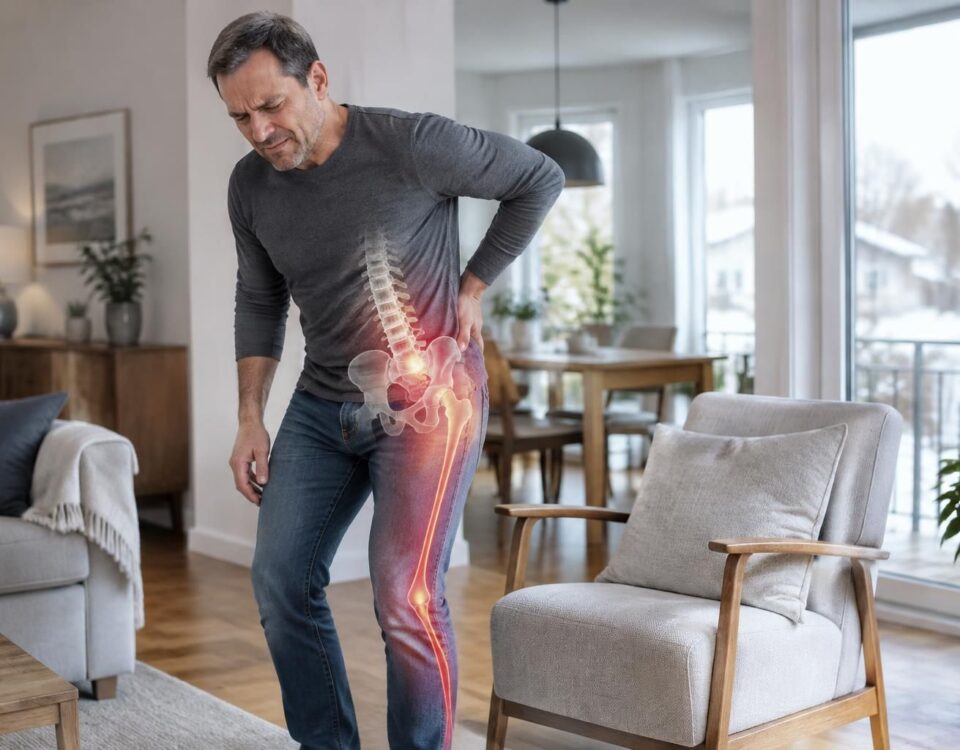
Pain compatible with sciatica may present as sharp pains, burning sensations, or electric shocks. Tingling or numbness may accompany the pain. Depending on the affected nerve root, symptoms may radiate to different parts of the leg or foot. These indicators are useful, but they are not sufficient to confirm that an L4-L5 protrusion is the cause.
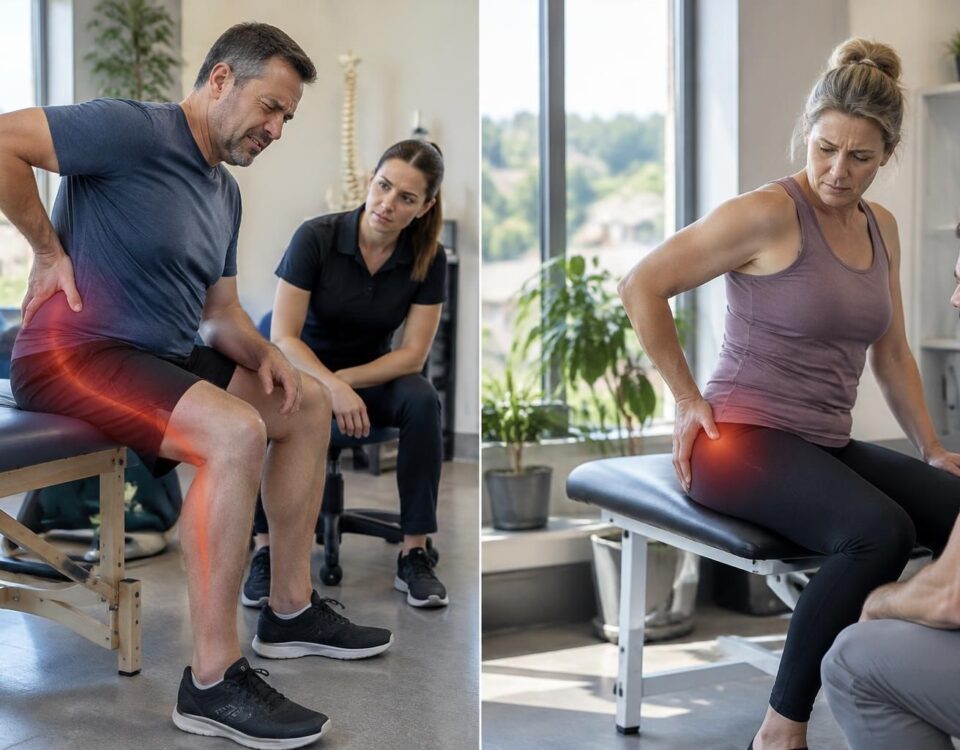
Note when the pain started, its side, how far it radiates, and what worsens or relieves it: sitting position, walking, coughing, exertion, or sleep. Also observe your ability to walk, work, and perform usual tasks. This information will help the professional understand the real impact of the symptoms.
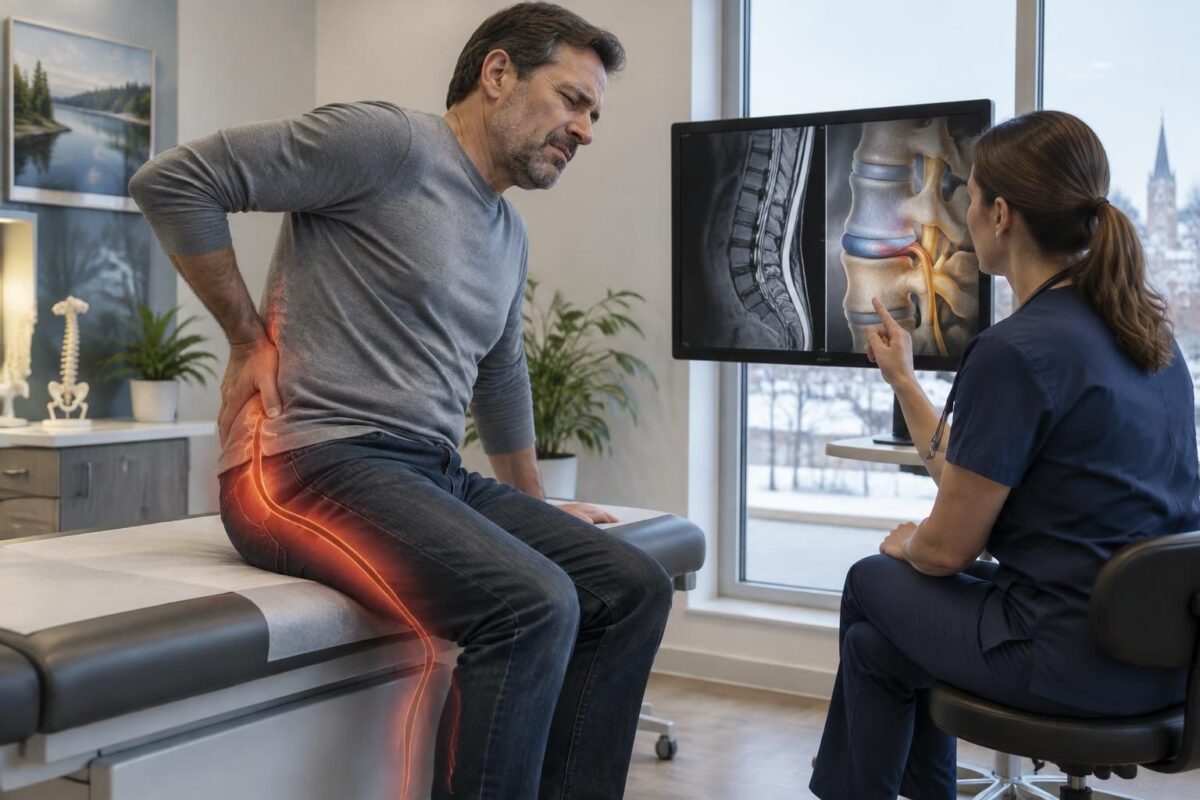
Sciatica in Terrebonne: what “disc-root conflict” means
IN BRIEF A disc-root conflict occurs when an intervertebral disc irritates or compresses a nerve root in the lower back. It can cause sciatica: lower back pain that radiates down into the buttock and leg, sometimes accompanied by sensory disturbances…
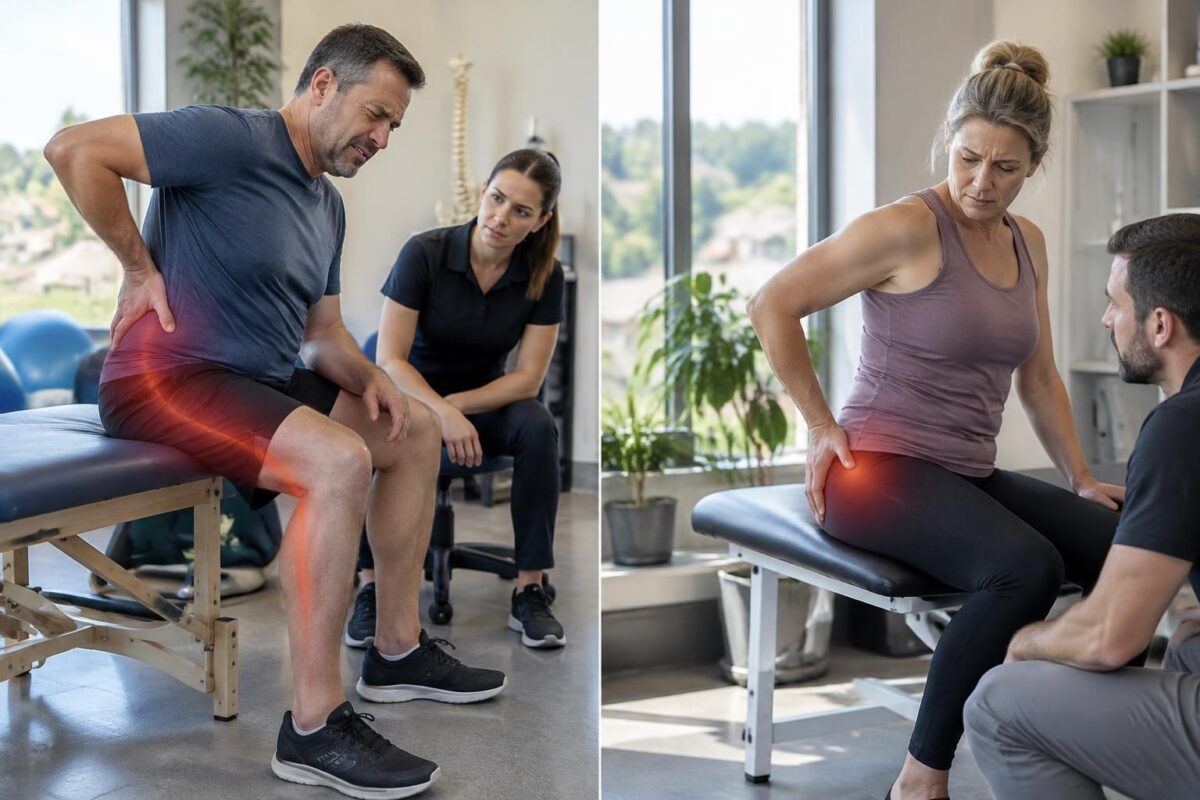
Sciatica in Terrebonne: radicular pain versus referred pain
IN BRIEF Sciatica refers to pain that radiates into the buttock and sometimes the leg. A radicular pain comes from the irritation of a nerve root and may be accompanied by tingling, numbness, or weakness; a referred pain spreads from…
Why imaging should be interpreted with caution
The MRI may show a disc bulge, but some anomalies are found in people who do not have pain. The result should therefore be correlated with the affected side, the level described, and the findings of the clinical examination. Bring your images or reports if you have them: they can contribute to the discussion without replacing a medical evaluation.
Pain in the leg can also have other origins, such as foraminal narrowing, lumbar stenosis, muscular irritation, or a hip problem. When symptoms are atypical, persistent, or worsening, a referral to a medical professional may be indicated.
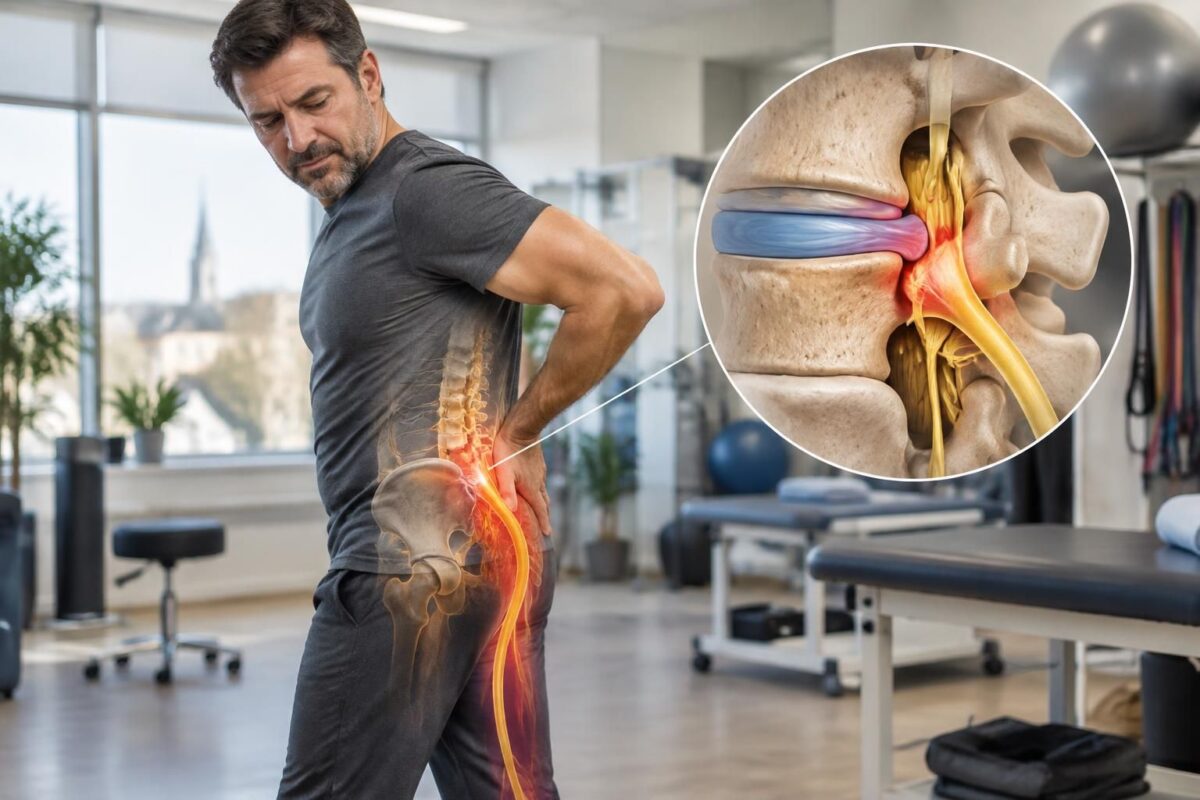
Sciatica in Terrebonne: nerve root, disc, and foramen explained simply
IN BRIEF Sciatica is pain that occurs when a nerve root in the lower back is irritated or compressed, sometimes by a disk or a narrowed foramen. Understanding these structures helps better locate the possible cause of symptoms and guide…
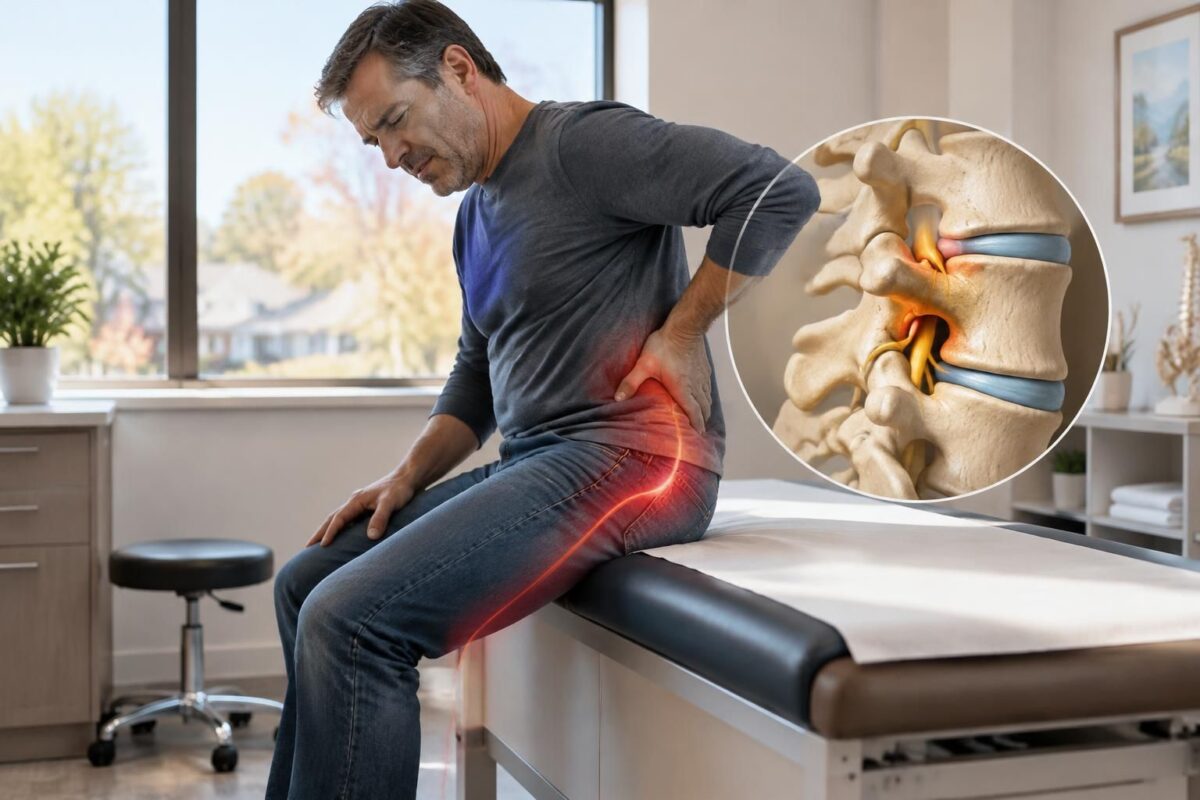
Sciatica in Terrebonne: understanding the L5-S1 foraminal compression
IN BRIEF The L5-S1 foraminal compression corresponds to a narrowing of the opening through which a nerve root passes, potentially contributing to sciatica. In Terrebonne, the assessment compares the side and course of the symptoms, neurological examination, imaging, and limited…
Cautious measures in daily life
Stay active according to your tolerance
Avoid prolonged complete rest if possible. Gentle and regular movements can limit stiffness, provided they do not cause significant worsening. Temporarily reduce actions that clearly trigger the pain, then gradually resume activities. Alternating positions and taking breaks during seated work can also be beneficial.
Adapt exercises and care
Mobility or strengthening exercises should be chosen according to your symptoms; a beneficial movement for one person may irritate the symptoms of another. A conservative plan may include functional advice, rehabilitation, or adapted manual approaches after evaluation. Motorized decompression is not indicated for everyone and does not guarantee correction of a disc. Results should be re-evaluated according to concrete goals, such as walking or tolerance to sitting.
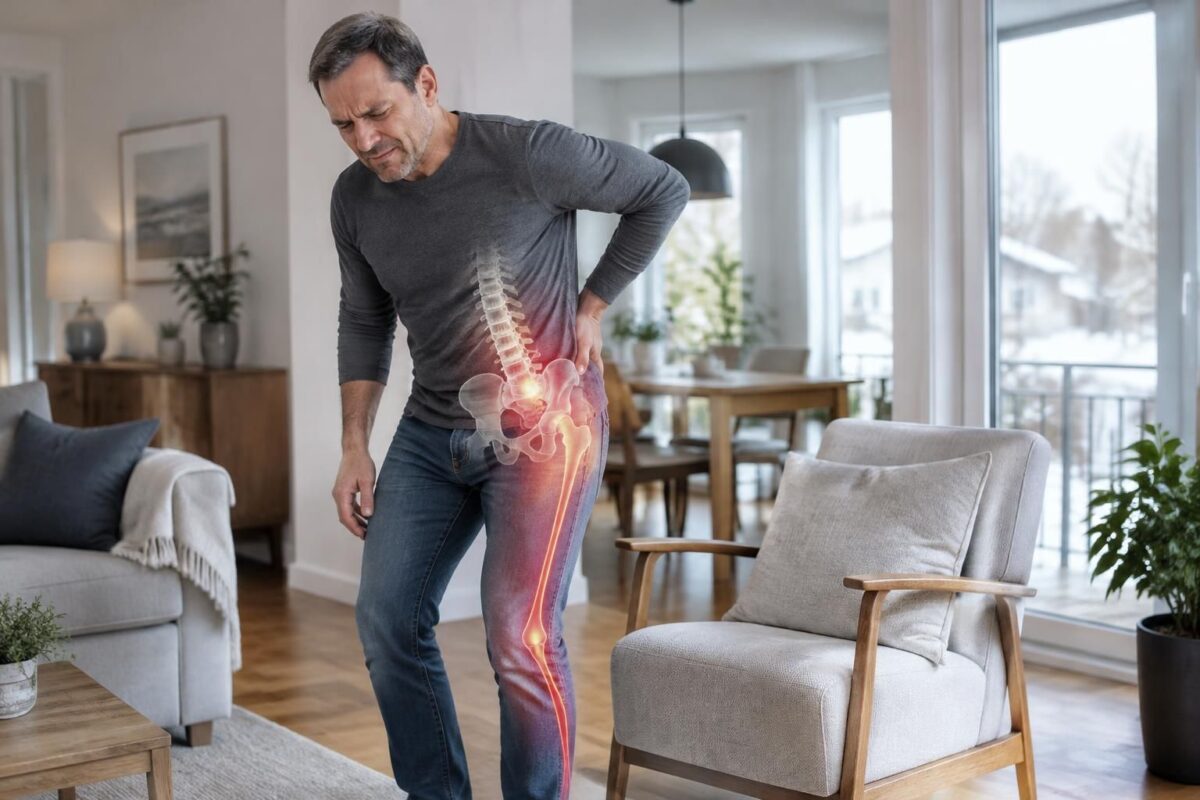
Sciatica in Terrebonne: why L5-S1 is often involved
IN BRIEF Sciatica corresponds to pain related to the irritation of a nerve root, which can extend from the buttock down to the leg. The L5-S1 level is often involved, as a disc herniation or irritation at this location can…

Sciatica in Terrebonne: L5 and difficulty lifting the foot
IN SHORT The L5 sciatica can cause pain or numbness on the side of the leg, the top of the foot, and the big toe, sometimes with difficulty lifting the foot. In Terrebonne, an evaluation compares strength, sensitivity, reflexes, and…
Evaluation of Sciatica in Terrebonne
At the TAGMED Clinic, located at 1150 Lévis Street, Suite 200, in Terrebonne, the first consultation may focus on the pain trajectory, sensitivity, strength, walking, and examinations already available. The proposed plan depends on the evaluation and may include medical referrals if necessary. To book online, select “I am a new client,” then “Osteopathy treatment” and Sylvain Desforges in Terrebonne.
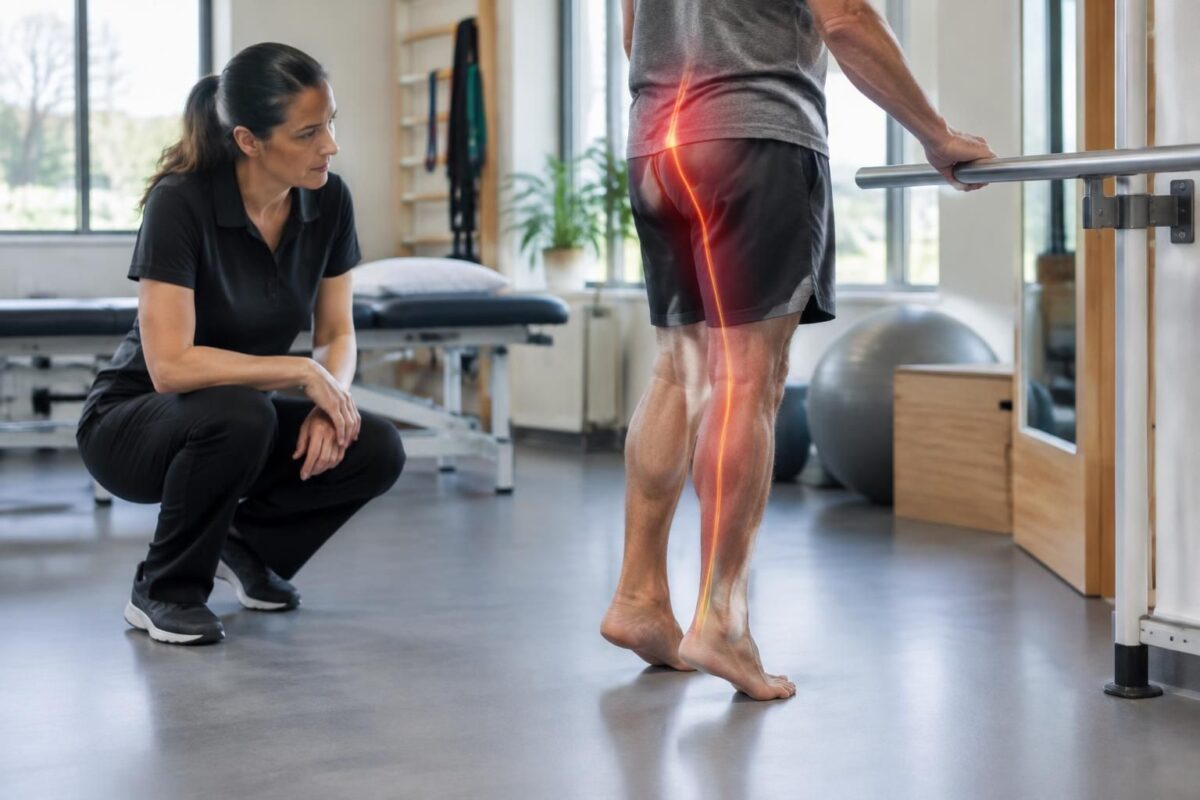
Sciatica in Terrebonne: S1 and difficulty standing on tiptoe
IN SHORT An S1 sciatica can irritate the nerve root associated with the calf and make it difficult to rise onto the balls of the feet. This sign should be evaluated with strength, sensitivity, reflexes, and walking: the pathway of…

Sciatica in Terrebonne: L4-L5 and pain towards the top of the foot
IN BRIEF A L4-L5 sciatica can radiate to the outer side of the leg and the top of the foot, sometimes reaching the big toe. This pathway can guide the assessment, though it does not suffice to confirm the cause:…
When to Seek Urgent Help
Consult without delay if you experience loss of bladder or bowel control, numbness in the saddle area, significant or progressive weakness, or recent onset of foot drop. Fever, major trauma, or rapid deterioration also require urgent medical evaluation.
About the Author and Medical Advice
Sylvain Desforges, B.Sc., D.O., N.D., Doctor of Osteopathy and Naturopath, is the founding president of TAGMED and the ACMA association. He dedicates his practice to chronic spinal pain, lower back pain, and symptoms consistent with sciatica.
This content is educational and does not replace a consultation, diagnosis, or treatment by a licensed healthcare professional. The author is neither a physician nor a specialist in a medical specialty recognized by the Collège des médecins du Québec. The approaches described do not replace medical follow-up.
| Clinical Marker | What it may indicate |
|---|---|
| Lower back pain and leg pain | May be consistent with nerve irritation. |
| L4-L5 protrusion on MRI | To be correlated with side, symptoms, and examination. |
| Pain in the top of the foot or big toe | May suggest an L5 profile, without confirming diagnosis on its own. |
| Tingling or numbness | Justify an evaluation of sensitivity. |
| Difficulty lifting the foot | A new or progressive weakness requires prompt evaluation. |
| Walking, sitting position, sleep | Specify the functional impact of the pain. |
| Other possible causes | Hip, muscles, or stenosis can also produce similar symptoms. |
| Evaluation in Terrebonne | History, function, and neurological signs guide options to discuss. |
| Urinary or bowel disorders, saddle anesthesia | Consult an emergency service without delay. |
Sciatica in Terrebonne: Examples of Illustrative Testimonials on L4-L5 Protrusion
Important Note: The situations below are fictional and serve only to illustrate reasons for consultation. They do not represent actual patient opinions nor guaranteed results.
Lower back pain into the leg
“My pain started in my lower back and went down into my buttock and leg. My MRI mentioned an L4-L5 protrusion, but I wanted to understand if it really matched my symptoms.” This example reminds us that an image must be interpreted with the trajectory of the pain, clinical examination, and daily limitations.
Tingling and discomfort while walking
“I had tingling in my leg and had to stop my walks. During the evaluation, the goal was to assess my sensitivity, strength, and ability to walk, then discuss appropriate options.” An L4-L5 protrusion may be relevant in some cases, but it is not enough to confirm the origin of symptoms on its own.
Pain more pronounced when sitting
“Sitting for a long time increased my pain in my buttock and thigh. I was looking for advice on how to better manage my activities and what conservative approaches could be considered.” The evaluation can take into account positions that worsen or alleviate pain, examinations already performed, and functional goals.
At the TAGMED Clinic in Terrebonne, located at 1150 Lévis Street, Suite 200, a consultation can allow for the examination of symptom trajectory, strength, sensitivity, and function, then relate these elements to an MRI or other available exams. The options discussed depend on the individual situation; no approach guarantees relief.
To book online on GoRendezVous, select “I am a new client,” then “Osteopathy treatment” and the available professional in Terrebonne.
Quickly consult a medical service in case of loss of bladder or bowel control, numbness in the saddle area, significant or progressive weakness, or recent foot drop. These signs require urgent medical evaluation.
Sylvain Desforges, B.Sc., D.O., N.D., Doctor of Osteopathy and Naturopath, is the founding president of TAGMED clinics and the ACMA association. His practice focuses on chronic spinal pain, lower back pain, and symptoms consistent with sciatica. In Terrebonne, this expertise may help better understand pain that starts in the lower back or buttock and radiates down into the thigh, calf, foot, or toes.
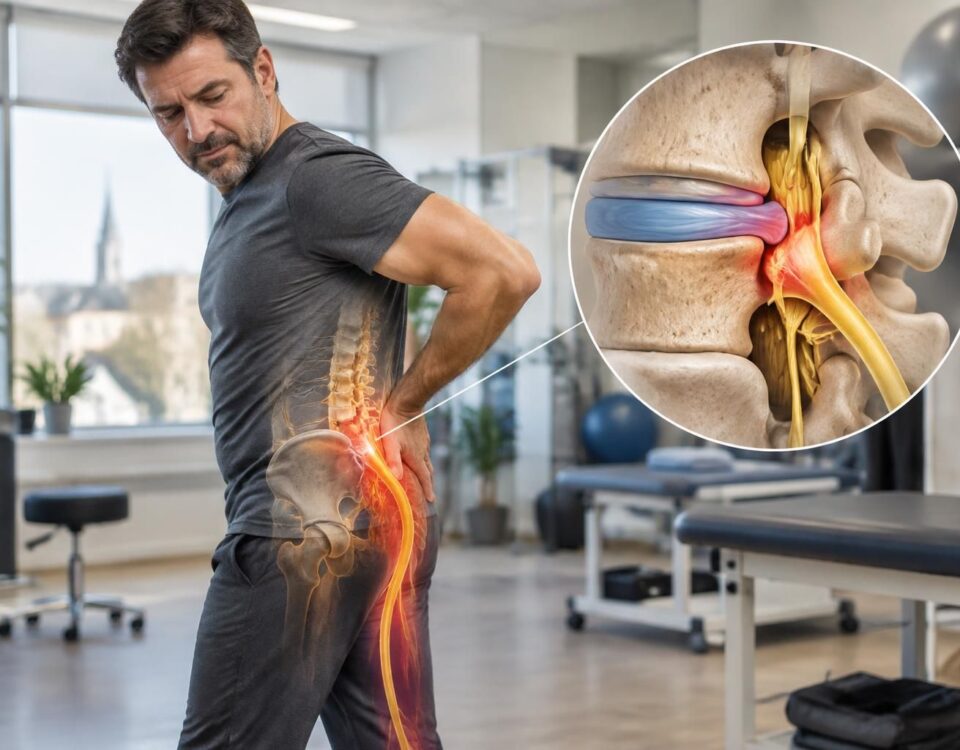
Among the possible causes of pain radiating into the leg is the L4-L5 disc protrusion. This refers to a bulging of the disc located between the fourth and fifth lumbar vertebrae. This finding does not automatically mean that a nerve is compressed or that the disc accounts for the symptoms: some protrusions visible on imaging cause no pain. The interpretation must consider the affected side, symptom trajectory, clinical examination, and function.
When a lumbar nerve root is irritated, a person may feel sharp pain, burning, electric shocks, tingling, or numbness. Weakness in the leg or foot may also occur. The trajectory provides useful markers, without confirming the diagnosis on its own: pain in the top of the foot or the big toe may correspond to certain L5 profiles, but other structures or conditions can produce similar manifestations.
At the TAGMED Clinic in Terrebonne, the first consultation aims to relate the history of symptoms, their distribution, the movements that aggravate or relieve them, and their impact on daily life. The evaluation may include walking, mobility, strength, sensitivity, and appropriate functional tests. An MRI or another exam already performed may be considered when relevant, comparing it to the observed signs rather than interpreting it in isolation.
The proposed plan is individualized. Depending on the results and needs, it may involve education, maintaining tolerated activities, adapted exercises, or conservative approaches. At the clinic, available care may include specific osteopathy, precision percussion, or motorized neurovertebral decompression, when the evaluation indicates that it is reasonable to consider them. Decompression is not a universal solution: its benefits should be monitored according to concrete objectives, such as walking, sitting duration, or pain intensity. If progress is unsatisfactory, the plan must be reassessed.
For a consultation in Terrebonne, the TAGMED Clinic is located at 1150 Lévis Street, Suite 200. When booking online on GOrendezvous, choose “I am a new client”, then “Osteopathy Treatment” and Sylvain Desforges in Terrebonne. Bringing available imaging reports may facilitate their contextualization. An evaluation does not replace a medical diagnosis or the care of a professional authorized to provide them.
Quickly consult a medical service in case of recent loss of bladder or bowel control, numbness in the saddle area, significant or progressive weakness, or a recent foot drop. These signs require urgent evaluation and should not wait for a routine appointment.
Medical warning: The information published is educational and does not replace a consultation, diagnosis, or treatment by a physician or other authorized health professional. Sylvain Desforges is neither a physician nor a specialist in a medical specialty recognized by the Collège des médecins du Québec. Osteopathy, manual medicine, or functional support approaches do not constitute medical acts and do not replace medical follow-up.
A L4-L5 disc protrusion can sometimes contribute to low back pain that radiates into the buttock or leg, but an anomaly observed on an MRI is not sufficient to determine the cause of the symptoms. In Terrebonne, the evaluation takes into account the trajectory of the pain, sensitivity, strength, walking, and available examinations in order to discuss appropriate options, without presuming that a disc is necessarily responsible.
L4-L5 Protrusion and Leg Pain: Useful Guidelines
A protrusion corresponds to a bulging of the disc that remains contained by its envelope; a hernia involves a different deformation or fissure. If the affected area irritates a nerve root, pain, tingling, or numbness may appear in the leg. However, their location does not solely confirm the level reached: symptoms need to be compared to the examination and, when relevant, to imaging. To better understand the topic, consult this guide on L4-L5 disc protrusion and this complementary overview of L4-L5 protrusion.
The trajectory of the symptoms provides clues, without constituting an isolated diagnosis. Discomfort towards the side of the leg or the top of the foot may be compatible with irritation of roots associated with L5; pain towards the back of the calf or the outer edge of the foot may point to other territories, including S1. Difficulty standing on tiptoe, nighttime pain in the leg, or a painful calf resembling a cramp deserve to be described precisely during the evaluation. You can consult the guidelines on levels L4-L5 and L5-S1, the difficulty standing on tiptoe, nighttime pain, and calf pain.
At the TAGMED Clinic in Terrebonne, located at 1150 Lévis Street, Suite 200, the first consultation can help clarify the onset of symptoms, their distribution, the positions that modify them, and their effect on walking, work, or sleep. Mobility, strength, and sensitivity are examined according to the situation; MRI reports or other exams may be related to clinical signs. A protrusion may be present without causing symptoms, and pain resembling sciatica may also have another origin. Additional resources explain the links between sciatica and disc herniation, the anatomy of sciatica, its causes and symptoms, as well as L5-S1 foraminal compression.
Depending on the results and functional objectives, conservative measures may be discussed: maintaining tolerated activities, adapted exercises, rehabilitation, or certain manual or instrumental approaches. No method suits everyone; motorized traction, for instance, is not routinely recommended in all situations and should be considered with caution, then reassessed according to concrete objectives. To make an appointment in Terrebonne, the provided information indicates to choose “I am a new client”, then “Osteopathy Treatment” and Sylvain Desforges in the GOrendezvous booking system.
In the presence of significant or rapidly progressive weakness, a foot that becomes difficult to lift, loss of bladder or bowel control, or numbness in the saddle region, do not delay seeking urgent medical evaluation for a routine consultation. Severe pain that worsens, fever, or pain occurring after significant trauma also justifies appropriate medical evaluation.

Sylvain Desforges, B.Sc., D.O., N.D., docteur en ostéopathie
Dr Sylvain Desforges, B.Sc., D.O., N.D., osteopath, is the founding president of TAGMED and of the ACMA association. He dedicates his practice to chronic spinal pain, low back pain and symptoms compatible with sciatica, particularly when pain radiates toward the buttock, leg, calf, foot or toes.
Through SOS Sciatique, he publishes educational content on sciatica symptoms, possible causes such as disc herniation, disc narrowing, foraminal stenosis or irritation of a lumbar nerve root, as well as non-surgical approaches that may be considered according to the evaluation. At Clinique TAGMED, care may include, depending on the case, motorized neurovertebral decompression, specific osteopathic care or precision percussion.
For an evaluation related to sciatica treatment in Montreal / Mount Royal or sciatica treatment in Terrebonne, please consult the services available at Clinique TAGMED.
Medical disclaimer
The information published on SOS Sciatique is provided for educational purposes only and does not replace a consultation, diagnosis, opinion or treatment provided by a physician or another authorized healthcare professional. The author of this article is neither a medical doctor nor a specialist in a medical specialty recognized by the Collège des médecins du Québec. The osteopathic, manual medicine or functional support approaches described on this site do not constitute medical acts and are not intended to replace medical follow-up.
Consult a physician or emergency service in cases of loss of bladder or bowel control, anesthesia in the saddle area, significant or progressive weakness in the leg or foot, fever, recent trauma, severe pain or rapid worsening of symptoms. For more details, please read our Legal Notice.