Sciatica in Montreal: what “disc-root conflict” means
28/10/2026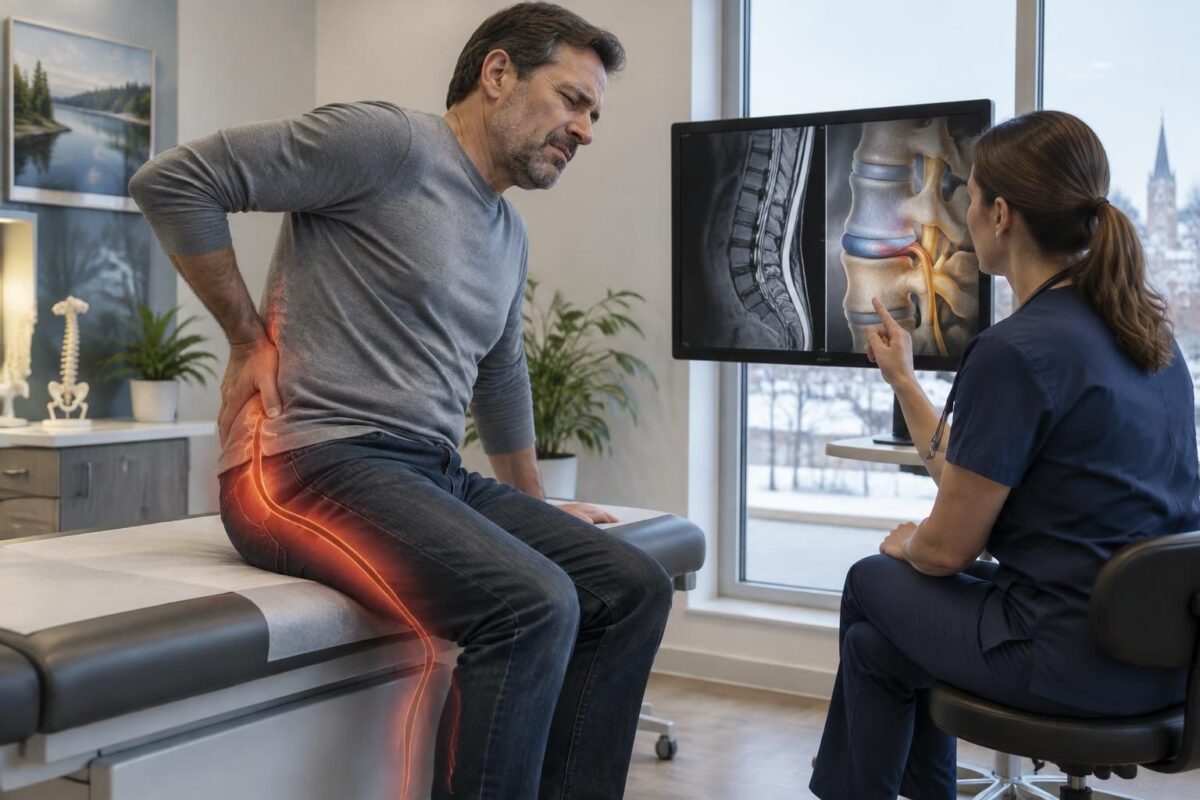
IN BRIEF A disc-root conflict occurs when an intervertebral disc irritates or compresses a nerve root in the lower back. It can cause sciatica: lower back pain that radiates down into the buttock and leg, sometimes accompanied by sensory disturbances or weakness. In Terrebonne, understanding this mechanism helps to better recognize the possible origin of symptoms and to guide the evaluation. |
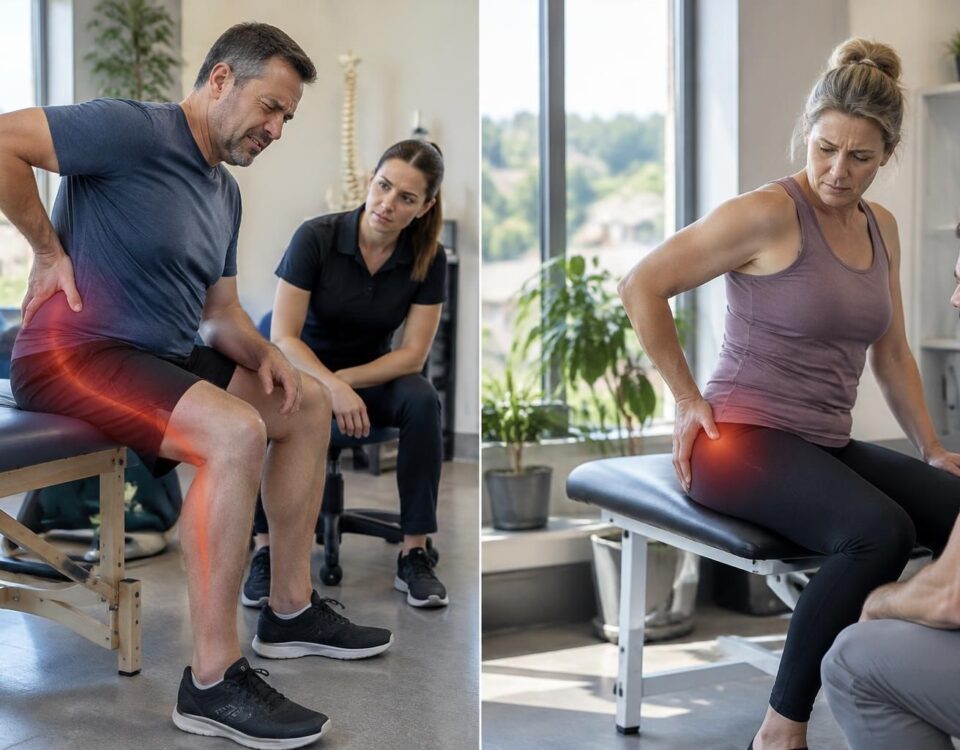
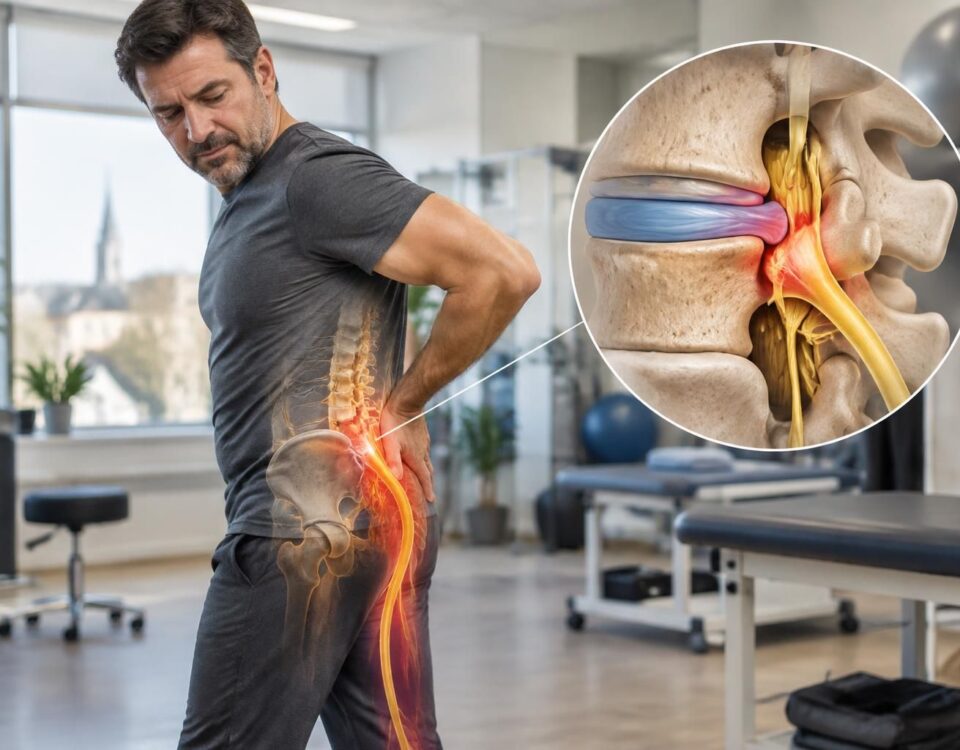
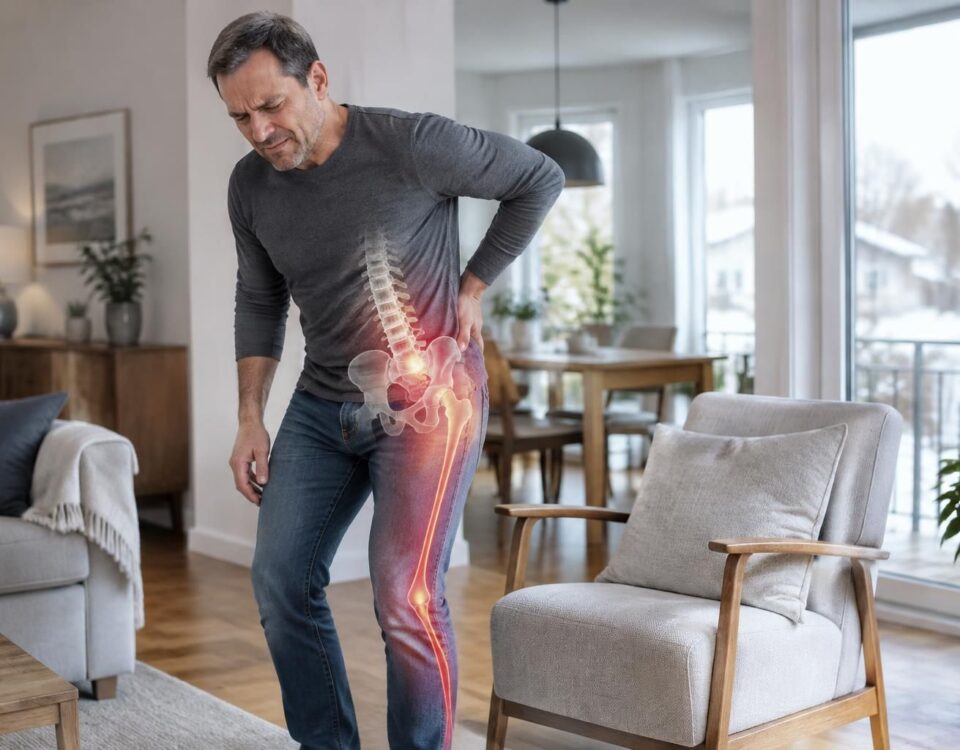
In Terrebonne, the term disc-root conflict refers to the irritation or compression of a nerve root in the lower back by an intervertebral disc. This irritation can cause lower back pain that shoots down into the buttock and leg — commonly referred to as sciatica — sometimes accompanied by tingling, numbness, or weakness.
Sciatica in Terrebonne: What “disc-root conflict” Means
In Terrebonne, the term disc-root conflict refers to an irritation or pressure exerted by an intervertebral disc on a nerve root in the lower back. This irritation can cause pain that follows the path of the nerve into the buttock and leg. It can also lead to changes in sensitivity or strength. An evaluation helps put the symptoms in context and determine the next steps.
Sciatica in Terrebonne: What “disc-root conflict” Means
The word sciatica commonly refers to pain that radiates down the leg along the path of a nerve root, often associated with the sciatic nerve. The source of irritation is usually in the lower back, even if the pain is felt lower, in the buttock, thigh, calf, or foot.
An intervertebral disc is located between two vertebrae. Over time, a change in the disc or an inflammatory reaction in the area can irritate a neighboring nerve root. This is referred to as a disc-root conflict. This term describes a possible link between a disc and a nerve root; it does not confirm the exact cause of the pain by itself.
What is the Role of the Disc and the Nerve Root?
Nerve roots leave the spine and transmit information between the back, legs, and nervous system. If a root is irritated, the pain can follow its path. A lumbar disc herniation associated with sciatica is a possible cause, but a clinical examination is necessary to interpret the symptoms and imaging results.
To understand the terms used during an evaluation, also check this page on disc-root conflict and sciatica. A general overview of sciatica is also available on the Centre Valmy website.
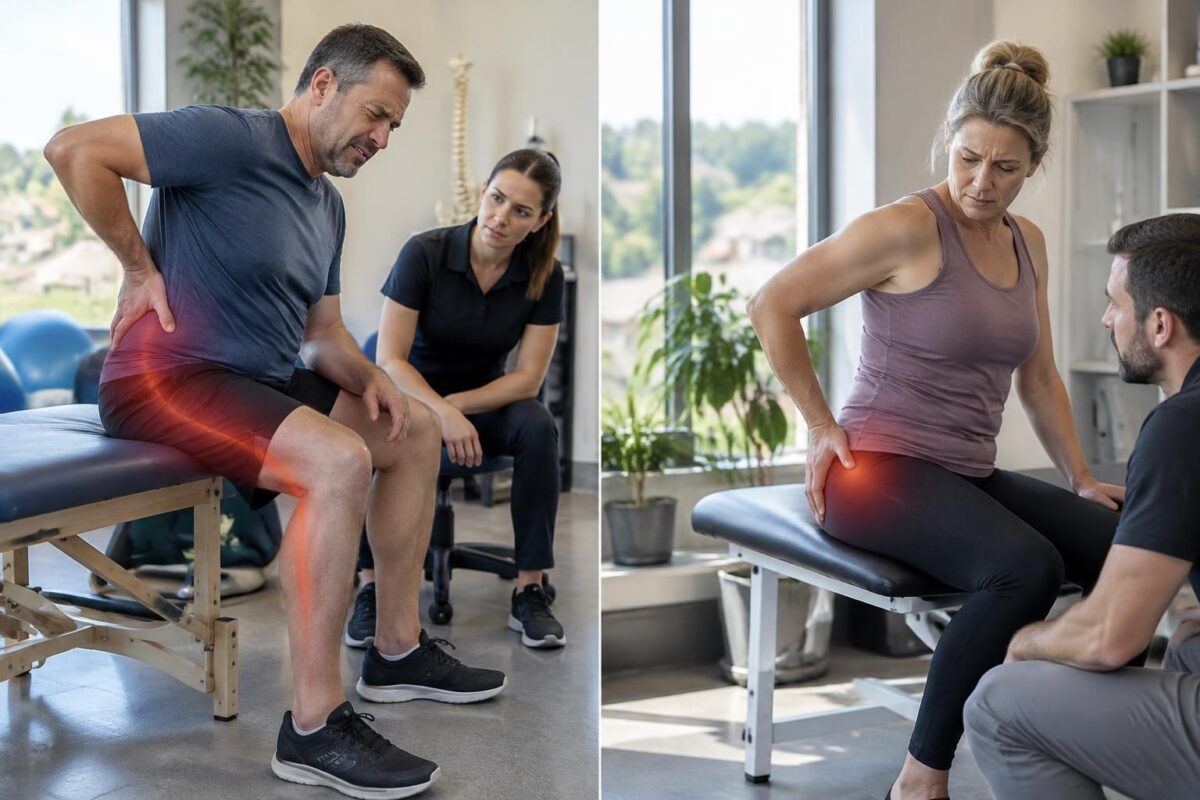
Sciatica in Terrebonne: radicular pain versus referred pain
IN BRIEF Sciatica refers to pain that radiates into the buttock and sometimes the leg. A radicular pain comes from the irritation of a nerve root and may be accompanied by tingling, numbness, or weakness; a referred pain spreads from…
What Symptoms Can Accompany Sciatica?
The pain can be sharp, burning, electric, or dull. It can remain in the buttock or radiate down part of the leg. Some people also experience tingling, numbness, or a decrease in strength in the affected limb.
Symptoms vary from person to person. Some individuals experience lower back pain in addition to leg pain. Others notice pain mainly in the leg. The absence of lower back pain does not exclude nerve irritation: read also why sciatica can occur without lower back pain.
A persisting or changing pain warrants an evaluation, especially if it limits usual activities. This article explains why constant pain related to sciatica should be evaluated.
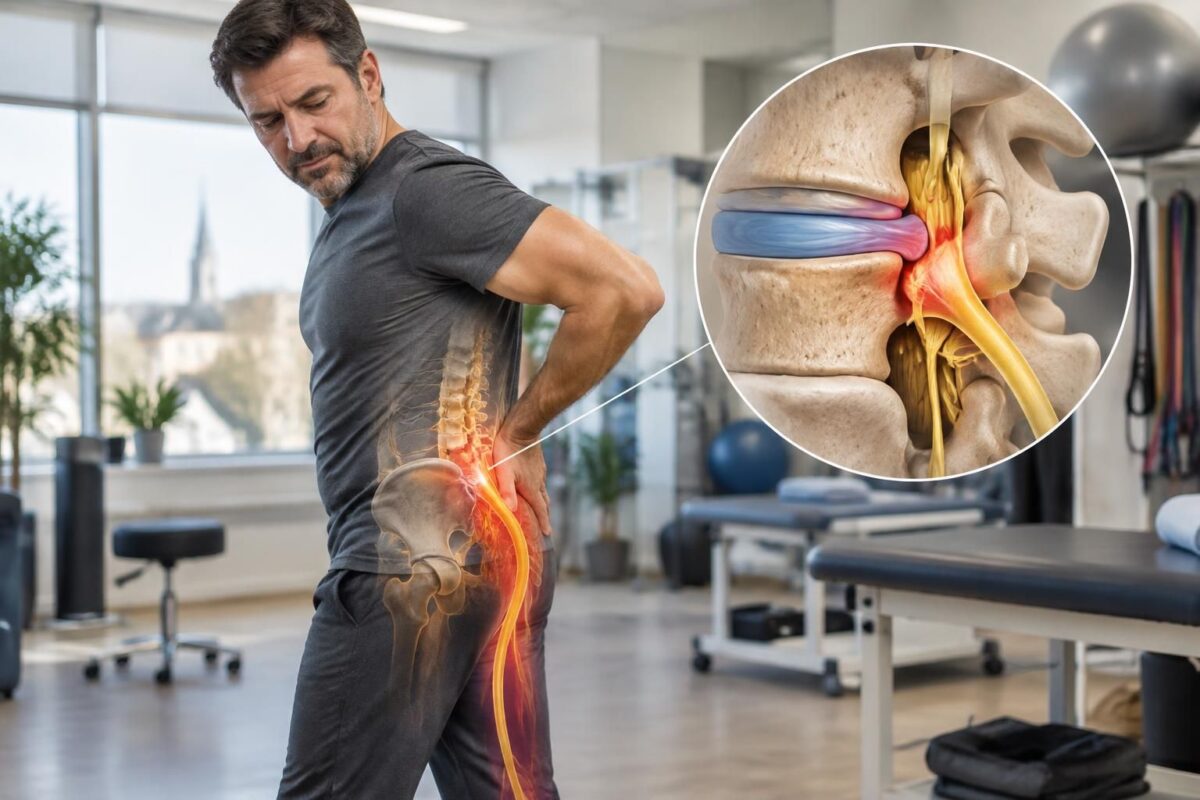
Sciatica in Terrebonne: nerve root, disc, and foramen explained simply
IN BRIEF Sciatica is pain that occurs when a nerve root in the lower back is irritated or compressed, sometimes by a disk or a narrowed foramen. Understanding these structures helps better locate the possible cause of symptoms and guide…
The Disc-Root Conflict and Imaging Results
An X-ray or magnetic resonance imaging may show changes in the discs. However, a visible abnormality does not automatically prove that it causes the symptoms. The healthcare professional compares the images with the history of the pain and the results of the examination.
An imaging report may describe a herniation, bulge, or contact with a nerve root. These terms do not always clarify if the nerve is responsible for the pain by themselves. To learn more, consult this explanation on disc-root conflict and the interpretation of MRI.
The presence of a possible mechanical cause does not mean that all pains require the same management. The page Herniated disc and sciatica: when the cause is mechanical presents helpful elements to understand this link. Another overview of the term is provided by Womenhouse.
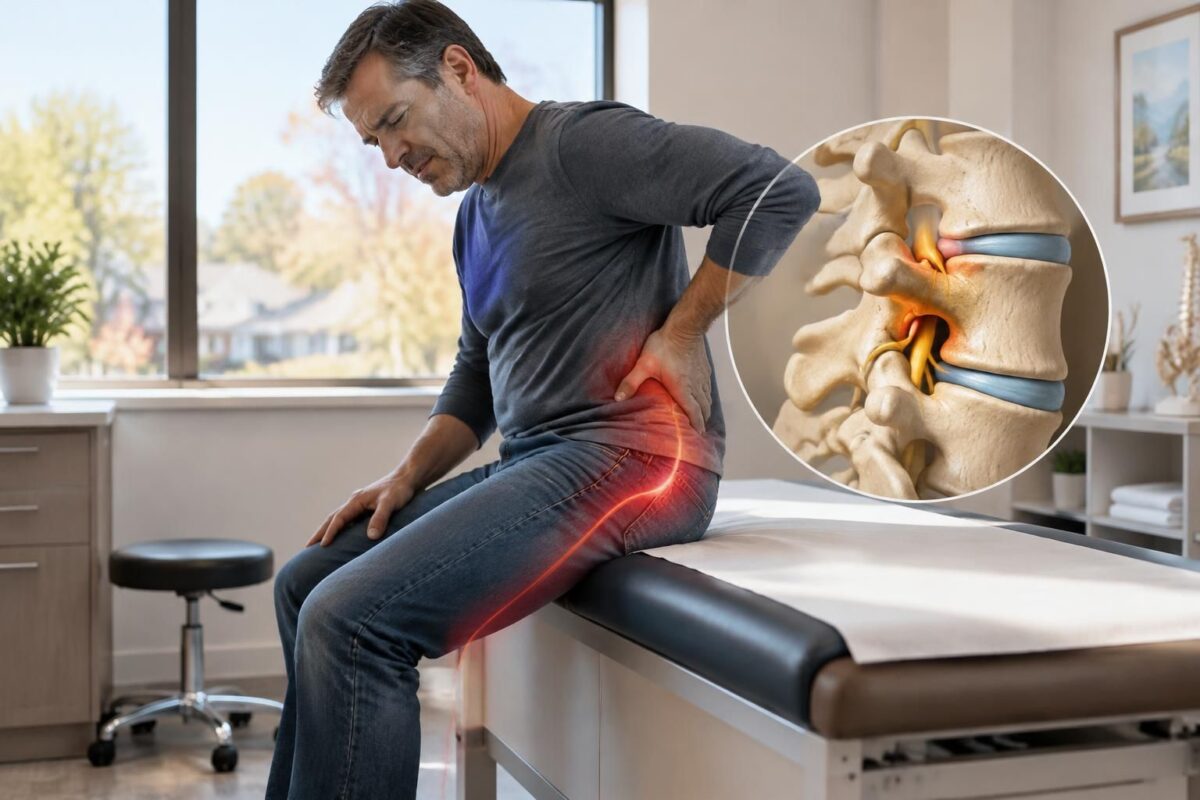
Sciatica in Terrebonne: understanding the L5-S1 foraminal compression
IN BRIEF The L5-S1 foraminal compression corresponds to a narrowing of the opening through which a nerve root passes, potentially contributing to sciatica. In Terrebonne, the assessment compares the side and course of the symptoms, neurological examination, imaging, and limited…
When to Seek an Evaluation in Terrebonne?
An evaluation can help clarify the distribution of pain, changes in sensitivity, and observed limitations. It also allows for discussing options tailored to the situation and determining if medical advice or further investigation is necessary.
At the TAGMED Clinic in Terrebonne, the evaluation focuses on symptoms and their evolution. Depending on the case, proposed care may include specific osteopathy or motorized neurovertebral decompression. These approaches do not replace a medical diagnosis and may not be appropriate for everyone.
Signs That Require Prompt Attention
Quickly consult a doctor or an emergency service in case of loss of bladder or bowel control, numbness in the saddle area, significant or progressive weakness in the leg or foot, fever, recent trauma, severe pain, or rapid worsening. These signs require immediate evaluation.
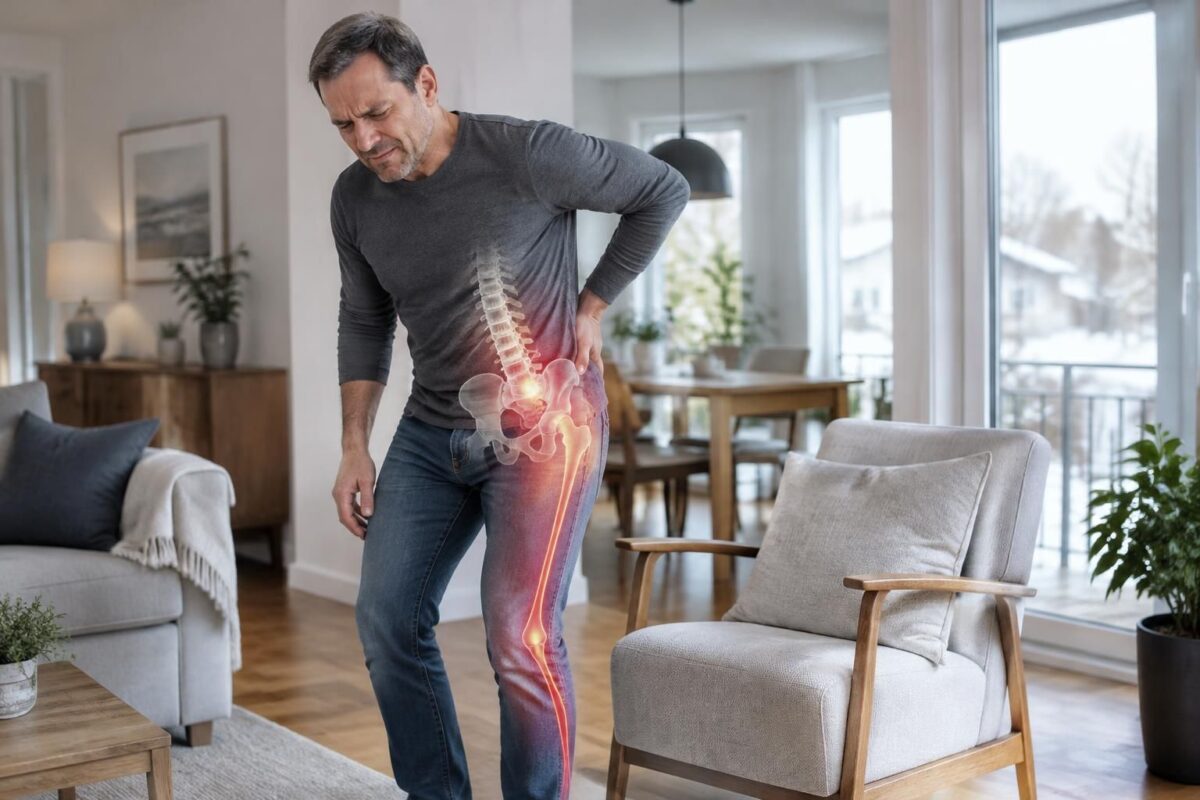
Sciatica in Terrebonne: why L5-S1 is often involved
IN BRIEF Sciatica corresponds to pain related to the irritation of a nerve root, which can extend from the buttock down to the leg. The L5-S1 level is often involved, as a disc herniation or irritation at this location can…
About the Author
Sylvain Desforges, B.Sc., D.O., N.D., doctor of osteopathy and naturopath, is the founding president of TAGMED and the ACMA association. He devotes his practice to chronic pain of the spine, lumbar pain, and pain compatible with sciatica, particularly when the pain radiates down to the buttock, leg, calf, foot, or toes.
Through SOS Sciatique, he publishes educational content on the symptoms of sciatica, possible causes such as disc herniation, disc pinching, foraminal stenosis, or irritation of a lumbar nerve root, as well as non-surgical approaches that may be considered based on the assessment. At the TAGMED Clinic, treatments may include, depending on the case, motorized neurovertebral decompression, specific osteopathy, or precision percussion.
For an evaluation related to sciatica treatment in Montreal / Mont-Royal or sciatica treatment in Terrebonne, consult the services available at the TAGMED Clinic.

Sciatica in Terrebonne: L5 and difficulty lifting the foot
IN SHORT The L5 sciatica can cause pain or numbness on the side of the leg, the top of the foot, and the big toe, sometimes with difficulty lifting the foot. In Terrebonne, an evaluation compares strength, sensitivity, reflexes, and…
Medical Warning
The information published on SOS Sciatique is provided for educational purposes and does not replace a consultation, diagnosis, opinion, or treatment conducted by a physician or other licensed healthcare professional. The author of this article is neither a physician nor a specialist in a medical specialty recognized by the Collège des médecins du Québec. The approaches of osteopathy, manual medicine, or functional support described on this site do not constitute medical acts and are not intended to replace medical follow-up.
Consult a doctor or emergency service in case of loss of bowel or bladder control, numbness in the saddle region, significant or progressive weakness of the leg or foot, fever, recent trauma, severe pain, or rapid worsening. For more details, please read our Legal Notice.
Medical Disclaimer: The information and advice provided on this site do not replace the advice, diagnosis, or treatment of a healthcare professional. Please note that Dr. Sylvain Desforges, an osteopath, is neither a medical doctor nor a physician, and is not a specialist in a medical specialty as defined by the Collège des médecins du Québec. Manual medicine, functional medicine, and sports medicine as described on this site exclude any treatment or diagnosis made by a physician or specialist doctor. Always consult your physician for any medical questions. For more details, please read our Complete Legal Notice.
Sciatica in Terrebonne: Understanding the Disc-Radicular Conflict
- Conflict: a disc irritates or compresses a nerve root in the lower back.
- Possible origin: disc wear or local inflammation.
Possible Effects
- Pain: lumbar, then sometimes in the buttock and leg.
- Other signs: tingling, numbness, or weakness of the leg.

In Terrebonne, the term disc-radicular conflict refers to irritation or compression of a nerve root in the back by an intervertebral disc. This situation can cause lumbar pain that extends into the buttock and leg, sometimes down to the foot. Understanding this mechanism helps to better describe symptoms and choose the next steps with a healthcare professional.
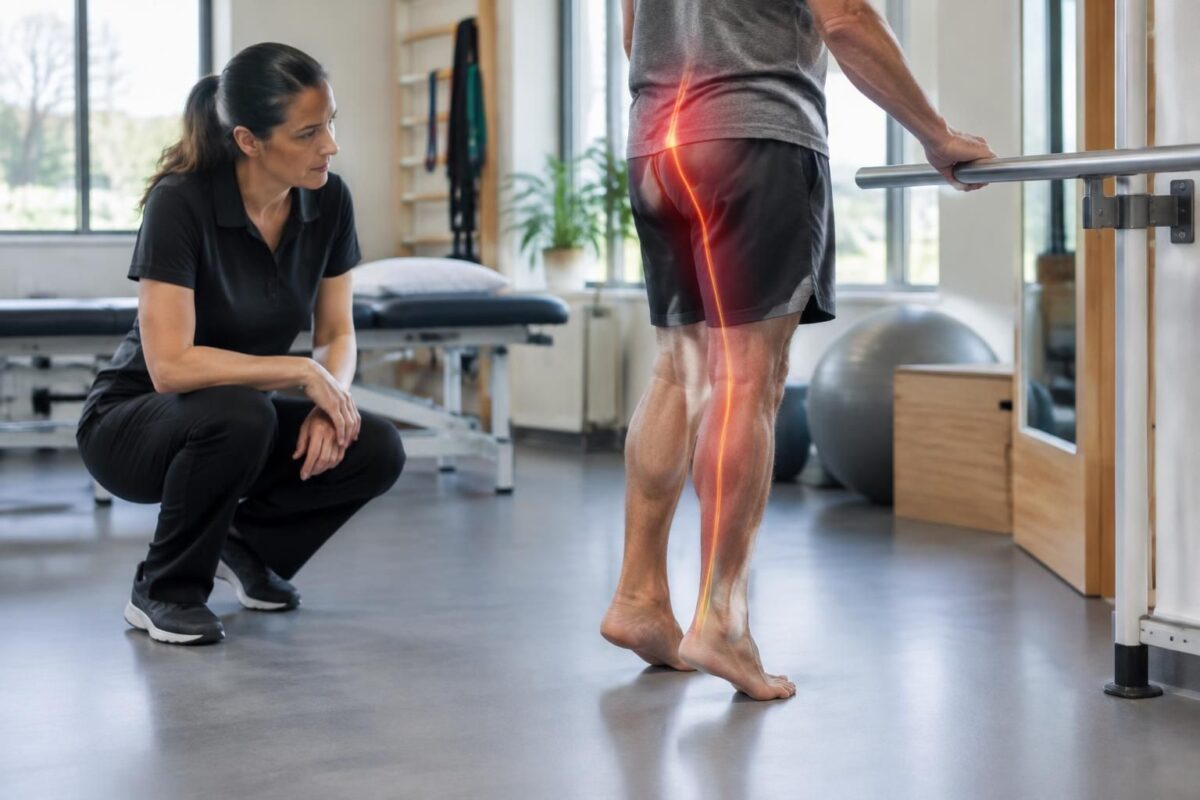
Sciatica in Terrebonne: S1 and difficulty standing on tiptoe
IN SHORT An S1 sciatica can irritate the nerve root associated with the calf and make it difficult to rise onto the balls of the feet. This sign should be evaluated with strength, sensitivity, reflexes, and walking: the pathway of…
What does “disc-radicular conflict” mean?
An intervertebral disc is located between the vertebrae and contributes to their mobility. Over time, or after certain stresses, it may undergo changes. A part of the disc or inflammation around it may then irritate a nerve root located in the lower back. The contact between the disc and this root is called disc-radicular conflict.
The term “sciatica” is commonly used to refer to pain that follows the path of the sciatic nerve, or related nerve branches. The source of irritation is often found near the lumbar spine, even though the pain is felt lower down in the leg. Thus, lumbar pain may accompany the symptoms, but it is not always present in the same way for every person.
Possible Symptoms
Depending on the affected nerve root and the degree of irritation, sensations may vary. Some people describe a sharp pain, burning, or stabbing sensations radiating from the lower back down to the buttock, thigh, calf, or foot. Tingling, numbness, or changes in sensitivity may also occur. More rarely, muscle weakness may be felt in the leg or foot.
These signs alone do not confirm a disc-radicular conflict. Other causes can produce similar symptoms. An evaluation by a healthcare professional can clarify the situation and determine if further tests or additional care are necessary.

Sciatica in Terrebonne: L4-L5 and pain towards the top of the foot
IN BRIEF A L4-L5 sciatica can radiate to the outer side of the leg and the top of the foot, sometimes reaching the big toe. This pathway can guide the assessment, though it does not suffice to confirm the cause:…
What to do when pain appears in Terrebonne?
If the pain is recent, note its location, path, and the movements or positions that seem to alter it. Avoid straining through a pain that increases significantly, while seeking advice before interrupting your usual activities for an extended period. A professional can guide you based on your symptoms, history, and overall condition.
An assessment can help clarify whether the signs suggest nerve irritation and discuss appropriate management options. Depending on the case, non-surgical support may include movement advice or manual approaches. At the TAGMED Clinic, the proposed care may include specific osteopathy, motorized neurovertebral decompression, or precision percussion, when the assessment indicates these approaches are appropriate. Results are not guaranteed, and care must be tailored to each individual.
When to seek urgent help
Quickly consult a doctor or an emergency service in case of loss of urinary or bowel control, numbness in the saddle region, significant or progressive weakness of the leg or foot, fever, recent trauma, severe pain, or rapid worsening. These symptoms warrant immediate medical evaluation.

Sciatica in Terrebonne: L5-S1 and symptoms in the calf
IN BRIEF A L5-S1 sciatica can cause pain that radiates down the calf, sometimes accompanied by tingling, numbness, or weakness. At Terrebonne, an assessment at the TAGMED Clinic helps to examine the symptom pathways, strength, and sensitivity, and then discuss…
About the Author
Sylvain Desforges, B.Sc., D.O., N.D., doctor of osteopathy and naturopath, is the founding president of TAGMED and the ACMA association. His practice focuses notably on chronic spine pain, lower back pain, and pain compatible with sciatica.
Through SOS Sciatique, he publishes educational content on symptoms, possible causes, and non-surgical approaches that may be considered based on evaluation.
Medical Warning
This information is provided for educational purposes and does not replace a consultation, diagnosis, advice, or treatment by a physician or another licensed healthcare professional. The author is neither a physician nor a specialist in a medical specialty recognized by the Collège des médecins du Québec. Osteopathy, manual medicine, or functional support approaches do not constitute medical acts and do not replace medical follow-up.
| Item | Meaning |
|---|---|
| Sciatica | Radicular pain felt in the buttock or leg. |
| Disc-root conflict | Possible irritating contact or compression between a disc and a nerve root. |
| Common origin | A degenerated lumbar disc or an inflammatory reaction. |
| Site of irritation | In the lower back, even if the pain radiates down the leg. |
| Pain pathway | The pain may follow the course of a branch of the sciatic nerve. |
| Other possible symptoms | Tingling, numbness, or weakness in the leg or foot. |
| To remember in Terrebonne | The term describes a possible mechanism, to be confirmed by an appropriate evaluation. |
Sciatica in Terrebonne: understanding the “disc-root conflict” through illustrative testimonies
Important note: the testimonies below are fictitious and serve only to illustrate possible experiences. They do not come from identifiable patients and guarantee no treatment results.
“My pain started in the lower back and radiated into the buttock, then down to the calf. I had heard of sciatica without understanding what it meant. I was explained that a nerve root could be irritated in the back and that the pain could be felt along its pathway in the leg.”
“The term ‘disc-root conflict’ worried me. I understood that it describes a situation where an intervertebral disc may irritate or compress a nerve root near the spine. This can happen especially when a disc is altered or an inflammatory reaction is present. However, an evaluation is needed to determine if this corresponds to my symptoms.”
“In addition to lower back pain, I had tingling in the foot. I was explained that nerve irritation can sometimes cause changes in sensitivity and, in some cases, weakness. These signs deserve evaluation rather than being interpreted alone.”
In everyday language, sciatica often refers to pain that follows the pathway of a nerve root into the buttock and leg. The conflict typically occurs near the lumbar spine, even if the pain can be felt lower, even into the calf, foot, or toes. The word ‘sciatica’ thus describes a type of pain, without itself determining its cause.
Radicular pain may be accompanied by tingling, numbness, or decreased strength in the affected leg. Symptoms vary from person to person. An evaluation by a healthcare professional allows for clarifying possible causes and options suited to the situation.
In Terrebonne, a support approach may notably focus on evaluating symptoms and functional abilities. Depending on the case, non-surgical approaches may be considered, but they are not suitable for everyone and do not replace a medical diagnosis when needed.
About the Author
Sylvain Desforges, B.Sc., D.O., N.D., doctor of osteopathy and naturopath, is the founding president of TAGMED and the ACMA association. His practice focuses notably on chronic spine pain, lower back pain, and pain compatible with sciatica.
Medical Warning
This information is provided for educational purposes and does not replace a consultation, diagnosis, or treatment conducted by a physician or another licensed healthcare professional. The author is neither a physician nor a specialist in a medical specialty recognized by the Collège des médecins du Québec. Osteopathy, manual medicine, or functional support approaches do not replace medical follow-up.
Quickly consult a doctor or an emergency service in case of loss of urinary or bowel control, numbness in the saddle region, significant or progressive weakness of the leg or foot, fever, recent trauma, severe pain, or rapid worsening.
Sciatica in Terrebonne: understanding the disc-root conflict
The term sciatica commonly refers to pain that radiates through the buttock and leg, sometimes to the calf, foot, or toes. It does not describe the cause of the problem by itself. In many cases, the pain is referred to as radicular because it is related to irritation of a nerve root located in the lower back. This irritation can cause symptoms along the nerve to which the root contributes, often a branch of the sciatic nerve.
A disc-root conflict occurs when an intervertebral disc irritates or compresses a neighboring nerve root. Discs are located between the vertebrae and serve notably as cushions. Over time, a disc may dehydrate or alter; a protrusion or herniation may also reduce the space available around a root. An inflammatory reaction may contribute to symptoms. However, the presence of an abnormal image on imaging does not necessarily mean it explains the pain: the evaluation must take into account symptoms and clinical examination.
As the affected nerve root is located in the lumbar region, back pain may accompany that felt in the leg. Some people describe a burning sensation, sharp pains, electric shocks, or tingling. Others notice a decrease in sensitivity, weakness, or difficulty performing certain movements. The manifestations vary depending on the affected root and the degree of irritation; they can also evolve over time. Pain that radiates down the leg is therefore not necessarily sciatica, and other causes may require special attention.
In Terrebonne, an evaluation related to pain compatible with sciatica aims to specify its path, onset, intensity, and activities that worsen or relieve it. The professional may also be interested in sensations, strength, and movements. These elements help guide the next steps, but do not replace a medical diagnosis when necessary. The choice of approach depends on the situation, history, and goals of the person. Non-surgical options may be considered after evaluation; these may include, depending on the case, specific osteopathy or motorized neurovertebral decompression. No results can be guaranteed, and these interventions are not suitable for everyone.
Sylvain Desforges, B.Sc., D.O., N.D., doctor of osteopathy and naturopath, is the founding president of TAGMED and the ACMA association. His practice focuses particularly on chronic spinal pain, lower back pain, and pain compatible with sciatica. At the TAGMED Clinic, the care provided is determined according to the evaluation and may include manual approaches, motorized neurovertebral decompression, or precision percussion therapy. These services are part of a supportive approach and do not replace medical follow-up.
Medical Warning: this content is provided for educational purposes and does not replace a consultation, diagnosis, or treatment by a physician or other licensed health professional. Sylvain Desforges is neither a physician nor a specialist in a medical specialty recognized by the Collège des médecins du Québec. Consult a doctor or an emergency service in case of loss of bladder or bowel control, numbness in the saddle area, significant or progressive weakness, fever, recent trauma, severe pain, or rapid worsening.
In Terrebonne, pain that starts from the lower back and radiates down into the buttock or leg may correspond to radicular pain, often referred to as “sciatica.” The term disc-root conflict describes a possible irritation or compression of a nerve root by an intervertebral disc. Understanding this term helps to better interpret the symptoms, but does not establish a diagnosis on its own.
What does “disc-root conflict” mean?
The nerves that travel down to the leg originate in the lumbar region. When a nerve root is irritated near the spine, the pain can follow its path and be felt in the buttock, thigh, calf, heel, or foot. The term disc-root conflict refers to a situation where an intervertebral disc contributes to irritating or compressing a nerve root. To learn more, see this explanation of disc-root conflict and sciatica, as well as this presentation on disc-root conflict.
A disc can change over time, or a local inflammatory reaction can contribute to irritating a nerve root. This may be accompanied by lower back pain, but some people mainly feel symptoms in the leg. The pain may also be associated with sensations of tingling, numbness, or, in some cases, muscle weakness. A summary resource on lumbosciatica also presents possible links between the lumbar region and lower limb pain.
Why might the pain reach the calf, heel, or foot?
The path of the pain particularly depends on the affected nerve root. This is why irritation located in the lower back can manifest further down the leg, sometimes as far as the toes. Therefore, pain felt in the foot does not necessarily mean that the problem lies in the foot itself. To better understand this connection, read the article about how the lumbar spine can cause foot pain.
In Terrebonne, pain that radiates down into the calf, heel, or outer edge of the foot deserves an evaluation suited to all symptoms. These areas may be involved in different painful conditions and do not alone determine the cause. You can consult the page dedicated to sciatica pain in Terrebonne in the calf, heel, or outer edge of the foot. A complementary resource describes similar symptoms to Montreal.
The term alone is not sufficient to determine the cause
The mention of a disc-root conflict, notably in an imaging report, must be interpreted based on symptoms and clinical examination. An image alone does not always establish that the observed disc is responsible for the pain. To delve deeper into this point, see the article on disc herniation, sciatica, and the limitations of MRI interpretation.
An evaluation can help clarify the nature of the symptoms and determine which non-surgical options could be considered based on the situation. At the TAGMED Clinic, services may include, depending on the evaluation, motorized neurovertebral decompression, specific osteopathy, or precision percussion therapy. For information on services related to sciatica treatment in Terrebonne, consult the TAGMED Clinic.
Promptly consult a doctor or an emergency service if you experience loss of bladder or bowel control, numbness in the saddle area, significant or progressive weakness of the leg or foot, fever, severe pain, or rapid worsening. This information is educational and does not replace a consultation, diagnosis, or treatment by a licensed health professional. The author is neither a physician nor a specialist in a medical specialty recognized by the Collège des médecins du Québec. For more details, please read the Legal Notice of SOS Sciatique.
About the author
Sylvain Desforges, B.Sc., D.O., N.D., doctor of osteopathy and naturopath, is the founding president of TAGMED and the ACMA association. His practice is dedicated to chronic spinal pain, lower back pain, and pain consistent with sciatica, especially when the pain radiates down to the buttock, leg, calf, foot, or toes.
Through SOS Sciatique, he publishes educational content on the symptoms of sciatica, their possible causes — such as herniated discs, disc pinching, foraminal stenosis, or irritation of a lumbar nerve root — as well as on non-surgical approaches that may be considered based on the evaluation.

Sylvain Desforges, B.Sc., D.O., N.D., docteur en ostéopathie
Dr Sylvain Desforges, B.Sc., D.O., N.D., osteopath, is the founding president of TAGMED and of the ACMA association. He dedicates his practice to chronic spinal pain, low back pain and symptoms compatible with sciatica, particularly when pain radiates toward the buttock, leg, calf, foot or toes.
Through SOS Sciatique, he publishes educational content on sciatica symptoms, possible causes such as disc herniation, disc narrowing, foraminal stenosis or irritation of a lumbar nerve root, as well as non-surgical approaches that may be considered according to the evaluation. At Clinique TAGMED, care may include, depending on the case, motorized neurovertebral decompression, specific osteopathic care or precision percussion.
For an evaluation related to sciatica treatment in Montreal / Mount Royal or sciatica treatment in Terrebonne, please consult the services available at Clinique TAGMED.
Medical disclaimer
The information published on SOS Sciatique is provided for educational purposes only and does not replace a consultation, diagnosis, opinion or treatment provided by a physician or another authorized healthcare professional. The author of this article is neither a medical doctor nor a specialist in a medical specialty recognized by the Collège des médecins du Québec. The osteopathic, manual medicine or functional support approaches described on this site do not constitute medical acts and are not intended to replace medical follow-up.
Consult a physician or emergency service in cases of loss of bladder or bowel control, anesthesia in the saddle area, significant or progressive weakness in the leg or foot, fever, recent trauma, severe pain or rapid worsening of symptoms. For more details, please read our Legal Notice.